

Porter Airlines Overview & Company Profile
Porter Airlines is a Canadian carrier founded on February 2, 2006 by aviation entrepreneur Robert Deluce, with commercial operations beginning on October 23, 2006. The airline is headquartered at Billy Bishop Toronto City Airport (YTZ), the compact airport on the Toronto Islands at the edge of the downtown core, and it is privately held through Porter Aviation Holdings Inc., a company controlled by the Deluce family. Michael Deluce serves as Chief Executive Officer, Kevin Jackson as President, and Robert Deluce as Executive Chairman.
For most of its history Porter was a niche regional operator flying turboprops from the convenient downtown island airport. That identity changed dramatically in 2022, when the airline launched the Embraer E195-E2 jet and began an aggressive North American expansion out of Toronto Pearson (YYZ), Ottawa (YOW), Montreal, Vancouver, and other points. Porter now operates an average of around 130 flights per day to roughly 30 destinations across Canada, the United States, Mexico, and the Caribbean, and it has positioned itself as a premium-economy hybrid carrier rather than a traditional regional or a pure low-cost operator.
For pilots, the most consequential recent development is organizational rather than operational. In August 2025, Porter pilots were certified by the Canada Industrial Relations Board as members of the Air Line Pilots Association (ALPA), ending Porter's status as the largest non-unionized airline in Canada. The group, which numbers roughly 910 pilots, entered first-contract bargaining with management in late 2025. That backdrop matters: much of the compensation and work-rule data below reflects company policy set before a collective agreement existed, and it is likely to evolve as the first ALPA contract is negotiated.
Fleet Composition & Type Ratings
Porter operates one of the youngest large fleets in North America, built around two very different aircraft. The Embraer E195-E2 is the engine of the airline's growth and its public identity. Porter took delivery of its 50th E195-E2 in December 2025 and continues to receive aircraft against a firm order of 75 jets, with purchase rights for a further 25. The type seats 132 passengers in an all-economy, two-by-two layout with no middle seats, and Porter markets it as a premium short-to-medium-haul product. Pilots consistently rate it as one of the most modern flight decks in the regional and narrowbody space, with fly-by-wire handling, fuel-efficient Pratt & Whitney geared turbofan engines, and quiet cabins.
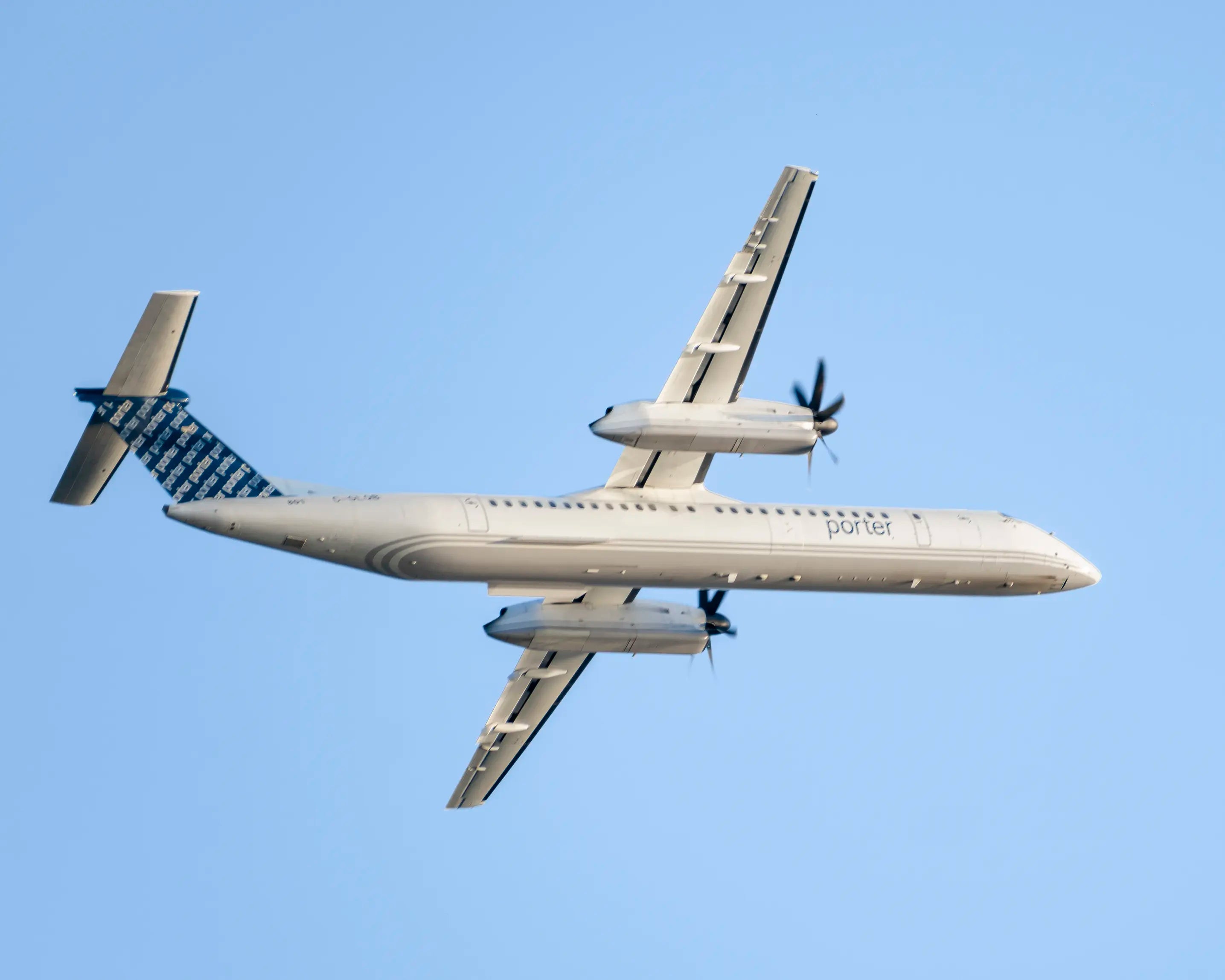
The second type is the veteran De Havilland Canada Dash 8-400 (Q400), a 78-seat turboprop. Around 29 remain in service, primarily flying the short-field operation out of downtown Billy Bishop, where the runway length and noise restrictions make a jet impractical. The Dash 8 is the heritage of the airline, but its long-term role is shrinking as the E2 jet fleet expands and certain regional bases are consolidated. For a new pilot, that trend has a practical consequence: the Dash 8 is increasingly an entry seat rather than a destination.
| Aircraft Type | Role | In Service | Notes |
|---|---|---|---|
| Embraer E195-E2 | Narrowbody jet | ~52 | 132 seats, 2-2 layout. Core growth fleet. 75 firm orders + 25 purchase rights. Toronto Pearson, Ottawa, Montreal, Vancouver. |
| De Havilland Dash 8-400 | Regional turboprop | ~29 | 78 seats. Downtown Billy Bishop short-field operation. Fleet gradually being reduced. |
Fleet data as of late 2025. Figures are approximate and change with ongoing E195-E2 deliveries and Dash 8 attrition.
Porter recruits both First Officers and, unusually for the Canadian market, Direct Entry Captains on each type. Type rating training is provided by the company for hired pilots. The Dash 8-400 has historically been the most common entry point for lower-time First Officers, while the E195-E2 is the larger and faster-growing fleet. Movement between the two types, and between First Officer and Captain seats, is governed by company bidding rules today and will be formalized under the seniority provisions of the first ALPA collective agreement. Always confirm the current entry fleet and bidding rules with the Porter pilot careers page before applying.
Pilot Salary & Compensation Breakdown
Porter publishes its pilot pay as hourly flight-pay rates with a guaranteed monthly minimum, the standard structure across North American airlines. The figures below are in Canadian dollars and reflect the company pay scales effective January 1, 2025, with scheduled annual increases of 1.5% beginning January 1, 2026. These rates pre-date Porter's first ALPA collective agreement, which was still being negotiated as of late 2025 and is widely expected to push pay upward, so treat them as a baseline rather than a ceiling.
Pay is differentiated by aircraft type. The larger E195-E2 jet pays materially more than the Dash 8-400 turboprop at every step, which is typical of fleet-based pay scales. A Dash 8 First Officer works to a minimum of roughly 77.5 block hours per month, and earnings rise with longevity steps that top out around year 12.
First Officer Pay Scale (CAD)
| Fleet & Step | Hourly Rate | Annual (est. at minimum) |
|---|---|---|
| Dash 8-400, Year 1 | $74/hr | ~$68,820 |
| Dash 8-400, Year 12 | $92/hr | ~$85,560 |
| E195-E2, Year 1 | $89.23/hr | ~$82,984 |
| E195-E2, Year 12 | $154/hr | ~$143,220 |
Annual estimates based on the guaranteed monthly minimum (around 77.5 block hours). Pilots who fly above the minimum earn more. Figures are gross, before Canadian income tax and deductions.
Captain Pay Scale (CAD)
| Fleet & Step | Hourly Rate | Annual (est. at minimum) |
|---|---|---|
| Dash 8-400, Year 1 | $119/hr | ~$110,670 |
| Dash 8-400, Year 12 | $161/hr | ~$149,730 |
| E195-E2, Year 1 | $212/hr | ~$197,160 |
| E195-E2, Year 12 | $298/hr | ~$277,140 |
A senior E195-E2 Captain at the top step approaches CAD $277,000 per year at the guaranteed minimum, and more with above-minimum flying. The Dash 8 Captain scale is considerably lower, reflecting the smaller aircraft.
These figures are company pay scales effective January 1, 2025, compiled from public pilot-career databases and recruitment listings. They were set before Porter's pilots unionized and began bargaining their first ALPA contract in late 2025, so the structure (and likely the numbers) may change once that agreement is ratified. Actual earnings depend on fleet, longevity step, hours flown above the monthly minimum, and any premiums. All amounts are in Canadian dollars and are gross of tax. Verify the latest published rates and the status of contract negotiations through the Porter ALPA pilot group before making career decisions.
Roster Pattern & Quality of Life
Quality of life at Porter is shaped by its network, which is overwhelmingly short and medium haul. The vast majority of flying is point-to-point within Canada and to the northeastern United States, with growing transcontinental and sun-destination routes. In practice this means a large share of duty periods are out-and-back day trips that return to base the same evening, with overnight layovers concentrated on the longer western and leisure routes. For pilots, that profile is a genuine lifestyle advantage compared with long-haul flying: more nights at home, less chronic jet lag, and a predictable geography centred on eastern Canada.
Pilots are based where the aircraft are. The Dash 8-400 operation centres on Billy Bishop (YTZ) downtown and Ottawa, while the E195-E2 jet flies from Toronto Pearson (YYZ), Ottawa, Montreal, and Vancouver, with further bases opening as the fleet grows. Because Porter's flying is concentrated in eastern Canada, commuting is more manageable than at carriers with scattered continental bases, though it still depends heavily on where a pilot lives relative to their assigned base.
📅 Illustrative Month — E195-E2 First Officer (Toronto)
Illustrative only. Porter does not publish a standard bid pack publicly, and detailed monthly day-off guarantees will be defined by the first ALPA collective agreement. This grid reflects a typical short-haul pattern of multi-day trips interspersed with days off, not an official Porter roster.
Working hours are governed by Canada's flight and duty time regulations under CARs (Canadian Aviation Regulations) Subpart 700, administered by Transport Canada. These rules cap duty periods and mandate minimum rest, and they were tightened in recent years to reduce fatigue risk. Until the first collective agreement is signed, scheduling protections beyond the regulatory minimums are set by company policy. Securing stronger day-off guarantees, predictable rostering, and fatigue protections is one of the stated priorities of the Porter ALPA negotiating committee.
Porter's bases are clustered in eastern Canada, anchored by the two Toronto airports plus Ottawa and Montreal, with Vancouver supporting western operations. The downtown Billy Bishop base is unique in North America, a rare big-city airport within walking distance of the financial district and served by a pedestrian tunnel. For pilots who live in the Greater Toronto, Ottawa, or Montreal areas, Porter offers an unusually home-friendly lifestyle by airline standards. Pilots based in Vancouver or commuting from elsewhere will weigh that against the relative scarcity of western bases.
Benefits, Travel Perks & Retirement
Porter's benefits package is built on Canadian norms: employer-supported group health and retirement plans rather than the defined-benefit pensions that older legacy carriers historically offered. The headline perks for pilots are the retirement matching, comprehensive health coverage, and a broad set of travel privileges that extend well beyond Porter's own network.
Like most modern Canadian carriers, Porter offers a defined-contribution retirement structure through a group RRSP and DPSP with employer matching, rather than the guaranteed defined-benefit pensions associated with older legacy airlines. For pilots, this means retirement outcomes depend on contribution levels and investment performance rather than a fixed pension formula. Strengthening retirement provisions is a common objective in first collective agreements, so pilots should watch how the ALPA contract addresses this. Confirm current matching rates and eligibility directly with Porter, as published third-party figures can be out of date.
Career Progression & Seniority
Career progression is where Porter currently looks most attractive relative to Canada's established majors. Because the airline is in a sustained growth phase, taking delivery of E195-E2 jets against a firm order book of 75 aircraft, it has been hiring across the board: First Officers on both types and, notably, Direct Entry Captains on both the E195-E2 and the Dash 8-400. The willingness to bring in direct-entry commanders is a sharp contrast with strictly internal-upgrade legacy carriers and signals genuine demand for experienced pilots.
For First Officers already inside the company, fleet growth is the main driver of upgrade speed. When an airline is adding aircraft faster than attrition would otherwise allow, command opportunities open up sooner. There is no long-published, contractually fixed upgrade timeline at Porter yet, precisely because the airline only unionized in 2025; historically, upgrade timing has been a function of growth, attrition, and company decisions rather than a formal seniority list. The first ALPA collective agreement is expected to formalize a single seniority list and codify bidding, upgrade, and fleet-transition rules.
| Career Milestone | Typical Pathway | Notes |
|---|---|---|
| Entry as First Officer | Dash 8-400 or E195-E2 | Minimum 1,000 hours total time plus required licences. Type rating provided. |
| Direct Entry Captain | Both types (when posted) | For experienced command-ready pilots. Subject to current openings. |
| Internal upgrade to Captain | Growth-dependent | Driven by fleet expansion and attrition. To be formalized under the ALPA contract. |
| Fleet transition (Dash 8 → E195-E2) | Bid-based | Common path as the jet fleet grows and the turboprop fleet shrinks. |
Porter's combination of rapid jet deliveries and active Direct Entry Captain hiring makes it one of the faster command-progression stories in Canadian aviation right now. The flip side is uncertainty: seniority rules, upgrade timelines, and pay are all being reshaped by the first collective agreement bargained from late 2025. Pilots joining during this window are entering a company that is simultaneously expanding its fleet and rewriting its internal rulebook. That can mean accelerated opportunity, but it also means the long-term framework for careers is not yet locked in. Follow developments through ALPA's Porter pilot group page.
Recruitment Process & Requirements
Porter recruits through two channels: direct hiring of qualified commercial pilots (First Officers and Direct Entry Captains), and an early-career mentorship pipeline called Destination Porter. All candidates must hold the appropriate Transport Canada licences and have the legal right to live and work in Canada. Porter does not sponsor foreign work visas for pilots, so eligibility to work in Canada is a hard requirement.
First Officer — Core Requirements
Destination Porter — Mentorship Pipeline
Destination Porter is the airline's structured pathway for lower-time commercial pilots. Pilots with roughly 200 to 1,000 hours are invited to connect with the company early and build a relationship. Once a participant reaches a minimum of 500 flight hours, they can interview for a First Officer position; a successful interview and simulator evaluation leads to a conditional offer, contingent on completing the required IATRA/ATPL examinations and reaching 1,000 hours total time. It is a mentorship and early-pipeline program rather than a fully funded ab-initio cadetship.
Selection Stages
Application
Submit an application through the Porter careers portal for the relevant posting (First Officer or Direct Entry Captain, by fleet and base). Ensure licences, hours, and Canadian work eligibility meet the stated minimums before applying.
Interview
Shortlisted candidates attend an interview assessing technical knowledge, professionalism, crew resource management, and fit with Porter's operation and culture.
Simulator Evaluation
A simulator assessment evaluates handling, instrument flying, and multi-crew coordination. This is a standard gate for both First Officer and Direct Entry Captain applicants.
Conditional Offer & Documentation
Successful candidates receive an offer subject to completing licensing requirements (for pipeline candidates), background and reference checks, and a valid Category 1 medical.
Type Rating & Line Training
New hires complete company-provided ground school, type rating, and line indoctrination on their assigned aircraft before flying the line.
Porter values pilots who fit its downtown, customer-facing brand and its growth culture, so professionalism and communication matter alongside raw flying skill. Lower-time pilots should look closely at Destination Porter to build an early relationship rather than waiting until they hit 1,000 hours. Because postings rotate by fleet and base as the airline grows, check the official Porter pilot careers page regularly for current openings and exact requirements, which can change with hiring demand.
Network & Top Layover Destinations
Porter is not a long-haul carrier, so its layover culture differs from a legacy airline's. Most flying is out-and-back within eastern Canada and to the northeastern United States, which means many duties end back at base the same day. The genuine layovers come from the longer transcontinental routes and the rapidly expanding sun network. As the E195-E2 has unlocked range, Porter has built up transcontinental flying to Las Vegas, Los Angeles, San Francisco, and Vancouver, and is scaling its winter sun program toward Mexico and the Caribbean (Cancún, Puerto Vallarta, Los Cabos, plus new Aruba, Jamaica, and Costa Rica service for the 2026-2027 season). The five destinations below are among the most relevant for crew night-stops based on route length and frequency.
Because Porter's core is short-haul, layovers are the exception rather than the rule, and they cluster on transcontinental and sun routes rather than across the whole network. Rest and duty are governed by Canadian flight and duty time rules under CARs Subpart 700. Specific overnight patterns, hotel standards, and per diem rates are determined by company policy today and will be shaped by the first ALPA collective agreement. Pilots who prioritize being home most nights tend to view Porter's network as a quality-of-life strength, while those chasing long international layovers will find more of that at a widebody operator.
How Porter Compares: Airline Radar Chart
How does Porter stack up against Canada's two largest carriers, Air Canada and WestJet? The chart below compares the three across the same six themes used in the scorecard. Scores are editorial estimates based on publicly available pay data, fleet information, and pilot-market reporting, and they reflect a general assessment for a pilot weighing a long-term career.
Key Takeaways from the Comparison
Air Canada leads on top-end pay and benefits. As Canada's flag carrier, Air Canada offers the highest ceiling: senior widebody (Boeing 787) Captains can reach hourly rates near CAD $390 and total compensation around CAD $350,000 or more, supported by its 2024 ALPA contract. Its deep benefits and scale give it the strongest job-security and benefits profile of the three. Porter's top E195-E2 Captain scale (around CAD $277,000 at the top step) is competitive for a narrowbody operator but sits below the legacy ceiling.
WestJet sits in the middle and upgrades quickly. WestJet's 2024 ALPA deal delivered roughly a 24% cumulative pay increase through 2026, narrowing the gap with Air Canada, and its 737 and 787 fleet growth has supported Captain upgrades commonly cited in the 5 to 10 year range. It offers a broad domestic and international network with widebody flying that Porter does not have.
Porter's edge is fleet modernity and command opportunity. Porter operates one of the youngest fleets in the comparison thanks to the brand-new E195-E2, and its growth phase plus active Direct Entry Captain hiring make command progression a real near-term draw. The trade-offs are a less mature framework (the first collective agreement is still being bargained), a defined-contribution rather than defined-benefit retirement model, and no widebody or long-haul flying.
Quality of life depends on what you want. Porter's short-haul, eastern-Canada-centric network means more nights at home and less jet lag, which many pilots value highly. Pilots who want international long-haul layovers and the widest route map will find more of that at Air Canada, and to a lesser extent WestJet.
Scores are editorial estimates based on our research into publicly available salary data, recruitment listings, fleet figures, union publications, and industry reporting. They represent a general assessment for an experienced pilot considering a long-term career and will shift as Porter's first ALPA collective agreement is finalized. Air Canada and WestJet figures are drawn from their respective 2024 ALPA agreements and public reporting. Individual experiences vary with base, fleet, and seniority.
Union & Industrial Relations
The union story is the single most important development for Porter pilots in years. For most of its history Porter was non-unionized, and indeed it was the largest non-unionized airline in Canada. That ended in 2025. Following a grassroots organizing effort known as "Porter Pilots for Change," the Canada Industrial Relations Board certified Porter's pilots as members of the Air Line Pilots Association, International (ALPA) on August 11, 2025.
ALPA is the world's largest pilot union, representing tens of thousands of pilots across North America, and it already represents the pilots of Air Canada, WestJet, Jazz, and numerous other Canadian and US carriers. Joining ALPA gives Porter's roughly 910 pilots access to that institutional bargaining experience, legal resources, and pattern data from comparable agreements across the continent.
From Certification to First Contract
Certification is only the first step; the substance comes from the collective agreement. Porter's pilots served notice to bargain in September 2025 and entered direct negotiations with management by December 2025, aiming to secure a strong first contract. Because Porter had no prior pilot collective agreement, this is a foundational negotiation: it will establish the seniority list, pay scales, scheduling and day-off protections, fatigue rules, upgrade and fleet-transition procedures, benefits, and job-security language all at once. First contracts are typically the hardest and most consequential, and they set the baseline that every future round builds on.
Recent Timeline & Key Disputes
Porter has no history of pilot strikes, simply because its pilots were not unionized until 2025. There is no adversarial industrial-relations track record to weigh, but there is also no settled contract framework yet. For a pilot joining now, that is a double-edged situation: you are arriving at the ground floor of a new bargaining relationship, with the chance to benefit from improvements a first contract typically brings, but also the uncertainty of an unfinished agreement. The broader Canadian context (Air Canada and WestJet both reached new ALPA deals in 2024 after near-strike negotiations) suggests pattern bargaining and rising pilot expectations across the country. Union membership and engagement are worth understanding before you sign.
Verdict: Who Is Porter For?
🎯 Our Take
Porter Airlines is one of the most interesting career bets in Canadian aviation right now. The combination of a brand-new Embraer E195-E2 fleet, sustained growth backed by a large order book, active Direct Entry Captain hiring, and a downtown-Toronto identity gives it a profile no other Canadian carrier shares. For pilots who value modern equipment, fast command opportunity, and a short-haul lifestyle that puts them home most nights, Porter is genuinely attractive.
The trade-offs are real and mostly tied to maturity. Pay is competitive for a narrowbody operator (a top-step E195-E2 Captain approaches CAD $277,000 at the minimum), but it sits below Air Canada's widebody ceiling, and the figures predate the first collective agreement. Retirement is defined-contribution rather than a guaranteed pension, there is no widebody or long-haul flying, and the entire framework of seniority, scheduling, and pay is being written for the first time through ALPA negotiations that began in late 2025. Joining now means accepting some uncertainty in exchange for ground-floor opportunity.
For Canadian-eligible pilots who want to fly a state-of-the-art jet, progress to command relatively quickly, and stay close to home in eastern Canada, Porter is a compelling option, provided you go in with clear eyes about the in-progress contract.
1 How much do Porter Airlines pilots make?
Under the company pay scales effective January 1, 2025, a Dash 8-400 First Officer starts around CAD $74/hour (roughly $68,800 per year at the monthly minimum) and an E195-E2 First Officer starts around $89/hour (roughly $83,000). Captains earn substantially more: a first-year Dash 8 Captain is about $119/hour and a top-step E195-E2 Captain reaches about $298/hour, approaching CAD $277,000 per year at the guaranteed minimum. These are pre-collective-agreement figures and may change once the first ALPA contract is ratified.
2 What are the minimum requirements to be a Porter First Officer?
Porter's stated minimum is 1,000 hours total time, plus the appropriate Transport Canada licence (CPL/ATPL with IATRA as applicable) and a valid Category 1 medical. You must have the legal right to work in Canada, as Porter does not sponsor foreign work visas. Selection includes an interview and a simulator evaluation.
3 Does Porter hire Direct Entry Captains?
Yes. Unlike strictly internal-upgrade legacy carriers, Porter has actively recruited Direct Entry Captains on both the E195-E2 and the Dash 8-400 during its growth phase. This reflects strong demand for experienced command-qualified pilots as the jet fleet expands. Availability depends on current openings, so check the careers portal.
4 Are Porter pilots unionized?
Yes, as of 2025. Porter pilots were certified as members of the Air Line Pilots Association (ALPA) by the Canada Industrial Relations Board on August 11, 2025, ending Porter's status as Canada's largest non-unionized airline. The pilots served notice to bargain in September 2025 and began direct negotiations for their first collective agreement in December 2025. Until that contract is signed, pay and work rules are based on company policy.
5 What aircraft does Porter fly, and which will I be on?
Porter operates two types: the Embraer E195-E2 (around 52 in service, the core growth jet, 132 seats) and the De Havilland Dash 8-400 turboprop (around 29, flying the downtown Billy Bishop short-field operation). The Dash 8 has historically been a common entry point for lower-time First Officers, while the E195-E2 is the larger and faster-growing fleet. As the jet fleet expands and the turboprop fleet shrinks, transition from the Dash 8 to the E2 is a common career path.
6 How fast is upgrade to Captain at Porter?
There is no contractually fixed, long-published upgrade timeline yet, because Porter only unionized in 2025. In practice, upgrade speed has been driven by fleet growth and attrition, and the airline's rapid E195-E2 expansion plus active Direct Entry Captain hiring point to relatively strong command opportunity compared with slower-growing legacy carriers. The first ALPA collective agreement is expected to formalize a single seniority list and upgrade rules.
7 What is Destination Porter?
Destination Porter is the airline's mentorship pipeline for lower-time commercial pilots. Pilots with roughly 200 to 1,000 hours can connect with Porter early; once a participant reaches 500 hours, they can interview for a First Officer role, with a conditional offer contingent on completing IATRA/ATPL exams and reaching 1,000 hours total time. It is an early-career relationship and pipeline program rather than a fully funded ab-initio cadet scheme.
8 Does Porter offer long-haul layovers?
Not in the legacy sense. Porter is a short-to-medium-haul carrier, so most flying returns to base the same day. Genuine overnight layovers concentrate on the longer transcontinental routes (Las Vegas, Los Angeles, San Francisco, Vancouver) and the growing winter sun network (Cancún, Puerto Vallarta, Florida and more). Pilots who prize being home most nights tend to see this as a strength; those seeking international long-haul layovers will find more of that at a widebody operator.
Official Links & Resources
Porter is in a period of rapid change, both in fleet and in labour relations, so verify everything against primary sources before applying or making career decisions. These are the key official resources for Porter pilot careers:
Because Porter's pay and work rules are actively being negotiated, the most valuable thing you can track is the first-contract process. Follow the Porter ALPA pilot group for negotiation updates, and check the official careers page often, since postings, requirements, and base options shift quickly with the airline's fleet growth.