


Plus Ultra Overview & Company Profile
Plus Ultra Líneas Aéreas is a small Spanish long-haul carrier based at Adolfo Suárez Madrid-Barajas Airport (MAD). It was founded in 2011 by Spanish aviation figures Julio Martínez Sola and Fernando González Enfedaque, obtained its Air Operator Certificate (recorded by the Spanish authorities as ES.AOC.118) in 2015, and launched commercial operations on 5 August 2015. From the start, the airline positioned itself as a niche, full-service operator linking Spain with Latin America rather than a short-haul competitor to low-cost carriers. Its name deliberately evokes the pioneering 1926 transatlantic flight of the Spanish seaplane "Plus Ultra," which connected Spain and South America.
This is a fundamentally different proposition from the legacy flag carriers many pilots research. Plus Ultra operates a fleet of just seven wide-body Airbus A330 aircraft from a single base, flying a handful of long-haul routes to cities such as Lima, Caracas and Buenos Aires. It is not a member of any global alliance (oneworld, Star Alliance or SkyTeam), and it competes on the busy Madrid to Latin America corridor already dominated by Iberia and Air Europa. With roughly 550 total employees and an estimated 70 to 80 pilots, Plus Ultra is one of the smallest scheduled long-haul operators in Europe.
Prospective pilots should understand from the outset that Plus Ultra carries an unusually high public profile for its size. The airline received a controversial 53 million euro state rescue loan from the Spanish public holding company SEPI in 2021, and its ownership structure, majority-linked to Venezuelan investors, has been at the centre of judicial investigations into alleged money laundering, culminating in the reported arrest of its president and chief executive in December 2025. These matters, covered in detail later in this guide, are directly relevant to any honest assessment of job security. The picture below reflects the best publicly available data as of mid-2026, and where airline-specific figures are not published, this is stated plainly.
Plus Ultra is a privately held company that does not publish detailed pilot pay scales, roster rules or headcount figures. Much of the airline-specific information available comes from corporate filings, Spanish trade press, the pilots' union SEPLA, the Spanish official gazette (BOCM), and investigative journalism. Where this guide gives salary or roster figures, they are clearly framed as Spanish market benchmarks or estimates, not confirmed Plus Ultra contract values. Always verify directly with the airline and SEPLA before making a career decision.
Fleet Composition & Type Ratings
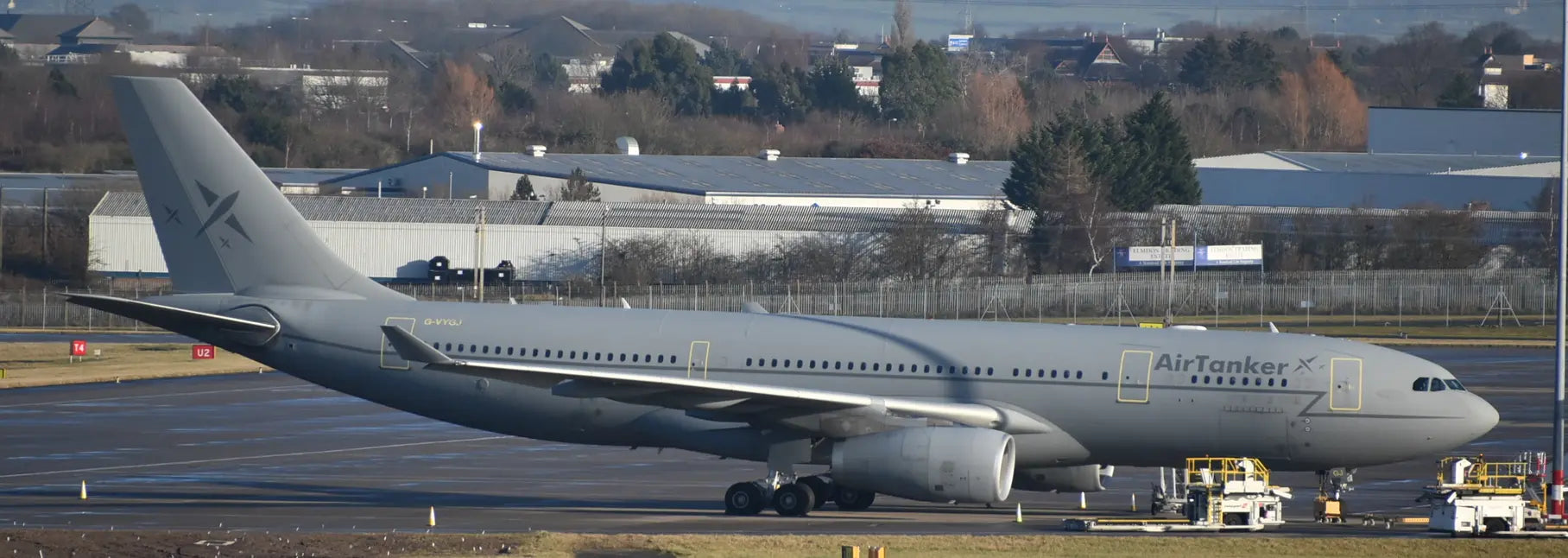
Plus Ultra operates an all Airbus A330 wide-body fleet. Having spent its early years flying older four-engined Airbus A340-300 and A340-600 aircraft, the airline completed its transition to the twin-engined A330 in 2025, retiring its last A340-300 (an airframe reported by ch-aviation to be around 24 years old). As of mid-2026, fleet trackers such as Planespotters and Airfleets list seven active A330s: five A330-200s and two A330-300s (the A330-343 sub-variant), with an average fleet age of roughly 18.6 years.
The shift to an all-A330 fleet matters for pilots in two ways. First, it aligns Plus Ultra with a widely operated type: A330 experience is transferable to many airlines worldwide, which improves career mobility for pilots who later move on. Second, the airframes are mid-life leased aircraft rather than factory-new deliveries, so pilots can expect the operational realities of older wide-bodies, including more frequent minimum-equipment-list (MEL) items and careful performance planning. There is no A330-900neo in the fleet, and no publicly confirmed order for new-generation aircraft.
| Aircraft Type | Role | In Service | Notes |
|---|---|---|---|
| Airbus A330-200 | Widebody | 5 | Long-haul backbone. Typical layout ~299 seats (24 Business / 275 Economy). Regs include EC-JQG and EC-NUL. |
| Airbus A330-300 (A330-343) | Widebody | 2 | Added 2025–2026 for Lima and Buenos Aires. EC-OOI (36C/263Y) and EC-ONX (30C/272Y). |
| Airbus A340-300 | Widebody | 0 | Retired 2024–2025. Last four-engined type phased out during fleet renewal. |
| Airbus A330-900neo | Widebody | 0 | Not operated. No confirmed order in public sources. |
Fleet data compiled from Planespotters, Airfleets and Spanish trade press, mid-2026. Small-carrier fleet data can vary between databases and change quickly with leasing rotations.
With a single-type wide-body fleet, every Plus Ultra line pilot flies the Airbus A330. There is no narrowbody feeder operation and no fleet choice: a pilot hired here operates long-haul A330 sectors to Latin America from day one on the line. The airline does not publish whether it funds A330 type ratings for new hires or expects candidates to arrive already rated. Given the carrier's small scale and financial constraints, prospective applicants should assume that a valid EASA A330 type rating (or willingness to discuss a bonded, partially self-funded arrangement) may strengthen an application, and should confirm the exact terms directly with recruitment.
Pilot Salary & Compensation
This is the section where honesty matters most. Plus Ultra does not publish its pilot pay scales, and no reliable, airline-specific salary table for its First Officers or Captains exists in the public domain. What can be stated with confidence is that, since February 2025, Plus Ultra pilots are covered by the company's first pilot collective agreement (convenio colectivo de pilotos), negotiated with the union SEPLA and registered by the Madrid regional labour authority (BOCM, resolution of 29 April 2025). This agreement sets a three-year framework with seniority-based pay scales, defined fixed and variable pay for flight hours and simulator or instruction duties, and improvements the union describes as long overdue.
Because the airline's own numbers are not public, the table below is a Spanish long-haul market benchmark, drawn from published data and estimates for Iberia and Air Europa, the two comparable Spanish carriers. It is provided so that a pilot can understand the range Plus Ultra operates within, not as a statement of Plus Ultra's actual figures. As a small, financially constrained carrier that only recently obtained its first pilot convenio, Plus Ultra is widely expected to sit at or below the lower end of these ranges.
Spanish Long-Haul Market Benchmark (Indicative, Not Plus Ultra-Specific)
| Rank & Seniority | Reference Carrier | Annual Gross (est.) |
|---|---|---|
| First Officer, mid-seniority (A330) | Iberia / Air Europa | ~€60,000 – €75,000 |
| Senior First Officer (long-haul) | Iberia / Air Europa | ~€75,000 – €90,000 |
| Captain, typical (long-haul widebody) | Iberia / Air Europa | ~€120,000 – €170,000 |
| Senior Captain (top of scale) | Iberia (A350) top end | ~€180,000 – €210,000+ |
Indicative Spanish legacy-carrier ranges (Iberia and Air Europa), compiled from public salary guides and industry benchmarks (EasyEASA, BAA Training, ReadyForTakeOff). These are reference figures for the market, not confirmed Plus Ultra pay. Plus Ultra is expected to pay at or below the lower boundary.
Several structural factors shape take-home pay for any Spain-based pilot. Spanish income tax rises to roughly 47% at the top marginal rate, which materially reduces net pay relative to gross. Per diems (dietas) for layovers are typically tax-free and can add meaningful income for active long-haul crews. Because Plus Ultra flies exclusively long-haul, the per-diem and flight-pay component of a package here is proportionally important, and the new convenio explicitly regulates these variable elements.
No verified Plus Ultra pilot pay scale is published. The figures above are Spanish market benchmarks from comparable carriers and should not be read as Plus Ultra salaries. The airline's actual scales are governed by the 2025 pilot convenio (in force to 31 January 2027), whose full salary annex is registered with the Community of Madrid but not widely reproduced online. Given the airline's financial fragility, discussed in the Financial Health section, pay progression and stability carry more uncertainty here than at a large legacy carrier. Verify current terms directly with Plus Ultra recruitment and with the SEPLA Plus Ultra section (sepla.es) before signing anything.
Roster Pattern & Quality of Life
Plus Ultra pilots work within the same regulatory ceiling as every European operator: EU Regulation 965/2012 and the EASA flight time limitation (FTL) rules (ORO.FTL), enforced in Spain by the national safety agency AESA. On top of that regulatory floor sits the 2025 pilot convenio, which the union and company both say improved schedule stability and predictability, one of the pilots' central demands during years of contentious bargaining. Beyond that, Plus Ultra does not publish its rostering system, monthly days-off guarantees or annual leave entitlement, so this section combines what is documented with the regulatory context that necessarily applies.
The defining feature of quality of life here is the operation itself: pure long-haul, wide-body flying from a single base in Madrid to Latin America. That means a smaller number of duty days per month than a short-haul pilot would fly, but each trip involves long transatlantic sectors, significant time-zone crossings, and multiple nights away from home on layover. Westbound departures from Madrid typically arrive in the afternoon or evening local time, while eastbound returns are often overnight, arriving in Europe in the early morning. Managing sleep and circadian disruption is a core part of the job, and under EASA FTL rules extended night duties and operations in an unknown state of acclimatisation trigger additional fatigue-risk-management requirements.
📅 Illustrative Long-Haul Month (Representative Pattern, Not an Official Plus Ultra Roster)
The grid above is an illustrative long-haul A330 pattern consistent with EASA FTL rest requirements. Plus Ultra does not publish its rosters, so this is a representative example for orientation only, not a confirmed company schedule.
All Plus Ultra pilots are based in Madrid, and there is no secondary base or base-bidding system. A crew member wanting to operate the airline's routes therefore needs to live in or near Madrid, or accept commuting to Barajas for every trip. On the positive side, a single stable base removes the complexity of multi-base networks and makes personal planning straightforward. The airline also positions aircraft and crew to Tenerife Norte in the Canary Islands to operate a weekly Tenerife to Caracas service, so some duties begin away from Madrid. Because the roster is purely long-haul, monthly duty days tend to be fewer than short-haul flying, but each is a multi-day transatlantic trip.
Benefits, Travel Perks & Retirement
As a Spanish employer, Plus Ultra operates within Spain's statutory social framework, which forms the baseline of any pilot's benefits here. All employees are enrolled in the Spanish social security system (Seguridad Social), which provides public healthcare and a state pension, and standard Spanish statutory rights on paid leave, maternity and paternity apply. On top of that baseline, the 2025 pilot convenio negotiated with SEPLA added a set of pilot-specific provisions, which the union and company describe as covering vacations, days off, uniform policy, paid leave, sabbaticals, reduced-hours arrangements, staff travel tickets and internal promotion criteria.
Unlike France's dedicated aircrew pension fund or some legacy carriers' enhanced schemes, there is no publicly documented supplementary pension or loss-of-licence scheme unique to Plus Ultra. Spanish pilots generally rely on the state pension plus any private arrangements they make individually, sometimes supported by collective agreements. Because Plus Ultra's convenio annexes are not widely published, the precise value of items such as per-diem rates, staff-travel conditions and any insurance cover should be confirmed directly with the airline or the union.
The most important benefit a pilot gained at Plus Ultra in recent years is arguably the collective agreement itself. Before February 2025, pilots operated without a company-specific convenio, which the union says left pay and conditions unstable. The signed agreement now provides a codified floor for salary steps, rostering, leave and staff travel. That said, staff-travel value is limited by the airline's small, alliance-free network, and there is no headline pension or loss-of-licence perk comparable to larger European carriers. Treat the package as a competent Spanish statutory baseline plus a first-generation convenio, rather than a premium benefits scheme.
Career Progression & Seniority
Career progression at Plus Ultra is shaped almost entirely by one fact: the airline is very small. With seven aircraft and an estimated 70 to 80 pilots, the number of command positions is limited, and the pace of upgrade depends heavily on fleet growth and retirements rather than on a large, predictable seniority pipeline. The 2025 pilot convenio introduced defined internal promotion criteria, which brings welcome structure, but no public upgrade-time figure exists for Plus Ultra, and it would be misleading to invent one.
For context, upgrade to Captain at the larger Spanish legacy carriers typically runs to roughly 10 to 15 years at Iberia and around 8 to 12 years at Air Europa, both strongly seniority-dependent. A micro-carrier like Plus Ultra does not fit neatly into those bands. In a small operation, a single wave of retirements or the addition of one or two aircraft can move upgrade prospects significantly, in either direction. The airline's recent moves, adding A330-300s and launching a Madrid to Buenos Aires route in May 2026, point to modest expansion, which could open command and flying opportunities. Against that, the airline's financial and legal difficulties inject real uncertainty into any long-term progression plan.
| Career Element | Situation at Plus Ultra | Notes |
|---|---|---|
| Entry role | A330 First Officer | Long-haul wide-body from day one on the line. No narrowbody or short-haul stepping stone. |
| Fleet transitions | None (single type) | All pilots fly the A330. No inter-fleet bidding. |
| Upgrade basis | Seniority + convenio criteria | Internal promotion rules defined in the 2025 agreement. |
| Upgrade timeline | Not published | Depends on a small fleet, retirements and growth. No reliable public figure. |
| Direct-entry Captains | Possible | Small carriers often recruit experienced Captains externally when expanding, though this is not confirmed policy. |
| Instructor / management roles | Limited | Few slots given the small pilot body. |
Career structure reconstructed from the airline's scale, fleet and the 2025 convenio. Specific upgrade timelines are not published by Plus Ultra.
Plus Ultra is best understood as a place to build genuine long-haul A330 command or wide-body experience at a small operator, not as a guaranteed lifetime career with a deep upgrade ladder. The upside is early exposure to transatlantic flying and a transferable A330 rating. The downside is a shallow bench of positions, no fleet variety, and a corporate backdrop (financial strain, ongoing investigations, executive arrests) that makes multi-decade planning risky. Many pilots may view it as a stepping stone toward a larger carrier rather than a final destination. Weigh progression here against your appetite for that uncertainty.
Recruitment Process & Requirements
Plus Ultra does not run a large, publicised cadet programme in the way that some flag carriers do. Recruitment is handled through the airline's own careers channels (the corporate site's empleo / careers page) and general Spanish job portals, on a rolling basis tied to operational need. Because the operation is exclusively long-haul wide-body, hiring is oriented toward experienced pilots rather than ab-initio cadets, and openings tend to be infrequent given the small pilot body.
The requirements below reflect standard EASA and Spanish practice for a wide-body operator; Plus Ultra does not publish a detailed public requirements matrix, so applicants should treat these as the expected baseline and confirm specifics with the airline. Fluency in Spanish is effectively essential: the company is Spanish, its internal communications and culture operate in Spanish, and its network is centred on Spanish-speaking Latin America. Strong aviation English (ICAO Level 4 or above) is a licensing necessity for international operations.
Expected Requirements (Experienced Pilot Entry)
Typical Application Path
Application
Submit a CV and licence documentation through the Plus Ultra careers page or a Spanish job portal when a wide-body pilot vacancy is open. Openings are occasional and tied to fleet and route growth, such as the recent A330-300 additions and the Buenos Aires launch.
Screening & Interview
Document and experience screening, followed by interview. Expect assessment of A330 or wide-body suitability, crew resource management, and Spanish and English language competence. Small carriers often run a leaner process than the multi-stage psychometric pipelines of large flag carriers.
Simulator Assessment
A simulator check is a common step for experienced-pilot entry at wide-body operators, to confirm handling and procedural standards on type or a representative Airbus platform.
Type Rating & Line Training
Pilots not already A330-rated complete type-rating training, then line training including Line Flying Under Supervision (LIFUS) with a training captain before operating unsupervised. LIFUS is a supervised training phase and, under EASA rules, a pilot in LIFUS is not a substitute for a required qualified crew member (see the Union section for why this matters at Plus Ultra).
Spanish fluency is non-negotiable for a genuine shot at this airline, so make it clear on your application. Because vacancies are rare and tied to growth, monitor the careers page and SEPLA channels rather than expecting an annual campaign. Given the airline's public controversies, do your due diligence: read the airline's recent financial coverage, speak to the SEPLA Plus Ultra section about current conditions and the state of the convenio, and clarify type-rating funding and contract stability before committing. Enter with a clear-eyed view of both the opportunity (real long-haul A330 flying) and the risk (a small carrier under legal and financial pressure).
Layover Destinations
Layovers are one of the genuine attractions of long-haul flying, and Plus Ultra's network gives its pilots a distinctly Latin American layover profile. The core scheduled routes from Madrid in 2026 are Lima, Caracas and Buenos Aires, supplemented by a weekly Tenerife to Caracas service and periodic charter or ACMI operations to destinations such as Malabo (Equatorial Guinea) and, seasonally, cities like Havana. Crew hotels are contracted by the airline rather than chosen by the pilot, and layover length is governed by EASA rest requirements, generally a minimum of around 24 hours away from base on these transatlantic rotations.
Crew hotels and airport transport are arranged by the airline; pilots do not book their own accommodation. Under EASA Flight Time Limitations, minimum rest and time-zone-crossing provisions determine layover length, and long sectors that push duty times toward the limits require augmented crews of three or four pilots so that in-flight rest can be rotated. Because the scheduled network is concentrated on a few Latin American cities, the layover set is narrow and repetitive rather than globally varied, which some pilots value for familiarity and others find limiting. Note also that some destinations that appear on third-party booking sites (for example Bogotá, Cartagena or Havana) are historical, seasonal or charter operations rather than the current core scheduled routes.
How Plus Ultra Compares: Airline Radar Chart
The natural comparison for Plus Ultra is with the two established Spanish carriers it competes against on the Madrid to Latin America corridor: Iberia, the flag carrier, and Air Europa. The radar below scores all three across the same six-metric framework used in the scorecard. These are editorial estimates based on publicly available data, pilot feedback and industry benchmarks, and they are intended to show relative positioning, not to be precise measurements.
Key Takeaways from the Comparison
Iberia and Air Europa lead on almost every axis. Both are far larger, financially more stable, and offer diverse fleets, deeper seniority ladders and better-documented pay. Iberia's long-haul Captains can reach the €180,000 to €210,000 range at the top of scale, and Air Europa's sit somewhat below that. Plus Ultra does not publish scales and is expected to pay at or below the lower end of the Spanish market, which is reflected in its lower salary score.
Job security is where the gap is widest. Iberia (part of IAG) and Air Europa are established carriers with mature structures. Plus Ultra, by contrast, is a micro-carrier that defaulted on part of its state rescue loan in March 2026, is negotiating a viability plan, and whose senior executives were reportedly arrested in a money-laundering investigation in December 2025. That backdrop drives Plus Ultra's low job-security score and is the single most important factor for a pilot weighing this airline.
Fleet scores reflect age and variety, not just type. All three fly the A330, but Iberia adds the modern A350 and a broad wide-body and narrow-body fleet, while Plus Ultra flies only mid-life A330s (average age near 18.6 years) with no new-generation aircraft. Air Europa's Boeing 787-heavy long-haul fleet is newer than Plus Ultra's.
Plus Ultra's relative strengths are narrower but real. A single stable Madrid base, purely long-haul A330 flying from day one, a first collective agreement that improved schedule stability, and a distinctive Latin American network are genuine positives for the right pilot. On work-life and benefits it is competitive on a basic level, even if it cannot match the larger carriers' depth.
Scores are editorial estimates based on research into publicly available salary data, union publications (SEPLA), corporate filings, Spanish trade and general press, and industry benchmarks (EasyEASA, BAA Training, ECA). They represent a general assessment for an experienced pilot considering a long-term career, not a precise metric. Plus Ultra's own pay and roster data are largely unpublished, so its scores carry more estimation uncertainty than those of Iberia and Air Europa. Individual experiences will vary with seniority, timing and personal priorities.
Union & Industrial Relations
Spanish airline pilots are represented primarily by SEPLA (Sindicato Español de Pilotos de Líneas Aéreas), the country's main pilots' union, which is affiliated internationally to the European Cockpit Association (ECA) and IFALPA. Plus Ultra pilots gained formal representation when SEPLA created a dedicated company section (sección sindical) in June 2020, following an assembly of Plus Ultra pilots who elected their legal representatives. That section is the vehicle through which pilots negotiate with the company and defend their working conditions.
The road to a pilot collective agreement was long and contentious. For years Plus Ultra pilots worked without a company-specific convenio. SEPLA reported a prolonged negotiation blockade and, after a court ruling obliged the company to negotiate, roughly a year and a half of limited progress that led pilots to authorise the union to consider pressure and collective-conflict measures. The breakthrough came in February 2025, when Plus Ultra and SEPLA signed the company's first pilot collective agreement, later registered by the Community of Madrid and published in the regional gazette (BOCM), in force through 31 January 2027.
Union Structure Relevant to Plus Ultra
The Trainee-Pilot (LIFUS) Safety Controversy
Industrial relations at Plus Ultra cannot be separated from a serious safety controversy that surfaced publicly in May 2026. The Spanish outlet The Objective reported (16 May 2026) that, between February 2023 and 2025, Plus Ultra had habitually used pilots still in the LIFUS (Line Flying Under Supervision) training phase as relief pilots on long-haul commercial flights, effectively operating certain transatlantic sectors with three pilots instead of the four normally required for crew augmentation. According to the report, trainees were placed at the controls during the rest periods of the titular crew despite not being legally authorised to operate unsupervised, and the motivation was described as economic: saving on salaries, hotels and per diems by carrying fewer fully qualified pilots.
The report stated that this practice was investigated by the Guardia Civil for possible offences against air safety. LIFUS is, by definition, a supervised training stage: under EU Regulation 965/2012 and the standards upheld by AESA and the professional pilots' college COPAC, a pilot in LIFUS is an addition to, not a replacement for, a required qualified crew member. Using such pilots to fill a mandatory relief position would breach crew-composition rules. As of mid-2026 these are allegations under investigation, and Plus Ultra's operating certificate remains active, but the episode is directly relevant to how a prospective pilot should read the airline's safety and cost culture.
Recent Industrial & Safety Timeline
The good news is that Plus Ultra pilots are unionised through SEPLA and, since 2025, protected by a registered collective agreement that codifies pay steps, rostering and promotion. That is a meaningful improvement on the previous no-convenio situation. The caution is equally important: the LIFUS allegations and the money-laundering investigation point to an operating and governance environment under real strain and scrutiny. A pilot joining now should engage directly with the SEPLA Plus Ultra section to understand the current climate, and should treat safety-culture and compliance questions as central, not peripheral, to the decision.
Financial Health & Legal Situation
For most airlines this topic would be a footnote. At Plus Ultra it is central to job security, so it deserves a dedicated, factual section. Two intertwined threads matter to pilots: the airline's finances, and the legal investigations surrounding its ownership and its 2021 state rescue.
The 2021 SEPI Bailout
On 9 March 2021 the Spanish Council of Ministers approved a 53 million euro rescue for Plus Ultra from the Solvency Support Fund for Strategic Companies (FASEE), managed by the public holding company SEPI. The support was structured as a 19 million euro ordinary loan (five years) and a 34 million euro participative loan (seven years). The rescue was politically explosive: Plus Ultra is a very small airline (analyses put its share at around 0.03% of flights in Spain in 2019), had recorded losses for much of its history, and its designation as a "strategic" company was widely questioned, especially compared with the far larger rescue granted to Air Europa. A Madrid court even temporarily suspended part of the payment at one stage. SEPI has maintained that the rescue was legal and transparent, citing later audits and a Court of Auditors report.
Ownership & the Venezuelan Connection
Public filings and press reporting indicate that roughly 56.8% of Plus Ultra is controlled through two Spanish companies, Snip Aviation (about 52.83%) and FlySpain (about 11.47%), linked to Venezuelan businessmen including Rodolfo José Reyes Rojas, Raif El Arigie Harbie and Roberto Roselli Mieles. Spanish founders Julio Martínez Sola (president) and Fernando González Enfedaque remain associated with the company. This ownership structure has drawn scrutiny from prosecutors, with investigators reportedly examining whether bailout funds were used to service debts channelled abroad as part of an alleged money-laundering network connected to Venezuela.
Investigations & Recent Developments
The situation escalated sharply into 2025 and 2026. In December 2025, Spanish police searched Plus Ultra's Madrid headquarters and, according to national and international coverage (including El País), the airline's president and chief executive were detained in a money-laundering investigation linked to Venezuelan funds and the state rescue. In parallel, reporting in 2026 indicated that Plus Ultra failed to meet a 19 million euro repayment obligation on the ordinary tranche of the rescue in March 2026 and was negotiating a viability plan with SEPI, despite reporting improved revenue.
Revenue has grown substantially since the pandemic, and the airline continues to operate and even add routes, which are genuine signs of commercial life. But the combination of an unpaid rescue tranche, a viability plan under negotiation, reported negative equity, and an active money-laundering investigation with detained executives represents a level of corporate and legal risk far beyond a normal airline. This is not a prediction of failure, and legal matters remain under investigation rather than concluded, but any pilot evaluating Plus Ultra should weight job security heavily and monitor developments closely through reputable Spanish media before and during employment.
Verdict: Who Is Plus Ultra For?
🎯 Our Take
Plus Ultra offers something genuinely uncommon: pure long-haul Airbus A330 flying from a single Madrid base to Latin America, at a small operator where a pilot is on wide-body metal from day one on the line. For a Spanish-speaking pilot who wants transatlantic experience and a transferable A330 rating without waiting years to move from narrowbody to wide-body, that is a real and specific attraction. The 2025 pilot collective agreement with SEPLA added a codified floor for pay, rostering and promotion that the airline previously lacked.
The trade-offs, however, are unusually serious and cannot be glossed over. Pay scales are unpublished and expected to sit at or below the lower end of the Spanish market. The fleet is small and mid-life, career progression is shallow with no fleet variety, and, most importantly, the airline is under exceptional financial and legal pressure: an unpaid state-rescue tranche, a viability plan under negotiation, and a money-laundering investigation that reportedly led to the detention of its top executives. On top of that, allegations that trainee pilots were used as long-haul relief crew raise legitimate questions about safety and cost culture.
For a pilot who understands and accepts that risk profile, and who values the specific opportunity of long-haul A330 command experience at a Spanish carrier, Plus Ultra can be a meaningful stepping stone. For a pilot prioritising stability, pay and a long, predictable career, the larger Spanish carriers are the safer choice.
1 Is Plus Ultra financially stable and is the job secure?
Job security is the airline's weakest point. Plus Ultra received a controversial 53 million euro state rescue in 2021, reportedly failed to repay a 19 million euro tranche in March 2026, and is negotiating a viability plan with SEPI. Its president and CEO were reportedly detained in December 2025 in a money-laundering investigation linked to Venezuelan funds. Revenue has grown to roughly 185 to 215 million euros, and the airline is still operating and adding routes, but the legal and financial risk is far higher than at a typical carrier. Treat stability as a serious open question.
2 Do I need to speak Spanish to fly for Plus Ultra?
Effectively yes. Plus Ultra is a Spanish company whose internal communications, culture and network are centred on Spain and Spanish-speaking Latin America. Fluent Spanish is expected for a realistic application, alongside ICAO English (Level 4 or above) for international operations. There is no English-only pathway advertised.
3 What aircraft would I fly, and how big is the fleet?
You would fly the Airbus A330. As of mid-2026 the fleet is seven aircraft: five A330-200s and two A330-300s, with an average age around 18.6 years. The older A340s were retired during the 2024 to 2025 fleet renewal. It is a single-type, all wide-body operation, so every line pilot flies long-haul A330 sectors.
4 How much do Plus Ultra pilots earn?
Plus Ultra does not publish its pilot pay scales. Since February 2025 pay is governed by the first pilot collective agreement with SEPLA, which sets seniority-based scales, but the detailed salary annex is not widely published. As a small, financially constrained carrier, Plus Ultra is generally expected to pay at or below the lower end of Spanish long-haul benchmarks (roughly 60,000 to 90,000 euros for First Officers and 120,000 euros upward for Captains at Iberia and Air Europa). Confirm actual figures with the airline and SEPLA.
5 Does Plus Ultra pay for the A330 type rating?
This is not publicly documented. Given the airline's small scale and financial constraints, applicants should not assume a fully funded type rating and should clarify the exact arrangement (company-funded, bonded, or self-funded) directly during recruitment. Holding a current EASA A330 rating may strengthen an application.
6 What is the trainee-pilot (LIFUS) controversy about?
In May 2026, The Objective reported that between February 2023 and 2025 Plus Ultra allegedly used pilots still in the LIFUS supervised-training phase as relief pilots on long-haul flights, operating some sectors with three pilots instead of the required four, reportedly to save on crew costs. LIFUS pilots are not a legal substitute for a required qualified crew member under EU Regulation 965/2012. The Guardia Civil is reported to be investigating for possible air-safety offences. As of mid-2026 these are allegations under investigation.
7 Where are Plus Ultra pilots based?
All pilots are based at Adolfo Suárez Madrid-Barajas Airport. There is no secondary base or base-bidding system, so living in or near Madrid (or commuting there) is required. Crews also position to Tenerife Norte in the Canary Islands to operate a weekly Tenerife to Caracas service.
8 Do Plus Ultra pilots have union representation?
Yes. Plus Ultra pilots are represented by SEPLA, which created a dedicated company section in June 2020. After several contentious years and a court order to negotiate, the company and SEPLA signed the first pilot collective agreement in February 2025, registered in the Madrid gazette (BOCM) and in force to 31 January 2027. It covers pay scales, rostering, leave and promotion criteria.
Official Links & Resources
Before applying or making any career decision, verify information directly with official sources. These are the key organisations and pages relevant to a Plus Ultra pilot career:
For a small carrier under active investigation, the most valuable due diligence is current and local. Follow the SEPLA Plus Ultra news feed and reputable Spanish outlets for developments on the convenio, the viability plan and the ongoing legal proceedings. Speak to the SEPLA section directly before signing any contract, and confirm type-rating funding, contract stability and current pay in writing. Treat corporate stability as a live topic to monitor, not a one-time check.
- 01Overview & Company Profile
- 02Fleet & Type Ratings
- 03Salary & Compensation
- 04Roster & Quality of Life
- 05Benefits & Retirement
- 06Career Progression
- 07Recruitment & Requirements
- 08Layover Destinations
- 09Airline Comparison
- 10Union & Industrial Relations
- 11Financial Health & Legal
- 12Verdict & FAQ
- 13Links & Resources