Omni Air International Overview & Company Profile
Omni Air International (IATA: OY, ICAO: OAE) is a U.S. passenger charter and ACMI carrier founded in 1993 and headquartered at Hangar 19, Tulsa International Airport in Tulsa, Oklahoma. It is not a scheduled airline. Instead, it operates under a FAR Part 121 supplemental certificate, meaning it contracts entire widebody aircraft to customers rather than selling individual tickets to the public. Its core business is built around U.S. military and government passenger airlift, seasonal Hajj and Umrah pilgrimage flying, sports and tour charters, and ACMI (Aircraft, Crew, Maintenance, Insurance) wet-lease work for other airlines.
Omni has been a subsidiary of Air Transport Services Group (ATSG) since the acquisition completed on November 9, 2018. ATSG is best known as a dominant 767 freighter operator for Amazon and DHL through sister carriers ABX Air and Air Transport International (ATI). In a major change of ownership, infrastructure investment firm Stonepeak completed its all-cash acquisition of ATSG on April 11, 2025, in a transaction valued at roughly $3.1 billion (shareholders received $22.50 per share). For pilots, this matters because capital priorities, fleet decisions, and bargaining posture now sit under a private-equity-style owner rather than a publicly traded parent.
A defining feature of Omni's identity is its participation in the Civil Reserve Air Fleet (CRAF). By committing capacity that the U.S. Department of Defense can activate during contingencies, Omni earns access to routine peacetime troop-movement contracts through U.S. Transportation Command. This is the backbone of the operation: long-haul transatlantic and transpacific flights moving service members and their families to and from overseas bases. The result, from a pilot's perspective, is an all-widebody, heavily international flying job with a home-based gateway lifestyle that resembles peers like Atlas Air and National Airlines far more than it resembles a domestic major. As the union has publicly confirmed, Omni employs approximately 350 pilots.
Understanding the supplemental model is essential before evaluating Omni. Because flying is contract-driven rather than schedule-driven, work can be awarded, modified, or cancelled with relatively little notice, and the calendar swings between intensely busy seasons (Hajj, troop rotations) and quieter periods. Pilots who join expecting the structured monthly bid line of a domestic major will be surprised; pilots who want long-haul international widebody time, a live-anywhere gateway system, and a contractor-like rhythm of long tours followed by concentrated time off tend to find the fit far more natural.
Fleet Composition & Type Ratings
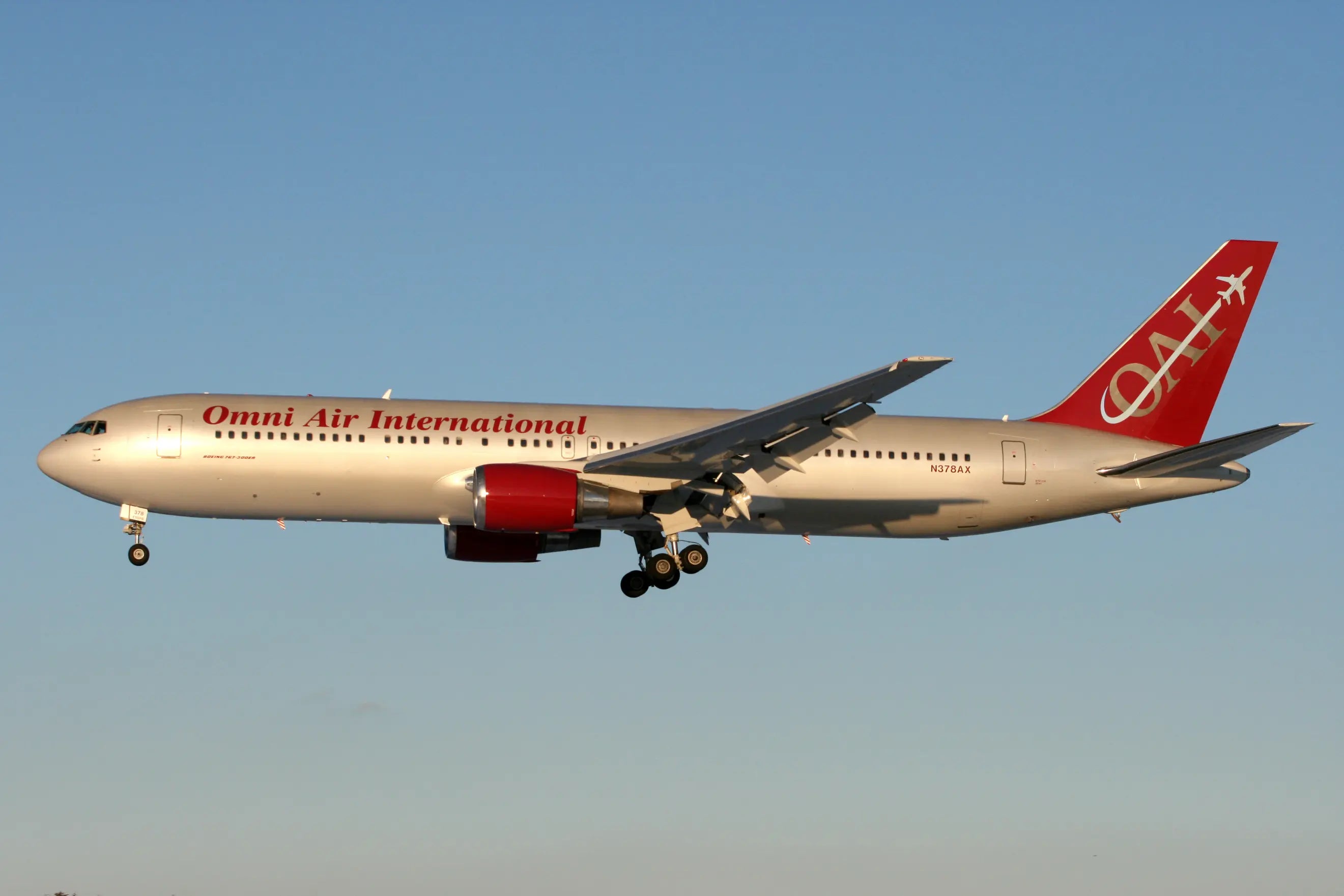
Omni Air International operates an all-Boeing, all-widebody fleet of roughly 15 aircraft spread across two type families: the Boeing 767 and the Boeing 777. The most current fleet sources (Omni's own fleet page and 2025 fleet tables) indicate 2 Boeing 767-200ER, 9 Boeing 767-300ER, and 3 Boeing 777-200ER. The 767-300ER is the clear workhorse of the operation, the 777-200ER provides high-capacity, long-range lift for dense troop movements and Hajj rotations, and the aging 767-200ER fills lower-demand long-range missions.
| Aircraft Type | Role | In Service | Notes |
|---|---|---|---|
| Boeing 767-200ER | Widebody | 2 | Oldest type in the fleet. Long-range, lower capacity. Likely the first candidate for retirement. |
| Boeing 767-300ER | Widebody | 9 | Core workhorse. Transatlantic military, ACMI and charter flying. Acquired second-hand and reconfigured. |
| Boeing 777-200ER | Widebody | 3 | High-capacity, long-haul lift for dense troop movements, Hajj, and transpacific ACMI. |
Fleet data compiled from Omni's official fleet page and public fleet registers, 2025. Numbers shift as aircraft are leased in or out and as retirements occur.
Because Omni acquires used airframes rather than ordering new-generation aircraft, the fleet skews old. Many of its 767s entered service with other carriers in the 1990s and early 2000s, putting average ages comfortably into the 20-to-30-year range for the 767 line and well over 15 years for the 777-200ERs. This is normal in the charter and ACMI sector, where low acquisition cost and intensive utilization drive profitability. For pilots, the practical meaning is a "legacy" Boeing glass cockpit environment rather than the latest fly-by-wire generation, with tail-to-tail variation in avionics, engine variants, and cabin layouts that is managed through aircraft-specific briefing material.
There is no publicly reported large order book in the way a major airline publicizes 787 or A350 commitments. Given ATSG's deep involvement in the 767 platform on the cargo side, the most likely path forward is continued opportunistic acquisition of used 767-300ERs, gradual retirement of the 767-200ER, and selective retention of the 777-200ER for high-capacity niches. Pilots joining today should expect to fly the 767-300ER first, with the 777 as a seniority-dependent step.
Per Omni's pilot careers page, new hires must obtain their PIC type rating during new-hire or transition training, which the company provides. A type rating is not required at the point of application for first officer roles. The 767 and 777 require separate type ratings, and most pilots operate one type at a time. The absence of any narrowbody means every hour logged at Omni is widebody, international, ETOPS-relevant time, which is a strong résumé asset, but it also means no domestic narrowbody experience is gained here.
Pilot Salary & Compensation Breakdown
Omni pilot pay is governed by the collective bargaining agreement negotiated with the Airline Professionals Association, Teamsters Local 1224. Like most unionized Part 121 carriers, compensation is built on an hourly block rate that rises with longevity, a monthly minimum guarantee, per diem for time away from base, and premium pay for specific situations. One important and confirmed figure comes straight from Omni's own pilot recruiting page: new-hire first officer pay is $128.36 per block hour, with a 64-hour monthly guarantee (an 80-hour guarantee applies to certain TDY and special programs).
The full longevity tables are not published openly. The captain figures below are compiled from public pay databases such as AirlinePilotCentral, which reflect the amendable 2018-era contract that Omni pilots are still working under. Treat the captain progression and the higher first-officer steps as estimates, while the year-one first officer rate, guarantee, and per diem are taken directly from Omni's official careers materials.
First Officer Pay Scale (estimated)
| Longevity | Hourly Rate | Annual @ 64 hr guarantee | Annual @ ~80 hr utilization |
|---|---|---|---|
| Year 1 (confirmed) | $128.36/hr | ~$98,600 | ~$123,000 |
| Year 3 | ~$140/hr | ~$107,500 | ~$134,000 |
| Year 6 | ~$155/hr | ~$119,000 | ~$149,000 |
| Senior F/O (10+ yrs) | ~$175–190/hr | ~$134,000–146,000 | ~$168,000–182,000 |
Year-1 rate is confirmed from Omni's careers page; later steps are estimates based on public databases and typical Teamsters widebody progressions. Per diem and premiums are additional.
Captain Pay Scale (estimated)
| Longevity | Hourly Rate | Annual @ 64 hr guarantee | Annual @ ~80 hr utilization |
|---|---|---|---|
| Year 1 | ~$192/hr | ~$147,000 | ~$184,000 |
| Year 5 | ~$235/hr | ~$180,000 | ~$226,000 |
| Year 9 | ~$275/hr | ~$211,000 | ~$264,000 |
| Top of scale (12+ yrs) | ~$298/hr | ~$229,000 | ~$286,000 |
Captain rates are the same across the 767-200, 767-300 and 777 in the public scale. Long international block times and TDY programs can push real-world utilization well above the 64-hour floor.
Two pay mechanics deserve attention. First, the per diem is structured as $2.30 per hour domestic and $3.20 per hour international (with $55.20 per day during training). Because Omni trips are long international rotations with multi-day overseas layovers, per diem accumulates meaningfully across a month, though the hourly rates themselves are on the low side compared with newer industry contracts. Second, Omni publishes call-out pay for short-notice assignments: $300 for day one, $400 for day two, and $500 per day from day three onward. Training pay is a flat $1,500 per week plus domestic per diem.
The year-one first officer rate ($128.36/hr), the 64-hour guarantee, per diem, call-out, and training pay are taken directly from Omni's official pilot careers page. The captain longevity scale and the higher first officer steps are estimates drawn from public compilations of the amendable 2018 contract, which is still in force. Crucially, Omni pilots have been bargaining a new agreement for years and authorized a strike in February 2024 (see the Union section), so these rates may change materially once a new contract is ratified. Always verify against the current CBA through Teamsters Local 1224 or Omni HR before making a career decision.
In sector terms, Omni's pay sits in the middle of the U.S. widebody charter and ACMI pack: clearly above regional airlines, broadly competitive with National Airlines, generally below the most recent Atlas Air widebody rates, and well below the post-2023 contracts at Delta, United, and American, where senior 777 and 787 captains can exceed $350,000 with profit sharing. The first officer entry rate of $128.36 is, notably, a strong number for a charter carrier and substantially higher than entry-level rates at some peers.
Schedule, Tours & Quality of Life
Quality of life at Omni is shaped by the supplemental charter model more than by any single roster rule. Flying is organized around tours: extended blocks during which a pilot is available to the company and can be assigned trips, followed by blocks of days at home. This is fundamentally different from a domestic carrier's bid line of day trips and short layovers. A tour can keep a pilot away from home for one to three weeks at a time, after which the schedule delivers a concentrated period off rather than a day or two between rotations. Omni's contract includes Guaranteed Days Off (GDO), a protection that matters a great deal in a business where contracts can shift on short notice.
Duty and rest are governed by the same FAA Part 117 flight and duty time rules that apply to every U.S. Part 121 carrier, including limits on duty periods, block hours, and required rest. The difference is variability: because flying is not anchored to a published schedule, report times, block times, and trip extensions are less predictable, and irregular operations (diversions, overflight denials, military re-tasking) are simply more common. Long-haul and ultra-long-haul sectors use augmented crews so pilots can take in-flight rest in designated crew rest facilities.
📅 Illustrative Tour Pattern — Widebody First Officer (Gateway-Based)
Illustrative only. Omni does not publish a fixed roster pattern; charter and ACMI tours vary widely by season, contract, and seniority. This grid shows the general rhythm of long duty blocks followed by concentrated days off, not an official Omni line.
Within a tour, junior pilots spend more time on reserve, sometimes positioned at a hotel near a gateway or overseas station awaiting assignment, while senior pilots bid more predictable patterns. Schedule bidding runs on a monthly cycle and is awarded in seniority order, but even awarded lines remain subject to operational change. The upside of reserve at a charter carrier is that per diem accrues while away from home; the downside is the loss of control over exactly when and where the next trip starts.
Omni's most distinctive lifestyle feature is its gateway system. Rather than requiring pilots to live in or commute to a fixed domicile, the company lets a pilot designate a home gateway airport and provides company-paid positive-space travel from that gateway to the start of a tour and back at the end. Because the positioning is company-purchased rather than standby jumpseating, pilots do not carry the usual commuter risk of getting bumped and missing a trip. This effectively makes Omni a home-based airline despite its Tulsa headquarters, and it is a genuine draw for pilots who want to live in smaller cities or far from traditional hubs. The trade-off is the tour structure itself: this is not a be-home-every-night job.
Benefits, Travel Perks & Retirement
Omni's benefits package, as published on its pilot careers page, covers the standard pillars of a U.S. Part 121 employer plus a few perks specific to its place in the ATSG group. The retirement plan is a 401(k) with a company match of 100% of pilot contributions up to 5% of pay. This is a functional, if not class-leading, match: the post-2023 passenger majors have pushed direct retirement contributions into the 16% range, so this is one area where Omni trails the top of the industry and where the union has explicitly cited retirement as a bargaining priority.
The travel benefit is structured differently from a network legacy carrier. Because Omni has no scheduled route network of its own, it provides United Airlines pass travel for pilots and their families, along with business-class eligibility on qualifying international flights. That is a meaningful perk for crews who want to commute or vacation on a global network, even if it lacks the breadth of an alliance benefit. The real "travel benefit," many Omni pilots would say, is the flying itself: the job routinely deposits crews in destinations that ordinary leisure travel would rarely reach.
The strengths are the gateway system (company-paid positioning), the higher-than-typical first officer entry rate, and the United pass travel. The weaker spots, relative to the broader industry, are the 5% retirement match, the low per diem rates, and the absence of a large profit-sharing plan of the kind the passenger majors offer. These are precisely the items the pilot group has been pressing in negotiations, so prospective applicants should watch for movement on retirement and per diem in any future contract.
Career Progression & Seniority
Career progression at Omni runs on a strict seniority system. Date of hire determines a pilot's place on the list, and seniority governs bidding for schedules, aircraft type, seat (captain versus first officer), and vacation. There is no merit-based leapfrogging, and seniority is not shared with sister ATSG carriers such as ATI or ABX Air, so moving between group companies means resigning one list and starting over on another. That independence is the single most important fact when weighing Omni as a destination versus a stepping stone.
Unlike legacy carriers that promote only from within, Omni has at times hired direct-entry captains (DEC) when internal supply could not cover growth or contract commitments, particularly for pilots with significant widebody PIC and ETOPS experience. DEC hiring gives experienced applicants immediate access to captain pay and responsibilities, though it can be a source of internal tension. Upgrade timelines for first officers are driven by fleet stability, captain attrition to the majors, and broader hiring cycles; in the recent strong pilot labor market, upgrades at charter and ACMI carriers have generally moved faster than in lean years.
| Career Milestone | Typical Path | Notes |
|---|---|---|
| Join as First Officer (767) | Day 1 post-training | Most common entry seat. Type rating provided during new-hire training. |
| Early years | More reserve | Build Part 121 widebody and international ETOPS time while climbing the list. |
| Captain upgrade (767) | Seniority & demand dependent | Transition course, sim evaluation, and line check. Varies with attrition and growth. |
| Direct-Entry Captain | Experienced hires | Available at times for pilots with heavy widebody PIC / ETOPS experience. |
| 777 transition | Seniority-based bid | Higher-capacity, long-haul flying. Limited number of frames (3). |
| Check Airman / Instructor | Selection-based | Requires separate selection and instructor qualification. |
Widebody PIC time on the 767 and 777, accumulated in demanding international and ETOPS environments, is a strong credential. Many Omni pilots have used it as a springboard to Delta, United, American, FedEx, and UPS over the years. Others treat Omni as a long-term home, valuing the gateway lifestyle and mission profile. The honest framing is that Omni works well as both, but with one caveat: because the fleet is small (around 15 aircraft) and growth is modest compared with the majors, seniority movement and upgrade speed are tied closely to attrition and to whatever fleet or contract expansion the new Stonepeak ownership pursues.
The February 2024 strike-authorization release quoted Captain Paul Rodell warning that Omni was "losing some of our best pilots and we are struggling to replace them," a candid signal that attrition to better-paying carriers has been real. For a prospective pilot, attrition is a double-edged sword: it can accelerate upgrades for those who stay, but it also reflects the pay and retirement gaps the union is fighting to close. Career planning here should account for both the upside of fast movement and the uncertainty of an unsettled contract.
Recruitment Process & Requirements
Omni recruits experienced pilots rather than ab-initio cadets. There is no company-sponsored cadet pathway: applicants are expected to arrive with an airline transport pilot certificate and turbine experience. The published requirements are straightforward, and the most authoritative source is the airline's own pilot careers page.
Core Requirements
Notably, Omni's public page emphasizes recent flying within the last 12 months rather than advertising a hard total-time minimum. In practice, a Part 121 widebody operator in the ACMI sector typically expects substantial multi-engine turbine experience, and competitive applicants tend to come from the regionals, corporate and fractional flying, or the military. For any direct-entry captain consideration, significant transport-category PIC time and ETOPS experience are strongly preferred. The valid passport and unrestricted international travel requirement is non-negotiable given the military, Hajj, and overseas nature of the flying.
Selection Stages
Application via Recruiting Session
Omni's careers page notes that hiring runs through invitation-style recruiting sessions, with open positions posted on the ATSG/Omni applicant portal (hosted on UltiPro). Candidates submit a pilot résumé, license and medical documentation, and logbook summaries.
Interview (HR + Technical)
A human-resources component explores background, motivation, CRM, and fit, while a technical component covers systems, Part 121 and Part 117 regulations, international procedures, fuel and alternate planning, and general airmanship.
Simulator Evaluation
A full-flight simulator session assesses fundamental instrument flying, departures, arrivals, holding, approaches, abnormal handling, and CRM. The focus is on raw flying skill, scan, and adaptability rather than type-specific button knowledge.
Conditional Offer & Background Checks
Successful candidates receive a conditional offer pending the 10-year background check, drug testing, and medical verification, after which a class date is assigned.
Initial Training & Probation
New hires complete indoctrination, systems ground school, simulator training, and line operating experience, paid at $1,500 per week plus per diem during training. A first-year probationary period applies, as is standard at U.S. unionized carriers.
Apply directly through Omni's official portal rather than third-party aggregators, and make sure your passport and international travel eligibility are current before applying, since the entire operation is international. Recent and continuous flying matters: the careers page specifically calls out flying within the last 12 months. For pilots targeting a direct-entry captain seat, emphasize transport-category PIC time and any ETOPS or international operating experience. Expect the simulator evaluation to test fundamentals, so refresh raw instrument flying and standard callouts beforehand.
Typical Destinations & Layovers
Omni's "network" is not a published route map; it is whatever its contracts demand. That said, certain destinations recur year after year because of the military, Hajj, and ACMI structure of the business. Unlike a legacy carrier, layover quality is mission-driven rather than glamour-driven, and crews cannot pick a famous city the way a senior airline pilot bids New York or Tokyo. What follows are representative destination clusters drawn from Omni's known operating profile, not a bid menu. Layovers can run from a single night up to multiple days, dictated by Part 117 rest requirements and trip structure.
Two things distinguish Omni layovers from a legacy carrier's. First, destinations are determined by contracts, not by a glamorous bid list, so a crew may be in Germany one week, the Gulf the next, and the Pacific shortly after. Second, irregular operations are part of the job: overflight denials, diplomatic clearances, weather, and military re-tasking can extend a layover or reroute a trip with little warning. Pilots who enjoy variety and adventure tend to love this; those who need predictability find it taxing. Rest is protected under FAA Part 117, with augmented crews and in-flight crew rest on the longest sectors.
How Omni Air Compares: Airline Radar Chart
The most useful comparison for Omni is not the passenger majors but its direct peers in the U.S. widebody charter and ACMI space: Atlas Air, the largest of the group, and National Airlines, a smaller passenger-and-cargo charter operator with a similar home-based model. Below is a comparative read across five metrics. Scores are editorial estimates based on public salary data, union materials, fleet registers, and pilot feedback, not precise measurements.
Key Takeaways from the Comparison
Atlas leads on top-end pay and fleet variety. After its recent contracts, Atlas Air sits at or near the top of the ACMI/charter pay range, especially for 747 and 777 captains, and its mixed fleet (747-400, 747-8, 767, 777, 737) offers more type variety than Omni's two families. Atlas also benefits from the stability of large, long-term Amazon cargo flying, which supports a higher job-security read despite a similarly demanding tour lifestyle.
Omni's first officer entry pay is a genuine strength. Omni's published new-hire first officer rate of $128.36 per hour is high for the charter sector and notably above the entry-level first officer rates published for some peers. Where Omni slips is at the very top end and in retirement and per diem, areas its union has targeted in bargaining.
National competes on flexibility, not raw pay. National Airlines runs a comparable home-based, widebody charter model with a mixed 757/767/A330/747 fleet. Its pay is generally regarded as below Atlas and roughly in the same neighborhood as Omni's, with the airline leaning on schedule flexibility and base options to compete for crews.
Work-life is tough across the board. All three carriers share the long-tour, time-away-from-home reality of charter flying. Omni and National both lean on home-based gateway systems with company-paid positioning, which softens the commuting burden, while the concentrated-days-off rhythm is a feature for some pilots and a drawback for others regardless of carrier.
Scores are editorial estimates built from public salary data (Omni's careers page, AirlinePilotCentral, Atlas pay tables), union publications from Teamsters Local 1224, fleet registers, and pilot community feedback. They represent a general assessment for an experienced pilot weighing a long-term move, and individual experiences will vary with seniority, fleet, and personal priorities. Because Omni's pilot contract is unsettled, the salary and benefits scores in particular could shift once a new agreement is ratified.
Union & Industrial Relations
Omni Air International pilots are represented by the Airline Professionals Association, Teamsters Local 1224 (APA 1224), the same union that represents pilots at several other cargo and ACMI carriers, including ABX Air and Air Transport International. This gives Local 1224 deep experience bargaining for non-scheduled widebody operators whose work rules and lifestyle resemble Omni's. Labor relations at U.S. airlines are governed by the Railway Labor Act (RLA), which keeps contracts in force past their amendable dates and channels disputes through National Mediation Board (NMB) mediation rather than allowing quick strikes.
Contract Status: An Unsettled Picture
This is the single most important industrial-relations fact for any prospective Omni pilot. The last clearly documented Omni pilot pay agreement dates to a tentative agreement ratified in 2018. Since then, the contract has become amendable, and the pilot group has been bargaining a new agreement for years without a publicly announced resolution. In February 2024, Omni pilots voted to authorize a strike, with the union reporting that 100% of participating members voted in favor. At that point the group had been negotiating for nearly three years, including roughly eight months under federal mediation.
As of 2025 and into 2026, public union communications indicate the Omni pilot group remains in NMB mediation, with no publicly announced tentative agreement or ratified new contract. A strike authorization is a bargaining tool, not an imminent walkout: under the RLA, an actual work stoppage requires the NMB to release the parties from mediation followed by a 30-day cooling-off period, a high bar that is rarely reached. Still, the unsettled state of the contract is the key uncertainty hanging over Omni's pay, retirement, and work rules.
What the Union Said
In the February 2024 release, Captain Paul Rodell framed the dispute bluntly: "It's time for Omni to come to the bargaining table to reach an agreement on a pilot contract that recognizes our contributions," adding that "Omni's strategy of attempting to force substandard contract terms on pilots is causing significant damage to the operation. We are losing some of our best pilots and we are struggling to replace them." The cited sticking points were wages, work rules, and retirement, precisely the areas where Omni's published package (a 5% retirement match, low per diem) trails the broader industry.
Joining Omni today means joining a pilot group with an unsettled contract and active labor tension. That is not necessarily a reason to avoid it, since the same dynamic exists across much of the ACMI sector and a new agreement could deliver meaningful pay and retirement gains. But it is a reason to do homework: ask current pilots and Local 1224 representatives about the latest bargaining status before accepting a class date, and weigh the possibility that pay rates, work rules, and retirement could change (likely upward) in the near term. Under the Railway Labor Act, an actual strike remains unlikely in the short run, but the contract's resolution is the biggest single variable in Omni's value proposition.
Verdict: Who Is Omni Air International For?
🎯 Our Take
Omni Air International is one of the more interesting niche flying jobs in U.S. aviation: an all-widebody, heavily international operation where a relatively small group of around 350 pilots flies Boeing 767s and 777s for the U.S. military, Hajj pilgrims, sports teams, and other airlines. For a pilot who wants long-haul widebody and ETOPS time without waiting on a major's hiring cycle, and who values the freedom to live almost anywhere through the company-paid gateway system, Omni offers something genuinely distinctive.
The trade-offs are real and should not be glossed over. The fleet is older legacy-generation Boeing metal. The lifestyle is tour-based, with long stretches away from home and a high degree of operational unpredictability. The benefits package, particularly the 5% retirement match and low per diem, trails the broader industry. And most importantly, the pilot contract is unsettled: pilots authorized a strike in February 2024 and remain in mediation, which means today's published pay (a confirmed $128.36/hr first-officer entry rate and an estimated captain scale topping out near $298/hr) could change before long.
Used as a stepping stone, Omni builds an excellent résumé of international widebody PIC time. Used as a destination, it rewards pilots who thrive on variety, embrace the contractor-like rhythm, and want to live far from a traditional hub. The right answer depends entirely on what you want from the job.
1 What does a first-year pilot earn at Omni Air International?
Omni's official pilot careers page lists a new-hire first officer rate of $128.36 per block hour, with a 64-hour monthly minimum guarantee (an 80-hour guarantee applies on certain TDY and special programs). At the guarantee that works out to roughly $98,600, and with typical long-haul utilization closer to $115,000–$125,000 before per diem. During training, pilots are paid $1,500 per week plus domestic per diem. Higher first officer steps and the captain scale are not published openly and are estimated from public databases.
2 What aircraft does Omni Air International fly?
Omni operates an all-Boeing widebody fleet of roughly 15 aircraft: approximately 2 Boeing 767-200ER, 9 Boeing 767-300ER, and 3 Boeing 777-200ER. New first officers typically start on the 767, with the 777 as a seniority-dependent transition. The aircraft are acquired second-hand and the fleet skews old, so expect legacy Boeing glass cockpits rather than the newest fly-by-wire generation.
3 Where are Omni pilots based, and is it commuter-friendly?
Omni is headquartered in Tulsa, Oklahoma, but pilots are not required to live there. The airline uses a gateway system: a pilot designates a home gateway airport, and the company provides paid positive-space travel from that gateway to the start of a tour and back at the end. Because positioning is company-purchased rather than standby commuting, pilots avoid the usual risk of being bumped and missing a trip, which makes Omni effectively a live-anywhere, home-based airline.
4 What are the minimum requirements to apply?
Per Omni's careers page, applicants need an FAA unrestricted ATP with multi-engine and instrument ratings, a First Class Medical, an FCC radio permit, recent flying within the last 12 months, a valid passport with unrestricted international travel, and the ability to pass a 10-year background check. The minimum age is 23. A 767 or 777 type rating is not required at application; the PIC type rating is obtained during new-hire or transition training. Omni does not advertise a hard total-time minimum publicly, but substantial multi-engine turbine experience is expected in practice.
5 Does Omni Air International hire direct-entry captains?
Yes, at times. When internal first-officer supply cannot cover growth or contract commitments, Omni has hired direct-entry captains, particularly candidates with significant transport-category widebody PIC time and international ETOPS experience. This gives experienced applicants immediate access to captain pay. Whether DEC positions are open at any given moment depends on staffing needs, so check the current postings on Omni's recruiting portal.
6 What is the status of the Omni pilot contract?
Unsettled. Omni pilots, represented by Teamsters Local 1224 (APA 1224), have been bargaining an amended contract for years and voted in February 2024 to authorize a strike, with 100% of participating members in favor, after nearly three years of negotiations and roughly eight months of federal mediation over wages, work rules, and retirement. As of 2025–2026 there is no publicly announced tentative agreement or ratified new contract, and the group remains in National Mediation Board mediation. An actual strike remains unlikely in the near term under the Railway Labor Act, but the contract's resolution is the biggest variable in Omni's pay and benefits.
7 Who owns Omni Air International?
Omni is a subsidiary of Air Transport Services Group (ATSG), which acquired it in November 2018. In April 2025, infrastructure investment firm Stonepeak completed an all-cash acquisition of ATSG valued at roughly $3.1 billion, taking the group private. Sister companies within ATSG include the freighter operators ABX Air and Air Transport International. Importantly, Omni maintains its own seniority list separate from those carriers, so moving between ATSG companies means starting over on a new list.
8 Is Omni a destination airline or a stepping stone?
It can be both. The widebody 767 and 777 PIC time built at Omni, in demanding international and ETOPS environments, is a strong credential for the passenger majors and large cargo carriers, and many Omni pilots have moved on to Delta, United, American, FedEx, and UPS. Others stay long-term because they value the gateway lifestyle, the mission variety, and the camaraderie of a small, mission-focused pilot group. Because the fleet is small and growth is modest, seniority movement and upgrade speed depend heavily on attrition and on whatever expansion the new ownership pursues.
Official Links & Resources
Before applying or making any career decision, verify the latest information directly with official sources. Charter-sector details (pay, contract status, fleet) change quickly, so these are the key websites and organizations relevant to an Omni Air International pilot career:
Because Omni's pilot contract is in active mediation, the most important page to monitor is the Teamsters Local 1224 (APA 1224) news feed. A ratified new agreement would likely reset the pay, retirement, and per diem figures discussed in this guide. Pair that with the official Omni careers page for current requirements, and talk to a current Omni pilot before accepting a class date.