

Norse Atlantic Overview & Company Profile
Norse Atlantic Airways is a Norwegian long-haul low-cost carrier founded in March 2021 by CEO and major shareholder Bjorn Tore Larsen. Headquartered in Arendal, Norway, the airline launched commercial operations on June 14, 2022, with its inaugural flight from Oslo to New York JFK. Norse was created to fill the transatlantic gap left by the collapse of Norwegian Air Shuttle's long-haul network, acquiring much of its Boeing 787 fleet from the same AerCap leasing agreements that Norwegian had used.
The airline operates under a dual Air Operator's Certificate (AOC) structure: Norse Atlantic Airways AS holds a Norwegian AOC, while Norse Atlantic UK LTD holds a UK AOC. This setup allows maximum scheduling flexibility across European and transatlantic routes. The parent company, Norse Atlantic ASA, is publicly traded on the Euronext Growth Exchange in Oslo. In 2024, Norse carried 1.46 million passengers (a 49% increase over 2023) and generated USD 588.1 million in revenue. The airline achieved a Q4 2024 load factor of 92% and completed 99.6% of scheduled flights, demonstrating solid operational reliability. While still loss-making (USD 135.5 million net loss in 2024, down from USD 168.7 million in 2023), cash flow from operations turned positive at USD 55.6 million, pointing toward a path to profitability.
Norse has increasingly diversified into ACMI (Aircraft, Crew, Maintenance, and Insurance) wet-lease operations, notably with IndiGo from early 2025 onwards. By late 2025, approximately six of its twelve 787-9s were deployed on ACMI contracts, with the remaining fleet flying scheduled transatlantic and long-haul leisure routes. The airline does not belong to any alliance and operates independently.
Fleet Composition & Type Ratings
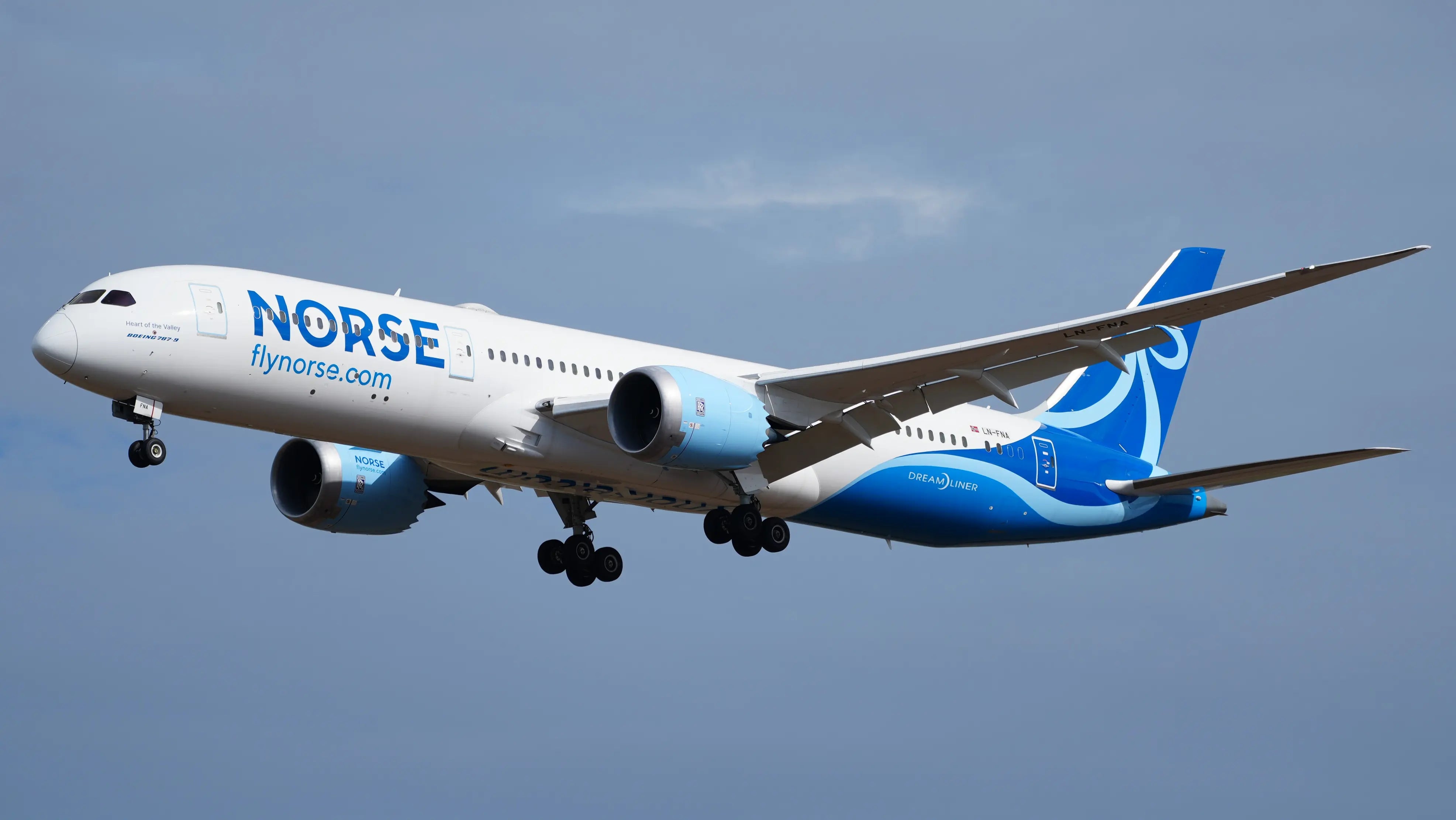
Norse Atlantic operates an exclusively Boeing 787 Dreamliner fleet, a strategic choice that simplifies crew training, maintenance, and operations. As of early 2026, the airline operates 12 Boeing 787-9 aircraft. Three older 787-8 airframes, which had been subleased to external charter operators, were redelivered to the head lessor during Q1 2025, leaving Norse with a uniform 787-9 fleet. All aircraft were originally sourced through AerCap leasing agreements first signed in March 2021 and previously operated by Norwegian Air Shuttle.
The Boeing 787-9 is well suited to Norse's long-haul point-to-point model. With a range exceeding 7,600 nautical miles and fuel efficiency roughly 20% better than previous-generation widebodies, the Dreamliner enables efficient transatlantic service without intermediate stops. Norse configures its 787-9s with approximately 290 seats split between a premium cabin (widely regarded as one of the best premium economy products in the low-cost long-haul segment, according to Skytrax recognition) and a standard economy cabin. The average fleet age of approximately 7.7 years means relatively low maintenance costs and plenty of remaining operational life.
| Aircraft Type | Role | In Service | Notes |
|---|---|---|---|
| Boeing 787-9 Dreamliner | Long-haul widebody | 12 | Core fleet. ~290 seats (Premium + Economy). Fixed-rate leases with ~10 years remaining. Several deployed on ACMI to IndiGo from 2025. |
| Boeing 787-8 Dreamliner | Long-haul widebody | 0 | 3 previously subleased, redelivered to lessor in Q1 2025. Different cabin config from the -9 fleet. |
Fleet data as of early 2026. Numbers reflect aircraft on Norse's operating certificate; several 787-9s are deployed on ACMI contracts.
A significant element of Norse's 2025-2026 strategy is the growing ACMI business. By late 2025, up to six of the twelve 787-9 aircraft were wet-leased to IndiGo and other operators, with the remaining fleet serving scheduled routes. Charter and ACMI flights surged from 71 in 2023 to 608 in 2024, generating USD 37 million in charter revenue alone. This dual model (scheduled + ACMI) provides revenue stability during off-peak periods and reduces the seasonal volatility inherent to transatlantic leisure travel.
Operating a single aircraft type means Norse pilots only need one type rating (Boeing 787). This simplifies career planning considerably: there is no fleet bidding, no type transition process, and no seniority-driven fleet assignment. Every pilot at Norse flies the same aircraft. For new joiners, this means immediate deployment on modern widebody equipment, a significant draw compared to carriers where junior pilots may spend years on narrowbody or regional types before accessing long-haul flying.
Pilot Salary & Compensation Breakdown
Norse Atlantic pilot compensation follows a structured seniority-based scale. The airline's pay package includes a base salary, sector pay (per flight operated), hourly duty pay, and per diem allowances for time spent away from base. Total earnings vary significantly between summer peak and winter off-peak periods due to the seasonal nature of transatlantic leisure demand.
First Officer (F/O) Pay Scale
| Seniority | Base Salary (approx.) | Annual Gross (est.) | Notes |
|---|---|---|---|
| Year 1 (entry) | ~£90,500 | ~£95,000 - £105,000 | Including sector pay, per diems, and hourly duty pay. |
| Year 3-5 | ~£95,000 - £105,000 | ~£105,000 - £120,000 | Progressive annual increments. Summer overtime adds significantly. |
| Senior F/O (5+ yrs) | ~£105,000 - £115,000 | ~£120,000 - £135,000 | Higher earnings during peak summer months (85+ block hours/month). |
Estimates based on pilot employment databases (updated February 2026) and crew reports. Actual figures depend on sector pay, overtime, and seasonal flying volume.
Captain (CPT) Pay Scale
| Seniority | Base Salary (approx.) | Annual Gross (est.) | Notes |
|---|---|---|---|
| Year 1 (new Captain) | ~£143,000 | ~£155,000 - £170,000 | Including all pay components. First year in command. |
| Year 3-5 Captain | ~£150,000 - £160,000 | ~£170,000 - £190,000 | Progressive increments. Peak summer earnings higher. |
| Senior Captain (5+ yrs) | ~£160,000 - £175,000 | ~£185,000 - £210,000 | Includes overtime and maximum per diem accumulation. |
Captain figures are estimates from industry databases. Senior captain earnings can reach £200,000+ with overtime during peak periods.
Additional Pay Components
Beyond base salary, Norse pilots receive several supplementary pay elements. Per diems are set at approximately €80 (roughly £68) per day away from home base, covering meals and incidentals during layovers. Sector pay adds approximately £126 per sector flown for UK-based crew. Hourly duty pay of approximately £5 per hour from check-in to check-out supplements the base rate. Overtime kicks in above 70 block hours per month at elevated premium rates, and during peak summer flying (85+ hours/month), this can meaningfully boost total compensation.
These figures are estimates compiled from pilot employment databases, crew forum reports, and industry benchmarking. Norse Atlantic's compensation sits in the mid-range of European long-haul carriers: competitive within the low-cost long-haul segment but below legacy carriers like British Airways or Lufthansa. The seasonal nature of operations means significant income variation between summer and winter. UK-based pilots are subject to UK income tax. Norwegian-based crew fall under Norwegian tax and social contribution rules. Always verify current rates through BALPA or the airline's recruitment portal.
Roster Pattern & Quality of Life
Norse Atlantic's roster structure reflects the demands of long-haul transatlantic operations within a low-cost framework. All pilots are guaranteed a minimum of 12 days off per month, with the option to request up to 4 additional days off through the CrewConnex scheduling system (subject to operational needs). Rosters are published a minimum of 14 days before the start of each month, giving pilots reasonable advance notice for personal planning.
A typical Norse pilot flies 3-4 transatlantic round trips per month. Eastern US destinations (New York JFK, Orlando) generally allow more trips per month due to shorter flight times, while western US routes (Los Angeles, Las Vegas) require three-crew operations on longer sectors, reducing the number of monthly trips. The airline also operates "W-pattern" scheduling on a voluntary basis: pilots fly one transatlantic trip, return to base for a hotel overnight, then depart on a second trip the following day, creating consolidated 5-6 day work blocks.
📅 Sample Month: First Officer (London Gatwick)
Block hours vary significantly by season. During summer peak (June-September), pilots commonly log 80-85+ hours per month, sometimes pushing into overtime territory above 70 hours. During winter (November-March), monthly block hours can drop to 30-60 hours as the airline reduces capacity on seasonal transatlantic routes. Annual block hour totals average around 700 hours. Standby crew can be called out within 90 minutes, though callouts are reportedly uncommon. Reserve crew receive 10-20 hours of advance notice.
Norse operates from multiple bases: London Gatwick (largest international base), Oslo Gardermoen, and seasonal bases at Rome, Athens, and Paris CDG. The airline positions itself as commuter-friendly, though crew reports suggest roster improvements are still needed to fully support commuting lifestyles. UK-based crew have access to jump-seat commuting agreements with Spirit Airlines, JetBlue, and Allegiant Air for US domestic positioning. Living near London Gatwick offers direct access to the airline's most varied route network.
Benefits, Travel Perks & Pension
As a relatively young airline operating across multiple jurisdictions (Norway and the UK), Norse Atlantic's benefits package is structured differently from legacy carriers. The package is modest by legacy standards but competitive within the low-cost long-haul segment, with particular strengths in staff travel and commuting support.
Norse's staff travel program is genuinely useful for a long-haul carrier. The combination of positive-space passes on Norse itself, ID90 access to a broad network of US and international carriers, and the ability to upgrade to Norse's well-regarded premium cabin for just USD $50 makes personal travel a tangible benefit. Travel partner changes every 6 months add flexibility. The commuting jump-seat agreements with three US carriers are particularly valuable for US-based crew or those with family connections across the Atlantic. Staff travel benefits begin on day one of employment, with full ID90 network access opening after 6 months.
Career Progression & Seniority
Career progression at Norse Atlantic is governed by a conventional airline seniority system, where length of service determines upgrade eligibility, schedule bidding priority, and base selection. However, as a young and growing airline, Norse offers notably faster advancement than established legacy carriers. The combination of fleet expansion, ACMI contract growth, and natural attrition has created regular internal command opportunities since the airline's second year of operations.
Norse does accept direct-entry Captains, which is a significant differentiator from airlines like Air France or Lufthansa where all Captains must be promoted internally. This means experienced pilots with sufficient PIC hours on heavy jets can join Norse directly as Captains, bypassing the First Officer stage entirely. For internal upgrades, crew reports from 2023-2024 indicate that several First Officers received commands within 2-3 years of joining, a pace virtually unheard of at legacy carriers.
| Career Milestone | Typical Timeline | Notes |
|---|---|---|
| Join as First Officer (787) | Day 1 | Immediate widebody assignment. No narrowbody phase. Type rating provided if needed. |
| Line check / operational | 2-3 months | Boeing 787 type rating + line training. Faster if already 787-rated. |
| Internal Captain upgrade | 2-5 years (estimated) | Dependent on seniority position, vacancies, and company growth. Notably fast for a widebody operator. |
| Direct-entry Captain | Day 1 | Requires 2,500h PIC on 50,000+ kg MTOW aircraft and 4,000+ total hours on multi-pilot jets. |
| Training Captain / TRE | Variable | Instructor roles available as airline scales. Training demand is high during expansion phases. |
The seniority system at Norse operates on multiple levels: system seniority (airline-wide ranking), base seniority (ranking within a specific crew base), and seat seniority (Captain vs. First Officer ranking). Since Norse operates a single fleet type, there is no aircraft seniority to manage. More senior pilots receive priority in schedule bidding, base selection, and route preferences. Seniority resets completely for pilots joining from other carriers, regardless of their prior experience or rank.
Norse's rapid scaling from 4 aircraft in 2022 to 12 by 2024 created substantial demand for both new hires and internal promotions. The ACMI expansion with IndiGo adds further crew demand. For pilots joining now, the combination of a growing fleet, frequent Captain vacancies, and no narrowbody waiting period makes Norse an attractive option for building widebody PIC time quickly. The flip side is that as a younger airline, long-term career stability is less proven than at a 50-year-old flag carrier. Pilots should weigh the acceleration opportunity against the inherent uncertainty of a carrier still finding its path to sustained profitability.
Recruitment Process & Requirements
Norse Atlantic recruits both First Officers and Captains through a structured selection process. The airline primarily targets EASA-licensed pilots, though certain other licenses may be considered on a case-by-case basis. Recruitment is handled through the airline's careers portal and industry job boards like Pilot Jobs Network.
Captain Requirements
First Officer Requirements
Selection Stages
Online Application & Screening
Submit application through the Norse careers portal or via partner job boards. CV, license documentation, and flight hour records reviewed. Online behavioral assessment may be conducted before assessment day.
Simulator Assessment
One-hour assessment in Pilot Flying (PF) role and one hour in Pilot Monitoring (PM) role. Exercises include takeoff, SID, radar vectoring, ILS approach, go-around with engine failure, VOR approach, and instrument landing. London Gatwick and Oslo bases use Boeing 737 NG simulators; Paris uses A350 simulators. Focus is on CRM, flight management, and emergency handling rather than pure stick-and-rudder skills.
Behavioral Interview & Group Exercise
Structured interview assessing alignment with Norse's core values: inclusivity, ownership, and kindness. Group-based time-sensitive exercise evaluating decision-making under pressure and teamwork. The airline places significant weight on cultural fit and CRM aptitude.
Medical & Contract
Valid EASA Class 1 Medical required. Successful candidates receive a base assignment and type rating date (if not already 787-rated). Boeing 787 type rating is provided by Norse for selected candidates.
Training Pathways for Aspiring Pilots
Norse has established structured entry pathways through partnerships with flight training organizations. OSM Aviation Academy in Norway offers a 20-24 month "Airline Ready Program" (costing approximately NOK 1,160,000 / USD 115,000), with graduates receiving priority consideration for Norse positions. Leading Edge Aviation offers an integrated pathway through Aurigny Air Services (regional ATR flying) into Norse Atlantic UK's 787 operation after approximately two years.
Norse's simulator assessment uses non-type aircraft (737 NG or A350), so specific 787 experience is not required for the evaluation stage. The airline emphasizes CRM and decision-making over raw handling skills. Crew reports suggest the interview process is straightforward and values genuine personality over rehearsed answers. The airline's emphasis on "inclusivity, ownership, and kindness" as core values is reflected in the interview structure. Preparation should focus on CRM scenarios, threat and error management, and demonstrating collaborative leadership style.
Top 5 Layover Destinations
Long-haul layovers are a defining feature of life at Norse Atlantic. With transatlantic routes spanning the US East Coast, West Coast, and seasonal services to Southeast Asia and South Africa, Norse crew enjoy a diverse range of overnight destinations. Layovers typically last 18-36 hours depending on the route and scheduling, with regulatory rest requirements ensuring adequate recovery time between duties. Hotels are contracted by the airline.
Layover destinations are determined by your roster bid and seniority within your crew base. More senior pilots get priority access to the most popular routes. Under EASA FTL regulations, pilots must have a minimum 10-hour rest opportunity before the next duty period, with 8 hours of uninterrupted sleep. Three-crew operations (required on sectors exceeding approximately 10 hours) result in longer layovers and in-flight rest periods, typically adding to the quality of the layover experience on routes like LA, Bangkok, and Cape Town.
How Norse Atlantic Compares: Airline Radar Chart
How does Norse Atlantic stack up against two comparable long-haul carriers? We compare Norse with Norwegian Air Shuttle (its historical predecessor in the transatlantic LCC space, now operating short-haul only) and Condor (the established German long-haul leisure carrier). Scores are editorial estimates based on publicly available data, crew reports, and industry benchmarks.
Key Takeaways from the Comparison
Norse leads on fleet modernity. Operating exclusively Boeing 787-9 Dreamliners with an average age of 7.7 years, Norse offers one of the youngest and most fuel-efficient widebody fleets in the European long-haul leisure segment. Condor operates a mixed fleet of 787s and older A330s, while Norwegian's current short-haul fleet (737 MAX) is irrelevant to long-haul comparison. The single-fleet advantage simplifies training and career planning for Norse pilots.
Career progression favors Norse. As a young, growing airline, Norse offers significantly faster Captain upgrade timelines (estimated 2-5 years) compared to established carriers. Direct-entry Captain positions are also available. Norwegian (in its current short-haul form) and Condor both operate more established seniority systems with potentially longer upgrade waits.
Job security is Norse's weakest area. The airline has yet to achieve sustained profitability, and its pivot toward ACMI operations introduces uncertainty about the long-term shape of the scheduled network. Norwegian's short-haul operation is now profitable and more stable, while Condor benefits from established market position and Thomas Cook ownership backing. Pilots prioritizing long-term career certainty may find Condor or Norwegian more reassuring.
Condor offers stronger overall compensation and benefits. German labor regulations, Vereinigung Cockpit (VC) union representation, and Condor's longer operational history translate into more comprehensive benefits, higher captain-level pay, and more established working conditions. Norse's compensation is competitive for a startup but trails Condor on total package value.
Scores are editorial estimates based on publicly available salary data, crew forum discussions, airline financial reports, and industry benchmarks. Norwegian Air Shuttle scores reflect its current short-haul European operation (post-2021 restructuring), not its defunct long-haul network. Condor scores reflect its current Boeing 787 and A330 long-haul operation from German bases. Individual experiences vary based on seniority, base, and personal priorities.
Union & Industrial Relations
Norse Atlantic distinguished itself early on by proactively engaging with pilot and cabin crew unions before the airline even began commercial operations. This collaborative approach to labor relations is relatively unusual for a low-cost carrier and has been a defining feature of the airline's employment culture.
Pilot Representation: BALPA
The British Airline Pilots Association (BALPA) announced a formal partnership with Norse Atlantic in September 2021, months before the airline's first flight. BALPA represents UK-based Norse pilots and provides collective bargaining on pay, working conditions, and scheduling. In its announcement, BALPA noted that it was "incredibly impressed" with the company's business plan and described Norse as "a different breed" of employer with "recognition of unions in their DNA." This proactive recognition contrasts sharply with the adversarial union relationships seen at some other low-cost carriers.
Cabin Crew Representation: AFA-CWA
The Association of Flight Attendants-CWA (AFA-CWA) reached a pre-hire agreement with Norse in August 2021, establishing union neutrality and facilitating organizing during the airline's initial hiring phase. AFA-CWA represents Norse cabin crew across all bases and maintains a dedicated website at norseafa.org with contract documents, negotiation updates, and crew resources.
Recent Negotiations & Agreements
Norse Atlantic has not experienced any pilot strikes or major industrial action since its founding. The proactive BALPA partnership and collaborative approach to negotiations suggest a management team that values constructive labor relations. For pilots considering Norse, union membership through BALPA (for UK-based crew) provides collective bargaining protection, grievance resolution support, and professional advocacy. The frequency of Letters of Agreement on specific operational issues (base closures, charter terms, scheduling systems) indicates an active, responsive negotiation process rather than rigid or adversarial dynamics. Norwegian-based crew should verify their specific union representation arrangements.
Verdict: Who Is Norse Atlantic For?
🎯 Our Take
Norse Atlantic Airways occupies a unique niche in European aviation: a dedicated long-haul low-cost carrier operating modern Boeing 787-9 Dreamliners on transatlantic and intercontinental routes. For pilots, Norse offers something genuinely rare: immediate widebody long-haul experience from day one, on a single modern fleet type, with notably fast career progression and direct-entry Captain opportunities.
The trade-offs are equally clear. Compensation sits below legacy carrier levels, the airline has not yet achieved sustained profitability (though the trajectory is improving), and the evolving business model (with increasing ACMI/charter emphasis) introduces uncertainty about the long-term shape of scheduled operations. Seasonal flying creates significant income variation between summer and winter. Benefits are adequate but not lavish compared to flag carriers with decades of union-negotiated packages.
For the right pilot, Norse represents an excellent career accelerator: build widebody PIC hours quickly, gain transatlantic experience across a diverse route network, and benefit from the growth opportunities inherent in a young, scaling airline. For those prioritizing maximum pay, long-term job security, and comprehensive benefits above all else, established legacy carriers remain the safer bet.
1 Does Norse Atlantic provide the Boeing 787 type rating?
Yes. Norse provides the 787 type rating for pilots selected through their recruitment process. Candidates with an existing 787 or 777 type rating have an advantage during selection, but it is not a mandatory prerequisite. The type rating and line training process typically takes 2-3 months from start to operational readiness.
2 Can I join Norse Atlantic as a direct-entry Captain?
Yes. Norse accepts direct-entry Captains, provided they meet the minimum requirements: 2,500 hours as PIC on aircraft exceeding 50,000 kg MTOW and 4,000+ total hours on multi-pilot jet aircraft. This is a significant advantage for experienced pilots seeking a command position without the long upgrade waits typical of legacy carriers.
3 How quickly can I upgrade to Captain at Norse?
Internal upgrade timelines at Norse have been notably fast compared to established carriers. Crew reports from 2023-2024 indicate several First Officers received internal commands within 2-3 years of joining. The pace depends on company growth, ACMI contract expansion, and natural attrition. As the airline stabilizes, upgrade timelines may extend, but Norse's growth trajectory continues to create regular vacancies.
4 Do I need to be an EU/EEA citizen to fly for Norse?
For European bases (London Gatwick, Oslo, Paris, Rome, Athens), unrestricted EU/EEA work rights are required. For the US base (Fort Lauderdale), US C1/D visa eligibility and unrestricted travel to all Norse destination cities are needed. Norse's dual AOC structure (Norwegian + UK) means work rights requirements depend on which AOC and base you are assigned to.
5 Is Norse Atlantic financially stable?
Norse has made significant progress toward profitability. Revenue grew 34% to USD 588.1 million in 2024, passenger numbers rose 49%, and operational cash flow turned positive at USD 55.6 million. The net loss narrowed from USD 168.7 million (2023) to USD 135.5 million (2024). The growing ACMI business with IndiGo provides revenue stability. However, the airline has not yet achieved full-year profitability. Pilots should consider this context when evaluating long-term career security.
6 What is the roster like during winter off-season?
Winter brings a significant reduction in transatlantic demand. Monthly block hours can drop to 30-60 hours (compared to 80-85+ in summer). Norse has mitigated this by launching winter seasonal routes to Bangkok and Cape Town, and by increasing ACMI operations. Some crew may be offered VLLF (Voluntary Leave in Lieu of Furlough) during the lowest-demand months. Income variability between seasons is a real factor pilots should plan for.
7 How does Norse pay compare to British Airways or Virgin Atlantic?
Norse compensation is competitive within the low-cost long-haul segment but sits below legacy carriers. A Norse Captain earns approximately £143,000-£175,000 base salary, while BA and Virgin Atlantic Captains on long-haul widebodies typically earn £150,000-£200,000+ with more comprehensive benefits packages. The gap is most pronounced in pension provision, seniority-based pay progression, and ancillary benefits. Norse compensates partially through faster career progression and immediate widebody access.
8 What bases does Norse operate from, and can I choose my base?
Norse currently operates from London Gatwick (largest base), Oslo, and seasonal bases at Rome Fiumicino, Athens, and Paris CDG. Fort Lauderdale serves as the US base. Base assignment is part of the recruitment process, with seniority influencing base transfer requests over time. London Gatwick offers the widest variety of routes and most consistent year-round flying. Base availability fluctuates with seasonal network changes.
Official Links & Resources
Before applying or making career decisions, always verify information directly with official sources. These are the key websites and organisations relevant to Norse Atlantic pilot careers:
Monitor Pilot Jobs Network and Pilot Career Centre for the latest Norse Atlantic recruitment campaigns and updated compensation data. The PPRuNe Norse Atlantic thread (Professional Pilots Rumour Network) provides candid crew feedback on working conditions, roster realities, and company developments. For formal questions about UK pilot employment terms, contact BALPA directly.