

Iberia Overview & Company Profile
Iberia (Iberia, Lineas Aereas de Espana) is the flag carrier of Spain and one of Europe's oldest airlines, founded on June 28, 1927. Headquartered in Madrid, the airline operates its primary hub at Adolfo Suarez Madrid-Barajas Airport (MAD), where it accounts for approximately 60% of overall airport traffic. As a subsidiary of International Airlines Group (IAG), Iberia sits alongside British Airways, Vueling, Aer Lingus, and LEVEL within one of the world's largest aviation holding companies.
Iberia is a founding member of the Oneworld alliance, connecting its passengers to a global network that includes American Airlines, Japan Airlines, Qatar Airways, Cathay Pacific, and others. The airline serves over 145 destinations across Europe, Latin America, North America, Africa, the Middle East, and Asia, with a particular strategic focus on the Europe-Latin America corridor where it holds market leadership. In 2025, Iberia delivered a record 16.2% operating margin, making it one of the strongest performers within the IAG group.
With approximately 1,400 pilots on its mainline seniority list and active recruitment campaigns to support its ambitious Flight Plan 2030 growth strategy, Iberia is investing €6 billion into fleet renewal, network expansion, and operational modernization. This plan includes growing the long-haul fleet from 48 to 70 aircraft, launching new transatlantic routes, and introducing next-generation aircraft like the Airbus A321XLR.
Fleet Composition & Type Ratings
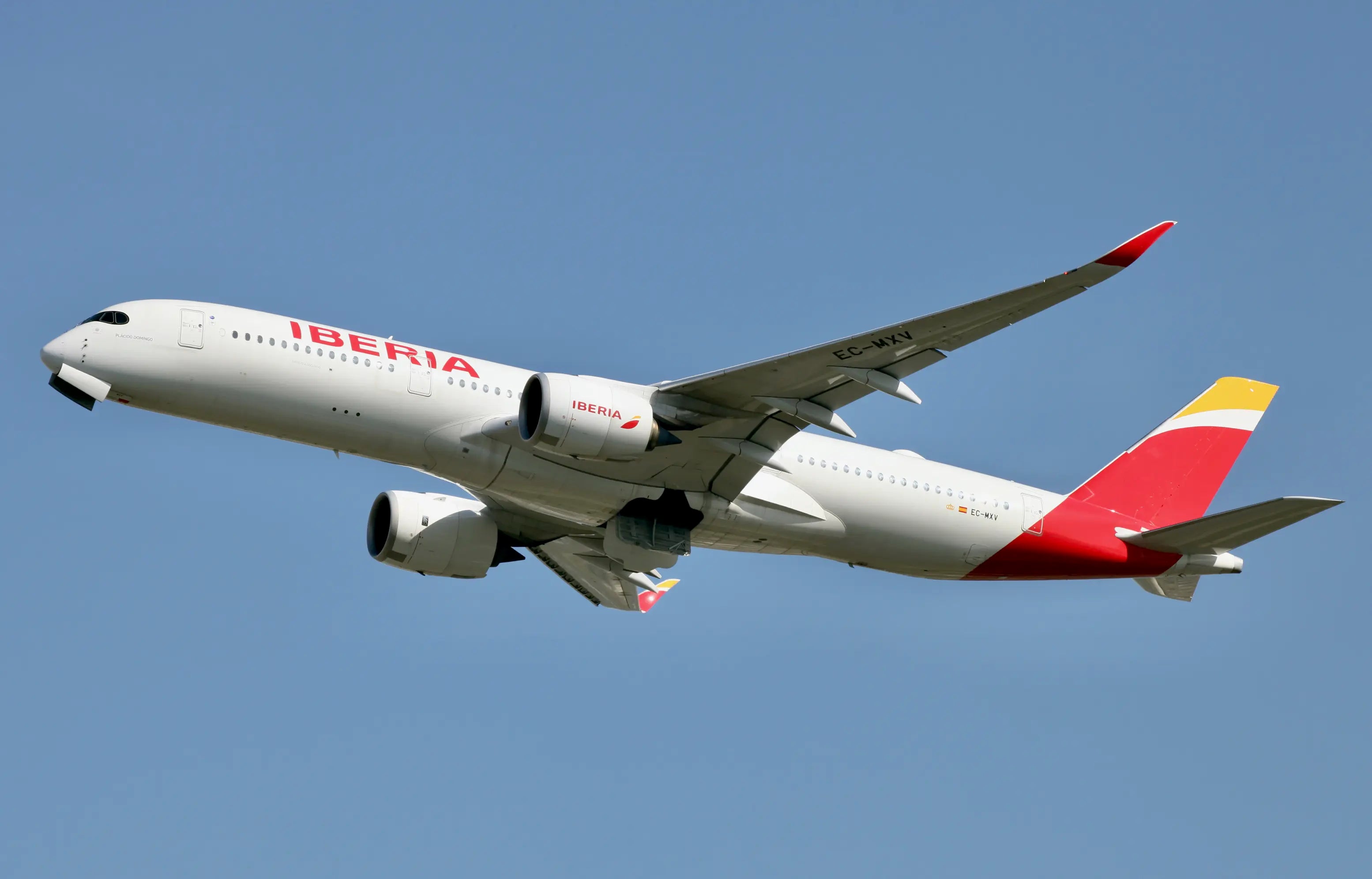
Iberia operates an all-Airbus fleet with an average age of just 9.7 years, one of the youngest among European legacy carriers. The fleet is currently undergoing a major renewal driven by Flight Plan 2030, with the Airbus A350-900 and the revolutionary A321XLR leading the modernization effort. The airline received worldwide launch customer status for the A321XLR in November 2024, positioning it at the forefront of next-generation narrowbody long-haul operations.
| Aircraft Type | Role | In Service | Routes / Notes |
|---|---|---|---|
| Airbus A350-900 | Widebody | 23 | Flagship long-haul. Buenos Aires, New York, Tokyo, Sao Paulo. 8 more on order + 31 options. |
| Airbus A330-200 | Widebody | 12 | Long-haul. Caribbean, Latin America, select North America. 19 options for A330-900 replacement. |
| Airbus A330-300 | Widebody | 8 | Long-haul. High-density Latin American routes. 21 firm A330-900 orders + 29 options. |
| Airbus A321XLR | Extended-range narrowbody | 7 | Launch customer. Transatlantic routes: Recife, Fortaleza, Toronto. 1 more on order + 14 options. 182 seats. |
| Airbus A321 | Narrowbody | 14 | High-capacity European & domestic routes. |
| Airbus A320neo | Narrowbody | 21 | European short/medium-haul. 8 more on order. Fuel-efficient replacement for older A320s. |
| Airbus A320 | Narrowbody | 11 | European & domestic. Being progressively replaced by A320neo. |
| Airbus A319 | Narrowbody | ~3 | Smallest mainline type. Being phased out. |
Fleet data as of December 2025. Numbers are approximate and change with ongoing deliveries and retirements. Source: Planespotters.net, Wikipedia.
In addition to the mainline fleet, Iberia Express operates 25 aircraft (13 A320-200 and 12 A321neo) on European leisure and domestic routes, with 5 more A321neo on order. The regional subsidiary Air Nostrum (branded as Iberia Regional) operates a separate fleet of CRJ and ATR turboprop aircraft on feeder routes.
The Airbus A321XLR is transforming Iberia's network strategy. With a range of 7,500 km, it enables profitable operations on transatlantic routes that would not fill a widebody aircraft, burning over 40% less fuel than traditional widebody models. Iberia is using the A321XLR to open new routes to Brazilian cities (Recife, Fortaleza), Toronto, and potentially other mid-range transatlantic destinations. For pilots, this creates a unique fleet category: single-aisle aircraft operating long-haul schedules with layovers, combining narrowbody type ratings with widebody-style trip patterns.
Pilot Salary & Compensation Breakdown
Iberia pilot salaries are governed by the 10th Collective Bargaining Agreement (X Convenio Colectivo) negotiated with SEPLA (Sindicato Espanol de Pilotos de Lineas Aereas), ratified in October 2023 and extended through December 31, 2027. The agreement includes a minimum 10% wage increase and innovative profit-sharing mechanisms tied to airline performance, punctuality, customer satisfaction (NPS), and productivity metrics.
First Officer (Copiloto) Pay Scale
| Seniority | Annual Gross (est.) | Notes |
|---|---|---|
| Year 1 (entry) | ~€40,000 - €45,000 | Entry-level base ~€2,400/month + allowances |
| Year 3-5 | ~€55,000 - €65,000 | Seniority increments + full per diem earnings |
| Year 7-10 | ~€65,000 - €80,000 | Approaching top of F/O scale. Widebody transition possible. |
| Senior F/O (long-haul) | ~€75,000 - €90,000 | A350/A330 long-haul assignments with higher per diems |
Estimates include base salary, flight pay, and standard allowances. Actual figures depend on aircraft type, flight hours logged, and collective agreement steps.
Captain (Comandante) Pay Scale
| Seniority | Annual Gross (est.) | Notes |
|---|---|---|
| Entry Captain (short/med-haul) | ~€90,000 - €110,000 | A320/A321 European operations |
| Captain, 5+ yrs (widebody) | ~€120,000 - €150,000 | A330/A350 long-haul with layover per diems |
| Senior Captain (A350 long-haul) | ~€150,000 - €210,000 | Top of scale. Includes profit sharing, per diems, overtime. |
Long-haul widebody Captains at the top of the scale can approach €200,000+ when all compensation components are included. Spanish income tax rates (up to 47%) apply.
These figures are estimates compiled from multiple public sources including industry salary surveys (EasyEASA, GrupoOneAir), pilot forums, and SEPLA publications. Actual compensation depends on the latest collective agreement steps, individual seniority, aircraft type assignment, and flight hours logged each month. The 10th Convenio Colectivo introduced a minimum 10% wage increase and performance-based profit sharing, which may further boost total compensation. Per diem allowances (€35-€85/day depending on destination) are tax-free and can add €8,000-€15,000 annually for active long-haul pilots. Always verify with the latest official SEPLA documentation.
Roster Pattern & Quality of Life
Iberia pilots operate under EASA Flight Time Limitations (FTL) as implemented by the Spanish aviation authority AESA, combined with specific provisions from the SEPLA collective agreement. The roster system is randomized (variable pattern), with schedule bids influenced by seniority. The recent collective agreement extension includes provisions aimed at improving quality of life and scheduling balance for pilots.
📅 Sample Month: Medium-Haul First Officer (MAD)
Long-haul crews operate on different patterns: a typical rotation to Buenos Aires or New York involves 2-4 days of flying with layovers at destination, followed by 3-5 recovery days off. Augmented crews (3-4 pilots) are used on ultra-long-haul sectors like Madrid-Buenos Aires or Madrid-Tokyo, allowing in-flight rest. The A321XLR introduces a new dynamic: transatlantic flights on a narrowbody with standard two-pilot crews on routes under 9 hours.
Virtually all Iberia mainline pilots are based at Madrid-Barajas Airport (MAD). Unlike some US carriers with multiple base options, Iberia operates a single-hub model. This means living in or commuting to the Madrid metropolitan area is essentially required. The cost of living in Madrid is considerably lower than Paris, London, or Zurich, making it one of the more affordable European capital cities for airline pilots. The city offers excellent public transport, a high quality of life, and a vibrant social scene. Madrid's central geographic position also makes it an efficient hub for both European and transatlantic operations.
Benefits, Travel Perks & Retirement
As a legacy flag carrier operating under Spanish labor law, Iberia provides a comprehensive benefits package. The combination of Spain's statutory employee protections, the SEPLA collective agreement, and airline-specific perks creates a package that often compensates for the salary gap versus northern European or Gulf carriers.
Spain's labor code provides some of Europe's strongest employee protections. Pilots benefit from 16 weeks of fully paid paternity leave (one of the highest in the world), strong dismissal protections, mandatory social security contributions funding public healthcare and state pension, and a legal framework that makes involuntary furloughs significantly more difficult than in the UK or US. Combined with Iberia's IAG-backed financial stability, this creates a level of job security that is difficult to match at smaller carriers.
Career Progression & Seniority
Career progression at Iberia is governed by a formal seniority system. Fleet assignments, aircraft transitions, and advancement from First Officer to Captain all depend on your position in the seniority list. The 10th Collective Agreement explicitly commits Iberia to providing 140 command promotions for mainline pilots (excluding Iberia Express and positions created by new aircraft arrivals), giving pilots concrete visibility on upgrade timelines.
Iberia does accept direct-entry First Officers with prior experience, unlike some European carriers that only recruit through cadet pathways. The airline also operates the Iberia Cadetes program for candidates with minimal or no flight experience. Both pathways feed into the same seniority list.
| Career Milestone | Typical Timeline | Notes |
|---|---|---|
| Iberia Cadetes training | ~24 months | Ab-initio via FTEJerez. ~50% company-financed, interest-free loan. |
| Join as F/O (A320 family) | Day 1 post-training | Most common entry fleet. A320/A320neo/A321 short & medium-haul. |
| Widebody F/O transition | 5-8 years | A330 or A350. Seniority-based bid. |
| A321XLR assignment | Variable | New fleet category. Narrowbody type rating with long-haul schedules. |
| Captain upgrade (short/med-haul) | ~10-15 years | Seniority-dependent. Command assessment required. |
| Captain on widebody (A350/A330) | 15-20+ years | Top of seniority list. Highest earning potential. |
Iberia's Flight Plan 2030 is a €6 billion investment strategy that plans to grow the long-haul fleet from 48 to 70 aircraft. This means significant new Captain and First Officer positions will be created over the coming years. In 2025-2026 alone, the airline launched new routes to Toronto, Newark, Philadelphia, Monterrey, Orlando, Fortaleza, and Recife. For pilots joining now, this growth trajectory could meaningfully accelerate upgrade timelines compared to previous decades. The 10th Collective Agreement's guarantee of 140 command promotions provides a contractual floor for career advancement.
Recruitment Process & Requirements
Iberia recruits pilots through two distinct pathways: the Direct Entry stream for experienced pilots and the Iberia Cadetes program for ab-initio candidates. Both pathways are managed through the Iberia pilot recruitment portal. In January 2026, Iberia launched a new recruitment call specifically targeting entry-level pilots based in Madrid to support Flight Plan 2030 growth.
Direct Entry First Officer: Requirements
Iberia Cadetes Programme
Selection Stages (Direct Entry)
Online Application & Screening
Submit application through the Iberia pilot recruitment portal with all supporting documentation. Initial eligibility screening against license, hours, language, and legal requirements. Preselected candidates receive email notification with assessment dates.
Psychometric & Aptitude Testing
Computer-based assessment evaluating cognitive capabilities, spatial reasoning, multitasking, and stress management. Tests are conducted in groups on a staggered basis according to airline recruitment needs.
Simulator Assessment
Simulator-based evaluation of basic aircraft handling, crew coordination, and decision-making in multi-crew environments. Assesses technical competency and CRM skills under operational pressure.
Interview & Final Selection
Panel interview assessing communication skills, motivation, safety-consciousness, and cultural fit. Successful candidates receive a conditional offer pending medical and background checks.
Medical & Type Rating
Valid Class 1 medical confirmed. Successful candidates proceed to company-funded type rating on their assigned aircraft (typically A320 family) and line training before entering operational service.
Spanish language fluency is essential. Unlike some European carriers where English alone suffices, Iberia requires ICAO Level 5 Spanish, which means near-native fluency. Internal communications, briefings, and company culture are conducted in Spanish. The Iberia Cadetes program has successfully integrated 51 pilots from previous editions, with the 5th edition selecting 12 new candidates in 2025 for training beginning September 2025. For direct entry candidates, positions are advertised on the Iberia careers portal on a rolling basis aligned with fleet expansion needs.
Top 5 Layover Destinations
Iberia's strategic position as Europe's leading carrier to Latin America creates some of the most desirable long-haul layover destinations in the industry. The airline operates up to 3 daily flights to Buenos Aires, 2 daily to Sao Paulo, 2 daily to Miami, and 2 daily to New York JFK, alongside daily services to Bogota, Lima, Mexico City, Havana, and many more. Layovers typically last 24-48 hours on standard rotations, with hotels contracted by the airline.
All crew hotels are contracted by the airline. Transport between hotel and airport is provided. Under EASA Flight Time Limitations, pilots must have a minimum 10-hour rest opportunity before the next duty period. Long-haul flights over 11 hours require augmented crews (3-4 pilots), and layovers are typically 24 hours minimum. Layover destinations are determined by your roster and seniority-based bidding. More senior pilots get first pick of the most popular routes.
How Iberia Compares: Airline Radar Chart
How does Iberia stack up against its closest Iberian Peninsula competitors, Vueling (IAG low-cost subsidiary) and TAP Air Portugal (Portuguese flag carrier)? Below is a comparative analysis across five key metrics relevant to pilot career decisions.
Key Takeaways from the Comparison
Iberia leads on fleet, job security, and compensation. With a 9.7-year average fleet age, A321XLR launch customer status, and active A350 fleet renewal, Iberia operates one of Europe's most modern fleets. IAG's financial backing and Flight Plan 2030's €6 billion investment provide stability that neither Vueling nor TAP can match. Iberia Captains earn significantly more than their counterparts at both competitors.
Vueling offers faster Captain upgrades but at a cost. Vueling is often described as a "training airline" where First Officers can upgrade to Captain more quickly than at Iberia. However, Vueling First Officers earn €40,000-€70,000 (vs. up to €90,000 at Iberia), Captains earn €70,000-€115,000 (vs. up to €210,000 at Iberia for long-haul), and quality of life is frequently cited as challenging due to extended periods away from home base and roster unpredictability.
TAP Air Portugal offers similar long-haul flying but with financial uncertainty. TAP operates a comparable fleet mix (A330neo, A321LR) and Latin American network (Brazil, Africa), with Captain salaries reaching €80,000-€170,000. However, TAP's recent financial restructuring and government ownership changes create employment uncertainty. TAP per diems for Captains reportedly reach €70/day net of tax.
Scores are editorial estimates based on publicly available salary data, pilot forum discussions, union publications, airline press releases, and industry benchmarks (EasyEASA, ECA, IFALPA). They represent a general assessment for an experienced pilot evaluating long-term career options. Individual experiences will vary based on seniority, fleet assignment, and personal priorities.
Union & Industrial Relations
The Sindicato Espanol de Pilotos de Lineas Aereas (SEPLA) is the primary collective bargaining organization for Iberia pilots. Founded in 1965, SEPLA represents more than 7,300 pilots across all airlines based in Spain, including passenger transport, aerial work, and helicopter operations. SEPLA's mission is the protection and development of working conditions and professional standards for its pilot members.
SEPLA Structure & Governance
Recent Negotiations & Key Developments
Iberia's mainline pilot relations have been constructive and stable in recent years. The 10th Convenio Colectivo was ratified with strong majority support, and its 2026 extension demonstrates a mature, partnership-oriented relationship between SEPLA-Iberia and airline management. The profit-sharing innovation aligns pilot interests with company performance in a way that benefits both sides. Note that conditions at Iberia's subsidiaries (Iberia Express, Air Nostrum) are governed by separate agreements and may differ significantly. For mainline Iberia pilots, union membership through SEPLA provides strong collective representation, access to legal support, and participation in shaping the industry's future at European and global levels.
Verdict: Who Is Iberia For?
🎯 Our Take
Iberia is one of the strongest legacy carrier opportunities in Southern Europe. The combination of a modern all-Airbus fleet (including A321XLR launch customer status), IAG's financial stability, Europe's richest Latin American route network, strong Spanish labor protections, and a €6 billion growth plan makes it an excellent long-term career choice for pilots who speak Spanish fluently.
The trade-offs are real: entry-level compensation is lower than at northern European carriers like Lufthansa or British Airways, the single Madrid base limits geographic flexibility, and the seniority-based system means Captain upgrade can take 10-15 years. Spanish income tax rates (up to 47%) reduce take-home pay further. However, Madrid's relatively affordable cost of living, Spain's generous parental leave (16 weeks for both parents), and the sheer volume of interesting long-haul destinations partially offset these considerations.
For Spanish-speaking pilots with a long-term perspective, Iberia offers something rare: a growing airline with genuine career advancement opportunities, diversified flying from European short-haul to transatlantic widebody operations, and the backing of one of the world's largest aviation groups.
1 Do I need to speak Spanish to fly for Iberia?
Yes. Iberia requires ICAO Level 5 Spanish (near-native fluency) for all pilot positions. Internal communications, company culture, briefings, and crew coordination are conducted in Spanish. English ICAO Level 4 is also required for international operations. There is no English-only pathway at Iberia.
2 Does Iberia pay for the type rating?
Yes. For pilots recruited through the official selection process (both direct entry and cadet pathways), Iberia covers the cost of type rating training. Cadets receive approximately 50% financing of their ab-initio training costs through an interest-free loan, with the remaining training supervised by Iberia at FTEJerez.
3 How long does it take to upgrade to Captain at Iberia?
Captain upgrade at Iberia typically takes 10-15 years depending on seniority, fleet expansion, and retirement waves. The 10th Collective Agreement guarantees 140 command promotions for mainline pilots, providing concrete visibility on advancement timelines. Flight Plan 2030's expansion (growing long-haul fleet from 48 to 70 aircraft) should create additional upgrade opportunities in the late 2020s.
4 Can non-EU citizens apply to Iberia?
No. Iberia requires applicants to hold an EU passport with no travel restrictions. This is stated explicitly in the eligibility requirements for both direct entry and cadet pilot selections. There is currently no work permit or sponsorship pathway for non-EU citizens.
5 What is the relationship between Iberia and Iberia Express for pilots?
Iberia Express is Iberia's low-cost subsidiary operating European leisure and domestic routes from Madrid with A320 and A321neo aircraft. Iberia Express has its own separate pilot seniority list, collective agreement, and pay scales. Pilots are not automatically interchangeable between the two operations. However, Iberia Express experience is valued for subsequent mainline Iberia applications, and some career pathway arrangements may exist under the broader IAG structure.
6 How does Iberia pilot pay compare to British Airways?
British Airways generally offers higher gross compensation, with long-haul Captains earning £115,000-£168,000 (~€135,000-€200,000) compared to Iberia's €90,000-€210,000 range. However, Madrid's significantly lower cost of living, Spain's generous parental leave, and Iberia's modern fleet partially offset the salary difference. Spanish social contributions are lower than French but higher than British, and income tax rates are broadly comparable at the top end.
7 What is the Iberia Cadetes program?
The Iberia Cadetes program is an ab-initio training partnership with FTEJerez (Flight Training Europe) in Jerez de la Frontera, Spain. It selects approximately 12 candidates per edition for a ~24-month integrated ATPL training program. Iberia finances approximately 50% of training costs through an interest-free loan. Upon completion, Iberia commits to facilitating integration into the Iberia Group. To date, 51 pilots have been successfully integrated from previous editions. The 5th edition launched in 2025.
8 Is Iberia financially stable?
Yes. Iberia delivered a record 16.2% operating margin in 2025, making it one of the strongest performers within the IAG group (which also owns British Airways, Vueling, and Aer Lingus). The airline's €6 billion Flight Plan 2030 investment, active fleet renewal, and expanding route network all signal strong financial health and growth ambitions. IAG's diversified portfolio provides additional financial resilience beyond any single subsidiary's performance.
Official Links & Resources
Before applying or making career decisions, always verify information directly with official sources. These are the key websites and organizations relevant to Iberia pilot careers:
Bookmark the SEPLA website (sepla.es) for the latest collective agreement updates and pilot-specific news across all Spanish airlines. For recruitment updates, check the Iberia careers portal regularly, as new pilot campaigns are launched on a rolling basis aligned with fleet expansion needs.