

flyadeal Overview & Company Profile
flyadeal (IATA: F3, ICAO: FAD, callsign "Adeal") is the low-cost arm of the Saudia Group, the state-owned aviation group built around Saudi Arabian Airlines (Saudia). The carrier was announced on 17 April 2016 and operated its maiden commercial flight on 23 September 2017, fittingly on Saudi National Day, from Jeddah to Riyadh. In under a decade it has grown from a handful of leased aircraft into one of the fastest-expanding budget airlines in the Gulf, carrying 10.7 million passengers in 2025, a year-on-year increase of roughly 33% and the first time the airline crossed the ten-million mark.
Headquartered in Jeddah, flyadeal runs a point-to-point, single-fleet model across the Kingdom and an expanding ring of regional international routes. By the end of 2025 it served around 43 scheduled destinations in 17 countries over 159 routes, operating roughly 200 flights per day from its three established bases at Jeddah (JED), Riyadh (RUH) and Dammam (DMM), with Madinah (MED) added as a fourth operational base from 1 January 2026. The airline is led by CEO Steven Greenway, appointed in January 2024, and employed more than 1,800 people by the close of 2025.
For pilots, the most important part of the flyadeal story is its trajectory rather than its current size. The airline is a direct instrument of Saudi Vision 2030, the national plan to triple aviation capacity and diversify the economy away from oil. Backed by the financial strength of Saudia Group, flyadeal has publicly committed to reaching around 100 aircraft and more than 100 destinations by 2030. That growth underpins structurally strong demand for flight crew, fast command opportunities, and a steady pipeline of new aircraft. The trade-offs are equally real: an intense short-haul operation, a labour environment with no pilot unions, and a benefits package that is competitive for the low-cost segment rather than at the top of the Gulf market.
flyadeal is a separate legal entity with its own management and contracts, but its fleet orders, training capacity, and long-term prospects are coordinated at Saudia Group level. This dual identity matters for pilots: you are employed by flyadeal, yet your career sits inside a state-backed group whose growth is tied to national policy. That backing is a meaningful source of stability in a region where some private start-ups have struggled, though it does not translate into the unionised job protections found in Europe or North America.
Fleet Composition & Type Ratings
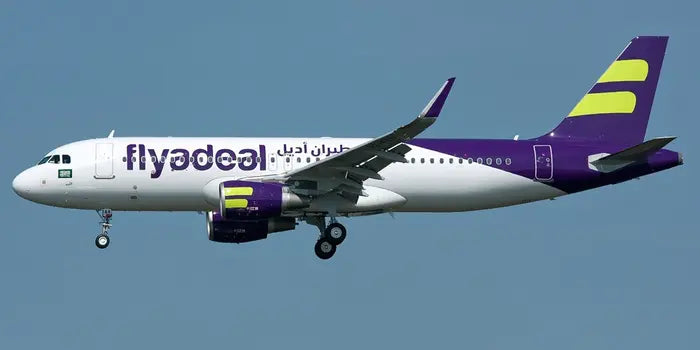
flyadeal flies an all-Airbus A320 family fleet, the classic low-cost recipe of one common type rating, high seat density, and quick turnarounds. The airline launched with leased A320ceo aircraft and has since pivoted heavily toward the more fuel-efficient A320neo. A fleet snapshot compiled from Cirium data in early January 2026 listed roughly 11 A320ceo and 33 A320neo in the operating fleet, with the airline itself describing a fleet of around 44 A320-family jets at the end of 2025. A small number of widebodies (A330s and a Boeing 777) have appeared in flyadeal colours via wet-lease arrangements to cover peak and pilgrimage demand, but they are not part of the core in-house operation.
The next phase of the fleet plan reshapes what a flyadeal career looks like. In May 2024, at the Future Aviation Forum in Riyadh, the airline confirmed an order for 51 Airbus narrowbodies (12 A320neo and 39 A321neo) as part of a wider Saudia Group order for 105 A320neo-family aircraft. The heavy weighting toward the larger A321neo signals an upgauging strategy on dense trunk routes. First A321neo deliveries are scheduled from 2026, which will give pilots more variation within the same type rating. The airline has stated this order positions it to roughly triple in size to more than 100 aircraft by 2030.
A further development extends flyadeal beyond pure short-haul. Saudia Group placed an order in April 2025 for 10 Airbus A330-900neo widebodies allocated to flyadeal, with the first aircraft targeted for delivery around July 2027 and long-haul scheduled services planned from 2027 onward. Specific route pairs have not yet been published. For First Officers and Captains, the A330neo introduction is significant: it opens the prospect of widebody flying within a carrier that has, until now, been a narrowbody-only operator, broadening the long-term career ceiling.
| Aircraft Type | Role | Status | Notes |
|---|---|---|---|
| Airbus A320ceo | Narrowbody | ~11 in service | Original launch type. Gradually being supplemented by neo deliveries. |
| Airbus A320neo | Narrowbody | ~33 in service | Current backbone of the fleet. Lower fuel burn and noise. |
| Airbus A321neo | Narrowbody | On order (12+39 deal) | Deliveries from 2026. Upgauge for high-demand trunk routes. |
| Airbus A330-900neo | Widebody | 10 on order | Allocated via Saudia Group. First delivery ~July 2027 for long-haul. |
| Airbus A330 / Boeing 777 | Widebody | Wet-lease (seasonal) | Used to cover peak and pilgrimage demand. Not core in-house flying. |
Fleet figures are approximate and reflect a Cirium-based snapshot from early 2026 plus airline statements. Numbers shift continually with new deliveries and lease returns.
The common A320 family type rating means pilots can be rostered across the A320ceo, A320neo, and (from 2026) A321neo with minimal differences training. Recruitment listings indicate flyadeal provides the A320 type rating for selected non-type-rated First Officers as part of employment. As is standard across the Gulf, company-funded type ratings are commonly tied to a service bond, so applicants should confirm the bond length and any pro-rata repayment terms in writing before signing. Type-rated and experienced applicants are recruited directly onto the line.
Pilot Salary & Compensation Breakdown
flyadeal does not publish official pay scales, so the figures below are compiled from recruitment-agency packages, pilot forum reports, and salary-aggregator data. They should be read as indicative ranges, not certified scales. The headline advantage is structural: salaries in Saudi Arabia carry no personal income tax, so the gross figure is effectively the take-home figure for the individual, subject only to minor deductions. Pay follows the regional modular model, combining a fixed monthly basic, several allowances, and variable flight pay tied to block hours.
Indicative Monthly Package: First Officer vs Captain
| Rank | Fixed Monthly (SAR) | Flight Pay | Typical Gross / Month | Annual Gross (est.) |
|---|---|---|---|---|
| First Officer (A320) | ~20,000 – 25,000 | Tiered hourly | ~SAR 23,000 – 25,000 | ~SAR 280,000 – 300,000 |
| Captain (A320) | ~39,000 | SAR 100 – 500 / hr | ~SAR 55,000 | ~SAR 600,000 – 680,000 |
First Officer figures are derived from salary-aggregator self-reports (roughly SAR 279,000–302,000 per year). Captain figures are from a circulating agency package. All amounts are tax-free in Saudi Arabia. At the SAR-USD peg (~3.75), a typical Captain gross of SAR 55,000 is around USD 14,700 per month.
Captain Package Component Breakdown
| Component | Monthly (SAR) | Notes |
|---|---|---|
| Basic salary | 26,625 | Fixed, rank-based. |
| Monthly / duty allowance | 5,625 | Fixed. |
| Housing allowance | 3,750 | Cash, or company-provided housing in some cases. |
| Transport allowance | 1,000 | Cash, or company transport. |
| Travel allowance | 2,000 | Fixed. |
| Fixed subtotal | ~39,000 | Before any flight pay. |
| Flight pay (variable) | 100 – 500 / hr | Tiered: ~SAR 100/hr for the first 25 block hours, rising to ~SAR 500/hr beyond 76 hours. |
Reported A320 Captain package from recruitment sources. The tiered flight pay rewards higher monthly utilisation, lifting typical gross toward SAR 55,000.
Two practical caveats follow from this structure. First, the flight-pay tiers mean monthly income is sensitive to roster intensity: a light month earns far less per hour than a heavy one. Second, the housing allowance is modest relative to actual rents in Riyadh and Jeddah. One Riyadh-based pilot reported spending close to SAR 10,000 on accommodation against a SAR 3,750 housing allowance, so the headline package can be eroded by living costs if company housing is not provided. Comparable A320 Captain pay is detailed on recruitment platforms such as PilotsGlobal, which is a useful cross-reference when evaluating an offer.
flyadeal publishes no official pilot pay scale. The numbers above come from third-party recruitment packages, pilot forums (PPRuNe), and salary aggregators (Glassdoor), and they vary by experience, contract type, nationality, and the hiring cycle. Treat them as a starting point for negotiation rather than guaranteed figures. Always confirm basic salary, allowance levels, flight-pay tiers, housing arrangement, and any type-rating bond directly in your written offer before committing.
Roster Pattern & Quality of Life
As a short-haul low-cost carrier, flyadeal builds rosters around high aircraft utilisation. A typical duty day involves two to four domestic sectors, for example a Jeddah-Riyadh-Jeddah pairing or a run down to Abha, Jizan, or Tabuk and back, with sector lengths usually between one and three hours. The defining quality-of-life feature is that most duties begin and end at the pilot's base, so overnights away from home are relatively rare compared with long-haul flying, and chronic jet lag is largely absent. The flip side is workload: repeated takeoffs, landings, and tight turnarounds across multiple Saudi airports make for cognitively demanding days, especially when rosters cluster early starts or late finishes.
Pilot forum reports indicate flyadeal uses a rotating roster, commonly described as a 20-on / 10-off pattern after line release, with average monthly block hours in the region of 70 to 85 hours. Annual leave aligns with Saudi labour norms, typically around 30 days per year for flight crew. Rostering is shaped by the flight and duty time limitations set by the General Authority of Civil Aviation (GACA), which draw on ICAO-based fatigue principles. Exact GACA caps should always be checked against current regulation, but typical limits in comparable regimes sit near 100 flight hours in any 28-day period and around 1,000 hours per year, with minimum rest periods and duty-length limits scaled by reporting time and sector count.
📅 Illustrative Month — Domestic A320 First Officer (Riyadh base)
Illustrative only. flyadeal does not publish detailed roster data; this grid reflects reported 20/10-style patterns and typical short-haul LCC duty density, not an official schedule.
flyadeal is base-centric: pilots are expected to live near their assigned base in Jeddah, Riyadh, Dammam, or now Madinah, rather than commuting from abroad on a formal basis. Informal self-commuting exists but carries the usual risks if operations are disrupted. New joiners are assigned a base on operational need, and transfers depend on staffing levels. Because the network is predominantly domestic, the lifestyle pay-off is stability: pilots generally sleep at home most nights, which suits those prioritising family routine over the long layovers of a legacy carrier. The cost is a high-tempo, productivity-focused operation with limited variety in the type of flying, at least until the A330neo long-haul operation begins.
Benefits, Allowances & End-of-Service
flyadeal's non-salary package follows the Saudi and broader Gulf template: a mix of cash allowances, statutory labour-law entitlements, and group travel perks. As a low-cost subsidiary, its benefits are generally leaner than those of full-service Gulf legacy carriers, with the emphasis on tax-free monthly cash rather than expansive expatriate perks such as full international schooling. The most distinctive advantage is the connection to the wider Saudia Group network through staff travel.
The end-of-service gratuity is the closest thing to a structured long-term benefit. Under Saudi Labour Law, employees accrue a lump-sum award on completion of service, calculated from final basic salary and tenure, with the precise formula differing between resignation and contract completion. For a pilot who stays several years, this can become a meaningful payout, but it is not a substitute for a conventional pension. Expatriate pilots in particular should plan their own retirement saving, since they do not build state pension entitlement in the Kingdom. Saudi nationals contribute to and benefit from the General Organization for Social Insurance (GOSI) system.
Family considerations deserve careful scrutiny before signing. International-school fees in Jeddah and Riyadh are high, and a low-cost subsidiary is less likely than a flag carrier to fund them generously. Dependent medical coverage, family visa status, and any schooling support vary by contract and should be confirmed line by line. On the positive side, social and lifestyle options in Saudi cities have expanded rapidly under the Vision 2030 reforms, and the staff-travel access to Saudia's intercontinental network is a genuinely valuable perk for pilots and families who travel.
The tax-free gross is attractive, but its real value depends on whether housing is paid in cash or provided, how dependent medical cover is structured, and what the end-of-service formula looks like for your contract type. Because there is no union-negotiated agreement to fall back on, the written individual contract is the only thing that binds the employer. Pilots relocating with families should budget independently for schooling and premium housing rather than assuming allowances will cover them.
Career Progression & Upgrade Path
Career progression at flyadeal is driven by fleet growth more than by a fixed seniority ladder. An airline planning to expand from roughly 44 aircraft to around 100 by 2030, while introducing both the A321neo and the A330neo, must continually create new Captain seats, instructor roles, and management positions. For capable First Officers, this is one of the strongest arguments in flyadeal's favour: command opportunities tend to appear faster at a rapidly scaling carrier than at a mature, slow-growth legacy airline.
Unlike strictly internal carriers, flyadeal also recruits Direct Entry Captains (DECs) from the external market to fill command capacity that the internal First Officer pool cannot yet supply. That keeps the expansion on track but can be a point of friction for internal pilots aiming for upgrade, which makes transparent promotion criteria important. Industry norms for narrowbody command typically require something in the order of 3,000 to 4,000 total hours with a substantial portion on type, and at a fast-growing LCC a motivated First Officer could realistically reach command consideration within roughly five to seven years, depending on prior experience and the pace of deliveries. These timelines are sensitive to external shocks and should be treated as indicative rather than promised.
| Career Milestone | Typical Timeline | Notes |
|---|---|---|
| Cadet training (cadet path) | ~24 months | Government-backed Saudi scholarship scheme. See Section 08. |
| Join as A320 First Officer | Day 1 (post type rating) | Type rating provided for selected non-type-rated hires; bonds may apply. |
| Command consideration | ~5 – 7 years | Growth-dependent. Faster than typical legacy timelines. |
| Direct Entry Captain | On joining | External hires with A320 command experience meeting minimums. |
| A321neo transition | From 2026 | Same type rating; differences within the A320 family. |
| A330neo widebody (future) | From 2027 | New long-haul fleet broadens the career ceiling. |
flyadeal headcount passed 1,800 by the end of 2025 and is targeted to grow substantially through 2030, with new aircraft arriving at a pace of close to one per month. That tempo creates a structurally favourable environment for hiring and upgrades, supplemented by Direct Entry Captain campaigns and the new Saudi cadet pipeline. The main constraint on the career ceiling has been the narrowbody-only fleet, but the incoming A330-900neos add a long-haul dimension from 2027, and internal transfer opportunities within Saudia Group give the structure additional depth.
Recruitment Process & Requirements
flyadeal recruits through three broad channels: Direct Entry Captains, experienced First Officers, and Saudi cadets from the government scholarship pipeline. Vacancies are posted on the airline's own portal at careers.flyadeal.com and, in parallel, through specialist recruitment agencies and platforms such as Flight Crew International, PilotsGlobal, and PilotAssessments. Requirements differ by role and by the channel advertising them, so the figures below are indicative of recent campaigns rather than a single fixed standard.
Direct Entry Captain (A320) — Requirements
First Officer (A320) — Requirements
Selection Stages
Application & Screening
Apply via the flyadeal careers portal or a contracted agency. Initial screening checks licences, hours, type rating, medical validity, English level, and the right to live and work in Saudi Arabia for the role in question.
Technical & Aptitude Assessment
Type-rated candidates face A320 systems and aviation-knowledge testing. Psychometric and cognitive assessments evaluate decision-making, personality, and aptitude in line with airline selection norms.
Simulator Assessment
A handling and procedures check evaluates raw flying skill, instrument work, SOP adherence, and crew resource management. This is a key gate for both First Officers and Direct Entry Captains.
Interview & Cultural Fit
Interviews with HR and flight operations explore motivation, professional background, and fit with a high-tempo, multicultural low-cost operation. References and records are reviewed.
Medical, Visa & Onboarding
A GACA-acceptable Class 1 medical is required. For sponsored expatriates, the work visa and iqama process follows. Non-type-rated hires then complete A320 type-rating and line training before release to the line.
Read each advert carefully, because the nationality and sponsorship rules differ by role. Some Captain campaigns offer visa sponsorship for expatriate pilots, while certain First Officer postings state that no sponsorship is provided and require candidates to already hold the right to work in Saudi Arabia, which in practice favours Saudi nationals and existing residents. If you are offered a funded type rating, ask directly about the bond term and any repayment liability if you leave early. Cross-check any agency-quoted package against the official flyadeal portal before committing.
Cadet Programme & Saudization
One feature genuinely distinguishes flyadeal from a typical expatriate-driven Gulf LCC: a government-backed cadet pilot programme aimed at building a Saudi national flight-crew pipeline. Industry reporting in 2025 described flyadeal participating in a Saudi government scholarship scheme set to put 150 trainees through pilot training over roughly two years, with the initiative starting in February 2025 and the first 10 cadets graduating in the first half of 2025. The airline frames the outcome explicitly in terms of onboarding more Saudi First Officers, which indicates the scheme targets Saudi nationals.
The cadet pathway is significant for two reasons. For Saudi nationals, it offers a structured, state-supported route into a professional flying career, with training funded through the scholarship and a clear employment destination at a fast-growing airline. For the wider workforce picture, it is the mechanism by which flyadeal intends to raise the share of local pilots over time, consistent with the localisation objectives at the heart of Vision 2030. The specific flight academy or training partner used for the programme has not been disclosed in public English-language sources, and no fixed Saudization percentage target for pilots has been published.
Crucially, the cadet pipeline does not displace expatriate recruitment in the near term. The pace of fleet expansion is simply too fast for domestic training alone to fill every seat, particularly in the Captain ranks and in training and standards roles. The realistic outlook through the late 2020s is a mixed cockpit: a growing cohort of Saudi First Officers progressing from the cadet scheme, alongside experienced expatriate Captains and First Officers recruited directly and through agencies. Expatriate pilots should therefore view flyadeal as a strong medium-term opportunity, with the understanding that the long-term policy direction favours increasing national participation.
If you are a Saudi national with little or no flight experience, the cadet scholarship is the most direct and affordable route into the flight deck, and it leads to a defined First Officer role. If you are an experienced expatriate pilot, the cadet programme is a positive signal of the airline's commitment to growth, but plan your career on a medium-term horizon and confirm contract renewal terms. Details of the cadet academy and intake cycles are not consistently published, so monitor the official flyadeal careers portal and Saudia Group communications for the latest openings.
How flyadeal Compares: Airline Radar Chart
The most relevant comparators for flyadeal are its two domestic peers: flynas, Saudi Arabia's original independent low-cost carrier, and Saudia, the full-service flag carrier that is also flyadeal's parent. The radar below scores all three across the same six dimensions used in the scorecard. Scores are editorial estimates drawn from public fleet and traffic data, recruitment packages, and pilot feedback, and they describe the picture for an experienced pilot weighing a long-term move.
Key Takeaways from the Comparison
Pay is broadly similar across the two LCCs. flyadeal Captains see a typical gross of around SAR 55,000 per month, while flynas Captain packages are quoted slightly higher at roughly SAR 60,000-plus at typical hours, with marginally richer allowances in some offers. Both are tax-free and competitive within the budget segment. Saudia, with its widebody fleet, can match or exceed LCC Captain pay at senior long-haul ranks, though junior First Officer pay at the flag carrier is often lower than at the cash-focused LCCs. Up-to-date flynas figures can be cross-checked on the flynas fleet and corporate pages.
Work-life balance favours flyadeal among the LCCs. Both budget carriers run intense short-haul rosters, but flynas attracts more frequent pilot complaints about last-minute roster publication and management practices, whereas flyadeal has fewer published grievances and the backing of Saudia Group. Saudia offers more structured, seniority-based rosters but adds long-haul nights away from base. None of the three escapes the demands of high-tempo operations at junior seniority.
Fleet scores are strong across the board. flynas operates the largest A320-family fleet of the three (around 60-plus aircraft, with a 280-aircraft Airbus order), flyadeal runs a young, growing all-Airbus fleet with A321neo and A330neo additions arriving, and Saudia offers the most diverse mix with genuine widebody variety. For pilots set on widebody long-haul, Saudia remains the primary Saudi pathway, at least until flyadeal's A330neo operation matures.
Saudia leads on benefits and job security. As a state flag carrier, Saudia typically provides stronger long-term benefits, schooling support, and the most institutional job security. flyadeal sits in the middle, helped by Saudia Group backing and ID travel, while flynas, as an independent private carrier, draws the most mixed feedback on job security and dispute handling.
Scores are editorial estimates based on public fleet and traffic data, recruitment-agency packages, salary aggregators, and pilot forum feedback (PPRuNe, PilotsGlobal). They reflect a general assessment for an experienced pilot considering a long-term move and will not match every individual experience, which depends on seniority, base, fleet, and personal priorities. Figures for all three carriers will be revised as more current official data becomes available.
Labour Law & Industrial Relations
The industrial-relations environment is one of the biggest differences between flying in Saudi Arabia and flying in Europe or North America, and it deserves clear-eyed attention. Saudi Arabia has no pilot unions and no collective bargaining in the Western sense. There is no SNPL, BALPA, or ALPA equivalent negotiating pay scales, roster rules, or seniority protections on pilots' behalf. Employment terms are set by the individual contract and by the framework of the Saudi Labour Law, administered by the Ministry of Human Resources and Social Development.
In practice, this means negotiation happens at the individual level and through company policy, not through a representative body with strike leverage. The upside for the airline is flexibility; the downside for pilots is the absence of a structured collective voice. The Labour Law still provides baseline protections, including statutory leave, notice periods, and the end-of-service gratuity, but these are general entitlements rather than aviation-specific, union-negotiated terms. Where disputes arise over pay, termination, or contract interpretation, the route is internal grievance handling and, if unresolved, the labour courts, which can be effective but slow.
Expatriate pilots should also understand the sponsorship system. Right to live and work in the Kingdom is tied to an employer-sponsored work permit and residence permit (iqama). Reforms in recent years have reduced some of the most restrictive elements and improved the ability to change employers, but the employer still holds meaningful leverage over legal status, and exiting at the end of a contract involves final settlement and exit procedures. The GACA flight and duty rules referenced in the roster section provide a regulatory safeguard against extreme schedules regardless of the union vacuum, and current limitations should always be confirmed via the GACA website.
Without a union, due diligence falls entirely on the individual. Insist on a clear, written contract; understand the bond, notice, and end-of-service terms before signing; and keep your own records. flyadeal's Saudia Group backing tends to mean more orderly HR processes than at some smaller private carriers in the region, which is a genuine plus. But pilots used to collective protections should adjust their expectations: the contract, not a collective agreement, is what governs the relationship, and personal financial and legal planning matters more here than in unionised markets.
Verdict: Who Is flyadeal For?
🎯 Our Take
flyadeal is one of the most dynamic places to build a narrowbody career in the Gulf right now. A young all-Airbus fleet, a credible plan to roughly double or triple in size to around 100 aircraft by 2030, tax-free pay, fast command prospects, and the financial backing of Saudia Group make it a compelling option, particularly for pilots who value short-haul stability and being home most nights over long-haul variety.
The trade-offs are clear and worth weighing honestly. Pay is competitive for the low-cost segment but below the top Gulf super-connectors in gross terms, and the modest housing allowance can be eaten up by Riyadh and Jeddah rents. The roster is intense, with multiple sectors a day on a reported 20-on / 10-off pattern. There are no pilot unions, so the individual contract and the sponsorship system define your protections. And while the cadet scheme and A330neo order are positive, the long-term policy direction favours rising Saudi national participation, which expatriates should factor into their planning horizon.
For Saudi nationals, the government-backed cadet pathway plus rapid expansion makes flyadeal a strong long-term home. For experienced expatriate pilots, it is an excellent medium-term opportunity to build A320 command time and tax-free savings inside a fast-growing, state-supported group.
1 Does flyadeal hire expatriate pilots or only Saudi nationals?
Both. flyadeal clearly recruits expatriate pilots, especially Direct Entry Captains, and some Captain campaigns offer visa sponsorship through the airline or its agencies. At the same time, certain First Officer postings state that no sponsorship is provided and require candidates to already hold the right to work in Saudi Arabia, which in practice favours Saudi nationals and existing residents. The long-term strategy, supported by the government cadet scheme, is to increase the share of Saudi pilots, but a mixed cockpit is expected throughout the late 2020s.
2 How much do flyadeal pilots earn, and is the salary really tax-free?
Saudi Arabia levies no personal income tax, so pay is effectively tax-free in the Kingdom (your home country may still tax you depending on residency). Based on recruitment packages and salary aggregators, an A320 Captain's typical gross is around SAR 55,000 per month (roughly SAR 39,000 fixed plus tiered flight pay), and First Officer total compensation is reported at around SAR 23,000 to 25,000 per month. These are indicative figures, not official scales, and actual pay varies with experience, hours, and contract.
3 Does flyadeal pay for the A320 type rating?
Recruitment listings indicate flyadeal provides the A320 type rating for selected non-type-rated First Officers as part of employment. As is standard in the Gulf, employer-funded type ratings are commonly tied to a service bond, meaning you commit to a set period or repay a pro-rata amount if you leave early. The specific bond length is not always stated publicly, so confirm it in writing. Type-rated and experienced pilots are recruited directly onto the line.
4 How long does it take to upgrade to Captain?
Upgrade is driven by the airline's rapid growth rather than a fixed seniority list. With the fleet planned to expand toward 100 aircraft by 2030, command opportunities appear faster than at a slow-growth legacy carrier. A capable First Officer could realistically reach command consideration within roughly five to seven years, depending on prior experience and delivery pace. flyadeal also hires Direct Entry Captains externally, so timelines are not guaranteed.
5 What are the minimum requirements for a Direct Entry Captain?
Recent Captain campaigns indicate around 4,000 total hours on the A320 family or comparable heavy turbojet, about 2,000 hours as Pilot-in-Command, a current A320 type rating, an ATPL (EASA, FAA, or other ICAO authority), ICAO English Level 4 or higher, and an age under 60. A GACA-acceptable Class 1 medical is required. Exact thresholds vary by campaign, so check the current advert.
6 Does flyadeal have a cadet pilot programme?
Yes. flyadeal participates in a Saudi government scholarship cadet scheme that will train 150 cadets over roughly two years, starting in February 2025, with the first 10 graduating in the first half of 2025. The programme is aimed at producing Saudi First Officers and is part of the airline's Saudization and Vision 2030 alignment. The specific training academy has not been disclosed in public English-language sources, so monitor the official careers portal for intake details.
7 What is the roster pattern and how many days off?
Pilot reports describe a rotating roster commonly characterised as 20 days on and 10 days off after line release, with monthly block hours around 70 to 85 and annual leave near 30 days. The operation is short-haul and base-centric, so most duties return to base and overnights away from home are rare. The trade-off is duty intensity: two to four sectors per day with tight turnarounds. flyadeal does not publish detailed roster rules, so treat these as reported norms.
8 Is there a pilot union at flyadeal?
No. Saudi Arabia does not have pilot unions or collective bargaining in the Western sense. Employment terms are governed by the individual contract and the Saudi Labour Law, with the General Authority of Civil Aviation (GACA) setting flight and duty limitations and the labour courts handling disputes. This makes careful review of your written contract, including bond, notice, and end-of-service terms, especially important before signing.
Official Links & Resources
Before applying or making any career decision, verify the details directly with official sources, as campaigns, requirements, and packages change frequently. These are the key working resources for a flyadeal pilot career:
Because flyadeal advertises in parallel through agencies, cross-reference any quoted package against the official flyadeal careers portal and confirm bond, housing, and end-of-service terms in writing. For independent pilot feedback, professional forums and recruitment review pages can be useful, but treat anecdotal pay and roster reports as indicative rather than authoritative.