

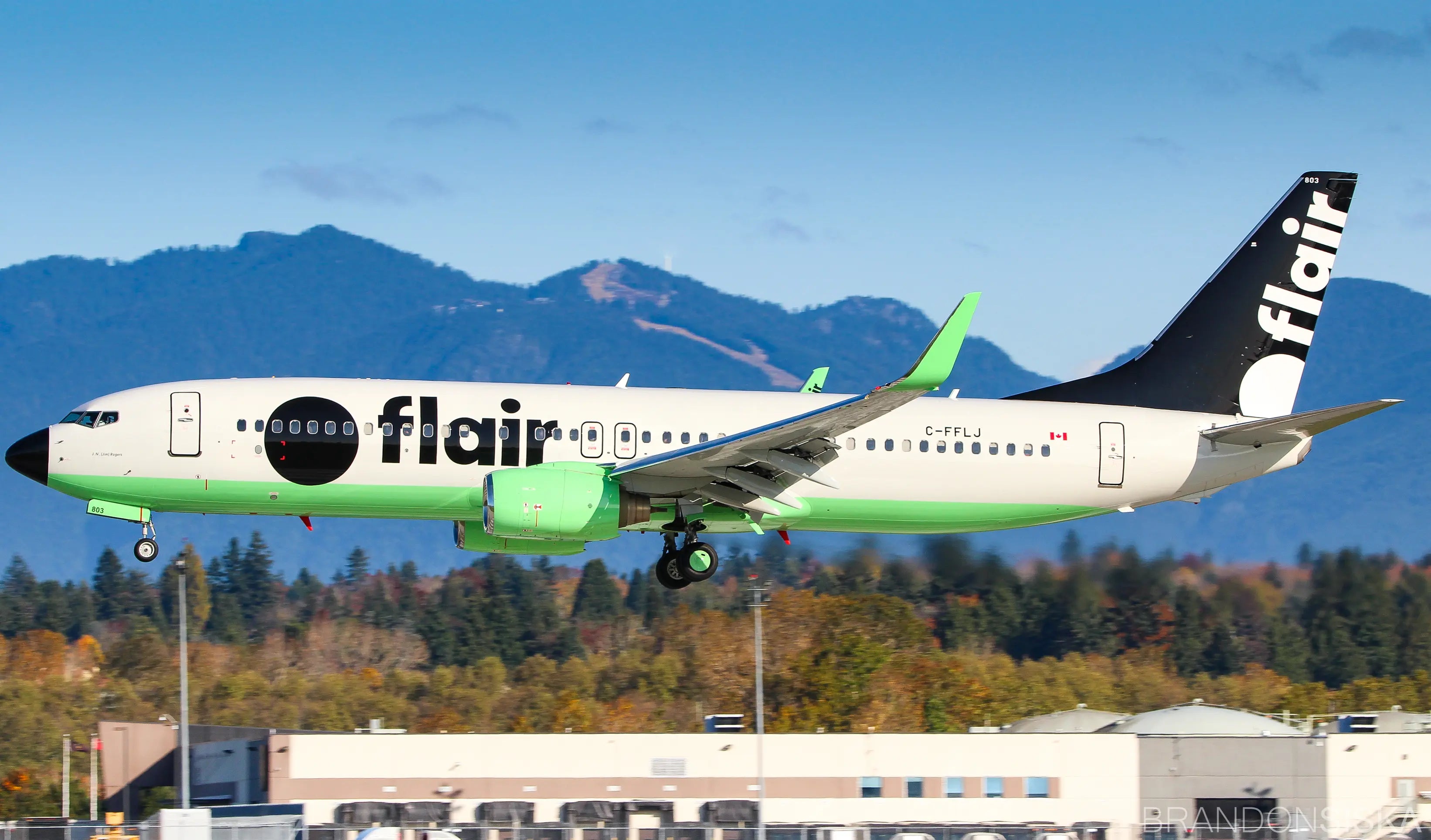
Flair Airlines Overview & Company Profile
Flair Airlines is Canada's largest independent ultra-low-cost carrier (ULCC), operating an all-Boeing 737 fleet on domestic, transborder, and sun-destination routes. The company traces its roots to 2005, when it was founded as Flair Air, a charter and contract operator based in British Columbia. Its transformation into a scheduled low-fare airline began in 2016 and 2017, when it absorbed the network and brand of the start-up reseller NewLeaf Travel Company and repositioned itself as a national point-to-point ULCC. Today its corporate headquarters and a primary crew base sit at Edmonton International Airport (YEG) in Alberta.
For pilots, Flair occupies an unusual position in the Canadian market. It pays what the airline and the Air Line Pilots Association have publicly described as the highest starting first officer wage of any airline in Canada, yet it carries the financial fragility and operational volatility that come with the ULCC model. The carrier survived a high-profile aircraft seizure in 2023, an ownership review by the Canadian Transportation Agency over its ties to U.S. investor 777 Partners, and the broader shake-out that ended Lynx Air and folded Swoop into WestJet. As of mid-2026, Flair is still flying, still expanding (recent additions include Moncton, Sault Ste. Marie, and new U.S. service), and is not in any court-supervised insolvency process. Prospective pilots should weigh that resilience against a risk profile that is materially different from a legacy carrier.
Pilots considering Flair should always cross-check current openings and conditions against the airline's own careers portal and the ALPA Flair pilot group page, since a ULCC's network, fleet, and bases can change faster than at an established network airline.
Flair spent its first decade as a low-profile charter and contract carrier before standardizing on the Boeing 737 and moving into scheduled low-fare flying. Its head office relocation to Edmonton reinforced a Western-Canada identity even as the network grew to span the country and reach into the United States, Mexico, and the Caribbean. Under CEO Stephen Jones, the airline has publicly reframed its ambition from a niche ULCC toward a larger, leisure-focused network carrier, while still targeting roughly 50 aircraft by 2027.
Fleet Composition & Type Rating
Flair runs a clean single-type fleet built entirely around the Boeing 737, a strategy that simplifies training, maintenance, and crew scheduling in the same way Ryanair and Southwest do at far larger scale. According to fleet trackers Planespotters and ch-aviation, as of June 2026 Flair operates around 20 aircraft, made up of 18 Boeing 737 MAX 8s and 2 Boeing 737-800s, with an average fleet age of about 7.6 years. That is a young, modern narrowbody fleet by Canadian standards, weighted heavily toward the newer, more fuel-efficient MAX 8.
Both variants share a common Boeing 737 type rating, so a pilot type-rated at Flair can be rostered on either the 737-800 (NG) or the 737 MAX 8, subject to company differences training for the MAX systems. The MAX 8 seats roughly 189 passengers in Flair's high-density single-class layout and gives the airline better unit economics on longer domestic and transborder sectors. The two remaining 737-800s are the legacy of the earlier fleet and are gradually being outnumbered by MAX deliveries.
| Aircraft Type | Role | In Service | Notes |
|---|---|---|---|
| Boeing 737 MAX 8 | Narrowbody | 18 | Core fleet. ~189 seats, single-class high density. Newest aircraft, lower fuel burn. |
| Boeing 737-800 (NG) | Narrowbody | 2 | Earlier generation. Shares the 737 type rating with the MAX. |
| Total fleet | ~20 | Average age ~7.6 years (Planespotters, June 2026). Target of 50 aircraft by 2027. | |
Fleet data per Planespotters and ch-aviation, June 2026. Counts shift as leases are added or returned; verify before applying.
Fleet growth at Flair is driven almost entirely by leasing rather than direct Boeing orders, much of it through sale-leaseback and operating-lease structures connected to its investors and third-party lessors. This gives the airline flexibility to add or shed capacity quickly, but it also concentrates financial risk: in March 2023, a lessor repossessed four 737 MAX 8 aircraft overnight over alleged lease arrears, forcing mass cancellations. The episode is the clearest illustration of how a heavily leased ULCC fleet can shrink with little warning, a point that matters directly to job security and roster stability.
New first officers fly the Boeing 737, the only fleet at Flair. There is no widebody path and no fleet to bid across, which keeps training straightforward but also means equipment progression is limited to NG-versus-MAX differences rather than a move to larger aircraft. A 737 rating earned at Flair is highly portable: the type is operated by WestJet, by carriers worldwide, and the multi-crew jet time transfers well toward a future move to a larger airline. Pilots should confirm whether the type rating is company-funded and whether any training bond or service commitment applies before signing.
Pilot Salary & Compensation
Compensation is Flair's strongest selling point. Pilot pay is set by the collective agreement negotiated by ALPA, and the published scales make Flair genuinely competitive at the junior end of the Canadian narrowbody market. The airline and union have publicly marketed the deal as delivering the highest starting first officer wage of any airline in Canada, a claim echoed in Canadian aviation press coverage of the contract. Pay is built on an hourly block rate multiplied by credited hours, against a monthly minimum guarantee, plus per diem while away from base.
The hourly figures below are compiled by the pilot pay aggregator AVCentral from the ALPA agreement, reflecting a 3% escalation applied in January 2025 and a stated 75-hour monthly guarantee. Annual estimates assume that 75-hour minimum across 12 months; most line pilots credit more than the guarantee in busy seasons, so real earnings typically run higher, before per diem.
First Officer Pay Scale (Boeing 737)
| Seniority | Hourly Rate (CAD) | Annual @ 75h Guarantee |
|---|---|---|
| Year 1 (entry) | $103.00 | ~$92,700 |
| Year 3 | $123.60 | ~$111,000 |
| Year 5 | $139.05 | ~$125,000 |
| Year 7 | $149.35 | ~$134,000 |
| Year 10+ (top) | $156.56 | ~$141,000 |
First officer scale per AVCentral (ALPA agreement, 3% Jan 2025 escalation). Annual figures are estimates at the 75-hour monthly guarantee, excluding per diem and additional credit.
Captain Pay Scale (Boeing 737)
| Seniority | Hourly Rate (CAD) | Annual @ 75h Guarantee |
|---|---|---|
| Year 1 (entry) | $206.00 | ~$185,000 |
| Year 3 | $220.42 | ~$198,000 |
| Year 5 | $233.81 | ~$210,000 |
| Year 8 | $260.59 | ~$235,000 |
| Year 12 (top) | $289.43 | ~$260,000 |
Captain scale per AVCentral. A first-year Flair captain starts above $206/hr, already higher than a top-of-scale WestJet 737 captain on the same data set.
Two things stand out for a pilot weighing the numbers. First, the entry rates are aggressive: a year-one first officer at roughly $103 per hour and a year-one captain at $206 per hour place Flair near the front of the Canadian narrowbody pack at the bottom of each scale. Second, the scales top out lower than the legacy or hybrid carriers over a full career, because there is no widebody premium and the captain scale caps at year 12. Flair rewards pilots who get in early and upgrade quickly, rather than those chasing maximum lifetime earnings.
These rates are compiled by a third-party pay aggregator from the ALPA collective agreement and reflect a January 2025 escalation. The full contract pay tables are not published in detail by ALPA or the company. Crucially, that first agreement reached its renewal date in 2025, and pilots are now negotiating a successor contract that, as of April 2026, had moved into conciliation (see the Union section below). Rates, the monthly guarantee, and work rules could all change with the next deal. Always confirm current figures with ALPA or Flair hiring materials, and remember that Canadian federal and provincial income tax reduces gross pay substantially.
Roster Pattern & Quality of Life
Flair pilots fly under Canada's federal flight and duty time rules in the Canadian Aviation Regulations (CARs), which apply to all 705 airline operators, layered on top of the protections in the ALPA collective agreement. Transport Canada's prescriptive limits cap flight time at 112 hours in 28 days, 300 hours in 90 days, and 1,000 hours in 365 days. Maximum flight duty periods run from about 9 to 13 hours depending on report time and the number of sectors flown, with minimum rest of 12 hours at home base or 10 hours away from base in suitable accommodation. The full framework is published on the Transport Canada fatigue management pages.
As a ULCC, Flair targets high aircraft utilization, often 10 to 12 block hours per aircraft per day at peak, with quick 35 to 50 minute turnarounds. In practice that means duty days commonly built from two to four short or medium sectors, early starts, and tight schedules where a single delay can ripple through the rest of the day. Domestic flying is frequently same-day out-and-back to base, while transborder and sun routes can include overnight layovers. The 75-hour monthly pay guarantee sets a floor on earnings even when flying is light in the off-season.
📅 Illustrative Month — Boeing 737 First Officer (Representative Pattern)
Illustrative only. Flair does not publish its line-construction rules, so this grid represents a typical Canadian 737 ULCC pattern with reserve-heavy junior lines, not an official Flair roster.
Quality of life is the area where the published record is thinnest and where pilots have signalled the most concern. When ALPA filed to open the next contract in September 2025, it stated that Flair pilots were seeking wage increases, improved scheduling, and contract language supporting a strong work-life balance, which tells you scheduling and rostering are points of friction under the current deal. Exact guaranteed days off per month are not publicly documented in the contract; the CARs baseline provides at least four single days free from duty per 28-day period, but the contractual figure should be confirmed directly with ALPA.
Flair domiciles pilots at four bases: Toronto (YYZ), Vancouver (YVR), Edmonton (YEG), and Calgary (YYC). Living in base reduces the strain of reserve, which can dominate a junior pilot's first years. Commuting on a small ULCC network is harder than at a major carrier, because there are fewer daily frequencies and limited interline options if a standby seat fills up. Pilots who must commute should study the actual flight availability between home and base before relying on it.
Benefits, Travel Perks & Retirement
Flair's benefits package sits within Canadian market norms for a ULCC: solid on the essentials, leaner than a legacy carrier on long-term and travel perks. ALPA's own Flair pilot group page lists the core employee benefits as a group RRSP, health and dental coverage, travel benefits, and parental leave. Detailed plan design (contribution percentages, coverage limits, eligibility windows) is not published publicly, so the items below describe the categories that are confirmed plus the broader Canadian context that applies to any 705 carrier.
For a younger pilot using Flair as an entry to jet flying, the immediate value lies in the pay and the rapid command potential rather than the retirement or travel package. The group RRSP is a reasonable, portable retirement vehicle, but it does not match the more generous matching or defined-benefit components found at the largest Canadian carriers. Travel benefits are genuinely useful for getting around Canada and to sun destinations on Flair metal, but pilots should not assume the broad worldwide standby and interline access that legacy-carrier employees enjoy.
A pilot's income depends on a valid Category 1 medical, so loss-of-licence protection matters. Public sources do not confirm a dedicated employer loss-of-licence benefit at Flair, though long-term disability is commonly part of a group plan and ALPA offers optional loss-of-licence coverage through its own programs. During the hiring process, ask specifically about disability and loss-of-licence terms, and consider supplementary cover if employer protection is limited. Treat the benefit categories here as confirmed in name, with the fine print to be verified against the actual plan documents.
Career Progression & Seniority
Like every unionized Canadian airline, Flair runs a strict seniority system. Date of hire into the pilot group drives almost everything: upgrade eligibility, base and schedule bidding, and furlough order in a downturn. The list is maintained jointly by the company and ALPA. For a pilot planning to stay, getting in early is the single most valuable move, because seniority cannot be bought back if you leave and return.
The headline attraction is upgrade speed. During its growth phases, Flair has offered command opportunities far faster than a mature carrier, with reports of first officers upgrading within roughly two to five years, and the airline also hires direct-entry captains to fill immediate needs. That is the classic ULCC trade: faster time in the left seat, in exchange for lower top-of-scale pay and a more volatile employer. The flip side is that direct-entry captain hiring, and any slowdown in fleet growth, can stretch internal upgrade times for first officers, so the pace is not guaranteed and depends heavily on whether the airline is expanding when you are in the queue.
| Career Milestone | Typical Path | Notes |
|---|---|---|
| Join as First Officer (B737) | From 1,000 hrs total | Direct-entry FO posting. Company 737 type rating if not already rated. |
| Cadet entry to First Officer | ~18 months | Via the Flair Cadet Program from 250 hours total time (see next section). |
| Upgrade to Captain | ~2–5 yrs (growth phase) | Seniority-driven and conditions-dependent. Faster than legacy carriers historically. |
| Direct-Entry Captain | Experienced hires | 5,000 hrs total plus jet PIC or 1,000 hrs on 737NG/MAX. Fills capacity quickly. |
| Training Captain / Instructor | Variable | Smaller airline means motivated pilots may reach instructor roles earlier. |
Flair's growth has been slower than its early ambitions. The CEO has acknowledged that the target of around 50 aircraft slipped from 2025 to roughly 2027, framing it as a delay of a year or two rather than an abandoned plan, with each additional aircraft creating roughly 50 jobs. Strong attrition across the Canadian market (pilots moving to WestJet, Air Canada, Porter, and international carriers) continues to open seats at ULCCs and regionals, which can accelerate junior upgrades. But the same volatility, plus the unresolved second contract, makes long-range planning at Flair less predictable than at an established carrier.
Recruitment Process & Requirements
Flair recruits through two distinct doors: direct-entry postings for first officers and captains who already meet experience minimums, and the structured Flair Cadet Program for lower-time pilots (covered in the next section). The direct-entry minimums are notably accessible at the first officer level, which is part of why Flair is often viewed as an attainable first jet job for Canadian pilots coming off instructing or regional flying.
First Officer — Requirements
Direct-Entry Captain — Requirements
Selection Stages
Online Application
Candidates apply through Flair's careers portal, submitting licences, medical, logbook summaries, and work-eligibility details. Postings specify the role (First Officer or Direct-Entry Captain) and whether a 737 type rating is required or provided.
Screening & Interview
Shortlisted candidates face a technical and competency interview covering IFR procedures, multi-crew operations, systems knowledge, and behavioural and CRM questions. Some airlines add aptitude or psychometric testing; Flair's exact use of branded tests is not publicly documented.
Simulator Assessment
A 737 simulator evaluation is common, especially for direct-entry captains and lower-time first officers. Assessors look for SOP compliance, instrument handling, CRM, decision-making, and composure under pressure, rather than deep type-specific familiarity.
Background Checks & Offer
References, logbook verification, criminal record and security checks (including RAIC eligibility) precede a final offer. Confirmation of unrestricted ability to travel to and from the United States is required given the transborder network.
Training & Line Indoctrination
New hires complete ground school, simulator training to a Transport Canada proficiency check, and line indoctrination with training captains on revenue flights. Non-type-rated pilots complete the full 737 type rating during this phase.
Flair cannot generally sponsor work permits, so candidates need to be legally entitled to work in Canada and able to travel unrestricted to the United States. The 1,000-hour first officer minimum is low by jet-airline standards, which makes Flair a realistic target straight out of instructing or a regional, but it also means strong sim performance and clean professionalism matter more in selection. Verify current openings and exact thresholds on the official Flair careers page, since minimums move with the pilot supply.
The Flair Cadet Program
One feature genuinely distinguishes Flair from most Canadian carriers: a structured cadet program that takes lower-time pilots and prepares them for a Boeing 737 MAX first officer seat. Launched with its first cohort in January 2024, the program is aimed at pilots who hold the core licences but lack the hours for a direct-entry job. Flair has described the pathway as turning cadets into 737 MAX first officers within about 18 months and roughly 250 hours of total flying time, a far lower entry point than the 1,000-hour direct-entry first officer route.
The program runs with partner flight schools, named by Flair as Genesis Flight College and CTS Aero, and includes a rigorous pre-selection stage before specialized training begins. Industry reporting indicated the inaugural cohort was relatively small, on the order of around ten pilots, consistent with a carefully managed first intake rather than a mass cadet pipeline.
Cadet training is self-funded, not free. Flair's official program page does not publish a fixed fee, but partner school Genesis Flight College lists its airline cadet / integrated ATPL course at roughly CAD $135,000 plus tax for around 200 hours of training, with additional cost if more hours are needed. Whether any training bond or service commitment applies to the airline placement is not confirmed in public sources. Treat the headline numbers as a starting point and request the current program terms, total cost, and any repayment obligations in writing before enrolling.
How Flair Compares: Airline Radar Chart
How does Flair stack up against the two most relevant Canadian comparators a narrowbody pilot would weigh it against: WestJet, the established 737 operator that absorbed Swoop, and Porter Airlines, the fast-growing hybrid carrier flying the Embraer E195-E2? The radar below scores all three across the same six themes used in the scorecard. Scores are editorial estimates grounded in published pay data, union materials, and industry benchmarks.
Narrowbody Pay, Side by Side
| Carrier (Narrowbody) | FO Year 1 | FO Top | Captain Year 1 | Captain Top |
|---|---|---|---|---|
| Flair (B737) | $103.00 | $156.56 | $206.00 | $289.43 |
| WestJet (B737) | ~$84 | ~$128 | $136 | $210 |
| Porter (E195-E2) | $90.57 | $156.31 | $215.18 | $302.47 |
CAD per block hour. WestJet and Porter figures per AirlinePilotCentral, PilotCareerCenter, and AVCentral (mid-2020s snapshots); scales change with each contract.
Key Takeaways
Flair leads on junior pay. A first-year Flair first officer at roughly $103 per hour outpaces a new-hire WestJet 737 first officer, and a first-year Flair captain at $206 per hour starts above a top-of-scale WestJet 737 captain on the same data. For pilots focused on the first few years of earnings, Flair is hard to beat in Canada.
Porter edges ahead at the top. Porter's E195-E2 captain scale tops out around $302 per hour, slightly above Flair's $289, and Porter's first-officer scale is broadly comparable. Porter also brings a brand-new jet fleet, a strong service brand, and a longer operating history, which many pilots read as lower risk.
WestJet wins on stability and ceiling. WestJet's narrowbody scales are lower than Flair's at the junior end, but it offers a far larger network, more bases, widebody flying with a substantial pay premium, and the security of an established carrier. That is why WestJet remains a common next step for Flair pilots.
Flair's weak spots are job security and work-life. The 2023 aircraft seizure, the collapse of Lynx Air, the integration of Swoop into WestJet, private ownership, and an unresolved second contract all weigh on Flair's stability score, while pilots' own bargaining priorities flag scheduling as a pressure point.
Radar scores are editorial estimates drawn from published pay scales (AVCentral, AirlinePilotCentral, PilotCareerCenter), ALPA materials, fleet trackers, and industry reporting. They represent a general assessment for a pilot weighing a multi-year narrowbody career and are not precise measurements. Individual experience varies with base, seniority, and personal priorities. Pay tables in particular are snapshots that move with each new collective agreement.
Union & Industrial Relations
Flair pilots are represented by the Air Line Pilots Association, International (ALPA), the largest pilot union in the world. Flair's pilots organized and aligned with ALPA in 2021, after a period working under what the union described as uncertain conditions during the airline's rapid growth. ALPA states that it represents roughly 140 Flair pilots in its 2025 and 2026 negotiation communications. The group is governed by a Master Executive Council (MEC) of elected Flair pilots, backed by ALPA's central resources for bargaining, legal support, and safety advocacy.
How Representation Works
The First Contract and the Current Dispute
Flair pilots ratified their first collective agreement around 2023, a three-year deal that established pay scales, scheduling rules, and a grievance framework where little structure had existed before. ALPA has publicly described the agreement as delivering significant raises, including the industry-leading first officer starting wage discussed earlier. That first contract reached its renewal date in 2025, and the relationship has since moved into a more contentious bargaining phase.
The current state of play is the single most important industrial-relations fact for anyone joining today. In September 2025, ALPA filed to open negotiations on a successor contract, stating that Flair pilots were seeking wage increases, improved scheduling, and stronger work-life-balance language. By April 2026, talks had stalled to the point that the pilots filed for conciliation and publicly sought government assistance to move negotiations forward. In other words, as of this writing the pilot group is in an active, unresolved contract fight with management.
The unresolved second contract cuts both ways. On one hand, ALPA representation gives Flair pilots a structured, protected channel to push for better pay and scheduling, and conciliation is a normal, lawful step in Canadian airline bargaining rather than a sign of imminent collapse. On the other hand, an active dispute creates uncertainty over future pay and work rules, and it confirms that scheduling and work-life balance are real pain points today. Anyone weighing an offer should ask the MEC directly where negotiations stand and what is on the table.
Verdict: Who Is Flair For?
🎯 Our Take
Flair is best understood as a high-pay, higher-risk entry point into Boeing 737 jet flying. For a Canadian pilot coming off instructing or a regional, the combination of a 1,000-hour first officer minimum, the highest published starting first officer wage in the country, a young MAX 8 fleet, and historically fast upgrades is a compelling on-ramp to narrowbody jet experience and an early command.
The trade-offs are equally real and should not be glossed over. Flair is a privately held ULCC that survived an overnight aircraft seizure in 2023, operates in a market that has already claimed Lynx Air and Swoop, and is currently locked in an unresolved second contract that reached conciliation in April 2026. Top-of-scale pay caps below the hybrid and legacy carriers because there is no widebody path, work-life balance is a live grievance, and benefits are solid but not generous. Job security is the weakest part of the picture.
For pilots who value rapid progression and strong junior pay, and who treat Flair as a launchpad rather than a 30-year home, it can be an excellent strategic move. For those prioritizing stability, maximum lifetime earnings, or widebody flying, WestJet, Porter, or Air Canada are the more conservative targets, potentially with Flair as a stepping stone along the way.
1 Does Flair really pay the highest first officer wage in Canada?
Flair and ALPA have publicly marketed the contract as delivering the highest starting first officer wage of any airline in Canada, and that claim is consistent with published pay data showing a year-one 737 first officer at roughly $103 per hour. That leads new-hire rates at WestJet and is broadly in line with Porter at the junior level. The picture flips at the top of scale, however, where Flair caps lower than the hybrid and legacy carriers because there is no widebody flying.
2 How many flight hours do I need to get hired at Flair?
Direct-entry first officer postings list a minimum of 1,000 hours total time, with either an ATPL or a CPL plus the IATRA or SAMRA/SARON exams completed, and a Category 1 medical. Direct-entry captains need around 5,000 hours total, plus either 500-plus PIC hours on jets above 75,000 lb or 1,000-plus hours on the 737NG/MAX. Lower-time pilots can enter through the Flair Cadet Program from roughly 250 hours.
3 Does Flair hire low-time pilots and run a cadet program?
Yes. The Flair Cadet Program, which ran its first cohort in January 2024, trains lower-time pilots into Boeing 737 MAX first officers in about 18 months from roughly 250 hours of flying time, in partnership with Genesis Flight College and CTS Aero. The training is self-funded (partner-school pricing runs around CAD $135,000 plus tax), so confirm the full cost and any bond before enrolling.
4 Is Flair financially stable? Will it survive?
As of mid-2026, Flair is still operating, adding routes, and is not in any bankruptcy or CCAA process, and the Canadian Transportation Agency previously confirmed it is Canadian-owned and controlled. That said, it is a privately held ULCC that endured a 2023 aircraft repossession and operates in a market that has already seen Lynx Air shut down and Swoop fold into WestJet. Job security is the weakest part of the Flair proposition, and pilots should plan accordingly.
5 How long does it take to upgrade to Captain at Flair?
During Flair's growth phases, first officers have reportedly upgraded to captain in roughly two to five years, much faster than at legacy carriers. Upgrade timing is strictly seniority-driven and depends on fleet growth and attrition, and the use of direct-entry captains can slow internal upgrades. With fleet expansion having slipped toward a 2027 target, treat fast upgrade as a possibility tied to growth, not a guarantee.
6 Do I need to speak French to fly for Flair?
No. Flair's postings require English and/or French proficiency, so strong English is sufficient and French is not mandatory. This contrasts with carriers where French fluency is a hard requirement. You will, however, need to meet ICAO language proficiency standards and hold the appropriate Canadian licences and medical.
7 Does Flair pay for the Boeing 737 type rating?
Flair hires both type-rated and non-type-rated pilots and provides 737 type-rating training as part of new-hire training for those who need it. Whether a training bond or service commitment applies is not confirmed in public sources, and ULCCs sometimes attach repayment terms. Ask specifically about type-rating funding and any bond during the hiring process and get the terms in writing.
8 Where are Flair's pilot bases?
Flair domiciles pilots at four Canadian bases: Toronto (YYZ), Vancouver (YVR), Edmonton (YEG), and Calgary (YYC). Living in base is a real advantage given that junior pilots can spend significant time on reserve, and commuting on a small ULCC network is harder than at a major carrier with many daily frequencies and interline options.
Official Links & Resources
Before applying or making a career decision, verify everything against primary sources. A ULCC's fleet, network, pay, and contract status can change quickly, so these official and authoritative resources are the ones to bookmark:
Because Flair is between contracts, the fastest way to track what actually matters to your pay and schedule is the ALPA press room and the Flair pilot group page. Watch for movement on the conciliation process that began in April 2026, since the next agreement will reset the pay tables and work rules quoted throughout this guide.