

Antonov An-72 History and Development: From STOL Concept to Service
The Antonov An-72 (NATO reporting name Coaler) is a twin-engine short takeoff and landing (STOL) jet transport conceived by the Antonov Design Bureau to support logistics from short, unprepared and remote airstrips. It was designed to replace and supplement earlier turboprop transports such as the An-26, offering jet performance while still operating from austere fields as short as 600 m. The program is widely regarded as the Soviet counterpart to the United States Advanced Medium STOL Transport (AMST) effort, which produced the Boeing YC-14 and McDonnell Douglas YC-15 demonstrators.
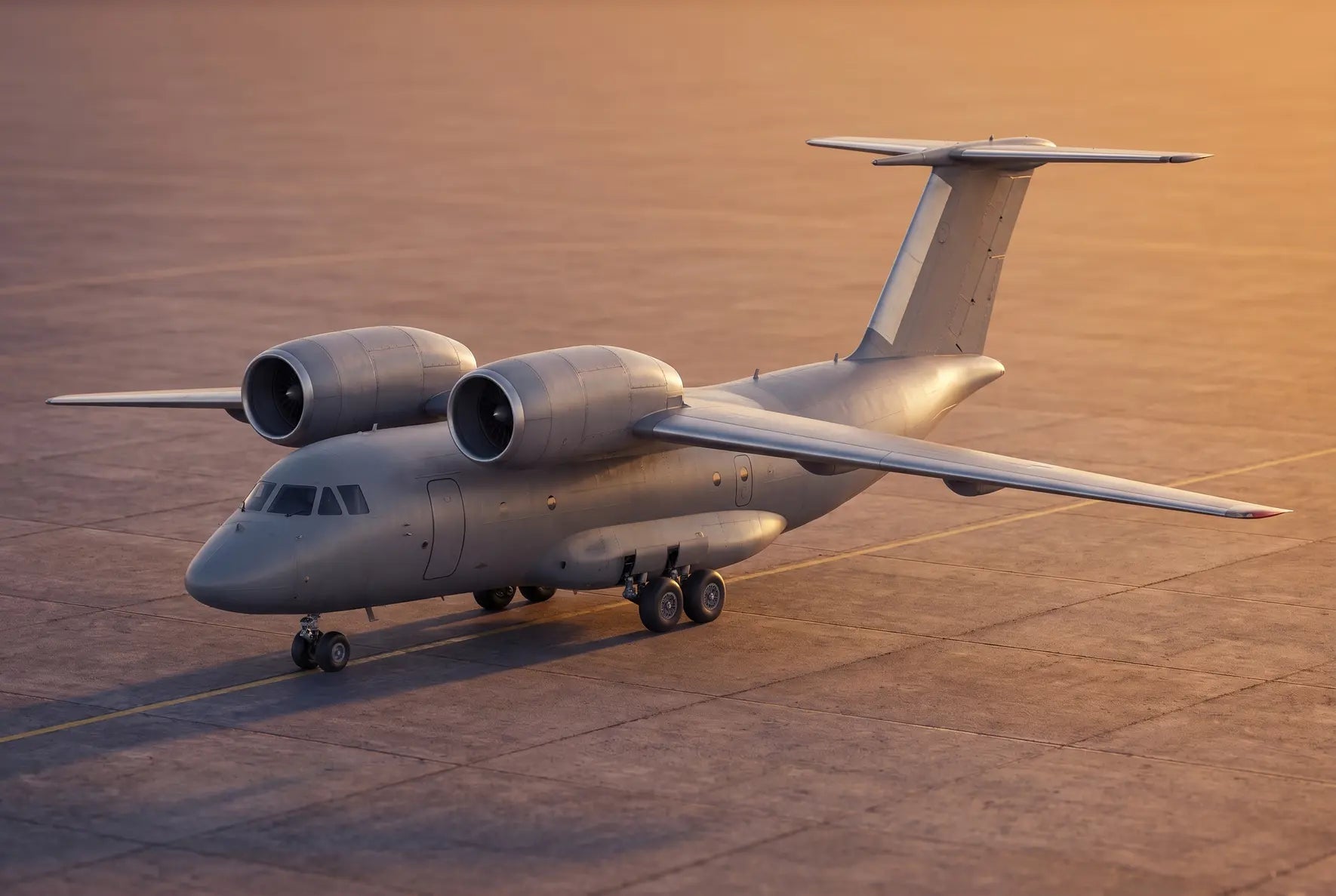
The aircraft is best known for its upper-surface blowing (USB) layout: two high-bypass turbofans are mounted in pods above and ahead of the wing leading edge, so that exhaust flows across the upper surface and the flaps. This exploits the Coandă effect, whereby the jet adheres to the curved surface and augments lift at low speeds, dramatically shortening takeoff and landing runs.
The program followed a clear chronology documented by the manufacturer:
- 16-27 May 1974: joint decision by the Ministry of Aircraft Industry, the Air Force and the Ministry of Civil Aviation to launch a new light military transport.
- 12 July 1976: formal government authorisation to develop the An-72.
- 6 May 1977: the first prototype rolled out of the assembly shop.
- 31 August 1977: first flight of the An-72 prototype, captained by Volodymyr Terskyi.
- June 1979: public debut at the 33rd Paris Air Show.
- 22 December 1985: first flight of the first production An-72 in Kharkiv.
- May 1987: production aircraft enter service.
According to Antonov, around 114 aircraft of the An-72 family were built between 1984 and 1992 at the Kharkiv Aircraft Manufacturing Company, in what is now Ukraine. After the dissolution of the Soviet Union, the type and its derivatives remained associated with Antonov of Ukraine.
Power comes from two Lotarev (Ivchenko-Progress) D-36 three-shaft high-bypass turbofans, each producing roughly 63.7 kN of thrust. Combined with the high wing, multi-segment double-slotted flaps and the USB arrangement, the baseline An-72 can carry up to about 10 tonnes of cargo, cruise near 540-600 km/h, and operate from very short fields, with takeoff distances of roughly 620 m and landing distances near 420 m in short-field configuration. Maximum takeoff weight is approximately 34,500 kg, with an operational range of about 4,320 km. These STOL characteristics make crews trained on demanding short-field and multi-role operations particularly valuable; pilots seeking structured pathways into such careers can review options like this integrated CPL(H)/IR programme.
What sets the An-72 apart from its closest relatives
The baseline An-72 is a general military and cargo STOL transport. Its closest derivatives adapt the same airframe and over-wing engine layout to specialised roles. The An-72P, first flown on 29 November 1984, is a maritime and border-patrol variant with search radar, electro-optical sensors, mission consoles and provisions for guns, rockets and bombs; it offers a higher MTOW of about 37,500 kg and endurance of roughly 7 hours 18 minutes. The An-74 is the Arctic and Polar-optimised development, adding enhanced de-icing and cold-weather systems, additional fuel and navigation equipment, and provisions for ski-equipped operations, with extended range up to around 5,300 km in light-payload configuration. The An-71 is an airborne early warning derivative distinguished by a tail-mounted rotodome and dedicated radar avionics, treated as a separate type. Later An-74 subvariants such as the An-74TK-300 moved the engines under the wing, abandoning the original USB concept that defines the baseline An-72.
The following identifiers summarise what characterises this specific variant:
- Engines: two Lotarev/Ivchenko-Progress D-36 high-bypass turbofans (~63.7 kN each), mounted above the wing.
- Lift system: upper-surface blowing using the Coandă effect for STOL performance.
- Field performance: design point for 600 m airstrips; takeoff ~620 m, landing ~420 m fully loaded.
- Weights: MTOW around 34,500 kg; payload up to ~10 tonnes; passenger capacity roughly 52-68.
- Range and speed: operational range ~4,320 km; cruise ~540-600 km/h.
- Configuration: high wing, rear loading ramp, T-tail, fixed-role transport airframe shared with the An-72P and early An-74.
One historical inconsistency is worth noting neutrally: some secondary aviation histories cite a first flight date of 22 December 1977, but Antonov's own corporate timeline and multiple technical references give 31 August 1977 as the authoritative date, with 22 December 1985 marking the first production example.

The image shows a Russian Antonov An-72 aircraft in mid-flight against a cloudy sky. The An-72 is a twin-engine, turbofan transport aircraft known for its unique engine placement above the wings.
Antonov An-72 Technical Specifications, Systems and Performance
The Antonov An-72 (NATO reporting name Coaler) is a jet-powered STOL tactical transport conceived to replace the An-26 and to operate from short, unprepared strips while keeping jet-class cruise speeds. Its defining trade-off is propulsion-lift integration: instead of maximising cruise efficiency like a conventional underwing-engine jet, the design places its turbofans above and ahead of the wing to exploit upper-surface blowing and the Coandă effect, dramatically raising the low-speed lift coefficient at the expense of some aerodynamic efficiency. This is the same high-wing, T-tail, rear-ramp philosophy seen across Antonov tactical transports, here adapted for rough-field logistics and airdrop.
The result is a balance between short-field capability and useful payload: roughly 10 t of cargo, jet speed, and the ability to operate from semi-prepared runways around 600 m long. Compared with a classic jet such as the Boeing 727-100, the An-72 sacrifices cruise economy and range for runway independence and FOD resistance, illustrating how mission priorities reshape an airframe.
- Wingspan: about 31.89 m (104 ft 7 in)
- Length: about 28.07 m (92 ft 1 in)
- Height: about 8.65 m (28 ft 4 in)
- Wing area: about 98.6–98.78 m² (1,062 sq ft)
- Empty weight: approximately 19,050 kg (42,000 lb)
- Maximum takeoff weight (MTOW): 34,500 kg (76,058 lb) per the baseline variant
- Maximum payload: 10,000 kg (22,045 lb)
- Powerplant: two Lotarev (ZMKB Progress) D-36 high-bypass turbofans, about 63.7–63.9 kN (14,330 lbf) each
- Cruise speed: about 540 km/h (291 kt) per manufacturer data, with references citing up to ~600 km/h
- Range: about 4,320 km (2,335 nm) operational, with ferry figures around 4,800 km
- Service ceiling: about 10,100 m (33,100 ft); some sources list up to 11,800 m
- Takeoff roll / landing distance: roughly 620 m / 420 m under favourable conditions, with operational takeoff distances near 1,170 m in some profiles
Baseline dimensional and weight data are corroborated by Antonov and by independent references such as aviation databases, while operational profiles appear in sources like SKYbrary.
Systems and handling-relevant technology
The An-72 uses conventional, hydraulically boosted flight controls rather than fly-by-wire, with ailerons, elevators and a rudder commanded through traditional columns and pedals. The aerodynamic heart of the aircraft is its high-lift system: large multi-segment trailing-edge flaps positioned in the engine efflux so the exhaust attaches to and follows the wing and flap surfaces, increasing local airflow and lift at high deflection. The T-tail keeps the horizontal stabiliser clear of the jet wake, preserving pitch authority during steep STOL approaches.
Over-wing engine placement also reduces foreign-object-damage risk on gravel or packed-earth strips, complemented by robust multi-wheel landing gear sized for rough surfaces. Avionics on early aircraft centre on an automatic navigation system, autopilot and period radio-navigation aids rather than a modern glass-cockpit FMS, so pilot workload during short-field and poor-weather operations remains relatively high.
Published performance figures vary widely between sources, and the differences are mostly contextual rather than contradictory. Numbers shift with operator options, cargo versus high-density passenger configurations, takeoff and landing weights, atmospheric assumptions (temperature, pressure altitude), and whether a quoted distance is a ground run, a balanced field length, or an operational takeoff distance. Quoted values should therefore be read as configuration-dependent, not absolute.
Engines: the Lotarev D-36 turbofan
The An-72 is powered by two D-36 three-shaft high-bypass turbofans, a design from the Ukrainian engine bureau historically branded Lotarev and now associated with Ivchenko-Progress (ZMKB Progress) and manufacturer Motor Sich. The D-36 was one of the Soviet Union's first high-bypass turbofans, and its modular, three-spool architecture was advanced for its era, offering relatively low fuel burn and noise for a Soviet engine of the 1970s. Each unit produces roughly 63.7–63.9 kN (14,330 lbf) of thrust in the An-72 installation.
The same engine family underpins other types: the D-36 first powered the Yakovlev Yak-42 regional jet, and derivatives equip the Antonov An-74, the polar-optimised development of the An-72 built for Arctic and Antarctic logistics. The lineage also extends to the related D-436 turbofan used on later Antonov and Beriev aircraft. This shared powerplant base helped standardise maintenance and parts across several Soviet and post-Soviet transport and regional aircraft programmes.
Antonov An-72 vs An-72P vs An-74 vs Yakovlev Yak-42D Specifications Comparison
Scroll horizontally to see more →
| Parameter | Antonov An-72 | Antonov An-72P | Antonov An-74 | Yakovlev Yak-42D |
|---|---|---|---|---|
| Entry into service | 1985 | 1990 | 1987 | 1980 |
| Engines | 2 × Progress D-36 turbofans | 2 × Progress D-36 turbofans | 2 × Progress D-36 turbofans | 3 × Lotarev D-36 turbofans |
| Length | 28.1 m | 28.1 m | 28.1 m | 36.4 m |
| Wingspan | 31.9 m | 31.9 m | 31.9 m | 34.9 m |
| Height | 8.7 m | 8.7 m | 8.7 m | 9.8 m |
| Typical seating and layout (short description + approximate passengers) | Single-class regional: 40–52 passengers | Patrol/transport layout: up to 40 passengers | Single-class regional: 40–52 passengers | 2-class medium-haul: 100–120 passengers |
| MTOW | 34.5 t | 34.5 t | 36.5 t | 57.0 t |
| Range | 2,320 nm | 2,320 nm | 2,600 nm | 2,600 nm |
| Cruise speed | 0.70 Mach | 0.70 Mach | 0.70 Mach | 0.78 Mach |
| Service ceiling | 31,170 ft | 31,170 ft | 37,730 ft | 29,500 ft |
| Program note | Baseline STOL jet transport designed by Antonov as a replacement for earlier tactical transports, optimized for short, rough airstrips. | Specialized An-72 derivative configured for maritime patrol and surveillance while retaining STOL transport capability. | Cold-weather and civil-oriented development of the An-72 family, tailored for Arctic operations and regional passenger/cargo service. | Contemporary Soviet three‑engine regional/medium-haul airliner offering higher capacity and range for trunk routes compared with the An‑72 family. |
Scroll horizontally to see more →
The table compares key specifications of the Antonov An-72 family (An-72, An-72P, An-74) against the larger Yakovlev Yak-42D. The An-72 variants share similar dimensions and D-36 engines, seating around 40–52, and cruise at Mach 0.70, while the An-74 increases MTOW, range, and ceiling. The Yak-42D is longer, heavier, faster (Mach 0.78), and carries about 100–120 passengers, reflecting a medium-haul airliner role rather than STOL transport.
Antonov An-72 Operations, Missions and Airlines Worldwide
The Antonov An-72 (NATO reporting name Coaler) was conceived as a short take-off and landing (STOL) tactical transport to replace the An-26 turboprop, and its mission profile reflects that origin. Its two Lotarev D-36 turbofans are mounted above and ahead of the wing so that exhaust blows over the upper surface and flaps, exploiting the Coandă effect to boost low-speed lift. The result is an aircraft able to work from non-equipped strips as short as 600 m, lifting up to 10 tonnes of cargo, roughly 52 passengers, or 57 paratroopers.
Typical missions are short to medium in length. With maximum payload the range falls to about 800 km, while lighter loads extend it to a ferry range near 4,300 km. Cruise speed sits around 540–600 km/h with a service ceiling close to 10,100 m. Daily utilisation is generally modest and irregular: most operators fly the type on ad-hoc cargo charters, government tasking or resupply runs rather than fixed high-frequency rotations, so flights cluster around remote, secondary and rough-field airports instead of major civil hubs.
Operationally the An-72 favours point-to-point logistics over hub-and-spoke networks. It thrives at gravel, snow and ice strips where Western jets cannot operate, and the high-set engines keep intakes clear of debris on unprepared surfaces. The main challenges for operators are fuel burn relative to payload, the steep range penalty at full load, a small support base outside the former Soviet sphere, and ageing airframes. For a contrasting wide-body civil platform, see our overview of the Airbus A300-600.
Where the An-72 operates
The type is concentrated in the former Soviet states but appears across four broad regions. In Europe it serves mainly as a military and government transport, with civil operators flying oil-and-gas and charter cargo. Across North & South America presence is limited and intermittent, with a few state and contractor airframes rather than scheduled fleets. In Asia, including Central Asia and the Middle East, air forces and charter carriers use it for regional airlift to mountainous and remote fields. In Africa it is widely employed for cargo, humanitarian and government flights into short, underdeveloped airstrips.
- Europe: the Russian Aerospace Forces and the Ukrainian Air Force remain the largest military users. On the civil side, Gazpromavia uses the type to ferry crews and freight to Arctic oil and gas fields, Shar Ink runs cargo and charter work, and Antonov Airlines operates it for lighter loads and support flights. Belarus and Moldova have also fielded the family, and Estonia's Enimex historically flew it on contract missions.
- North & South America: operation is sporadic. The Peruvian Air Force has used An-72/An-74 aircraft for transport over the Andes and Amazon, where STOL and high-altitude performance help on short strips. In North America the type has appeared only with private operators and contractors, never as an adopted military fleet.
- Asia: the Kazakhstan Air Force, Iran, Turkmenistan and the Lao People's Liberation Army Air Force have flown the family for regional and government lift. Badr Airlines, though Sudan-based, regularly operates the An-74 on routes reaching the Middle East and remote sites.
- Africa: the Angolan Air Force and Libyan government units have operated the type for tactical and VIP transport, and Equatorial Guinea is a noted military user. Egypt flies the An-74 for desert lift, while Badr Airlines uses freighters on charter and humanitarian work into rough airfields.
Typical seating and cabin layouts
Cabin arrangements vary sharply by operator role. Military and utility layouts use folding sidewall seats plus removable centre seats, giving up to roughly 52 passengers or 68 troops, with medevac fits of 24 stretchers, 12 seated casualties and an attendant. Cargo operators strip the cabin to carry four UAK-2.5 containers or four PAV-2.5 pallets of up to 2,500 kg each, loaded through the rear ramp. Network-style scheduled use is rare; most carriers run combi or pure-freight configurations rather than dense passenger maps.
Executive variants tell a different story. The An-72S and the later An-74 offer three-compartment VIP interiors with galley, toilet and conference seating, typically around 24 seats, and can be reconfigured for freight, a light vehicle or stretchers. The modernised An-74TK-300, with conventional under-wing engines, is widely used in corporate and government roles. Detailed type background is documented by Antonov.
In this video, discover the An-72, one of the most unusual-looking modern aircraft. Learn what makes it distinctive, explore its design features, and see why it’s viewed as revolutionary, or not.
Antonov An-72 Safety Record and How Safe Is This STOL Transport?
The Antonov An-72 (NATO reporting name Coaler) has a small, dispersed fleet and a limited but well-documented accident history. The type first flew in 1977, with series production at Kharkiv running roughly between 1984 and 1992 and around 114 An-72 airframes built, while combined An-72/An-74 family output is commonly cited at about 195 aircraft, of which an estimated 100 remained active in 2024. Across several decades of service, the Aviation Safety Network lists roughly a dozen significant occurrences, including around eight written-off hull losses and several substantial-damage events. Because most operations are military, paramilitary or charter flights into remote, polar or mountainous regions, the recorded events reflect demanding mission profiles rather than a recurring design fault. Many operators have been state bodies such as border-guard and air-force units, alongside cargo and utility carriers.
Notable An-72 and An-74 accidents and what changed
The following events, drawn from recognised safety databases and official investigations, illustrate the main risk patterns for the type.
- Trigana Air Service (Enimex), Wamena, Indonesia, 2002: an An-72-100 freighter conducted a visual approach above the manual's prescribed speed, could not fully configure flaps, bounced three times and suffered nose-gear failure followed by a post-landing fire. The investigation found no aircraft system malfunction, but highlighted crew handling and inadequate airport firefighting readiness, reinforcing the need for strict approach-speed and configuration discipline and for compliant aerodrome rescue services.
- Antonov Design Bureau, near Lensk, Russia, 1991: an An-74 was lost on a flight near Lensk Airport with 13 fatalities, the first major fatal accident recorded for the family and an early reminder of the hazards of operating into sparsely equipped airfields.
- Libyan Air Force, near Kousseri, Cameroon, 2006: an An-74TK-200 was destroyed during a flight in central Africa with six fatalities, an event consistent with the elevated risk of operations in regions with limited navigation aids and poor weather.
- IRGC Air Force, Tehran-Mehrabad, Iran, 2006: an An-74T-200 crashed shortly after take-off with 37 fatalities, the deadliest event recorded for the type. As with several state-operated losses, detailed public causal findings are limited, but the case underscores how take-off and departure phases concentrate risk.
Across these occurrences the common thread is operational context, crew handling and challenging environments rather than intrinsic airframe weakness. After the Wamena event, emphasis fell on closer check-pilot supervision under national civil aviation rules and on improving aerodrome emergency response.
How safe is the Antonov An-72?
Judged against its traffic volume, the An-72 has accumulated a modest number of hull losses relative to its long service life and small fleet, with most accidents tied to terrain, weather and operating discipline rather than design. Its STOL philosophy is a genuine safety asset: engines mounted above the wing exploit the upper-surface-blowing or Coanda effect to boost low-speed lift, shorten take-off and landing runs from unpaved strips as short as 600 m, and reduce debris ingestion, as outlined by SKYbrary. Realising that performance depends on disciplined standard operating procedures and effective regulatory oversight, which are not uniform across the type's varied operators. Crews moving between airframes and carriers should treat each operator's training and oversight standards seriously, a theme also relevant to wider industry discussions such as those covering GetJet Airlines. Even so, the broader picture is reassuring: as confirmed by global statistics from ICAO, commercial aviation remains one of the safest modes of transport.
01 What is the Antonov An-72 typically used for and on what kinds of routes does it fly?
The Antonov An-72 is primarily a short- to medium-range utility transport aircraft used for cargo, troop transport, and specialized missions such as airdrop and medical evacuation. Its design allows operations from short, unpaved, or icy runways, so it is often used to reach remote airfields in Arctic regions, Siberia, Central Asia, and other hard-to-access areas. It has also been employed for military and government transport, including peacekeeping and logistics support. Passenger operations have generally been on charter, regional, or special-purpose flights rather than regular high-density airline routes.
02 What is the range and performance profile of the Antonov An-72?
Depending on configuration and payload, the Antonov An-72 typically offers a range of roughly 2,000–4,000 km, making it suitable for regional missions and multi-leg ferry flights. Its STOL (short takeoff and landing) performance is a key feature, helped by engines mounted above the wings that blow exhaust over the flaps to generate extra lift at low speeds. This allows the An-72 to operate from relatively short runways and in challenging conditions, including snow and rough surfaces. Cruise speed is lower than many modern jet airliners, but adequate for its transport and utility roles.
03 What is the passenger experience like on an Antonov An-72 flight?
Passenger layouts on the Antonov An-72 vary widely because many airframes are configured primarily for cargo or mixed cargo-passenger operations. When fitted with seats, the cabin is more functional than luxurious, often with basic seating, limited overhead storage, and a higher noise level due to the proximity of the engines and relatively simple interior insulation. Windows are typically smaller and fewer than on modern airliners, so the cabin can feel more utilitarian. Travellers can expect a robust, practical environment designed around mission flexibility rather than comfort-focused amenities.
04 Which airlines or operators use the Antonov An-72 today?
The Antonov An-72 is now relatively rare in mainstream commercial airline fleets and is more commonly found with state operators, military air arms, and specialized cargo or charter companies. Various air forces and government agencies in Eastern Europe, Central Asia, and Africa have used the An-72 for transport tasks. Some civil operators have employed it for cargo runs and charter missions to remote or demanding destinations where its STOL capabilities are valuable. Fleet sizes are small and individual airframes may move between operators over time, so availability for regular passenger service is limited.
05 How does the safety record and design of the Antonov An-72 compare with similar aircraft?
The Antonov An-72 has a relatively small global fleet, so its accident statistics are not directly comparable to large Western airliners, but its safety record reflects a mix of operational and environmental challenges rather than inherent design flaws. Its high-mounted engines, rugged landing gear, and reinforced airframe were engineered for demanding conditions, including unprepared runways and extreme weather. As with any older aircraft type, safety depends heavily on the specific operator’s maintenance standards, crew training, and adherence to procedures. Many An-72s now serve in governmental or military roles where operational risk profiles can differ from routine commercial airline service.
06 What should a traveller know if their flight is scheduled on an Antonov An-72?
A traveller on an Antonov An-72 can expect a more utilitarian experience than on a typical modern airliner, with fewer amenities and a louder cabin. Seat selection options may be limited, but seats closer to the front and away from over-wing areas may feel slightly quieter and offer a somewhat smoother ride. The aircraft’s robust design and STOL capability can be reassuring on short or rough runways, though it may involve steeper climb and descent profiles than large commercial jets. Because cabin layouts vary by operator, it is advisable to check any available pre-flight information or photos from the specific airline or charter company operating the An-72.