

History and Development of the Hawker Siddeley HS 748
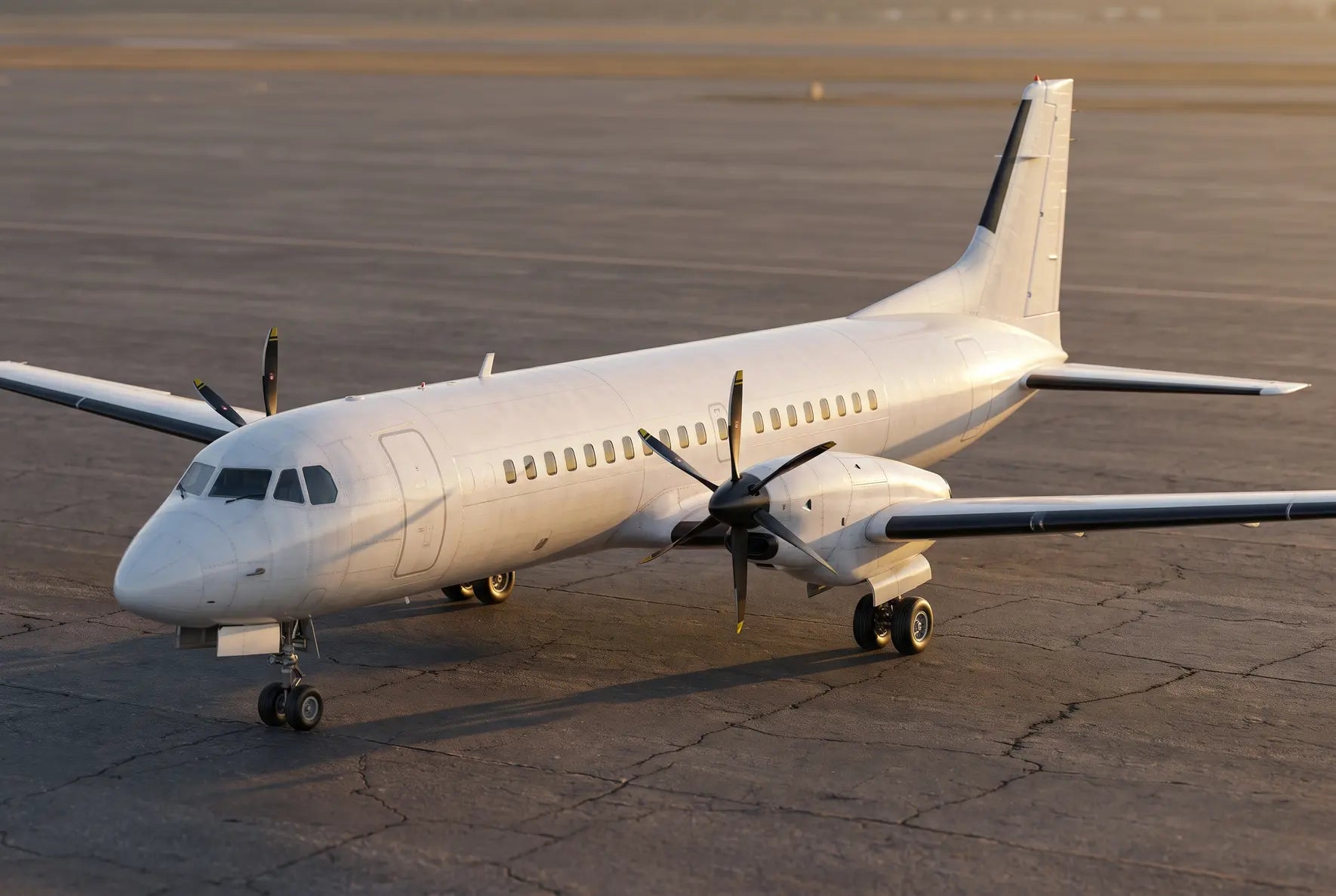
The Hawker Siddeley HS 748 began life as the Avro 748, a project launched in the late 1950s by A.V. Roe & Co. (Avro), then part of the Hawker Siddeley Group. After the company decided to re-orient itself towards civil and export markets, designers studied operator demand and settled on a rugged, pressurised, twin-turboprop feederliner aimed squarely at replacing the ageing fleets of Douglas DC-3 airliners then flying regional and secondary routes worldwide. Market research pointed to roughly 40 seats as the optimum, combined with good short take-off and landing (STOL) capability and the ability to work from rough or short strips.
The prototype made its maiden flight on 24 June 1960 from Avro's Woodford factory in Cheshire. The first production aircraft entered revenue service on 1 April 1962 with launch customer Skyways Coach-Air. Following corporate rationalisation of brand names within the group, the type was redesignated the HS 748, and after the formation of British Aerospace in 1977 the design and final production passed to BAe. The aircraft was also licence-built in India by Hindustan Aeronautics Limited as the HAL-748, with the first Indian-assembled example flying on 1 November 1961; HAL completed 89 aircraft (72 for the Indian Air Force and 17 for Indian Airlines). In total around 380 to 381 airframes were produced between 1961 and 1988, including the military Andover derivative, making it one of Britain's more commercially successful regional turboprops. Full development detail is recorded by reputable aerospace references such as the type's documented production history.
What sets this variant apart
The HS 748 evolved through incremental series rather than radical redesign. The initial Series 1 (roughly 18 built) used early Rolls-Royce Dart turboprops and seated around 44 to 48 passengers. Production then switched to the Series 2, fitted with the more powerful Rolls-Royce Dart RDa.7 Mk.531, which raised take-off performance, maximum weights and typical capacity to about 52 seats. The later Series 2A and Series 2B built on this with further weight and systems upgrades, while the Super 748 was a hush-kitted Series 2B intended to meet tighter noise regulations without re-engining. The dedicated military transport, the HS 780 Andover, differed more substantially with an upswept rear fuselage, a large loading ramp and kneeling main landing gear for vehicle and pallet handling. Compared with later, larger four-engined widebodies such as the Boeing 747SP, the HS 748 occupied the opposite end of the spectrum: a compact, robust regional workhorse built for short fields rather than long-haul reach.
The main features that identify a given HS 748 variant are summarised below.
- Engines: twin Rolls-Royce Dart turboprops throughout; Series 1 used earlier Dart marks, while Series 2 onward adopted the Dart RDa.7 Mk.531.
- Capacity: roughly 44 to 48 seats on Series 1, rising to about 52 seats on Series 2 and later.
- Weights and performance: higher maximum take-off weight and improved hot-and-high capability on Series 2/2A/2B versus Series 1.
- Noise compliance: the Super 748 added a hush kit to a Series 2B airframe.
- Military distinction: the Andover (HS 780) featured a rear loading ramp and kneeling gear, marking it apart from the civil airframe.
The programme is notable for the absence of major crises or structural redesigns; development progressed through steady series improvements and the Andover derivative, with the type remaining in operational service, including with the Indian Air Force, well into the 21st century.

The image shows an Air North Hawker Siddeley HS 748 aircraft in flight. The plane features an orange and white livery, with the word 'Yukon' visible on the tail fin.
HS 748 Technical Specifications, Systems and Dart Engines
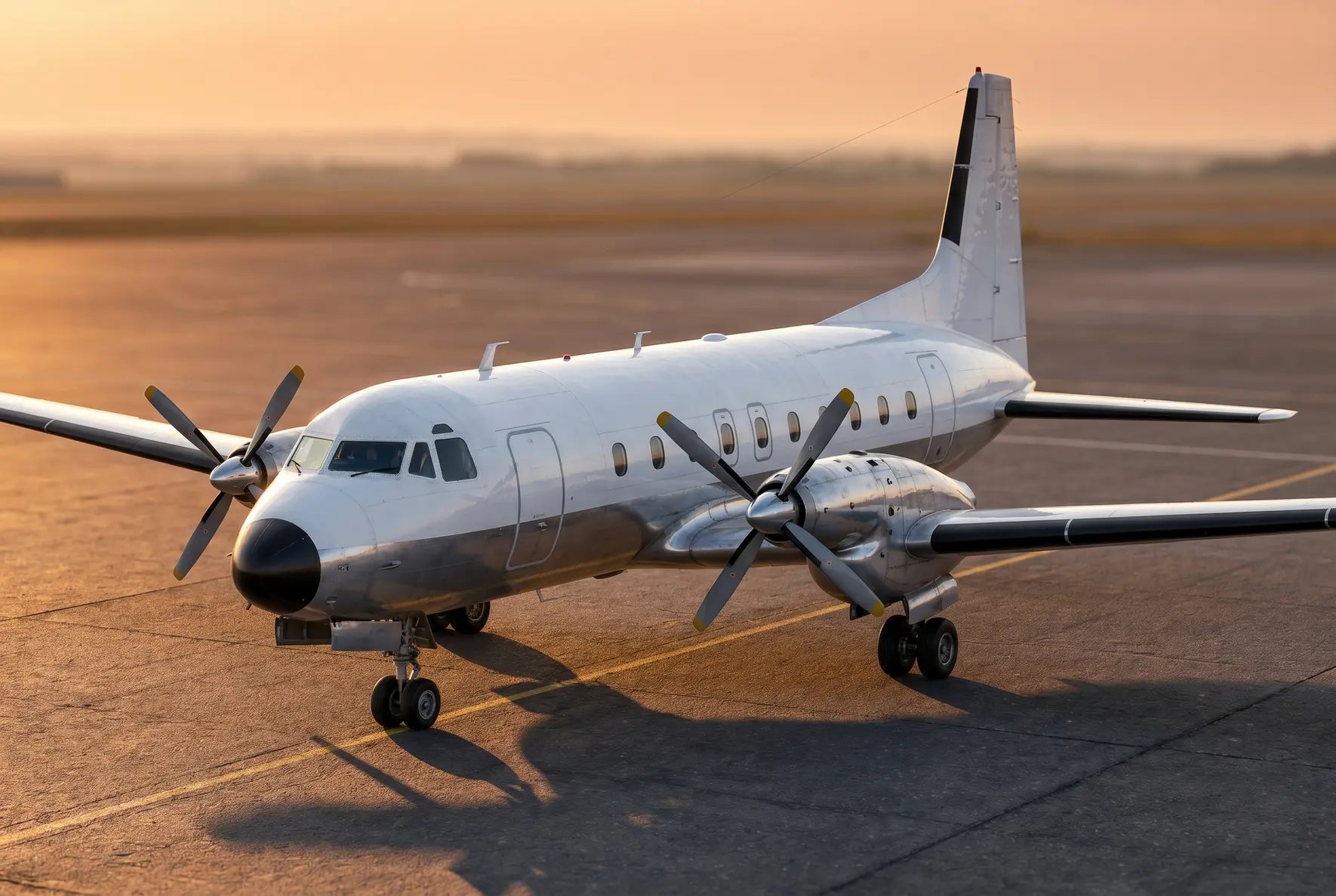
The Hawker Siddeley HS 748 was conceived as a rugged, DC-3-class replacement for regional operators, and its engineering reflects that brief at every level. Originating as the Avro 748 in the late 1950s and continued under Hawker Siddeley from 1959, the type prioritised short-field and rough-field capability, simple and maintainable systems, and reliable twin-turboprop power over outright speed or altitude. The high wing keeps the engines and propellers clear of debris, while a relatively low wing loading and large double-slotted flaps deliver strong low-speed lift for steep approaches and short take-offs.
The principal design trade-off is range against payload at a modest service ceiling: the aircraft was optimised for short sectors from basic airfields rather than long-haul efficiency. This is why it remains in niche cargo use today, particularly on gravel and unpaved strips in remote regions. The result is an airframe that favours predictable, "honest" handling and operational simplicity, a philosophy valued by the commuter and regional sector, including the kinds of carriers profiled among regional pilot operations such as Mesa Airlines.
- Length: 67 ft 0 in (20.42 m), per published type data
- Wingspan: 102 ft 5.5 in (31.23 m)
- Height: 24 ft 10 in (7.57 m)
- Wing area: 829 sq ft (77.0 m²)
- MTOW: 46,500 lb (21,092 kg)
- Operating empty weight: 27,126 lb (12,304 kg)
- Fuel capacity: 1,440 imp gal (6,500 L)
- Passengers: typically 40–58, with combi and freight options
- Cruise speed: 244 kn (452 km/h)
- Service ceiling: 25,000 ft (7,600 m)
- Range: 926 nmi (1,715 km) with maximum payload
- Take-off run / to 50 ft: approx. 2,624 ft (800 m) / 3,800 ft (1,200 m)
- Landing run / from 50 ft: approx. 1,968 ft (600 m) / 2,034 ft (620 m)
- Engines: two Rolls-Royce Dart turboprops, around 2,280 shp each on later marks, driving four-bladed constant-speed, fully-feathering propellers
Systems and handling-relevant technology
The HS 748 keeps its primary flight controls (ailerons, elevators and rudder) conventionally driven through mechanical cables, rods and quadrants, with no powered boost on the basic airliner versions and manual trim via tabs. The large double-slotted trailing-edge flaps and the retractable tricycle landing gear are hydraulically actuated by engine-driven pumps, so a loss of hydraulics primarily affects flaps, gear and braking rather than basic controllability. Main wheels use hydraulically actuated multi-disc brakes operated by toe pedals, and higher-specification examples were fitted with a wheel-speed anti-skid system to protect against lock-up on short or contaminated surfaces. The wide-track main gear and rugged oleo design support repeated operations from unprepared strips, a quality summarised in the SKYbrary type record.
The flight deck was a conventional two-pilot analogue layout with dual VHF communications, VOR/ILS, ADF, DME and nose-mounted weather radar typical of IFR regional work. The later Super 748 introduced an updated flight deck and improved systems, while individual airframes were often retrofitted by operators with modern GPS and upgraded navigation equipment.
Published performance figures should be read in context. Take-off and landing distances, range and cruise vary with the specific series, engine mark, cabin density, operating weights, and atmospheric and runway conditions. Manufacturer charts are proprietary and weight-dependent, so the values above are representative rather than absolute guarantees for any given flight.
The Rolls-Royce Dart engine family
The HS 748 is inseparable from the Rolls-Royce Dart, an early axial-centrifugal turboprop developed by Rolls-Royce in the late 1940s. It first flew on the prototype Vickers Viscount and went on to power a long list of regional and utility types, making it one of the most successful turboprops of its era. Production HS 748s were powered by Dart RDa.7 marks, with later aircraft using engines such as the Mk 534, Mk 536-2 or Mk 552 rated around 2,280 shp each, as documented in the type specifications and the SKYbrary entry.
The Dart earned a reputation for high reliability and straightforward maintenance, with competitive specific fuel consumption for short-haul routes, which is precisely why Avro selected it. Beyond the HS 748, the Dart powered the Vickers Viscount and the Fokker F27 among others, accumulating millions of flight hours and remaining in front-line airline service into the 1980s and 1990s. That durability is one reason a small number of HS 748 freighters remain economically viable in remote operations today.
HS 748 vs Fokker F27 vs ATR 42-300 vs DHC-7: Regional Turboprop Comparison
Scroll horizontally to see more →
| Parameter | Hawker Siddeley HS 748 | Fokker F27 Friendship | ATR 42-300 | De Havilland Canada DHC-7 Dash 7 |
|---|---|---|---|---|
| Entry into service | 1961 | 1958 | 1985 | 1978 |
| Engines | 2 × Rolls-Royce Dart turboprops | 2 × Rolls-Royce Dart Mk 528/532 turboprops | 2 × Pratt & Whitney Canada PW120 turboprops | 4 × Pratt & Whitney Canada PT6A-50 turboprops |
| Length | 20.4 m | 25.1 m | 22.7 m | 24.6 m |
| Wingspan | 30.0 m | 29.0 m | 24.6 m | 28.4 m |
| Height | 7.6 m | 8.5 m | 7.6 m | 8.4 m |
| Typical seating and layout (short description + approximate passengers) | Single-class: 40–58 passengers | Single-class: 44–52 passengers | Single-class: 42–50 passengers | Single-class: 40–50 passengers |
| MTOW | 21 t | 20.4 t | 16.7 t | 19.3 t |
| Range | 925 nm | 1,200 nm | 800 nm | 1,000 nm |
| Cruise speed | 0.40 Mach | 0.47 Mach | 0.44 Mach | 0.40 Mach |
| Service ceiling | 25,000 ft | 25,000 ft | 25,000 ft | 20,000 ft |
| Program note | Robust short-haul twin-turboprop regional airliner optimized for operations from short and rough airfields. | Contemporary European twin-turboprop regional airliner and major competitor, widely used for similar short-haul routes. | Next-generation high-efficiency regional turboprop offering lower fuel burn and operating costs on short sectors. | Specialized STOL regional airliner designed for very short runways and challenging airport environments. |
Scroll horizontally to see more →
The table compares four regional turboprops by entry into service, engines, dimensions, capacity, MTOW, range, speed, and ceiling. The HS 748 is shorter than the F27 but has similar seating and slightly higher MTOW, while the F27 leads on range and cruise Mach. The ATR 42-300 is the lightest with the shortest range, reflecting later efficiency aims. The DHC-7 stands out with four engines, lower ceiling, and STOL focus for very short runways.
HS 748 Routes, Missions and Airlines Operating It Worldwide
The Hawker Siddeley HS 748 was conceived as a rugged DC-3 replacement, and its operational record reflects that brief. Powered by Rolls-Royce Dart turboprops, it cruised at roughly 244 kt (about 452 km/h) and offered a maximum range near 926 nmi (1,715 km) with full payload, according to SKYbrary. In daily service it rarely flew anywhere near that limit: typical sectors ran 150 to 600 nm, with flight times of roughly 30 to 120 minutes. Operators exploited its short-field and rough-field performance to run high-frequency rotations, often six to ten short legs per day, linking small communities with larger centres.
The type was designed for environments that defeated early jets. Its STOL capability allowed operations from unpaved, gravel and marginal strips with minimal ground equipment. This made it a natural fit for hub-and-spoke feeder networks and point-to-point regional services to secondary and remote airports rather than congested major hubs. The main operational challenges were the usual constraints of austere fields: limited runway length, unprepared surfaces, and payload-versus-range trade-offs when operating from short or hot-and-high airstrips.
Where the HS 748 operates around the world
The HS 748 found a global market spanning four broad regions. In Europe, it served domestic trunk and short cross-border routes to airfields unsuited to jets. Across North & South America, it ranged from Argentine and Brazilian domestic networks to Canadian Arctic freight and bush flying. In Asia, India became the single largest market, with dense domestic feeder operations. In Africa, its rough-field strength suited regional, charter and government missions into modestly equipped airports.
- Europe: Dan-Air London and BKS Air Transport used the type on UK domestic and short continental services into small airports, while Braathens SAFE flew regional sectors across Norway where weather and runway length constrained jets.
- North & South America: In Canada, Air Creebec, Air Inuit, Wasaya Airways and Air North operated freight and combi flights to remote northern and First Nation communities. In South America, Aerolineas Argentinas was an early large customer, while VARIG and LAN-Chile ran domestic feeder services, and LIAT linked Caribbean islands.
- Asia: Indian Airlines was the largest operator worldwide with 26 aircraft on dense domestic routes; Thai Airways covered Thai regional sectors, Bouraq Airlines served Indonesian island and remote destinations, and Philippine Airlines flew regional links.
- Africa: Regional and charter operators across East, Central and West Africa used the type for scheduled, freight and contract work into bush strips, supporting mining, humanitarian and government missions, including head-of-state transports.
Typical seating and cabin layouts
Cabin configurations varied by operator type. The standard regional airliner layout was four-abreast (2-2) economy seating of about 40 to 48 seats, with published capacity reaching 58 passengers in higher-density form, notably on the Super 748. Network and scheduled carriers typically favoured the 44 to 52-seat range, while leisure and charter operators sometimes pushed densities higher. Many later aircraft flew as quick-change combis, with a movable bulkhead allowing roughly 4 to 40 rear seats plus palletised freight forward, and VIP or head-of-state examples carried bespoke low-density interiors. Type-level capacity and configuration details are documented in manufacturer and historical records and in cargo-focused specifications from Air Charter Service. For readers comparing turboprop cabins across types, additional context is available in our aviation resources.
In this video, discover why the Hawker Siddeley HS 748, a British turboprop airliner developed in the 1950s, still operates in Canada, and what keeps this classic aircraft relevant today.
Hawker Siddeley HS 748 Safety Record and How Safe Is It
The Hawker Siddeley HS 748 entered revenue service in the early 1960s, with around 380 aircraft built by Avro and Hawker Siddeley, plus further examples licence-built in India as the HAL-748. Designed to replace ageing DC-3s on regional routes, it accumulated decades of intensive service across hundreds of thousands of cycles, frequently from short, unpaved or grass strips in remote regions of Canada, Africa, Asia and Latin America. Set against that demanding operating profile and long fleet life, its accident history is consistent with a robust 1960s turboprop of its generation. Many recorded events were non-fatal hull losses tied to runway excursions, braking on contaminated surfaces and short-field freight work rather than fundamental design flaws. A type-specific overview of accidents and serious incidents is maintained on the Aviation Safety Network HS 748 page, where events can be filtered by year, operator and outcome.
Notable accidents and what changed
Several well-documented cases illustrate recurring operational themes and the safety actions that followed:
- Skyways Coach-Air, Lympne, 1965: an Avro 748-101 was written off in a landing accident on a very wet grass runway, with all 51 occupants surviving. The official investigation attributed it to inadequate braking from an extremely low surface friction coefficient, prompting more conservative performance planning for wet grass strips and better attention to runway surface condition reporting.
- Canadian operator, Thompson, Manitoba, 1994: the Transportation Safety Board report A94C0009 details a loss of main hydraulic system pressure and a successful diversion, reinforcing improvements to hydraulic component reliability and crew checklist procedures for abnormal landings.
- Wasaya Airways, Kasabonika, Ontario, 1998: an HS 748-2A freighter overran on landing and was destroyed, with all four occupants surviving. Contributing factors included a late touchdown, delayed selection of ground fine pitch and inappropriate runway analysis data, leading to revised landing-distance planning and propeller-handling training for short-field operations.
- Emerald Airways, Guernsey, 2006: a cargo HS 748-2A suffered a loss of hydraulic pressure on approach. The UK CAA review summarised in Factor F10/2008 reinforced maintenance and defect-reporting practices, emergency procedures and crew training for hydraulic-related failures.
How safe is the Hawker Siddeley HS 748
Judged against its traffic volume across more than four decades of frequent regional and bush flying, the HS 748 has proven a dependable and forgiving aircraft. Its design philosophy prioritised ruggedness and short take-off and landing performance, with a high-lift wing and sturdy landing gear suited to marginal airfields, and it was certified to British transport-category standards under the Air Registration Board, later the UK Civil Aviation Authority. Most accidents reflect the difficult environments it served rather than inherent weaknesses, and standard operating procedures, performance planning discipline and regulatory oversight have steadily reduced exposure to the runway and systems issues seen in earlier years. As with any older type, safety today depends heavily on diligent maintenance, accurate runway analysis and well-trained crews. For broader context, statistics published by the International Civil Aviation Organization confirm that, despite isolated events, commercial aviation overall remains one of the safest modes of transport. Readers comparing turboprop reliability with early jet operations may also find the analysis of the Boeing 720 a useful point of reference.
01 What is the Hawker Siddeley HS 748 designed for?
The Hawker Siddeley HS 748 is a twin-engine turboprop designed for short- to medium-haul regional transport, with a strong emphasis on operating from shorter and less-prepared runways. It was also widely used in commuter, cargo, and utility roles because its rugged landing gear and good low-speed handling made it versatile in real-world service. [2]
02 How far can the Hawker Siddeley HS 748 fly?
Different HS 748 versions were typically used on regional sectors rather than long-haul routes, and published performance figures place its range in the roughly 1,000 to 1,500 nautical mile class depending on payload and variant. In practice, airlines used it for sectors that could be completed comfortably in a single hop without the fuel burn and runway needs of larger jets. [2] [3]
03 What is the cabin like on a Hawker Siddeley HS 748?
The HS 748 has a fairly compact turboprop cabin, usually arranged for short regional flights rather than premium comfort. Passengers can expect a utilitarian interior, more propeller and engine noise than on a jet, and a ride that is generally steady but still influenced by the weather because it often serves lower-altitude regional routes. [2]
04 Which airlines and routes used the Hawker Siddeley HS 748?
The HS 748 was operated by many regional airlines, military operators, and cargo carriers around the world, especially in the UK, Commonwealth countries, and parts of Asia, Africa, and Latin America. It was commonly assigned to feeder services, inter-island routes, remote-community links, and airports with short or challenging runways. [2] [3]
05 How does the Hawker Siddeley HS 748 compare with similar turboprops?
The HS 748 is often compared with regional turboprops such as the Fokker F27 because both were built for dependable short-haul service rather than speed. Its strengths were ruggedness, short-field capability, and flexible mission use, while its trade-off was slower cruise speed and less cabin refinement than later-generation regional aircraft. [2] [3]
06 Is the Hawker Siddeley HS 748 considered a safe aircraft?
The HS 748 developed a long operational record and earned a reputation as a tough, practical airliner when properly maintained and flown within its limits. Like any older aircraft type, its safety record depends heavily on operator standards, maintenance, and the specific conversion or variant in service, but its design included features suited to demanding regional operations. [2]