Everts Air Overview & Company Profile
Everts Air is a privately held, family-owned Alaskan airline headquartered in Fairbanks and organized under the parent company Tatonduk Outfitters Limited. The operation traces its origins to 1977, when founder Clifton "Cliff" Everts started Tatonduk Flying Service with a single Cessna 180. His son, Robert W. "Bobby" Everts, now serves as President and CEO, and remains actively involved as a line pilot. The company obtained its Part 121 certificate in 1995, when the cargo arm was formally established, and it has grown into one of the most distinctive operators in North America.
Everts Air is split into three sister operations under the same corporate roof. Everts Air Cargo is the Part 121 freight carrier that flies MD-80, DC-9, DC-6, and C-46 aircraft across Alaska and throughout the Lower 48, Canada, Mexico, and Central and South America. Everts Air Alaska is the Part 135 regional arm, serving 11 Interior Alaska communities with Cessna 208 Caravans and Pilatus PC-12s on scheduled passenger, mail, and freight runs. Everts Air Fuel is a smaller Part 125 piston operation that keeps the DC-6 and C-46 tradition alive on dedicated fuel-hauling missions.
For pilots, Everts occupies a unique slot in the US aviation market. It is one of the few operators still flying piston radial transports on revenue cargo work, alongside a modern fleet of MD-80s that serve some of the busiest rural supply lanes in North America. The IATA code is 5V, the ICAO code is VTS, and the radio callsign is "Everts." According to the company's own careers page, the flight crew family totals more than 80 pilots, with additional dispatchers, mechanics, and loaders bringing total staff to roughly 255 across Alaska.
Most pilots join Everts Air for one of three reasons. First, it offers a rare home-every-night lifestyle for Anchorage-based MD-80 crews, which is essentially unheard of at narrowbody cargo carriers. Second, it provides one of the only remaining paths in commercial aviation to log genuine radial-piston and tailwheel transport time on the Douglas DC-6 and Curtiss C-46. Third, it has a reputation as a "career airline" where pilots stay for decades rather than treating it as a stepping stone, which contributes to the stable, low-churn culture Robert Everts has cultivated since the mid-1990s.
Fleet Composition & Type Ratings
The Everts Air fleet is one of the most eclectic in scheduled commercial aviation. The backbone of the Part 121 cargo operation is the McDonnell Douglas MD-80, operated in an all-cargo configuration with large forward cargo doors. Everts was, according to its own AirlinePilotCentral profile, the first US airline to operate the MD-80 in an all-cargo role, and the type now serves routes from Anchorage throughout the Alaska bypass-mail system and across Central and South America out of Laredo, Texas.
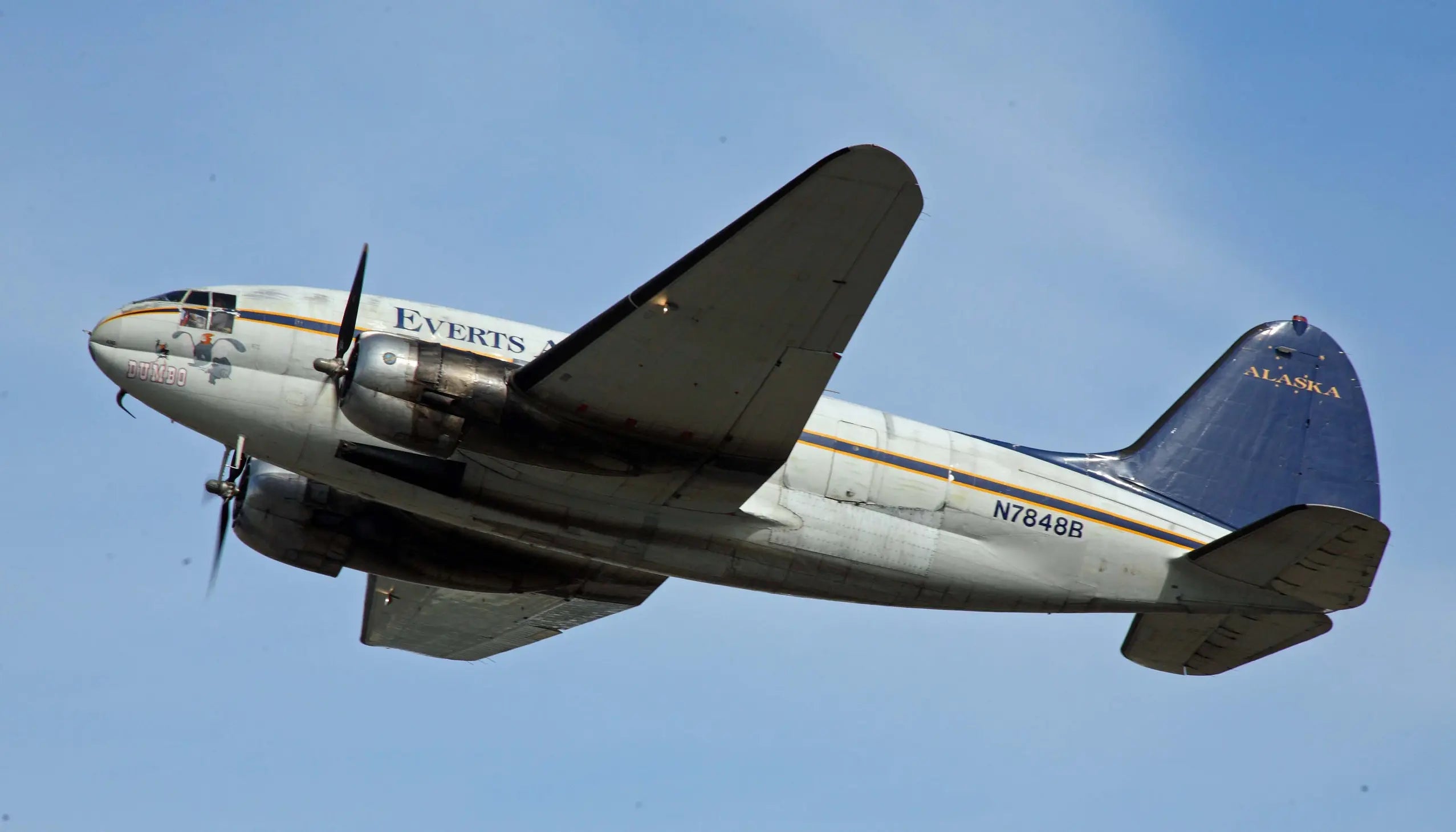
Alongside the MD-80, Everts still operates a small number of Douglas DC-9-33F freighters for shorter cargo legs. What truly sets the airline apart, however, is its continued use of vintage piston-radial transports. Three Douglas DC-6B aircraft remain in scheduled and charter service, making Everts one of the largest and most active civilian DC-6 operators in the world. A single Curtiss C-46F Commando, built in 1945, continues to serve remote Alaskan destinations where gravel strips and oversized freight demand a rugged airframe. The smaller fleet includes Cessna 208 Grand Caravans acquired from Ravn Alaska's estate in 2020, Pilatus PC-12s, and more recently the Cessna 408 SkyCourier for mid-size turboprop feeder work.
| Aircraft Type | Role | In Service | Notes |
|---|---|---|---|
| McDonnell Douglas MD-80 / MD-83 | Cargo, Part 121 | 6 | Primary narrowbody cargo jet. Bases: ANC and Laredo (LRD). First US carrier to operate MD-80 all-cargo. |
| Douglas DC-9-33F | Cargo, Part 121 | ~4 | Shorter intra-Alaska and charter cargo legs. Average airframe age over 50 years. |
| Douglas DC-6B | Cargo / Fuel, Part 121 & 125 | 3 | Piston-radial transport. Rare worldwide. Handles gravel strips and heavy fuel runs. |
| Curtiss C-46F Commando | Cargo, Part 121 | 1 | Built 1945. One of the last commercial C-46s flying. Oversized loads to remote airstrips. |
| Cessna 208 Grand Caravan | Regional passenger & freight, Part 135 | 6 | Operated by Everts Air Alaska. Village service from Fairbanks to Interior communities. |
| Pilatus PC-12 | Regional passenger & freight, Part 135 | Small fleet | Higher-capacity turboprop for longer village runs. |
| Cessna 408 SkyCourier | Mid-size turboprop freighter | Growing | Newer addition to the fleet. Bridges the gap between Caravan and jet operations. |
| Boeing 727-227F (Zero-G) | Specialty charter | 1 | Operated on contract for Zero Gravity Corporation parabolic flights. Based outside Alaska. |
Fleet figures reflect publicly available data from airline communications and AirlinePilotCentral as of early 2026. Numbers shift with ongoing door conversions and retirements.
Everts Air Cargo pays for initial type rating when pilots are hired onto the MD-80, DC-9, DC-6, or C-46. New hires are typically placed on the MD-80 at either Anchorage or Laredo, which offers the fastest line training and widest route exposure. Pilots already holding a relevant type rating can sometimes be hired directly into that seat. The DC-6 and C-46 positions are filled internally and require specific piston and high-performance aircraft training at the FAA-approved in-house program, plus an FAA 121.436(b) exemption allowing single-pilot-in-command flight without a formal type rating on those legacy types.
Flying 50-plus-year-old airframes is not for every pilot. Maintenance dispatch reliability is generally lower than a modern narrowbody, winter operations in Alaska demand constant attention, and cargo configurations mean long hours on the ramp in extreme weather. Pilots considering the DC-6, C-46, or DC-9 seats should be comfortable with analog flight decks, non-precision approaches, and the reality that historical transport aircraft require active stick-and-rudder skills that modern jets largely engineer away.
Pilot Salary & Compensation Breakdown
Everts Air Cargo states openly that it is "leading the cargo industry in pilot pay for narrow-body aircraft" on the MD-80, and the publicly disclosed pay scales bear that claim out for niche-cargo operators. Because Everts is a non-union airline, compensation is set by company policy rather than a collective bargaining agreement. The structure is straightforward: an hourly rate multiplied by block time, with a monthly minimum guarantee, a fixed per-diem, and performance bonuses layered on top.
New hires arriving with current Part 121 experience (and less than 24 months out of that operation) start at year-five pay rather than first-year pay, which is unusually favorable compared with most regional cargo carriers. The monthly guarantee is 60 block hours per 28-day bid period, with 13 periods per year. Pilots are paid for all block hours flown plus a minimum of 3.7 hours of block time for any additional non-scheduled flying on days off.
First Officer (MD-80) Pay Scale
| Seniority | Hourly Rate | Monthly Gross (60 hrs) | Annual Gross (est.) |
|---|---|---|---|
| Year 1 | ~$115 / hr | ~$6,900 | ~$85,000 – $95,000 |
| Year 3 | ~$119 / hr | ~$7,140 | ~$90,000 – $100,000 |
| Year 5 (new-hire 121 entry) | ~$123 / hr | ~$7,380 | ~$95,000 – $110,000 |
| Year 10 + | ~$126 / hr | ~$7,560 | ~$100,000 – $115,000 |
Annual estimates include base flight pay plus typical Lower-48 trip incentive bonuses and per-diem. Hourly rates are drawn from the AirlinePilotCentral and pilot-forum data for Everts Air Cargo.
Captain (MD-80) Pay Scale
| Seniority | Hourly Rate | Monthly Gross (60 hrs) | Annual Gross (est.) |
|---|---|---|---|
| Year 1 (upgrade) | ~$200 / hr | ~$12,000 | ~$150,000 – $175,000 |
| Year 5 | ~$210 / hr | ~$12,600 | ~$165,000 – $190,000 |
| Year 10 | ~$221 / hr | ~$13,260 | ~$180,000 – $210,000 |
| Senior (10 +) | up to $250 / hr | up to $15,000 | ~$200,000 – $232,000 |
Captain totals reflect salaries reported on Glassdoor (range $136K to $251K) and the published AirlinePilotCentral data. Top-of-scale earnings assume consistent L48 trip incentives and international flying out of Laredo.
Incentives, Per Diem & Extras
Everts Air does not publish a complete official pay chart. The figures above are best-effort estimates compiled from AirlinePilotCentral, Glassdoor (which reports an Everts Air Cargo pilot range of roughly $136K to $251K total compensation), Indeed, and public pilot-forum discussions. DC-9, DC-6, and C-46 pay is similar in shape but not always identical: DC-6 First Officer year-10 pay is reported at approximately $126 per hour, while Captain pay on legacy fleets trails MD-80 pay by a modest margin in some cases. Always confirm the current scale directly with Everts Air's recruiting team before accepting an offer.
Roster Pattern & Quality of Life
Quality of life is arguably the strongest selling point at Everts Air Cargo. The airline runs two very different schedule models depending on base. Anchorage-based MD-80 and DC-9 pilots come home to their families almost every night, a rarity in the narrowbody cargo world where most operators fly multi-day rotations with hotels. Intra-Alaska cargo runs out of ANC are typically built as round-robin day trips into the bypass-mail hubs and back, often with two or three legs per duty day.
The Lower 48 MD-80 crews based out of Laredo, Texas, and on home-based contracts elsewhere, operate on a clearly defined 16 days on / 14 days off rotation. The airline provides positive-space travel during the commute between the pilot's home and the assigned trip, which removes a common pain point at other cargo operators. DC-6 and C-46 crews work similar block-based rotations but with longer layovers at remote airstrips to accommodate loading and weather.
📅 Sample Month : MD-80 Lower-48 Crew (Home Based)
Anchorage-based pilots see a completely different pattern: six or seven one-day round-trips in a row, then a cluster of days off, typically cycling 4-on / 3-off or similar within the week. That structure is rare even among cargo carriers and is one of the main reasons long-tenured pilots stay at Everts for full careers. A Captain flying out of ANC can reasonably expect to sleep in their own bed nearly every night of the year.
Everts offers some of the most flexible base policies in Part 121 cargo aviation. Active bases are Anchorage (ANC) and Laredo (LRD), but MD-80 Lower-48 crews can home-base from most US cities, typically commuting through Seattle (SEA), Portland (PDX), or Dallas (DFW). Alaska-based pilots commute through ANC or FAI. According to pilot-forum discussions, Alaska home-basing (living in Alaska while flying the L48 rotation) is possible for pilots based in SEA or PDX gateway cities. The Anchorage MD-80 base has grown in recent years and is typically where new hires are trained, even if they eventually shift to a Lower-48 contract.
Benefits, Per Diem & Retirement
Everts offers a solid but not top-tier benefits package by US airline standards. As a privately held, non-union carrier, it competes on cash compensation and quality-of-life rather than on deep employer-funded retirement or pass-rider travel. Health coverage, a matching 401(k), and Part 121 standard insurance are all in place, and the company publishes its benefits on the official Everts Air benefits page.
Pilots comparing Everts to a legacy passenger airline should note a few gaps. There is no defined-benefit pension; retirement savings sit entirely in the 401(k). There is no pass-rider (non-rev) travel program of the kind Alaska Airlines, United, or Delta pilots enjoy, because Everts is a cargo-focused operator. Loss-of-license insurance is not a published headline benefit the way it is at ALPA-contract carriers, so pilots should confirm what the company's group policy currently covers and consider a private LOL policy through a provider such as ALPA's individual LOL program or an equivalent. These are real trade-offs for pilots weighing Everts against a mainline carrier.
Career Progression & Seniority
Career progression at Everts Air Cargo is significantly faster than at most US legacy or regional carriers. Because the airline is comparatively small and grows primarily through new MD-80 door conversions and route expansion, upgrade opportunities open regularly. The company openly markets "quick upgrades" in its recruiting materials, and pilots with strong line performance and leadership skills are actively tracked for Line Check Pilot, Check Airman, and Training Captain roles.
Unlike the strict seniority locks found at ALPA-contract airlines, Everts does allow some lateral movement between fleets based on both seniority and operational need. Pilots with MD-80 time may be invited to transition onto the DC-9, DC-6, or C-46, and vice versa. The DC-6 and C-46 seats are highly coveted because of the unique experience they confer, and competition for those positions is internal and relatively informal rather than bid strictly by date of hire.
| Career Milestone | Typical Timeline | Notes |
|---|---|---|
| New-hire MD-80 First Officer | Day 1 post-training | Most common entry point. ANC or L48 base. |
| Captain upgrade (MD-80) | 2 – 5 years (typical) | Upgrade timing driven by fleet growth, retirements, and door conversions. |
| DC-9 / DC-6 / C-46 transition | Variable, internal selection | Requires additional type training. C-46 is the rarest seat in the fleet. |
| Line Check Pilot / Instructor | 3 – 7 years | Open to pilots with strong mentoring skills. Additional pay and duty credit. |
| Training Captain / TRE | Variable | Requires dedicated selection and FAA qualification. Limited slots. |
| Full career to retirement | 20 – 30 + years possible | Low-churn culture. Many pilots retire at 65 without leaving the company. |
Pilots researching the airline should be clear-eyed about what "quick upgrade" means in practice. Upgrade can happen in as little as two to three years for well-performing First Officers, but the pace depends on fleet activity, new hire flow, and individual line-check results. Because Everts is non-union, there is no formal seniority-based upgrade guarantee, and the company retains significant discretion in selecting captains. In practice this is less of a risk than it sounds, since the airline's reputation depends on fair treatment and consistent advancement, but it is genuinely different from the rigid bid-by-date system at United Cargo, UPS, or Atlas Air.
Recruitment Process & Requirements
Everts Air Cargo hires new pilots year-round, typically starting an Initial New Hire Class every quarter. Applications are submitted through the Airline Apps platform, with postings mirrored on the Everts Air careers page. The selection process is relatively compact by large-airline standards, and candidates are typically contacted four to six weeks before the next class start date.
Published Hiring Minimums
Selection Stages
Online Application via Airline Apps
Candidates submit a complete resume, logbook summary, and certificate documentation through Airline Apps. Ensure all hours are broken out clearly (Total, PIC, SIC, MEL, Jet, Turboprop, Night, Instrument, Cross-Country). Pilots are reminded explicitly not to log International Relief Officer (IRO) time as Pilot-in-Command.
First Interview (Phone or Video)
An initial screening call with a recruiter or chief pilot designee. Covers professional background, availability, base preference, and general cultural fit. Relatively conversational, typically 30 to 45 minutes.
Second Interview (Video or In-Person)
A more technical interview conducted over video conference or, for Anchorage-area candidates, in person in Fairbanks. Expect FAR/AIM knowledge questions, scenario-based CRM discussions, and targeted questions about Alaska operations, icing, and non-radar procedures. Preference is given to candidates with previous Instructor or Check Airman experience under Part 121.
Possible Simulator Evaluation
Depending on experience level and fleet assignment, a simulator evaluation may be required. Candidates without recent Part 121 jet time are more likely to be asked to complete this step. The profile typically includes an ILS, a non-precision approach, an engine failure, and basic instrument handling.
Conditional Offer, Drug Test & Background Check
Successful candidates receive a conditional offer subject to a pre-employment drug test, a 10-year PRIA background check, and verification of certificates. Everts Air Cargo is an E-Verify employer and a CASS participant, and all hires are enrolled in the Known Crewmember (KCM) program.
Training & Line Indoctrination
New hires begin ground school, sim training, and type rating (where required) at the Everts training facility. Initial Operating Experience (IOE) follows under a line check captain. Full check-out typically takes 8 to 12 weeks depending on fleet, prior type rating, and currency.
Three things matter most when applying. First, the hiring team reads the logbook carefully, so every column needs to add up and IRO time must be logged as SIC rather than PIC. Second, demonstrable Alaska or rugged-terrain experience is genuinely valued. Even modest Part 135 time in the Arctic or mountainous West is a plus, and so is comfort with gravel strips and contaminated runways. Third, culture fit is central to a small family-owned airline. Interviewers are looking for pilots who want to settle in and fly a full career, not stepping-stone candidates en route to United or FedEx. Frame your answers accordingly, and be honest about your long-term plans.
How Everts Air Compares: Airline Radar Chart
Most pilots evaluating Everts Air Cargo are also looking at the other two major Alaska-focused cargo operators: Northern Air Cargo (a unionized Teamsters carrier flying the Boeing 737 Classic freighter) and Lynden Air Cargo (an ALPA-contract Part 121 operator of the Lockheed L-382 Hercules). Each of the three has a distinctive pilot proposition. Everts wins on quality-of-life and upgrade speed. Northern Air Cargo wins on aircraft modernity for its size. Lynden wins on international charter variety and union protections. The radar chart below compares the three across the same six-axis framework used in the scorecard.
Key Takeaways from the Comparison
Everts wins on work-life balance. The home-every-night Anchorage model is essentially unique among US narrowbody cargo operators. Northern Air Cargo runs a 4-on / 3-off pattern that, while orderly, still involves hotels in remote Alaska communities. Lynden's international Hercules charter work can send crews on multi-week trips far from home. For a pilot with a family in Alaska, Everts is hard to beat.
Northern Air Cargo and Lynden win on benefits. Both are unionized (NAC with the Teamsters Local 959, Lynden with ALPA) and both have collectively bargained retirement contributions and more detailed loss-of-license provisions. Everts' 50% match on the first 8% of 401(k) contributions is competitive but not class-leading. Over a full career, the cumulative retirement gap between unionized peers and a non-union 401(k)-only employer is a real consideration.
Salaries are close, with different structures. Northern Air Cargo 737 First Officers progress from roughly $92/hr to $150/hr over 12 years per the Northern Air Cargo pilot-conditions guide, with a 65-hour monthly guarantee. Everts MD-80 First Officers start around $115/hr and reach the $125/hr range by year ten, with a 60-hour guarantee and the aggressive $250 per-trip L48 incentive. Over the long term, top-of-scale MD-80 Captain pay at Everts is directly competitive with NAC 737 Captain pay and close to Lynden Hercules Captain pay.
Fleet and route variety favor Lynden and NAC. The Hercules and 737F respectively offer more modern avionics and broader international charter exposure. Everts' edge is the vintage fleet, which is irreplaceable from a flying-skills perspective but means older cockpits, noisier cabins, and more hands-on maintenance coordination.
Scores on the radar chart are editorial estimates derived from publicly available salary data, pilot-forum reporting, AirlinePilotCentral entries, and the airlines' own published materials. They represent a directional assessment for an experienced pilot weighing a long-term career, not a precise score. Individual experience will vary by base, seniority, and fleet assignment.
Labor Relations & Union Context
Everts Air Cargo pilots are not represented by a union. There is no ALPA, Teamsters, or IBT contract in place, and pay, benefits, work rules, and upgrade policy are set unilaterally by the company. This puts Everts in the minority among US Part 121 cargo operators: Atlas Air, Kalitta Air, ABX Air, Polar Air Cargo, FedEx, UPS, Northern Air Cargo, and Lynden Air Cargo are all unionized. Only a handful of niche Part 121 cargo airlines remain non-union, and Everts is among the largest by pilot headcount.
For many pilots considering Everts, this is a significant topic. Unionization confers specific protections, including a grievance procedure, contractually binding pay scales, defined retirement contributions, and formal protections against arbitrary fleet or base changes. The absence of a collective bargaining agreement at Everts means that these protections exist, if at all, as company policies rather than enforceable contractual rights. On the other side of the ledger, non-union airlines can be more flexible, quicker to adjust schedules, and sometimes faster to promote high performers.
What This Means in Practice
Everts has enjoyed a long period of industrial peace. There have been no publicly reported pilot strikes, lockouts, or organized labor actions at the carrier in its 30-plus years of Part 121 history. Turnover among senior pilots is low, which is generally a sign of reasonable treatment, competitive pay, and a culture that pilots are willing to stay in. Robert Everts' hands-on ownership and continued presence on the line is repeatedly cited in pilot-forum threads as a reason the company "feels" more collegial than the average cargo operator.
That said, pilots should enter the relationship with clear eyes. In a non-union environment, everything from pay raises to retirement contributions is subject to company discretion. Review the FAA Part 121 framework to understand which protections are federally guaranteed regardless of union status (flight time limits, rest rules, training minimums) versus those that depend on company policy (pay, vacation, retirement, discipline). That distinction matters more at a non-union airline than anywhere else.
The single most meaningful signal for any pilot is retention. Everts Air Cargo has maintained a core group of senior captains and check airmen across the MD-80, DC-9, DC-6, and C-46 fleets for years. The 2020 Ravn Alaska bankruptcy (from which Everts acquired Caravan assets) and the broader volatility in Alaska aviation have not produced turbulence inside the Everts flight department. For pilots evaluating job security at a non-union carrier, that track record matters more than any formal contract language.
Verdict: Who Is Everts Air For?
🎯 Our Take
Everts Air Cargo is one of the best-kept secrets in US cargo aviation, and it is an outstanding home for a specific type of pilot. The home-every-night Anchorage operation, the 16-on / 14-off Lower-48 rotation with positive-space commute travel, the rapid upgrade to MD-80 Captain, and the rare chance to fly the DC-6 or C-46 on revenue work combine into a proposition no other US Part 121 operator can match.
The trade-offs are equally real. The airline is non-union, so pay and benefits depend on company discretion rather than a collectively bargained contract. Retirement is 401(k)-only, with no defined-benefit pension and no meaningful pass-rider travel program. The legacy aircraft are mechanically demanding, and Alaska winter operations are unforgiving. Top-of-scale Captain compensation is competitive with Northern Air Cargo and Lynden Air Cargo, but noticeably behind the Big Three US passenger airlines or the major integrators (FedEx, UPS, Atlas).
For a pilot who prioritizes lifestyle, genuine stick-and-rudder flying, and long-term stability over maximum gross pay, Everts Air Cargo is an excellent choice. For a pilot whose goal is the highest possible retirement package or a direct path to a legacy major, it is more likely a great career chapter than a final destination.
1 Do I need to be a US citizen to fly for Everts Air?
Yes. Published postings for Everts Air Cargo require US citizenship and a valid US passport. This is standard for US Part 121 operators and is not negotiable. Everts is also an E-Verify employer, so work authorization is verified at hire.
2 What are the minimum flight hours to be hired as a First Officer?
For the MD-80 Lower-48 First Officer posting, Everts requires approximately 2,000 hours total time, 500 hours multi-engine land, and 500 hours of jet or turboprop time, along with an ATP certificate or ATP written pass. Candidates with Part 121 Instructor or Check Airman background are given preference, and the airline emphasizes that IRO time should not be logged as PIC.
3 Does Everts Air pay for the MD-80 type rating?
Yes. Everts Air Cargo covers the cost of initial type rating for new hires assigned to the MD-80. Pilots arriving with a current and qualified MD-80 or MD-88 type rating may receive additional pay credit and often start at the year-five pay scale if they have recent Part 121 experience within the last 24 months.
4 How quickly can I upgrade to Captain at Everts?
The company openly markets "quick upgrades" and upgrade timelines of two to five years are common for strong First Officers, driven by fleet growth, MD-80 door conversions, and retirements. Because Everts is non-union, upgrades are not strictly seniority-bid, so line performance, CRM, and training record carry significant weight in the selection.
5 Can I be based outside Alaska?
Yes. Everts Air Cargo operates active bases in Anchorage (ANC) and Laredo (LRD), and offers Lower-48 home-basing for MD-80 crews on the 16-on / 14-off rotation. Pilots typically commute through Seattle (SEA), Portland (PDX), or Dallas (DFW). Alaska-based home-basing is possible for some crews gateway-ing through SEA or PDX, which is worth clarifying with recruiting during the interview.
6 Is Everts Air unionized?
No. Everts Air Cargo pilots are non-union. There is no ALPA or Teamsters contract. Pay, work rules, benefits, and retirement are set by company policy. This is a real difference from unionized peers such as Northern Air Cargo (Teamsters Local 959) and Lynden Air Cargo (ALPA), and pilots should weigh it carefully when comparing offers.
7 What is Everts Air Alaska and how does it differ from Everts Air Cargo?
Everts Air Alaska is the Part 135 regional arm, based in Fairbanks and operating scheduled passenger and combi service to 11 Interior Alaska communities aboard Cessna 208 Caravans and Pilatus PC-12s. Everts Air Cargo is the Part 121 freight operation flying MD-80, DC-9, DC-6, and C-46 aircraft. The two share ownership and management but use different certificates, different hiring minimums, and different pay scales. Lower-time pilots sometimes build hours at Everts Air Alaska (Part 135) before moving into the Part 121 cargo side.
8 How does Everts pay compare to Alaska Airlines or Horizon Air?
Alaska Airlines and Horizon Air, as ALPA-contract passenger carriers, offer higher top-of-scale pay, better retirement contributions, and full pass-rider travel benefits. Everts Air Cargo is best understood as a specialized cargo alternative rather than a direct competitor. The Everts proposition emphasizes fast upgrade, home-every-night Anchorage operations, and vintage aircraft experience rather than mainline pay maxima. A senior MD-80 Captain at Everts earns roughly $200K to $230K, competitive with narrowbody Captain pay at mid-tier passenger carriers but below top-of-scale widebody Captain pay at the passenger majors.
Official Links & Resources
Before applying or making any career decisions, always verify information directly with official sources. These are the key websites and organizations relevant to an Everts Air pilot career:
For a US cargo pilot career, bookmark both the AirlinePilotCentral Everts Air Cargo page and the Airline Pilot Forums Cargo board. They are the two most reliable third-party sources for real-time hiring status, new-hire class dates, and pay-scale adjustments at Everts. The airline's own careers page is authoritative for job postings and benefits, but does not publish full pay scales publicly, so the third-party sources remain essential.