

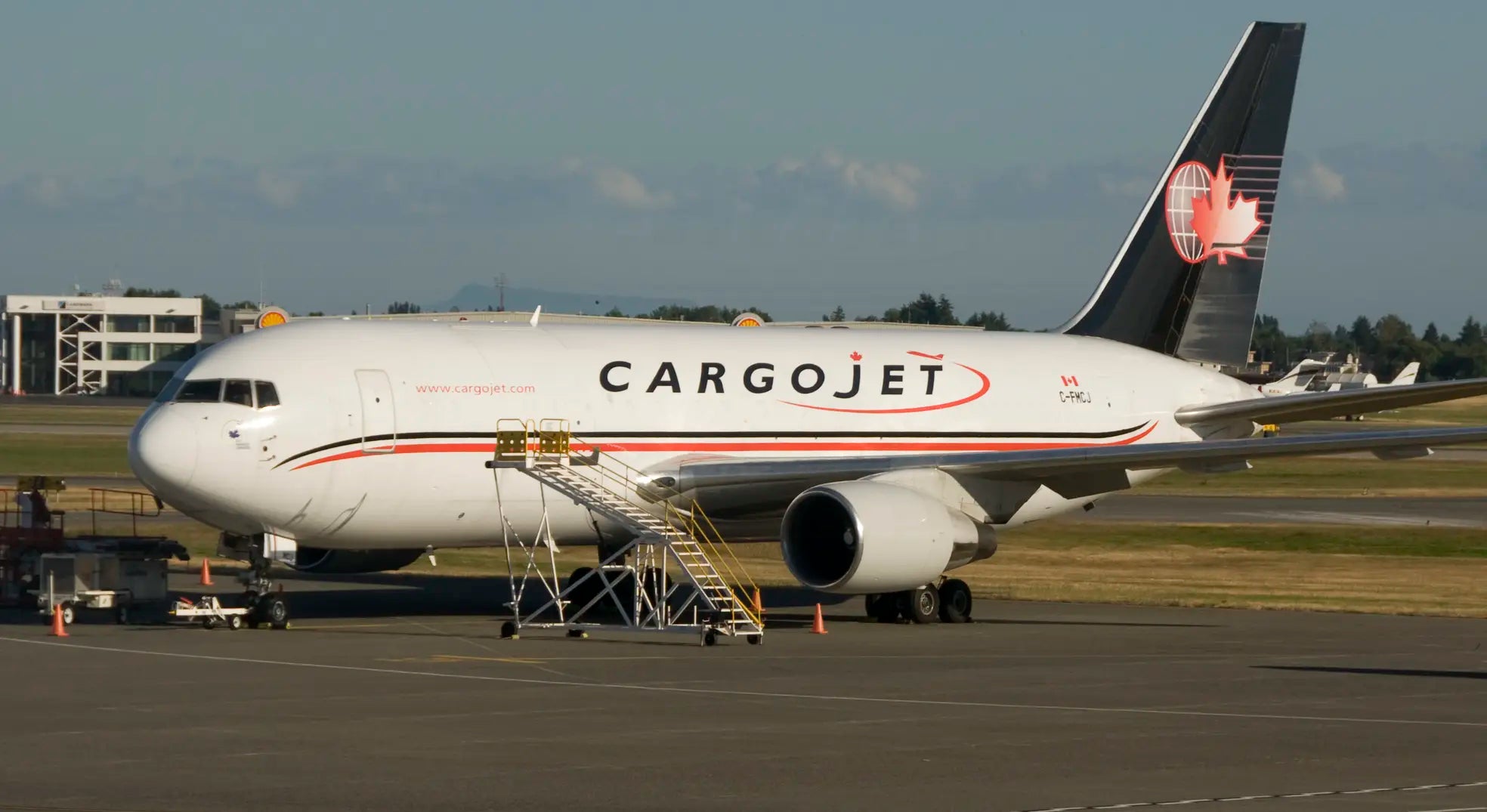
Cargojet Overview & Company Profile
Cargojet Airways (IATA code W8, ICAO CJT) is Canada's dominant scheduled all-cargo airline. Founded as an airline in 2002 under entrepreneur Ajay Virmani, who consolidated earlier overnight cargo operations beginning in 2001, it is the operating subsidiary of Cargojet Inc., a company listed on the Toronto Stock Exchange under the symbol CJT. That public listing matters to pilots: it means audited financial statements, an annual information form, and management circulars are published every year, so the airline's revenue, fleet, contracts, and even pilot-related disclosures are open to scrutiny in a way that privately held cargo operators are not.
The corporate office sits in Mississauga, Ontario, but the operational heart of the airline is John C. Munro Hamilton International Airport (YHM), where Cargojet runs a near 24/7 sorting and flying hub that closes only for short windows in the early hours of Sunday and Monday. From Hamilton, the airline operates a dense overnight hub-and-spoke network that links the major Canadian cities and feeds the country's express and postal supply chains. Cargojet reports flying more than 15,000 flight legs per year, the majority of them at night, and crossed a milestone in 2024 by posting full-year revenue of C$1.0 billion (C$1,000.8 million, up 14.1% from C$877.5 million in 2023, per the company's 2024 results), with net earnings of roughly C$108 million.
The business rests on three pillars: a scheduled domestic overnight network, ACMI (Aircraft, Crew, Maintenance and Insurance) wet-lease flying for other carriers and integrators, and ad-hoc or contracted charter operations. Its anchor customer relationship is with the Canada Post Group, including Purolator's national air network, which guarantees stable banks of overnight flying. Cargojet also flies for Amazon in Canada under an Air Transportation Services Agreement (two Boeing 767-300s), which was extended in July 2025 through March 2029 with an option to 2031, and it counts DHL, UPS and FedEx among its major clients. Long-term customer contracts generate roughly three-quarters of annual revenue, which is the structural reason job security scores well despite the cyclicality of air freight.
For an aspiring or transitioning pilot, the single most important thing to understand before reading any further is that Cargojet is not a passenger airline with a cargo sideline. It is a pure freight operator whose schedule is built around when parcels need to move, which is overnight. That fact colours everything that follows: the pay structure, the roster, the lifestyle, the type of flying, and the kind of pilot who thrives here. Much of the granular detail below is drawn from Cargojet's own corporate filings, the airline's careers portal, ALPA's Cargojet pilot group page, and public pilot-pay databases. Where a figure is dated, estimated, or cannot be independently confirmed, that is flagged explicitly rather than smoothed over.
Fleet Composition & Type Ratings
Cargojet operates an all-Boeing, all-freighter fleet, a deliberate strategy that keeps maintenance, training, and crew qualification streamlined. In its 2026 management circular the company states it owns and operates a fleet of 41 aircraft, built around two families: the narrowbody Boeing 757-200 freighter and the widebody Boeing 767-200 and 767-300 freighter. The great majority of these airframes are passenger-to-freighter conversions (designations such as PCF, BCF and BDSF), which is standard practice in air cargo and helps explain an estimated average fleet age in the high-20-year range according to independent tracker Planespotters.
A notable development arrived in July 2025, when Cargojet took delivery of its first factory-built Boeing 767-300F (registration C-FNPJ), rather than a conversion, with at least one further 767-300 reported as under conversion for delivery in 2026. Prospective applicants should also note an important correction to older online chatter: although Cargojet discussed adding Boeing 777 freighters several years ago, none appear in the company's current official fleet disclosures, so as of 2026 the airline does not operate the 777. Plan your career expectations around the 757 and 767, not the 777.
| Aircraft Type | Role | In Service (approx.) | Notes |
|---|---|---|---|
| Boeing 757-200F (PCF) | Narrowbody freighter | ~16 | Backbone of the domestic overnight network and shorter ACMI sectors. Converted passenger airframes. |
| Boeing 767-200ERF (BDSF) | Widebody freighter | ~3 | Oldest widebody variant in the fleet. Mix of owned and leased. |
| Boeing 767-300ERF (BCF / BDSF) | Widebody freighter | ~22 | Transcontinental trunk routes plus international ACMI and charter. Roughly 16 owned and 6 leased. |
| Boeing 767-300F (factory-built) | Widebody freighter | 1 (+1 in 2026) | First factory freighter, C-FNPJ, delivered July 2025. A further 767-300 was under conversion for 2026. |
| Boeing 777F | Widebody freighter | 0 | Previously discussed but not in service. Absent from all current official fleet lists. |
Fleet figures reconcile Cargojet's 2026 circular (41 aircraft owned/operated) with mid-2025 industry reporting. Counts are approximate and shift with conversions, deliveries, and lease activity. Independent trackers list 43 to 45 airframes depending on parked and on-order aircraft.
Cargojet pilots fly on Transport Canada licences with the appropriate Boeing type rating. The 757 and 767 share a common type rating and a near-identical flight deck, which is one of the biggest structural advantages of this fleet: a pilot qualified on the 757/767 can be deployed across most of the operation, and transitions between the two are far simpler than moving between unrelated types. First Officer postings are advertised as non-type-rated, indicating that Cargojet trains successful candidates rather than requiring them to buy a rating in advance. Specific training bond terms are not publicly disclosed, so confirm them in writing before accepting an offer.
Pilot Salary & Compensation Breakdown
Cargojet pilot pay is governed by a collective agreement and is structured around position (First Officer or Captain), aircraft type, and years of service. The detailed ALPA pay table is not posted publicly, so the figures below blend the most reliable open sources: pilot-pay databases such as AirlinePilotCentral and PilotJobsNetwork, current Cargojet job postings, and aggregator data from Indeed and Glassdoor. All figures are in Canadian dollars and represent estimated annual gross pay, not take-home.
The pay system historically used a "727 scale" baseline (a legacy label that survives even though Cargojet no longer flies the 727), with fixed premiums layered on top for the larger aircraft: roughly +C$10,000 for Captains and +C$6,000 for First Officers on the 757, and +C$20,000 for Captains and +C$12,000 for First Officers on the 767. Compensation is rounded out by overtime, which AirlinePilotCentral reports is paid for flying beyond 85 flight hours per month or for work on a scheduled day off, plus per diems and a company incentive program tied to the most recent contract extension.
First Officer Pay (estimated annual gross, CAD)
| Career Stage | Annual Gross (est.) | Basis |
|---|---|---|
| Year 1 (entry, Level 1) | ~C$80,000 | 2025 Cargojet First Officer posting, Hamilton |
| Years 2 to 5 | ~C$82,000 to C$92,000 | Contractual step increases plus fleet premium |
| Senior F/O (767, 8 to 12 yrs) | ~C$88,000 to C$105,000 | 767 premium plus overtime and per diems |
Entry pay has clearly risen from the older published scales (which showed First Officers in the C$52,000 to C$69,000 range) following recent contract changes, so newer job-posting figures are weighted more heavily here.
Captain Pay (estimated annual gross, CAD)
| Career Stage | Annual Gross (est.) | Basis |
|---|---|---|
| New Captain (757) | ~C$115,000 to C$130,000 | 727 baseline plus 757 premium; internal upgrade or direct entry |
| Captain (767, mid-career) | ~C$135,000 to C$150,000 | 2025 Cargojet Captain posting cited ~C$143,920 |
| Senior Captain (767, 10+ yrs) | ~C$150,000 to C$165,000 | Top of scale plus overtime and international per diems |
Per diems are reported at roughly C$2.50 per duty hour domestic and C$3.50 per duty hour international (AirlinePilotCentral). Overtime above 85 flight hours per month lifts the better-earning years toward the top of each range. Glassdoor estimates a Cargojet Captain near C$150,500.
These figures are estimates compiled from public pilot-pay databases, current Cargojet job postings, and salary aggregators. The exact, current ALPA pay table for Cargojet is not published, and several legacy scales online predate recent contract changes, so treat the numbers as directional rather than definitive. Actual pay depends on fleet assignment, seniority step, monthly block hours, overtime, and the outcome of the successor contract that ALPA opened early in July 2025. Canadian income tax and payroll deductions further reduce take-home pay relative to these gross figures. Always verify against the current collective agreement and a written offer.
Roster, Night Flying & Quality of Life
This is the section that separates Cargojet from a passenger career, and it deserves an honest reading. Cargojet's core domestic operation is intrinsically nocturnal. Parcels are collected during the business day, sorted in the evening, flown overnight, and delivered the next morning, so the bulk of line flying departs late at night and lands in the small hours or at dawn. Pilots routinely operate through the window of circadian low (roughly 02:00 to 06:00), when human alertness is naturally at its weakest. For some pilots, the trade of daytime freedom for night work is genuinely attractive; for others it is the hardest part of the job. Either way, you should go in clear-eyed.
Scheduling operates under Canada's flight and duty time rules in Part VII of the Canadian Aviation Regulations (CARs), administered by Transport Canada. For multi-crew operations these cap flight time at 112 hours in any 28 days, 300 hours in any 90 days, and 1,000 hours in any 365 days. Flight duty periods generally run between 9 and 13 hours depending on start time and number of sectors, can extend up to 18 hours for augmented crews with onboard rest facilities, and require a fatigue risk management system for anything beyond that. The regulations also build in specific protections around consecutive night duties and minimum rest, which is precisely the regime that governs an overnight cargo carrier.
On time off, the public picture is consistent if not perfectly precise. AirlinePilotCentral lists roughly 12 scheduled days off per month, while Pilot Career Centre frames it as approximately 15 work days per month (which implies a similar number of days off). Annual vacation begins at 15 days and rises to 18 days after 10 years of service. That is a solid but not generous package by global standards, and notably leaner than the long leave entitlements seen at major European flag carriers.
📅 Illustrative Month — Narrowbody First Officer (Boeing 757, Hamilton)
Illustrative only. Built to reflect the published ~12 to 15 days off per month and the overnight nature of the network, not an actual Cargojet bid line. Flying days typically begin in the evening and finish overnight or at dawn.
Domestic pairings are frequently out-and-back: a crew departs Hamilton or another base in the evening, operates one or several short sectors between Canadian cities through the night, and returns to base by morning, often with minimal or no away-from-base layover. The 757 in particular can string together multiple short legs with tight turnarounds to meet cargo cut-off and delivery commitments, which raises the number of takeoffs and landings and the workload per duty. Widebody 767 flying on transcontinental and international ACMI routes is the opposite shape: fewer, longer sectors, augmented crews with in-flight rest on the longest legs, and genuine layovers at the destination.
Cargojet pilot postings are advertised as Hamilton (YHM) based, and there is no public evidence of a multi-base bidding system for flight crew of the kind found at large US carriers. Living in the Greater Toronto and Hamilton area keeps the commute short and reserve callouts manageable. Pilots based further afield commute in to start pairings, a common arrangement in Canadian aviation, but reserve and standby obligations make commuting to Hamilton more demanding than at airlines with multiple domiciles. Factor housing costs and commute logistics into any move.
Benefits & Retirement
Cargojet's benefits package is a standard Canadian private-sector employer offering, strengthened by ALPA representation but more modest than the legacy schemes of large passenger flag carriers. The core elements are well documented; a few are not publicly detailed and are flagged below so you can confirm them directly.
Three items are genuinely undocumented in public sources for Cargojet pilots: the precise terms of any loss-of-licence insurance, the extent of parental-leave top-ups beyond the statutory minimum, and the existence of any staff or interline travel benefits. These are not claims that the benefits are absent; rather, the public record does not confirm them. ALPA-represented groups commonly secure loss-of-licence protection, but you should treat all three as open questions and confirm them in writing with Cargojet's HR team or the ALPA Cargojet Master Executive Council before making a career decision based on them.
Cargojet's retirement architecture is defined-contribution in nature: a Deferred Profit Sharing Plan that matches employee RRSP contributions up to about 3%. There is no defined benefit pension. In the Canadian context this is a respectable but unremarkable benefit, and noticeably lighter than the pension entitlements at the largest passenger carriers. Pilots who start contributing early and consistently, and who add their own registered savings on top of the match, can still build a strong retirement position given the competitive base pay and overtime potential.
Career Progression & Seniority
Career movement at Cargojet follows the seniority-based model typical of unionized airlines: a pilot's number on the list drives upgrades, fleet bids, vacation, and schedule choices. There is, however, one defining difference from many flag carriers, and it is one of the most important facts for any applicant to absorb: Cargojet hires Direct-Entry Captains. The company actively advertises external Captain positions for pilots who meet its command minimums, which means the left seat is not filled exclusively by internal upgrade.
This cuts both ways. If you arrive with substantial heavy-jet command experience, you can potentially walk in as a Captain rather than waiting years behind a seniority list. If you join as a First Officer hoping to upgrade from within, direct-entry hiring can slow that path, because external Captains occupy commands that might otherwise have gone to internal pilots. Cargojet does not publish an average upgrade timeline, and with a relatively small pilot group of around 470, upgrade speed is sensitive to fleet growth, retirements, and the balance between internal promotion and external command hiring.
| Career Milestone | Typical Path | Notes |
|---|---|---|
| Join as First Officer (757 or 767) | ~1,000 hrs total time | Company-provided type rating. Hamilton base. |
| Build experience as F/O | Several years | Accumulate jet and PIC time toward command minimums. |
| Internal upgrade to Captain | Seniority and slot dependent | Competes with direct-entry Captain hiring. No published average. |
| Direct-Entry Captain (external) | 5,000 hrs TT | Requires 3,000 hrs jet PIC or 500 hrs PIC on type. Bypasses internal upgrade. |
| Fleet move (757 to 767) | Bid dependent | Shared 757/767 type rating eases the transition. Higher fleet premium on 767. |
| Instructor / check airman roles | Variable | Separate selection. Cargojet advertises instructor positions periodically. |
Cargojet grew its pilot group from roughly 400 in early 2024 to about 470 by 2025, signalling expansion rather than contraction. The fleet is being refreshed with additional 767-300 freighters, including the first factory-built 767-300F in July 2025 and another conversion due in 2026, which supports continued hiring and command opportunities. Air freight is cyclical, and Cargojet's own filings noted softer quarters in 2025, so growth is not guaranteed to be linear. But the anchor contracts with Canada Post, Purolator, Amazon, and DHL give the network a stable floor that many smaller cargo operators lack.
Recruitment Process & Requirements
Cargojet recruits directly into First Officer and Captain seats rather than through an ab-initio cadet academy. There is no funded cadet pipeline of the kind run by some European flag carriers; instead, candidates apply against published experience minimums through the airline's careers portal and third-party pilot job boards. The two entry points have markedly different bars, reflecting the existence of direct-entry command hiring.
First Officer — Requirements
Captain (Direct Entry) — Requirements
Typical Hiring Flow
Application & Document Screening
Apply through the Cargojet careers portal or pilot job boards. Submit licence, medical, logbook summary, and references. Recruiters screen against the total-time, multi-turbine, and PIC minimums for the seat applied for.
Interview
A panel-style interview assessing technical knowledge, CRM and decision-making, suitability for night cargo operations, and cultural fit. Cargojet does not publish its exact interview format, so prepare broadly for both technical and human-factors questions.
Simulator Assessment
A simulator evaluation is common for heavy-jet cargo hiring, particularly for Captain candidates, to confirm instrument flying, handling, and procedural discipline. Treat a sim check as likely even if not advertised.
Conditional Offer & Medical
Successful candidates receive a conditional offer subject to a valid Transport Canada Category 1 medical and background checks. Clarify any training bond terms at this stage, in writing.
Type Rating & Line Indoctrination
Ground school and simulator training for the 757/767 type rating, followed by line training and an initial proficiency check. A probationary period (12 months under the legacy agreement) typically applies from completion of initial training.
Cargojet does not publish a detailed staged selection process, so the sequence above is the typical Canadian heavy-cargo hiring flow rather than an official Cargojet script. Two practical points stand out from the published requirements. First, the First Officer bar (around 1,000 hours total time with 250 multi-turbine) is genuinely accessible to pilots coming off instructing, regional, or charter flying, which makes Cargojet a realistic step up to heavy-jet operations. Second, be honest with yourself about night work in the interview, because thriving in overnight operations is a real selection factor for a carrier whose whole network runs after dark.
Route Network, Bases & Layover Reality
Glamorous layovers are one of the headline perks of passenger long-haul flying, so it is worth being direct: a cargo career is not built around them, and Cargojet is no exception. The honest picture is two distinct worlds of flying. The first is the domestic overnight network, which is the bread and butter of the operation and produces mostly out-and-back duties with little or no time at a destination. The second is the international ACMI and charter flying, which is where genuine layovers, and the variety some pilots love, actually appear.
The domestic network is a hub-and-spoke system anchored at Hamilton, with tightly coordinated overnight banks linking the major Canadian cities. Cargojet's locations and network materials reference stations including Vancouver, Calgary, Edmonton, Winnipeg, Regina, Saskatoon, Toronto, Ottawa, Montreal, Moncton, Halifax, and St. John's, among others. Crews push freight from regional sort centres to the central hub overnight and back out for morning delivery, then return to base, so the typical domestic "layover" is often just a rest stop, not a city visit.
| Network Segment | Representative Routing | Layover Profile |
|---|---|---|
| Domestic overnight network | Hamilton hub to/from major Canadian cities (YVR, YYC, YEG, YWG, YYZ, YUL, YHZ, etc.) | Mostly out-and-back; minimal away-from-base time |
| Transborder Canada to US | Canada to US gateways and the New York to Bermuda corridor | Short layovers, varies by schedule |
| Latin America | ACMI and charter corridors south of the US | Genuine layovers on longer rotations |
| Europe | Transatlantic ACMI on 767 widebody | Overnight rest at destination, augmented crews on long legs |
| China to Canada | Great Vision HK Express scheduled charter on a 767-300F (since May 2024, minimum 3 flights/week) | Long-haul rotations with destination rest |
Network segments confirmed from Cargojet filings and route disclosures. Specific layover hotels, durations, and city assignments are not published and are deliberately not invented here.
The China-Canada agreement with Great Vision HK Express, launched in May 2024 with a minimum of three flights per week on a 767-300F, is the clearest example of how international contract flying expands a Cargojet pilot's world beyond the overnight domestic grind. ACMI work by its nature is variable: routes, frequencies, and layover points shift with the customer's needs, which means the international flyer trades predictability for variety. Whether you get more domestic or more international flying depends on your fleet, your seniority, and the contract mix at the time.
Under CARs Part VII, rest requirements scale with duty length, time-zone shifts, and consecutive night duties, and long-haul international sectors trigger augmented crews with onboard rest. In practice that means the 767 international flyer sees real overnight rest at foreign stations, while the 757 domestic flyer is far more likely to be home, or at base, by morning. If layover travel and seeing the world from a crew hotel is a core motivation for you, understand that at Cargojet this is a feature of the widebody international flying, not of the network that most defines the airline.
How Cargojet Compares: Airline Radar Chart
Most Canadian pilots weigh a cargo career at Cargojet against the country's two major passenger carriers, Air Canada and WestJet, both also ALPA-represented. The radar below compares the three across five metrics. Scores are editorial estimates based on publicly available salary data, contract reporting, fleet information, and pilot feedback. They describe a general assessment for an experienced pilot weighing a long-term career, not a guarantee for any individual.
Key Takeaways from the Comparison
The passenger majors win on top-end pay. Air Canada First Officers start around C$87 per hour and its senior widebody Captains top out near C$424 per hour on the Boeing 777 under the 2024 ALPA contract, with senior 787 Captains reported around C$390 per hour. WestJet, after a contract delivering roughly 24% in raises across four years, sees top 787 Captains near C$335 per hour. Cargojet's estimated Captain ceiling of around C$150,000 to C$165,000 a year is competitive within the cargo segment and sits above the national pilot average, but it does not reach the heights of widebody passenger command.
Cargojet's edge is the on-ramp and the command path. A First Officer minimum near 1,000 hours total time is far more accessible than the experience pools that feed Air Canada and WestJet, and Cargojet's willingness to hire direct-entry Captains means an experienced pilot can reach the left seat without queueing behind a long seniority list. By contrast, Air Canada quotes 3 to 5 years to a narrowbody command and 11 to 15 years to widebody, while WestJet upgrades are commonly described in the 7 to 10 year range.
Work-life and benefits favour the passenger carriers. The overnight-heavy schedule is the single biggest quality-of-life cost at Cargojet, and the passenger majors offer broader benefits, staff travel, and in places richer retirement provisions. Cargojet's RRSP match of around 3% and lighter perks reflect its cargo cost structure.
Job security is a genuine Cargojet strength. A TSX-listed balance sheet, C$1 billion in 2024 revenue, and multi-year anchor contracts (Canada Post, Purolator, Amazon to 2029/2031, DHL reportedly to 2033) give the network a stable floor. For a pilot who values predictable employment and is comfortable flying at night, that stability is a meaningful counterweight to the lifestyle trade-offs.
Scores are editorial estimates drawn from public salary databases (AirlinePilotCentral, PilotJobsNetwork, Glassdoor, Indeed), published contract reporting for the Air Canada 2024 and WestJet 2023 ALPA agreements, fleet data, and pilot community sources. They reflect a general assessment for an experienced pilot and will vary by seniority, fleet, and personal priorities. A direct cargo comparator worth researching separately is Morningstar Air Express, the FedEx Canada feeder, which advertised Boeing 757 First Officer starting pay around C$92,634.
Union & Industrial Relations
Cargojet pilots are represented by the Air Line Pilots Association, International (ALPA), the largest pilot union in North America. This is a relatively recent development and an important one for anyone evaluating the airline. For most of the past decade, Cargojet pilots were represented by Unifor (Local 7378), which negotiated the foundational pilot agreements. In 2025 the Canada Industrial Relations Board recognized ALPA as the pilots' bargaining agent, moving Cargojet into the same union framework that covers Air Canada, WestJet, and many North American cargo groups.
Contract Status & Negotiations
The collective agreement in force traces back to a Unifor-negotiated contract for July 1, 2018 to June 30, 2023, which was later extended by 36 months to June 30, 2026 (with associated workload, scheduling, and incentive changes). On July 17, 2025, ALPA announced that Cargojet pilots had voted overwhelmingly to open negotiations early on a successor contract, well ahead of expiry. As of mid-2026, that successor agreement is the live issue, and it is the document that will define pay scales, roster protections, and benefits going forward. The published pay figures in this guide predate any new agreement and should be read in that light.
How the Framework Fits Together
Industrial Climate
The labour relationship has been businesslike rather than combative. Public sources show no pilot strikes, no strike-authorization votes, and no formal conciliation process at Cargojet through the current negotiating cycle. The original 2018 Unifor contract reportedly raised compensation by about 20% and included a no-strike, no-lockout commitment, and the 2019 extension added a retention bonus. There has been documented friction, notably a dispute over flight-and-duty-time fatigue-rule exemptions in which ALPA publicly criticized the arrangements before it represented the group, but that played out as a regulatory and inter-union safety debate rather than a work stoppage.
Joining Cargojet today means joining an ALPA-represented group at a pivotal moment: the successor contract being negotiated now will shape pay and conditions for years. That is both an opportunity (momentum and pilot engagement are high) and an uncertainty (terms are not yet settled). The track record is one of bargaining without work stoppages, which is reassuring for income stability. Union membership and active engagement with the Cargojet MEC are the best ways to stay current on where negotiations land and how they affect your seat, fleet, and seniority.
Verdict: Who Is Cargojet For?
🎯 Our Take
Cargojet is the strongest dedicated heavy-jet cargo career in Canada, and for the right pilot it is an excellent one. It offers an accessible entry point (a First Officer minimum near 1,000 hours), real heavy-jet experience on the Boeing 757 and 767, the rare option of a direct-entry command for experienced applicants, ALPA representation, and unusually solid job security underpinned by a TSX-listed balance sheet and multi-year anchor contracts with Canada Post, Purolator, Amazon, and DHL.
The trade-offs are equally real and centre on lifestyle. The network is built around overnight flying, so circadian disruption is the defining feature of the job, not an occasional inconvenience. Pay is competitive within the cargo segment and above the national pilot average, but it does not match the top-end widebody command salaries at Air Canada or WestJet. Benefits are sound but modest: an RRSP match around 3% rather than a defined-benefit pension, and limited staff-travel perks given the all-cargo model. A handful of benefit details, including loss-of-licence cover, are not publicly documented and should be confirmed directly.
For a pilot who wants to fly big Boeings, values employment stability over glamour, and can genuinely live with night work, Cargojet is a compelling long-term home. For a pilot whose priorities are daytime schedules, maximum pay, and extensive travel perks, the passenger majors are the better fit.
1 What are the minimum requirements to be hired as a Cargojet First Officer?
Cargojet First Officer postings list roughly 1,000 hours total time and about 250 hours multi-engine turbine, plus a Transport Canada ATPL, or a CPL with the IATRA, SAMRA, and SARON written exams passed, and a valid Category 1 medical. The role is advertised non-type-rated, which indicates Cargojet provides the 757/767 type rating to successful candidates. These minimums make Cargojet one of the more accessible heavy-jet operators in Canada for pilots stepping up from instructing, regional, or charter flying.
2 Does Cargojet hire direct-entry Captains?
Yes. Cargojet advertises external Captain positions with minimums of around 5,000 hours total time and either 3,000 hours of transport-jet PIC time or 500 hours of PIC on type (757 or 767), plus an ATPL. This is a meaningful difference from carriers that fill all commands internally: an experienced pilot can be hired straight into the left seat. The flip side is that direct-entry hiring can lengthen the internal upgrade path for First Officers already on the list.
3 Is all Cargojet flying done at night?
The core domestic network is overnight by design, because it exists to move parcels for next-morning delivery, so most line flying departs late and finishes in the small hours or at dawn. Crews regularly operate through the window of circadian low. International ACMI and charter flying on the 767 can have different patterns with daytime departures and destination layovers, but a Cargojet career should be planned around the expectation of substantial night work.
4 How much do Cargojet pilots earn?
Based on public databases and job postings, entry First Officers earn around C$80,000 a year, rising toward C$90,000 to C$105,000 for senior 767 First Officers with overtime. Captains range from roughly C$115,000 to C$130,000 on the 757 up to about C$150,000 to C$165,000 for senior 767 Captains, with a 2025 posting citing around C$143,920 and Glassdoor near C$150,500. These are estimates in Canadian dollars; the precise ALPA pay table is not public, and a successor contract under negotiation since July 2025 may change them.
5 Where are Cargojet pilots based?
Pilot positions are advertised as based at John C. Munro Hamilton International Airport (YHM), the airline's main hub. There is no public evidence of a multi-base bidding system for flight crew. Pilots who live elsewhere in Canada commute in to start their pairings, but reserve and standby obligations make proximity to Hamilton an advantage compared with airlines that offer several domiciles.
6 Which union represents Cargojet pilots, and is a strike likely?
Cargojet pilots are represented by ALPA, which the Canada Industrial Relations Board recognized as the bargaining agent in 2025, replacing Unifor. The current agreement was extended to June 30, 2026, and pilots voted to open successor negotiations early in July 2025. Public records show no strikes, strike votes, or conciliation at Cargojet, and the earlier contracts included no-strike, no-lockout provisions, so the labour history is stable, though the successor contract remains to be settled.
7 Does Cargojet operate the Boeing 777, and what will I fly?
No. Despite earlier discussion of adding Boeing 777 freighters, none appear in Cargojet's current official fleet disclosures. New pilots should expect to fly the Boeing 757-200 or the Boeing 767-200/300 freighter. The 757 and 767 share a common type rating, which simplifies moving between the narrowbody and widebody fleets as seniority allows.
8 How does a Cargojet cargo career compare to Air Canada or WestJet?
Air Canada and WestJet offer higher top-end pay (widebody Captains well above Cargojet's ceiling), broader benefits, staff travel, and daytime-inclusive schedules, but they require more experience to enter and longer internal upgrade times. Cargojet counters with a lower entry bar, direct-entry command opportunities, genuine heavy-jet flying, and strong contract-backed job security, at the cost of an overnight-heavy lifestyle and leaner perks. The right answer depends on whether you prioritize lifestyle and maximum pay or accessibility, command speed, and stability.
Official Links & Resources
Before applying or making any career decisions, verify information directly with official and primary sources. These are the key resources relevant to a Cargojet pilot career:
Pair the official Cargojet careers page with the ALPA Cargojet pilot group page. The careers portal tells you what the company is hiring for, while the ALPA page is the fastest way to track where the successor contract negotiations stand, which directly affects the pay scales, roster rules, and benefits described throughout this guide. Confirm any undocumented benefit (loss-of-licence cover, parental-leave top-ups, training bonds) in writing before accepting an offer.