

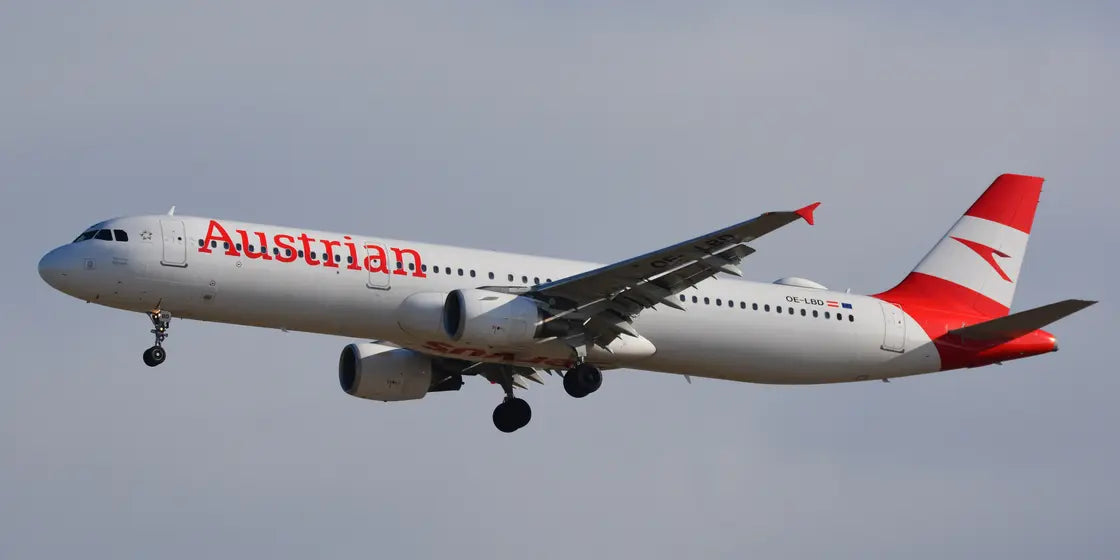
Austrian Airlines Overview & Company Profile
Austrian Airlines is the flag carrier of Austria, founded on September 30, 1957, and headquartered at Vienna International Airport (VIE) in Schwechat. The airline traces its heritage back to 1923, when the original Osterreichische Luftverkehrs AG (OLAG) conducted its first flight between Vienna and Munich. Since 2009, Austrian Airlines has been a wholly owned subsidiary of the Lufthansa Group, one of the world's largest aviation groups. It became a member of Star Alliance in March 2000, giving its passengers and crew access to one of aviation's most extensive global networks.
Austrian Airlines employs approximately 1,000 pilots and operates around 330 flights per day during peak periods, connecting Vienna to 138 destinations across 55 countries. The airline's strategic position in Central Europe, particularly its "Focus East" strategy launched in 2004, has made it the market leader in transfer traffic between Eastern and Western Europe. In 2024, the airline generated revenue of €2.46 billion and carried 14.6 million passengers, a five percent increase year-on-year. Adjusted EBIT for 2024 stood at €76 million, with profitability impacted by a 36-hour crew strike in March 2024 (€35M impact) and Middle East conflict disruptions (€41M impact).
Fleet Composition & Type Ratings
Austrian Airlines operates a mixed fleet of 68 aircraft, split between Airbus narrowbodies for European routes and Boeing widebodies for intercontinental services. The airline is in the midst of a significant fleet renewal program that will transform the fleet by 2028-2029. New Boeing 787-9 Dreamliners are replacing the aging 777 and 767 widebodies, while Airbus A320neo and A321neo deliveries are progressively replacing the legacy A320ceo fleet. The Embraer 195 regional jets are also being phased out, with all 17 aircraft scheduled for transfer to Air Dolomiti by 2028.
| Aircraft Type | Role | In Service | Routes / Notes |
|---|---|---|---|
| Airbus A320-200 | Narrowbody | 29 | European short/medium-haul workhorse. Avg. age 19.4 yrs. Being replaced by A320neo. |
| Airbus A321-100/200 | Narrowbody | 6 | Higher-capacity European routes. Avg. age 24-28 yrs. Being phased out. |
| Airbus A320neo | Narrowbody | 5 | New-gen European fleet. 180 seats. 20% less fuel, 50% quieter. 11 more on order + 6 A321neo. |
| Embraer 195 | Regional | 17 | 120 seats. Medium-haul & secondary routes. Full retirement by 2028 (transfer to Air Dolomiti). |
| Boeing 777-200ER | Widebody | 6 | Flagship long-haul. 330 seats (3-class). LAX, NRT, BKK, JFK. Retirement by 2028. |
| Boeing 767-300ER | Widebody | 3 | Mid-capacity long-haul. 211 seats (3-class). Retirement by 2027. |
| Boeing 787-9 | Widebody | 2 | New flagship. 294 seats (3-class). 12 total planned by 2028 (5 from LH + 5 on order). |
Fleet data as of late 2025. Numbers are approximate and change with ongoing deliveries, retirements, and transfers within the Lufthansa Group.
New First Officers at Austrian Airlines typically begin on the Airbus A320 family, which forms the backbone of the European network. Type rating costs are covered by the airline for pilots recruited through the official selection process. Transition to widebody types (B787, B777) is seniority-based. The fleet modernization means pilots joining now will likely transition to the A320neo/A321neo and eventually the Boeing 787-9 as older types retire. Each aircraft transition requires formal type rating training, ranging from a few days for related Airbus variants to two to three weeks for a full Boeing type conversion.
Pilot Salary & Compensation Breakdown
Austrian Airlines pilot salaries are governed by a collective agreement negotiated between the airline, the vida trade union, and employee representatives. The most recent agreement, concluded in April 2024 after a 36-hour strike, provided average salary increases of 19.4% distributed across three phases (April 2024, January 2025, and January 2026). First Officers received an additional 11% average increase on top of this. Austrian salaries are typically paid 14 times per year (12 monthly payments plus holiday and Christmas bonuses), which is standard in Austria.
First Officer (F/O) Pay Scale
| Seniority | Monthly Gross | Annual Gross (est.) | Notes |
|---|---|---|---|
| Year 1 (entry) | €6,082 | ~€85,000 | 14x monthly. Entry-level on A320. |
| Year 3 | €6,558 | ~€92,000 | Incremental seniority step. |
| Year 5 | €7,034 | ~€98,000 | Mid-level F/O. |
| Year 10 | €8,225 | ~€115,000 | Senior F/O, potential widebody transition. |
| Year 15 | €9,000 | ~€126,000 | Top-tier F/O before Captain upgrade. |
| Year 20 | €9,410 | ~€132,000 | Maximum F/O scale. |
Figures are gross monthly pay (x14 for annual estimate). Actual take-home depends on Austrian income tax (up to ~50%) and social contributions (~18% employee share). Per diems, overtime, and bonuses are additional.
Captain (CDR) Pay Scale
| Seniority | Monthly Gross | Annual Gross (est.) | Notes |
|---|---|---|---|
| Year 1 (upgrade) | €8,575 | ~€120,000 | Entry Captain, typically narrowbody. |
| Year 5 | €9,640 | ~€135,000 | Mid-career Captain. |
| Year 10 | €10,439 | ~€146,000 | Experienced Captain, possible widebody. |
| Year 15 | €12,303 | ~€172,000 | Senior Captain. |
| Year 20 | €13,634 | ~€191,000 | Maximum Captain scale. Top of pay grid. |
Long-haul widebody Captains at maximum seniority can exceed €190,000 gross annually when all allowances and bonuses are included.
These salary figures are based on data from PilotJobsNetwork, industry reports, and the April 2024 collective agreement terms reported in Austrian media. Actual compensation depends on the specific collective agreement step, aircraft type assignment, flight hours logged, and per diem allowances. Austrian income tax is progressive (up to ~50% marginal rate), and employee social security contributions total approximately 18% of gross salary. Always verify current figures with the latest vida/ACA publications before making career decisions.
Roster Pattern & Quality of Life
Austrian Airlines operates under EASA Flight Time Limitation (FTL) rules combined with the vida collective agreement, which together define the scheduling framework for all flight crew. Pilots receive approximately 6 elective days off per month (Days to Choose Off, or DBF), plus additional rostered days off. In total, pilots typically have around 12 to 15 days off per month depending on the operational period. Pilots may also submit three preferred flight requests per month, though final assignments depend on seniority bidding and operational needs.
📅 Sample Month — A320 First Officer (VIE)
Long-haul crews on the Boeing 777 or 787 operate on different patterns: a typical rotation involves one or two long sectors with 24 to 48 hour layovers at destination, followed by several days off for recovery. Augmented crews (3 to 4 pilots) are used on flights exceeding 11 hours, such as Vienna to Los Angeles or Tokyo, allowing in-flight rest periods.
Austrian Airlines pilots are primarily based at Vienna International Airport (VIE), with secondary bases at Graz, Innsbruck, and Salzburg for selected regional operations. Vienna is the main hub for both short-haul and long-haul operations. Living in or near Vienna is the default expectation, though some pilots commute from other Austrian or Central European cities. Vienna offers a high quality of life, excellent public transport, affordable housing (relative to Paris or London), and consistently ranks among the world's most liveable cities. The cost of living is moderate by Western European standards, and the city's central European location allows easy travel across the continent.
Benefits, Travel Perks & Retirement
As a Lufthansa Group subsidiary operating under Austrian labor law, Austrian Airlines offers pilots a comprehensive benefits package that combines strong statutory Austrian employee protections with group-wide Lufthansa perks. The travel benefits alone, covering the entire Lufthansa Group and Star Alliance network, make this one of the most attractive packages among European carriers.
Lufthansa Group staff travel privileges are among the most generous in European aviation. Pilots and their families can fly on any Lufthansa Group airline (Austrian, Lufthansa, SWISS, Brussels Airlines, Eurowings, Edelweiss, and more) at heavily reduced fares or for free on standby. The network covers over 300 destinations across six continents. Fixed-price bookings at 30-50% below published fares are also available for confirmed travel. These benefits begin on day one of employment, with no waiting period. For pilots who love to travel, this is one of the strongest reasons to consider a Lufthansa Group carrier.
Career Progression & Seniority
Career progression at Austrian Airlines is strictly seniority-based. Your seniority number is assigned on your first day and determines everything from schedule bidding and vacation timing to fleet assignment and Captain upgrade eligibility. The airline does not accept direct-entry Captains: all command positions are filled through internal upgrade. The current upgrade timeline from First Officer to Captain is estimated at approximately 5 to 8 years, though this fluctuates with retirement waves, fleet expansion, and hiring rates. Pilots recruited during the post-COVID recovery period (2022-2024) may benefit from accelerated timelines as a wave of retirements approaches.
| Career Milestone | Typical Timeline | Notes |
|---|---|---|
| Join as F/O (A320 family) | Day 1 | Most common entry fleet. Type rating funded by the airline. |
| Senior F/O (narrowbody) | 3-5 years | Higher seniority steps, better schedule bidding. |
| Captain upgrade (narrowbody) | 5-8 years | Command assessment: interview + simulator check. Not guaranteed. |
| Widebody F/O transition | 5-10 years | B787 or B777. Seniority-dependent bid. |
| Widebody Captain | 10-15+ years | B787-9 or B777-200ER command. Top of seniority list. |
| Training Captain / TRE / TRI | Variable | Requires separate selection and instructor training pathway. |
Austrian Airlines is in the middle of a major fleet transformation. By 2028, the airline will operate up to 12 Boeing 787-9 Dreamliners, replacing the older 777 and 767 fleets. Simultaneously, 17 new A320neo and A321neo aircraft will replace the legacy narrowbody fleet. This creates significant type rating transition opportunities and potentially accelerates seniority progression as older aircraft retire. Pilots joining now are well-positioned to ride this modernization wave, gaining experience on both current and next-generation aircraft. The Lufthansa Group structure also offers potential (though not guaranteed) lateral transfer opportunities to Lufthansa, SWISS, or other group carriers, though seniority resets on any such move.
Recruitment Process & Requirements
Austrian Airlines recruits pilots through two pathways: the lateral entry stream (experienced pilots from other airlines) and periodic ab-initio cadet programmes (candidates with no flight experience, typically offered every 3-5 years via the Austrian Airlines careers portal). Both pathways lead to the same seniority list and career progression. The selection process is demanding and multi-stage, reflecting the airline's position as a prestigious European flag carrier.
Minimum Requirements
Selection Stages
Online Application & Screening
Submit CV, licenses, medical certificate, training records, and references via the Austrian Airlines careers portal. HR screening eliminates candidates not meeting minimum requirements. Turnaround is typically 2-4 weeks.
Aptitude & Psychometric Testing
Computer-based tests assessing mathematical aptitude, spatial reasoning, multi-tasking, reaction time, and decision-making under pressure. Similar in format to DLR/Lufthansa Group assessments. This stage eliminates the majority of applicants.
Assessment Centre & Interview
Group exercises, individual presentation, and structured interview with pilot recruitment specialists and senior captains. Focus on CRM skills, leadership potential, motivation, and cultural fit. Conducted partly in German.
Simulator Evaluation
Full-motion simulator assessment evaluating technical proficiency, standard and emergency procedures, judgement, and safety consciousness. Check airmen observe and score the session. For experienced pilots, this may include type-specific scenarios.
Medical & Contract
Final Class 1 medical verification and contract offer. Successful candidates receive a start date and type rating assignment (typically A320 family for new joiners). Type rating training is company-funded.
German language fluency is absolutely critical. Unlike some Lufthansa Group carriers where English-only pathways exist, Austrian Airlines operates predominantly in German. All internal communications, briefings, and union interactions are in German, and the selection process includes German-language components. Candidates should also prepare thoroughly for the DLR-style aptitude tests, as these carry significant weight. The Austrian Cockpit Association (ACA) website provides useful resources for aspiring pilots considering Austrian carriers.
Top 5 Layover Destinations
Austrian Airlines operates an intercontinental network from Vienna that, while smaller than Air France or Lufthansa, includes some genuinely attractive long-haul destinations. Layovers on these routes typically last 24 to 48 hours, with augmented crews (3-4 pilots) used on ultra-long sectors exceeding 11 hours. Hotels are contracted by the airline and are generally 4-star properties. Here are five of the most notable layover destinations for Austrian Airlines pilots.
All crew hotels are contracted by the airline. Transport between hotel and airport is provided. Under EASA FTL rules, pilots must have a minimum 10-hour rest opportunity before the next duty period, with 8 hours of uninterrupted sleep. Flights over 11 hours require augmented crews (3-4 pilots), and layovers are typically 24 hours minimum. Layover destinations are determined by your roster bid and seniority: more senior pilots get first pick of the most popular routes.
How Austrian Airlines Compares: Airline Radar Chart
How does Austrian Airlines stack up against two comparable Lufthansa Group carriers: Swiss International Air Lines (SWISS) and Eurowings? Below is a comparative analysis across the same five core metrics. Scores are editorial estimates based on publicly available data, pilot feedback, and industry benchmarks.
Key Takeaways from the Comparison
SWISS leads on compensation. Entry-level First Officers at SWISS earn approximately €99,700 annually, compared to Austrian's €85,000. Senior SWISS Captains can reach €206,000, exceeding Austrian's top Captain pay of ~€191,000. However, Switzerland's higher cost of living partially offsets this nominal advantage. SWISS also offers dual bases (Zurich and Geneva), giving pilots more geographic flexibility than Austrian's Vienna-centric model.
Austrian offers a strong middle ground. While not matching SWISS salaries, Austrian Airlines significantly outperforms Eurowings on compensation, benefits, and career structure. Entry Eurowings First Officers earn as little as €44,000-€50,000, roughly 40% less than Austrian. Austrian's flag carrier status, long-haul network, and Lufthansa Group pension make it a more complete career proposition than any LCC, even within the same group.
Eurowings wins on base flexibility. Eurowings offers multiple bases across Europe (Prague, Berlin, Cologne, and more), allowing pilots to live in their preferred country. Austrian's Vienna focus is a limitation for pilots who do not wish to relocate to Austria. Eurowings also offers part-time scheduling models not available at Austrian.
Fleet diversity favours Austrian and SWISS. Both network carriers offer narrowbody and widebody fleets, giving pilots a career path from short-haul to intercontinental operations. Eurowings is primarily narrowbody-only (though this is evolving with new long-haul expansion). Austrian's incoming 787-9 fleet is a significant draw for pilots interested in modern long-haul flying.
Scores are editorial estimates based on research into publicly available salary data, pilot forums, union publications, and industry benchmarks (ECA, PilotJobsNetwork, IFALPA). They represent a general assessment for an experienced pilot considering a long-term career. Individual experiences vary based on seniority, fleet, and personal priorities. These scores will be updated as new data becomes available.
Union & Industrial Relations
Understanding the union landscape is essential for any pilot considering Austrian Airlines. Two organisations play key roles in representing pilots: the Austrian Cockpit Association (ACA), which is the independent professional advocacy body for Austrian commercial pilots, and the vida trade union (Vereinigte Dienstleistungsgewerkschaft), which handles collective bargaining and industrial negotiations on behalf of flight crew.
Representation Structure
Recent Strike History & Key Disputes
The March 2024 strike was significant but ultimately productive for pilots: the resulting 19.4% salary increase (plus additional F/O uplift) was one of the strongest outcomes across the entire Lufthansa Group that year. The "peace obligation" through December 2026 means no further strikes are expected in the near term. For new recruits, ACA membership is strongly encouraged (all delegates are volunteer active pilots), and vida union membership ensures you are covered by the collective agreement. The strong 94% strike vote demonstrated remarkable pilot solidarity, which typically translates into effective representation in future negotiations.
Verdict: Who Is Austrian Airlines For?
🎯 Our Take
Austrian Airlines is a solid flag carrier choice for German-speaking pilots seeking a balanced career that combines European short-haul flying with genuine long-haul opportunities. The Lufthansa Group backing provides financial stability, world-class travel benefits, and a pension structure that few independent carriers can match. The fleet modernization programme (12 Boeing 787-9s and 17 new A320neo/A321neo aircraft by 2028) signals genuine investment in the future and creates real career advancement opportunities for pilots joining now.
The trade-offs are honest: salaries are competitive within the Austrian market but trail SWISS and some other Western European flag carriers in gross terms. The Vienna-only base limits geographic flexibility. The fleet is mid-sized, meaning fewer routes and less variety than larger carriers like Lufthansa mainline or Air France. And Austrian income tax rates (up to ~50%) plus social charges significantly reduce take-home pay compared to Gulf or US carriers.
For the right pilot, though, Austrian Airlines offers something genuinely appealing: a prestigious flag carrier career in one of Europe's most liveable cities, with a manageable upgrade timeline, modern aircraft, and the security of the Lufthansa Group behind it.
1 Do I need to speak German to fly for Austrian Airlines?
Yes. Fluent German is mandatory for all pilot positions at Austrian Airlines. German is the working language of the airline, used for internal communications, briefings, union interactions, and parts of the selection process. Non-native German speakers must demonstrate full professional fluency. There is no English-only pathway.
2 Does Austrian Airlines pay for the type rating?
Yes. For pilots recruited through the official selection process (both lateral entry and cadet pathways), Austrian Airlines covers the cost of type rating training. New joiners are typically assigned to the Airbus A320 family. Subsequent fleet transitions (e.g., to the Boeing 787-9) are also company-funded.
3 How long does it take to upgrade to Captain?
Current estimates suggest approximately 5 to 8 years for Captain upgrade at Austrian Airlines, depending on your hiring cohort, retirement rates, and fleet expansion. The airline does not accept direct-entry Captains. All upgrades are internal and seniority-based. The upgrade process involves a command assessment including interview and simulator check, and is not guaranteed on first attempt.
4 Can non-EU citizens apply?
Non-EU citizens may apply if they hold a valid Austrian work permit. However, the vast majority of successful candidates are EU/EEA citizens. Austrian Airlines does not typically sponsor work visas for pilot positions. EU citizenship or existing Austrian residency/work authorization is strongly preferred.
5 How does Austrian Airlines pay compare to other Lufthansa Group carriers?
Austrian Airlines pilot pay sits in the middle of the Lufthansa Group range. SWISS pays significantly more (entry F/O ~€99,700 vs. Austrian's ~€85,000), reflecting Switzerland's higher cost of living. Eurowings pays considerably less (entry F/O ~€44,000-€50,000). Lufthansa mainline compensation is generally comparable to or slightly above Austrian levels. The 2024 collective agreement brought Austrian salaries closer to group averages with a 19.4% increase.
6 Is Austrian Airlines a good first airline job?
Yes, particularly for German-speaking pilots. The combination of flag carrier prestige, comprehensive training, Lufthansa Group benefits, and a clear career path from A320 F/O to widebody Captain makes Austrian Airlines an excellent career foundation. The ab-initio cadet programme (when available) provides a fully funded pathway for candidates with no flight experience. Competition is significant, but successful candidates gain a lifetime career at a respected European carrier.
7 What is the retirement age for Austrian Airlines pilots?
Under EASA regulations, commercial airline pilots may operate as part of a multi-pilot crew until age 65. Austrian Airlines follows this standard. The mandatory retirement age for Austrian state pension purposes is 65 for men and 60 for women (though the women's retirement age is gradually equalizing to 65). Pilots receive combined benefits from the Austrian state pension, the Lufthansa Group occupational pension, and any private pension arrangements.
8 Can I transfer to Lufthansa or SWISS from Austrian Airlines?
Lateral transfers within the Lufthansa Group are possible but not guaranteed, and they come with a significant caveat: your seniority resets to zero at the new airline. This means starting at the bottom of the seniority list regardless of your experience. Some pilots choose to stay at Austrian precisely because their seniority number is more valuable than a potential salary increase at a larger carrier. Transfers typically require meeting the hiring requirements of the destination airline and going through their standard selection process.
Official Links & Resources
Before applying or making any career decisions, always verify information directly with official sources. These are the key websites and organisations relevant to Austrian Airlines pilot careers:
Bookmark the ACA website (aca.or.at) for the latest pilot-specific developments in Austrian aviation. For Lufthansa Group-wide career opportunities, also check the Lufthansa Group careers portal, which lists pilot positions across all group airlines including Austrian, Lufthansa, SWISS, Brussels Airlines, and Eurowings.