

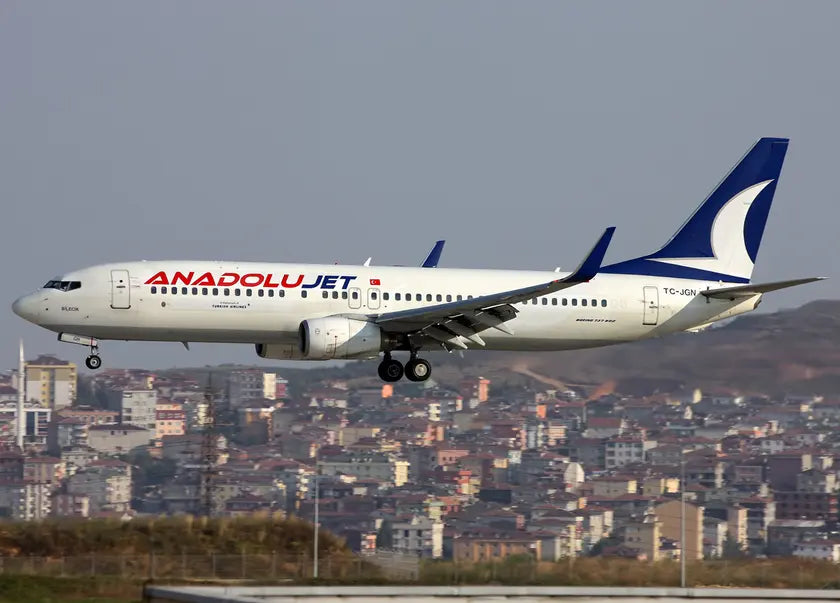
AJet Overview & Company Profile
AJet is the low-cost subsidiary of Turkish Airlines, founded as AnadoluJet on 23 April 2008 and rebranded as a fully independent airline on 31 March 2024 after receiving its own Air Operator Certificate from Turkey's civil aviation authority (SHGM) on 2 January 2024. Officially registered as AJet Hava Taşımacılığı Anonim Şirketi, the carrier operates under IATA code VF, ICAO code TKJ and callsign ANATOLIA. Its main hub is Istanbul Sabiha Gökçen International Airport (SAW), with a secondary base at Ankara Esenboğa (ESB).
The rebrand was not a cosmetic exercise. AJet now operates as a legally separate entity with its own AOC, commercial agreements, livery and pilot contracts, while remaining 100 percent owned by Turkish Airlines. This structure allows the parent group to compete head-to-head with Pegasus Airlines in the Turkish low-cost market without being constrained by Turkish Airlines' mainline labour agreements. According to the airline, AJet carried over 23 million passengers in 2025 and now connects 42 domestic points with 58+ international destinations across 33 countries, placing it among the fastest-growing carriers in Europe and the Middle East.
The airline's expansion plan is aggressive. AJet has stated it intends to reach roughly 107 aircraft by the end of 2026 and 200 aircraft by 2033, with up to 199 destinations served by the end of that period. For pilots, this means sustained hiring demand on both the Boeing 737 and Airbus A320 fleets, faster upgrades than at most European legacy carriers, and a formal transfer pathway to Turkish Airlines mainline. The trade-off is that AJet sits outside the Star Alliance, unlike its parent. Pilots benefit indirectly through Turkish Airlines staff travel but do not get a direct alliance-wide commercial relationship.
AJet's position in the Turkish market is unique. It does not operate under Turkish Airlines' flight code anymore, but inherits a powerful brand association, a robust safety culture, and a long-haul fallback option that no independent low-cost competitor can match. Information about its strategy and route network is published on the official AJet corporate website, while regulatory oversight is provided by Turkey's Directorate General of Civil Aviation (SHGM).
Fleet Composition & Type Ratings
AJet operates a deliberately mixed narrowbody fleet built around two parallel families: the Boeing 737 (NG and MAX) and the Airbus A320 family (ceo and neo). This dual-fleet structure is unusual among low-cost carriers, which typically standardise on one manufacturer. It exists because AJet inherited a large 737-800 fleet from Turkish Airlines at the moment of separation, while taking on A320neo and A321neo deliveries originally destined for Russian carrier S7 Airlines that became available after 2022. As of late 2025, the airline operates roughly 85 aircraft, with planespotting and corporate sources placing the total in the 85–116 range depending on how leased ACMI capacity is counted.
| Aircraft Type | Role | In Service (approx.) | Notes |
|---|---|---|---|
| Boeing 737-800 | Narrowbody | ~42–44 | Inherited from Turkish Airlines. 186–189 seats, all-economy. Being phased out as MAX deliveries arrive. |
| Boeing 737 MAX 8 | Narrowbody | ~12–25 | 168–176 seats. Featured aircraft for fleet renewal. DAE leasing 10 additional 737-8s through 2026–27. |
| Airbus A320-200 | Narrowbody | ~5 | Previous generation, limited operations. |
| Airbus A320neo | Narrowbody | ~27 | CFM LEAP engines. Many sourced from cancelled S7 Airlines orders. |
| Airbus A321-200 | Narrowbody | ~8 | Mostly leased through SmartLynx and SmartLynx Malta. |
| Airbus A321neo | Narrowbody | ~12–17 | 203–240 seats. High-density configuration for European leisure routes. |
Fleet snapshot as of late 2025 / early 2026. Figures vary by source due to ongoing deliveries, ACMI leases, and aircraft transfers from Turkish Airlines. Average fleet age reported at around 8.9 years.
The longer-term fleet plan is one of the most aggressive in European aviation. AJet aims for 76 percent of its fleet to be next-generation aircraft within three years, growing to 200 aircraft by 2033. Dubai Aerospace Enterprise (DAE) has signed a long-term lease for 10 additional Boeing 737-8s with deliveries scheduled across 2026 and 2027. The first locally-equipped MAX aircraft featuring Turkish-made Miligram seats from supplier TCI entered service in August 2025. High-speed in-flight connectivity is being rolled out through a Türksat partnership.
Unlike many European legacy carriers, AJet does not currently cover the cost of the initial type rating for external recruits. Candidates must arrive with a valid type rating on either the Boeing 737 family or the A320 family before applying. The airline does, however, fund licence validation, conversion training, recurrent training, all assessment-related travel and accommodation, and the company medical. New First Officers are assigned to either the 737 or the A320 fleet based on existing type rating and operational need. According to recent recruitment posts, A320-rated pilots are currently prioritised as the Boeing 737 line is closer to fully crewed.
Pilot Salary & Compensation Breakdown
AJet pilot compensation is structured around a net (after-tax) USD-denominated package, which is unusual for a Turkish employer and reflects the airline's strategy of attracting international expat pilots alongside Turkish nationals. The total package is built from a base salary, sector pay calculated by flight segment length, quarterly bonuses, peak-season uplifts, and per-diem allowances. Turkish income tax and social security contributions are deducted before the net amount is paid, so the figures below already account for those withholdings.
First Officer Pay Scale
| Seniority | Monthly Net (USD) | Annual Net (USD, est.) | Notes |
|---|---|---|---|
| Entry F/O (500+ hrs on type) | $5,500 – $6,500 | ~$66,000 – $78,000 | Direct-entry First Officer, type-rated. |
| Mid-level F/O (2–4 yrs) | $6,500 – $8,000 | ~$78,000 – $96,000 | Full operational currency, sector pay growth. |
| Senior F/O (5+ yrs) | $8,000 – $9,500 | ~$96,000 – $114,000 | Approaching command consideration window. |
Net figures including base, sector pay, and standard allowances. Peak summer earnings can be 30–50% higher than off-season months.
Captain Pay Scale
| Seniority | Monthly Net (USD) | Annual Net (USD, est.) | Notes |
|---|---|---|---|
| Direct-Entry Captain | $11,000 – $13,000 | ~$132,000 – $156,000 | Joining with prior airline command experience. |
| Experienced Captain (3+ yrs) | $13,000 – $16,000 | ~$156,000 – $192,000 | Standard line operations. |
| Senior Captain / TRI / TRE | $16,000 – $19,000 | ~$192,000 – $228,000 | Training Captain or Examiner roles. Peak season can push monthly net higher. |
Sources for these figures include published pilot pay reviews and contract documentation; ranges reflect base + sector pay + standard quarterly bonuses.
Sector Pay Structure
Sector pay is one of the most distinctive features of the AJet contract and is paid in Turkish Lira on top of base. Reported rates for line pilots:
| Sector Length | Sector Pay (TRY) |
|---|---|
| 0 – 59 minutes | 3,727 TRY |
| 60 – 119 minutes | 6,012 TRY |
| 120 – 179 minutes | 7,695 TRY |
| 180+ minutes | 8,536 TRY |
| Night sectors | 10,220 TRY |
Sector pay rates as reported on PPRuNe pilot forums for 2024–2025. From June to October the sector pay is uplifted by 50%, materially increasing summer earnings. Always verify current rates with AJet's recruitment desk.
On top of base and sector pay, AJet pays three quarterly bonuses per year, each broadly equivalent to one month of basic flight salary. This effectively adds the equivalent of three extra paychecks across the year. Per-diem allowances for layovers are paid separately and cover meals and incidentals; hotels and ground transport are arranged and paid for by the airline. Pilot forum reports suggest that an experienced Captain can clear roughly $18,000 net in a single peak-summer month when all components stack, although that figure is not the year-round average.
These figures are compiled from public pilot recruitment portals, the Ready For Takeoff AJet profile, and pilot forum reports (PPRuNe). They are presented as net USD ranges and are subject to change with each contract revision and with currency fluctuations between the Turkish Lira and the USD. The published sector pay rates were verified against multiple 2024–2025 sources. Actual personal compensation will depend on individual seniority, fleet, monthly utilisation, and the season. Always cross-check with AJet's recruitment team and the latest contract documentation before signing.
Roster Pattern & Quality of Life
AJet operates two genuinely different roster systems, which is unusual in European aviation and is one of the airline's strongest selling points for international pilots. The choice between them is made at contract signing and depends on the pilot's residency status, family situation, and willingness to commute.
Full-Time Roster (Turkey-Based Pilots)
The full-time roster applies to pilots holding Turkish residence at one of the airline's bases (SAW or ESB). The pattern is a rolling 6 days on / 3 days off cycle, which averages out to roughly 10 days off per calendar month. Standby duties and ground duties (training, simulator, recurrent checks) are absorbed within the duty blocks. This roster suits Turkish nationals and expats who relocate permanently to Istanbul or Ankara.
📅 Sample Month — Full-Time A320 First Officer (SAW)
Part-Time Roster (Commuting Expat Pilots)
The commuter contract is structured as 23 consecutive days on duty followed by 7 consecutive calendar days off. Within the 23-day block the pilot may be rostered for flying, standby, or ground duty. This pattern is specifically built for expat pilots who keep their primary residence in Western Europe (or beyond) and accept high-density working blocks in exchange for week-long uninterrupted breaks at home. Commuting logistics are the pilot's responsibility, but AJet's dense European network makes it easier than at many comparable carriers.
Flight Time Limitations follow Turkey's SHGM rules, which are closely aligned with EASA Subpart FTL. The maximum Flight Duty Period is 13 hours for a two-sector duty, with reductions when sector count rises or when the duty period encroaches on the WOCL (window of circadian low) between 0200 and 0559 local. Maximum cumulative block time is 100 hours in any 28 consecutive days and 900 hours per calendar year. SHGM has signalled that it intends to move toward full EASA FTL adoption, which would harmonise AJet operations with most of Europe.
Annual leave is governed by Turkish labour law: 14 days for 1–5 years of service, 20 days for 5–15 years, and 26 days for 15+ years. This is lower than at most Western European legacy carriers, but is supplemented by the substantial day-off entitlement built into the roster patterns above. Maternity leave was extended to 24 weeks and paternity leave doubled to 10 paid days under Turkish labour law amendments effective 1 May 2026.
Full-time contract pilots must establish a permanent residence at the assigned base. Istanbul (SAW) is the dominant operation and the default for most new joiners; Ankara (ESB) is smaller and tends to be used for crews flying domestic Turkish sectors and some Central European routes. Istanbul is a large, dense city with a young population and strong public transport links to Sabiha Gökçen. Cost of living in Istanbul is significantly lower than in Paris, London or Frankfurt, which means the USD-denominated salary stretches further. The commuter contract is the route of choice for pilots who want AJet pay without permanently relocating.
Benefits, Travel Perks & Retirement
AJet's benefits package combines mandatory Turkish employment-law provisions with airline-specific perks that ride on the back of Turkish Airlines' global infrastructure. The mix is more limited than at a European flag carrier but more generous than at most independent low-cost competitors.
Turkey does not have a dedicated aviation pension fund equivalent to France's CRPN, Germany's VBL aviation provisions, or US-style 401(k) matching. The mandatory SGK (Sosyal Güvenlik Kurumu) system provides basic state pension contributions and healthcare access, with both employer and employee paying defined percentages of gross salary. The result is a relatively modest state pension by Western European standards. Most expat pilots at AJet treat the high net salary as a vehicle for personal savings and private retirement planning rather than relying on the Turkish state system. This is one of the most important structural differences from flying for a Western European flag carrier.
Staff travel is the most tangible non-salary benefit. AJet pilots get guaranteed seats on AJet flights, which alone covers Northern Cyprus, much of Europe, the Gulf and Central Asia. Through Turkish Airlines family travel benefits, they also access discounted standby tickets across Turkish Airlines' global network of around 350 destinations, including premium cabins on widebody flights to North America, East Asia and Africa. Indirect Star Alliance access is limited because AJet itself is not an alliance member, but cabin upgrades on Turkish Airlines metal remain available on staff fares.
Career Progression & Turkish Airlines Pathway
Career progression at AJet is the single most attractive feature of the airline for ambitious pilots. The combination of rapid internal fleet growth, a fast upgrade pipeline, and a documented transfer pathway to Turkish Airlines mainline produces a career trajectory that few European carriers can match.
Internal upgrade from First Officer to Captain at AJet is currently estimated at 3 to 6 years, depending on individual performance, fleet growth, and total time on type. This is substantially faster than at Air France (around 15 years), Lufthansa (8–12 years) or British Airways (5–12 years), and is broadly comparable with Pegasus Airlines. AJet does not operate a fixed seniority list in the same rigid way as legacy flag carriers; command selection includes a formal interview, simulator check and CRM evaluation, but progression is closely tied to the airline's expansion pace.
The standout feature is the Turkish Airlines transfer pathway. After completing a minimum of three years of service at AJet, pilots become eligible to apply for transfer to Turkish Airlines mainline operations, with AJet seniority credited toward Turkish Airlines seniority calculations. In practice this means the time spent on the AJet line is not lost when moving up to widebody flying; it accelerates the route to widebody Captain at the parent carrier by several years. Turkish Airlines operates an extensive widebody fleet (A350, B787, B777) on long-haul routes to North America, East Asia, Africa and Australia.
| Career Milestone | Typical Timeline | Notes |
|---|---|---|
| Join as F/O (B737 or A320 family) | Day 1 | Must arrive with valid type rating. A320-rated pilots currently prioritised. |
| Senior F/O / line training | 2–4 years | Sector pay growth, eligibility for line training duties. |
| Captain upgrade (internal) | 3–6 years | Command course: interview + sim check + CRM evaluation. |
| Eligible for THY transfer | 3+ years at AJet | Seniority credited at Turkish Airlines. |
| Turkish Airlines widebody F/O | 3–7 years (combined) | A330, A350, B777, B787 fleets. |
| Widebody Captain at THY | 7–12 years (combined) | Significant acceleration vs hiring directly into THY mainline. |
| TRI / TRE qualification | Variable | Top of the AJet pay scale at $16k–$19k net / month. |
Direct-entry Captain recruitment is available for pilots arriving with substantial prior command experience on the 737 or A320 family. There is no internal-only requirement at the Captain level. AJet has formally disqualified candidates who were previously dismissed from Turkish Airlines or any of its subsidiaries for performance or disciplinary reasons, and those who have failed training events at other carriers, so the entry route demands a clean track record.
Hiring directly into Turkish Airlines mainline as a foreign national is competitive and the upgrade ladder there is significantly longer (8–15 years to Captain depending on fleet). Using AJet as a launchpad shortens the combined time-to-widebody-Captain to roughly 7–12 years for ambitious pilots, while still delivering competitive net pay during the AJet phase. For First Officers who want a realistic career path into widebody long-haul flying within the next decade, this is one of the most efficient routes in European aviation today.
Recruitment Process & Requirements
AJet recruits experienced, type-rated pilots only. There is no cadet programme equivalent to those run by Lufthansa, Air France, or British Airways. The pathway in is via the official AJet careers portal at ajet.com/en/career (which routes applications to the recruitment system at jobs.ajet.com), and through accredited international aviation recruitment agencies. The airline accepts both Turkish nationals and foreign nationals, sponsoring work permits for non-Turkish applicants who clear the selection process.
First Officer Requirements
Captain Requirements
Selection Stages
Online Application & Document Screening
Applications go through ajet.com/en/career. Required documents include CV, licence and rating copies, medical certificate, English proficiency proof, last 12-month flight log, and any training records. Initial screening verifies eligibility against minimum hours and recency.
Assessment Invitation to Istanbul
Successful applicants are invited to Istanbul for a multi-day assessment. AJet pays for travel and hotel accommodation. The assessment typically takes 3 to 5 days end-to-end depending on candidate volume.
Psychometric & Technical Testing
Computer-based aptitude testing (commonly using the CASE system or similar) covering cognitive ability, multitasking, working memory and personality traits. A technical knowledge test on the candidate's type may also be included.
Simulator Assessment
Standard line-orientated simulator evaluation on the 737 or A320 family, depending on the candidate's applied type. Focus on hand-flying skills, instrument scan, SOP adherence, and CRM under pressure. Both raw-data and standard-instrumentation profiles are typically assessed.
CRM Group Exercise & Interview
A behavioural assessment including a group exercise designed to evaluate CRM, leadership and conflict-management skills, followed by a structured panel interview with senior AJet management and pilot instructors. Motivation, cultural fit and command potential are central evaluation criteria.
Company Medical & Contract
Successful candidates undergo a final company medical at a designated Istanbul facility (paid by AJet) and receive a contract offer. Licence validation under Turkish DGCA follows for non-Turkish ATPL holders, then line training begins.
The selection process closely mirrors what Turkish Airlines uses internally, and AJet draws on the same assessment infrastructure. Candidates who recently failed a Turkish Airlines mainline assessment or who left the group on bad terms are automatically disqualified, so it is critical to apply at the right point in your career. For First Officers, having current A320 experience is a strong advantage in 2025 because the airline is prioritising A320-rated pilots over 737-rated pilots. Be prepared for a structured CRM group exercise: the airline takes non-technical skills seriously and uses them as a primary differentiator between strong technical candidates.
Top 5 Layover Destinations
AJet is a short and medium-haul carrier, so most of its operations are turn-arounds rather than long layovers. That said, the airline's growing international network, evening arrivals into European cities, and night-stops on the more distant destinations create a recurring set of layovers in cities pilots can genuinely enjoy. The five destinations below are based on frequency, network importance, and reported layover experiences in 2024–2025.
Hotels and ground transport are arranged and paid for by the airline, with per-diem allowances paid for meals and incidentals. Many AJet rotations are out-and-back turn-arounds, especially on shorter European sectors, so true layovers are concentrated on Gulf, Central Asian, and longer European routes. Under SHGM and EASA-aligned Flight Time Limitations, pilots are entitled to a minimum rest opportunity of 10 hours away from base after a duty period. Long-haul style augmented crews are not used at AJet, since no scheduled flight exceeds standard FTL single-crew limits.
How AJet Compares: Airline Radar Chart
How does AJet stack up against its two most direct Turkish-market competitors, Pegasus Airlines and SunExpress? Below is a comparative analysis across the same six metrics used in the scorecard above. Scores are editorial estimates based on publicly available data, pilot recruitment posts, and pilot forum reports.
Key Takeaways from the Comparison
Pegasus leads on fleet modernity. With one of the youngest fleets in Europe at under 5 years average age and 88 percent next-generation aircraft, Pegasus Airlines offers a clear technology edge. AJet is closing the gap rapidly with planned MAX and A321neo deliveries, but its inherited 737-800s pull the average age up to roughly 8.9 years for now. SunExpress operates an all-737 fleet (NG and MAX) with a moderate renewal pace.
AJet leads on career progression. The Turkish Airlines transfer pathway is unique and accelerates the long-term route to widebody Captain. Pegasus offers fast internal upgrades (4–7 years) but no formal pathway to widebody flying; pilots must change employers to reach long-haul. SunExpress offers slower upgrades (5–8 years typical) within a smaller operation.
Salaries cluster within a similar band at the top. Captain net pay across all three carriers ranges from roughly €11k–18k per month for experienced commanders. SunExpress is slightly lower at €7.5k–10k net, reflecting its more conservative joint-venture structure (Turkish Airlines + Lufthansa). AJet pays in USD with seasonal uplifts, Pegasus in EUR with a similar high-season vs low-season split.
Work-life balance varies by structure. SunExpress publishes a transparent rotational contract popular with European-based pilots. AJet offers the same dual structure (full-time + commuter). Pegasus's roster is primarily full-time domestic. For pilots who want to keep a Western European home and family base, the AJet 23/7 commuter contract is one of the most competitive offerings in the region.
Job security favours AJet and Pegasus. AJet has the implicit safety net of Turkish Airlines ownership. Pegasus is a profitable, publicly listed independent carrier. SunExpress relies on a joint venture between two parents (Turkish Airlines and Lufthansa) which can occasionally produce strategic friction, but has been operationally stable for decades.
Scores are editorial estimates based on research into publicly available salary data, pilot recruitment posts, official brochures, union publications, and pilot forum reports (PPRuNe, ReadyForTakeoff, FlightDeckFriend, Epic Flight Academy). They represent a general assessment for an experienced pilot considering a long-term career. Individual experiences vary based on seniority, fleet, base and personal priorities. Numbers will be updated as new contract data becomes public.
Union & Industrial Relations
Turkey's pilot labour landscape works very differently from the Western European model. There is no equivalent of France's SNPL, Germany's Vereinigung Cockpit, or the UK's BALPA wielding direct collective bargaining authority over a major airline. Two organisations matter for AJet pilots in practice: TALPA (the Turkish Airline Pilots Association) and Hava-İş (the wider Turkish civil aviation workers' trade union).
TALPA: Professional Association, Not a Collective Bargaining Union
TALPA (talpa.org) functions as a professional association rather than a contract-negotiating trade union. Membership is voluntary. It provides international representation through IFALPA, technical and safety advocacy, professional networking, and access to supplementary loss-of-licence insurance. It does not negotiate pay or roster patterns on behalf of pilots at AJet; individual employment contracts are negotiated directly between pilot and employer under the framework of the Turkish Labour Code.
Hava-İş: Broader Aviation Union
Hava-İş (Türkiye Sivil Havacılık Sendikası) is a much larger trade union covering Turkish Airlines, AJet, Turkish Technic and related ground services. It is affiliated with the International Transport Workers' Federation (ITF). Its membership skews toward cabin crew, ground staff, and engineering personnel, but it also represents some pilots in collective negotiations. Its collective bargaining agreements set baseline working conditions across the Turkish Airlines group, including subsidiaries like AJet.
Recent Industrial Action
Three practical takeaways for anyone joining AJet. First, you negotiate your contract individually; there is no union ceiling or floor that automatically applies to your pay. Second, collective bargaining exists at the Turkish Airlines group level via Hava-İş, but its pilot-specific impact at AJet is limited and primarily indirect. Third, the May 2025 strike notice shows that labour tensions can flare even in an environment historically known for stability. Joining TALPA as a member is strongly recommended for the safety advocacy, international representation and loss-of-licence support, even though it will not negotiate your salary for you.
Verdict: Who Is AJet For?
🎯 Our Take
AJet is one of the most interesting airline opportunities in Europe and the Middle East right now. The combination of competitive USD-denominated net pay, two contract types (full-time and 23/7 commuter), rapid internal upgrades, and a formal Turkish Airlines transfer pathway creates a career trajectory that very few carriers can match. For type-rated First Officers and experienced Captains willing to base, or commute to, Istanbul, the package is genuinely strong.
The trade-offs are real. AJet does not offer ab initio cadet training, so this is not a first-job airline. Type ratings must be paid for elsewhere first. The Turkish Lira exposure can be a factor depending on how the contract is structured, although the USD net headline figures protect most of the package. There is no aviation-specific supplementary pension on the scale of CRPN or German VBL, so personal retirement savings discipline is needed. Industrial relations are more individualised than at a unionised European carrier, which cuts both ways: more direct negotiation, less collective protection.
For pilots with a clear plan to either build long-term residence in Turkey or use AJet as a fast path to Turkish Airlines widebody flying, this is one of the best-value carriers in the wider European region. For pilots whose priority is a strong unionised environment with a defined pension and short, predictable rosters, a Western European legacy carrier remains the better fit.
1 Do I need to speak Turkish to fly for AJet?
For most foreign national applicants, no. ICAO Level 4 English is the minimum requirement for the cockpit and for company communications. Turkish language proficiency is only mandatory for Blue Card holders (foreign nationals of Turkish origin), who must demonstrate fluent Turkish. That said, conversational Turkish improves day-to-day quality of life when you are based in Istanbul or Ankara, particularly for ground operations interactions outside the airline.
2 Does AJet pay for the type rating?
No. AJet does not currently fund initial type rating training for external recruits. Candidates must arrive with a valid Boeing 737 family or Airbus A320 family type rating. The airline does, however, pay for licence validation, line training, recurrent training, all assessment-related travel and accommodation, and the company medical examination at recruitment. Cadet programmes are not offered.
3 How long does it take to upgrade to Captain?
Internal upgrade is currently estimated at 3 to 6 years for a First Officer joining type-rated, depending on individual performance, fleet expansion, and total hours on type. The command course is a formal selection process involving an interview, a simulator check, and a CRM evaluation. Direct-entry Captains are also recruited, with separate experience requirements (1,500 hours on aircraft above 27 tonnes and 1,000 hours PIC on type).
4 Can non-Turkish citizens apply?
Yes. AJet sponsors Turkish work permits for foreign national pilots who successfully complete the selection process. Both Turkish and non-Turkish nationals are eligible. The airline actively recruits expat pilots from across Europe, the Middle East and beyond, and the 23-day-on / 7-day-off commuter contract is specifically designed for pilots maintaining a primary residence outside Turkey.
5 What is the relationship between AJet and Turkish Airlines for pilots?
AJet is a 100 percent Turkish Airlines-owned subsidiary, but it now operates under its own AOC, IATA code (VF) and ICAO code (TKJ). Pilots are AJet employees on AJet contracts, not Turkish Airlines employees. Crucially, after a minimum of three years of service at AJet, pilots become eligible to apply for transfer to Turkish Airlines mainline, with AJet seniority credited at the parent carrier. This is the most distinctive career advantage available at any Turkish carrier today.
6 Is AJet a good first airline job?
Not as a first job for an unrated pilot, no. AJet does not run a cadet programme and does not fund initial type ratings. You will need to obtain a CPL/IR with ATPL theory or a full ATPL, plus a valid type rating on the 737 or A320 family, and meet the 500-hour-on-type minimum, before applying. AJet is a strong second airline or first airline-with-type-rating job, particularly if your medium-term goal is widebody Captain via Turkish Airlines.
7 What is the difference between AJet's full-time and commuter contracts?
The full-time contract is a 6-days-on / 3-days-off rolling pattern, averaging about 10 days off per month, with the pilot resident at the assigned Turkish base (SAW or ESB). The commuter contract is structured as 23 consecutive days on duty followed by 7 consecutive calendar days off, designed for pilots keeping their primary residence outside Turkey. The choice is made at contract signing and affects both lifestyle and on-base costs.
8 How does AJet pilot pay compare to Pegasus and SunExpress?
At the experienced Captain level, AJet ($13k–$16k net per month) and Pegasus (€13k–€18k net per month in peak season) are broadly comparable, with both running well above SunExpress (around €7.5k–€10k net per month for experienced Captains based on the 2025 brochure). AJet's distinctive advantage is the Turkish Airlines transfer pathway, which Pegasus and SunExpress cannot match. Pegasus offers the most modern average fleet age; AJet offers fleet diversity and the upside of mainline transfer.
Official Links & Resources
Before applying or making any career decisions, always verify information directly with official sources. These are the key websites and organisations relevant to AJet pilot careers:
Bookmark the AJet careers portal (ajet.com/en/career) and check it weekly during a hiring window. The airline runs rolling recruitment campaigns rather than fixed annual intakes, so the difference between waiting and landing a slot can come down to timing. Pair this with a TALPA membership for safety advocacy and access to the regional pilot network, and you will have both the data and the contacts needed to navigate the Turkish market.