

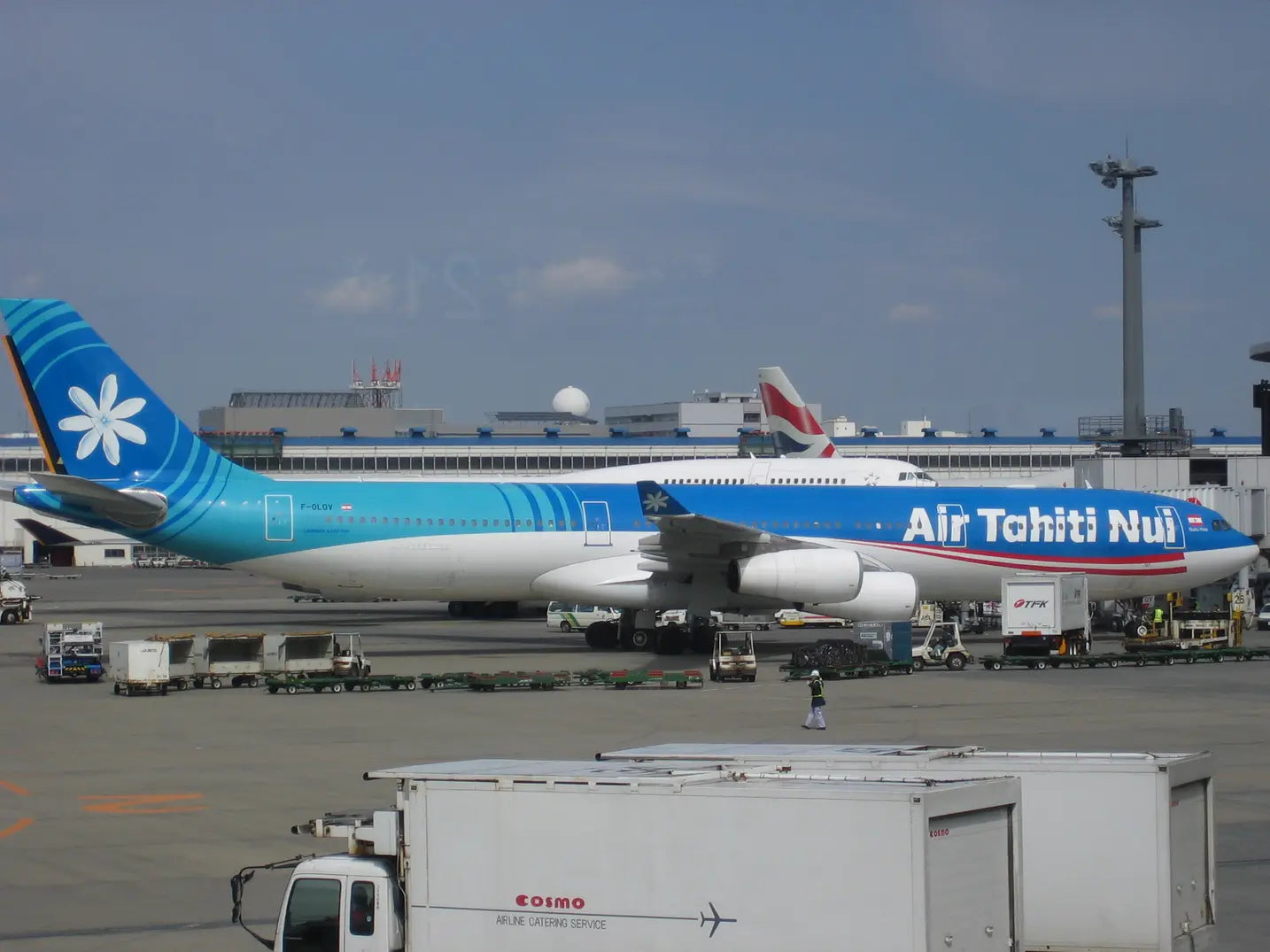
Air Tahiti Nui Overview & Company Profile
Air Tahiti Nui is the international flag carrier of French Polynesia, founded on October 31, 1996, and based at Faa'a International Airport (PPT) in Papeete, Tahiti. The airline commenced operations on November 20, 1998, becoming the first dedicated long-haul carrier connecting French Polynesia to the rest of the world. It operates an all-widebody fleet of Boeing 787-9 Dreamliners on routes linking Tahiti to North America, Europe, Japan, and New Zealand.
The airline is majority-owned by the Government of French Polynesia, which holds 84.4% of shares, with the remainder held by local investors. This public ownership structure shapes the airline's strategic priorities, which extend beyond pure commercial performance to include maintaining international connectivity for French Polynesia's tourism-dependent economy (tourism accounts for roughly 25% of the territory's GDP). Air Tahiti Nui is not a member of any global airline alliance, but maintains codeshare agreements with American Airlines, Air France, Air New Zealand, Japan Airlines, Korean Air, Qantas, and SNCF, providing connectivity to over 40 additional cities.
In 2024, the airline carried 450,462 passengers across 2,002 commercial flights totalling 16,556 flight hours. Total revenue reached 34.3 billion XPF (approximately €287 million), with passenger traffic accounting for 91% of revenues. However, the airline recorded an operating loss of 2.8 billion XPF (approximately €23 million), reflecting the structural challenges of operating long-haul services from a remote Pacific island territory with a limited local population of around 280,000 inhabitants. The airline employs approximately 708 staff members, including around 69 flight deck crew and 285 cabin crew.
Air Tahiti Nui has faced recurring financial difficulties throughout its history, including a near-bankruptcy in 2011 and a cumulative deficit exceeding 22 billion XPF (~€185M) by end of 2024. A 2024 strategic review by consultancy Arthur D. Little recommended discontinuing the Seattle and Tokyo routes due to heavy losses. Only the Los Angeles route is currently profitable. The airline's government ownership provides a financial backstop, but prospective pilots should weigh this operational and financial context carefully when evaluating long-term career prospects.
Fleet Composition & Type Ratings
Air Tahiti Nui operates one of the simplest yet most modern fleets in the airline industry: four Boeing 787-9 Dreamliners, all delivered between October 2018 and August 2019. This single-type fleet replaced the airline's previous fleet of five Airbus A340-300s, which had served since 2001. The last A340 service was operated in September 2019, completing a fleet renewal that significantly improved fuel efficiency, passenger comfort, and operational economics for the carrier's ultra-long-haul routes.
Each aircraft is configured with 294 seats in three classes: 30 seats in Poerava Business (lie-flat, 2-2-2), 32 seats in Moana Premium Economy (2-3-2), and 232 seats in Moana Economy (3-3-3). All four Dreamliners are powered by General Electric GEnx-1B74/75 PIP II engines. Two aircraft were ordered directly from Boeing and two are leased through Air Lease Corporation (ALC). The fleet is branded as the "Tahitian Dreamliner," with each aircraft named after Polynesian places or figures.
| Registration | Aircraft Name | Delivered | Source |
|---|---|---|---|
| F-OMUA | Fakarava | October 2018 | Air Lease Corporation (lease) |
| F-ONUI | Tupaia | December 2018 | Air Lease Corporation (lease) |
| F-OVAA | Bora Bora | June 2019 | Boeing (direct order) |
| F-OTOA | Tetiaroa | August 2019 | Boeing (direct order) |
Fleet data as of early 2026. Aircraft names carry symbolic meaning: TOA (warrior), MUA (forward), NUI (great), VAA (canoe).
The fleet average age is approximately 6.5 years, making it one of the youngest widebody fleets in the region. The Boeing 787-9 offers a range of 7,530 nautical miles, sufficient for all of Air Tahiti Nui's routes, including the demanding Papeete-Tokyo Narita sector. The Dreamliner's composite fuselage enables higher cabin humidity (up to 6% vs. 2-3% on older aluminium aircraft) and lower cabin altitude (6,000 ft vs. 8,000 ft), resulting in less fatigue for both passengers and crew on the airline's ultra-long-haul operations. Onboard Wi-Fi is available on all four aircraft.
A single-type fleet means all pilots are qualified on the same aircraft, simplifying scheduling, training, and crew planning. There are no fleet transition bids or complex seniority-based fleet assignments. However, this also means there is no variety in type ratings and no possibility of moving to a different aircraft within the airline. For pilots who value fleet diversity or wish to build multiple type ratings, Air Tahiti Nui's operation is inherently limited. For those who appreciate simplicity and want deep expertise on a single modern widebody, it is an advantage.
Pilot Salary & Compensation
Publicly available salary data for Air Tahiti Nui pilots is extremely limited. The airline does not publish pay scales, and no current collective agreement details have been made public. This lack of transparency makes it difficult for prospective applicants to evaluate compensation competitiveness. The information below is drawn from the best available sources, including historical job listings and industry databases, but should be treated as indicative rather than definitive.
Historical data from 2011 (the most recent publicly available figures) indicated a Captain base salary of approximately €5,200/month and a First Officer base salary of approximately €3,800/month, according to pilot job network databases. These figures are significantly dated and likely do not reflect current compensation levels, particularly given the global pilot salary increases driven by post-COVID pilot shortages and inflationary pressures since that period. Compensation is believed to be denominated in CFP Francs (XPF) or Euros (EUR), with the XPF pegged to the Euro at a fixed rate of 1 EUR = 119.332 XPF.
Estimated Compensation Ranges (Indicative)
| Position | Estimated Annual Gross | Notes |
|---|---|---|
| First Officer (entry) | €50,000 - €70,000 | Based on historical data adjusted for inflation. Unverified. |
| First Officer (senior) | €70,000 - €95,000 | Estimate. Depends on seniority, flight hours, and allowances. |
| Captain (entry) | €90,000 - €120,000 | Estimate based on regional comparisons. Unverified. |
| Captain (senior) | €120,000 - €160,000 | Top of scale. Includes base, flight pay, and allowances. |
These figures are editorial estimates based on limited historical data and regional benchmarks. They have not been confirmed by Air Tahiti Nui.
The salary figures above are rough estimates compiled from historical data (2011 base salary reports), regional airline comparisons (Air New Zealand, Fiji Airways), and general French aviation industry benchmarks. Air Tahiti Nui has not publicly disclosed current pilot pay scales. Actual compensation may differ significantly. The airline's recurring financial losses and small fleet size suggest pay may be below larger legacy carrier levels. Prospective applicants should request current compensation details directly from Air Tahiti Nui's recruitment team during the application process. French Polynesia has a distinct tax regime with no personal income tax, which may offset lower gross salaries compared to metropolitan France.
One significant financial advantage of being based in French Polynesia is that there is no personal income tax in the territory. Instead, French Polynesia levies a Contribution de Solidarite Territoriale (CST) at rates significantly lower than metropolitan France's income tax (which can reach 45%). This means that while gross salaries at Air Tahiti Nui may appear lower than at Air France or other European carriers, the net take-home pay difference may be considerably smaller. Pilots based in Tahiti also benefit from a lower cost of living in certain categories (housing outside Papeete, tropical lifestyle) compared to Paris, London, or other major European bases, though imported goods can be expensive.
Roster Pattern & Quality of Life
Air Tahiti Nui is an exclusively long-haul carrier, meaning all pilot flying involves extended duty periods, significant time zone changes, and layovers at overseas destinations. The airline operated 2,002 commercial flights totalling 16,556 flight hours in 2024, averaging approximately 8.3 block hours per flight. With around 69 flight deck crew for four aircraft, the pilot-to-aircraft ratio is approximately 17:1, which is within normal ranges for long-haul widebody operations requiring augmented crews on the longest sectors.
The airline operates under French DGAC regulations and EASA Flight Time Limitations (Subpart Q), which govern maximum duty periods, rest requirements, and cumulative flight hour limits. Historical operational data from 2013 indicated an average pilot duty time of approximately 9.75 hours per day, with reductions from the previous year suggesting ongoing fatigue management improvements. EASA FTL rules cap cumulative duty at 190 hours per 28-day period and 60 hours per 7 consecutive days, with mandatory weekly rest of at least 36 hours including two local nights.
📅 Sample Month: Long-Haul First Officer (PPT base)
Given the nature of Air Tahiti Nui's network, a typical rotation involves flying from Papeete to Los Angeles (approximately 8 hours), with some rotations continuing onward to Paris (an additional 11 hours). Augmented crews (3 or 4 pilots) are used on the longest sectors, particularly the PPT-NRT route (~11 hours). Layovers at destination typically range from 24 to 48 hours, providing genuine rest and recovery time before the return leg.
Unlike most airline pilot bases, Papeete offers a tropical island lifestyle with year-round warm weather, access to world-famous lagoons, and a strong Polynesian cultural identity. Housing costs in Papeete are moderate compared to Paris or Los Angeles, though imported goods (food, electronics, vehicles) carry significant markups due to shipping costs. The territory benefits from excellent healthcare through the French social security system. For pilots with families, French-curriculum schools are available, and the quality of life outside work hours is often cited as a major draw. However, the geographic isolation (5 hours to the nearest major city, Los Angeles) can be challenging for those with strong ties to mainland France or Europe.
Benefits, Travel Perks & Retirement
As a French Polynesian employer governed by French labor law, Air Tahiti Nui provides a benefits package that includes statutory protections alongside airline-specific perks. While detailed benefit information is not publicly disclosed, employee reviews and operational documentation provide a partial picture of what pilots and staff can expect.
French-based aircrew are typically enrolled in the CRPN (Caisse de Retraite du Personnel Navigant), which provides a supplementary pension on top of the basic French retirement system. The CRPN has been operating since 1951 and covers pilots and cabin crew at French-registered airlines. While Air Tahiti Nui's participation in the CRPN is not explicitly confirmed in public sources, the airline operates under French aviation regulations (DGAC oversight) and employs flight crew under French labor law, making CRPN enrollment highly probable. Pilots considering Air Tahiti Nui should verify CRPN participation directly with the airline during recruitment discussions.
Career Progression & Seniority
Career progression at Air Tahiti Nui is fundamentally shaped by the airline's small scale: four aircraft, approximately 69 flight deck crew, and a single aircraft type. This creates a very different career trajectory compared to large legacy carriers with hundreds of aircraft and thousands of pilots. Captain positions are limited, and upgrade timelines depend heavily on retirements, attrition, and any potential fleet growth.
The airline operates a seniority-based system, as is standard in the airline industry. Pilots advance from First Officer to Captain based on their position in the seniority list. Given the small pilot corps, there may be fewer than 30-35 Captain positions across the entire operation. This means upgrade opportunities arise infrequently, and wait times could be significantly longer than at larger carriers experiencing rapid growth.
| Career Milestone | Estimated Timeline | Notes |
|---|---|---|
| Join as First Officer (B787) | Day 1 | Entry position. Boeing 787 type rating required or provided. |
| Senior First Officer | 5-8 years | Based on seniority. Limited fleet variety (single type). |
| Captain upgrade | 10-20+ years (est.) | Highly dependent on retirements and fleet size. Very limited positions. |
| Training Captain / TRE | Variable | Requires additional selection and instructor qualification. |
There is no publicly available information regarding a direct-entry Captain policy at Air Tahiti Nui. Given the airline's small size and the complexity of its long-haul operations, it is possible that the airline accepts experienced Captains from other carriers for direct placement, but this is speculative. Similarly, there is no documented cadet programme or ab initio training pathway specific to Air Tahiti Nui.
Pilots seeking rapid career advancement should carefully consider Air Tahiti Nui's structural limitations. With only four aircraft and a small pilot corps, the number of Captain upgrades per year is likely in the low single digits. The airline's financial difficulties (operating losses in 2024, route closures under consideration) add uncertainty to future fleet growth prospects. For pilots who prioritize stability, lifestyle, and the unique experience of flying the 787 from a Pacific island base, Air Tahiti Nui can be rewarding. For those focused on fast progression to command or building diverse type ratings, larger carriers will offer better prospects.
Recruitment Process & Requirements
Air Tahiti Nui recruits pilots on a rolling basis through its official careers portal and aviation job boards. Due to the airline's small size, pilot vacancies are infrequent and competitive. The airline does not run large-scale annual recruitment campaigns like major European carriers. Instead, positions are advertised as they arise, and spontaneous applications are accepted through the airline's website.
First Officer Requirements
Selection Process (Indicative)
Online Application
Submit CV, licenses, and supporting documents through the Air Tahiti Nui careers portal or via aviation job boards such as Pilot Career Centre. Spontaneous applications are accepted year-round.
Document Screening & Initial Review
HR and flight operations review qualifications, experience, language proficiency, and suitability. Shortlisted candidates are invited to the next stage.
Interview & Technical Assessment
Technical knowledge assessment covering Boeing 787 systems (if type-rated), aviation regulations, and operational scenarios. Panel interview assessing CRM skills, motivation, and cultural fit.
Simulator Assessment
For candidates not already type-rated on the B787, a simulator evaluation may be included. Type-rated candidates may undergo a proficiency check.
Medical & Contract
Valid Class 1 medical required. Successful candidates receive a contract offer and begin type rating training (if needed) or line training on the Boeing 787.
French language fluency is absolutely essential: internal operations, crew communications, and company culture are conducted in French. Unlike Air France, Air Tahiti Nui does not operate a formal cadet programme, so applicants must already hold a professional pilot license. The airline's small size means personal fit and adaptability to island life are likely important selection criteria beyond pure technical qualifications. Demonstrating familiarity with Pacific operations, long-haul flying, and willingness to relocate to Papeete will strengthen applications. Monitor the careers page regularly, as positions are posted infrequently.
Top Layover Destinations
As a purely long-haul carrier, every Air Tahiti Nui flight involves a layover at the destination. The airline's compact network means pilots regularly cycle through the same four international cities, building deep familiarity with each destination. Layovers typically range from 24 to 48 hours depending on scheduling and crew rotation patterns. Hotels are contracted by the airline and transport between airport and hotel is provided.
With only four international destinations, pilots quickly become deeply familiar with each layover city. This is a significant contrast to large network carriers where pilots may visit dozens of different cities. Some pilots appreciate the consistency and predictability; others may find the limited variety monotonous over time. The quality of layover life at Air Tahiti Nui is generally rated positively in employee reviews, with crew hotels meeting professional standards and the airline's South Pacific identity creating a distinctive esprit de corps among the small pilot team.
How Air Tahiti Nui Compares: Airline Radar Chart
How does Air Tahiti Nui stack up against two comparable Pacific-region carriers? Fiji Airways operates as a similar island-based flag carrier with government ownership and a focus on tourism connectivity. Air New Zealand represents a significantly larger alternative in the same geographic region, offering extensive domestic and international operations from Auckland. Below is a comparative analysis across five key pilot career metrics.
Key Takeaways from the Comparison
Air New Zealand leads on almost every metric. With a substantially larger fleet (A320, A350, B777, B787 across domestic and international networks), documented First Officer salaries of NZ$86,000-181,000 and Captain salaries of NZ$94,000-228,000 annually, and stronger financial performance, Air New Zealand offers superior career progression, compensation, and job security. Pilots based in Auckland also enjoy a cosmopolitan city with excellent quality of life.
Air Tahiti Nui and Fiji Airways face similar challenges. Both are small, government-backed island carriers serving tourism markets with limited fleets. Fiji Airways operates a slightly larger fleet including A350-900 and A330 aircraft, providing modest fleet diversity. Both airlines face financial pressures inherent to small-scale, geographically isolated operations. However, Fiji Airways has demonstrated more consistent profitability in recent years.
Air Tahiti Nui's fleet quality is exceptional. The all-787-9 fleet is one of the youngest and most modern in the Pacific region. This is the airline's clearest competitive advantage from a pilot perspective: the opportunity to fly a state-of-the-art widebody on long-haul routes from day one.
Job security is a genuine concern at Air Tahiti Nui. The cumulative deficit exceeding €185 million, operating losses in 2024, and consultant recommendations to cut routes create real uncertainty. Government ownership mitigates the risk of outright failure but cannot guarantee fleet growth or salary increases. Fiji Airways and particularly Air New Zealand offer more stable long-term career environments.
Scores are editorial estimates based on publicly available salary data, airline annual reports, employee reviews, fleet composition, route network analysis, and industry benchmarks. They represent a general assessment for an experienced pilot evaluating long-term career options. Individual experiences will vary based on seniority, personal preferences, and specific contract terms. Air Tahiti Nui's limited salary transparency makes precise compensation comparison particularly difficult.
Verdict: Who Is Air Tahiti Nui For?
🎯 Our Take
Air Tahiti Nui is one of the most unique pilot employers in the world. Flying a modern all-Boeing 787-9 fleet on long-haul routes from a tropical Pacific island hub, the airline offers an experience that no major carrier can replicate. The combination of ultra-long-haul widebody flying, a small and close-knit crew, layovers in Los Angeles, Paris, Tokyo, and Auckland, and a Papeete base with no income tax makes it genuinely distinctive.
The trade-offs are equally real. The airline's financial situation is precarious, with cumulative losses exceeding €185 million and only one profitable route. Career progression is constrained by four aircraft and roughly 69 flight deck crew. Salary transparency is poor, and compensation is likely below that of larger carriers like Air New Zealand or Air France. The geographic isolation of Tahiti, while beautiful, can be challenging for those with strong ties to mainland France or Europe. The limited route network means repetitive flying and only four layover cities.
For French-speaking pilots who dream of combining professional widebody flying with a Polynesian island lifestyle, and who are comfortable with the financial and career limitations of a small flag carrier, Air Tahiti Nui offers something truly special. It is not a career move driven by salary maximization or rapid command upgrade. It is a lifestyle choice, backed by a modern fleet and a proud aviation heritage.
1 Do I need to speak French to fly for Air Tahiti Nui?
Yes. Fluency in French is mandatory for all pilot positions. Internal operations, company communications, and crew interactions are conducted in French. English proficiency at ICAO Level 4 or above is also required for international operations. Non-French speakers will not be considered.
2 What aircraft does Air Tahiti Nui operate?
Air Tahiti Nui operates an exclusively modern fleet of four Boeing 787-9 Dreamliners, delivered between 2018 and 2019. All pilots are qualified on this single type. The aircraft are configured with 294 seats across three classes (Business, Premium Economy, Economy) and powered by GE GEnx engines.
3 Is there a cadet programme at Air Tahiti Nui?
No. Air Tahiti Nui does not operate a formal cadet or ab initio training programme. Applicants must already hold a professional pilot license (EASA ATPL or CPL/IR-ME) with a minimum of 1,000 total flight hours. The airline recruits experienced pilots through its careers portal on a rolling basis.
4 Where are pilots based?
All Air Tahiti Nui pilots are based in Papeete, Tahiti (French Polynesia). There is no alternative base option. Pilots must either live in French Polynesia or be willing to relocate there. Some recruitment postings have noted a preference for candidates with existing French Polynesian residency.
5 Is there income tax in French Polynesia?
French Polynesia does not levy personal income tax in the traditional sense. Instead, a Contribution de Solidarite Territoriale (CST) applies at rates considerably lower than metropolitan France's income tax (which can reach 45%). This is a significant financial advantage that may partially offset lower gross salaries compared to carriers based in metropolitan France.
6 How stable is Air Tahiti Nui financially?
The airline has faced recurring financial challenges. In 2024, it reported an operating loss of approximately €23 million on revenues of €287 million. The cumulative deficit exceeds €185 million. Only the Los Angeles route is currently profitable. However, the Government of French Polynesia holds 84.4% of the airline and considers it a strategic national asset for tourism. This government backing provides a financial safety net that pure commercial carriers lack, making outright failure unlikely but not guaranteeing growth or salary increases.
7 How long does it take to upgrade to Captain?
Specific upgrade timelines are not publicly disclosed. Given the airline's small size (approximately 69 flight deck crew, 4 aircraft), Captain positions are extremely limited. Upgrade is seniority-based and likely takes 10 to 20+ years depending on retirements and any future fleet changes. Pilots seeking rapid command progression should consider larger carriers.
8 Can non-EU citizens apply?
Publicly available recruitment information does not explicitly restrict applications to EU/EEA citizens, but French language fluency is mandatory and EASA licensing is required. Some job postings have noted a preference for candidates with at least 10 years of residency in French Polynesia. Non-EU applicants would need to verify work permit requirements with the airline directly, as French Polynesia has its own immigration framework within the broader French system.
Official Links & Resources
Before applying or making any career decisions, always verify information directly with official sources. These are the key websites and organisations relevant to Air Tahiti Nui pilot careers:
Air Tahiti Nui's Annual Activity Reports are freely available on the airline's website and contain detailed workforce, financial, and operational data that is invaluable for career research. The 2024 report, for example, includes headcount by category, flight hours, passenger numbers, and route-level financial commentary. Reviewing this document before applying demonstrates genuine interest and provides conversation material for interviews.