

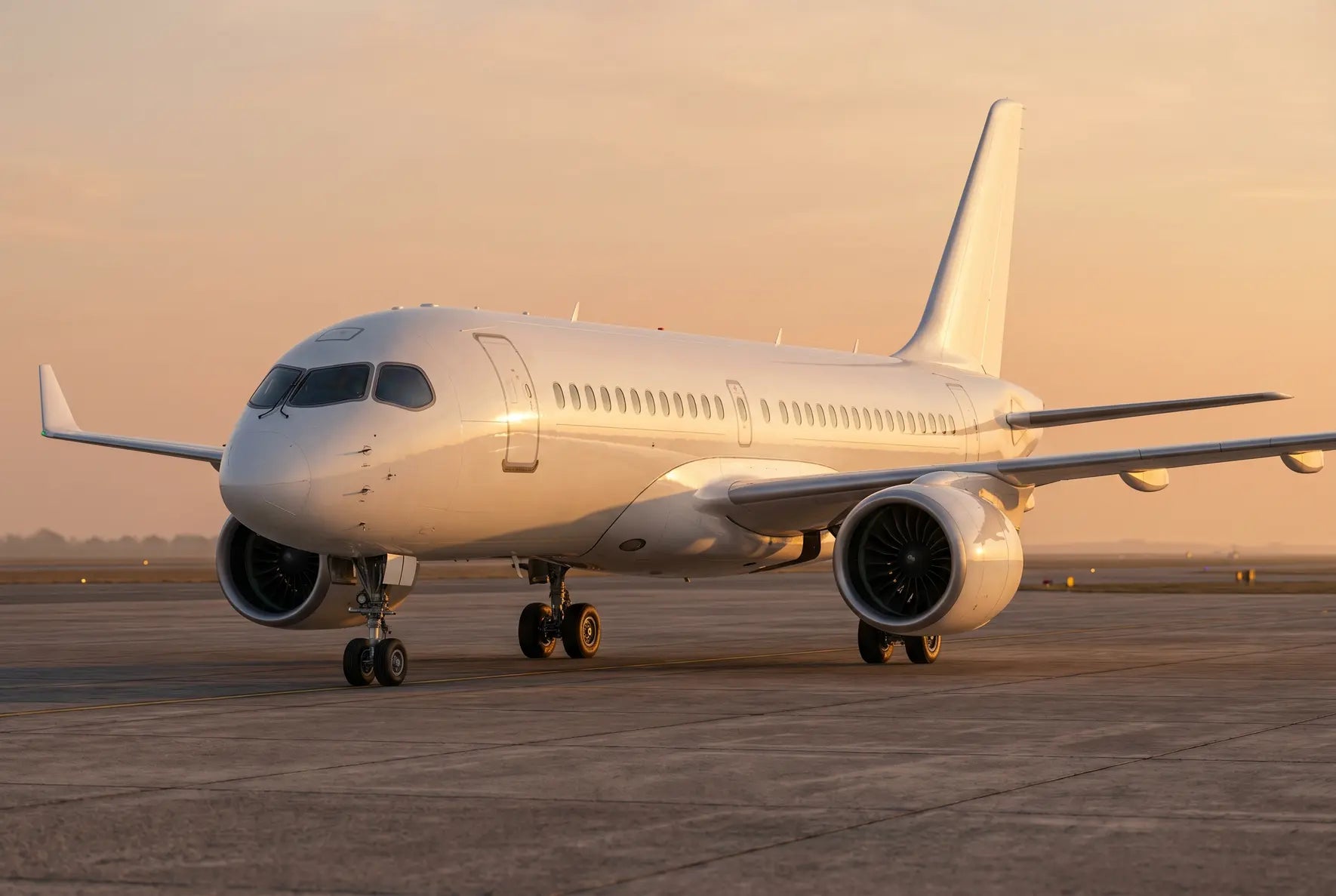
Airbus A220-100: History, Program Launch, and Development of the Smallest A220 Variant
The Airbus A220-100 traces its origins to the Bombardier CSeries program, a bold initiative by the Canadian manufacturer to build a clean sheet aircraft purpose built for the 100 to 150 seat market segment. In July 2004, Bombardier Aerospace publicly announced its intention to develop a new family of single aisle jets under the CSeries name. A concept definition phase ran from 2004 through 2006, but insufficient launch orders led to a temporary program suspension in January 2006. Work resumed in January 2007, and after securing letters of interest from airlines such as Lufthansa, the program was officially launched at the Farnborough International Airshow in July 2008.
The first firm orders were announced on 11 March 2009. Bombardier selected the Pratt & Whitney PW1500G geared turbofan engine in November 2007 as the exclusive powerplant, a decision that proved pivotal in delivering the fuel efficiency and noise reduction targets the program demanded. The smaller variant, designated CS100 (now A220-100), completed its maiden flight on 16 September 2013 from Montréal Mirabel International Airport. Transport Canada issued the initial type certificate on 18 December 2015, and commercial service began on 15 July 2016 when launch operator Swiss International Air Lines flew its first revenue flight.
Development of the CSeries was marked by considerable cost overruns and delays. Originally, Bombardier targeted entry into service around 2013, but certification challenges pushed the timeline back by roughly three years. Program costs, initially estimated at approximately US$3.5 billion, escalated significantly. In 2014, an additional US$1.05 billion in tooling and financing costs was announced, and by October 2015, Bombardier recorded a US$4.4 billion write down largely tied to the program. The Government of Quebec injected approximately US$1 billion to support the financially strained program.
Adding to the pressure, Boeing filed a trade complaint in 2017 with the U.S. Commerce Department, alleging that Bombardier had sold 75 CS100 aircraft to Delta Air Lines at below market prices, benefiting from unfair government subsidies. The U.S. Commerce Department initially proposed tariffs of nearly 300%, but on 26 January 2018, the U.S. International Trade Commission (ITC) voted unanimously (4 to 0) to reject Boeing's complaint, ruling that no material injury had occurred. This cleared the path for CS100 deliveries to U.S. carriers.
Meanwhile, in October 2017, Airbus and Bombardier announced a strategic partnership under which Airbus would acquire a majority stake in the CSeries Aircraft Limited Partnership (CSALP). The transaction closed on 1 July 2018, with Airbus taking a 50.01% controlling interest. On 10 July 2018, the program was officially rebranded: the CS100 became the Airbus A220-100, and the CS300 became the Airbus A220-300. In February 2020, Airbus increased its stake to 75% after Bombardier exited entirely, leaving the Quebec government as minority partner. Production continues at the Mirabel facility near Montréal and at a second final assembly line in Mobile, Alabama, which produced its first A220 in 2020. Today, the A220-100 is operated by airlines including Delta Air Lines, Swiss International Air Lines, ITA Airways, Bulgaria Air, and Croatia Airlines. Regional carriers across Europe continue to evaluate narrowbody jets like the A220 for routes similar to those served by operators such as Binter Canarias, reflecting a broader industry trend toward modern, fuel efficient aircraft on short and medium haul networks.
What Distinguishes the Airbus A220-100 from the A220-300
The Airbus A220-100 is the shorter fuselage member of the A220 family. At 35.0 metres in length, it is 3.7 metres shorter than the A220-300 (38.7 metres). This difference is achieved through fuselage plugs fore and aft of the wing on the stretched variant, while both models share the same wingspan (35.1 metres), height, cockpit, and fuselage cross section, with over 95% parts commonality. The A220-100 typically seats 100 to 120 passengers in a two class configuration, with a maximum certified capacity of 135 seats, compared to the A220-300's 130 to 160 seat range (maximum 160). Thanks to the same fuel tank capacity, the lighter A220-100 achieves a slightly longer range of up to 3,600 nautical miles (6,700 km) compared to 3,400 nm for the A220-300, making it particularly well suited to thinner, longer routes where payload is lower.
The following variant identifiers summarise the key characteristics of the Airbus A220-100:
- ICAO type designator: BCS1
- Engines: 2 × Pratt & Whitney PW1500G geared turbofans (certified variants include PW1519G, PW1521G, and PW1524G)
- Maximum takeoff weight (MTOW): 63.7 tonnes (upgraded from the original 60.8 tonnes)
- Range: up to 3,600 nm (6,700 km)
- Typical seating: 100 to 120 (two class); maximum 135 (high density)
- Fuselage length: 35.0 m (3.7 m shorter than A220-300)
- Structural materials: carbon composite wing, aluminum lithium fuselage panels
- Avionics: Rockwell Collins Pro Line Fusion with fly by wire flight controls

The image shows an Airbus A220-300 aircraft in flight against a clear blue sky. The airplane is elegantly soaring with its distinct livery and streamlined design.
Airbus A220 100 Technical Specifications, Systems and Engine Overview
The Airbus A220 100 is a clean sheet, narrow body twinjet purpose built for the 100 to 135 seat market segment. Originally developed as the Bombardier CS100, it was designed from the outset to deliver superior fuel efficiency, low noise emissions and strong runway performance on short to medium haul routes. Its airframe combines a carbon composite wing with an aluminium lithium fuselage, resulting in a lighter structure that directly contributes to lower operating costs. The aircraft fills a niche between regional jets and larger single aisle families, offering widebody levels of passenger comfort in a cabin 3.28 m (10 ft 9 in) wide with a 2+3 seat layout.
From a design philosophy standpoint, the A220 100 prioritises range and field performance over maximum payload. With a manufacturer stated range of 3,400 NM (6,300 km) in a typical two class configuration of 100 to 120 passengers, it can serve thinner routes that would be uneconomical for larger narrow bodies. Its short field capability, combined with modern geared turbofan engines, makes it well suited for operations at constrained airports. For readers interested in how newer competitors in a similar class compare, the COMAC C919 offers a useful point of reference in the single aisle market.
- Overall length: 35.0 m (114 ft 10 in)
- Wingspan: 35.1 m (115 ft 2 in)
- Height: 11.5 m (37 ft 9 in)
- Wing area (ESDU reference): 112.3 m² (1,209 sq ft)
- Typical seating (two class): 100 to 120 passengers; maximum single class up to 135
- Maximum takeoff weight (MTOW): approximately 63,100 kg (139,100 lb)
- Maximum landing weight (MLW): 54,700 kg (120,600 lb)
- Maximum zero fuel weight (MZFW): 52,600 kg (115,960 lb)
- Maximum fuel capacity: 21,918 litres (5,790 US gal)
- Range: 3,400 NM (6,300 km) with typical two class layout
- Maximum operating speed (Mmo): Mach 0.82
- Typical cruise speed: Mach 0.78 (829 km/h / 515 mph)
- Service ceiling: 41,000 ft (12,500 m)
- Takeoff field length: approximately 1,500 m (4,920 ft)
- Landing field length: approximately 1,350 m (4,430 ft)
- Cargo volume: 23.3 m³ (823 cu ft)
- Engines: 2 × Pratt & Whitney PW1500G geared turbofan
- Avionics: Rockwell Collins Pro Line Fusion glass cockpit
- Flight controls: full fly by wire with sidestick controllers
Systems, Fly by Wire Architecture and Handling Technology
The A220 100 features a full fly by wire (FBW) flight control system, where pilot sidestick inputs are converted into electronic signals processed by redundant flight control computers before commanding hydraulic actuators on ailerons, elevators, rudder and spoilers. The system provides flight envelope protection, preventing the aircraft from exceeding critical angles of attack, load factors or speed limits. Vibration motors integrated into the sidesticks deliver haptic feedback to alert pilots to conditions such as proximity to stall, enhancing situational awareness without relying solely on visual cues.
The Rockwell Collins Pro Line Fusion avionics suite equips the flight deck with large format LCD displays, supporting GPS, RNAV and RNP navigation capabilities. A Flight Path Vector (FPV) symbol is displayed on the primary flight display, allowing pilots to visualise the instantaneous flight path angle and track during approach and other critical phases. The automation philosophy prioritises pilot intuition and reduced workload. An Emergency Descent Mode (EDM) can be activated with a single button press, initiating an autonomous descent to 15,000 ft in the event of cabin depressurisation or crew incapacitation. The aircraft also integrates health monitoring systems that transmit real time diagnostic data for predictive maintenance, helping operators reduce unscheduled downtime.
Published performance figures for the A220 100 can vary depending on the operator's chosen cabin configuration, seat count, selected MTOW option, atmospheric conditions (temperature and altitude), and runway surface state. Manufacturer range values typically assume a standard two class layout with full fuel. Operators flying denser configurations with more passengers may see reduced range but improved per seat economics, while those operating from hot and high airports will experience longer takeoff distances. Readers should treat published numbers as representative benchmarks rather than absolute operational limits.
Pratt & Whitney PW1500G Geared Turbofan Engine
The A220 100 is exclusively powered by two Pratt & Whitney PW1500G geared turbofan (GTF) engines, each producing thrust in the 19,000 to 25,000 lbf range. The PW1500G was the first engine in the PW1000G family to achieve certification, reaching that milestone in 2013 while the aircraft was still known as the Bombardier CS100. Pratt & Whitney invested an estimated $10 billion in developing the entire PW1000G GTF family, making it one of the most significant propulsion programmes in modern commercial aviation.
The defining technology of the PW1500G is its epicyclic reduction gearbox, which decouples the fan from the low pressure turbine. This allows the large diameter 73 inch fan to rotate at an optimal lower speed while the three stage low pressure turbine spins at higher RPM for maximum efficiency. The result is an ultra high bypass ratio of 12:1, contributing to approximately 16% lower fuel consumption and up to 75% reduction in noise footprint compared to previous generation engines in the same thrust class. The engine core features an eight stage high pressure compressor driven by a two stage high pressure turbine, and uses Full Authority Digital Engine Control (FADEC) for precise thrust management.
Final assembly of the PW1500G takes place at the Mirabel Aerospace Centre near Montreal, Canada, with major components supplied by partners including MTU Aero Engines and Japanese Aero Engines Corporation (JAEC). The broader PW1000G family also powers the Airbus A320neo family (as the PW1100G JM) and the Embraer E Jet E2 series (as the PW1900G), spanning a combined thrust range of 14,000 to 33,000 lbf. In 2018, the PW1500G achieved FAA 180 minute ETOPS certification, enabling A220 operators to fly extended overwater routes with confidence.
Airbus A220-100 vs A220-300 vs Embraer E195-E2 vs Airbus A319neo Specifications
Scroll horizontally to see more →
| Parameter | Airbus A220-100 | Airbus A220-300 | Embraer E195-E2 | Airbus A319neo |
|---|---|---|---|---|
| Entry into service | 2016 | 2016 | 2018 | 2016 |
| Engines | 2 × Pratt & Whitney PW1500G | 2 × Pratt & Whitney PW1500G | 2 × Pratt & Whitney PW1900G | 2 × CFM LEAP-1A |
| Length | 35.0 m | 38.7 m | 38.4 m | 33.8 m |
| Wingspan | 35.1 m | 35.1 m | 35.0 m | 35.8 m |
| Height | 11.5 m | 11.5 m | 12.0 m | 11.8 m |
| Typical seating and layout | 2-class: 100–120 passengers | 2-class: 120–150 passengers | 2-class: 120–146 passengers | 2-class: 140–160 passengers |
| MTOW | 64 t | 70 t | 63 t | 76 t |
| Range | 3,600 nm | 3,600 nm | 2,850 nm | 3,700 nm |
| Cruise speed | 0.78 Mach | 0.78 Mach | 0.78 Mach | 0.78 Mach |
| Service ceiling | 41,000 ft | 41,000 ft | 41,000 ft | 41,000 ft |
| Program note | Baseline model, optimized for 100-120 seat regional routes with best-in-class efficiency | Stretched version with higher capacity for denser regional/medium-haul routes | Direct regional jet competitor with similar capacity and Pratt & Whitney GTF engines | Larger narrowbody from Airbus family offering more seats for higher-density operations |
Scroll horizontally to see more →
The table compares key specs of the A220-100, A220-300, Embraer E195-E2 and A319neo. All cruise at Mach 0.78 and share a 41,000 ft ceiling, but capacity and range differ: A220-300 and A319neo carry more passengers, while the A220 variants offer 3,600 nm range versus 2,850 nm for the E195-E2; the A319neo leads range at 3,700 nm and has the highest MTOW at 76 t.
Airbus A220-100 Operations: Airlines, Typical Routes and Missions Worldwide
The Airbus A220-100 was purpose built for the 100 to 135 seat market segment, filling a gap between regional jets and larger single aisle narrowbodies. With a maximum range of approximately 3,400 nautical miles (6,300 km) and a cruising speed of Mach 0.78 (829 km/h), this aircraft is optimised for short to medium haul missions typically lasting between one and four hours. Most operators deploy it on sectors ranging from 500 to 2,500 kilometres, although certain routes extend well beyond that threshold. Powered by two Pratt & Whitney PW1500G geared turbofan engines, the aircraft delivers fuel savings of around 25% compared to previous generation types in this category, making previously unprofitable thin routes economically viable.
In terms of daily utilisation, the A220-100 is designed to support high cycle operations. Airlines typically schedule between four and six rotations per day on domestic or intra regional routes, translating to roughly 8 to 11 block hours of daily flying. Its maintenance intervals, including 1,000 hour A checks and 8,500 hour C checks, are designed to maximise time on wing and minimise ground time. The aircraft performs well in both hub and spoke networks and point to point operations. Network carriers such as Delta Air Lines and SWISS use it to feed their main hubs with high frequency services, while other operators leverage its range and low seat mile costs to open direct routes between secondary cities that larger aircraft would not serve profitably.
One notable operational challenge facing A220 operators relates to the PW1500G engines. Corrosion issues linked to a manufacturing defect have led to accelerated inspections, unscheduled engine removals and significant maintenance backlogs. By late 2025, nearly 17% of the global A220 fleet was temporarily grounded due to engine related issues. Airlines such as airBaltic were forced to suspend routes and reduce frequencies, while Air Austral retired its A220 fleet entirely. Pratt & Whitney has stated it aims to reduce aircraft on ground incidents to near zero by late 2026 through improved spare engine availability and upgraded components. Despite these setbacks, operators broadly value the type for its cabin comfort, fuel efficiency and versatility. Historically, adapting to new powerplant technology has been a recurring theme in commercial aviation, much like the early jet age challenges experienced by the Tupolev Tu-104.
Where the Airbus A220-100 Operates Around the World
The A220-100 serves airlines across several continents, although the fleet is concentrated in Europe and North America. In Europe, flag carriers and leisure operators deploy it on intra European routes connecting major hubs to regional destinations, with flight times typically between one and three hours. In North America, Delta Air Lines operates the largest A220-100 fleet in the world, using it on domestic routes from hubs such as New York LaGuardia and Seattle. In Asia and the Pacific, the type has a smaller but growing presence, with orders placed by carriers looking to modernise ageing regional fleets. No confirmed A220-100 operations have been identified in Africa or South America to date, though the aircraft's range and runway performance would suit various routes in those regions.
- Europe: SWISS was the launch customer in 2016 and operates 9 A220-100s on short haul intra European routes from Zurich and Geneva. ITA Airways flies 8 units on domestic Italian and European services. Croatia Airlines has introduced the type with 2 aircraft for regional connectivity, while Bulgaria Air also operates the variant on its European network.
- North & South America: Delta Air Lines is by far the dominant operator, with 45 A220-100s serving high frequency domestic routes including New York LaGuardia to Boston and Dallas Fort Worth. Delta was the first US airline to take delivery of the type in 2018. No confirmed A220-100 operators have been identified in South America.
- Asia: Air Niugini in Papua New Guinea has ordered up to 8 A220-100s to modernise its fleet and serve regional Pacific routes. This represents the most significant commitment to the variant in the Asia Pacific region to date.
- Africa: No airlines in Africa currently operate the A220-100. EgyptAir previously operated A220-300s but retired them due to engine availability issues; the smaller variant has not entered service on the continent.
Typical Seating Configurations on the Airbus A220-100
The A220-100 features a 2+3 abreast cabin layout, meaning the vast majority of passengers sit in either a window or an aisle seat. The manufacturer quotes a maximum single class capacity of 135 seats, though most airlines configure the cabin for between 109 and 125 passengers in multi class layouts.
Delta Air Lines operates a three cabin layout with 109 seats: 12 in First Class arranged 2+2 with 20.5 inch wide seats at 37 inches of pitch, 15 in Delta Comfort+ at 33 inches of pitch, and 82 in Main Cabin at 30 to 32 inches of pitch. This configuration, detailed on Delta's website, is designed for the US domestic market where a premium cabin drives revenue.
SWISS uses a flexible dual class configuration totalling 125 seats. The business class section is created by blocking the middle seat in the forward rows to achieve a 2+2 layout, with the number of business rows adjusted by a moveable curtain based on demand. This approach is typical of European short haul operators and allows the airline to optimise revenue per departure. ITA Airways configures its A220-100 with approximately 123 seats in a similar two class arrangement for short haul European flying. Overall, network carriers tend to favour lower density layouts with a premium cabin, while leisure or charter oriented operators may opt for higher density configurations closer to 130 seats.
In this video, see a Delta A220-100 economy review and learn why this jet is a potential game changer for US domestic flying, including how it compares with the A220-300 and what to expect onboard.
Airbus A220-100 Safety Record: How Safe Is This Aircraft?
The Airbus A220-100 holds one of the strongest safety records in commercial aviation. Originally developed as the Bombardier CS100, the type entered revenue service with Swiss International Air Lines in July 2016. As of early 2026, approximately 67 A220-100 units have been delivered, while the broader A220 family has surpassed 500 deliveries, accumulated over three million flight hours and served more than 100 million passengers across 25 operators worldwide. In roughly a decade of commercial operations, no A220-100 airframe has been involved in a fatal accident or suffered a hull loss. The Aviation Safety Network database for the A220-100 lists only a handful of minor or non-fatal occurrences, none of which resulted in passenger fatalities.
Notable Incidents and Lessons Learned
While the A220-100 itself has an unblemished hull loss record, two significant events involving its sibling, the A220-300, deserve attention because they share the same type certificate, systems and powerplant.
- Swiss International Air Lines Flight LX1885 (A220-300, December 2024): On 23 December 2024, an A220-300 (registration HB-JCD) operating from Bucharest to Zurich experienced a left engine failure at cruise altitude, resulting in cockpit and cabin smoke. The crew declared an emergency and diverted to Graz Airport, Austria, where all 74 passengers and 5 crew members were evacuated via emergency slides. One cabin crew member later died from injuries sustained during the evacuation. The Austrian Federal Safety Investigation Authority preliminary report attributed the event to a previously unknown fault pattern in the Pratt & Whitney PW1500G engine. This incident prompted Swiss to accelerate reviews of its protective breathing equipment programme and reinforced industry attention on PW1500G engine durability.
- airBaltic A220-300 Ground Fire, Riga (June 2025): On 14 June 2025, airBaltic A220-300 YL-AAO caught fire during a mandatory auxiliary power unit ground run at Riga Airport while in maintenance. The fire originated near the ozone filter in the environmental control system and caused severe structural damage. No passengers or crew were on board, and no injuries occurred. Airbus Engineering assessed the airframe as beyond economic repair in December 2025, making it the first hull loss in A220 history. The event, however, was a ground maintenance occurrence rather than an operational accident.
Beyond these two events, the broader A220 fleet has experienced PW1500G engine availability challenges. By late 2025, nearly 20% of the global A220 fleet was temporarily grounded due to engine corrosion and accelerated maintenance requirements. Swiss grounded its entire fleet of nine A220-100 aircraft until at least 2027 pending engine shop visits. Pratt & Whitney has introduced improvement packages that roughly double the time on wing compared to earlier configurations and aims to reduce aircraft on ground incidents to near zero by late 2026.
How Safe Is the Airbus A220-100?
Measured against the volume of flights and cycles performed, the Airbus A220-100 ranks among the safest narrowbody aircraft in service today. Its clean sheet design incorporates a full fly by wire control system with flight envelope protection, advanced composite structures in the wings and empennage, and aluminium lithium alloy fuselage panels that collectively enhance structural integrity and handling precision. These features, combined with rigorous EASA and FAA type certification requirements, ensure that the aircraft meets the highest airworthiness standards.
From a procedural standpoint, every A220 operator follows standardised operating procedures derived from the manufacturer's recommendations and approved by national regulators. Continuous monitoring through flight data analysis programmes and mandatory reporting of occurrences contribute to an evolving safety culture. Industry initiatives, such as Airbus's own accident statistics programme, help identify trends before they become systemic risks.
For passengers evaluating which airlines operate this type, our ultimate airline guide comparing comfort, service, safety, value for money and customer experience provides a broader perspective on carrier quality. In the wider context of transport safety, commercial aviation remains statistically the safest mode of long distance travel, and the A220-100's record to date reflects the effectiveness of modern design philosophy, regulatory oversight and industry collaboration in keeping it that way.
01 What is the typical range of the Airbus A220-100?
The Airbus A220-100 has a maximum range of about 3,450 nautical miles, making it suitable for medium-haul routes like transatlantic flights from smaller European airports to North America or intra-continental hops in North America. This range allows efficient operations on missions up to 3,500 km without refueling. Airlines use it for routes that balance passenger demand with fuel economy.
02 How is the cabin laid out on the Airbus A220-100, and what is the passenger experience like?
The Airbus A220-100 typically seats 110 to 135 passengers in a two-class layout with 12 business and 100 economy seats, or up to 145 in high-density single-class. Passengers enjoy larger windows, more overhead bin space, and a quieter cabin due to advanced composites and engine design. The 31-inch seat pitch in economy provides good legroom compared to similar narrowbody jets.
03 Which airlines operate the Airbus A220-100 and on what routes?
Major operators include Air Canada, Swiss International Air Lines, and Delta Air Lines, with others like Korean Air and LATAM. They deploy it on short to medium-haul routes such as North American domestic flights, European regional services like Zurich to London, and some transatlantic paths from secondary airports. It excels on high-frequency, point-to-point routes with 100-150 passengers.
04 How does the Airbus A220-100 perform in fuel efficiency compared to similar aircraft?
The A220-100 offers 25% better fuel efficiency per seat than previous-generation jets like the Boeing 737-700 or A319, thanks to its Pratt & Whitney PW1500G geared turbofan engines and lightweight composite materials. It burns about 20-30% less fuel on comparable missions. This efficiency lowers operating costs and emissions, positioning it as a modern replacement for older narrowbodies.
05 What is the safety record of the Airbus A220-100?
The Airbus A220-100 has an exemplary safety record with no fatal accidents or hull losses since entering service in 2016. Key design features include advanced fly-by-wire controls, enhanced ground proximity warning systems, and composite airframe for durability. Its rigorous certification by EASA and FAA underscores its reliability in operations worldwide.
06 What should passengers know about seats, windows, and flying the Airbus A220-100?
Opt for window seats in rows 1-12 for the largest panoramic windows, which are 10% bigger than on competing jets. The aircraft handles turbulence smoothly due to its lighter weight and high aspect ratio wings. USB ports and Wi-Fi are standard on most operator configurations, enhancing comfort on longer flights.