

Mokulele Airlines Overview & Company Profile
Mokulele Airlines is a Hawaii-based commuter carrier founded in 1994 and headquartered in Kailua-Kona on the Big Island. The airline operates as a scheduled FAR Part 135 commuter, not a Part 121 airline, which shapes almost every aspect of the pilot job: the regulatory framework, duty limits, pay structure, training, and career trajectory all look very different from a mainline or regional carrier. Since August 2023, Mokulele has operated under the umbrella of Surf Air Mobility (NYSE: SRFM), the publicly listed parent that also owns Southern Airways Express and Surf Air.
Despite the corporate reshuffle, Mokulele retains its own brand, livery, and inter-island identity. The airline flies more than 100 daily departures across nine Hawaiian airports, linking the major hubs of Kahului (OGG), Honolulu (HNL), and Kona (KOA) to smaller communities on Molokai, Lanai, Kalaupapa, and the Big Island. For many of those smaller destinations, especially Kalaupapa on the Molokai peninsula, Mokulele is a near-essential air service that connects residents and medical staff to the rest of the state. That public-service flavor is part of what makes Mokulele unusual: the operation is commercially small but socially important.
For an aspiring pilot, the most important thing to understand about Mokulele is its place in the US career ladder. It is almost never a destination job. The overwhelming majority of pilots join Mokulele to build 1,000–1,500 hours of turbine multi-engine and high-density single-pilot time required for the FAA Airline Transport Pilot (ATP) certificate, then move to a Part 121 regional or a cargo operator. That reality, and the economics of Part 135 commuter flying, explains the relatively low pay scales, the lean benefits, and the high turnover. It also explains why getting into Mokulele can be easier than breaking into a regional: the airline is essentially an hour-building pipeline that happens to run scheduled flights.
A Brief History of the Airline
Mokulele began life in 1994 as a small flight-seeing and charter operator based on the Big Island. The modern scheduled airline really emerged in the late 2000s through a series of ownership changes and partnerships, including a short-lived interline relationship with Republic Airways-era Shuttle America. After the collapse of that arrangement, Mokulele rebuilt itself as a pure commuter operator using the Cessna 208 Caravan, a rugged single-engine turboprop that has become the workhorse of Hawaii inter-island service for everything except jet-scale trunk routes.
In 2019, Mokulele was acquired by Southern Airways Express, a Memphis-based Part 135 commuter with an Essential Air Service (EAS) footprint across the US mainland. The two airlines kept separate brands but consolidated back-office operations. In July 2023, Surf Air Mobility completed a direct NYSE listing, and in August 2023 it closed its acquisition of Southern Airways Corp, making Mokulele part of a publicly traded group for the first time. The airline's identity, routes, and livery have been preserved, but ownership is now public and investor-facing.
The Mokulele Proposition for Pilots
Mokulele is best understood as a first airline job for pilots who want turbine PIC time quickly, want to fly in a spectacular environment, and are willing to accept low pay and lean benefits as the trade-off. The operation is small enough that recruitment cycles are short, training is concentrated, and newly qualified commercial pilots can be in revenue service within a month of showing up in Hawaii. For those who can financially sustain the first year, the upgrade to Captain and the accumulation of turbine PIC hours can be very fast by US standards. That combination, more than pay or perks, is the real product the airline sells to its pilot workforce.
Fleet Composition & Cessna 208 Operations
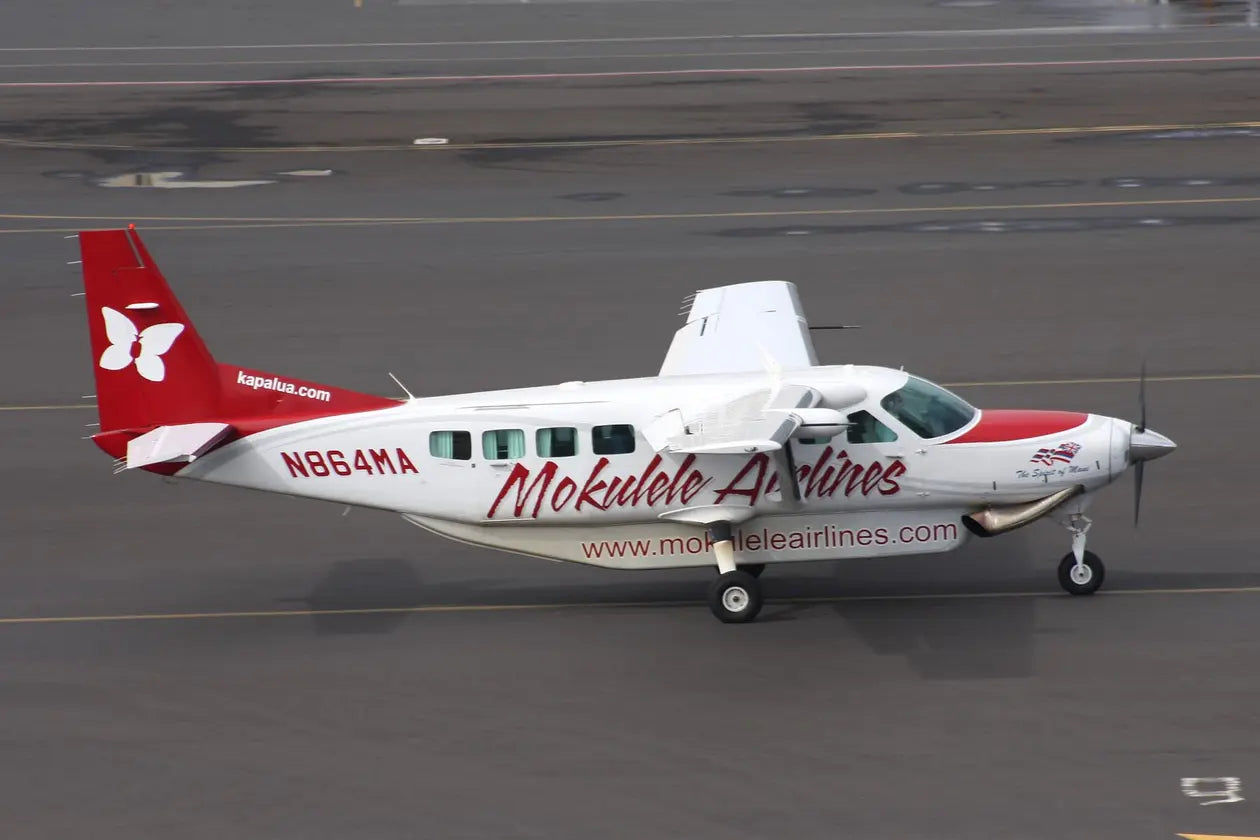
Mokulele's fleet is built around a single aircraft type, the Cessna 208EX Grand Caravan. This is both the airline's greatest strength and its most significant operational constraint. A single-type fleet simplifies training, maintenance, crew scheduling, and spares, which allows a Part 135 operator to run lean. But a single-engine turboprop fleet also limits where and when the airline can fly (especially over water at night in certain conditions) and caps the ceiling of pilot experience pilots can accumulate before they need to move on.
As of 2024–2025, the airline has publicly stated a Grand Caravan fleet in the 11 to 18 aircraft range, with Surf Air Mobility adding new deliveries through its exclusive Textron partnership. Industry reporting (including Maui Now's coverage of the 2024 Molokai service crunch) suggests the fleet number fluctuates daily depending on maintenance availability, and the airline itself has acknowledged that aircraft dispatch reliability has been a challenge in recent years.
Current Aircraft Types
| Aircraft Type | Engine | Seats | Role | Status |
|---|---|---|---|---|
| Cessna 208EX Grand Caravan | PT6A-140 turboprop | 9 passengers | Inter-island scheduled commuter | Active backbone (~11-18) |
| Tecnam P2012 Traveller | 2 x Lycoming piston | 9 passengers | Secondary (briefly operated) | Retired / sold 2024 |
| Saab 340 | 2 x CT7 turboprop | 28-30 passengers | Higher-density inter-island | Indefinitely grounded (engine issues) |
Why the Single-Engine Caravan Dominates
The Cessna 208 Caravan is the defining aircraft of small-scale Hawaii inter-island operations because it hits a specific cost-versus-capability sweet spot. Its single PT6A-140 turboprop provides reliable turbine power, its 9-seat configuration keeps the operation under the FAR Part 135 commuter ceiling (9 passengers or fewer, which removes the need for flight attendants), and its short-field performance lets it serve runways like Kalaupapa (PHLU) that would be inaccessible to larger regional aircraft. The Caravan's unpressurized cabin is not a limitation on typical Hawaiian sectors because cruise altitudes rarely exceed 10,000 feet and flight times are measured in tens of minutes rather than hours.
The flip side is that the Caravan is noisy, hot on the ramp, and physically demanding to operate at high frequency. Pilots routinely handle their own preflights, passenger briefings, cargo loading, and weight-and-balance calculations, often in the Hawaiian sun with no jetway and no ground crew doing the walking for them. The pace of operation (six to ten sectors per duty period is common across Part 135 Caravan operators) builds hands-on aviation experience fast.
The Caravan is certified for single-pilot operation under US FAA rules, and that is Mokulele's standard operating mode for revenue flights. Historically, the airline has at times paired newly hired pilots in the right seat for line-indoctrination and hour-building before they transition into the left seat for single-pilot revenue work. Candidates should assume that the overwhelming majority of revenue flight hours will be flown as sole-manipulator pilot-in-command, and that "First Officer" at Mokulele is typically a training phase rather than a long-term position. This is very different from a Part 121 regional where the FO seat is a permanent rank.
Fleet Renewal and Electric Aircraft Plans
Surf Air Mobility has publicly positioned itself as a future operator of electric and hybrid-electric Caravans converted using magniX and other powertrain partners. The parent company has announced an exclusive commercial relationship with Textron Aviation covering up to 150 Caravans and has signed MOUs, including a 2024 letter of intent with Auric Air to upgrade a dozen Caravans once certification is in place. As of early 2026, however, no electric or hybrid-electric Caravans are yet in revenue service with Mokulele. For pilots joining today, the flying you will do is conventional PT6A turbine flying, full stop, and any future electric conversion would require a dedicated differences-training cycle.
On the conventional side, Surf Air announced a $22.4 million investment program for Mokulele covering fleet modernization, airport infrastructure, passenger lounges, and loyalty. How much of that translates into quality-of-life improvements for the pilot group (cockpit avionics upgrades, scheduling software, crew facilities) remains to be seen and should be monitored through the parent's SEC filings.
Pilot Salary & Compensation Breakdown
Compensation at Mokulele is the section most candidates underestimate. This is not a Part 121 regional with its six-figure first-year pay bumps; it is a small Part 135 commuter with an FAA-regulated but unilaterally set pay scale. There is no collective bargaining agreement, there is no published multi-year payscale, and hourly rates move based on management discretion, cost pressure, and the competitive labor market in Hawaii rather than negotiated contract steps.
Public data sources (airline pilot forums, pilot career portals, Indeed reviews, and Surf Air Mobility's investor materials) consistently describe a two-tier structure. Pilots in the training / right-seat phase are paid modest block-hour rates and see very low annualized compensation, while left-seat Captains flying a full line earn a substantially higher figure driven more by flight-hour volume than by rate. Because Part 135 duty days can produce 6–8 block hours routinely, the gap between an FO's year-one pay and a line Captain's take-home is very wide.
First Officer / Right-Seat Compensation
| Seniority Phase | Block-Hour Rate (est.) | Annualized Range (est.) | Notes |
|---|---|---|---|
| Initial training / ground school | Unpaid or stipend | Effectively $0 for ~5 ground days | Hotel often provided during concentrated training |
| Right-seat revenue flying (pre-upgrade) | ~$12–$21 / block hour | $18,000–$28,000 | Highly dependent on monthly block hours flown |
| Late right-seat / line-check prep | Upper end of FO band | $25,000–$30,000 | Shorter duration as upgrade approaches |
Captain / Single-Pilot PIC Compensation
| Seniority Phase | Effective Hourly Rate (est.) | Annualized Range (est.) | Notes |
|---|---|---|---|
| Newly upgraded Captain | ~$55–$70 / block hour | $90,000–$110,000 | Driven by sector volume; 80-100 block hours/mo typical |
| Mid-seniority line Captain | ~$70–$85 / block hour | $120,000–$150,000 | Line bidding favors productive lines |
| Senior Captain / check airman | Top block rate + override | $150,000–$185,000 | Check airman / instructor roles add supplemental pay |
Training Contract & Financial Traps
Mokulele has historically used a training contract around $7,500 with a one-year commitment. Pilots who leave before the year is complete owe back a prorated amount of training costs. This matters for financial planning: the first 6–12 months at Mokulele are when income is lowest, housing in Hawaii (especially Maui and Oahu) is most expensive, and the temptation to jump to a Part 121 regional offering $90,000+ first-year pay is greatest. Candidates should budget for the training contract repayment if there is any realistic chance they will depart early.
Hawaii is one of the most expensive US states to live in. Median rent on Maui and Oahu routinely exceeds $2,500–$3,500 per month for a one-bedroom. A Mokulele pilot earning $18,000–$28,000 in the right-seat phase cannot realistically pay market rent solo in most Mokulele base locations without a roommate, a partner's income, or personal savings. This is the single most common complaint in public employee reviews, and it is the most important financial reality candidates should model before accepting an offer.
What Is Not Paid Like at a Part 121
There is no published longevity pay escalator, no widely disclosed profit sharing, no annual raise tied to a multi-year contract, and no "year-three to year-twelve" pay progression of the kind a Part 121 payscale would show. Pay is negotiated individually at hiring and adjusted by management at its discretion. Pilots who want long-run compensation certainty will find it at a Part 121 regional (SkyWest, Republic, Envoy, PSA, Piedmont, Endeavor) or further along the career path at a mainline carrier, not at Mokulele.
The salary figures above are editorial estimates compiled from publicly available employee-reported sources (Indeed, airlinepilotforums.com, pilotcareercenter.com) and industry references (Epic Flight Academy). Mokulele does not publish an official payscale, and there is no collective agreement. Individual offers vary based on hiring market, experience, and base. Candidates should request written compensation details before signing any training agreement.
Roster Pattern & Quality of Life
If the pay is the weakness, the schedule is the feature. The single biggest reason Mokulele retains pilots long enough to hit their hour targets is that the roster pattern is simple, predictable, and commuter-friendly in a way that most Part 121 regional schedules are not. Because the airline is a short-sector day operation (no red-eyes, no multi-day trips with hotel sequences, no transoceanic fatigue), life outside work can actually be planned.
The classic Mokulele line is structured around a 4-days-on / 4-days-off rotation, with duty days of up to 13 hours and typical block flying of 6–8 hours per day on a full day. That equates to roughly 80–100 block hours per month for a line-Captain bid, which is why annualized Captain pay reaches six figures despite a modest hourly rate. The downside is the intensity of the duty days themselves: eight short sectors in tropical heat, multiple quick-turns, cargo loading, and little sit time.
Typical Duty Day Pattern
| Phase | Typical Timing | Key Activities |
|---|---|---|
| Show / report | 05:30–06:30 local | Preflight, weather, NOTAMs, fuel, weight & balance |
| First rotation | 06:30–10:30 | 3-4 inter-island sectors (OGG-HNL, OGG-MKK, HNL-LNY etc.) |
| Mid-day ground time | 10:30–12:30 | Crew lunch, short rest, passenger reloads between sectors |
| Afternoon rotation | 12:30–17:00 | 3-4 additional sectors, return to base |
| Debrief / release | 17:00–18:00 | Paperwork, aircraft tie-down, postflight |
Sample Month: 4-On / 4-Off Caravan Line
Sample Month — Kahului (OGG) Caravan Captain, 4×4 Rotation
Quality-of-Life Nuances Candidates Often Miss
Three aspects of the Mokulele QoL are frequently misunderstood by new pilots. First, Part 135 does not use FAR 117 rest rules. That matters because 117 (which governs Part 121 operators) includes the well-known fatigue-based look-back provisions and cumulative fatigue protections. Part 135 duty limits are less granular, which in practice means more flexibility for the operator and less structural protection for the pilot against back-to-back demanding days. Pilots are responsible for their own fitness-for-duty calls.
Second, single-pilot IFR in Hawaii weather is a real skill that takes months to develop. Kona-side trade wind rotors, windward showers, convective build-ups on the Big Island, and the Molokai channel all combine to produce conditions that look small on a map but are demanding in the cockpit. Pilots arriving from flat-terrain instructing jobs should expect a real learning curve.
Third, although the rotation is nominally 4×4, reserve assignments, IOE pairings, and maintenance-driven changes can compress rest periods. Public employee reviews consistently cite management-driven schedule changes and last-minute base reassignments as the biggest friction point with the operation. Work-life balance is strong when the schedule holds; it weakens quickly when the fleet is short an aircraft or two.
Benefits, Travel Perks & Retirement
Benefits at Mokulele are functional rather than generous. The airline provides the baseline US employer-benefits package a Part 135 operator needs to be competitive for pilots: health insurance, dental, some time off, and an industry-standard travel perks scheme through myIDTravel. What it does not provide is the rich, contractually codified benefits envelope of a Part 121 carrier. There is no pension (defined benefit), no loss-of-license insurance mandated by contract, no negotiated maternity/paternity package, and no layered long-term disability structure.
Travel & Jumpseat Privileges
Travel benefits are one of the better Mokulele perks, mostly because they plug into industry-standard systems rather than being a Mokulele-specific scheme. Pilots get myIDTravel space-available access on a long list of participating carriers, which makes it possible (with listing savvy and a flexible schedule) to travel off-island on other airlines' non-revenue tickets. CASS-authorized cockpit jumpseat access means Mokulele pilots can also use reciprocal flight-deck jumpseats to commute on US Part 121 operators, subject to the host captain's approval and each operator's jumpseat policy.
For a junior pilot with a single-engine Part 135 gig in Hawaii, CASS jumpseat access is arguably more financially meaningful than any cash allowance. It is what makes it possible to live off-island and commute to a Mokulele base, which a number of pilots do, particularly from the US mainland West Coast.
Retirement
Like most US employers, Mokulele operates within the 401(k) / defined-contribution framework. That means there is no pension guarantee, retirement income depends on what the pilot contributes and how markets perform, and employer matching (if any) is modest by industry standards. Pilots serious about long-term retirement planning should treat Mokulele as a base camp, not a destination, and plan to convert their Part 135 experience into a Part 121 seat where 401(k) matching rates are typically higher, contribution limits include additional pilot-specific provisions, and some carriers retain legacy benefit structures worth meaningful long-term money.
Per Diem & Expenses
Because Mokulele operates as a day-trip commuter without scheduled overnight layovers, the traditional airline per diem structure does not produce meaningful supplementary income. Per diem applies primarily during training trips and ad hoc overnights driven by weather or aircraft swaps. Expense coverage for training travel (hotel during ground school) is a useful benefit but does not change the annual compensation picture materially.
The CASS jumpseat access that comes with a Part 135 airline job is one of the most underrated perks in US aviation. Pilots who commute to Mokulele from the mainland West Coast should plan their living location around reliable jumpseat availability on carriers that fly into HNL, OGG, and KOA multiple times per day. Alaska Airlines, Hawaiian Airlines, and Southwest are particularly relevant here given their Hawaii frequencies and generally jumpseat-friendly policies.
Career Progression & Upgrade Path
Career progression at Mokulele is shaped by the fact that the airline is a single-fleet Part 135 commuter, not a multi-fleet Part 121 operator. There is no widebody upgrade, no narrowbody-to-widebody jump, no A-scale versus B-scale divide, and no long bidding queue for an exotic aircraft. The progression is binary: you start in the right seat as a training pilot, and you upgrade to single-pilot Captain on the Cessna 208. Everything else (check airman, instructor, ground school work) is a supplemental role on top of the same airframe.
The Upgrade Timeline
Upgrade timing is driven primarily by three factors: the pilot's accumulated turbine time at Mokulele, the FAA Part 135 PIC requirements (1,200 total time and 500 cross-country for IFR Part 135 PIC, with additional multi-engine and night considerations), and fleet/base demand. For a pilot who joined Mokulele at roughly the 500-hour mark with a commercial single-engine and instrument rating, the typical path to a left-seat revenue line is:
Initial training & right-seat IOE (Month 1-2)
Five days of ground school, systems and regs testing, followed by right-seat flying for initial operating experience. Pay is minimal during this phase.
Right-seat revenue flying (Month 2-8)
Building Caravan turbine time, local-knowledge airmanship, and Part 135 IFR proficiency. Pilots who do not already hold ATP continue building total time toward the 1,500-hour minimum in parallel.
PIC qualification & check ride (Month 6-12)
FAR Part 135.293 recurrent competency check, 135.299 line check, and single-pilot PIC qualification. Upgrade timing varies with fleet demand and base vacancies.
Line Captain (Year 1-2+)
Full single-pilot revenue line, ~80-100 block hours/month, bidding based on seniority within the Mokulele pilot group.
Departure to Part 121 regional (Year 2-3)
The typical Mokulele pilot reaches ATP mins (1,500 TT or 750-1,250 R-ATP with degree) and moves to a Part 121 regional carrier like SkyWest, Republic, Envoy, PSA, Endeavor, Piedmont, or GoJet.
The Real Career Value of Mokulele
The career value of a Mokulele tour is not the Captain title on a 9-seat single. It is the turbine PIC time logged in a demanding, real-world IFR environment. Hiring committees at Part 121 regionals and cargo operators weigh Caravan PIC hours differently than they weigh flight-instructor time. An 800-hour Cessna 208 Captain with Hawaii IFR experience tends to interview well at a regional because the hours are operational, current, and in the Part 135 framework that pattern-matches with Part 121 line flying more closely than CFI-only time does.
For pilots who already hold an ATP before applying (military background, University Airline cadet, prior 135 job elsewhere), the sequencing can be faster. Many applicants at that point treat Mokulele as a 12–18 month turbine-PIC generator rather than a two-year commitment.
Lateral Moves Within the Surf Air Group
The corporate consolidation with Southern Airways Express in theory opens a path for lateral transfers to the Southern Airways mainland operation, which flies similar Caravan scheduled commuter work on the US mainland (EAS routes across the Midwest, Mid-Atlantic, and Gulf Coast). In practice, the two operations still run distinct pilot groups, and lateral transfers are not automatic. Candidates with strong ties to the mainland should treat Southern Airways Express as a separate application rather than a guaranteed internal transfer from Mokulele.
Recruitment Process & Requirements
One of Mokulele's defining features is that the recruitment bar is deliberately achievable for freshly qualified commercial pilots. The airline does not require an Airline Transport Pilot certificate, does not require heavy multi-engine turbine time, and does not require a specific cadet or airline-pipeline background. What it does require is a clean medical, a clean record, the legal right to work in the US, and the personal flexibility to relocate to Hawaii (or the US West Coast for Southern Airways Express sister operations).
Minimum Pilot Requirements
| Requirement | Detail |
|---|---|
| License | FAA Commercial Pilot License (CPL), single-engine land and instrument rating required; multi-engine land helpful but not always mandatory |
| Medical | FAA First-Class medical certificate preferred; Second-Class minimum |
| Total Time | Preferred ~500 TT with reasonable IFR currency; some candidates hired at lower hours into right-seat/IOE |
| Cross-Country | ~100 hours cross-country, including ~25 hours at night and 50 turbine (or 75 IMC/instrument) preferred |
| Citizenship / Work Authorization | Must have US work authorization (TSA flight-training vetting, ramp access). No visa sponsorship. |
| Language | FAA ICAO Level 4 English (standard FAA requirement) |
| Background | Clean FAA record; satisfactory 10-year PRIA and DOT drug-testing history |
| ATP | Not required at time of hire (Part 135 PIC uses different mins); ATP is the exit qualification, not the entry qualification |
Selection Stages
Application & document screen
Resume, pilot history, logbook summary, and certificate scans submitted through Southern Airways Express / Surf Air Mobility ADP careers portal.
Phone or video interview
Initial conversation with recruitment, covering motivation for Hawaii, willingness to commit to the training contract, and basic technical knowledge.
Technical interview & written test
FAR/AIM, IFR procedures, aircraft systems (Caravan knowledge helpful but not assumed), decision-making scenarios, and weather.
Conditional offer & background checks
PRIA letters, DOT drug test, TSA fingerprinting, medical verification, training contract signature.
Ground school & IOE
~5 days of ground instruction (aircraft systems, company operating procedures, Part 135 regulations), followed by initial operating experience in the right seat.
Line check & release to line
FAR Part 135.299 line check with a designated check airman before release to full revenue flying.
Unlike a Part 121 regional where interview prep is dominated by structured HR scenarios and CRM role-plays, a Mokulele interview is more operationally blunt. Expect to be asked why Hawaii, how you will afford the first six months, what you know about the Caravan and PT6A-140 engine, and how you would handle single-pilot IMC with an unexpected weather deviation. Decision-making, judgment under pressure, and realistic self-awareness about Hawaii cost-of-living matter as much as technical depth. The Ready for Take-Off pilot assessment book can help frame those decision-making scenarios.
Bases & Hawaii Network
Because Mokulele is a day commuter operation, the traditional long-haul "layover destinations" section does not apply: most pilots start and finish each duty day at their assigned base, with no scheduled overnights. The equivalent concept at Mokulele is the base assignment, which has a much larger effect on quality of life than any layover pattern would. Where you are based dictates where you live, what your commute looks like, the sectors you fly most frequently, and the housing market you enter.
Route Economics & What Pilots Actually Fly
In volume terms, the OGG-HNL corridor is Mokulele's highest-frequency route. OGG-KOA and OGG-MKK are next in line, with LNY and Kalaupapa (PHLU) runs making up the bulk of the remainder. A typical month on a line Captain bid will see a pilot repeat the same three or four sector pairs many dozens of times. The upside is total familiarity with the airspace, approaches, and common weather patterns; the downside is the operational monotony that some pilots find tiring after the first 12 months.
The Kalaupapa service deserves a separate mention. Kalaupapa (PHLU) is a short, single-runway strip on the isolated northern peninsula of Molokai, historically the site of the Hansen's disease settlement. Mokulele is the primary scheduled air link for the community, and the flying there is technically demanding (short runway, terrain, wind). Pilots based at MKK or HNL who are regularly rostered to Kalaupapa pick up a distinctive set of stick-and-rudder skills that transfer well to bush flying, Alaska operators, and niche 121 turboprop jobs.
Because Mokulele doesn't provide employer housing at any scale and doesn't pay mainland regional-level salaries, your base choice is effectively a housing decision. Pilots routinely share multi-bedroom rentals to make Maui or Oahu affordable. Candidates should spend real time on Craigslist, Zillow, and local Hawaii rental Facebook groups for the specific base they would be assigned before accepting an offer. The difference between an OGG base and a KOA base can be the difference between breaking even and going into debt.
Union & Labor Relations
One of the most structurally important facts about Mokulele Airlines is that its pilots are not unionized. There is no Air Line Pilots Association (ALPA) master executive council at Mokulele, no International Brotherhood of Teamsters (IBT) representation, and no independent pilots' association running collective bargaining. This is not unusual for Part 135 commuter operators of Mokulele's size; ALPA's membership list explicitly consists of Part 121 airlines and a small number of large 135 cargo operators, and Mokulele does not appear among them. Confirming this yourself is straightforward: ALPA's pilot-groups directory lists every airline the union represents in North America.
What Non-Union Status Means in Practice
There are four practical consequences of working at a non-union Part 135 operator that prospective pilots should internalize clearly before signing a training contract. First, pay is not contractually protected. Rates can be adjusted at management's discretion, with whatever notice is stipulated in the employee handbook. There is no negotiated multi-year payscale, and there is no arbitration backstop if the company decides to freeze rates in a downturn.
Second, schedule rules live in the ops manual, not in a contract. Changes to bidding procedures, base assignments, or reserve rules can be implemented by updating the FAA-approved General Operations Manual and the company's internal policies, without requiring union agreement. This is flexible when the company is being reasonable and uncomfortable when it is not.
Third, grievance and discipline procedures are governed by employer policy rather than a Railway Labor Act collective-bargaining grievance system. Pilots have the protections of federal law (FAA ALPA whistleblower-style protections, the Aviation Investment and Reform Act for the 21st Century (AIR 21), OSHA, etc.), but they do not have a union rep to walk into a disciplinary meeting with them.
Fourth, there is no formal "seniority list" with legal weight. Mokulele uses date-of-hire for bidding purposes internally, but the seniority construct is fundamentally different from a Part 121 merger-and-fragmentation-protected seniority list. Pilots should not assume that a Mokulele seniority date will translate into any external value.
Labor Climate Under Surf Air Mobility
Since the Surf Air Mobility listing and the acquisition of Southern Airways Corp, there has been no public reporting of a union organizing drive at Mokulele (or at Southern Airways Express). The parent's SEC filings do not disclose a material collective-bargaining exposure at the Mokulele or Southern Airways Express levels, which is consistent with a fully non-union pilot group across the group's Part 135 commuter operations. The broader US airline labor environment has been active since 2022, with many Part 121 pilot groups achieving large contract gains, but that activity has not spread into the Hawaii Part 135 space in a meaningful way.
Regulatory & Safety Oversight
Although Mokulele pilots lack union representation, they are covered by the FAA's Aviation Safety Action Program (ASAP) and the federal whistleblower protection framework under AIR 21 for safety reporting. These programs are administered by the FAA (www.faa.gov) and the Department of Transportation rather than by any union, but they provide a confidential avenue for reporting safety concerns without fear of retaliation.
If collective bargaining protection is important to your risk tolerance, Mokulele may not be the right first airline job. Pilots who want the cheapest possible hour-building experience often treat the lack of a union as an acceptable trade-off for two years. Pilots who expect to build a long career in one place, who plan to have a family during that tenure, or who need clear long-term economic visibility typically skip 135 commuters entirely and aim directly for a Part 121 regional like SkyWest, Republic, or Endeavor, all of which are ALPA-represented.
How Mokulele Compares: Airline Radar Chart
Mokulele sits in a very specific slot in the US pilot career map: it is a Part 135 Hawaii commuter that competes most directly for talent with its sister brand Southern Airways Express (the mainland Caravan operation) and, at a very different scale, with Hawaiian Airlines (the Part 121 legacy operator that dominates inter-island jet service). The radar chart below benchmarks Mokulele against both of those carriers across the same six metrics used in the scorecard above. Scores are editorial estimates based on publicly available data, employee reviews, SEC filings, and ALPA contract benchmarks.
Key Takeaways from the Comparison
Mokulele and Southern Airways Express are near-clones of each other on the radar. That should not be a surprise: they share a parent (Surf Air Mobility), a regulatory framework (FAR Part 135 scheduled commuter), an aircraft type (Cessna 208 Caravan), and a pilot workforce economics profile (non-union, low first-year pay, fast turbine PIC, high turnover). The marginal differences sit in geography and commute: Southern Airways Express offers mainland US bases that are cheaper to live in, while Mokulele offers Hawaii lifestyle at the cost of a much higher housing burden.
Hawaiian Airlines sits in a different universe on salary and benefits. Under its March 2023 ALPA contract, Hawaiian first-year FOs earn $84 per hour with ~75-hour monthly guarantees, and senior Captains reach $294–$407 per hour depending on fleet, figures detailed in the Hawaiian Airlines payrates database. Annualized, a senior A330/B787 Hawaiian Captain earns multiples of a Mokulele line Captain for a lower monthly duty load. For any pilot whose end goal is the best Hawaii pilot job, Hawaiian is the destination and Mokulele is at most a stepping stone.
Work-life balance is closer than salary. Mokulele's 4-on/4-off commuter schedule and predictable day-trip structure actually scores reasonably well against the multi-day 121 pairing-based schedule at Hawaiian. What Mokulele gives up on total rest hours, it partially recovers on no-overnight predictability. The real work-life gap is in paid vacation and sick leave, where Hawaiian's ALPA contract provides multiples of Mokulele's ~10 days.
Job security is the most nuanced metric. Hawaiian's ALPA-protected seniority list gives long-term career security that Mokulele cannot match, but the post-Alaska Air Group merger environment introduces some list-integration uncertainty that Mokulele (and Southern Airways Express) do not have. Being unimportant to a corporate merger can itself be a kind of security.
Scores are editorial estimates based on our research into publicly available pay data, pilot forums (airlinepilotforums.com, jetcareers.com), union publications, SEC filings from Surf Air Mobility (SEC EDGAR), and industry benchmarks. They represent a general assessment for a pilot considering these airlines as their next move. Individual experiences will vary based on seniority, base, and personal priorities. The comparison is intended as a directional guide, not a precise ranking.
Verdict & FAQ
Mokulele Airlines: Final Verdict
Mokulele Airlines is a hour-building airline job, not a destination airline job. The pay is low, the benefits are lean, the pilot group is non-union, and the aircraft is a single-engine turboprop that will not appear on your resume at a mainline interview in the same way a jet type will. The reason to join Mokulele is operational: fast turbine PIC time, in a demanding real-world IFR environment, in one of the most beautiful flying environments on the planet, with a simple 4-on/4-off schedule that lets you plan a life.
For a pilot who wants to reach ATP mins and move on to a Part 121 regional within 18 to 24 months, Mokulele is a reasonable and in some cases excellent choice. For a pilot who wants long-term financial security, negotiated benefits, and a defined career ladder inside one airline, Mokulele is not the right fit and better options exist one tier up at the ALPA-represented regionals.
01 Do I need an ATP to fly for Mokulele Airlines?
No. Mokulele is a FAR Part 135 scheduled commuter, and Part 135 PIC requirements are different from the Part 121 ATP rules. Pilots typically join Mokulele with a FAA Commercial Pilot License, instrument rating, and roughly 500 total time, then build turbine PIC time toward the 1,500-hour ATP minimum (or 1,250/1,000 restricted-ATP with qualifying degree or military background). The ATP is usually your exit qualification from Mokulele, not your entry qualification.
02 Is Mokulele single-pilot or two-pilot on the Caravan?
The Cessna 208 is certified for single-pilot operation, and that is Mokulele's standard revenue operating mode. Historically, newly hired pilots have flown right-seat initial operating experience alongside a Captain before upgrading to single-pilot PIC. Candidates should expect that the vast majority of their revenue hours will be logged as sole-manipulator pilot-in-command.
03 How long does it take to upgrade to Captain at Mokulele?
Typical upgrade timelines fall in the 6 to 12 month range, driven by total time accumulation, Part 135 PIC qualification (1,200 TT, 500 XC for IFR PIC), and fleet/base demand. Pilots who already hold an ATP at hire, and who have relevant turbine time, often upgrade at the faster end of that range. Pilots who join at lower total time spend more months in the right seat building hours before qualifying for the left seat.
04 Can I commute to Mokulele from the mainland?
Yes, but with friction. Many Mokulele pilots use CASS cockpit jumpseat access on Part 121 operators (Alaska Airlines, Hawaiian Airlines, Southwest, United) to commute from the US West Coast into HNL, OGG, or KOA. The commute adds significant time off either side of each rotation, and it only works with a 4-on/4-off schedule that leaves enough slack for cancellations and weather. Pilots based at Molokai or Lanai have a much harder commute because the frequency of mainland service into those airports is extremely limited.
05 Are Mokulele pilots unionized?
No. Mokulele pilots are not represented by ALPA, the Teamsters, or any other organized pilot labor group. The airline is a non-union Part 135 commuter. Pay, scheduling, and discipline are governed by company policy and the employee handbook rather than by a collective bargaining agreement.
06 What is the training contract, and can I leave early?
Mokulele has historically used a training agreement of approximately $7,500 with a one-year commitment. Pilots who leave before completing the contracted period owe back a prorated portion of the training cost. The contract is contractually enforceable in most US jurisdictions, so candidates should treat it as real money and plan their finances accordingly before signing. Exact terms vary and should be reviewed in writing before accepting any offer.
07 Which Part 121 regionals do Mokulele pilots typically flow to?
Mokulele pilots do not have a formal flow-through agreement with any mainline or regional, so departures are through the open market. Common next-step employers include SkyWest, Republic, Envoy, PSA, Endeavor, Piedmont, GoJet, and Horizon Air. Cargo operators like Ameriflight and some 135 cargo carriers (Empire, Alpine Air) also hire pilots with Mokulele Caravan PIC time. First-year Part 121 regional pay in 2025–2026 is materially higher than Mokulele pay, which is why turnover at Mokulele is structurally high.
08 Can I realistically live on a Mokulele first-year salary in Hawaii?
Not easily, and that is the single most common critique from employee reviews. First-year right-seat pay of roughly $18,000–$28,000 is below the cost of solo market rent on Maui or Oahu, and is tight even on the Big Island. Most junior Mokulele pilots share housing with other pilots, rely on a partner's income, draw on personal savings, or stack side work to make the math work. Candidates should model their personal cash-flow carefully before accepting, especially factoring in the training contract repayment exposure.
Official Links & Resources
The resources below are the authoritative starting points for any candidate doing due diligence on Mokulele Airlines. Career information is routed through the parent Surf Air Mobility / Southern Airways Express recruitment portal rather than a standalone Mokulele careers page, so always apply through the corporate posting rather than a job aggregator.