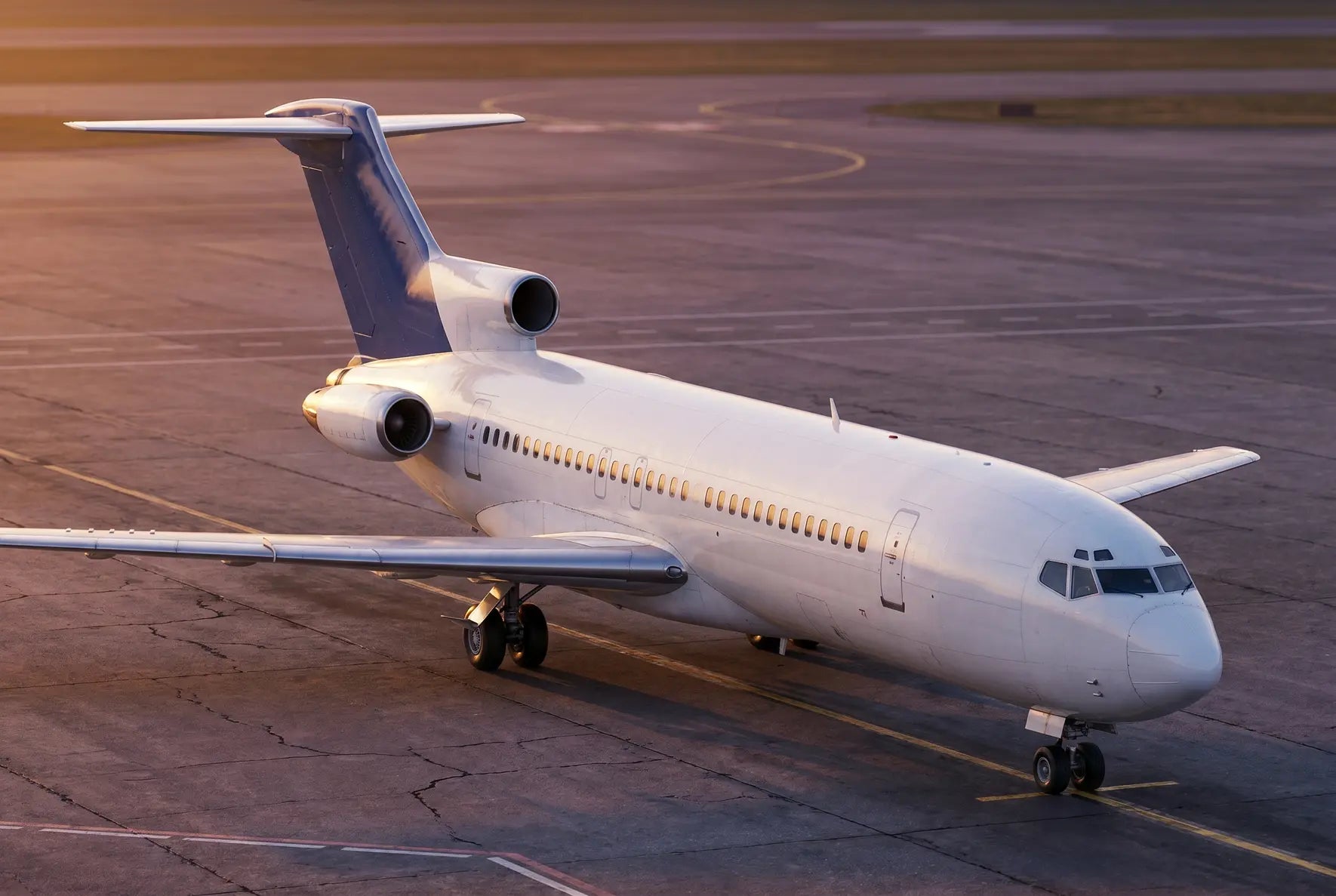
Boeing 727-200: History, Program Launch, and Development of the Stretched Trijet
The Boeing 727 family was conceived in the late 1950s as a response to airline demand for a versatile short to medium range jetliner capable of operating from smaller airports with shorter runways. Building on the success of the four engine Boeing 707, the company sought a trijet configuration that could bring efficient jet service to regional routes previously served only by propeller aircraft. Boeing officially launched the 727 program on December 5, 1960, after securing initial orders of 40 aircraft each from United Airlines and Eastern Air Lines.
The original 727-100 made its first flight on February 9, 1963, and entered revenue service with Eastern Air Lines on February 1, 1964. It introduced several firsts for Boeing: fully powered flight controls, rigorous fatigue testing, and a distinctive rear mounted trijet layout with a built in ventral airstair, enabling boarding without ground equipment at remote airports. However, as airlines sought greater passenger capacity for growing medium haul routes, Boeing recognized the need for a stretched variant.
The Birth of the Boeing 727-200
Boeing announced development of the Boeing 727-200 in the mid 1960s to address demand for higher seating capacity while retaining the operational flexibility that made the 727-100 popular. The airframe was stretched by 20 feet (6.1 metres), bringing the overall fuselage length from 133 feet 2 inches (40.6 m) on the 727-100 to 153 feet 2 inches (46.7 m). This allowed typical seating for 150 to 189 passengers depending on cabin layout, a significant increase over the 727-100's capacity of around 100 to 131 seats.
The Boeing 727-200 completed its maiden flight on July 27, 1967, and received its FAA Type Certificate (TCDS No. A3WE) on November 29, 1967. The variant entered commercial service with Northeast Airlines in December 1967, just five months after its first flight. Early 727-200 models were powered by three rear mounted Pratt & Whitney JT8D-9 turbofan engines, each producing approximately 14,500 lbf (64.4 kN) of thrust. Delta Air Lines later acquired Northeast's fleet of 727-100s and early 727-200s following their merger on August 1, 1972.
The Boeing 727-200 Advanced: A Decisive Upgrade
In the early 1970s, Boeing introduced the 727-200 Advanced, a significantly enhanced sub variant that would become the most produced model in the entire 727 family. The first 727-200 Advanced was delivered to All Nippon Airways on June 30, 1972. This version incorporated more powerful JT8D-15 or JT8D-17 series engines, increased fuel capacity that extended the range by approximately 620 nautical miles, and structural reinforcements to support a higher maximum takeoff weight. Standard MTOW reached 191,000 pounds (86,600 kg), with an optional configuration of up to 210,000 pounds (95,300 kg).
Interior refinements on the Advanced model included enclosed overhead bins and improved cabin lighting, part of Boeing's effort to offer a more modern passenger experience. These upgrades made the 727-200 Advanced an immediate commercial success, with approximately 935 units delivered, compared to roughly 310 standard 727-200 airframes. A dedicated freighter variant, the 727-200F Advanced, was also produced, with 15 units built exclusively for Federal Express beginning in 1981.
Role in Airline Deregulation and Legacy
The Boeing 727-200 proved indispensable during the era of U.S. airline deregulation in 1978. Its ability to operate from a wide range of airports, combined with its payload flexibility and short field performance thanks to advanced triple slotted flaps and leading edge devices, made it the backbone of airline hub and spoke networks that emerged in the post deregulation landscape. Carriers such as Northwest Airlines, Delta, American, and United relied heavily on the type throughout the 1970s and 1980s.
Total production of the entire Boeing 727 family reached 1,832 aircraft, manufactured at Boeing's Renton, Washington plant between 1962 and 1984, when the last airframe was delivered. The 727-200 series (including the Advanced) accounted for approximately two thirds of all 727 production, making it Boeing's best selling jetliner until surpassed by the 737 family.
Key identifiers that distinguish the Boeing 727-200 and its sub variants from the 727-100 include:
- Fuselage length: 153 ft 2 in (46.7 m), stretched 20 ft (6.1 m) over the 727-100
- Engines: Three Pratt & Whitney JT8D turbofans (JT8D-9 on base models; JT8D-15 or JT8D-17 on Advanced)
- MTOW (Advanced): 191,000 lb (86,600 kg) standard, up to 210,000 lb (95,300 kg) optional
- Passenger capacity: 150 to 189 (single class), compared to 100 to 131 on the 727-100
- Centre engine intake: Round intake design, replacing the oval shaped intake of the 727-100
- FAA Type Certificate: TCDS No. A3WE (shared across all 727-200 series)

A Boeing 727 aircraft from Iberia Airlines is captured in flight against a clear blue sky with clouds below. The aircraft features the airline's distinctive livery.
Boeing 727 200 Technical Specifications, Systems and Engine Performance Overview
The Boeing 727 200 was designed as a short to medium range commercial transport, stretching the original 727 100 fuselage by 6.1 metres (20 feet) to seat up to 189 passengers in a single class layout. The variant inherited the distinctive T tail, triple rear engine configuration and 32 degree wing sweep that defined the 727 family, while introducing higher gross weights and, from 1970 with the Advanced subvariant, more powerful engines and increased fuel capacity. These changes shifted the design envelope toward greater payload and range, making the 727 200 the most produced member of the family with 1,240 units built before production ended in 1984.
The core design trade off of the 727 200 centred on balancing short field capability with medium range economics. Its triple slotted trailing edge flaps and leading edge slats allowed operations from shorter runways than many competitors, while the three engine layout provided redundancy and climb performance suitable for noise sensitive and obstacle rich airports. The Advanced version raised MTOW from 83,820 kg up to 95,027 kg (184,800 to 209,500 lb) depending on engine and structural options, extending range to approximately 2,550 nautical miles with optional fuselage fuel tanks installed.
- Length: 46.69 m (153 ft 2 in)
- Wingspan: 32.92 m (108 ft 0 in)
- Height: 10.36 m (34 ft 0 in)
- Typical seating: 148 to 189 passengers (single class)
- MTOW: 83,820 to 95,027 kg (184,800 to 209,500 lb), depending on subvariant and engine selection
- OEW: approximately 45,360 kg (100,000 lb) for the Advanced
- MLW: 70,080 to 73,028 kg (154,500 to 161,000 lb)
- MZFW: 62,595 to 65,315 kg (138,000 to 144,000 lb)
- Fuel capacity: 30,623 litres (8,090 US gal) standard; up to 40,070 litres (10,585 US gal) with optional fuselage tanks
- Range: approximately 2,550 nmi (4,720 km) with optional fuel tanks and typical payload
- Cruise speed: Mach 0.84 typical; maximum operating speed Mach 0.90
- Service ceiling: 10,730 m (35,200 ft)
- Engines: 3 x Pratt & Whitney JT8D turbofans (variants from JT8D 7 at 62 kN / 14,000 lbf to JT8D 17R at 77 kN / 17,400 lbf per engine)
- Takeoff field length (FAR, at MTOW): approximately 2,938 m (9,640 ft)
- Landing distance (FAR): approximately 1,430 m (4,690 ft)
Systems, Flight Controls and Handling Technology
The 727 200 was the first Boeing jetliner with completely powered flight controls. The primary surfaces, including inboard and outboard ailerons, elevators, and upper and lower rudders, are actuated by two independent hydraulic systems (A and B) controlled from the overhead panel. Ten spoiler panels supplement roll authority and provide in flight speed braking. Manual reversion is available for the ailerons and elevators in the event of a dual hydraulic failure, with depressurised actuators serving as gust locks. A standby hydraulic system powers the lower rudder if System A pressure is lost.
Pitch feel is synthesised by dual feel computers that blend dynamic air pressure with stabilizer position data. The horizontal stabilizer is electrically trimmed, with separate electrical limits and mechanical stops to prevent runaway. Two independent yaw damper couplers, each driving a separate rudder section through rate gyros, suppress Dutch roll without transmitting motion to the rudder pedals. Stall protection relies on a single angle of attack vane driving a stick shaker that activates at approximately 1.15 times the stall speed, factoring in flap position. Flap asymmetry protection closes bypass valves to halt drive to the affected flap section, though split flap protection was not incorporated.
Published performance figures for the 727 200 vary considerably depending on the operator's chosen engine variant, structural weight option, cabin density, atmospheric assumptions (ISA or otherwise) and runway condition. Quoted MTOW values, for example, span more than 11,000 kg across certified configurations, and range figures depend heavily on payload, fuel tank options and reserve policies. All numbers should be interpreted in context, and operators often published their own performance data in specific operating conditions that reflected actual route planning rather than manufacturer brochure values.
Pratt & Whitney JT8D: The Engine Behind the 727 200
Every Boeing 727 200 was powered by three Pratt & Whitney JT8D low bypass turbofan engines, mounted with one on each side of the rear fuselage and a centre engine fed through an S duct intake beneath the vertical stabilizer. The JT8D traces its origins to the late 1950s, when Pratt & Whitney adapted the J52 military turbojet by adding a two stage fan and two additional low pressure turbine stages, creating a compact two spool axial flow turbofan with a bypass ratio of approximately 1.0. The engine made its maiden flight on the Boeing 727 in February 1963 and quickly became the dominant powerplant for short and medium range jets of that era.
On the 727 200, the standard JT8D family progressed through several thrust ratings as the variant evolved. Early aircraft used the JT8D 7 producing 62 kN (14,000 lbf) per engine, while the JT8D 9 offered 64.5 kN (14,500 lbf). The 727 200 Advanced introduced higher thrust options including the JT8D 15 at 67 kN (15,000 lbf) and the JT8D 17 and JT8D 17R delivering up to 77 kN (17,400 lbf), enabling the increased gross weights and improved hot and high performance that defined the Advanced subvariant. A later quiet conversion, the 727 200S, used JT8D 217S engines for reduced noise levels.
Beyond the 727, the JT8D powered some of the most widely operated narrowbody jets in commercial aviation history. The Boeing 737 100 and 737 200, the Douglas DC 9 family, and the McDonnell Douglas MD 80 series all relied on variants from this engine programme. The higher bypass JT8D 200 series, with thrust ratings from 82 to 97 kN (18,500 to 21,700 lbf), powered the MD 80 and was also evaluated for 727 re engining programmes. Over its production life, which ended in 1985 for commercial variants, Pratt & Whitney manufactured more than 14,000 JT8D engines. The type accumulated over 500 million flight hours across more than 350 operators worldwide before mainline airline service concluded in 2020 with the retirement of Delta Air Lines' MD 88 fleet.
Boeing 727-200 vs 737-200 vs 727-100 vs DC-9-30: Specifications Comparison
Scroll horizontally to see more →
| Parameter | Boeing 727-200 | Boeing 737-200 | Boeing 727-100 | McDonnell Douglas DC-9-30 |
|---|---|---|---|---|
| Entry into service | 1967 | 1968 | 1964 | 1967 |
| Engines | 3 × Pratt & Whitney JT8D-9 | 2 × Pratt & Whitney JT8D-9 | 3 × Pratt & Whitney JT8D-1 | 2 × Pratt & Whitney JT8D-9 |
| Length | 46.7 m | 30.5 m | 40.6 m | 36.4 m |
| Wingspan | 32.9 m | 28.4 m | 32.9 m | 28.3 m |
| Height | 10.4 m | 11.3 m | 10.4 m | 9.1 m |
| Typical seating and layout | 2-class: 149–189 passengers | 2-class: 115–130 passengers | 2-class: 125–149 passengers | 2-class: 125–155 passengers |
| MTOW | 95 t | 52 t | 77 t | 64 t |
| Range | 2,600 nm | 2,000 nm | 2,200 nm | 2,500 nm |
| Cruise speed | 0.84 Mach | 0.82 Mach | 0.84 Mach | 0.84 Mach |
| Service ceiling | 35,000 ft | 37,000 ft | 37,000 ft | 37,000 ft |
| Program note | Stretched T-tail trijet for medium-range routes with rear airstair | Twin-engine short/medium-haul workhorse, direct 727 successor | Original shorter 727 baseline version | Mainline competitor twinjet with similar capacity and range |
Scroll horizontally to see more →
The table compares key specs of four classic short/medium-haul jets. The Boeing 727-200 is the largest and heaviest (46.7 m, 95 t MTOW) and offers the longest range at 2,600 nm, while the 737-200 is smallest and lightest (30.5 m, 52 t) with a shorter 2,000 nm range. The 727 variants are trijets with similar Mach 0.84 cruise, whereas the 737-200 and DC-9-30 are twinjets; the 737 also has the highest ceiling at 37,000 ft.
Boeing 727-200 Operations: Typical Routes, Missions and Airlines Worldwide
The Boeing 727-200 was designed as a short to medium range airliner, and it fulfilled that role with remarkable versatility from its entry into service in 1968 until its gradual retirement from passenger operations in the early 2000s. Typical missions covered sectors of up to 2,550 nautical miles (4,720 km) with 134 passengers in a two class configuration, translating into flights lasting roughly two to five hours. The stretched fuselage, 20 feet (6.1 m) longer than the original 727-100, allowed operators to carry more passengers on the same routes while retaining the type's acclaimed short field performance.
In daily operations, the Boeing 727-200 was a high utilisation workhorse. Delta Air Lines, which operated 183 examples, reported that its 727 fleet flew approximately 426,000 miles per day, carrying an average of 65,000 passengers and 600 tons of cargo daily across the network. This level of utilisation was common among major carriers: the aircraft's triple slotted trailing edge flaps, leading edge slats and Krueger flaps gave it access to airports with shorter runways, such as New York LaGuardia and high altitude fields like Denver. Its built in auxiliary power unit (APU) allowed ground independence at remote stations, enabling rapid turnarounds without external equipment.
The Boeing 727-200 was the backbone of hub and spoke networks that expanded rapidly after U.S. airline deregulation in 1978. Airlines used it to feed passengers from secondary and regional airports into major hubs, then redistribute them onto connecting flights. Its ability to operate efficiently on high frequency, short sectors of 500 to 1,500 nautical miles made it ideal for this model. It also served point to point routes between medium sized cities where demand did not justify widebody equipment.
Operators eventually faced significant challenges. Tightening Stage 3 noise regulations required expensive hushkit installations or re-engining with quieter Pratt & Whitney JT8D-217 series powerplants. The three engine configuration, while offering redundancy, consumed more fuel than the newer twin engine narrowbodies such as the Boeing 737-300 and Airbus A320 that gradually replaced it. Rising fuel costs and maintenance overhead eventually drove most passenger operators to retire the type by the early 2000s, although several cargo carriers continue to fly it today. For a broader look at how the aviation industry is addressing environmental pressures, see this overview of the future of aviation and sustainability.
Where the Boeing 727-200 Operates and Key Airlines
At its peak during the 1970s and 1980s, the Boeing 727-200 could be found on every inhabited continent. In North America, it dominated domestic networks for all the major trunk carriers. In South America, flag carriers and regional airlines deployed it on both domestic routes and international connections. Across Europe, scheduled and charter airlines used the type on intra-European and Mediterranean services. In Asia and Africa, the aircraft served a mix of domestic trunk routes and regional international links. Today, the surviving airframes are concentrated almost entirely in cargo operations, primarily in the Americas and Africa.
- North America: The largest operators were all based in the United States. Delta Air Lines flew 183 units, American Airlines operated 125, United Airlines had around 90, Eastern Air Lines used 99 (Eastern was also the launch customer for the 727 family), Northwest Airlines flew approximately 82, Continental Airlines operated 109, and Trans World Airlines (TWA) used 61. Pan American World Airways operated 105 on international routes. After passenger retirement, cargo operators kept the type alive: FedEx Express historically flew 60 as freighters, and today USA Jet Airlines, Kalitta Charters II and Everts Air Alaska still operate small numbers on freight missions.
- South America: Avianca (Colombia) operated 18 units on regional and international routes. Avensa (Venezuela) flew 13 on domestic and international services. Faucett Perú used 3 domestically, and LAN Chile also operated the type briefly. In current cargo operations, Aerosucre (Colombia) remains one of the most visible 727 operators, alongside Total Linhas Aéreas and Air Class Líneas Aéreas (Uruguay).
- Europe: Scheduled carriers included Alitalia (Italy, 18 aircraft), Iberia (Spain, 48 on domestic and European routes), JAT Yugoslav Airlines (18) and Olympic Airways (Greece, 10 on Mediterranean services). Charter operators such as Sterling Airways (Denmark, 28) and Condor (Germany, 8) used the type for holiday flights. TAP Air Portugal operated 8 units. In the cargo segment, 2Excel Aviation (United Kingdom) has been noted as a late operator of the 727-200F.
- Asia and Africa: In Asia, All Nippon Airways (Japan) was among the largest operators with 33 aircraft on domestic routes. Ansett Australia flew 19 until its closure in 2002, and Singapore Airlines briefly operated 6 on regional sectors. Iran Air and Kuwait Airways used the type in the Middle East. In Africa, Royal Air Maroc (Morocco) flew 9, Ethiopian Airlines operated 4 on regional African routes, and Libyan Arab Airlines used 15 domestically. Today, Astral Aviation and Safe Air (both Kenya) and Serve Air Cargo (Democratic Republic of the Congo) continue freight operations with the type.
Typical Seating Configurations
The Boeing 727-200 featured a single aisle cabin with six abreast seating in a 3+3 layout. In a standard two class arrangement used by most network carriers, the aircraft seated between 134 and 148 passengers. A typical split placed around 14 first class seats at the front of the cabin with the remainder in economy. First class pitch was generally around 38 inches (97 cm), while economy pitch sat at approximately 34 inches (86 cm) on full service carriers. In single class, all economy configurations commonly used by charter and leisure operators, seating rose to around 155 passengers, with pitch reduced to 30 to 31 inches (76 to 79 cm). The maximum certified capacity reached 189 seats in the densest possible layout.
Network airlines such as United Airlines configured their 727-200 Advanced models with roughly 14 first class and 118 economy seats for a total of 132. Delta Air Lines offered similar two class layouts. Charter operators and airlines in high density domestic markets pushed seat counts higher by eliminating the first class cabin entirely. Cargo conversions, designated 727-200F, removed all passenger seating in favour of main deck freight capacity, extending the aircraft's economic life well beyond its passenger years. For a detailed reference on the aircraft's specifications, see the Boeing 727 page and the Boeing 727-200 overview on PlaneFYI.
In this video, watch the M-STAR Starling Boeing 727-200 at Geneva Airport in Full HD, capturing a smooth landing and an impressive takeoff at GVA/LSGG, a standout moment for classic jet enthusiasts.
Boeing 727-200 Safety Record: Accident History and How Safe Is This Trijet?
The Boeing 727-200 entered service in 1968 and quickly became one of the most widely operated airliners of its era. Across all sub-variants, approximately 1,245 units of the stretched 727-200 were delivered, forming the backbone of the broader 727 family of 1,831 aircraft produced between 1963 and 1984. Over decades of intensive commercial and cargo operations worldwide, the type accumulated tens of millions of flight hours and cycles. According to the Aviation Safety Network, the Boeing 727-200 (ICAO code B722) has been involved in 70 hull loss accidents, of which 49 were fatal, resulting in a total of 1,433 fatalities. Across the entire 727 family, some 120 airframes have been lost to accidents, hijackings or sabotage acts. While those raw figures appear significant, they must be weighed against the sheer scale of the fleet's operations spanning more than five decades, during a period when global aviation safety standards evolved dramatically.
Notable Accidents and the Safety Lessons They Produced
PSA Flight 182 (1978). On 25 September 1978, a Pacific Southwest Airlines Boeing 727-214 (N533PS) collided mid-air with a Cessna 172 during a visual approach into San Diego, California. All 135 occupants of the 727, both occupants of the Cessna and seven people on the ground were killed, for a total of 144 fatalities. The NTSB investigation (Report AAR-79-05) determined that the flight crew failed to maintain visual contact with the smaller aircraft and did not inform air traffic control when they lost sight of it. ATC visual separation procedures were also found inadequate for the traffic density around Lindbergh Field. This tragedy was a catalyst for enhanced ATC radar separation rules, expanded transponder requirements near terminal airspace, and, critically, it accelerated research into the Traffic Collision Avoidance System (TCAS), which the FAA eventually mandated on all large transport aircraft by the early 1990s.
Mexicana de Aviación Flight 940 (1986). On 31 March 1986, a Boeing 727-264 Advanced (XA-MEM) operating from Mexico City to Puerto Vallarta crashed into Mt. San Andrés near Maravatío, Michoacán, killing all 167 people on board. Investigation by Mexico's CIDAIA, with NTSB participation, concluded that a defective brake assembly in the left main landing gear dragged during the takeoff roll, generating extreme heat. Because the tires were inflated with compressed air instead of inert nitrogen, the overheated tire burst and exploded inside the wheel well. The blast ruptured fuel and hydraulic lines, severed electrical cabling and triggered an uncontrollable in-flight fire that led to structural failure. The accident reinforced industry momentum toward mandatory nitrogen inflation of aircraft tires, improved wheel well fire detection and suppression, and tighter brake inspection protocols. It remains one of the deadliest events involving a 727-200.
Avianca Flight 203 (1989). On 27 November 1989, a Boeing 727-200 operating a domestic route from Bogotá to Cali, Colombia, was destroyed by an explosive device detonated on board shortly after takeoff. All 107 occupants and three people on the ground were killed. The attack, attributed to narcoterrorism, underscored vulnerabilities in passenger and baggage screening. In the years that followed, ICAO strengthened Annex 17 provisions on aviation security, and many countries accelerated deployment of advanced explosive detection systems and more rigorous screening processes.
Early approach accidents (1960s). During the first years of 727 operations, four fatal accidents involving steep, fast approaches were traced to crew unfamiliarity with the type's unique high-descent characteristics. The CAB investigation into United Air Lines Flight 227 at Salt Lake City (1965) highlighted the need for stabilised approach criteria. As a result, operators restricted flap settings, standardised approach speed gates and updated flight manuals, laying the groundwork for the stabilised approach concept that is now a universal best practice in commercial aviation.
How Safe Is the Boeing 727-200 Today?
When evaluating the safety of the Boeing 727-200, context matters. The vast majority of fatal events occurred during the 1970s and 1980s, a period characterised by less mature cockpit resource management, limited ground proximity warning coverage and the absence of traffic collision avoidance technology. Many of the design and procedural weaknesses exposed by 727 accidents directly drove the introduction of GPWS, EGPWS, TCAS and modern stabilised approach protocols that benefit the entire industry today. The trijet's robust structural design, built around a fail-safe philosophy with redundant flight controls and three independent hydraulic systems, contributed to numerous survivable incidents throughout its career. Strict regulatory oversight by authorities such as the FAA and EASA, combined with continuous airworthiness directives, kept the fleet aligned with evolving safety standards well into the 2000s. Pilots transitioning to or from the 727-200 often operated under standardised airline procedures designed to mitigate human-factor risks, a practice now embedded across the global airline workforce. With only a handful of airframes still active today, mostly in cargo roles, the Boeing 727-200's operational footprint is minimal, but its safety legacy endures. Each incident in its history contributed lessons that made subsequent generations of aircraft and their operations significantly safer. According to IATA, the global fatal accident rate for commercial jets has fallen by more than 90% since the 1970s. Aviation remains, by a wide margin, one of the safest modes of transport in the world.
01 What is the typical range and mission profile of the Boeing 727-200?
The Boeing 727-200 has a maximum range of about 2,500 nautical miles with full passengers, suited for medium-haul routes like transcontinental U.S. flights or intra-regional international trips. It excels in missions requiring short-field performance, such as operations from smaller airports with runway lengths under 5,000 feet. Common profiles include high-frequency shuttle services between major hubs and regional destinations.
02 How is the cabin laid out on the Boeing 727-200, and what is the passenger experience like?
The Boeing 727-200 typically features a trijet configuration with a narrow-body cabin seating 149 to 189 passengers in a single-aisle layout, often in a 3-3 seating arrangement. Noise levels are higher than modern jets due to its older engines, but the rear airstair door allows quick boarding without jet bridges. Passengers note a stable ride with good window views, though the aft cabin can feel warmer.
03 Which airlines operated the Boeing 727-200 and on what routes?
Major operators included United Airlines, Delta Air Lines, and Northwest Airlines for domestic U.S. routes, while internationally, airlines like Scandinavian Airlines and Garuda Indonesia used it for medium-haul flights in Europe and Asia. It was popular for high-density short-haul routes, such as New York to Chicago or London to Mediterranean destinations. Many have been retired, but some cargo variants remain active with FedEx.
04 How does the Boeing 727-200 perform compared to similar aircraft in fuel efficiency?
The Boeing 727-200 offers strong short-field performance with powerful Pratt & Whitney JT8D engines, but its fuel efficiency lags behind contemporaries like the McDonnell Douglas DC-9 or Boeing 737-200 due to three engines and older technology. It burns around 5,000 pounds of fuel per hour in cruise, making it less economical for long sectors. Its advantage lies in hot-and-high operations and rapid climb rates.
05 What is the safety record of the Boeing 727-200?
The Boeing 727-200 has a solid safety record with over 1,800 built and low hull-loss rates per million departures, comparable to peers when adjusted for its era. Key design features include triple redundant hydraulics and a rear airstair for emergency evacuations. Incidents were often linked to operations rather than inherent flaws, with rigorous maintenance contributing to its reliability.
06 What should passengers know about seating and flight characteristics on the Boeing 727-200?
Seats near the wings offer the smoothest ride during turbulence, while forward seats provide quicker deplaning via the forward airstair. Large windows enhance views, but the narrow cabin means limited overhead space. It handles turbulence steadily due to its robust structure, though engine noise is noticeable without modern soundproofing.