

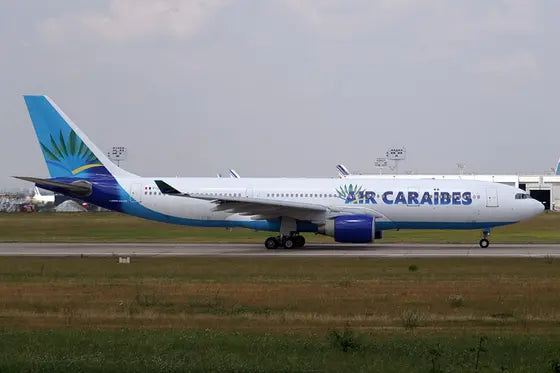
Air Caraïbes Overview & Company Profile
Air Caraïbes is a French airline specialising in the Caribbean and South American markets, headquartered in Les Abymes, Guadeloupe. The carrier was formed in July 2000 through the merger of four regional airlines: Air Guadeloupe, Air Martinique, Air Saint-Barthélemy, and Air Saint-Martin. It operates scheduled transatlantic long-haul services from Paris Orly Airport (ORY) to the French overseas territories of Guadeloupe, Martinique, and French Guiana, alongside a dense regional Caribbean network.
Air Caraïbes is owned by Groupe Dubreuil, a diversified family holding company founded in 1924 and based in Bellevigny, Vendée. Groupe Dubreuil holds an 85% equity stake in the airline. The group's aviation division, Groupe Dubreuil Aéro, also controls sister airline French Bee (low-cost long-haul A350 operator) and cargo subsidiary Héline Cargo. The group's broader interests span grocery distribution, fuel, automotive, and public works, with consolidated revenues of approximately €2.2 billion.
The airline transports around 1.6 million passengers annually across its combined transatlantic and Caribbean operations. The transatlantic network links Paris Orly with the French West Indies (Pointe-à-Pitre, Fort-de-France, Cayenne, Saint-Martin) as well as leisure destinations in the Dominican Republic, Mexico, Haiti, and Cuba. The regional network, operated by ATR 72-600 turboprops, carries approximately 385,000 passengers per year on inter-island shuttle services. In January 2026, Karen Virapin was appointed as the airline's new CEO, becoming the first woman from the French overseas territories to lead the company.
Fleet Composition & Type Ratings
Air Caraïbes operates a modern, mixed fleet designed to cover both transatlantic long-haul and regional Caribbean operations. The backbone of the airline's widebody fleet is the Airbus A350 family, with seven A350s (three -900s and four -1000s) providing the latest-generation fuel efficiency and passenger comfort on routes between Paris Orly and the Caribbean. The older A330 fleet (two A330-300 and one A330-200) remains in service for peak-season capacity and specific routes such as the recently launched Paris-Saint Martin direct service. The regional Caribbean shuttle network is served exclusively by four ATR 72-600 turboprops.
| Aircraft Type | Role | In Service | Routes / Notes |
|---|---|---|---|
| Airbus A350-1000 | Widebody | 4 | Flagship long-haul. 429 pax (24J / 45W / 360Y). First delivered Dec 2019. Additional -1000 on order. |
| Airbus A350-900 | Widebody | 3 | Long-haul. 326 pax (18J / 45W / 263Y). First delivered Feb 2017. |
| Airbus A330-300 | Widebody | 2 | Long-haul. 378 pax (35J / 45W / 298Y). In service since 2006. Used for peak demand. |
| Airbus A330-200 | Widebody | 1 | Long-haul / seasonal. Operates new ORY-SXM direct route (Dec 2025). |
| ATR 72-600 | Regional Turboprop | 4 | Caribbean inter-island. 74 pax. Shuttle PTP-FDF, PTP-SXM, FDF-SLU, and more. 1 additional on order. |
Fleet data as of early 2026. The airline shares certain A350 frames with sister airline French Bee during seasonal demand shifts.
The fleet modernisation strategy has been aggressive. The A350 family now accounts for the majority of long-haul capacity, replacing older widebody types. Air Caraïbes was notably an early adopter of the A350-1000 variant, taking delivery of its first frame in December 2019. The airline's A350-1000 uses a relatively uncommon 3-4-3 economy layout, maximising capacity on high-demand leisure routes to the Caribbean. Groupe Dubreuil has committed to a total order book of 33 A350-900s and 18 A350-1000s across both Air Caraïbes and French Bee, ensuring fleet commonality and economies of scale in training and maintenance.
On the regional side, the ATR 72-600 fleet was introduced from December 2016, replacing earlier ATR 72-500 variants. These turboprops feature the latest Pratt & Whitney PW127XT engines, consuming approximately 45% less fuel than comparable regional jets, according to ATR's published case study. The airline performs approximately 3,700 ETOPS (Extended Twin-Engine Operations) flights per year on its widebody fleet, requiring specific operational training and regulatory compliance for extended overwater operations across the Atlantic.
New First Officers at Air Caraïbes are typically assigned to the A330 fleet, with transitions to the A350 family based on seniority and operational need. The airline became the European and Caribbean launch customer for the Airbus Evidence Based Training (EBT) recurrent training programme for A330 and A350 crews in November 2022, in partnership with Airbus Training Services. This modern training approach incorporates operational data to customise technical and non-technical skills development for each pilot.
Pilot Salary & Compensation Breakdown
Air Caraïbes does not publicly disclose detailed pilot pay scales, and salary information for this airline is notably scarce in public sources compared to larger French carriers. However, a combination of data from sister company French Bee (same Groupe Dubreuil ownership), job listing details from Air Caraïbes Atlantique, and broader French airline industry benchmarks provides a reasonable picture of compensation positioning.
French Bee, which operates an all-A350 fleet under identical Dubreuil group management, publishes reference salary data on pilot recruitment platforms. These figures offer the closest publicly available benchmark for Air Caraïbes compensation, given the shared corporate structure and similar operational profile (widebody long-haul from Paris Orly).
Estimated First Officer (F/O) Pay Scale
| Seniority | Monthly Net (est.) | Annual Net (est.) | Notes |
|---|---|---|---|
| Year 1 (entry) | €5,500 - €6,000 | ~€66,000 - €72,000 | Based on ~70 block hours/month |
| Year 3-5 | €7,000 - €7,500 | ~€84,000 - €90,000 | Progressive seniority increments |
| Year 7-10 | €8,000 - €8,750 | ~€96,000 - €105,000 | Senior F/O range |
Estimated Captain (CDB) Pay Scale
| Seniority | Monthly Net (est.) | Annual Net (est.) | Notes |
|---|---|---|---|
| Entry Captain | €8,500 - €9,500 | ~€102,000 - €114,000 | Based on ~70 block hours/month |
| Captain, 5 yrs | €10,500 - €11,500 | ~€126,000 - €138,000 | Mid-career Captain |
| Senior Captain (10+ yrs) | €12,000 - €13,000 | ~€144,000 - €156,000 | Top of scale on A350 |
Figures are monthly and annual net estimates based on French Bee published benchmarks and Air Caraïbes Atlantique job listing data. Actual compensation may vary based on collective agreement terms and individual circumstances.
Additional Compensation Components
According to pilot job network data for Air Caraïbes Atlantique, additional pay elements include: night time pay at 150% of base hourly rate after 75 credited hours per month, overtime premium of +15% between 68 and 75 block hours, and per diem allowances of €75 to €90 per day depending on destination. French labour law also mandates annual profit-sharing (intéressement and participation) when the company is profitable.
These figures are estimates compiled from sister company French Bee recruitment publications, Air Caraïbes Atlantique job listings on pilot networks, and general French airline industry surveys. Air Caraïbes does not publicly publish its pilot pay scales. Net figures represent post-tax, post-social-charge income under the French fiscal system. Gross compensation is typically 25-35% higher than net due to French social charges. Always verify current compensation directly with the airline's HR department at recrutement.aircaraibes.com before making any career decisions.
Roster Pattern & Quality of Life
Air Caraïbes long-haul pilots operate under EASA Flight Time Limitation (FTL) rules combined with French national provisions and the company's collective agreement. Rostering is based on a random schedule system with bidding influenced by seniority. According to available data from the Air Caraïbes Atlantique operation, pilots receive approximately 14 days off per month excluding recovery days following long-haul rotations, with flexibility to bid for 4-5 day consolidation blocks or alternative scheduling arrangements.
Transatlantic rotations between Paris Orly and the Caribbean typically involve 8-9 hours of flight time each direction, with layovers at destination lasting 48 to 72 hours. This creates a natural rhythm of 2-3 days of flying followed by several days off. Pilots on the long-haul operation typically accumulate between 50 and 80 block hours per month, depending on roster construction and rotation frequency. Back-to-back rotation options are available for commuting pilots, enabling consolidation of flights with longer off-duty blocks.
📅 Sample Month: Long-Haul First Officer (ORY Base)
Long-haul pilots are based at Paris Orly Airport, which serves as the sole transatlantic hub. Regional ATR crews are based in the Caribbean (Pointe-à-Pitre or Fort-de-France). Some long-haul pilots maintain Caribbean home residences and commute to Paris for their rotations, which the back-to-back scheduling option helps facilitate. Living costs in Paris are high, but the airline's focus on Caribbean routes means frequent layovers in familiar tropical environments. EASA regulations mandate a minimum 14-hour rest period (or duration equivalent to the preceding duty period, whichever is greater) following long-haul flight operations.
Benefits, Travel Perks & Retirement
As a French-registered airline, Air Caraïbes pilots benefit from France's comprehensive social protection framework combined with aviation-specific provisions. The combination of statutory French employee rights, the CRPN pilot pension system, and airline-specific perks creates a solid overall benefits package.
The CRPN is a private non-profit pension fund specifically for French-based aircrew, operational since 1951. Membership is compulsory for all air crew employed in France as their main occupation. Pensions are calculated using career-average indexed earnings over your best 25 years, with bonus provisions for parents who raised 3+ children. The scheme includes a survivors' pension (60% of member's pension) and orphan's benefits. The CRPN Insurance Fund also provides lump-sum compensation for permanent unfitness: 100% of basic compensation (3-12x yearly social security ceiling) for air accident-related unfitness, with reductions applying after age 50. This dedicated aircrew pension system is one of the strongest in European aviation.
Career Progression & Seniority
Career progression at Air Caraïbes follows the standard seniority-based system used across French and European airlines. Your date of hire determines your seniority number, which in turn governs schedule bidding priority, route preferences, fleet assignment, vacation timing, and ultimately your upgrade eligibility from First Officer to Captain. The airline recruits experienced First Officers from outside (no cadet programme), and Captain upgrades come from within the existing pilot workforce.
As a smaller carrier with approximately 14 aircraft and a focused route network, Air Caraïbes offers fewer upgrade slots than major legacy airlines. However, the Groupe Dubreuil aviation division's ongoing fleet expansion (with additional A350 orders) and the growth of sister airline French Bee are creating new opportunities. The shared corporate structure means pilots may have future mobility options within the Dubreuil group, although formal inter-airline transfer mechanisms and their impact on seniority are not publicly documented.
| Career Milestone | Typical Timeline | Notes |
|---|---|---|
| Join as F/O (A330) | Day 1 | Most common entry fleet. Requires 3,000+ TT hours. |
| Transition to A350 | 3-7 years | Seniority-dependent. A350-900 or A350-1000. |
| Captain upgrade | ~8-12 years (est.) | Depends on fleet growth and attrition. Command assessment required. |
| Senior Captain (A350) | 12+ years | Top of seniority list. A350-1000 command. |
| Training Captain / TRE | Variable | Requires separate selection and Airbus instructor certification. |
Groupe Dubreuil's committed order book of 51 A350 aircraft (33 A350-900 and 18 A350-1000) across Air Caraïbes and French Bee signals sustained fleet growth over the coming decade. Each new aircraft delivery creates additional crew positions and potentially accelerates upgrade timelines. The December 2025 launch of the direct Paris-Saint Martin service with a dedicated A330-200 also demonstrates network expansion, which requires additional crew. The airline's partnership with Airbus for Evidence Based Training (EBT) further underscores investment in pilot development and progression pathways.
Recruitment Process & Requirements
Air Caraïbes recruits experienced pilots through its official recruitment portal. The airline does not operate a cadet or ab-initio programme; all pilot recruits must hold a valid professional pilot licence with significant multi-crew jet experience. Recruitment is ongoing, with positions advertised on the company portal and major pilot job networks.
First Officer Requirements
Selection Stages
Online Application & HR Screening
Submit your application via recrutement.aircaraibes.com with CV, cover letter, and supporting documents (licence, medical, logbook summary). HR reviews eligibility and experience requirements. The process takes approximately two weeks according to employee reviews on Indeed.
Technical & HR Interview
Candidates meeting requirements are invited for a combined technical and human resources interview. Expect questions on CRM, decision-making, operational scenarios, and motivation for joining the airline. French language proficiency is assessed during this stage.
Simulator Assessment
A simulator evaluation assessing normal and abnormal procedures, crew resource management, and overall airmanship. The session typically lasts several hours and is conducted on a full-flight simulator. Pilot aptitude preparation resources are available through platforms like PilotAptitudeTest.com.
Medical & Background Verification
Successful candidates must present a valid EASA Class 1 medical certificate and pass background verification checks. Criminal record clearance is required.
Type Rating & Line Training
Upon selection, pilots proceed to type rating (if not already current on A330/A350) followed by line training under supervision. The airline partners with Airbus Training Services for type rating and recurrent training delivery.
French fluency is non-negotiable. All internal communications, briefings, and company culture are conducted in French. While ICAO English Level 4 is the stated minimum, strong English proficiency is essential for international operations. The airline appears flexible on type rating requirements for experienced Airbus pilots with significant multi-crew jet time, potentially sponsoring type rating for qualified candidates. Monitor both the official recruitment portal and major pilot job networks (PilotsGlobal, PilotJobsNetwork) for current openings.
Top 5 Layover Destinations
One of the defining perks of flying for Air Caraïbes is the Caribbean lifestyle. Unlike most European long-haul carriers where layovers span diverse continents, Air Caraïbes pilots operate almost exclusively to tropical destinations in the French West Indies, French Guiana, and the wider Caribbean. Layovers typically last 48 to 72 hours, giving crews genuine time to enjoy the destination. Hotels are contracted by the airline and transport between the hotel and airport is provided.
Unlike flying for a major network carrier where layovers span Tokyo to Johannesburg, Air Caraïbes pilots develop deep familiarity with a focused set of Caribbean and South American destinations. The French cultural connection across the DOM-TOM (overseas departments and territories) means crews operate in a linguistically and culturally familiar environment. Many pilots describe the lifestyle as a key draw: warm weather year-round, regular exposure to island culture, and the possibility of maintaining a Caribbean home base while commuting to Paris for rotations.
How Air Caraïbes Compares: Airline Radar Chart
Air Caraïbes operates in a unique market segment: French long-haul carriers serving the overseas territories and leisure destinations from Paris Orly. Its two most direct competitors are French Bee (sister airline under Groupe Dubreuil, low-cost long-haul A350 operator) and Corsair International (independent Orly-based long-haul carrier with an all-A330neo fleet). Below is our comparative analysis across five key metrics.
Key Takeaways from the Comparison
Air Caraïbes leads on fleet modernity and diversity. With both A350-900 and A350-1000 widebodies plus ATR 72-600 regional aircraft, Air Caraïbes offers more fleet variety than either competitor. French Bee operates an all-A350 fleet (6 aircraft), while Corsair has standardised on the A330neo (9 aircraft). The A350 family gives Air Caraïbes pilots access to one of the most advanced commercial aircraft in service.
Salaries are broadly comparable across all three carriers. All three operate from Paris Orly in the French long-haul leisure segment, competing for the same pilot pool. French Bee published data suggests First Officer net pay of €5,500-€8,750/month and Captain net pay of €8,500-€13,000/month. Air Caraïbes likely sits in a similar range, though precise data is not publicly available. All three carriers pay significantly below Air France mainline scales.
Work-life balance is strongest at Air Caraïbes. With approximately 14 days off per month and Caribbean-focused layovers of 48-72 hours, Air Caraïbes offers more predictable and lifestyle-friendly scheduling than French Bee (where crew complaints about excessive workload and long absences from home have been documented on industry forums). Corsair's roster data is not publicly available.
Job security is moderate across all three. Air Caraïbes benefits from Groupe Dubreuil's diversified ownership (which provides financial resilience beyond aviation), but the niche DOM-TOM market is sensitive to economic cycles and government connectivity policies. Corsair has undergone multiple ownership changes and financial restructurings. French Bee is newer but benefits from the same Dubreuil group backing.
Scores are editorial estimates based on publicly available data from pilot job networks, airline publications, employee reviews, and industry benchmarks. They represent a general assessment for an experienced pilot evaluating a long-term career at each airline. Individual experiences will vary based on seniority, fleet assignment, and personal priorities. French Bee data is based on published recruitment information; Corsair data is more limited in public sources.
Union & Industrial Relations
French airline pilot representation is dominated by the SNPL France ALPA (Syndicat National des Pilotes de Ligne), the national union representing professional airline pilots across all French-based carriers. Founded in 1952 and headquartered at Roissy-en-France near Paris CDG, the SNPL covers Air Caraïbes pilots alongside colleagues at Air France, Transavia, Corsair, and other French operators. The union is affiliated with the European Cockpit Association (ECA, representing 40,000+ pilots across 36 countries) and the International Federation of Air Line Pilots' Associations (IFALPA, 100,000+ pilots in 95 countries).
SNPL Structure
Recent Industrial Relations Context
Air Caraïbes has maintained relatively stable labour relations on the pilot side, with no documented airline-specific pilot strikes in recent years. The November 2024 national strike was an exceptional sector-wide action driven by tax policy rather than an internal dispute. The SNPL's role as primary pilot representative ensures collective bargaining on salary scales, roster protections, training standards, and pension preservation. Union membership is optional but strongly encouraged. The airline's smaller size means the SNPL Air Caraïbes section has less bargaining weight than the Air France section, but pilots still benefit from the union's national-level advocacy on issues like FTL rules and opposition to single-pilot operations.
Verdict: Who Is Air Caraïbes For?
🎯 Our Take
Air Caraïbes occupies a unique niche in French aviation: a mid-sized, Guadeloupe-headquartered carrier operating modern widebody equipment on transatlantic routes to the Caribbean, backed by the financial stability of a diversified family-owned group. For pilots who value Caribbean lifestyle, a focused route network with long layovers in tropical destinations, and the security of French labour protections and the CRPN pension system, Air Caraïbes offers a distinctive career proposition.
The trade-offs are real: the airline is small (14 aircraft), which limits upgrade opportunities compared to major carriers. Salary data suggests compensation sits below Air France mainline levels, though broadly in line with French Bee and Corsair. The niche DOM-TOM market means less route diversity than flying for a global network carrier. Public transparency around pay scales and working conditions is limited compared to larger airlines.
The growth outlook is positive. Groupe Dubreuil's 51-aircraft A350 order book, the recent network expansion (direct Paris-Saint Martin service), and the airline's investment in modern training partnerships (Airbus EBT, IBS Software crew management) all signal a carrier investing in its future. For French-speaking pilots with Airbus experience seeking a stable, lifestyle-oriented career flying widebody equipment to the Caribbean, Air Caraïbes deserves serious consideration.
1 Do I need to speak French to fly for Air Caraïbes?
Yes. Fluent French is mandatory for all pilot positions at Air Caraïbes. The airline's internal communications, briefings, and company culture are conducted in French. English proficiency at ICAO FCL.055 Level 4 or higher is also required for international operations.
2 Does Air Caraïbes have a cadet programme?
No. Air Caraïbes recruits experienced pilots only. Candidates must hold a valid EASA CPL or ATPL with a minimum of 3,000 total flight hours, including significant multi-crew jet time. There is no ab-initio or cadet pathway.
3 What aircraft types will I fly?
Long-haul pilots fly the Airbus A330 and/or A350 family on transatlantic routes between Paris Orly and the Caribbean. The A350-900 and A350-1000 are the primary long-haul types, with the A330-300 and A330-200 used for additional capacity. Regional pilots fly the ATR 72-600 on Caribbean inter-island routes. Fleet assignment depends on seniority and operational need.
4 Where is the pilot base?
Long-haul pilots are based at Paris Orly Airport (ORY). Regional ATR crews are based in the Caribbean, primarily at Pointe-à-Pitre (PTP) in Guadeloupe or Fort-de-France (FDF) in Martinique. Some long-haul pilots maintain Caribbean home residences and commute to Paris for rotations, taking advantage of back-to-back scheduling options.
5 How does Air Caraïbes compare to French Bee for pilots?
Both airlines are owned by Groupe Dubreuil and operate from Paris Orly with A350 equipment. French Bee is a pure low-cost long-haul operator (USA, Reunion, Tahiti) while Air Caraïbes focuses on the French Caribbean. Compensation appears broadly similar. Air Caraïbes offers more fleet diversity (A330 + A350 + ATR) and Caribbean-focused layovers, while French Bee provides exposure to longer-range destinations (San Francisco, Papeete). Some pilot forums have noted higher workload pressures at French Bee.
6 Does Air Caraïbes pay for the type rating?
The airline has not publicly confirmed whether it sponsors type ratings. Job listings indicate that an A330 type rating is preferred but not strictly required for experienced Airbus pilots with sufficient multi-crew jet hours. The airline partners with Airbus Training Services for type rating and recurrent training delivery. Confirm type rating sponsorship policy directly with HR during the application process.
7 Can non-EU citizens apply?
Air Caraïbes requires candidates to have the legal right to live and work in the EU/EEA. This effectively limits recruitment to EU/EEA nationals or holders of valid EU work permits. Non-EU citizens without existing work authorization are not eligible.
8 What is job security like at Air Caraïbes?
Moderate to good. The airline benefits from Groupe Dubreuil's diversified ownership, which provides financial resilience beyond the aviation sector. The DOM-TOM market (French overseas territories) has strong baseline demand driven by family connections and administrative travel between the Caribbean and mainland France. However, the €13 million competition fine in December 2024 and the new TSBA aviation tax represent financial headwinds. The 51-aircraft A350 order book signals confidence in long-term growth. French labour protections (CDI contract, CRPN pension, strong union representation) provide solid individual job security.
Official Links & Resources
Before applying or making any career decisions, always verify information directly with official sources. These are the key websites and organisations relevant to Air Caraïbes pilot careers:
Monitor both the official recruitment portal at recrutement.aircaraibes.com and specialist pilot job platforms like PilotJobsNetwork and PilotsGlobal for current openings. Air Caraïbes positions tend to be posted on these networks with specific experience requirements and application deadlines. Bookmark the SNPL press releases page (snpl.com/presse) to stay informed about sector-wide developments affecting all French airline pilots.