

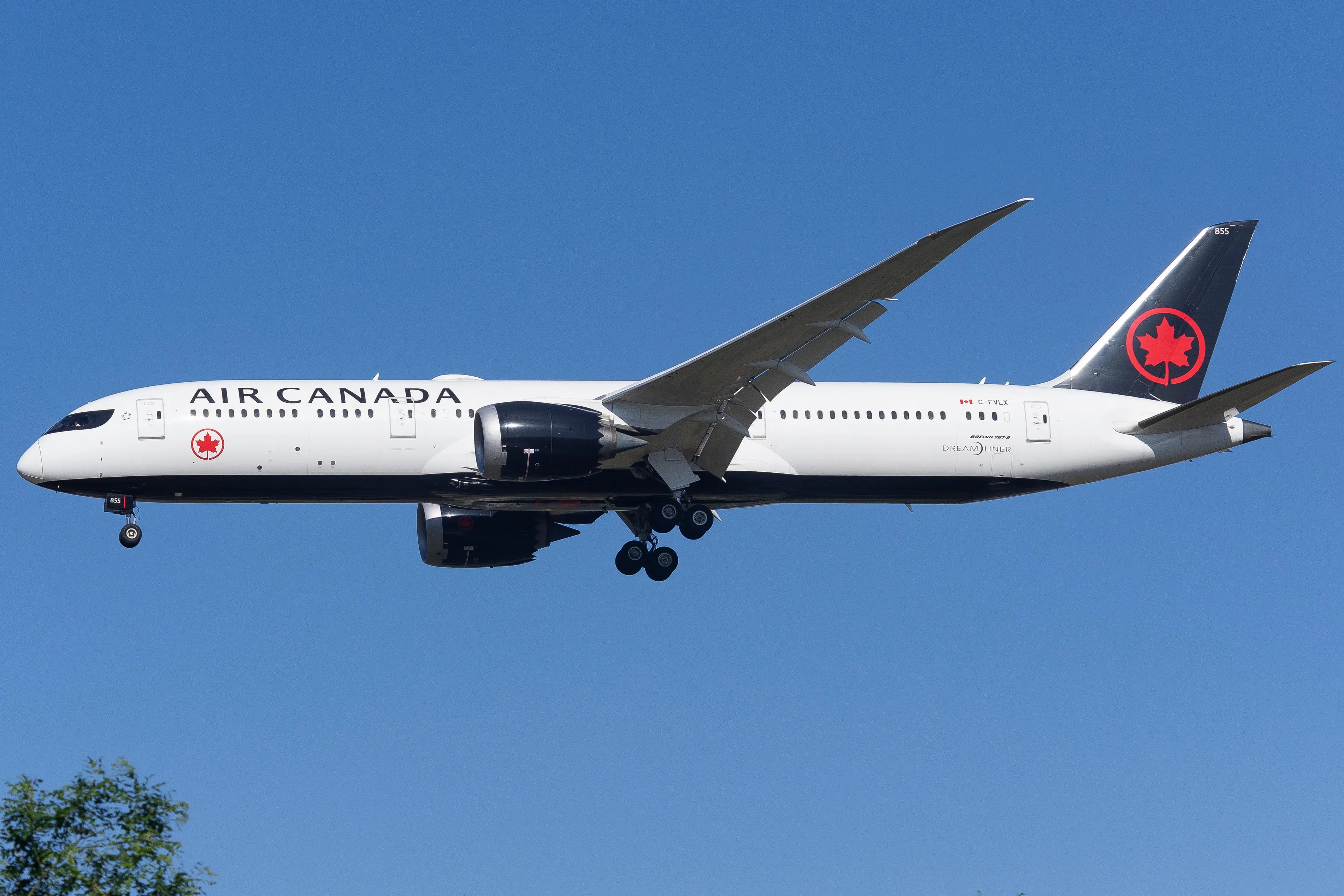
Air Canada Overview & Company Profile
Air Canada is the flag carrier and largest airline of Canada, tracing its origins to 1937 when it was founded as Trans-Canada Air Lines. It is headquartered in the Saint-Laurent borough of Montreal, Quebec, and operates a classic hub-and-spoke network anchored on three primary hubs: Toronto Pearson (YYZ), its largest global gateway, Montreal-Trudeau (YUL), and Vancouver (YVR), the airline's Pacific gateway. Calgary (YYC) functions as an important secondary focus point for western Canadian flying. As a founding member of the Star Alliance, the world's largest global airline alliance, Air Canada connects passengers and crews to a network spanning more than 190 carriers and territories worldwide.
The scale of the operation is substantial. According to Air Canada's corporate profile, the group fleet (mainline plus Air Canada Rouge plus the Jazz-operated Air Canada Express) numbers roughly 350 aircraft serving around 208 destinations, and the airline carried 45.3 million passengers in 2025. Financially, Air Canada reported record annual revenue of C$22.3 billion in 2024, achieved on a five percent increase in capacity over 2023. That record performance set the backdrop for the landmark pilot contract ratified later that year, since restored profitability strengthens any pilot group's bargaining position in a tight North American labour market.
The pilot workforce is significant. The 2024 collective agreement covers approximately 5,200 pilots across Air Canada mainline and Air Canada Rouge, all of whom sit on a single, unified seniority list with identical wages and working conditions. Regional flying under the Air Canada Express brand is performed by Jazz Aviation (a Chorus Aviation subsidiary) under a long-term capacity purchase agreement, and those pilots are employed and represented separately, though a pilot-mobility program provides a structured pathway toward mainline. Importantly, since May 2023 Air Canada and Rouge pilots are represented by the Air Line Pilots Association, International (ALPA), the world's largest pilot union, having voted to merge the former Air Canada Pilots Association (ACPA) into ALPA.
Fleet Composition & Type Ratings
Air Canada operates one of the most diverse mainline fleets in North America, mixing Airbus and Boeing types across short-haul, medium-haul and long-haul missions. Per the airline's corporate profile (fleet table revised in 2025), the mainline passenger fleet totals roughly 214 to 216 aircraft with a moderate average age of around 13 years, the figure being pulled up by older A319, A320, A321 and A330 frames and pulled down by young A220, 737 MAX and 787 deliveries. The airline is in the middle of a major renewal and reshuffle: the entire Boeing 737-8 MAX fleet is being progressively transferred to Air Canada Rouge through 2026, A320-family jets are moving from Rouge back to mainline, the Airbus A220-300 fleet is growing toward the high-60s, the A321XLR began arriving in 2025, and the first Boeing 787-10s are scheduled to land from 2026. For ultra-long-range growth, Air Canada has publicly narrowed future widebody candidates to the Airbus A350-1000 and the Boeing 777-8.
| Aircraft Type | Role | In Service | Routes / Notes |
|---|---|---|---|
| Boeing 777-300ER | Widebody | 19 | Long-haul flagship. Highest-paying pilot seat in the fleet. |
| Boeing 777-200LR | Widebody | 6 | Ultra-long-haul missions from Toronto and Vancouver. |
| Boeing 787-9 | Widebody | 32 | Long-haul backbone. Europe, Asia, South America, Oceania. |
| Boeing 787-8 | Widebody | 8 | Long-haul. Slightly smaller Dreamliner variant. |
| Boeing 787-10 | Widebody | 0 (18 on order) | Not yet delivered. First arrivals expected from 2026. |
| Airbus A330-300 | Widebody | 20 | Long/medium-haul. Ageing, a candidate for replacement. |
| Airbus A321XLR / neo | Narrowbody | ~6 (deliveries from 2025; ~26 on order) | Long-range narrowbody. Thinner transatlantic routes. |
| Airbus A321-200 | Narrowbody | ~20 | Transcontinental & transborder. More transferring from Rouge. |
| Airbus A320-200 | Narrowbody | ~22 | Domestic & US. Some frames returning from Rouge. |
| Airbus A319-100 | Narrowbody | ~5 | Small, ageing sub-fleet being retired. |
| Airbus A220-300 | Narrowbody | 37 (28 on order) | Modern Canadian-built jet. Growing toward high-60s. |
| Boeing 737-8 MAX | Narrowbody | 47 | Transitioning to Rouge through 2026 (target ~53 at Rouge). |
| Boeing 767-300F | Freighter | 6 | Cargo operations. Separate from passenger flying. |
Mainline fleet data as of 2025, from Air Canada's corporate profile and fleet-tracking sources. Numbers are approximate and shift continually with deliveries, retirements and the ongoing MAX-to-Rouge transfer.
Two related operations round out the group. Air Canada Rouge, the leisure subsidiary based largely at Toronto and the warm-weather network, flew roughly 37 aircraft in early 2025 (about 18 A319s, 5 A320s and 14 A321s) and is being rebuilt around the Boeing 737-8 MAX, with a planned fleet of around 53 MAX after all transfers. Air Canada Express, operated by Jazz Aviation, fields roughly 99 regional aircraft: about 25 Embraer E175s, around 35 Bombardier CRJ900s and roughly 39 De Havilland Dash 8-400 turboprops. Crucially, Rouge pilots are on the same seniority list and contract as mainline, whereas Express/Jazz pilots are a distinct group.
Air Canada funds the type rating for pilots it hires; new First Officers do not pay for their own rating. The most common entry fleets are narrowbody types: the Airbus A220, A320 family or Boeing 737 MAX. Movement to widebody First Officer (A330, 787, 777) and any upgrade to Captain is governed entirely by seniority and monthly bidding. Because mainline and Rouge share one seniority list, being assigned to Rouge-branded flying has no effect on long-term career progression. Note that Rouge MAX flying and mainline narrowbody flying are paid on the same scales.
Pilot Salary & Compensation Breakdown
Air Canada pilot pay is set by the collective agreement negotiated by ALPA, and it changed dramatically in late 2024. According to AVweb's reporting on the ratification vote, the four-year deal approved on October 10, 2024 delivered an immediate 26% wage increase followed by roughly 4% per year for the remaining three years, for approximately 42% in cumulative raises over the life of the contract and around C$1.9 billion in new value for the pilot group. ALPA described it as the largest agreement in the airline's history and the one that made Air Canada pilots the highest paid in Canada.
The pay structure has two phases. For roughly the first four years, pilots are on flat pay: a fixed annual figure that does not change with aircraft type, so a first-year First Officer earns the same whether they fly an A220 or a 777. After that, pilots move to formula pay, where the hourly rate is driven by aircraft type, seat (Captain or First Officer) and years of service, plus add-ons such as navigation, weight and overnight pay. Across the system, the company guarantees a minimum of 75 credited block hours per month, and pilots are paid the greater of that guarantee or their actual credited hours.
First Officer (FO) Pay by Fleet
| Stage / Fleet | Annual Gross (est.) | Approx. Hourly | Notes |
|---|---|---|---|
| Year 1 (flat pay) | ~C$57,000 – 60,000 | flat rate | Same regardless of aircraft type. |
| Year 3 (flat pay) | ~C$73,000 – 85,000 | flat rate | Still in the flat-pay window. |
| A220 / A320 / 737 FO (~6 yrs) | ~C$107,000 – 113,000 | ~C$119 – 126/hr | Narrowbody formula pay. |
| A330 / 787 FO (~6 yrs) | ~C$142,000 – 145,500 | ~C$158 – 162/hr | Widebody First Officer premium. |
| Boeing 777 FO (~6 yrs) | ~C$157,000 | ~C$174/hr | Highest-paying First Officer seat. |
Estimates assume the 75-hour monthly guarantee. Hourly figures are derived by dividing annual pay by 900 hours and exclude per diems and premiums.
Captain (CA) Pay by Fleet
| Fleet (~6 yrs in seat) | Annual Gross (est.) | Approx. Hourly | Notes |
|---|---|---|---|
| Airbus A220 | ~C$194,640 | ~C$216/hr | Modern narrowbody command. |
| Boeing 737 MAX | ~C$196,212 | ~C$218/hr | Mainline or Rouge, same scale. |
| Airbus A320 | ~C$198,708 | ~C$221/hr | Domestic & transborder. |
| Airbus A330 | ~C$256,980 | ~C$285/hr | Widebody command. |
| Boeing 787 | ~C$262,989 | ~C$292/hr | Long-haul Dreamliner. |
| Boeing 777 | ~C$286,296 | ~C$318/hr | Top of the pay structure. |
Senior widebody Captains can earn more than C$286,000 in gross pay before per diems and premiums. Long-haul flying yields the highest total earnings due to overnight and weight pay.
These figures are estimates compiled from published 2024 Canadian pilot salary analyses and reflect roughly six years of service at the 75-hour monthly guarantee. The exact scales depend on the ratified ALPA collective agreement, which is not fully public, and on individual seniority, fleet and hours flown. The October 2024 contract layered an immediate 26% raise plus annual increases on top of prior rates, so first-year pay in particular may sit slightly higher than the flat-pay figures shown. Canadian income tax and payroll deductions reduce take-home pay materially versus these gross numbers. Always verify against the current ALPA Air Canada agreement.
Roster Pattern & Quality of Life
Scheduling at Air Canada is built on seniority-based monthly bidding, with most fleets using a preferential bidding system (PBS) in which the most senior pilots have their preferences for days off, pairings and credit ranges honoured first. Flight and duty limits are governed by Transport Canada's Canadian Aviation Regulations and the ALPA collective agreement. The 75-hour monthly guarantee sets the pay floor, while typical credited block time runs in the 75 to 85 hour range, comparable to global norms. Discussions among Air Canada pilots on the long-running AvCanada forum indicate that line holders generally work up to about 16 days per month, leaving roughly two weeks off, with senior pilots able to construct considerably better schedules.
📅 Sample Month — Narrowbody First Officer (Toronto)
The grid above is a representative narrowbody pattern, not a published Air Canada roster; actual lines vary by fleet, base and seniority. Long-haul widebody crews follow a different rhythm: a typical pairing involves one or two long sectors with a 24 to 48 hour layover at the destination, followed by several days off at home to recover. The longest sectors (Vancouver to Sydney or Hong Kong, for example) use augmented crews of three or four pilots so that each can take in-flight rest in dedicated bunks. Long-haul pilots fly fewer duty days per month but spend more total time away from base.
Air Canada's mainline pilot bases align with its hubs: Toronto (YYZ), Montreal (YUL) and Vancouver (YVR), with smaller domiciles in the network. Base assignment is seniority-driven, so junior pilots may not immediately hold their preferred city and many choose to commute using staff travel privileges. Commuting offers flexibility to live where you like, but it adds fatigue and effectively lengthens trips. Living in or near a base, particularly for reserve-eligible junior pilots, generally produces the best quality of life. As seniority grows, pilots gain far more control over schedule, days off and which layover cities they hold.
Benefits, Travel Perks & Retirement
Beyond base pay, Air Canada offers the comprehensive benefits package expected of a major flag carrier operating under Canadian federal labour law. The combination of statutory protections under the Canada Labour Code, the ALPA collective agreement and company-specific perks gives pilots strong health, retirement and travel coverage, even if the variable-pay elements are more modest than at the richest US majors.
Pension structure is one of the more nuanced areas of an Air Canada pilot career and a key point to verify before signing. Air Canada historically sponsored several defined-benefit plans, and federal funding-relief regulations were written specifically around those obligations. For pilots hired more recently, the structure has moved toward defined-contribution or hybrid arrangements with company matching, mirroring the hybrid model now used for cabin crew. On profit sharing, Air Canada runs a company-wide program, but industry consensus is that its pilot payouts are comparatively small and flat, unlike Delta's plan, which distributes roughly 10% of the first US$2.5 billion of pre-tax profit (and 20% above that) to employees. Confirm the current pension and profit-sharing terms directly through ALPA before making a decision.
Career Progression & Seniority
Like every major North American airline, Air Canada runs a strict seniority system. Your position on the single mainline-plus-Rouge seniority list, set by date of hire, governs almost everything: aircraft type, base, Captain or First Officer status, schedule quality and vacation. Seniority is non-transferable, so leaving for another airline means starting again at the bottom of that carrier's list. This makes the choice of first major airline one of the most consequential decisions in a pilot's career, and it makes hiring waves and retirement bulges the main drivers of how fast you move.
Air Canada does not hire direct-entry Captains at mainline; every Captain is promoted from within once seniority allows them to win a command bid. There is no published average upgrade time because it swings with growth and retirements, but pilot community reports suggest that holding a widebody Captain seat (787, 777, A330) typically takes on the order of 11 to 15 years of seniority, while narrowbody command, especially during aggressive hiring and the MAX build-up at Rouge, can come considerably sooner. The current renewal wave (A220 growth, A321XLR, 787-10 deliveries from 2026, and evaluation of the A350-1000 or 777-8) should keep creating new positions and supporting movement through the late 2020s.
| Career Milestone | Typical Timeline | Notes |
|---|---|---|
| Build to mainline minimums | Varies (often via Jazz) | 2,000 hrs fixed-wing required to apply. Many build time at a regional first. |
| Join as narrowbody F/O | Day 1 at Air Canada | A220, A320 family or 737 MAX. Type rating funded by the airline. |
| Widebody F/O transition | Seniority-dependent | A330, 787 or 777. Pay jumps sharply versus narrowbody F/O. |
| Narrowbody Captain upgrade | Faster in growth cycles | Command course: interview, sim, line indoctrination, line check. |
| Widebody Captain | ~11–15+ years | 787 / 777 / A330 command. Top of the seniority list. |
| Training / Check Pilot | Variable | Requires separate selection and instructor qualification. |
Air Canada is actively hiring as it renews its fleet and replaces retiring pilots (mandatory retirement at 65 creates predictable vacancy waves). The shift of the 737 MAX to Rouge, the A220 ramp-up, and incoming A321XLR and 787-10 aircraft all expand the number of flight-deck seats, which generally supports upgrades and fleet movement. A practical reality to plan around is the four-year flat-pay window: it pays the same regardless of prior experience, a long-standing point of friction for experienced pilots joining mid-career. The trade-off is entry into a deep, well-protected seniority system with one of the broadest fleet ladders in the world, from the A220 all the way to the 777.
Recruitment Process & Requirements
Air Canada mainline recruits experienced pilots directly as First Officers. Unlike some European carriers, it does not run a branded ab-initio cadet program; instead, the standard route is to build experience (very commonly at Jazz or another regional) and then apply once you meet the published minimums. Those minimums, drawn from Air Canada's own "Pilot (for non AC-Express Pilots only)" posting on its careers portal, are clear and non-negotiable.
Direct-Entry First Officer — Requirements
The posting does not break the 2,000 hours into specific pilot-in-command or multi-crew minimums, but successful candidates typically carry substantial turbine, multi-crew time from regional or military flying. A Category 1 medical from Transport Canada is mandatory, and you must already hold the right to work in Canada; there is no advertised sponsorship route for foreign pilots at mainline.
Selection Stages
Online Application
Apply through the Air Canada careers portal under Flight Operations and Pilots. Upload your resume, licences, Category 1 medical, logbook summary and education details. Applications are screened against the published minimums before advancing.
Online Assessments
Candidates complete computer-based testing, reported to include a computerized knowledge test covering regulations, procedures and systems, plus an extensive personality questionnaire of roughly 325 to 350 true/false items. These assessments evaluate aptitude, knowledge and fit.
Panel Interview
A panel interview, commonly with two Air Canada Captains, lasting around 45 minutes. Expect behavioural, "tell me about a time" questions focused on crew resource management, decision-making and judgement, along with rapid-fire technical and scenario questions.
Simulator Assessment
A simulator evaluation at an Air Canada training facility assesses raw handling, instrument flying, procedural discipline and CRM in a multi-crew setting. Preparation on standard instrument procedures and multi-crew flows pays off here.
Medical, Background & Offer
A thorough company medical (on top of the Transport Canada Category 1), security and background checks, and the Restricted Area Identity Card process precede a formal offer and an assigned type-rating course date.
If you are still building hours, the most common bridge to Air Canada mainline is a regional carrier, especially Jazz Aviation, which operates the Air Canada Express flying. Jazz runs structured pathways including a cadet-style program with partners such as CAE and Cygnet Aviation Academy, and "Jazz Direct" routes for graduates of affiliated college programs that can start as low as 500 hours with a CPL, Group 1 IFR and Class 1 medical. Pilots build multi-crew turbine experience at Jazz, then move to Air Canada mainline through competitive hiring or the pilot-mobility provisions in the capacity purchase agreement. Bilingual fluency in English and French is a genuine differentiator throughout the Canadian system.
Top 5 Layover Destinations
Long-haul layovers are one of the defining rewards of widebody flying at a global carrier, and Air Canada's network reaches across Europe, Asia, Oceania and South America from its Toronto, Montreal and Vancouver hubs. Specific layover patterns are not published by the airline, so the destinations below are representative of the routes and aircraft Air Canada operates rather than a fixed schedule. Crew hotels are contracted by the company (pilots do not book their own), ground transport is provided, and the longest sectors use augmented crews with onboard rest. The most desirable layover cities go to the most senior bidders.
Crew hotels are contracted by the airline, with company-provided transport between hotel and airport. Under Canadian flight and duty regulations, pilots must receive adequate rest before the next duty period, and long-haul sectors beyond a set length require augmented crews (three or four pilots) with onboard bunks so each pilot can sleep in flight. Which destinations you hold is a function of your fleet, base and seniority: senior pilots get first pick of the marquee Pacific and Oceania layovers, while more junior widebody pilots often start with the higher-frequency transatlantic routes.
How Air Canada Compares: Airline Radar Chart
How does Air Canada stack up against its main domestic rival, WestJet, and against the North American compensation benchmark, Delta Air Lines? The radar below scores all three across the same six dimensions used in the scorecard (five shown on the chart). Scores are editorial estimates based on publicly available pay data, collective-agreement reporting, fleet information and industry benchmarks.
Key Takeaways from the Comparison
Air Canada leads Canada, but Delta leads on total compensation. The October 2024 ALPA contract made Air Canada the highest-paying airline in Canada, with senior 777 Captains around C$286,000 in gross pay. Delta, however, pairs higher base rates with a 17% company contribution to the pilot 401(k) and an industry-leading profit-sharing plan that has paid employees roughly 9 to 10% of earnings in recent years, pushing senior widebody Captain total compensation well past US$450,000. On raw total package, Delta is stronger; within Canada, Air Canada is the benchmark.
WestJet has closed much of the gap with Air Canada. WestJet's 2024 ALPA agreement delivered roughly 24% in raises over four years (a 15.5% retroactive bump plus further increases through 2026) worth around C$400 million. That lifts WestJet 737 Captains to roughly C$190,000 to C$210,000 early and 787 Captains past C$310,000 at the top. WestJet pay is now competitive, but Air Canada generally retains a slight edge at the senior widebody end and offers far more widebody seats overall.
Progression speed cuts both ways. WestJet's rapid 737 MAX growth has produced fast narrowbody Captain upgrades in recent cycles, sometimes quicker than at Air Canada, though its widebody command remains a long-seniority position with only the 787. Air Canada's larger, more varied fleet offers more rungs on the ladder (A220 and A320 family up through A330, 787 and 777), but its strictly internal, seniority-only system means widebody command can take 11 to 15 years or more.
Fleet diversity favours Air Canada. Air Canada operates a notably broader fleet, from the A220 to the 777, in the middle of an aggressive renewal (A321XLR, 787-10 from 2026, and an A350-1000 or 777-8 decision ahead). WestJet's fleet is more concentrated on the 737 with a small 787 long-haul arm, while Delta's fleet is modern and large but the comparison axis here rewards the sheer range of types and missions a pilot can fly over a career.
These scores are editorial estimates synthesised from public salary tables (AVCentral, EpicFlightAcademy, ReadyForTakeoff), collective-agreement reporting (ALPA, AVweb, Skies Magazine), airline corporate data and fleet trackers. They reflect a general assessment for an experienced pilot weighing a long-term career, not a precise contractual comparison. Currency differences (CAD vs USD), tax systems and cost of living all affect real take-home and are not normalised here. Individual outcomes vary by seniority, fleet and personal priorities.
Union & Industrial Relations
Union representation is central to understanding pay and conditions at Air Canada, and it changed in a major way in 2023. Air Canada and Air Canada Rouge pilots are now represented by the Air Line Pilots Association, International (ALPA), the world's largest pilot union, which represents tens of thousands of pilots across dozens of North American airlines. In May 2023, pilots voted overwhelmingly (reported at more than 84% in favour) to merge the former Air Canada Pilots Association (ACPA) into ALPA, gaining access to ALPA's legal, economic and bargaining resources and aligning Air Canada pilots with the contract benchmarks set at major US carriers.
ALPA Structure at Air Canada
This structure connects Air Canada's roughly 5,200 pilots to a continental network of ALPA-represented groups, including those at United, Delta and WestJet, which strengthens benchmarking and information sharing during bargaining. You can follow official positions and updates through the ALPA Air Canada pilot group page.
The 2024 Contract and Recent Disputes
The headline event of the past few years was the 2024 negotiation. With Air Canada posting record revenue and US majors having already secured large raises, the talks went down to the wire and a strike or lockout looked possible in September 2024 once a conciliation process opened the door to job action. A tentative agreement was reached in mid-September, averting any actual stoppage, and pilots ratified the four-year deal on October 10, 2024 (99% turnout, 67% in favour). The contract runs to September 29, 2027.
The move to ALPA and the 2024 contract mark a clear turning point: after a decade widely viewed as lagging the market, Air Canada pilots secured an industry-leading Canadian deal without a strike. For a new recruit, strong representation is a meaningful asset, since pay, scheduling protections, pension terms and scope are all set collectively. Union membership comes with the territory at a unionised carrier, and the overwhelming majority of Air Canada pilots are engaged ALPA members. The next bargaining round (the contract expires in September 2027) will likely revisit flat pay, profit sharing and scope, so it is worth following ALPA communications closely.
Verdict: Who Is Air Canada For?
🎯 Our Take
Air Canada is, by some distance, the premier airline career in Canada and a genuinely strong major in the global context. The 2024 ALPA contract reset pay to the top of the Canadian market, the fleet spans the A220 all the way to the 777 with an aggressive renewal underway, the route network offers world-class long-haul flying and layovers, and ALPA representation is now firmly established. For a Canadian-based pilot, it is the most complete package available domestically.
The trade-offs are real and worth weighing. Progression is strictly seniority-based with no direct-entry Captain shortcut, and widebody command can take well over a decade. The first four years sit on a flat-pay scale that ignores prior experience. Profit sharing is modest next to Delta's, and total compensation, once US 401(k) contributions and profit-sharing are counted, still trails the richest US majors. The job is restricted to Canadian citizens and permanent residents, requires fluency in English and French, and effectively requires living near or commuting to Toronto, Montreal or Vancouver.
For pilots who fit that profile and value a deep, well-protected seniority system, broad fleet variety and the stability of Canada's flag carrier, Air Canada offers a career few employers in the country can match: a full ladder from narrowbody First Officer to widebody Captain, all within one of the strongest pilot contracts in Canadian history.
1How many flight hours do I need to be hired at Air Canada?
Air Canada mainline's published minimum for a direct-entry First Officer is 2,000 hours of fixed-wing flying time, plus a Canadian ATPL with a current Group 1 (multi-engine) instrument rating and a Transport Canada Category 1 medical. The posting does not specify a separate pilot-in-command or multi-crew minimum, but competitive candidates usually carry substantial turbine, multi-crew time, often from a regional carrier such as Jazz.
2Do I need to speak French to fly for Air Canada?
Fluency in both English and French is listed as a requirement for Air Canada pilots, reflecting the airline's federal and bilingual operating context. ICAO English proficiency is required for licensing in any case. While some pilots get hired with stronger English than French, bilingualism is a real advantage throughout the Canadian airline system, including at feeder carriers like Jazz, and removes a potential barrier in the process.
3How long does it take to upgrade to Captain?
There is no official average because upgrades are purely seniority-based and depend on hiring and retirement waves. Pilot community reports suggest a widebody Captain seat (787, 777, A330) typically takes on the order of 11 to 15 years of seniority, while narrowbody command can come sooner, especially during strong hiring and the 737 MAX build-up at Rouge. Air Canada does not hire direct-entry Captains; every command is filled internally.
4Can non-Canadians apply to Air Canada?
No. Air Canada mainline requires applicants to be Canadian citizens or permanent residents (landed immigrants). There is no advertised work-permit or sponsorship pathway for foreign pilots at mainline. You must also already be able to clear Canadian airport security to obtain a Restricted Area Identity Card.
5How much do Air Canada pilots earn?
Pay rose sharply under the October 2024 ALPA contract (an immediate 26% raise plus annual increases). Estimates put a first-year First Officer near C$57,000 to 60,000 on flat pay, rising to roughly C$107,000 to 157,000 for a six-year First Officer depending on fleet. Captains range from about C$195,000 on narrowbody types to roughly C$286,000 on the 777, before per diems and premiums. These are gross estimates; Canadian taxes reduce take-home, and exact figures depend on the ratified collective agreement.
6What is the difference between Air Canada, Rouge and Air Canada Express?
Air Canada mainline and Air Canada Rouge (the leisure brand) share a single pilot seniority list and the same ALPA contract, so being assigned to Rouge has no effect on your career or pay scale. Air Canada Express is regional flying operated by Jazz Aviation under a capacity purchase agreement; Jazz pilots are a separate group with their own contract, though a pilot-mobility program provides a pathway from Jazz toward Air Canada mainline.
7Does Air Canada have a cadet program?
Air Canada mainline does not run a branded ab-initio cadet scheme. The realistic pathway for low-time pilots is through a regional carrier, most commonly Jazz (Air Canada Express), which offers structured cadet-style and "Jazz Direct" programs with partner flight schools that can start as low as 500 hours. Pilots build experience at the regional level, then move to mainline through competitive hiring or mobility provisions once they meet the 2,000-hour ATPL minimum.
8How does Air Canada compare to WestJet and US airlines?
Air Canada is the highest-paying airline in Canada after the 2024 contract, with a slight edge over WestJet at the senior widebody end and far more widebody flying overall. WestJet's 2024 deal (about 24% in raises) closed much of the gap and its fast 737 growth can mean quicker narrowbody upgrades. US majors like Delta still lead on total compensation once their 17% 401(k) contributions and large profit-sharing are counted, but moving south means licence conversion, immigration and starting at the bottom of a new seniority list.
Official Links & Resources
Before applying or making any career decision, verify the details directly with official sources. These are the key websites and organisations relevant to an Air Canada pilot career:
Bookmark the ALPA Air Canada pilot group page and the Air Canada careers portal together. The first keeps you current on contract terms, pay scales and union developments; the second tells you when postings open and what the live minimums are. Because pay and scheduling are set collectively, the union page is often the fastest place to learn what a future at Air Canada will actually pay and how the work rules are evolving toward the 2027 contract expiry.