

Air Cairo Overview & Company Profile
Air Cairo (IATA: SM, ICAO: MSC) is an Egyptian low-cost and leisure carrier founded in 2003 and headquartered in the Sheraton Heliopolis district of Cairo, close to Cairo International Airport (CAI), which is also its main operating base. It began life as a charter operator moving European holidaymakers to Egypt's Red Sea and Nile Valley resorts, then progressively remodelled itself into a hybrid low-fare airline that mixes scheduled point-to-point services with inclusive-tour and charter flying. For a pilot, that hybrid identity matters: the day-to-day work sits somewhere between a classic European low-cost operation (multiple short sectors, tight turnarounds) and a leisure carrier tied to tour-operator schedules.
Air Cairo is majority owned by EgyptAir Holding, the state-owned flag-carrier group, which holds a 60% stake. The remaining 40% is held by Egyptian financial investors (public sources variously cite an investment vehicle reported as "360 Investments," as well as Egyptian banks). Because EgyptAir itself is fully state-owned, Air Cairo carries an indirect government link that tends to shape its safety culture, regulatory posture, and employment structures, even though it operates commercially as a separate airline. Air Cairo is not a member of any global alliance, though its parent EgyptAir is the only Star Alliance member based in the Middle East and North Africa.
The airline has scaled quickly in the mid-2020s. According to figures released by Egypt's Ministry of Civil Aviation, Air Cairo carried 5 million passengers in 2024, up from 4.1 million in 2023, operating around 42,000 flights and roughly 123,000 block hours with a fleet that had grown to 37 aircraft. The network spans about 50 international and domestic destinations across more than 20 countries, with more than 200 flights per week and a strong lean toward Gulf labour and pilgrimage traffic plus European leisure flows. Leadership sits with Chairman & CEO Hussein Sherif, appointed in 2025. Prospective applicants can review corporate information via the airline's official site at aircairo.com.
Being a 60%-owned affiliate of EgyptAir gives Air Cairo something most independent low-cost startups lack: the backing of a large state group, an established training and safety ecosystem, and a theoretical long-term pathway toward wide-body flying at the parent airline. It also means the airline operates within Egypt's public-sector-linked framework. For pilots, the practical read is a growth-driven carrier with reasonable institutional stability, balanced against pay scales and contract structures that reflect the Egyptian low-cost market rather than a Gulf mega-carrier.
Fleet Composition & Type Ratings
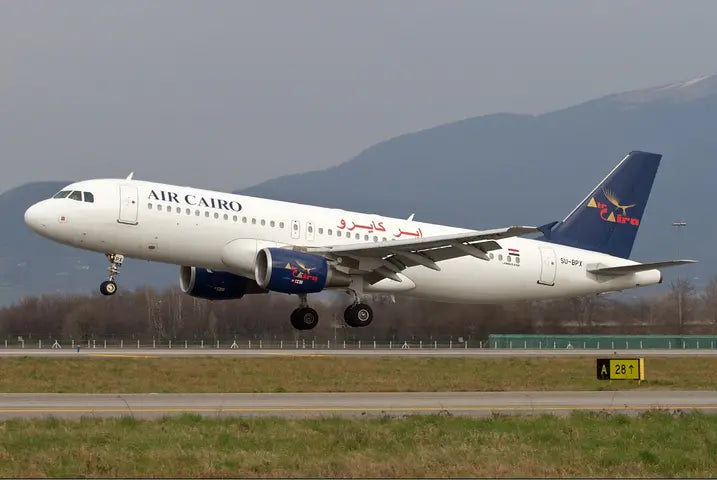
Air Cairo runs a predominantly Airbus A320-family operation, supplemented by a small ATR 72-600 turboprop wing for thinner regional and domestic routes and a handful of Embraer E190 regional jets. As of the most recent public fleet data (mid-to-late 2025, per Planespotters and Wikipedia's fleet table), the operating fleet numbered roughly 36 aircraft, with the Ministry of Civil Aviation citing 37 aircraft during 2024. The reported average age is about 11.4 years, pulled down by a rapidly growing block of new A320neos and pushed up by the older A320ceo airframes still in service.
For a pilot, this is essentially an A320-family job. The overwhelming majority of line flying, upgrades, and recruitment centres on the A320 (both the classic ceo and the newer neo). The ATR 72-600 and E190 are meaningful but modest sub-fleets, each with their own type rating and a smaller pool of crews. New First Officers and direct-entry Captains are almost always hired onto the A320.
| Aircraft Type | Role | In Service | Notes |
|---|---|---|---|
| Airbus A320neo | Narrowbody jet | ~18 | Core growth type. First delivered 2021. Backbone of scheduled and charter flying. |
| Airbus A320-200 (ceo) | Narrowbody jet | ~9 | Older classic-engine A320s. Gradually complemented by neos. |
| ATR 72-600 | Regional turboprop | 6 | Leased via Nordic Aviation Capital. Short domestic and regional sectors. |
| Embraer E190 (E1) | Regional jet | 3 | Leased from CIAF Leasing (late 2022, 12-year terms). Cairo–Marsa Alam, Sharm, Southern Europe and Balkan routes. |
Fleet data as of 2025 (Planespotters / Wikipedia fleet table / Aviation Week). Numbers are approximate and shift with ongoing lease deliveries. Fleet tracking is available via Planespotters.
The direction of travel is aggressive expansion. In a plan presented to Egypt's General Assembly, Air Cairo set out to roughly double its fleet to around 60 aircraft by 2027 and to reach 72 aircraft by 2030. That growth is being funded largely through operating leases: in 2025 alone, China Aircraft Leasing Group (CALC) agreed to supply two additional A320neos for 2026 delivery (on top of two leased since 2023), and SMBC Aviation Capital signed for one A320neo, also for 2026. Management has publicly stated it is studying the larger Airbus A321neo for longer-range routes, though as of 2025 that remains an evaluation rather than a confirmed order.
Unlike major legacy carriers that pay for ab-initio training and type ratings, Air Cairo's public pilot advertisements consistently ask for candidates who already hold a valid A320 type rating. There is no advertised airline-funded type-rating scheme for line pilots, and the airline's initial Second Officer (S/O) A320 pathway for Egyptians is explicitly described as self-paid. In practice, most pilots enter on the A320 with recent time on type; the ATR and E190 sub-fleets are smaller communities that a pilot may move into depending on operational need. A fast-expanding neo fleet is generally good news for upgrade and progression prospects.
Pilot Salary & Compensation
Honest reporting requires an upfront caveat here: Air Cairo does not publish pilot pay scales, and its recruitment adverts advertise the benefits package rather than the salary. There is no verified, company-specific captain or first-officer scale in the public domain. What follows is therefore built from the best available Egyptian-market benchmarks (chiefly published EgyptAir data and Egyptian salary aggregators), clearly framed as context rather than a guaranteed Air Cairo figure. Any pilot evaluating the airline should confirm the exact package directly in writing before signing.
The clearest published benchmark in the Egyptian market comes from the flag carrier, EgyptAir. Industry salary trackers (compiled from Pilot Jobs Network and Egyptian media) report EgyptAir First Officers earning roughly USD 4,500 to 5,500 per month in base pay, plus a local Egyptian-pound supplement of around EGP 4,500 per month and a per-sector per diem near USD 40. EgyptAir narrow-body Captains are reported to start around USD 7,500 per month base, with senior and wide-body Captains reaching USD 10,000 or more, plus a larger local supplement. Air Cairo, as a low-cost affiliate flying short and medium-haul narrow-bodies, generally sits at or below the flag-carrier level for a comparable role.
Egyptian Market Pay Benchmark (context, not an Air Cairo scale)
| Role / Segment | Reported Monthly | Reported Annual (est.) | Basis |
|---|---|---|---|
| First Officer (EgyptAir benchmark) | ~USD 4,500–5,500 + EGP 4,500 | ~USD 54,000–66,000 | Published flag-carrier figures |
| Captain, entry narrowbody (EgyptAir benchmark) | from ~USD 7,500 + EGP 12,000 | ~USD 90,000+ | Published flag-carrier figures |
| Captain, senior / widebody (EgyptAir benchmark) | ~USD 10,000+ + EGP 12,000+ | ~USD 120,000+ | Published flag-carrier figures |
| Cairo "airline pilot", all levels blended | — | ~EGP 602,000 | Glassdoor Cairo aggregate |
These are Egyptian-market reference points, not confirmed Air Cairo pay. As a low-cost affiliate, Air Cairo narrow-body pay is generally expected to sit at or below the flag-carrier benchmark for the equivalent rank. Figures blend base, local supplement, and allowances differently by source.
Two structural features are worth understanding. First, Egyptian airline pay is often built as a USD-linked base plus an Egyptian-pound supplement, which matters given the pound's volatility against the dollar in recent years; a pilot's effective earnings can move noticeably with the exchange rate. Second, Air Cairo's international pilot contracts are typically structured as fixed-term (one-year renewable) agreements, and the headline value of those contracts leans heavily on the non-cash benefits (accommodation, transport, insurance, family travel) rather than a Gulf-style tax-free mega-salary.
No verified Air Cairo-specific pilot salary scale exists in public sources as of 2025. The figures above are Egyptian-market benchmarks (primarily EgyptAir, plus a Cairo aggregate from Glassdoor) presented for context only, and they mix base pay, local supplements, and allowances in ways that are not directly comparable. Actual Air Cairo compensation depends on rank, aircraft, contract type (direct-hire versus agency-mediated), nationality, and the prevailing EGP/USD rate. Treat any single number with caution and obtain a written offer before making decisions. Where a source could not confirm a figure, this guide leaves it blank rather than estimating one.
Roster, FTL Rules & Quality of Life
Air Cairo rosters are governed by the Egyptian Civil Aviation Authority's flight and duty time limitation rules, set out in ECAR 121, Subpart Q, alongside Egyptian labour law and the airline's own scheduling practices. The airline does not publish its exact roster patterns publicly, and its recruitment partners describe "various roster patterns" without detail, so this guide focuses on the regulatory framework (which is documented and enforceable) rather than fabricating a sample month. What can be said with confidence is that this is a short and medium-haul operation with high aircraft utilisation, meaning multiple sectors per duty day, early starts, and late finishes are a normal part of the job.
Egypt's ECAR 121 Subpart Q sets the hard limits that any Air Cairo roster must respect. A flight duty period (FDP) is counted from 1 hour 30 minutes before scheduled departure to 30 minutes after the last flight, so pre-flight and post-flight time are inside the duty clock, not on top of it. The basic maximum FDP is 15 hours, night flying is capped at 18 hours in any 72 consecutive hours, and minimum rest before a duty must be at least as long as the preceding duty period or 12 hours, whichever is greater (more when resting away from base). The full text of these rules is available through the ECAA at civilaviation.gov.eg.
The regulation also requires at least two consecutive days off within any 14 days, and a minimum of six days off in any four consecutive weeks. That six-day figure is a regulatory floor, not the expected roster; in practice a stable narrow-body operation usually rosters more than the legal minimum, but Air Cairo has not published its target. Monthly block hours in a short-haul European-style operation typically land in the 60 to 90 hour range, bounded by the 100-hours-in-30-days ceiling. Annual leave follows Egyptian labour law, which provides paid annual leave (commonly in the range of 21 to 30 days depending on length of service), supplemented by the regulatory days off.
Two Subpart Q provisions are particularly relevant to Air Cairo's mix of aircraft. For intensive short-sector flying, a crew averaging 10 or more landings per hour must be given a break of at least 30 minutes away from the aircraft within any continuous three-hour period, a rule that bites on dense ATR and domestic rotations. And the commander retains discretion to reduce rest in genuinely exceptional operational circumstances (weather, technical delays), but such reductions must be reported and cannot be used to erode rest repeatedly.
Air Cairo's crew bases are Cairo (CAI), Sharm El Sheikh (SSH) and Hurghada (HRG), with Assiut also used as a base for cabin crew. Recruitment posts for pilots mention Cairo or a Red Sea base. This gives a genuine lifestyle choice that most single-base European carriers do not offer: a pilot can potentially be domiciled in the capital or in a Red Sea resort city. Cairo brings the widest schedule variety and the longest commutes through heavy traffic, while Sharm El Sheikh and Hurghada offer coastal living and shorter airport runs but more seasonal, leisure-driven flying. Because the network is short and medium-haul, many duties are same-day out-and-back, so pilots are home far more often than long-haul crews, at the cost of more takeoffs, landings, and unsocial hours.
Benefits, Travel Perks & Insurance
Where Air Cairo's public salary information is thin, its benefits package is comparatively well documented, because the airline's own pilot advertisements spell it out. For its internationally recruited A320 First Officer and Captain contracts, the advertised package is unusually explicit for a low-cost carrier and forms a meaningful part of the total value proposition, especially for pilots relocating to Egypt.
The two standout items for a career-minded pilot are the loss-of-license insurance and international medical insurance. Loss-of-license cover, which protects income if a pilot loses their Class 1 medical, is not universal at low-cost carriers and is genuinely valuable. International medical insurance is also a strong signal that the airline is set up to hire and support non-Egyptian pilots, not just local crew. The provision of five-star accommodation and transport substantially lowers the cost of living for a relocating pilot, which changes how the headline salary should be read.
On retirement, Egyptian nationals participate in the national social-insurance and pension system, with employer and employee contributions accruing pension rights over a career, and end-of-service gratuity entitlements under Egyptian labour law. Air Cairo has not publicly disclosed any supplementary occupational pension or profit-sharing scheme for pilots, so a prospective candidate should not assume the kind of dedicated aircrew pension fund found in some European countries. Family staff travel on the Air Cairo network is confirmed; access to discounted travel across the wider EgyptAir or interline network is plausible given the parent relationship but is not something the public sources confirm in detail, and should be checked directly.
Air Cairo's compensation is best understood as a total package rather than a headline number. A moderate base salary is bundled with hotel accommodation, transport, family travel, and two forms of insurance that de-risk a pilot's biggest exposures (medical loss and health costs). For a pilot relocating to Egypt on a one-year renewable contract, that bundle can be worth considerably more than the same base salary elsewhere without those provisions. For a local Egyptian pilot already settled in Cairo, the accommodation and transport elements are less decisive, so the emphasis shifts back to cash and career progression.
Career Progression & Seniority
Air Cairo's career model differs from a classic seniority-locked legacy carrier in one important way: it hires direct-entry Captains. The airline's public A320 Captain advertisements are open to experienced, type-rated command candidates rather than requiring every Captain to be promoted from within. That makes Air Cairo a viable move for an already-qualified Captain, and it means First Officers compete for upgrades in a pool that can also be filled externally when the airline is growing fast.
The published requirement thresholds give a clear picture of the experience gates. First Officer roles ask for a valid A320 type rating with around 300 hours on type (and, on the Egyptian-national advert, 500+ hours total time), while Captain roles ask for a valid A320 type rating with at least 500 hours on the A320 and command-level experience. Separately, Egyptian-market captain adverts have referenced much higher totals (in the region of 4,500+ hours total time), which is consistent with normal narrow-body command expectations. The airline does not publish a fixed First-Officer-to-Captain upgrade timeline, and it should be treated as variable.
| Career Stage | Typical Requirement | Notes |
|---|---|---|
| Initial S/O (self-paid, Egyptians) | ECAA CPL/ATPL, max age 35 | Self-funded initial A320 entry route; A320 rating preferable. Not an ab-initio cadet scheme. |
| First Officer (A320) | ~300 h on A320 | Type rating required. Egyptian-only ads add 500+ h total time. |
| Captain upgrade / direct entry | 500+ h on A320, command experience | Direct-entry Captains accepted. Command assessment and checks apply. |
| Training roles (TRI / TRE / LTC) | Variable | Type Rating Instructor, Examiner, and Line Training Captain roles recruited. |
| Group mobility to EgyptAir | Subject to policy | Potential future path to wide-body flying at the parent, not guaranteed. |
The strongest tailwind for progression is fleet growth. Air Cairo's stated plan to roughly double the fleet to around 60 aircraft by 2027 and reach 72 by 2030 implies a steady demand for Captains and, in turn, upgrade opportunities for First Officers, plus openings in the instructor and examiner ranks (TRI, TRE, LTC) that the airline actively recruits. A rapidly expanding carrier generally moves people up faster than a stagnant one. Beyond command, the EgyptAir group relationship offers a theoretical route toward long-haul, wide-body flying at the parent, though such transfers depend on group policy and vacancies rather than any published entitlement.
Air Cairo is in an aggressive growth phase, adding A320neos through multiple lessors (CALC, SMBC and others) and studying the A321neo for longer routes. For a pilot, growth is the single most important variable in career planning: it drives upgrades, base openings, and instructor vacancies. The counterweight is that pilot roles are commonly offered on one-year renewable contracts rather than permanent tenure, so the security profile is different from a European legacy carrier with an indefinite contract and a locked seniority list. Verify contract tenure, upgrade policy, and any bonding terms directly before committing.
Recruitment Process & Requirements
Air Cairo recruits type-rated pilots rather than running a funded cadet scheme. Its adverts appear directly (LinkedIn, Facebook, Instagram) and through the aviation recruiter Rishworth Aviation, which maintains a dedicated Air Cairo pilot jobs page. Two recruitment tracks run in parallel: an international track open to all nationalities (for pilots holding an EASA or ICAO licence with a current A320 rating) and an Egyptian-national track for locally licensed pilots. Applications are generally directed to the airline by email at career@aircairo.com, with a full copy of the licence and logbook.
International A320 Track (all nationalities)
Egyptian-National A320 Track
Typical Application-to-Line Sequence
Air Cairo does not publish a formal multi-stage selection funnel in the way large European carriers do. The sequence below reflects the airline's advertised requirements plus standard industry practice for a type-rated, direct-entry recruiter, and should be read as an informed outline rather than a fixed published process.
Application & Document Screening
Apply by email to career@aircairo.com (or via Rishworth Aviation) with CV, a full copy of the licence, ratings, medical, and logbook. Screening confirms the A320 rating, hours on type, recency (last flight within six months), English level, and a clean safety record.
Interview & Technical Assessment
Shortlisted candidates undergo an interview and technical evaluation covering A320 systems, procedures, and CRM. For direct-entry Captains, command experience and decision-making are examined in more depth.
Simulator Assessment
A simulator check is standard for type-rated recruitment, verifying handling, standard operating procedures, and multi-crew coordination on the A320. This is a common stage across the Egyptian and regional market.
Medical, Licence Validation & Contract
Successful candidates finalise a valid Class 1 medical and, where needed, ECAA licence validation or conversion, then sign a one-year renewable contract with the airline. Non-Egyptian pilots require the appropriate work authorisation.
Line Training & Entry Into Service
Company induction, operator conversion where required, and supervised line training under a Line Training Captain precede release to normal line flying from the assigned base (Cairo or a Red Sea base).
Air Cairo does not advertise a fully funded ab-initio cadet programme comparable to those at major European carriers. The closest local route is a self-paid initial Second Officer (A320) pathway for Egyptian nationals up to age 35 who already hold an ECAA CPL or ATPL, with ICAO English Level 5, a Class 1 medical, and preferably an A320 rating. In short, this is a post-licence entry route for people who have already funded their own training, not a zero-to-airline sponsored scheme. Aspiring pilots without a licence should plan their training and type rating independently.
Route Network, Bases & Destinations
Because Air Cairo is a short and medium-haul low-cost and leisure carrier, it does not offer the long-haul overnight layover culture that defines a legacy wide-body career. Most flying is same-day out-and-back or short overnights, so this section maps the network and base structure that actually shapes a pilot's roster, rather than presenting long-haul layover cards. The network splits cleanly into three flows: domestic Egyptian routes, Gulf and regional Middle East services, and European leisure and charter markets.
The Gulf is the volume engine. Ministry of Civil Aviation data shows Saudi Arabia as by far the largest international market, with around 5,028 flights in 2024 (up more than 1,300 on 2023), serving city pairs such as Jeddah and Riyadh from Cairo and Assiut, driven by labour traffic and pilgrimage demand. Kuwait grew to roughly 1,070 flights in 2024, and Air Cairo also serves Qatar and Jordan. For pilots, these are the bread-and-butter medium-haul sectors, typically three to five hours, often flown as out-and-backs or short night stops.
The European network is leisure and charter led, with Germany and Italy as core markets. German services have included Frankfurt, Düsseldorf, Stuttgart, and Hanover, and Italy saw strong growth in 2024 (an increase of 72 flights to 1,094 in total), with charter activity extending to pilgrimage flying from Italian cities. The airline has also pushed into new Western European markets, launching a direct Porto (Portugal) to New Alamein service, and it carries charter traffic from source markets including France and the United Kingdom on behalf of tour operators.
The domestic network connects Cairo with the tourist and regional centres: Sharm El Sheikh, Hurghada, Luxor, Marsa Alam, Alexandria (Borg El Arab), Assiut, and the developing New Alamein. These are the short sectors where the ATR 72-600 turboprops and Embraer E190s earn their place, feeding resort demand and providing internal connectivity.
The upside of Air Cairo's network is variety within a short-haul framework: desert domestic hops, high-density Gulf trunk routes, and European leisure runs, flown from a choice of a capital-city or Red Sea base. The trade-off is intensity. High utilisation, seasonal peaks around summer leisure and the Hajj and Umrah pilgrimage seasons, and multiple sectors per duty day are the norm. Pilots who value being home most nights and building solid narrow-body experience will find the pattern rewarding; those seeking multi-day international layovers should recognise that this is not a long-haul operation.
How Air Cairo Compares: Airline Radar Chart
The most relevant benchmarks for Air Cairo are its two closest Egyptian peers: EgyptAir, the state-owned flag carrier and its own majority owner, and Air Arabia Egypt, the Egyptian arm of the Air Arabia low-cost group and Air Cairo's most direct low-cost competitor. The radar below compares the three across the same six-metric framework used in the scorecard. Scores are editorial estimates based on the research in this guide, not precise measurements.
Key Takeaways from the Comparison
EgyptAir leads on pay, benefits, and stability. As a fully state-owned flag carrier flying wide-bodies with USD-linked pay, Star Alliance staff travel, and a large group structure, EgyptAir offers the highest ceiling on salary and the strongest job security of the three. Its trade-off is a bigger, more rigid seniority environment and slower upgrades, plus the jet-lag of long-haul flying. EgyptAir career details are on egyptair.com.
Air Cairo and Air Arabia Egypt are close low-cost peers. Both fly young-ish A320-family fleets on short and medium-haul networks with market-based pay. Air Cairo edges ahead on advertised benefits (the explicit five-star accommodation, family travel, and dual insurance package) and on the indirect state backing of EgyptAir ownership. Air Arabia Egypt offers integration into a larger multi-hub low-cost group with its own mobility options; its group hiring details sit on airarabiagroupcareers.com.
Career progression can be quicker at the low-cost carriers. Air Cairo's willingness to take direct-entry Captains and its aggressive fleet-doubling plan can move an already-rated pilot into command faster than the flag carrier's internal ladder. That upside is balanced by one-year renewable contracts rather than the near-permanent tenure at EgyptAir.
Fleet modernity is a genuine Air Cairo strength. The growing A320neo block, backed by lessor deliveries through 2026 and a studied A321neo option, keeps the jet fleet reasonably current, even if the mixed presence of older A320ceos, ATR turboprops, and E190s lifts the average age to around 11 years.
The radar scores are editorial estimates drawn from the public data reviewed for this guide (fleet trackers, Ministry of Civil Aviation figures, recruitment advertisements, and Egyptian salary benchmarks). Because Air Cairo and Air Arabia Egypt do not publish pilot pay scales, the Salary and Benefits axes in particular carry real uncertainty. Scores represent a general assessment for an experienced pilot considering a medium-term move, and individual experiences vary with rank, base, contract type, and the EGP/USD exchange rate.
Unions & Industrial Relations
Industrial relations for pilots in Egypt are shaped by national labour law, the dominant position of the state-owned EgyptAir group, and professional pilot bodies rather than by the powerful, adversarial pilot unions seen in parts of Europe or North America. Reliable, Air Cairo-specific detail on collective representation is limited in public sources, so this section is deliberately cautious and flags clearly where the record is thin.
At the national-carrier level, EgyptAir pilots have long been represented by a professional pilots' association that engages on conditions, safety, and pay. Whether Air Cairo cockpit crew are covered by the same body, by a separate arrangement, or primarily by individual contract is not documented in the public sources reviewed for this guide, and pilots should verify the current representation position directly. Because Air Cairo commonly hires on one-year renewable contracts (and recruits internationally as well as locally), the collective-bargaining picture is likely to differ from a unionised legacy carrier with a single seniority list.
On industrial action, the public record reviewed for this guide shows no evidence of a recent major pilot strike affecting Air Cairo or EgyptAir. Recent Egyptian aviation headlines have centred on traffic growth, fleet expansion, and government plans to privatise airport management (not the airlines themselves) rather than on labour disputes. The absence of reported strikes should be read as an absence of evidence rather than a guarantee of a dispute-free environment.
Do not assume the strong, contractually entrenched pilot representation common in Western Europe. Egyptian aviation relations are more employer and regulator led, with the ECAA providing the enforceable safety and duty-time floor and Egyptian labour law providing baseline employment rights. For an incoming pilot, the practical advice is to rely on the written contract and the ECAR 121 duty-time protections, to clarify how rest, rostering, and contract renewal are handled, and to connect with the local pilot community to understand the current state of representation before signing.
Verdict: Who Is Air Cairo For?
🎯 Our Take
Air Cairo is a fast-growing, EgyptAir-backed low-cost and leisure carrier that suits an already-qualified A320 pilot looking for a short and medium-haul job with a clearly defined benefits package. Its strengths are tangible: a modernising A320neo fleet, an ambitious plan to roughly double in size by 2027, a choice of Cairo or Red Sea bases, acceptance of direct-entry Captains, and an advertised package that bundles five-star accommodation, transport, family travel, loss-of-license cover, and international medical insurance around the salary.
The trade-offs are equally clear. Pay scales are not published and are expected to sit at or below the Egyptian flag-carrier benchmark rather than competing with Gulf carriers in gross terms, part of the package is denominated in a volatile local currency, contracts are commonly one-year renewable rather than permanent, and there is no funded cadet route or airline-paid type rating, so candidates must already hold an A320 rating. This is a leisure-heavy, high-utilisation short-haul operation, not a long-haul layover career.
For a type-rated First Officer or Captain who values fleet growth, base flexibility, and a defined benefits bundle, and who reads the total package rather than just the base number, Air Cairo is a credible and expanding option in the Egyptian and regional market. For a zero-hours aspiring pilot or someone chasing top-of-market gross salary, it is not the right entry point.
1 Do I need to be Egyptian to fly for Air Cairo?
Not always. Air Cairo runs two tracks. Its internationally advertised A320 First Officer and Captain contracts are stated as open to all nationalities, provided you hold a valid EASA or ICAO ATPL with a current A320 type rating and meet the hours, recency, English, and medical requirements. A separate Egyptian-national track (and the self-paid initial Second Officer route) is reserved for Egyptian citizens with ECAA licences. So an experienced, type-rated non-Egyptian pilot can apply to the international roles, while some local entry routes are Egyptian-only.
2 Does Air Cairo pay for the A320 type rating?
Based on public recruitment material, no. Air Cairo's pilot adverts ask for candidates who already hold a valid, current A320 type rating, and its initial Second Officer pathway for Egyptians is explicitly described as self-paid. There is no advertised airline-funded type-rating scheme for line pilots. Candidates should budget for holding their own A320 rating and recent experience on type before applying.
3 How many hours do I need for a First Officer or Captain role?
For the international A320 First Officer role, adverts cite around 300 hours on the A320 with a valid rating and a last flight within six months. The Egyptian-national First Officer advert adds 500+ hours total time and 300+ hours as an A320 First Officer. For Captain, the international advert asks for 500+ hours on the A320 plus command experience, and Egyptian-market captain listings have referenced substantially higher total times (around 4,500+ hours), consistent with normal narrow-body command standards.
4 What aircraft does Air Cairo operate?
The fleet is built around the Airbus A320 family (roughly 18 A320neos and 9 older A320-200 ceos as of 2025), plus 6 ATR 72-600 turboprops and 3 Embraer E190 regional jets. New pilots are almost always hired onto the A320. The airline has announced plans to roughly double the fleet to around 60 aircraft by 2027 and reach 72 by 2030, largely through A320neo leases, and is studying the A321neo for longer routes.
5 How much do Air Cairo pilots earn?
Air Cairo does not publish pilot pay scales, so no verified company-specific figure exists publicly. As an Egyptian low-cost affiliate, its narrow-body pay is generally expected to sit at or below the flag-carrier benchmark. For context, published EgyptAir figures put First Officers around USD 4,500 to 5,500 per month base plus a local supplement, and Captains from about USD 7,500 per month rising to USD 10,000+ for senior wide-body commanders. Much of Air Cairo's value is in the non-cash package (accommodation, transport, family travel, insurance). Always confirm the exact offer in writing.
6 Where would I be based?
Air Cairo's crew bases are Cairo (CAI), Sharm El Sheikh (SSH), and Hurghada (HRG), with recruitment posts referring to Cairo or a Red Sea base. This is more base flexibility than many single-base European low-cost carriers offer. Cairo gives the widest schedule variety, while the Red Sea bases offer coastal living and shorter airport commutes but more seasonal, leisure-driven flying. Base allocation depends on operational need.
7 Does Air Cairo hire direct-entry Captains?
Yes. Unlike legacy carriers that promote every Captain from within, Air Cairo advertises A320 Captain positions open to experienced, type-rated command candidates. Combined with its aggressive fleet expansion, that makes it a realistic move for an already-qualified Captain and means upgrade opportunities for First Officers can be filled both internally and externally.
8 How does Air Cairo compare to EgyptAir and Air Arabia Egypt?
EgyptAir, the flag carrier and Air Cairo's majority owner, offers higher pay, wide-body long-haul flying, Star Alliance travel, and the strongest job security, but a larger, slower internal seniority ladder. Air Cairo and Air Arabia Egypt are close low-cost peers on young A320 fleets with market-based pay; Air Cairo stands out for its explicit benefits bundle and EgyptAir backing, while Air Arabia Egypt offers integration into a larger multi-hub low-cost group. For faster command on a narrow-body, the low-cost carriers can move an already-rated pilot up more quickly than the flag carrier.
Official Links & Resources
Before applying or making a career decision, verify everything directly with official sources. Air Cairo distributes most pilot vacancies by email and social channels rather than a permanent job portal, so bookmarking the airline and its recruiters is worthwhile. These are the key resources relevant to an Air Cairo pilot career:
Air Cairo posts most flight-crew openings through its own social channels (LinkedIn, Facebook, Instagram) and via recruiters such as Rishworth, with applications routed to career@aircairo.com. Rather than waiting for a portal listing, follow the airline's LinkedIn page and the Rishworth Air Cairo jobs page, keep a current A320 type rating and recent time on type, and have your licence, logbook, and Class 1 medical ready to submit the moment a campaign opens.