
Air Austral Overview & Company Profile
Air Austral is the flag carrier of La Reunion, the French overseas department in the Indian Ocean. Founded in December 1974 by local businessman Gerard Etheve under the name Reunion Air Services (RAS), the airline has evolved over five decades into the primary aviation link between Reunion Island, mainland France, and the wider Indian Ocean region. The airline was renamed Air Reunion in 1986, then adopted its current name, Air Austral, in November 1990 when the semi-public company Sematra acquired operations.
Headquartered at Roland Garros Airport in Sainte-Marie, Reunion, Air Austral serves approximately 17 destinations across 10 countries. Its flagship route connects Reunion to Paris Charles de Gaulle, a 9,364-kilometre sector requiring roughly eleven hours of flight time. The airline also operates regional services across the Indian Ocean basin to Mayotte, Madagascar, Mauritius, Comoros, and Johannesburg, plus long-haul services to Bangkok, Thailand. Air Austral is a founding member of the Alliance Vanille, a regional airline partnership, and holds IOSA certification from IATA.
Financially, Air Austral achieved EUR 440 million in turnover during 2024, up from EUR 393 million the previous year. However, the airline carries significant post-pandemic debt totalling approximately EUR 250 million. In January 2023, the European Commission approved a comprehensive restructuring plan that included EUR 119.3 million in French state aid. Additional shareholder injections of EUR 15 million were approved in November 2024. The ownership is now split between Sematra (44.82%, owned by the Reunion regional government) and Run Aviation (55.18%, a consortium of 27 local private investors).
Fleet Composition & Type Ratings
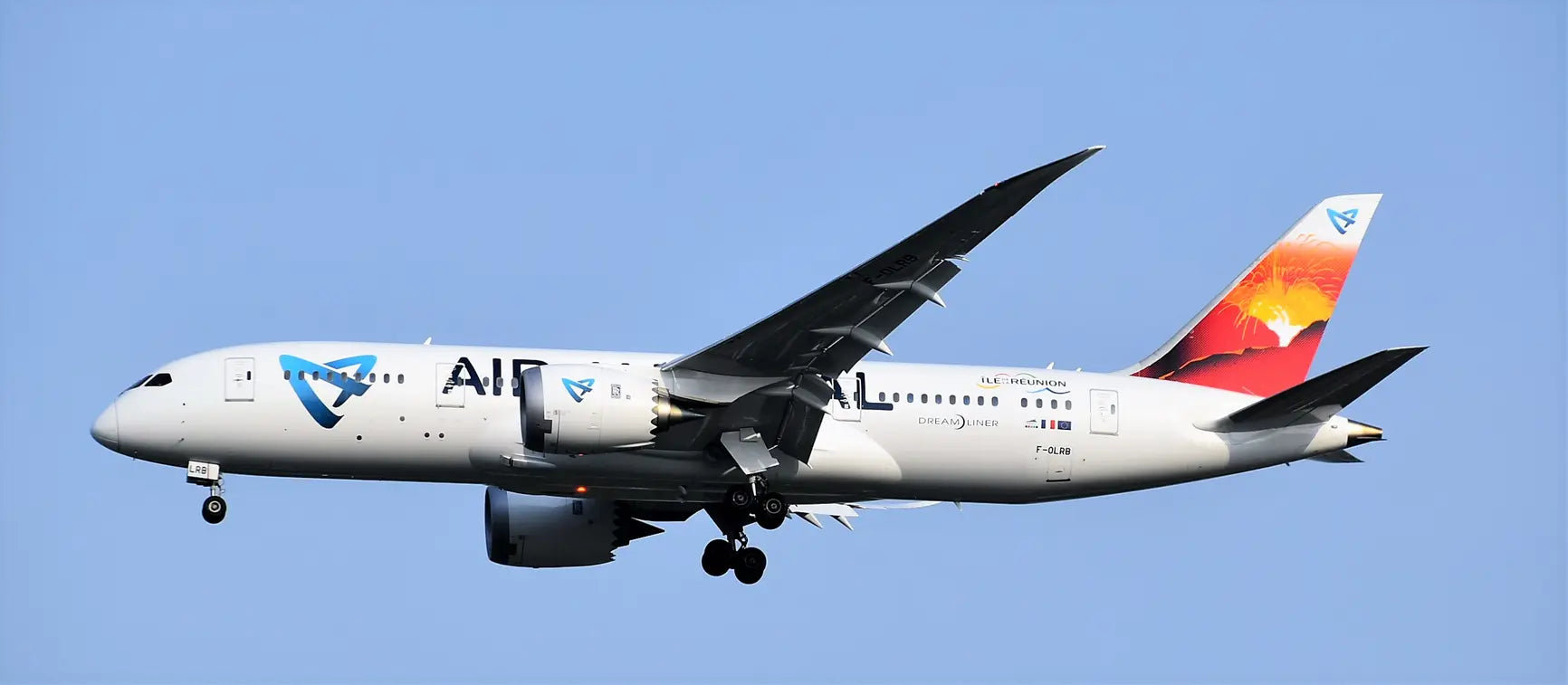
Air Austral operates a mixed fleet of widebody and narrowbody aircraft tailored to its dual role as both a long-haul carrier (serving the Reunion-to-Paris trunk route) and a regional operator across the Indian Ocean. The fleet is compact but diverse for an airline of its size. The Boeing 777-300ER serves as the flagship long-haul workhorse, while the Boeing 787-8 Dreamliner provides modern, fuel-efficient widebody capacity. Regional operations rely on the Airbus A220-300, although this type faces imminent retirement due to persistent Pratt & Whitney GTF engine reliability issues.
The airline is undergoing a significant fleet transition. All three A220-300 aircraft are scheduled for retirement by mid-2026, with two already grounded as of late 2025 due to engine problems. Air Austral has placed firm orders for two Airbus A320neo aircraft, with deliveries expected from 2027. In the interim, the airline has sourced wet-leased narrowbody capacity (including a Boeing 737-800) to maintain regional services. The ATR 72-500 turboprops, which previously served shorter island-hopping routes, were retired from the mainline fleet in 2022; some regional services are now handled by subsidiary Ewa Air based in Mayotte.
| Aircraft Type | Role | In Service | Routes / Notes |
|---|---|---|---|
| Boeing 777-300ER | Widebody | 3 | Paris CDG trunk route. 442-seat config (18J + 40W + 384Y). Flagship aircraft. |
| Boeing 787-8 | Widebody | 2 | Paris CDG, Bangkok, Johannesburg. 262-seat config (18J + 244Y). Most modern type. |
| Airbus A220-300 | Narrowbody | 3 (2 grounded) | Regional Indian Ocean routes. 132-seat config. Retiring by mid-2026 (GTF engine issues). |
| Boeing 737-800 (wet-lease) | Narrowbody | 1 | Temporary replacement for grounded A220s. Regional and medium-haul routes. |
| ATR 72-600 (wet-lease) | Turboprop | 1 | Short-haul island routes. Temporary capacity supplement. |
Fleet data as of late 2025. The A220 fleet is being phased out. Two Airbus A320neo are on order for delivery from 2027.
Air Austral formally announced plans to retire its entire A220-300 fleet following persistent Pratt & Whitney GTF engine reliability problems that have grounded two of the three aircraft. This mirrors issues affecting A220 and A320neo operators worldwide. Pilots currently typed on the A220 will need to transition to replacement narrowbody equipment (likely A320neo from 2027 or wet-leased 737s in the interim). The fleet transition creates both uncertainty and opportunity: pilots willing to retrain on new types will be well-positioned as the airline modernizes its regional fleet.
Pilot Salary & Compensation Breakdown
Air Austral pilot salaries are governed by collective labor agreements negotiated under French aviation industry frameworks, with compensation structured around a seniority-based progression ladder. Pay scales differ between widebody (Boeing 777/787) and narrowbody (A220) operations, with widebody pilots earning a premium. According to data published on PilotJobsNetwork, the monthly salary figures below represent base pay before allowances, per diems, and supplemental bonuses.
First Officer (OPL) Pay Scale: Widebody (B777/B787)
| Seniority | Monthly Base (EUR) | Annual Gross (est.) | Upgrade Timeline |
|---|---|---|---|
| Year 1 (entry) | 3,645 | ~43,700 | 33 months |
| Year 3 | 4,444 | ~53,300 | 31 months |
| Year 5 | 5,026 | ~60,300 | 31 months |
| Year 7 | 5,721 | ~68,700 | 31 months |
| Year 10 | 8,437 | ~101,200 | 22 months |
| Year 14+ | 10,455 (cap) | ~125,500 | 13 months |
Source: PilotJobsNetwork. "Upgrade timeline" indicates the estimated months of additional service required before captain upgrade eligibility at that seniority level.
Captain (CDB) Pay Scale: Widebody (B777/B787)
| Seniority | Monthly Base (EUR) | Annual Gross (est.) |
|---|---|---|
| Year 1 (entry Captain) | 3,837 | ~46,000 |
| Year 5 | 7,036 | ~84,400 |
| Year 7 | 8,196 | ~98,400 |
| Year 10 | 10,024 | ~120,300 |
| Year 12 | 11,130 | ~133,600 |
| Year 14+ (cap) | 12,001 | ~144,000 |
Captain pay caps at EUR 12,001/month at 14 years of seniority. These are base figures before per diems, flight hour premiums, and supplemental allowances.
These figures represent monthly base salary only and are compiled from publicly available pilot career databases. Total annual compensation will be higher when per diem allowances (calculated hourly for time away from base), flight hour premiums, night/weekend supplements, and profit-sharing are included. However, Air Austral's capped captain salary of approximately EUR 144,000 per year (base) falls well below the French airline industry average for major carrier captains (estimated around EUR 200,000+ at Air France). French social charges (~22-25%) significantly reduce net take-home pay. The relatively low entry-year captain salary of EUR 3,837 likely reflects a probationary pay step before the seniority ladder takes effect. Always verify current figures with the latest collective agreement or SNPL publications.
Roster Pattern & Quality of Life
Air Austral operates under French labor regulations combined with EASA flight time limitation (FTL) rules. As a French-registered carrier, the airline must comply with European regulations governing maximum flight duty periods, minimum rest requirements, and acclimatization protocols. The airline's unique operational profile, combining ultra-long-haul Paris sectors with short regional Indian Ocean hops, creates a distinctive rostering environment that differs significantly from purely European or purely regional operators.
The Reunion-to-Paris route, at approximately 11 hours, requires augmented crew configurations (3 or 4 pilots) to comply with FTL regulations on ultra-long-haul sectors. This means widebody pilots share cockpit duties and benefit from in-flight rest periods. Layovers in Paris typically last 24 to 48 hours, providing genuine recovery time. Regional routes within the Indian Ocean (Reunion to Mayotte, Madagascar, Mauritius) operate with standard two-pilot crews on shorter sectors, creating a more intensive flight cycle pattern but with minimal time zone disruption.
📅 Sample Month: Widebody First Officer (RUN Base)
Long-haul patterns on the Paris route typically involve 2 days of duty (outbound + layover + return) followed by 3 to 5 days of recovery. The three-hour time difference between Reunion (GMT+4) and Paris (GMT+1/+2) creates manageable circadian disruption compared to transatlantic or transpacific operations, though the 11-hour flight time remains fatiguing. Pilots operating Bangkok services face a greater time zone offset, requiring careful fatigue management.
All Air Austral pilots are based on Reunion Island. There is no mainland France base option. This means pilots must either live on the island or accept a very long commute (11 hours to Paris). Reunion offers a high quality of life with French infrastructure, healthcare, and social services, combined with a tropical climate, volcanic landscapes, and significantly lower living costs than Paris. However, the geographic isolation (9,364 km from mainland France) is a major lifestyle consideration. Pilots who embrace island life benefit from a relaxed pace, outdoor activities, and a close-knit aviation community. Those who prefer the cultural and social offerings of a major European city may find the adjustment challenging.
Benefits, Travel Perks & Retirement
As a French-registered carrier, Air Austral pilots benefit from France's comprehensive social protection framework. This includes mandatory enrollment in the CRPN (Caisse de Retraite du Personnel Navigant), the dedicated French pension fund for professional aircrew, as well as full coverage under the French social security system. The benefits package, while less publicly documented than at major carriers like Air France, follows French aviation industry standards and collective labor agreement provisions.
The CRPN is a private non-profit pension fund exclusively for French-based aircrew, operating since 1951. Contributions are calculated on gross earnings (up to 8x the social security ceiling), and the pension is based on career-average indexed earnings. Full pension rights are earned after 25 years of contributions. The fund also provides a survivors' pension (60% of the member's pension) and orphan's benefits. For Air Austral pilots, CRPN membership is mandatory and represents one of the most valuable long-term benefits of flying for a French carrier, regardless of the airline's size. The fund also covers permanent loss of pilot license due to occupational causes.
Career Progression & Seniority
Career progression at Air Austral follows a seniority-based system standard across European aviation. Your hire date determines your position on the company seniority list, which directly impacts aircraft assignment, route selection, schedule quality, and promotion to Captain. One of Air Austral's most attractive features for career-minded pilots is the relatively fast upgrade timeline to Captain compared to major carriers. With a small pilot workforce and steady fleet operations, first officers can realistically expect to reach the left seat within approximately 5 to 8 years, significantly faster than the 12 to 15 years typical at carriers like Air France.
All external hires enter Air Austral as First Officers, regardless of previous experience or rank held elsewhere. There is no publicly documented direct-entry Captain pathway, though the airline's small size means individual circumstances may allow exceptions for highly experienced candidates when operational needs demand it.
| Career Milestone | Typical Timeline | Notes |
|---|---|---|
| Join as F/O (B777 or B787) | Day 1 | Widebody from the start. Type rating typically covered by the airline. |
| Establish seniority | Years 1-3 | Build experience on long-haul (Paris) and regional (Indian Ocean) sectors. |
| Senior F/O | Years 5-7 | Priority bidding for preferred routes. Per diem income increases with seniority. |
| Captain upgrade eligibility | ~5-8 years | Faster than major carriers. Requires command assessment (interview + sim check). |
| Senior Captain | 10-14 years | Pay caps at EUR 12,001/month base. Top of seniority list. |
| Training Captain / TRE | Variable | Requires separate selection and instructor qualification. Enhanced responsibility. |
Air Austral's compact pilot workforce means that proportionally more captain positions open up relative to the number of first officers waiting for upgrade. Unlike Air France (4,000+ pilots) or Corsair, the small seniority list at Air Austral creates a faster-moving queue. However, this advantage comes with a trade-off: fewer total positions means less flexibility if operational changes (fleet retirements, route cuts, or financial difficulties) reduce the number of available captain slots. The ongoing A220 retirement and fleet transition period may temporarily affect upgrade timing for narrowbody-assigned pilots.
Recruitment Process & Requirements
Air Austral recruits experienced pilots on a rolling basis when operational needs arise. Unlike Air France, which runs structured annual cadet campaigns, Air Austral does not operate a formal cadet or ab-initio pilot training programme. Recruitment focuses on licensed professional pilots who already hold the required qualifications. Positions are typically advertised through the airline's HR department, aviation job boards, and industry networks.
Minimum Requirements
Selection Process
Application & CV Screening
Submit application to Air Austral's HR department (Service Ressources Humaines, Zone Aeroportuaire de Gillot, 97438 Sainte-Marie, Reunion). Include license documentation, logbook summary, medical certificate, and CV. Applications may also be submitted via the Air Austral recruitment page.
Technical Interview & Knowledge Assessment
Shortlisted candidates undergo a technical interview assessing systems knowledge, procedural understanding, and aeronautical aptitude. French and English language proficiency are evaluated during this stage.
Simulator Assessment
Practical flying evaluation in a flight simulator to assess handling skills, CRM competencies, and airmanship under normal and abnormal scenarios.
HR Interview & Final Selection
Interview with HR and flight operations management. Focus on motivation, cultural fit, willingness to relocate to Reunion, and career objectives. According to employee reviews, the overall process typically takes approximately two weeks.
Medical Verification & Contract
Successful candidates provide a valid Class 1 medical certificate and complete onboarding documentation. Type rating training (if required) is arranged before line operations begin.
French language fluency is absolutely essential. Unlike some international carriers that operate primarily in English, Air Austral's operational language is French. All briefings, company communications, and union interactions are conducted in French. Candidates should also demonstrate genuine willingness to relocate to Reunion Island, as this is the only pilot base. Highlighting experience on Boeing widebody types (particularly 777 or 787) will significantly strengthen an application, as these represent the core of Air Austral's fleet.
Top 5 Layover Destinations
Air Austral's network creates a distinctive set of layover destinations spanning from metropolitan Paris to tropical Indian Ocean islands and Southeast Asia. Long-haul layovers on the Paris and Bangkok routes offer genuine rest and exploration time, while regional Indian Ocean sectors typically involve shorter turnarounds. The variety is notable for such a compact airline: in a single month, a pilot might layover in central Paris, on a beach in Mauritius, and amid the temples of Bangkok.
Unlike major carriers with thousands of crew members, Air Austral's smaller workforce creates a close-knit layover culture. Pilots and cabin crew often know each other well, and layover experiences tend to be more social and collegial. Paris layovers are the most coveted, offering both the best per diem income and access to mainland France. Regional Indian Ocean layovers are shorter but offer a unique tropical lifestyle that few airlines can match. Layover hotels and ground transport are arranged by the airline.
How Air Austral Compares: Airline Radar Chart
How does Air Austral stack up against its two most comparable French long-haul competitors, Corsair International and French Bee? All three airlines operate long-haul services from France to overseas territories and leisure destinations, making them natural comparators for pilots evaluating career options in the French aviation market.
Key Takeaways from the Comparison
Air Austral leads on career progression speed. With a compact pilot workforce, upgrade timelines to Captain (5-8 years) are notably faster than at Corsair or French Bee, both of which have larger seniority lists. For ambitious first officers seeking rapid command experience, Air Austral offers a compelling pathway that larger carriers cannot match.
French Bee wins on fleet modernity. Operating an all-A350-900 fleet, French Bee offers pilots the most modern and efficient equipment of the three carriers. Corsair's all-A330-900 fleet is also brand-new (second youngest fleet in Europe), while Air Austral's mix of ageing 777s and troubled A220s lags behind. The 787-8 partially bridges this gap, but fleet modernity is not Air Austral's strongest suit.
Job security is Air Austral's weakest area. The airline's ongoing financial restructuring (EUR 250 million in post-pandemic debt, repeated shareholder injections, and EU state aid approval) creates genuine uncertainty. Both Corsair (backed by the Intro Aviation group) and French Bee (part of the Dubreuil Group alongside Air Caraibes) have more stable ownership structures. Air Austral's implicit government support through Sematra provides a safety net, but the financial situation remains fragile.
Salaries are comparable but not leading. All three carriers sit in the French mid-market salary range, well below Air France levels. Air Austral's capped captain salary (EUR 12,001/month) is broadly in line with Corsair and French Bee, though French Bee captains may earn slightly more (up to EUR 13,000/month at senior levels according to industry reports). The real compensation differentiator at Air Austral is the lower cost of living on Reunion compared to Paris-based competitors.
Radar chart scores are editorial estimates based on publicly available salary data, fleet information, pilot career databases, company financial reports, and industry benchmarks. They represent a general assessment for a pilot evaluating a long-term career at each airline. Individual experiences vary based on seniority, fleet assignment, and personal priorities. Scores will be updated as dedicated articles are published for Corsair International and French Bee.
Union & Industrial Relations
Air Austral pilots, as employees of a French-registered airline, are represented by the SNPL France ALPA (Syndicat National des Pilotes de Ligne), France's primary pilot labor organization. The SNPL represents airline pilots across all major French carriers, including Air France, Corsair, Air Caraibes, and regional operators. It provides collective bargaining representation, labor dispute management, and advocacy on working conditions, safety, and compensation issues.
Air Austral has a relatively low public profile in terms of pilot-specific industrial disputes. The airline's small size and close-knit workforce tend to favour internal resolution of grievances. However, Air Austral pilots have participated in industry-wide SNPL actions affecting all French carriers, particularly on issues of pension protection and aviation tax policy.
Recent Industrial Actions Involving Air Austral Pilots
Air Austral has been relatively free of airline-specific pilot strikes. The industrial actions involving Air Austral pilots have been national, sector-wide movements organized by the SNPL on issues affecting all French carriers (pension reform, aviation taxes). This suggests a relatively stable internal labor relations environment. Union membership is optional but strongly encouraged; the SNPL provides valuable protections including collective agreement negotiations, legal support, and pension advocacy that benefit all pilots at the airline.
Verdict: Who Is Air Austral For?
🎯 Our Take
Air Austral is a niche but genuinely interesting career option for pilots seeking something different from the mainstream European airline experience. The combination of widebody flying from day one (Boeing 777 and 787), a fast track to Captain (5-8 years versus 12-15 at major carriers), tropical island-based lifestyle on Reunion, and the full protection of French labor law and the CRPN pension system creates a distinctive proposition that no other European airline can replicate.
The trade-offs are significant and must be weighed carefully. Salaries cap at approximately EUR 144,000 per year for senior captains (well below Air France or Gulf carrier levels). The airline's financial situation remains fragile, with EUR 250 million in post-pandemic debt and dependence on shareholder injections and state aid. The A220 fleet retirement adds operational uncertainty. And living on Reunion Island, 9,364 km from mainland France, is a major lifestyle decision that not every pilot or family will embrace.
For French-speaking pilots who are drawn to the Indian Ocean, value rapid career progression over maximum salary, and want the security of a French employment contract with CRPN pension rights, Air Austral offers a career experience that is genuinely unique in European aviation.
1 Do I need to speak French to fly for Air Austral?
Yes. Fluent French is mandatory for all pilot positions at Air Austral. The airline is based on Reunion, a French department, and all internal operations, briefings, company communications, and union interactions are conducted in French. English proficiency (ICAO Level 4+) is also required for international operations.
2 Where are Air Austral pilots based?
All Air Austral pilots are based on Reunion Island, either at Roland Garros Airport (Sainte-Marie) or Pierrefonds Airport (Saint-Pierre). There is no mainland France base. Pilots must live on the island or accept commuting from 9,364 km away, which is not practical for regular operations.
3 How long does it take to upgrade to Captain at Air Austral?
Captain upgrade at Air Austral is estimated at approximately 5 to 8 years, significantly faster than major carriers like Air France (approximately 15 years). The small pilot workforce means the seniority list moves quickly. However, upgrade timelines can fluctuate with fleet changes, financial conditions, and retirement patterns.
4 Does Air Austral have a cadet programme?
No. Air Austral does not operate a formal cadet or ab-initio pilot training programme. The airline recruits experienced pilots who already hold a valid ATPL or CPL/IR-ME. Candidates are expected to have completed their flight training independently before applying.
5 Is Air Austral financially stable?
This is the most important question for prospective applicants. Air Austral carries approximately EUR 250 million in post-pandemic debt, has received EUR 119.3 million in EU-approved state aid, and required an additional EUR 15 million shareholder injection in late 2024. Revenue reached EUR 440 million in 2024 (up from EUR 393 million in 2023), and the airline targets a positive operating result. The airline has implicit government support through the Reunion regional government's stake via Sematra. While this creates a safety net, the financial trajectory requires ongoing improvement for long-term viability.
6 What aircraft will I fly at Air Austral?
Most new pilot hires will be assigned to the widebody fleet: Boeing 777-300ER or Boeing 787-8 Dreamliner. These aircraft operate the flagship Paris route and long-haul services to Bangkok and Johannesburg. The A220-300 narrowbody fleet is being retired by mid-2026, and replacement A320neo aircraft are expected from 2027. Pilots may also operate temporary wet-leased narrowbody types (currently a 737-800) for regional services.
7 How does Air Austral pilot pay compare to Air France?
Air Austral pays considerably less than Air France. A senior widebody captain at Air Austral caps at approximately EUR 12,001/month (EUR 144,000/year base), while Air France senior long-haul captains can earn EUR 18,000-21,000/month (EUR 220,000-260,000/year). First officer pay is also lower at all seniority levels. However, Air Austral offers faster upgrade to Captain, lower living costs on Reunion, and the same CRPN pension rights as Air France pilots.
8 What is life like on Reunion Island for a pilot?
Reunion is a French overseas department with full French infrastructure, healthcare, schools, and social services. The island offers a tropical climate, volcanic landscapes, excellent hiking, surfing, and a vibrant Creole culture. Living costs are lower than mainland France (particularly housing), though some imported goods are more expensive. The pilot community is small and close-knit. The main challenge is geographic isolation: mainland France is 11 hours away by air, which can affect family ties and access to European cultural and social life.
Official Links & Resources
Before applying or making any career decisions, always verify information directly with official sources. These are the key websites and organisations relevant to Air Austral pilot careers:
Air Austral does not always have active pilot recruitment campaigns running. Monitor the official recruitment page regularly and consider registering with pilot career platforms like PilotJobsNetwork for alerts when positions open. Networking with current Air Austral pilots (the community is small and approachable) can also provide early notice of upcoming hiring waves.