

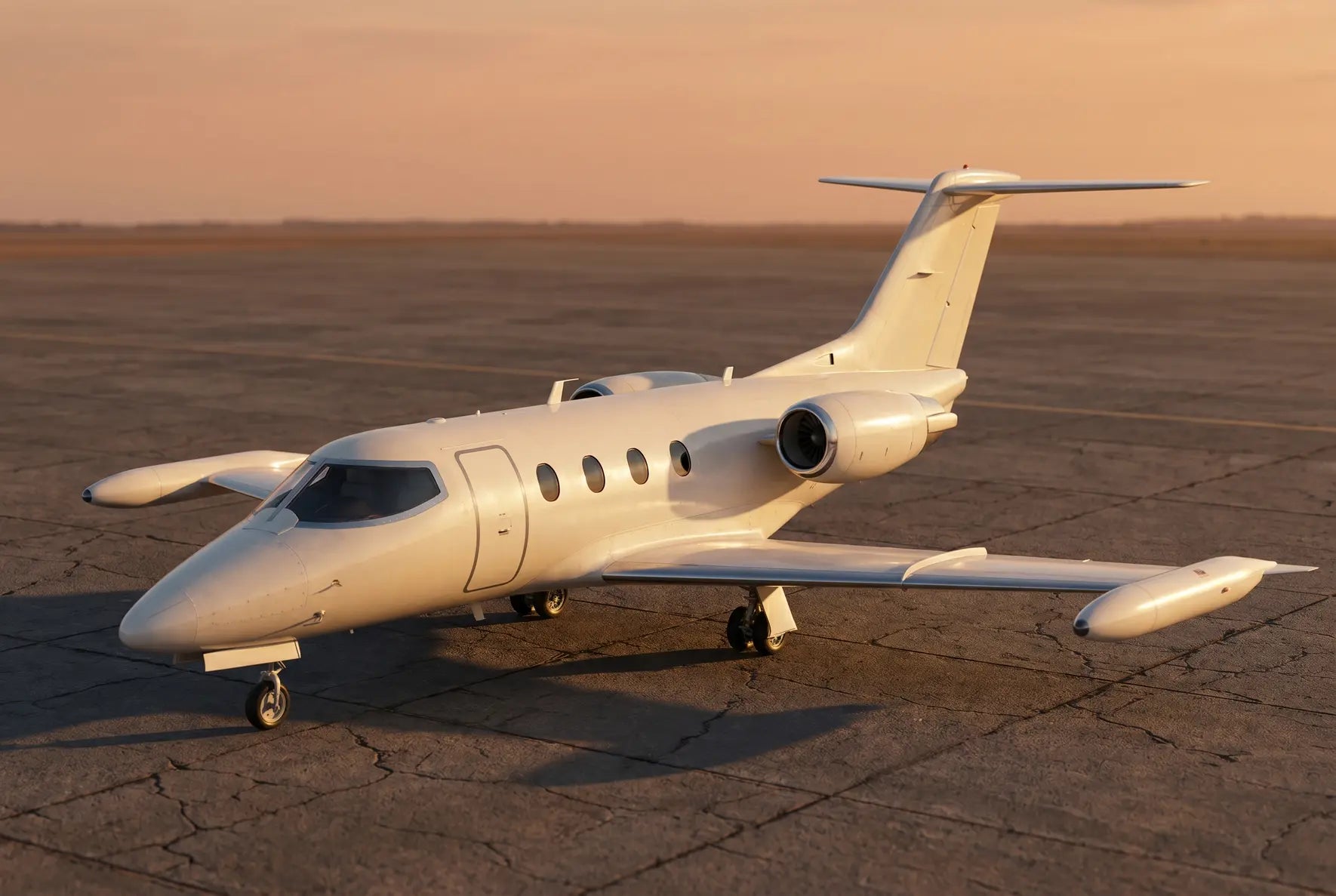
History and Development of the Aérospatiale SN 601 Corvette Business Jet
The Aérospatiale SN 601 Corvette emerged from a French government initiative in the late 1960s to develop an indigenous light twin-jet suitable for business transport, air-taxi, liaison, and regional commuter services. At a time when the business-jet market was largely dominated by American manufacturers such as Learjet and Cessna, France sought to establish a credible European competitor by leveraging new, fuel-efficient small turbofan engines that were entering the market.
The programme began in 1967 when both Sud Aviation and Nord Aviation, two state-owned French aerospace companies, independently studied designs for a compact twin-engine jet. By January 1968, the two firms decided to pool their efforts into a joint project designated SN 600 Diplomate. The "SN" prefix reflected the Sud and Nord collaboration. A full-scale mock-up of the SN 600 was publicly presented at the 1968 Hanover Air Show. The intended powerplant was the SNECMA M49 Larzac turbofan, but development delays on that engine led the team to select the Pratt & Whitney Canada JT15D-1 turbofan as a substitute, each producing approximately 2,200 lbf of thrust.
The sole SN 600 prototype (registered F-WRSN) completed its maiden flight on 16 July 1970. By this point, the French government had merged Sud Aviation, Nord Aviation, and SEREB into a single national entity known as Société Nationale Industrielle Aérospatiale (SNIAS), later simply called Aérospatiale. The Corvette thus became one of the first programmes carried forward under the new company's banner.
Tragically, on 23 March 1971, the SN 600 prototype was lost during stall-test trials near Istres, killing the crew. The accident prompted a thorough structural and aerodynamic review and ultimately led to a significant redesign. The fuselage was stretched by approximately 1.05 m (3 ft 5 in) to accommodate up to 12 passengers, the airframe was reinforced, and more powerful Pratt & Whitney Canada JT15D-4 engines (approximately 2,500 lbf thrust each) replaced the earlier JT15D-1 units. The redesigned aircraft was designated SN 601 Corvette 100.
The first SN 601 prototype (F-WUAS) made its first flight on 20 December 1972. A second prototype, closer to the production standard, followed on 7 March 1973, and the first series-production SN 601 flew on 9 November 1973. French civil aviation authority (DGAC) type certification was granted on 28 May 1974, and the Corvette entered commercial service that same year. However, initial deliveries were hampered by engine supply disruptions caused by strikes at the Pratt & Whitney Canada factory.
Aérospatiale originally planned to deliver 20 aircraft in 1974 and ramp up to six airframes per month, but these targets proved overly optimistic. The Corvette faced stiff competition from established types such as the Cessna Citation and the Dassault Falcon series, and early operators reported technical teething issues including asymmetric flap extension events. Sales remained sluggish, and by late 1976 Aérospatiale decided to halt production and discontinue all further development, including a proposed stretched variant known as the Corvette 200 (or SN 602), which would have accommodated up to 18 passengers but never progressed beyond the concept stage. In total, 40 airframes were built, comprising one SN 600 prototype, two SN 601 prototypes, and 37 series-production aircraft. The type certificate is today held by Airbus SAS under EASA Specific Airworthiness Specification EASA.SAS.A.176.
Among the most notable operators were French regional airlines Air Alpes, Air Alsace, and Touraine Air Transport (TAT), as well as Denmark's Sterling Airways. European air charter and third-level carriers used the Corvette on thin routes where larger jets were uneconomical, typically seating 10 to 14 passengers. Airbus Industrie itself later operated five Corvettes as corporate liaison shuttles between its European sites from 1981 until 2009, accumulating roughly 63,500 flight hours. Outside Europe, the Congolese Air Force used at least one Corvette for VIP transport.
What Distinguishes the SN 601 Corvette 100 from the SN 600 Prototype
The SN 601 Corvette 100 was the sole production variant and differed substantially from the original SN 600 Diplomate prototype. Beyond the stretched fuselage and upgraded engines, the production aircraft featured revised aerodynamics informed by the lessons of the 1971 accident, a higher maximum take-off weight of approximately 6,600 kg (14,550 lb), and the option of wingtip fuel tanks to extend range. No winglets were fitted. Standard avionics were supplied by Rockwell Collins, consistent with IFR-equipped business jets of the era.
Key identifiers of the production Aérospatiale SN 601 Corvette 100 include:
- Engines: two Pratt & Whitney Canada JT15D-4 turbofans, each rated at approximately 2,500 lbf
- Fuselage length: 13.83 m (45 ft 4 in), roughly 1.05 m longer than the SN 600
- Wingspan: 12.87 m (42 ft 3 in), with optional wingtip fuel tanks (no winglets)
- Seating capacity: 6 to 14 passengers depending on cabin configuration
- Maximum cruise speed: approximately 410 kt (759 km/h)
- Service ceiling: 41,000 ft
- Range: approximately 840 to 1,380 nm depending on payload and tank configuration
- Total production: 40 airframes (including prototypes), 1970 to 1977

An Aérospatiale Corvette jet airplane is captured in the air, flying against a clear blue sky. The aircraft displays a distinctive livery with red, white, and blue striping.
Aérospatiale SN 601 Corvette: Technical Specifications, Systems and Engine Overview
The Aérospatiale SN 601 Corvette was designed to bridge two markets: corporate transport and short-haul regional operations. Seating between 6 and 14 passengers depending on cabin configuration, it was one of the smallest jets ever to serve in scheduled airline service. Its low-wing, T-tail layout with two rear-mounted turbofans followed established business jet conventions, prioritising cabin quietness and simplicity over cutting-edge aerodynamic innovation. With a maximum takeoff weight of approximately 6,600 kg (14,550 lb), the Corvette offered a practical range of roughly 1,200 to 1,380 nm with wingtip tanks fitted, at the cost of a relatively modest payload capacity compared to larger contemporaries.
The airframe inherited little from a broader family, as the Corvette was Aérospatiale's sole business jet programme. The design philosophy, described in period flight evaluations as involving "mainly conventional systems" with "no new departure in aircraft," reflected a deliberate choice: keep the aircraft simple, certifiable, and easy to operate from smaller airfields. This approach made the Corvette accessible to operators without extensive jet maintenance infrastructure, even as it limited its appeal against more technologically ambitious American competitors. In the regional jet role, the Corvette occupied a niche similar to that of the Fokker F28, though on a significantly smaller scale.
- Length: 13.83 m (45 ft 4 in)
- Wingspan: 12.87 m (42 ft 3 in)
- Height: 4.23 m (13 ft 11 in)
- Wing area: 22.0 m² (237 sq ft)
- Cabin dimensions: 5.73 m length, 1.60 m width, 1.52 m height (18.8 x 5.25 x 4.99 ft)
- Crew: 1 or 2 (certified for single-pilot operations with appropriate equipment)
- Passenger capacity: 6 (executive) to 14 (high-density commuter)
- MTOW: approximately 6,600 kg (14,550 lb)
- Basic empty weight: approximately 3,510 kg (7,738 lb)
- Engines: 2 x Pratt & Whitney Canada JT15D-4 turbofans, each rated at approximately 2,500 lbf (11.1 kN)
- Maximum cruise speed: approximately 410 kt (760 km/h) at altitude
- Economy cruise speed: approximately 306 kt (566 km/h)
- Service ceiling: 12,500 m (41,000 ft)
- Rate of climb: approximately 2,700 ft/min
- Range (with tip tanks, economy cruise, reserves): approximately 1,380 nm (2,555 km)
- Fuel capacity (with tip tanks): approximately 625 US gal (2,366 litres)
- Takeoff distance (over 35 ft obstacle, near MTOW, ISA sea level): approximately 1,250 to 1,400 m (4,100 to 4,600 ft)
- Landing distance: approximately 800 m (2,625 ft)
- Stall speed (gear and flaps down): approximately 91 kt
- ICAO type designator: S601
- Avionics baseline: Rockwell Collins analog suite with weather radar
Systems, Flight Controls and Handling Characteristics
The Corvette employed conventional, mechanically linked primary flight controls with cables, rods and bellcranks driving ailerons, elevators and rudder. No fly-by-wire system or electronic stability augmentation was fitted. Trim tabs on primary surfaces provided the usual manual trim capability. The flap system, consistent with period light-jet design, supported adequate short-field performance without leading-edge devices. Hydraulic power, generated by engine-driven pumps, operated the retractable tricycle landing gear, flaps and wheel brakes. Primary flight controls reverted to full manual operation, ensuring simplicity and reliability.
Single-point pressure refuelling was provided via a fuselage bay. The avionics suite comprised standard 1970s-era analog instruments, including dual VHF comm/nav radios, DME, ADF, transponder, radio altimeter and a conventional two-axis autopilot with flight director. Weather radar occupied the lower nose radome bay. No FMS, EFIS or autothrottle was fitted.
Contemporary test pilots noted minimum control speeds of approximately 73 kt on the ground (Vmcg) and 88 kt in the air (Vmca), indicating adequate but not generous directional authority in asymmetric thrust scenarios. The aircraft was generally described as honest and straightforward to fly, with no unusual handling traits reported in the literature. However, as with all light twins of the era, strict adherence to engine-out procedures and V-speed limitations was essential for safe operations.
Published performance figures for the SN 601 Corvette can vary depending on several factors. Operator-selected cabin configurations affect operating empty weight and, consequently, range and payload. Wingtip tank installation is a significant variable: range figures quoted with tip tanks fitted differ substantially from those without. Atmospheric assumptions (ISA conditions versus hot-and-high airports), runway surface condition, and the definition of reserves (30-minute versus 45-minute) all influence takeoff distance, landing distance and quoted range. The figures listed above reflect manufacturer-published or widely cited reference values under standard conditions and should be treated as planning guidelines rather than absolute guarantees.
Pratt & Whitney Canada JT15D: The Corvette's Powerplant
Production SN 601 Corvettes were powered by two Pratt & Whitney Canada JT15D-4 turbofans, each producing approximately 2,500 lbf (11.1 kN) of takeoff thrust. The earlier SN 600 prototype had flown with JT15D-1 engines rated at roughly 2,200 lbf, which were fitted as an interim solution after the originally intended SNECMA M49 powerplant was cancelled.
The JT15D was Pratt & Whitney Canada's first turbofan engine. Development began in 1966 at Cessna's request for the new Fanjet 500 (later Citation I), and the engine first ran in 1967. Production JT15D-1 models entered service around 1971. The design was notable for its single-stage centrifugal high-pressure compressor, a simpler and more robust solution than the multi-stage axial compressors found in larger turbofans. A reverse-flow annular combustor, single-stage HP turbine and two-stage LP turbine completed the core. The Smithsonian National Air and Space Museum preserves a cutaway JT15D-1 from the original Citation prototype programme.
The JT15D-4 variant used on the Corvette featured increased thrust over the baseline -1, with a dry weight of approximately 253 kg (558 lb), a length of roughly 1,600 mm (63 in) and a fan diameter of about 690 mm (27 in). Its bypass ratio was approximately 2.6:1. Later members of the JT15D family, such as the -5 and -5D variants, pushed thrust to approximately 3,045 lbf and powered aircraft including the Beechjet 400A, Hawker 400XP, Cessna Citation II and Citation V/Ultra, the Mitsubishi MU-300 Diamond, and the Raytheon T-1A Jayhawk military trainer. The family's versatility also extended to experimental programmes, with JT15D engines powering the Boeing Bird of Prey stealth demonstrator and the Northrop Grumman X-47A Pegasus UCAV prototype, among others.
Aérospatiale SN 601 Corvette vs Citation II vs Falcon 10 vs Hawker 600: Specs Comparison
Scroll horizontally to see more →
| Parameter | Aérospatiale SN 601 Corvette | Cessna Citation II (Model 550) | Dassault Falcon 10 | BAe 125-600 (Hawker 600) |
|---|---|---|---|---|
| Entry into service | 1974 | 1978 | 1973 | 1972 |
| Engines | 2 × Pratt & Whitney Canada JT15D-4 | 2 × Pratt & Whitney Canada JT15D-4 | 2 × Honeywell TFE731-2 | 2 × Rolls-Royce Viper 601-22 |
| Length | 13.83 m | 14.39 m | 13.53 m | 15.50 m |
| Wingspan | 12.87 m | 15.91 m | 13.08 m | 14.32 m |
| Height | 4.20 m | 4.57 m | 4.61 m | 5.05 m |
| Typical seating and layout (short description + approximate passengers) | Executive: 6–14 passengers | Executive: 7–9 passengers | Executive: 6–8 passengers | Executive: 6–8 passengers |
| MTOW | 6.60 t | 6.83 t | 7.48 t | 10.43 t |
| Range | 1,380 nm | 2,000 nm | 1,500 nm | 1,600 nm |
| Cruise speed | 0.72 Mach | 0.62 Mach | 0.80 Mach | 0.77 Mach |
| Service ceiling | 41,000 ft | 43,000 ft | 45,000 ft | 41,000 ft |
| Program note | French light business / commuter jet aimed at the U.S. corporate and regional market; limited sales and short production run. | U.S. light business jet and Citation family mainstay, offering simple systems and low operating costs for charter and corporate operators. | French fast light business jet positioned as a high-performance step up from entry-level jets, with higher cruise speed and altitude. | British mid-size business jet (Hawker 600) evolved from the HS.125 line, offering more cabin comfort and range than earlier small jets. |
Scroll horizontally to see more →
The table compares four early-generation business jets across dimensions, engines, performance, and mission. The SN 601 Corvette and Citation II share JT15D-4 engines, but the Citation II offers the longest range (2,000 nm) while the Corvette is shorter-legged (1,380 nm). Falcon 10 is the fastest (Mach 0.80) and highest (45,000 ft). Hawker 600 is largest by MTOW (10.43 t) with solid range (1,600 nm) and a bigger cabin class.
Aérospatiale SN 601 Corvette Operations: Airlines, Missions and Global Routes
With only 40 airframes built between 1972 and 1977, the Aérospatiale SN 601 Corvette had a modest but diverse operational footprint. Designed as a twin-engine light jet capable of seating 6 to 14 passengers, the aircraft straddled two roles: corporate transport and short-haul regional airliner. Its two Pratt & Whitney Canada JT15D-4 turbofans provided a practical range of approximately 800 to 1,400 nm depending on payload and configuration, translating into typical stage lengths of 300 to 700 nm and flight times of roughly 1 to 2.5 hours per sector.
Regional airline operators typically flew the Aérospatiale SN 601 Corvette on point-to-point routes connecting secondary cities, bypassing major hubs. Air Alpes, for instance, operated a documented Lyon to Brussels service that avoided a Paris connection entirely. Corporate and shuttle operators, such as Airbus Industrie, used the type for inter-site liaison flights linking factories across Europe. Daily utilisation patterns for airline operators would have been moderate, limited by the thin demand on regional routes served. Government and military users deployed the aircraft for VIP transport and special missions, including aerial photography and chase duties during high-speed rail testing in France.
Operators faced several significant challenges. The small fleet size meant limited spare parts availability and a shallow maintenance support network. The aircraft was considered costly to operate relative to turboprops serving similar route profiles. The French Centre d'Essais en Vol (CEV) ultimately replaced its Corvettes with turboprops that were considerably more economical. Additionally, early technical issues such as asymmetric flap deployment affected dispatch reliability for some airlines. The lack of a strong North American distribution partner meant that residual values remained low and long-term support was uncertain, contributing to relatively early retirements across the fleet.
Where the Aérospatiale SN 601 Corvette Operated Around the World
The operational geography of the Aérospatiale SN 601 Corvette was concentrated primarily in Europe, with limited presence in Africa. Europe accounted for the vast majority of commercial, corporate and government operations, centred on France and extending to Scandinavia. In Africa, the type served exclusively in military and presidential transport roles. There is no documented evidence of sustained fleet operations in Asia or North & South America, although the aircraft was actively marketed in the United States through several failed distribution partnerships with companies including LTV, Piper and Air Center Inc.
French regional carriers formed the core of airline operations, using the Corvette on thin domestic and intra-European routes during the mid-to-late 1970s. Airbus Industrie became the longest-serving operator, flying five Corvettes as corporate shuttles from 1981 until 2009 and accumulating approximately 63,500 flight hours across the fleet. In Africa, military operators used the aircraft for head-of-state transport, with at least one airframe still on strength as late as 2013.
- Europe: The primary market for the Aérospatiale SN 601 Corvette. Air Alpes operated four aircraft on regional routes including Lyon to Brussels, flying on behalf of Air France. Air Alsace used two Corvettes for regional services in eastern France. Air Languedoc operated four aircraft on routes in southern France. TAT (Touraine Air Transport) flew at least two Corvettes on domestic French regional services. Air Champagne also operated the type on a small scale. Outside France, Sterling Airways of Denmark was the only non-French commercial operator, using the aircraft on short-haul Scandinavian and near-European routes. Airbus Industrie operated five aircraft as corporate shuttles linking its facilities in Toulouse, Hamburg and other sites. The French Centre d'Essais en Vol used three Corvettes for VIP transport and liaison duties, while the French Customs service briefly operated a seized airframe between 1980 and 1982.
- North & South America: Despite extensive marketing efforts, the Aérospatiale SN 601 Corvette failed to establish a commercial presence in the Americas. Multiple US distribution agreements collapsed, and Air Center Inc. of Oklahoma never received a single production aircraft from a planned order of 70. Individual airframes may have carried US registrations temporarily, but no sustained airline or fleet operation has been documented in the region.
- Asia: No Asian military, government or airline operators of the Aérospatiale SN 601 Corvette are listed in any major aviation reference. The tiny production run and its geographic concentration in Europe meant the type never reached Asian markets.
- Africa: Two countries operated the Corvette in government and military roles. The Republic of the Congo (Congo-Brazzaville) used one aircraft as a VIP transport with the Armée de l'Air congolaise before withdrawing it in the late 1990s. Mali operated one Corvette for presidential transport, with the aircraft reportedly still on strength at the end of 2013, although it sustained damage during Operation Serval.
Typical Seating Configurations and Cabin Layouts
The Aérospatiale SN 601 Corvette featured a narrow pressurised cabin approximately 5.73 m long, 1.60 m wide and 1.52 m high, with five oval windows per side. Seating capacity ranged from 6 to 14 passengers depending on the operator's requirements, as documented in the aircraft's type specifications.
In corporate and executive configurations, the cabin typically seated 6 to 8 passengers in club-style arrangements with face-to-face seating and a small refreshment area near the entry door. These layouts prioritised comfort and workspace for business travellers on short sectors. Regional airline operators such as Air Alpes configured the cabin for approximately 12 passengers in single seats on each side of a central aisle, maximising capacity within the compact fuselage. No flight attendant was carried on these commuter services due to the small passenger count. Government and VIP operators generally adopted executive-style interiors similar to corporate configurations, sometimes with additional communications equipment. According to Plane & Pilot Magazine, the standard data listed seating for 6 to 14, confirming the wide range of layouts adapted to each operator's mission profile. Overall, the Corvette's cabin was comparable in size and feel to early Cessna Citations, offering adequate comfort for flights of up to two hours but lacking the stand-up headroom and amenities found in larger business jets of the era.
In this video, discover the Aérospatiale SN 601 Corvette in No one’s Business, featuring key details and visuals of this distinctive light business jet and what made it stand out in aviation history.
Aérospatiale SN 601 Corvette Safety Record: How Safe Is This Aircraft?
The Aérospatiale SN 601 Corvette is a French twin-engine business jet that entered service in 1974 after receiving certification from the French DGAC. With only around 40 airframes built (including the SN 600 prototype), it remains one of the rarest light jets ever produced. According to data compiled by the Aviation Safety Network, approximately eight Corvettes have been written off in accidents over more than four decades of operation. Of those hull losses, three resulted in fatalities, accounting for at least 17 confirmed deaths. Given the tiny fleet size and the limited total flight hours accumulated across all airframes, deriving statistically meaningful accident rates is difficult. However, the known incidents reveal patterns more closely tied to engine component failures, operational decision-making and test-programme risks than to fundamental airframe design flaws.
Notable Accidents and Incidents Involving the SN 601 Corvette
Prototype crash during stall testing (March 1971, Istres, France) - During an early test flight, the SN 600 prototype was conducting stall manoeuvres at approximately 2,000 feet with gear and flaps extended. The aircraft entered an unrecoverable dive and struck terrain near Istres-Le Tubé Air Base. All three test crew members were killed. While stall-related test accidents were not uncommon for new types in the early 1970s, the event delayed the programme significantly and led Aérospatiale to redesign and recertify the airframe as the improved SN 601, incorporating aerodynamic refinements before production commenced.
Sterling Airways double engine failure (3 September 1979, Nice, France) - An SN 601 Corvette registered OY-SBS, operated by Danish airline Sterling Airways, was completing a taxi flight from Copenhagen to Nice carrying executives. During the final approach to runway 05 at Nice-Côte d'Azur Airport, both Pratt & Whitney Canada JT15D engines stopped nearly simultaneously. The aircraft stalled and crashed into the Mediterranean Sea approximately one kilometre short of the runway, killing all 10 occupants. As reported by the Bureau of Aircraft Accidents Archives, investigators determined that the left engine likely failed due to fatigue cracking in the accessory drive gearbox, while the exact cause of the right engine stoppage could not be established. This accident, the deadliest involving the type, prompted closer scrutiny of JT15D accessory gearbox inspection intervals across the broader fleet of aircraft using the same powerplant.
Attempted single-engine takeoff (19 March 1998, Portland, USA) - At Portland International Airport, an SN 601 Corvette (N600RA) attempted takeoff with the right engine inoperative after the pilot could not start it due to a fractured starter-generator drive shaft. The aircraft briefly lifted off, lost directional control, veered off the runway and came to rest on airport property. All four occupants escaped without injury. The NTSB investigation attributed the accident to the pilot-in-command's decision to attempt departure with one engine inoperative, combined with the mechanical failure that prevented a normal engine start. This event is frequently cited in crew resource management training as a case study in poor aeronautical decision-making rather than an airframe deficiency.
State flight accident (16 November 1981, Lagos, Nigeria) - A Corvette registered TY-BBK, operated by the State of Benin on a government flight from Cotonou, crashed on approach to Lagos-Murtala Muhammed Airport. All four occupants were killed. Detailed causal findings for this accident are not widely available in public records.
How Safe Is the Aérospatiale SN 601 Corvette?
Evaluating the overall safety of the Aérospatiale SN 601 Corvette requires context. The fleet was extremely small, and the type was certified under French transport-category standards of the mid-1970s, which required engine-out performance capability, pressurised cabin integrity and redundant systems. The documented accidents do not point to a recurring structural weakness or an inherent aerodynamic instability. Instead, the principal causal factors across known events include engine accessory component fatigue, test-programme envelope exploration and, notably, pilot decision-making. Much like other regional and light transport aircraft of the era, the Corvette's safety profile is shaped as much by operational and maintenance standards as by its design.
Compared to modern business jets, the SN 601 Corvette predates many contemporary safety improvements such as enhanced ground proximity warning systems, digital engine monitoring and advanced crew alerting. Operators still flying the type are expected to comply with current airworthiness directives issued by EASA or equivalent national authorities, which helps mitigate risks associated with an ageing fleet. As the International Civil Aviation Organization (ICAO) consistently notes, commercial aviation remains one of the safest modes of transport worldwide, a record built on decades of regulatory oversight, design improvements and lessons learned from incidents across all aircraft types, including rare ones like the Corvette.
01 What was the typical role and range of the Aérospatiale SN 601 Corvette?
The Aérospatiale SN 601 Corvette was designed as a small regional jet for short to medium-haul routes, mainly serving as a corporate transport and feeder airliner. Its range was roughly 2,000–2,400 km depending on load and configuration, making it suitable for sectors such as Paris–Rome or London–Madrid without refuelling. The aircraft was optimized for sectors of about one to three hours, balancing speed with relatively modest fuel capacity. Many operators used it for executive charter, government flights, and short regional services rather than long-distance operations.
02 What is the cabin like on the Aérospatiale SN 601 Corvette?
The cabin of the Aérospatiale SN 601 Corvette is relatively narrow and low compared with modern regional jets, reflecting its 1970s design and business-jet origins. Typical layouts used 6–14 seats, often in a club or executive configuration with facing seats and a small refreshment area. Overhead storage is limited, so most hand luggage needs to be placed under seats or in small cabinets. Passengers can expect a more intimate, private-jet feel rather than the spacious cabin of newer regional airliners.
03 How noisy and comfortable is a flight on the Aérospatiale SN 601 Corvette?
As a rear‑engined 1970s jet, the Aérospatiale SN 601 Corvette tends to be noisier than modern regional jets, especially during take-off and climb. Once in cruise, noise levels in the forward cabin are generally more comfortable, while seats closer to the engines and rear fuselage experience more vibration and sound. Seat pitch and comfort depend heavily on the operator’s interior, but executive layouts usually provide generous legroom. Travellers sensitive to noise may prefer sitting toward the front of the cabin when possible.
04 Which airlines and operators have used the Aérospatiale SN 601 Corvette?
Only a small number of Aérospatiale SN 601 Corvettes were built, so the type never became common with large airlines. Historically, it saw limited regional airline service in Europe and was also used by government and military operators, particularly in France, for liaison and VIP transport. Over time, most aircraft migrated to corporate and charter roles as newer regional jets entered service. Today the type is rare, with only a handful of examples believed to remain in private, training, or museum use.
05 How does the Aérospatiale SN 601 Corvette compare with similar small jets?
The Aérospatiale SN 601 Corvette competed with early business jets such as the Dassault Falcon 10 and Cessna Citation series, but it was configured more as a small regional jet. It offered jet speeds and pressurization, yet its fuel efficiency and operating economics lagged behind some contemporaries, which contributed to limited sales. The Corvette’s main advantages were its compact size, relatively high cruise speed for short routes, and the flexibility to serve both airline and corporate markets. However, later-generation regional and business jets surpassed it in range, comfort, and cost-effectiveness.
06 What is known about the safety record and handling of the Aérospatiale SN 601 Corvette?
The Aérospatiale SN 601 Corvette had a small global fleet, so its accident record is limited but includes a few notable incidents typical of early regional jets. Its design incorporated standard safety features of the era, such as a pressurized cabin, anti-icing systems, and twin-engine redundancy. Pilots have described its handling as conventional for a small jet, with performance adequate for short runways and regional operations when flown within its limitations. For travellers, this means the aircraft offered safety standards broadly in line with other certified jets of its time, even if it does not meet the latest modern design standards.