

History and Development of the Aero Spacelines Super Guppy: From Space Race to Airbus
The Aero Spacelines Super Guppy emerged from one of the most pressing logistical challenges of the 20th century: moving enormous rocket stages by air during the Space Race. In the early 1960s, NASA needed a way to transport Saturn rocket components from factories scattered across the United States to launch facilities at Cape Canaveral. Shipping by barge took up to 25 days. The solution came from John M. "Jack" Conroy, a former pilot who founded Aero Spacelines, Inc. in California with a radical idea: converting surplus Boeing 377 Stratocruiser and C-97 Stratofreighter airframes into voluminous, bulbous-bodied freighters capable of swallowing oversized cargo whole.
Conroy's first creation, the Pregnant Guppy (B-377PG), made its maiden flight on September 19, 1962. Built from a former Pan American Boeing 377, it featured a dramatically enlarged fuselage and a detachable rear section for loading. NASA's Flight Research Center at Edwards Air Force Base evaluated the aircraft, and despite its unconventional appearance, the Pregnant Guppy proved that airlifting complete rocket stages was viable. It carried the second stage of the Saturn I rocket, slashing transit times from weeks to hours. The success validated Conroy's concept and paved the way for larger variants.
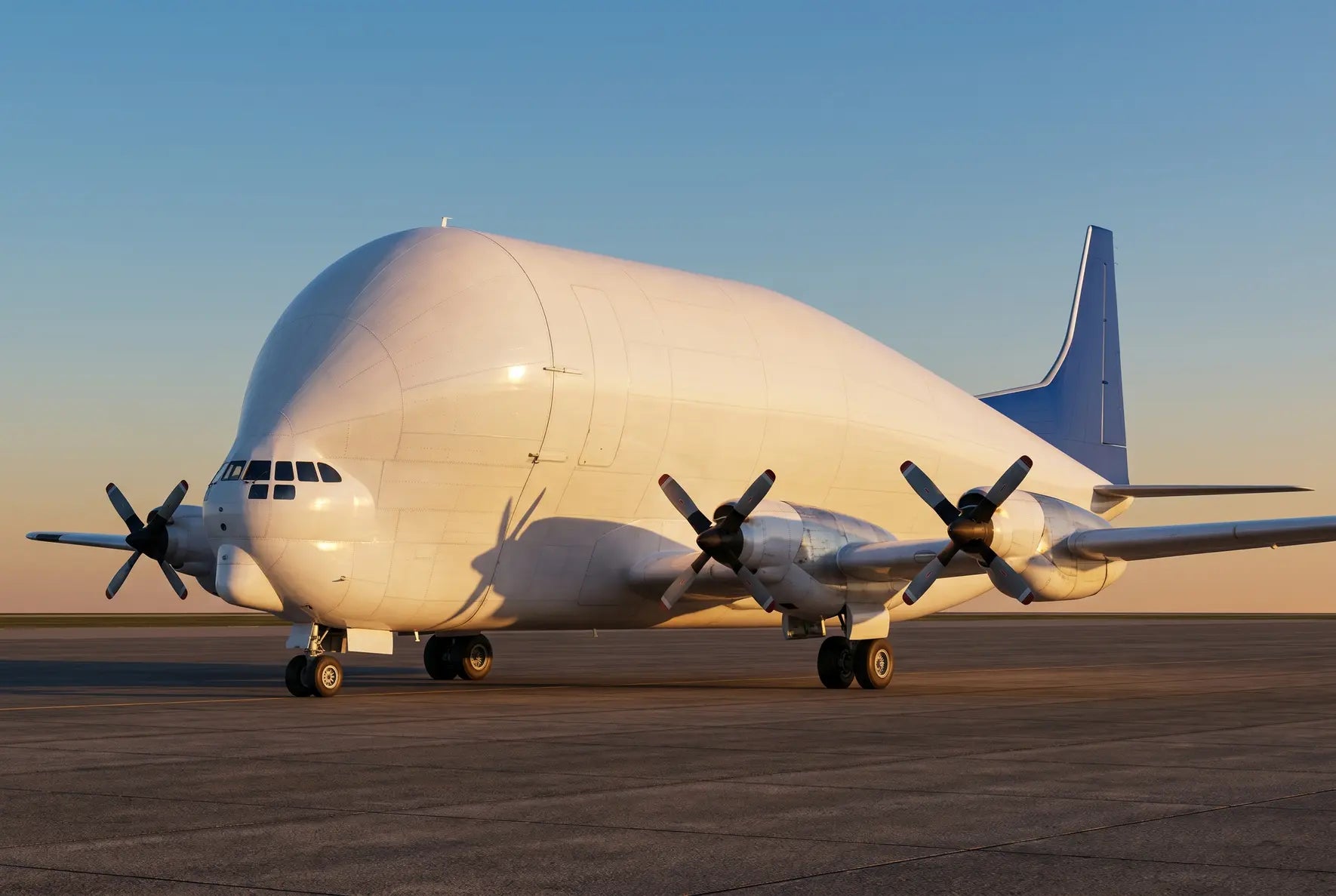
Aero Spacelines then developed the Super Guppy (B-377SG), a significantly larger aircraft constructed from a retired U.S. Air Force Boeing YC-97J Stratofreighter. The fuselage was stretched to approximately 141 feet (43 metres) in length, and the cargo bay expanded to a maximum internal diameter of 25 feet (7.6 metres). Four Pratt & Whitney T34-P-7WA turboprop engines replaced the original powerplants, and a hinged nose section allowed front-loading of outsized cargo. The Super Guppy completed its first flight in 1965 and became the only aircraft in the world capable of carrying a complete S-IVB stage, the third stage of the Saturn V rocket.
Development was not without setbacks. On September 25, 1965, during high-speed certification dive tests at approximately 10,000 feet, the upper fuselage structure collapsed. The aircraft was carrying 30,000 pounds of borate powder as ballast, which spilled into the cockpit and temporarily blinded the crew. Aided by a DC-9 chase plane, the pilots managed to land safely on Rogers Dry Lake bed at Edwards AFB. The superstructure was subsequently redesigned and rebuilt, and the aircraft went on to achieve certification. Over the following decades, the original Super Guppy flew more than three million miles in support of NASA's Apollo, Gemini, and Skylab programmes before being retired in 1991 and preserved at the Pima Air & Space Museum in Tucson, Arizona.
From Super Guppy to Super Guppy Turbine: What Changed
The final and most refined evolution of the family was the Super Guppy Turbine (SGT, model 377-SGT or SGT-201). Unlike the original Super Guppy, which reused a modified military airframe, the SGT featured a newly built main fuselage section with a widened cargo floor of 13 feet (4 metres), nearly 50% wider than the SG's 8 feet 9 inches. Four Allison 501-D22C turboprop engines, each producing approximately 4,680 equivalent shaft horsepower, replaced the Pratt & Whitney T34s, providing greater reliability and commonality with the engines used on the C-130 Hercules and Lockheed Electra. A total of four SGTs were built: the first two by Aero Spacelines in the early 1970s, and two additional units manufactured by Union de Transports Aériens Industries (UTAI) in France between 1982 and 1983, after Airbus acquired the production rights.
The Super Guppy Turbine played a pivotal role in European aviation. From the early 1970s onward, Aéromaritime operated SGTs (registrations F-BTGV and F-BPPA) to ferry Airbus A300 fuselage sections and other large aircraft components to the final assembly line in Toulouse. Without these aircraft, the multinational Airbus manufacturing model, with parts produced in different countries, would have faced significant delays. The SGTs served Airbus for nearly a quarter of a century before being replaced by the purpose-built Airbus Beluga in the 1990s. The last SGT was sold to NASA in 1997 (tail number N941NA), and it was used to transport International Space Station components from its base at Ellington Field near Johnson Space Center. For those interested in how oversized cargo operations have evolved in modern aviation, the lineage of the Super Guppy offers essential context.
Key identifiers that distinguish the Super Guppy variants from each other and from the earlier Pregnant Guppy include:
- Engines: Pregnant Guppy used Pratt & Whitney R-4360 radial pistons; Super Guppy (SG) used P&W T34-P-7WA turboprops; Super Guppy Turbine (SGT) used Allison 501-D22C turboprops
- Fuselage construction: SG modified from a YC-97J airframe; SGT built with a new-construction main fuselage section
- Cargo floor width: SG approximately 8 ft 9 in (2.7 m); SGT widened to 13 ft (4 m)
- Maximum payload: SG rated at 54,000 lb (24,000 kg); SGT rated at approximately 54,500 lb (24,700 kg)
- Cruise speed: SG approximately 300 mph (480 km/h); SGT approximately 250 mph (410 km/h) at economical cruise
- Range: SGT approximately 1,734 nautical miles (3,211 km)
- Production total: 1 Super Guppy (SG) built; 4 Super Guppy Turbines (SGT) built

A NASA Super Guppy aircraft descends for a landing on a clear day. The unique cargo plane, with its distinctive bulbous shape, is used for transporting oversized loads.
Aero Spacelines Super Guppy: Technical Specifications, Systems and Engine Details
The Aero Spacelines Super Guppy was purpose-built for a single, extraordinary mission: transporting outsized aerospace cargo that no other aircraft could carry. Derived from the Boeing 377 Stratocruiser and its military C-97 Stratofreighter sibling, the Super Guppy inherited the wings, empennage and landing gear of its 1940s-era ancestor, but grafted on a dramatically enlarged fuselage with a constant 25-foot (7.62 m) interior diameter. Two main variants exist: the original Super Guppy (B-377SG), converted directly from a YC-97J airframe and powered by Pratt & Whitney T34 turboprops, and the production Super Guppy Turbine (377SGT), also known as the Guppy 201, which featured an entirely new fuselage section and re-engined with Allison 501-D22C turboprops. The design trade-off was clear: volumetric cargo capacity took absolute priority over speed, range and aerodynamic efficiency.
The 377SGT's hinged nose swings open 110 degrees, allowing direct front-loading of items such as Saturn V rocket stages and, later, large aircraft fuselage sections for manufacturers like Airbus. Dual parallel floor rails with rollers and an electric winch rated at up to 4,300 lb of pulling force move cargo into position, while 44 hydraulic lock pins secure loads for flight. This combination of massive internal volume and practical loading geometry made the Super Guppy indispensable to both NASA and early Airbus logistics.
- Length: 43.84 m (143 ft 10 in)
- Wingspan: 47.63 m (156 ft 3 in)
- Height: 14.78 m (48 ft 6 in)
- Wing area: 182.51 m² (1,965 sq ft)
- Cargo bay dimensions: 25 ft (7.62 m) diameter, approximately 111 ft (33.8 m) long; usable volume approximately 39,000 cu ft
- Maximum takeoff weight (377SGT): 77,111 kg (170,000 lb)
- Maximum payload (377SGT): approximately 24,500 kg (54,000 lb)
- Cruise speed (377SGT): approximately 220-250 knots (407-463 km/h), altitude-dependent
- Range (377SGT): approximately 1,734 NM (3,211 km)
- Service ceiling: 25,000 ft (7,620 m)
- Engines (377SGT): 4 x Allison 501-D22C turboprops, 3,491 kW (4,680 shp) each
- Engines (B-377SG): 4 x Pratt & Whitney T34-P-7WA turboprops, approximately 4,850 kW (6,500 shp) each
- Crew: 3 (two pilots, one flight engineer) plus up to 4 passengers in the pressurised cockpit section
Systems, Flight Controls and Handling
The Super Guppy retains a largely conventional flight-control architecture rooted in its 1940s Boeing lineage. Rudder and elevator surfaces are fabric-covered and mechanically actuated, with no fly-by-wire augmentation. The hinged nose section uses a control-lock and cable-disconnect system with sledge-ball tensioners at the fuselage break, a unique arrangement that allows the nose to be opened and closed without re-rigging the flight controls. Hydraulic locking pins, upgraded from manual bolts on the prototype, secure the nose for flight. The cockpit on the 377SGT is pressurised and features improved radios and avionics compared to the earlier B-377SG, though the overall instrumentation remains analogue. Three ground jacks (two forward of the wing, one aft) support the airframe during loading operations, and the aircraft is rated for cargo handling in crosswinds up to 20 knots.
Published performance figures for the Super Guppy vary depending on the variant (B-377SG vs. 377SGT), payload weight, atmospheric conditions and altitude. The range of approximately 1,734 NM cited for the 377SGT assumes standard conditions and is reduced with heavier loads. Similarly, cruise speed depends significantly on altitude and weight; figures between 220 and 250 knots are typical but not absolute. Maximum takeoff weight can differ between references due to operational restrictions imposed by individual operators, and the aircraft's service ceiling of 25,000 ft is a certificated figure that may not reflect typical mission profiles, which often involved lower-altitude routing.
Engines: Allison 501-D22C and Pratt & Whitney T34
The production Super Guppy Turbine (377SGT) is powered by four Allison 501-D22C turboprop engines, each producing 3,491 kW (4,680 shp). The 501-D22C belongs to the Allison T56/501 engine family, one of the most prolific military turboprop lineages ever produced. Developed in the 1950s under a U.S. Air Force contract for the Lockheed C-130 Hercules, the T56 family went on to power more than 2,500 C-130 aircraft worldwide. Variants of the engine also serve on the Lockheed P-3 Orion maritime patrol aircraft and the Shorts Belfast strategic freighter. The 501-D22C is a free-turbine design with a 14-stage axial compressor and a 4-stage power turbine, offering improved hot-section durability and fuel efficiency compared to earlier T56 marks. For the Super Guppy, this translated into better reliability and lower operating costs than the original engine installation, while still providing adequate power for the aircraft's low-speed, high-drag flight profile.
The original Super Guppy (B-377SG) used four Pratt & Whitney T34-P-7WA turboprops, each rated at approximately 4,850 kW (6,500 shp). The T34 was among the first large American turboprop engines, with development beginning in 1945 under U.S. Navy funding. It first ran in January 1948 and flew on a B-17 testbed in September 1950. The engine features a 13-stage axial compressor and a 3-stage axial turbine, with a dry weight of approximately 1,175 kg (2,590 lb). Beyond the Super Guppy, the T34 family powered the Douglas C-133 Cargomaster heavy-lift transport and the Boeing KC-97J tanker. The -P-7WA variant was specifically rated for the C-133A and Super Guppy applications. Despite its higher raw power output, the T34 reflected 1950s turboprop technology and was less fuel-efficient and harder to maintain than the later Allison 501 series, which is why the 377SGT adopted the Allison powerplant for its production run. The Smithsonian National Air and Space Museum preserves a T34-P-7WA specimen in its collection.
Super Guppy vs An-124 vs C-5 vs 747-8F: Outsize Cargo Aircraft Comparison
Scroll horizontally to see more
| Parameter | Aero Spacelines Super Guppy | Antonov An-124 Ruslan | Lockheed C-5 Galaxy | Boeing 747-8F |
|---|---|---|---|---|
| Entry into service | 1965 | 1986 | 1970 | 2011 |
| Engines | 4 × Allison 501-D22C | 4 × Progress D-18T | 4 × GE TF39 | 4 × GE GEnx-2B67 |
| Length | 43.8 m | 69.1 m | 75.3 m | 76.3 m |
| Wingspan | 47.6 m | 73.3 m | 67.9 m | 68.4 m |
| Height | 14.8 m | 21.1 m | 19.8 m | 19.4 m |
| Typical seating and layout | N/A (cargo) | N/A (cargo) | N/A (cargo) | N/A (cargo) |
| MTOW | 77 t | 405 t | 381 t | 448 t |
| Range | 1,734 nm | 2,400 nm | 7,000 nm | 4,120 nm |
| Cruise speed | 0.36 Mach | 0.44 Mach | 0.49 Mach | 0.86 Mach |
| Service ceiling | 25,000 ft | 39,000 ft | 41,000 ft | 43,100 ft |
| Program note | Outsize cargo turboprop freighter derived from Boeing Stratocruiser for NASA components transport | Largest military outsize cargo jet, extreme payload capacity for heavy equipment | U.S. Air Force strategic airlifter for oversized military cargo, high-volume transport | Modern 747 freighter variant optimized for high-volume containerized cargo |
Scroll horizontally to see more
The table compares four heavy-lift cargo aircraft across key specs such as dimensions, engines, MTOW, range, speed, and ceiling. The Super Guppy is far lighter and slower, with the lowest ceiling, but purpose-built for outsized components. The 747-8F has the highest MTOW and by far the fastest cruise, while the C-5 offers the longest range. The An-124 emphasizes heavy military payload capacity with a shorter range than the C-5 and 747-8F.
Aero Spacelines Super Guppy: Missions, Routes and Operators Around the World
The Aero Spacelines Super Guppy was never designed for airline service or scheduled cargo operations. Instead, this oversized turboprop freighter was built for a single purpose: moving extremely large aerospace components that no other aircraft could carry. With a 25-foot-diameter cargo bay stretching 111 feet long and a hinged nose that swings open 110 degrees, the Super Guppy filled a niche so specialized that only five airframes were ever produced between the 1960s and 1983.
Typical missions involve transporting rocket stages, spacecraft heat shields, satellite components, large aircraft fuselage sections and even complete military airframes such as T-38 Talons or V-22 Ospreys. Flight lengths generally range from 1 to 8 hours depending on the route, with a maximum range of approximately 1,734 nautical miles at a cruise speed of around 250 knots. NASA's flight operations data shows the last active Super Guppy Turbine (NASA 941) flies roughly 4 to 8 missions per year, logging around 100 to 110 flight hours annually. This extremely low utilisation rate reflects the aircraft's role as an on-demand heavy-lift asset rather than a daily workhorse.
Operationally, the Super Guppy works in a point-to-point model, flying directly between manufacturing facilities, test centres and launch sites. It requires long runways of approximately 10,000 feet for takeoff at maximum gross weight of 170,000 pounds, which limits it to major airports and military airfields. Nose-loading demands specialised ground equipment and elevated platforms, since the cargo floor sits roughly 11 feet above ground level. Operators face significant challenges including sourcing replacement parts for the 1950s-era airframe and Allison 501-D22C turboprop engines, maintaining a cockpit with analogue instrumentation that predates modern avionics standards, and managing weather-dependent scheduling due to performance limitations at high temperatures and altitudes. The specialised skills required to fly unique aircraft like the Super Guppy represent a distinct niche within the broader aviation profession.
Where the Aero Spacelines Super Guppy Operates
Operations of the Super Guppy have been concentrated almost entirely in two regions: North America and Europe. In the United States, both Aero Spacelines and later NASA used the aircraft to ferry Apollo, Gemini, Skylab, Space Shuttle and now Artemis programme components across the country, primarily between manufacturing plants in California and Texas and the Kennedy Space Center in Florida. Before the Guppy programme, these oversized parts had to travel by barge through the Panama Canal, a journey of 18 to 25 days that was reduced to roughly 18 hours by air. In Europe, Airbus Industries operated a fleet of up to four Super Guppy Turbines from the 1970s through the mid-1990s to shuttle A300 and A310 fuselage sections, wings and nose assemblies between factories in Germany, the United Kingdom and France for final assembly in Toulouse. No confirmed operations have taken place in Asia or Africa, as the aircraft's mission profile has always been tied to aerospace manufacturing hubs in the West.
- North America: NASA is the sole current operator, flying the last airworthy Super Guppy Turbine (registration N941NA) from its base at El Paso International Airport, Texas. Missions support the Artemis programme, carrying Orion spacecraft heat shields and SLS components to Kennedy Space Center. Previously, Aero Spacelines operated the original fleet from the early 1960s until selling the aircraft to NASA in 1979, hauling complete Saturn V S-IVB third stages for the Apollo programme.
- Europe: Airbus Industries was the principal European operator, using four Super Guppy Turbines on routes such as Hamburg to Toulouse (approximately 1,000 km, 2 to 3 hours), Broughton (UK) to Toulouse and Saint-Nazaire to Toulouse. Two additional SGT airframes were manufactured under licence by Union de Transports Aeriens (UTA) Industries in France in 1982 and 1983. The fleet was retired in the late 1990s when Airbus introduced the purpose-built Beluga as a replacement. Retired European airframes are now preserved at museums including Aeroscopia in Toulouse.
- Asia: No confirmed Super Guppy operations have been documented in this region. The aircraft's limited range and specialised mission profile confined it to Western aerospace corridors.
- Africa: No recorded operations of the Super Guppy have taken place on the African continent.
Cargo Configuration and Interior Layout
The Aero Spacelines Super Guppy carries no passengers and has never been configured with cabin seating of any kind. The entire fuselage behind the cockpit forms a single unpressurised cargo hold with a circular cross-section measuring 25 feet in both width and height, providing roughly 39,000 cubic feet of usable volume. The cockpit, accommodating a crew of four, is the only pressurised section of the aircraft. Payloads up to 54,500 pounds are secured to the cargo floor using straps, cradles and custom-built adapters, with detailed load limits specified per floor beam in NASA's Super Guppy Transport User's Guide. Unlike modern freighters with side or rear doors, all loading is performed through the hinged nose, which requires the entire forward section of the aircraft to swing open. This unique design means there are no seat-map variations, economy or business class layouts, or airline-specific configurations to compare. Every Super Guppy ever built was delivered and operated exclusively as a dedicated outsize cargo transporter.
In this video, discover the Aero Spacelines Super Guppy, the world’s most awkward airplane, and learn how this massive, one-of-a-kind aircraft safely transports oversized cargo across the globe.
Aero Spacelines Super Guppy Safety Record: How Safe Is This Aircraft?
The Aero Spacelines Super Guppy has accumulated a remarkably clean operational safety record over nearly six decades of service. Five Super Guppies were built across two variants: one original 377-SG and four 377SGT Super Guppy Turbine models. Operators have included NASA, various aerospace organisations, Airbus Industrie and the European Space Agency. Despite the tiny fleet size, these aircraft logged thousands of flight hours each, with one airframe reportedly covering around three million miles over 32 years. NASA's last airworthy example, N941NA, has been flying continuously since 1983 and remains in active service for Artemis programme logistics. Throughout this operational history, no fatal accident has ever occurred during a revenue or mission flight of a Super Guppy. The incidents on record are confined to flight-test campaigns involving early prototypes, not routine cargo operations.
Notable Incidents During Development and Testing
The most significant event in the Super Guppy lineage took place on 25 September 1965, when the original 377-SG prototype (N1038V) suffered a structural failure during high-speed dive certification tests over Edwards Air Force Base, California. As the aircraft dived through 10,000 feet at approximately 275 mph, the forward upper fuselage collapsed, opening a hole roughly 23 feet wide. The crew, temporarily blinded by spilled borate test ballast, managed an emergency landing on Rogers Dry Lake with the help of a chase plane. All three crew members survived. The aircraft was subsequently rebuilt with a substantially reinforced upper fuselage. This redesign fed directly into the improved Super Guppy Turbine variant, which featured a cargo section built from scratch rather than adapted from existing Boeing C-97 components.
A second serious event involved the related but distinct 377MGT Mini Guppy prototype (N111AS) on 12 May 1970, also at Edwards Air Force Base. During a planned single-engine takeoff test at 109 knots, the aircraft rolled sharply to the left after rotation, struck a wingtip on the ground and was destroyed. All four crew members were killed. An investigation identified bending overload fractures in the rudder bell crank and boost control link, although the exact cause remained officially undetermined. Because the Mini Guppy was a one-off prototype, no fleet-wide airworthiness directive followed, but the findings contributed to tighter certification scrutiny under FAR Part 25 for subsequent Guppy variants.
In October 1993, a Super Guppy Turbine registered F-GDSG and operated by Airbus Skylink diverted to Lyon after encountering headwinds en route to Toulouse. During landing, the nose landing gear collapsed. No fatalities or serious injuries resulted, and the aircraft was repaired and returned to service. Earlier in the programme, two separate ground incidents saw wind gusts catch an open hinged nose section, tearing it from the fuselage in Madrid and Hamburg respectively. These events prompted stricter adherence to the 20-knot crosswind limit during loading and unloading operations.
How Safe Is the Aero Spacelines Super Guppy?
When evaluating the safety of the Super Guppy, context matters. The type was never a mass-produced airliner; only five were built, and mission profiles involved low-frequency, carefully planned cargo flights rather than high-cycle airline operations. Within that framework, the operational record is excellent: zero hull losses and zero fatalities during actual mission flights across more than five decades. The two serious test-phase events led to meaningful design improvements, particularly the reinforced fuselage structure of the Turbine variant, which proved its durability over decades of reliable service.
Each Super Guppy mission is governed by detailed standard operating procedures. NASA's Super Guppy operations require comprehensive stress reports verifying positive margins for both in-flight limit loads and emergency conditions. Payload clearance limits, floor load distribution standards and crosswind restrictions during ground handling are all codified. The aircraft operates under FAA oversight with a type certificate originally issued to Aero Spacelines and later transferred to Tracor Aviation. Regulatory scrutiny has been continuous throughout the programme's life.
The design philosophy behind the Super Guppy prioritised structural conservatism for its unique mission. The cargo bay was engineered to tolerate fuselage deflections of up to six inches under emergency conditions, and modified floor panels ensured even load distribution for heavy, irregularly shaped payloads. These measures, combined with low operational tempo and experienced flight crews, have kept the type's safety margins wide. As noted in the SKYbrary technical profile for the 377SGT, the aircraft's operational parameters are well defined and conservative.
While the Super Guppy cannot be compared statistically to high-production commercial jets, its incident-free operational history over nearly 60 years speaks clearly. Aviation as a whole remains one of the safest forms of transport, and the Super Guppy's record within its specialist niche is consistent with that broader trend.
01 What is the Aero Spacelines Super Guppy and what is it used for?
The Aero Spacelines Super Guppy is a large cargo aircraft designed specifically for transporting oversize and outsized loads that cannot fit in standard freight aircraft. Built on a modified Boeing 377 Stratocruiser airframe, it features an enormous hinged cargo door and pressurized fuselage, making it ideal for aerospace component transport, satellite delivery, and military equipment. The aircraft has been operated primarily by specialized cargo operators and aircraft manufacturers since its introduction in 1965.
02 How does the Super Guppy compare in cargo capacity to modern freighter aircraft?
The Super Guppy offers approximately 52,500 cubic feet of cargo volume with a maximum payload of around 26,000 pounds, making it exceptional for oversized but relatively light cargo. While newer freighters like the Airbus A400M or Boeing 747-8F carry heavier payloads, the Super Guppy's unique advantage is its ability to accommodate non-standard dimensions and bulky aerospace components that cannot be broken down. Its specialized design makes it irreplaceable for certain mission profiles despite its age and less efficient fuel consumption.
03 Which airlines and operators currently use the Aero Spacelines Super Guppy?
Very few Super Guppies remain in active service today, as the aircraft type is nearly retired from commercial operations. Historically, NASA and Airbus Industrie were major operators, using the aircraft to transport Space Shuttle components and aircraft sections respectively. Today, one or two privately owned examples may still operate for specialized charter work, though the aircraft is considered a rare sight in modern aviation.
04 What are the typical routes and range capabilities of the Super Guppy?
The Super Guppy has a maximum range of approximately 1,400 nautical miles with a full cargo load, suitable for intercontinental cargo delivery when paired with fuel stops. Its mission profile typically involves point-to-point flights between manufacturing facilities and assembly plants, such as transporting Space Shuttle components from California to Florida or Airbus aircraft sections between European factories. The aircraft operates from major cargo hubs and specialized airfields equipped to handle its unique loading requirements.
05 How does the Super Guppy perform compared to similar-era cargo aircraft?
The Super Guppy sacrificed speed and payload capacity for volumetric cargo space, cruising at approximately 290 knots and burning fuel at rates higher than contemporary freighters. Its four Pratt and Whitney piston engines require significant maintenance and produce lower efficiency than modern turbofan aircraft. However, its specialized internal dimensions and cargo-handling features made it uniquely valuable for aerospace manufacturing, justifying its operational costs despite these performance limitations.
06 What safety features and operational considerations define the Super Guppy design?
The Aero Spacelines Super Guppy incorporates a pressurized fuselage with a massive hinged cargo door, integral structural reinforcement for load distribution, and reliable piston-engine architecture with a strong safety record. The aircraft requires specialized loading procedures and weight-and-balance calculations due to its unusual center-of-gravity envelope. Its design prioritizes reliability and structural integrity over speed, contributing to its reputation as a dependable, if dated, workhorse for specialized cargo missions.