

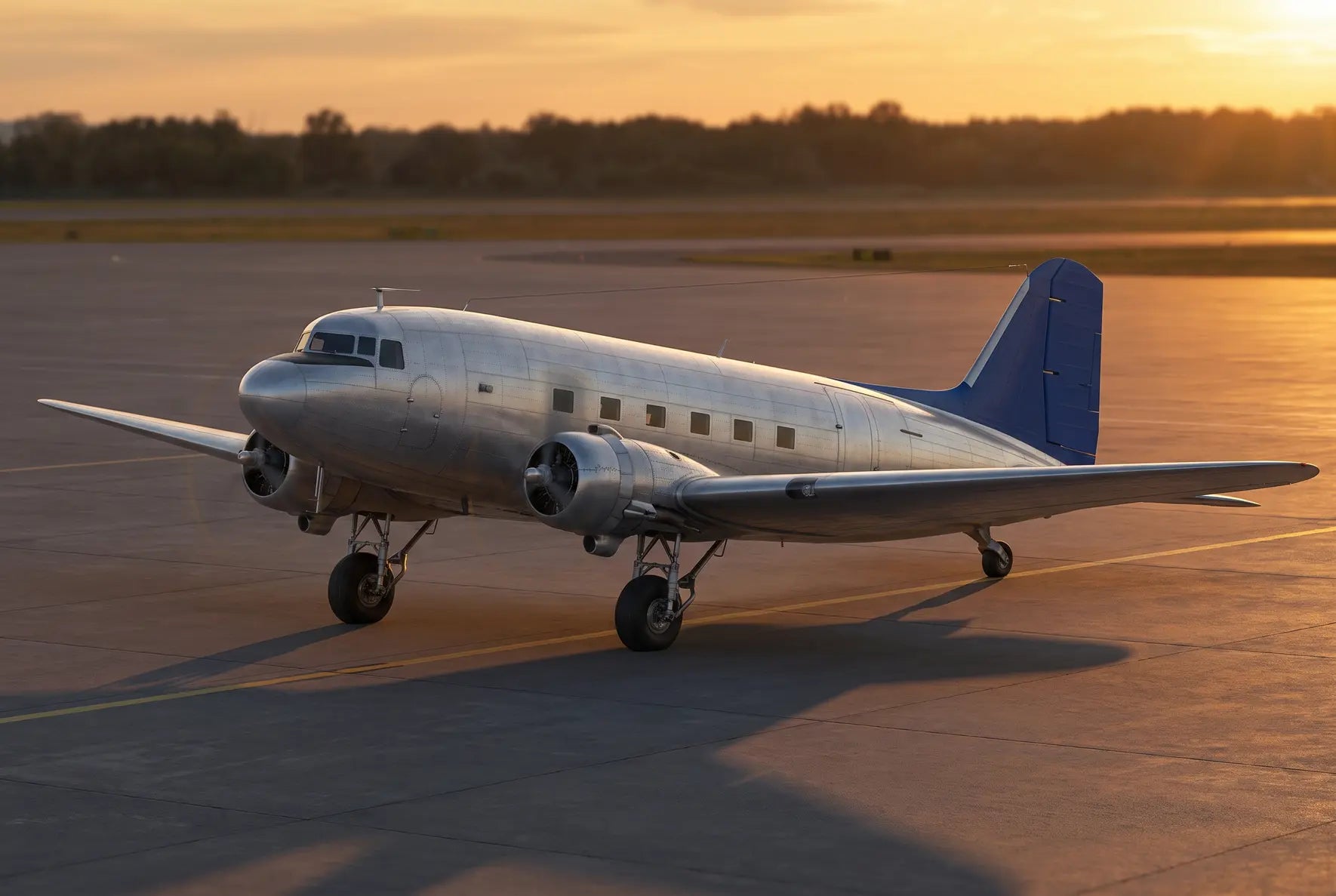
History and Development of the Martin 2-0-2: Launch, Design and Distinctive Traits
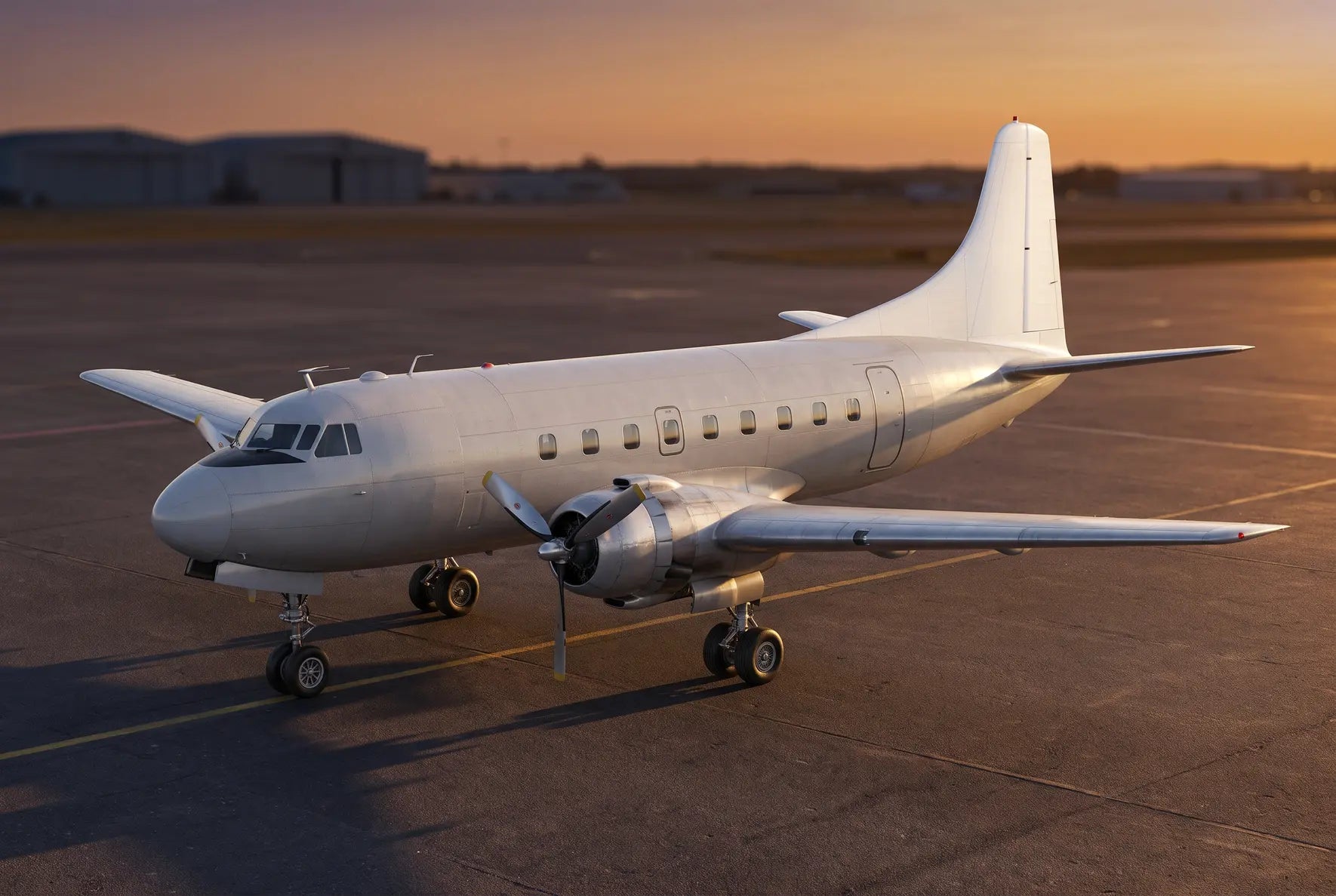
The Martin 2-0-2 was conceived as a postwar successor to the ubiquitous Douglas DC-3, offering U.S. airlines a faster, larger and more modern twin-engine airliner for short- and medium-haul routes. Designed and built by the Glenn L. Martin Company, a major American manufacturer founded in 1912 and long known for bombers such as the B-26 Marauder and for large flying boats, the 2-0-2 marked Martin's principal attempt to enter the competitive civil airliner market against Douglas and Convair.
Development began in 1945, as carriers sought unpressurised, roughly 40-seat aircraft to modernise regional networks. Early commitments came quickly: Pennsylvania Central Airlines ordered 35 examples on 13 November 1945, followed by Colonial Airlines with 20 aircraft, and by January 1947 combined orders reportedly approached 137 aircraft. To learn more about how such piston airliners fit into the wider evolution of commercial aviation, see our overview of aircraft types.
The programme reached its major milestones in rapid succession:
- 22 November 1946: first flight of the 2-0-2 prototype.
- August 1947: full civil certification under the Civil Aeronautics Administration, making it the first U.S. postwar twin-engine airliner to be certified.
- 13 October 1947: entry into service with Northwest Airlines on the Minneapolis to Chicago route.
Power came from two Pratt & Whitney R-2800 CA-18 Double Wasp 18-cylinder radial engines, each rated at about 1,800 hp continuous and up to 2,400 hp for take-off with water injection. Typical layouts seated 36 to 40 passengers, and the design combined an all-metal low-wing structure with retractable landing gear and an integral airstair. Early operators included Northwest, TWA and LAN Chile.
The type's promising start was overshadowed by a structural crisis. On 29 August 1948, a Northwest Airlines 2-0-2 broke up in flight near Winona, Minnesota, an accident traced to fatigue failure in the wing spar and centre-section. The finding exposed inadequate fatigue life in the original wing design under routine airline loads. Aircraft were grounded and inspected, and Martin undertook a major redesign of the wing centre-section, spar caps and attachments, introducing heavier-gauge material and revised geometry to improve fatigue resistance. This reinforced structure became the basis for later airframes and for the more capable successor model.
What distinguishes the Martin 2-0-2 from the 2-0-2A and 4-0-4
The baseline 2-0-2 is defined above all by being unpressurised and by its original, later-strengthened wing. The designation 2-0-2A generally refers to existing 2-0-2 airframes modified to incorporate the post-Winona structural reinforcements rather than a wholly new certificated model; most references group the 2-0-2 and 2-0-2A together, with a combined total of about 47 aircraft. The Martin 4-0-4, first flown in 1950, was the substantive redesign: it added a fully pressurised cabin, a fuselage lengthened by roughly three feet to 74 ft 7 in, the strengthened wing structure and uprated R-2800-CB16 engines, with 103 examples built.
The following identifiers help place a specific Martin 2-0-2 airframe within the family:
- Cabin: unpressurised (contrast with the pressurised 4-0-4).
- Engines: two Pratt & Whitney R-2800 CA-18 Double Wasp radials, ~1,800 hp normal / 2,400 hp take-off.
- Dimensions: length 71 ft 4 in (21.74 m); wingspan 93 ft 3 in (28.42 m).
- Weights: maximum take-off weight around 39,900 lb (18,098 kg).
- Capacity: 36 to 40 passengers with a crew of three.
- Structure: original wing later reinforced (2-0-2A standard) after the 1948 spar-fatigue findings.

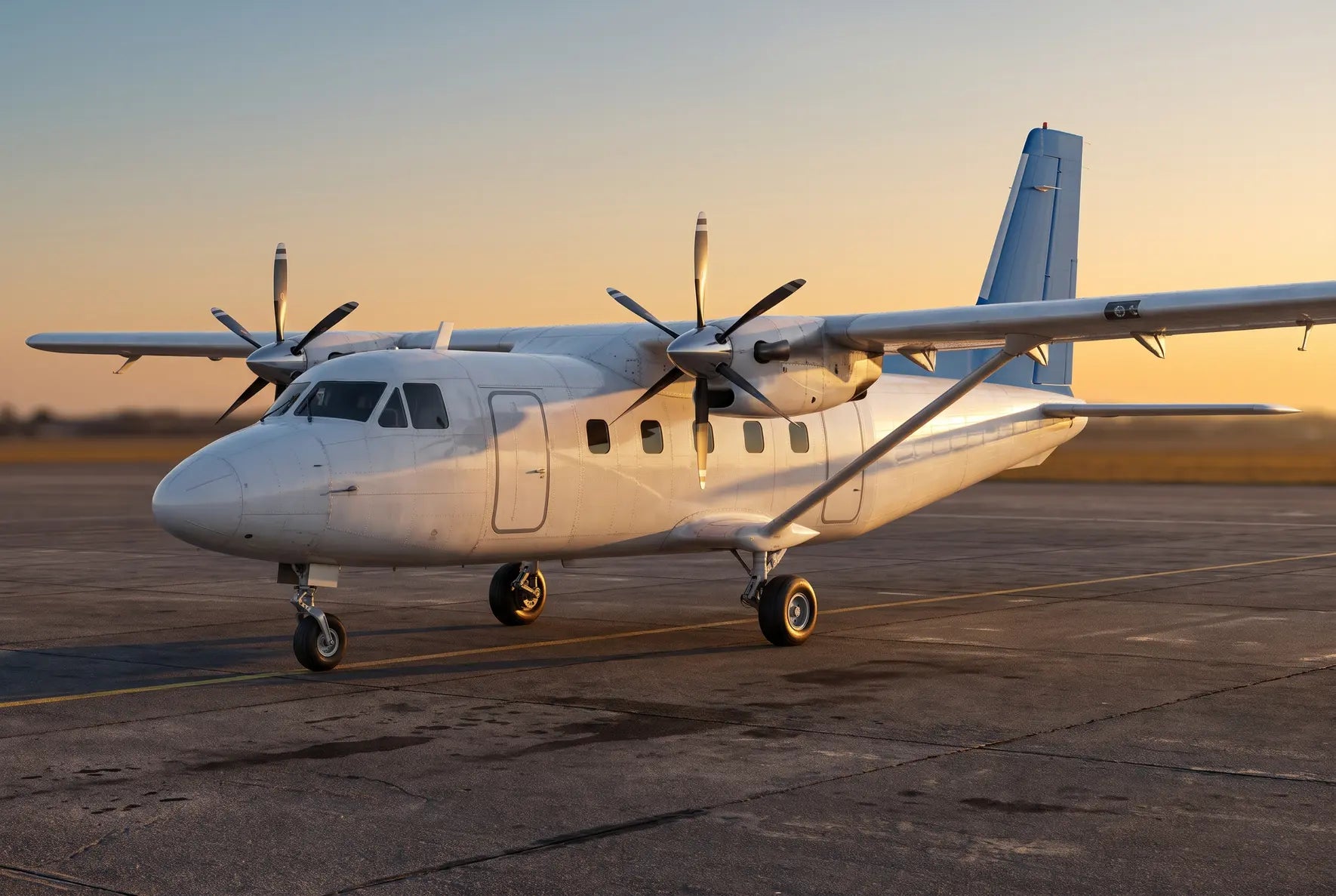
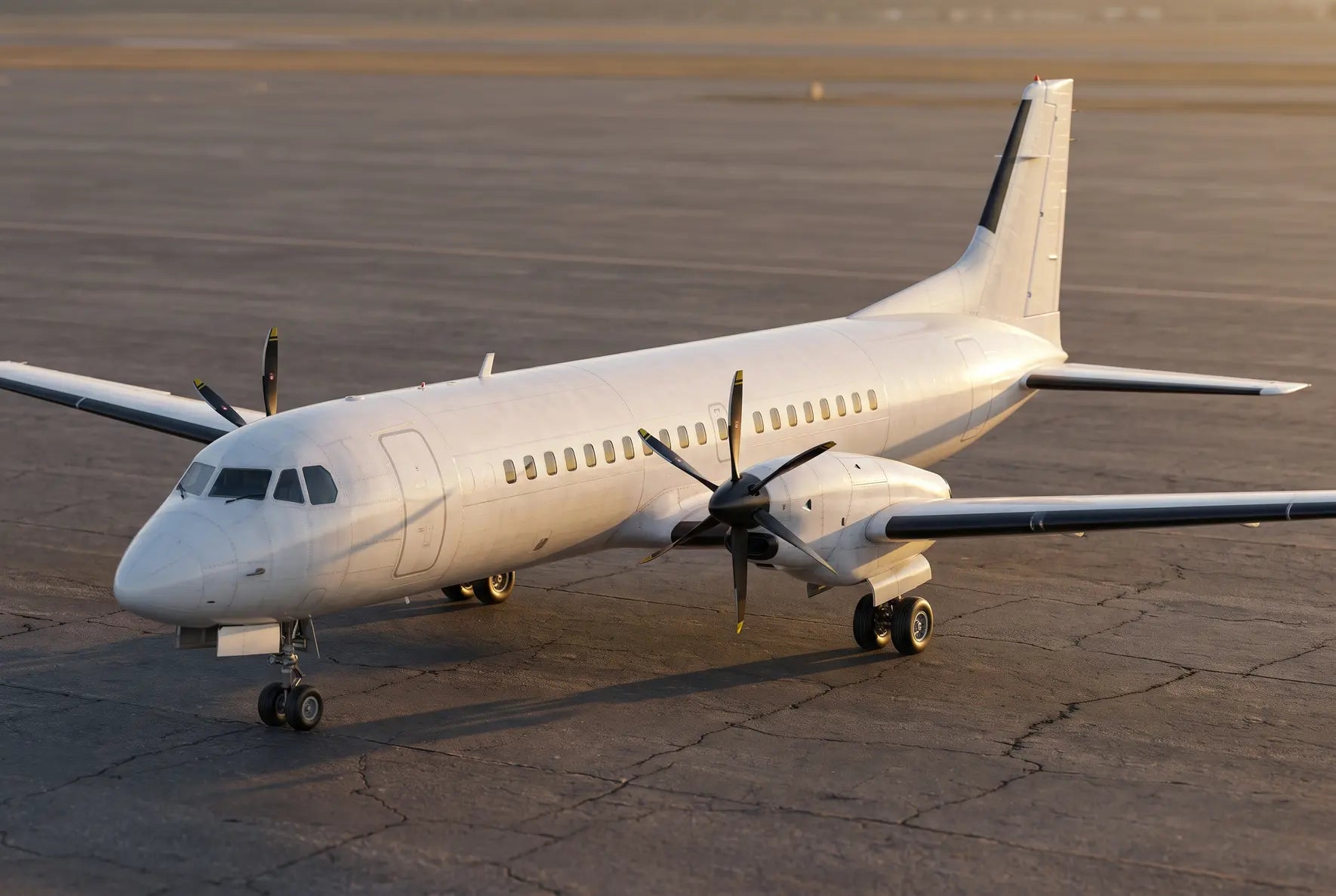
A vintage propeller aircraft is parked on an airport tarmac under a clear blue sky. The white and blue aircraft has the registration number HK-1484 visible on its tail.
Martin 2-0-2 Technical Specifications, Systems and Engine Highlights
The Martin 2-0-2 was conceived as a postwar short-to-medium-haul airliner intended to replace the ubiquitous Douglas DC-3 on regional routes. Its design prioritised higher cruise speeds and more comfortable, all-metal accommodation over ultra-long range, reflecting a mission built around frequent stops and modest sector lengths rather than transcontinental hauls. The unpressurised airframe (an important trade-off that later drove the pressurised Martin 4-0-4 development) kept structural weight and complexity down while allowing the type to lift up to 40 passengers on relatively short runways.
Technically, the 2-0-2 balances payload against range: a generous wing area supports respectable field performance and a healthy service ceiling, but the fuel load and unpressurised cabin place practical limits on stage length. Much of what it inherits comes from wartime engineering practice at the Glenn L. Martin Company, particularly a robust twin-radial layout and conventional flight-control architecture proven on 1940s transports and bombers.
- Wingspan: 93 ft 3 in (28.42 m)
- Length: 71 ft 4 in (21.74 m)
- Height: 28 ft 5 in (8.66 m)
- Wing area: 864 sq ft (80.3 m²)
- Empty weight: 25,086 lb (11,379 kg)
- Gross / max takeoff weight: 39,900 lb (18,098 kg)
- Passenger capacity: up to 40
- Cruise speed: 293 mph (472 km/h, 255 kn)
- Maximum speed: 311 mph (501 km/h, 270 kn)
- Service ceiling: 33,000 ft (about 10,058 m)
- Range: 552 nmi (1,022 km), with the standard payload and reserve condition stated by the manufacturer
- Fuel capacity: 1,740 U.S. gal
- Engines: 2 × Pratt & Whitney R-2800 Double Wasp, 18-cylinder air-cooled radial
Systems and handling-relevant technology
The 2-0-2 uses a conventional flight-control architecture typical of its era: mechanically actuated ailerons, elevators and rudder connected to the yoke and pedals, with trim tabs for pilot workload relief rather than powered assistance. Braking relied on hydraulically actuated main-wheel brakes suited to the shorter regional strips the type served, and performance planning was handled through paper charts and slide-rule computation rather than any onboard automation. Engine management was manual, with the crew coordinating throttle, propeller pitch and mixture, and water injection available for takeoff power augmentation.
Automation, in the modern sense, was minimal. Instrumentation and navigation followed late-1940s practice, and there was no integrated health-monitoring system; maintenance depended on scheduled inspections and pilot reports. This simplicity kept the aircraft accessible to operators transitioning from earlier piston twins.
Published performance figures for the 2-0-2 should be read with context. Numbers vary between sources because operators specified different cabin densities and interior fits, weights changed with fuel and payload, and quoted speeds and ranges depend on atmospheric assumptions, cruise settings and runway condition. A range figure quoted at a given payload and reserve is not directly comparable to one measured under different assumptions, so absolute claims are best avoided.
The Pratt & Whitney R-2800 Double Wasp
Power came from two Pratt & Whitney R-2800 Double Wasp radials, in the R-2800 CA-18 rating delivering about 1,800 hp normal power and up to 2,400 hp at takeoff with water injection. The R-2800 was the first American 18-cylinder radial, arranged as two rows of nine air-cooled cylinders with a displacement of roughly 2,800 cu in (about 46 L). First run in 1937 and produced from 1939 to 1960, more than 125,000 examples were built, making it one of the most successful piston aero-engines in history.
Developed by Pratt & Whitney, the Double Wasp earned its reputation for durability on wartime types such as the Republic P-47 Thunderbolt, Vought F4U Corsair, Grumman F6F Hellcat and Martin B-26 Marauder. After 1945 it became a mainstay of civil aviation, powering the Douglas DC-6 and the Convair 240/340/440 family alongside the Martin 2-0-2 and 4-0-4. That same engine family also supported later four-engine, long-range piston airliners; for context on how the era's powerplant technology evolved toward turbine airliners, see our overview of the Ilyushin Il-62.
Martin 2-0-2 vs Martin 4-0-4 vs Convair CV-240 vs Douglas DC-6A Specifications Comparison
Scroll horizontally to see more →
| Parameter | Martin 2-0-2 | Martin 4-0-4 | Convair CV-240 | Douglas DC-6A |
|---|---|---|---|---|
| Entry into service | 1947 | 1951 | 1948 | 1948 |
| Engines | 2 × Pratt & Whitney R-2800 CA-18 Double Wasp | 2 × Pratt & Whitney R-2800 CB16 Double Wasp | 2 × Pratt & Whitney R-2800-CA13 Double Wasp | 4 × Pratt & Whitney R-2800-CB16 Double Wasp |
| Length | 21.74 m | 23.12 m | 23.38 m | 32.19 m |
| Wingspan | 28.42 m | 32.92 m | 32.00 m | 35.81 m |
| Height | 8.66 m | 9.78 m | 9.68 m | 9.88 m |
| Typical seating and layout (short description + approximate passengers) | 2-class: 36–40 passengers | 2-class: 44–48 passengers | 1-class: 40–44 passengers | 1-class cargo/passenger: 52–68 passengers |
| MTOW | 18 t | 23 t | 21 t | 46 t |
| Range | 552 nm | 1,200 nm | 1,000 nm | 3,750 nm |
| Cruise speed | 0.39 Mach | 0.40 Mach | 0.39 Mach | 0.43 Mach |
| Service ceiling | 33,000 ft | 20,000 ft | 21,000 ft | 24,500 ft |
| Program note | Short-lived postwar Martin twin designed as a small feeder airliner, with limited range and payload. | Improved and stretched follow-on to the 2-0-2, offering more seats and better range for the same market niche. | Contemporary twin-engined short-haul competitor with slightly larger cabin and broadly similar regional-airliner mission. | Four-engined long-range postwar transport that sat above the Martin twins in size, payload, and mission capability. |
Scroll horizontally to see more →
The table compares four postwar piston airliners by size, capacity, and performance. The Martin 2-0-2 is the smallest and shortest-range (552 nm, 18 t MTOW, 36–40 seats). The stretched Martin 4-0-4 adds seats and nearly doubles range to 1,200 nm with higher MTOW. The CV-240 is similar in speed but slightly larger. The DC-6A is a different class: four engines, 46 t MTOW and 3,750 nm range.
Martin 2-0-2 Operations: Typical Routes, Missions and Airlines Worldwide
The Martin 2-0-2 was conceived as a post-war, unpressurised twin-engine airliner intended to replace DC-3-class equipment on domestic and regional networks. Its missions were overwhelmingly short-haul, with sectors of roughly 200 to 400 statute miles, such as the inaugural Northwest Orient Airlines service between Minneapolis and Chicago (about 350 miles) opened on 13 October 1947. With a practical range of approximately 1,000 to 1,200 miles (1,600 to 1,900 km) and a cruise speed near 250 to 270 mph, it could also cover medium-length legs when payload and fuel reserves allowed. Powered by two Pratt & Whitney R-2800 radial engines, it typically carried around 36 to 40 passengers. Daily utilisation followed the intensive pattern of period regional carriers, with several short rotations per aircraft feeding city pairs and regional hubs.
Operationally, the type worked mainly in point-to-point and hub-and-spoke regional systems, connecting major cities with secondary airports. Its unpressurised cabin, limiting comfortable cruise to around 20,000 feet, and its early structural fatigue issues were notable challenges for operators, prompting the improved 2-0-2A and later the pressurised Martin 4-0-4. You can review the full development history on Wikipedia and technical summaries at the World Airliner Directory.
Where the Martin 2-0-2 Operates
Commercial service was concentrated in the Americas and, briefly, in Asia. Across North America, the aircraft was a workhorse for United States trunk and regional carriers on domestic feeder routes, later migrating to charter and cargo roles. In South America and Central America, a handful of carriers used it for regional passenger links. In Asia, the type featured in the earliest days of Japanese scheduled aviation on domestic sectors such as Tokyo-Osaka. There is no documented civil operation of the type in Europe or Africa.
- Europe: No civil operators of the Martin 2-0-2 are recorded in standard operator references, and the type saw no scheduled service on the continent.
- North & South America: In the United States, Northwest Orient Airlines was the launch customer with 25 aircraft from 1947, followed by Trans World Airlines (12 2-0-2A from 1950), Allegheny Airlines (around 18 mostly ex-TWA aircraft), Pioneer Air Lines, Pacific Air Lines, Southwest Airways and Transocean Air Lines, which flew regional and charter sectors and later cargo work. In South and Central America, LAN Chile operated four aircraft from 1947-1948, Línea Aeropostal Venezolana took two new examples in 1947, while Aeroproveedora of Colombia, Servicios Aéreos Baja of Mexico and RAPSA Panama flew smaller fleets on regional links.
- Asia: Japan Air Lines began operations in October 1951 with three 2-0-2s leased from Transocean Air Lines, using them on domestic Japanese trunk routes during the carrier's start-up phase.
- Africa: No civil operators of the Martin 2-0-2 are documented, and the type is not recorded in scheduled African service.
Typical Seating and Cabin Layouts
Cabin configurations were consistent across operators, with published technical data treating the aircraft as a roughly 40-seat airliner. Network carriers such as Northwest Orient Airlines and Trans World Airlines favoured a 2+2, four-abreast arrangement with a single aisle, typically yielding 36 to 40 seats plus a small galley and lavatory. Secondary and regional operators like Allegheny Airlines retained similar layouts on inherited airframes, while later charter and commuter users, and some carriers profiled in independent guides such as Simple Flying, reconfigured or converted aircraft for mixed passenger and freight roles. Enthusiasts researching the wider ecosystem of small US commuter and island carriers may also find our overview of Mokulele Airlines useful for context on regional operations. No authoritative source indicates layouts exceeding about 40 passengers in normal airline configuration.
In this video, discover the top 9 deadliest air crashes involving the Martin 2-0-2, with a focused look at key incidents, circumstances, and impacts, set to licensed music by Chris Zabriskie.
Martin 2-0-2 Safety Record: How Safe Was This Airliner?
The Martin 2-0-2 occupies a difficult place in postwar aviation history. With only around 47 aircraft built across the 2-0-2 and 2-0-2A variants, and airline service beginning in 1947, the type operated a relatively small fleet over a short career before being withdrawn in the early 1950s. Against that limited number of airframes, flights and cycles, the accident record stands out as unusually severe. Aviation historians and the Aviation Safety Network record multiple hull-loss events for the type, with sources citing roughly 13 hull losses and around nine fatal accidents, a high proportion relative to fleet size. The central problem was structural: a wing spar fatigue weakness that undermined confidence in the aircraft and shaped its brief commercial life.
Notable Accidents and What Changed
- Northwest Airlines, 29 August 1948: A Martin 2-0-2 broke up in flight over Minnesota. Investigators attributed the loss to structural failure linked to material fatigue in the wing structure. The event directly exposed the wing spar weakness and made mandatory modification of all surviving aircraft necessary, while contributing to the curtailment of 2-0-2 production.
- Northwest Orient Airlines Flight 307, 8 March 1950: A Martin 2-0-2 was lost near Winona, Minnesota. It remains one of the best-known accidents associated with the type and added to public unease about the aircraft during Northwest's operations.
- Repeated Northwest losses: Northwest historical records note the type suffered several crashes within roughly three years. The cumulative effect prompted a public backlash and accelerated the removal of the fleet from service by around March 1951.
The lasting consequences were both technical and commercial. Beyond the required spar modifications, the manufacturer redirected its efforts toward the improved, pressurized Martin 4-0-4, which addressed the 2-0-2's structural and competitive shortcomings. In this sense, the 2-0-2's difficulties helped drive an industry lesson still central today: the importance of understanding metal fatigue, inspection intervals and structural life limits, principles reinforced across later generations of airliners and formalised in modern airworthiness rules overseen by bodies such as the Federal Aviation Administration.
How Safe Was the Martin 2-0-2?
Judged by the standards of its own era, the Martin 2-0-2 had a comparatively poor safety record, driven primarily by its wing spar fatigue vulnerability rather than by day-to-day operational error. When accident counts are weighed against the small fleet and limited traffic volume, the rate was high, which is precisely why the surviving aircraft were modified and the design was quickly superseded. It is important to read these figures in historical context: the 2-0-2 predates the mature fatigue analysis, standard operating procedures and continuous airworthiness oversight that define aviation today. Modern piston and turboprop designs, including regional aircraft such as the ATR 42-400, benefit from decades of accumulated engineering knowledge, structured maintenance programmes and strict regulatory certification. The evolution from aircraft like the 2-0-2 to current types illustrates how each generation refined structural design and safety practice. As broader statistics compiled by organisations like ICAO consistently confirm, aviation remains one of the safest modes of transport available.
01 What kind of routes and mission profile did the Martin 2-0-2 typically fly?
The Martin 2-0-2 was designed for short- to medium-haul domestic routes, typically in the 300–900 mile range, making it suitable for services between regional cities and major hubs. Airlines used it on trunk routes such as Chicago–Detroit, Pittsburgh–New York, and similar corridors where quick turnarounds and frequent flights were important. Its range of roughly 1,000 miles allowed flexible scheduling without refueling on many US routes. The aircraft’s size and performance made it ideal for post-war expansion of scheduled passenger services in North America.
02 What was the cabin layout and passenger experience like on the Martin 2-0-2?
The Martin 2-0-2 typically seated around 40 passengers in a single-aisle cabin with a 2–2 seating layout, which was relatively spacious for its era. Overhead storage was minimal and most carry-on items were placed under seats or in small racks, reflecting travel habits of the late 1940s and early 1950s. Noise levels were higher than on modern jets due to the twin radial piston engines, with more vibration and engine sound noticeable, especially near the wing and engine area. Comfort was largely determined by airline outfitting, but wider seats and generous legroom compared with many modern narrowbodies were common features.
03 Which airlines operated the Martin 2-0-2 and on what kinds of services?
Major US carriers such as Northwest Airlines, TWA, and Eastern Air Lines were among the principal operators of the Martin 2-0-2 in the late 1940s and early 1950s. These airlines used the type on busy domestic routes linking key industrial and population centers, including Midwest–East Coast and intra-East Coast services. Smaller and regional carriers also employed the Martin 2-0-2 to replace older DC-3s, offering higher capacity and faster schedules. The aircraft did not achieve widespread global use, remaining primarily a North American workhorse until more advanced types, including the improved Martin 4-0-4 and early jets, took over.
04 How does the performance of the Martin 2-0-2 compare with similar aircraft of its era?
The Martin 2-0-2 offered higher speed and capacity than the DC-3, with cruise speeds around 190–200 knots and seating for roughly 40 passengers, which gave airlines improved economics on dense routes. Its piston engines and airframe design placed it in the same general category as contemporaries like the Convair 240, competing directly in the short- to medium-range market. While fuel efficiency was modest by modern standards, it was competitive among piston airliners, and airlines gained economic advantage mainly through increased capacity and quicker turnarounds rather than fuel savings alone. The type’s performance helped bridge the gap between early classic airliners and later, more refined pressurized and turbojet designs.
05 What is notable about the safety record and design features of the Martin 2-0-2?
The Martin 2-0-2 is known for early structural concerns related to its wing design, which led to scrutiny and modifications after service introduction. Unlike some contemporaries, it was not pressurized, so it operated at lower cruising altitudes, which simplified systems but limited weather-avoidance options compared with later pressurized types. The aircraft incorporated then-modern features such as tricycle landing gear and all-metal construction, contributing to predictable handling and operational reliability once initial issues were addressed. Overall, its safety record reflects the rapid development phase of post-war airliners, with lessons from the 2-0-2 feeding directly into the improved and better-regarded Martin 4-0-4.
06 If a traveller today could fly on a Martin 2-0-2, what practical things would be noticeable?
A traveller would immediately notice the lower cruising altitude and higher cabin noise from the piston engines compared with modern jets, especially when seated near the wing. Seat pitch and width would likely feel generous, but storage for personal items would be limited and cabin amenities simple, with no modern inflight entertainment or overhead bins. Window views would be good, as the Martin 2-0-2 had relatively large, widely spaced windows, though seats over the wing would have partially obstructed downward views. Turbulence would be felt more directly than in many modern airliners due to lower flight levels, but the sturdy structure and conventional control layout gave crews predictable handling characteristics in typical weather conditions.