ATR 42-400: History, Development, and What Sets This Rare Variant Apart
The ATR 42 family traces its origins to the late 1970s, when growing demand for efficient, short haul regional air connectivity drove two European aerospace firms to collaborate on a new turboprop airliner. On 4 November 1981, France's Aérospatiale (now part of Airbus) and Italy's Aeritalia (now Leonardo S.p.A.) signed the founding agreement for ATR (Avions de Transport Régional), a joint venture headquartered in Toulouse, France. Their goal was to develop a modern, fuel efficient turboprop capable of operating on short and unpaved runways, serving thin regional routes that jets could not profitably reach. Final assembly of all ATR aircraft takes place at the company's facility in Toulouse.
The original ATR 42 prototype made its maiden flight on 16 August 1984 from Toulouse. French and Italian airworthiness certification followed in September 1985, and the first commercial delivery went to Air Littoral on 3 December 1985. The initial production model, the ATR 42-300, was powered by two Pratt & Whitney Canada PW120 turboprop engines and seated up to 48 passengers. Its success prompted the development of improved sub variants. The ATR 42-320, certified on 27 April 1987, introduced the more powerful PW121 engine, providing enhanced performance in hot and high altitude conditions while retaining the four bladed Hamilton Standard 14SF propellers of its predecessor.
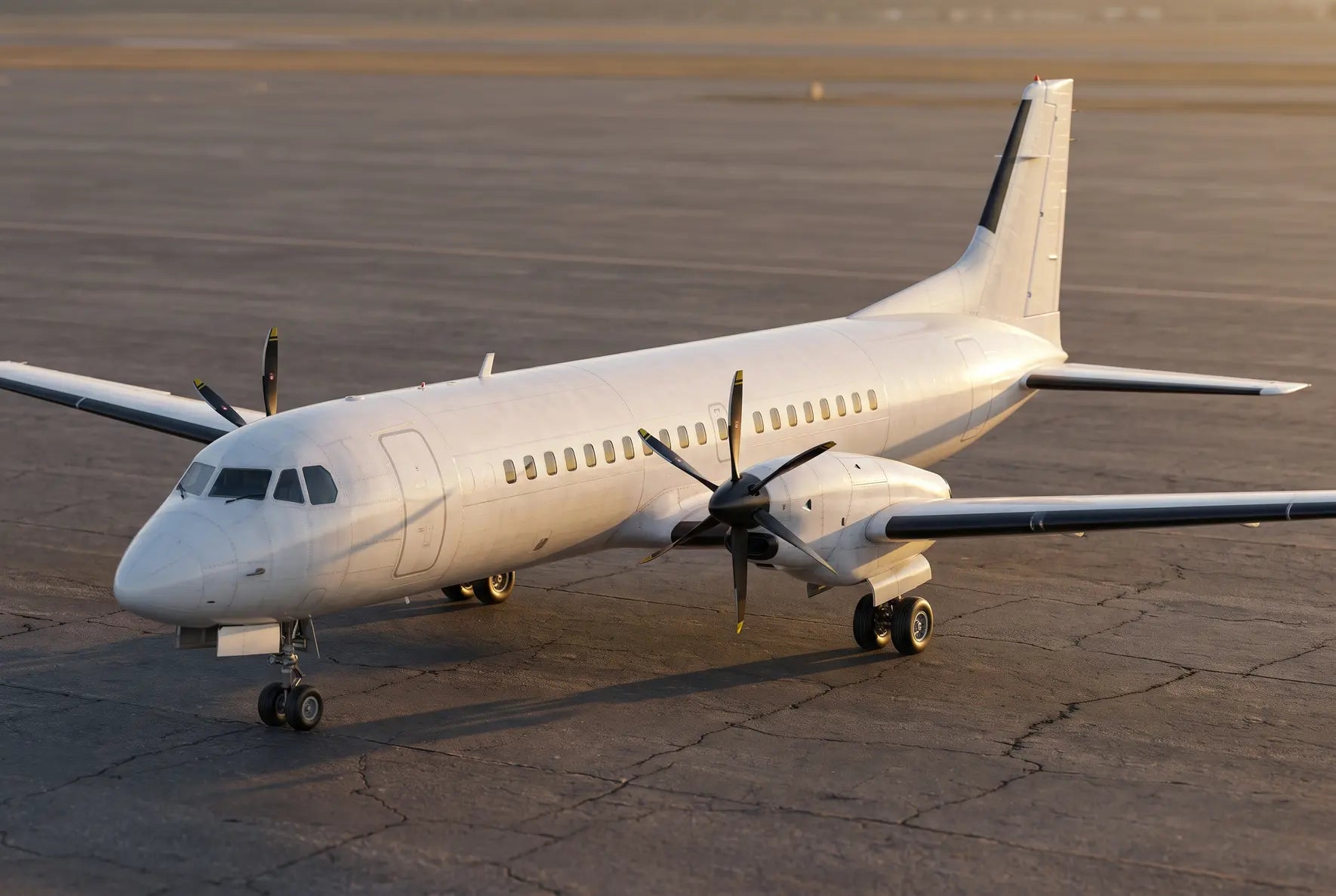
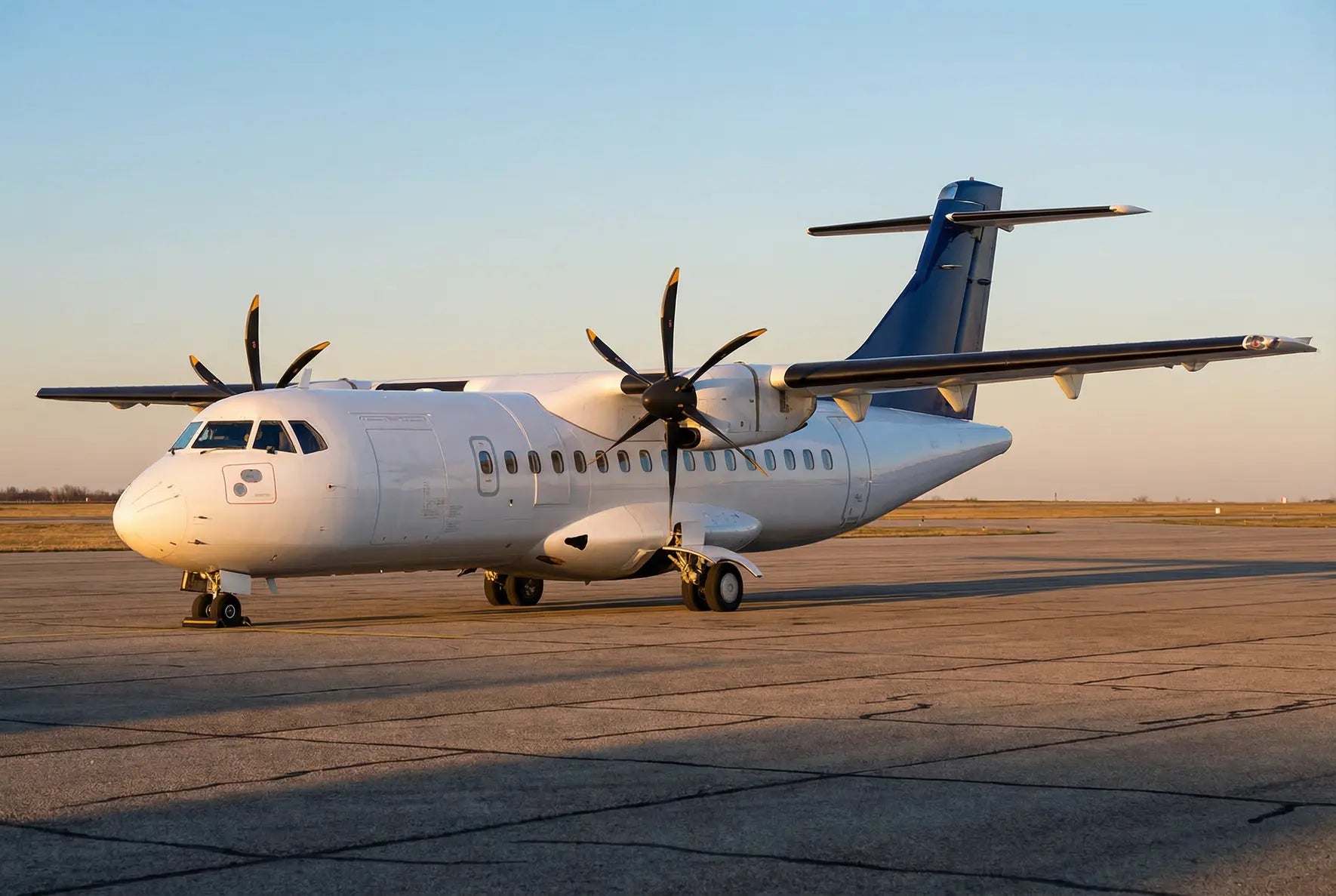
The ATR 42-400 emerged in the mid 1990s as a further evolution of the ATR 42-320 airframe. This variant retained the Pratt & Whitney Canada PW121 series powerplant but introduced a significant change: six bladed Hamilton Standard 568F composite propellers, replacing the four bladed units of earlier models. This propeller upgrade reduced cabin noise and vibration, improved aerodynamic efficiency, and enhanced overall operational performance. The EASA Type Certificate Data Sheet A.084 lists the ATR 42-400 with PW121A engines rated at 1,980 hp (1,480 kW) each and records its type certification date as 19 July 1995. According to SKYbrary, the ATR 42-400 carries the ICAO type designator AT44, with a wingspan of 24.57 m, fuselage length of 22.67 m, and a height of 7.59 m.
Production of the ATR 42-400 was extremely limited. Only three aircraft are confirmed to have been manufactured, all built in 1995. This makes the ATR 42-400 one of the rarest variants in the entire ATR 42 lineage. At least one of these airframes was adapted into the ATR 42 Surveyor, a maritime patrol configuration operated by Italian government authorities. The variant's small production run reflected its transitional nature: ATR had already announced the more comprehensive ATR 42-500 upgrade in 1993, which first flew on 16 September 1994 and received certification in July 1995. The ATR 42-500 introduced PW127E engines, further increased the maximum takeoff weight to 18,600 kg, and adopted the same six bladed propeller concept pioneered on the ATR 42-400, along with a redesigned cabin and improved hot and high performance. With the ATR 42-500 entering service shortly after, the ATR 42-400 essentially served as a bridge between the established ATR 42-320 platform and the next generation variant. Much like how the McDonnell Douglas DC 8 61 represented an incremental evolution of the DC 8 family before more advanced versions followed, the ATR 42-400 introduced targeted upgrades within an existing airframe to validate improvements later applied on a larger scale.
What Differentiates the ATR 42-400 from Other ATR 42 Sub Variants
The ATR 42-400 occupies a unique position in the ATR 42 family tree. Compared to the ATR 42-300 and ATR 42-320, the most visible external change is the switch from four bladed to six bladed composite propellers, which lowered noise levels and improved propulsive efficiency. The powerplant was upgraded from the PW120 (on the 300) and PW121 (on the 320) to the PW121A, offering marginally improved performance ratings at 1,980 hp per engine. Compared to the ATR 42-500, which followed almost immediately, the ATR 42-400 lacked the PW127E engines, the higher maximum takeoff weight, and the modernised passenger cabin interior that defined the later model. In essence, the ATR 42-400 tested the six bladed propeller configuration and refined engine variant on the proven ATR 42-320 platform before these features became standard on the production ATR 42-500.
Key identifiers of the ATR 42-400 include:
- Engines: Two Pratt & Whitney Canada PW121A turboprops, each rated at 1,980 hp (1,480 kW)
- Propellers: Hamilton Standard 568F six bladed composite propellers (diameter 3.93 m), replacing the four bladed 14SF units of earlier variants
- ICAO type designator: AT44
- Production total: Three aircraft, all manufactured in 1995
- Type certification: 19 July 1995 under EASA TCDS A.084
- Special mission adaptation: ATR 42 Surveyor maritime patrol variant for Italian government use
A Hop! airline ATR 42-500 aircraft is captured in flight against a clear blue sky. The regional aircraft features the airline's branding and is equipped with turboprop engines.
ATR 42-400 Technical Specifications, Systems and Engine Overview
The ATR 42-400 is a high-wing, twin-engine regional turboprop built by ATR (a joint venture between Airbus and Leonardo) as a transitional upgrade between the ATR 42-320 and the more widely produced ATR 42-500. First flown on 12 July 1995, the variant retained the proven airframe and manual flight-control philosophy of earlier ATR 42 models while introducing quieter six-bladed propellers and minor aerodynamic refinements such as small winglets at the wingtips. The design objective was straightforward: improve cabin comfort and external noise footprint without altering the type's core strengths in short-field performance, low fuel burn and operational simplicity on thin regional routes.
Because the ATR 42-400 shares its fuselage, wing structure and most systems with the ATR 42-300/320, many published figures apply across the family. The key differentiator is the powerplant installation: a pair of Pratt & Whitney Canada PW121A turboprops driving Hamilton Sundstrand 568F six-bladed propellers, which reduce flyover noise compared with the four-bladed units on the preceding models. Payload-range trade-offs remain typical of a sub-50 seat turboprop: competitive fuel economy over stages of a few hundred nautical miles, with runway requirements that open access to smaller airports.
- Overall length: 22.67 m (74 ft 5 in)
- Wingspan: 24.57 m (80 ft 7 in)
- Height: 7.59 m (24 ft 11 in)
- Wing area: 54.5 m²
- Typical seating: 48 passengers in standard single-class layout at 30 in (760 mm) pitch
- Maximum ramp weight (MRW): 18,070 kg, per EASA Type Certificate Data Sheet A.084
- Maximum takeoff weight (MTOW): 17,900 kg
- Engines: 2 × Pratt & Whitney Canada PW121A, each rated at 1,980 SHP for takeoff
- Propellers: Hamilton Sundstrand 568F, six-bladed, constant speed, fully feathering
- Maximum cruise speed: 266 kt (493 km/h)
- Range (full passenger payload): approximately 825 nm (1,528 km)
- Service ceiling: 25,000 ft
Systems, Flight Controls and Handling Technology
Like all ATR 42 variants, the 42-400 relies on manual primary flight controls for pitch, roll and yaw, with electrical trim and hydraulically powered secondary surfaces (flaps and ground spoilers). This design philosophy keeps the aircraft light and mechanically straightforward, while still offering predictable handling characteristics across the speed envelope. The elevator system features a pitch-coupling mechanism that provides redundancy: if one control run jams, differential force allows the other to disengage and maintain pitch authority. Ailerons use spring tabs to compensate for aerodynamic loads, reducing pilot effort during manual flight. Stall protection is provided by a stick shaker and stick pusher integrated into the multifunction computers.
Braking is handled by multi-disc carbon units with anti-skid protection. The automation philosophy across the ATR 42 family is deliberately conservative, relying on a basic flight director with lateral and vertical mode coupling, heading and altitude selectors, and autopilot engagement. The ATR 42-400 supports CAT II instrument approaches when fitted with ATR Modification 1112. Engine control on the PW121A is managed through an electronic engine control system that schedules power according to ambient temperature and spool-speed limits, with automatic power increase capability during single-engine scenarios. Looking through the cockpit windows, pilots see a panel that in the 42-400 still uses a mix of analogue and hybrid instrumentation rather than the full glass cockpit later introduced on the ATR 42-600.
Published performance figures for the ATR 42-400 should always be read in context. Range, takeoff distance and fuel burn vary significantly with operator-selected cabin configuration, actual takeoff weight, altitude, ambient temperature (ISA or ISA+), runway surface condition and reserve policy. Manufacturer range values typically assume standard passenger count at a reference weight and still-air conditions with standard fuel reserves. Different operators may also select optional equipment or structural modifications that change the empty weight, further affecting payload-range calculations. No single number applies universally, and flight crews rely on aircraft-specific performance computation tools for dispatch.
Pratt & Whitney Canada PW121A Engine
The PW121A belongs to the PW100 engine family, a series of free-turbine turboprops developed by Pratt & Whitney Canada (now part of RTX Corporation). Development of the PW100 began in 1977 to fill the gap above the popular PT6A, which was reaching its practical power ceiling around 1,000 SHP. The initial PW120 variant received certification in December 1983 and entered service in 1984 aboard the de Havilland Canada Dash 8-100. Over four decades, the family has expanded to more than 30 certified models spanning 1,800 to over 5,000 SHP, with roughly 9,000 engines produced and some 200 million flight hours accumulated across nearly 3,000 aircraft worldwide.
The PW100 family uses a distinctive three-shaft architecture. Two independent spools, each consisting of a centrifugal compressor driven by its own cooled turbine stage, handle air compression. A third shaft connects the free power turbine to the propeller through a reduction gearbox, allowing the propeller to operate at its optimum speed independently of the gas generator. This arrangement offers excellent part-load fuel efficiency, a significant advantage on the short sectors where turboprops compete most effectively against jets.
The PW121A, rated at 1,980 SHP for takeoff, sits in the lower-mid range of the family. It is closely related to the PW121 used on the ATR 42-320, offering refined temperature scheduling and improved thermal margins. Beyond the ATR 42 and ATR 72 series, other members of the PW100 family power a diverse fleet of regional and utility aircraft including the De Havilland Canada Dash 8 (PW120 through PW150), the Fokker 50, the Embraer EMB-120 Brasilia, the Dornier 328 and military platforms such as the Airbus C295. The latest evolution of the family, the PW127XT, entered service in 2022 and is now standard on new-build ATR aircraft, offering reduced maintenance costs, improved fuel efficiency and compatibility with sustainable aviation fuel blends up to 50%.
ATR 42 Variants vs ATR 72-500 Specifications Comparison
Scroll horizontally to see more
| Parameter | ATR 42-400 | ATR 42-500 | ATR 42-300 | ATR 72-500 |
|---|---|---|---|---|
| Entry into service | 1995 | 1996 | 1989 | 1997 |
| Engines | 2 × PW121A | 2 × PW127E | 2 × PW120 | 2 × PW127F |
| Length | 22.7 m | 22.7 m | 22.7 m | 27.2 m |
| Wingspan | 24.6 m | 24.6 m | 24.6 m | 27.1 m |
| Height | 7.6 m | 7.6 m | 7.6 m | 7.7 m |
| Typical seating and layout | Single-class: 42-50 passengers | Single-class: 48 passengers | Single-class: 42-48 passengers | Single-class: 64-70 passengers |
| MTOW | 17 t | 18.6 t | 16.4 t | 23 t |
| Range | 801 nm | 900 nm | 459 nm | 825 nm |
| Cruise speed | 0.51 Mach | 0.51 Mach | 0.50 Mach | 0.51 Mach |
| Service ceiling | 25,000 ft | 25,000 ft | 25,000 ft | 25,000 ft |
| Program note | Improved hot/high performance version with PW121A engines | Current production model with higher power PW127E engines and increased MTOW | Original baseline model with PW120 engines | Stretched 72-seat version of ATR family flagship |
Scroll horizontally to see more
This table compares key specifications across ATR 42-300, 42-400, 42-500 and the larger ATR 72-500. The ATR 72-500 is longer with a wider wingspan and the highest MTOW (23 t), supporting 64–70 seats, but its range (825 nm) is similar to the 42-400 (801 nm). The 42-500 offers the longest range at 900 nm with increased MTOW versus earlier 42 models.
ATR 42-400 Operations, Typical Missions and Airlines Around the World
The ATR 42-400 is one of the rarest variants in the ATR 42 family. Produced in very limited numbers during the mid 1990s, it served as a transitional model between the ATR 42-320 and the more widely adopted ATR 42-500. Powered by two Pratt & Whitney Canada PW121A turboprops delivering 1,980 shp each and fitted with six-blade propellers for reduced noise, the ATR 42-400 retained the same airframe dimensions as its siblings: 22.67 m in length, 24.57 m wingspan, and a maximum take-off weight of 18,600 kg. Its operational profile aligns closely with the broader ATR 42 platform, which is optimised for short regional sectors typically ranging from 200 to 350 nautical miles, with average flight times between 35 and 50 minutes per sector.
Regional turboprop operators using ATR 42 family aircraft generally achieve daily utilisation rates of around 6 to 7 flight hours, completing multiple rotations on short routes. The type excels at serving secondary and regional airports with runways as short as 1,100 m, and its low operating costs make it well suited for thin routes where larger jets would be uneconomical. ATR 42 aircraft typically operate in both hub-and-spoke networks, feeding passengers from smaller cities into larger hubs, and on point-to-point services connecting communities that lack direct jet service. The aircraft performs reliably in challenging environments, including hot-and-high airfields where its turboprop engines maintain strong take-off performance even at elevated temperatures and altitudes.
Operational challenges for ATR 42 operators include icing conditions in colder climates, which require certified de-icing systems and careful dispatch procedures, as well as the inherently lower cruise speed of approximately 265 to 300 knots compared to regional jets. Maintenance demands, while lower per flight hour than jet equivalents, require specialised turboprop expertise, and the type's line check programme includes transit checks before each flight, daily checks every 24 hours, and weekly inspections. Despite these considerations, the ATR 42 family remains among the most cost-efficient regional aircraft ever produced, a quality it shares with other purpose-built types such as the Tupolev Tu-104, which also demonstrated how dedicated designs can reshape regional connectivity.
Where the ATR 42-400 Operates
Unlike the widely deployed ATR 42-300, -500, and -600 variants, the ATR 42-400 saw extremely limited commercial adoption. No major airline is confirmed to have operated the ATR 42-400 in scheduled passenger service. The variant's primary documented operator is the Italian Coast Guard (Guardia Costiera), which uses a specially configured version known as the ATR 42MP Surveyor, a multirole maritime patrol aircraft built by Leonardo (formerly Alenia Aeronautica). These aircraft are equipped with search radar, forward-looking infrared sensors, electronic support measures, and mission management systems for maritime surveillance, search and rescue coordination, and coastal security operations in Europe. The Surveyor variant can remain airborne for up to 8 hours and patrol at ranges exceeding 200 nautical miles from base, demonstrating the platform's endurance on specialised missions.
While the ATR 42-400 itself did not achieve widespread airline adoption, the broader ATR 42 family has seen extensive use across all major world regions. In Europe, airlines have deployed the type on domestic and intra-regional routes connecting island communities, mountain towns, and secondary cities. In North and South America, operators have relied on ATR 42 aircraft for northern Canadian routes, Caribbean island-hopping, and remote domestic services in countries like Colombia and Brazil. Across Asia, the type has served Himalayan routes, Indonesian archipelago connections, and Japanese island services. In Africa, it has supported regional passenger networks in East and West Africa, where short runways and limited infrastructure favour turboprop operations.
- Europe: The Italian Coast Guard is the principal confirmed ATR 42-400 operator in this region, using it for maritime patrol. For the wider ATR 42 family, Loganair operates ATR 42-500 and ATR 42-600 aircraft on Scottish and UK regional routes. Air France Hop formerly operated 13 ATR 42-500s on domestic French services, and Eurowings in Germany was historically the largest European ATR 42 operator with 27 aircraft serving regional German routes.
- North & South America: Canadian North and Calm Air in Canada have used ATR 42-300 and ATR 42-320 variants to connect remote Arctic and northern communities. Mountain Air Cargo in the United States operates ATR 42 freighters. In South America, SATENA in Colombia uses ATR 42-500 and ATR 42-600 aircraft for domestic services to remote airfields, while MAP Linhas Aéreas in Brazil has used ATR 42 variants for regional cargo and passenger operations.
- Asia: Buddha Air in Nepal operates ATR 42-320 aircraft on Himalayan regional routes. AirSWIFT in the Philippines uses ATR 42-600s for island-hopping tourist routes. Amakusa Airlines in Japan took delivery of its first ATR 42-600 in 2023 for scheduled services from Amakusa to Kumamoto, Fukuoka, and Osaka.
- Africa: Precision Air in Tanzania operates ATR 42-320, ATR 42-500, and ATR 42-600 aircraft on East African regional routes. Royal Air Maroc in Morocco formerly used four ATR 42-300s for domestic and intra-African services.
Typical Seating Configurations
Across all ATR 42 variants, including the ATR 42-400, the standard cabin layout features a 2-2 abreast arrangement with a single centre aisle. Most operators configure the aircraft with 46 to 48 economy class seats at a standard seat pitch of 30 inches (76 cm) and a seat width of 17 to 18 inches. High-density configurations can accommodate up to 50 passengers, though this is uncommon. For example, Cape Air operates its ATR 42 with 46 seats across 12 rows at 30-inch pitch, while Loganair fits 48 seats using Geven Neo Prestige slimline seats. Winair, serving Caribbean routes from Sint Maarten, also configures 48 seats in an all-economy layout. PIA (Pakistan International Airlines) has offered a mixed configuration with premium economy and economy seating on its ATR fleet. Since the ATR 42-400 was primarily operated in a government maritime patrol role rather than passenger service, its cabin was typically outfitted with mission systems and operator consoles rather than standard airline seating. Network carriers and regional subsidiaries generally standardise on 48 seats to maximise revenue per departure, while smaller independent operators sometimes opt for 46 seats to allow slightly more cargo capacity in the forward hold. Newer ATR 42-600 models offer updated cabin interiors with larger overhead bins, LED lighting, and improved ergonomics, setting the benchmark for passenger comfort in the 50-seat turboprop segment.
In this video, explore what led an ATR 42-500 operated by Air Indonesia Transport to be in an unexpected place, and how events unfolded on January 17, 2026, in a tragic loss that shook aviation.
ATR 42-400 Safety Record: Accident History and How Safe Is This Turboprop?
The ATR 42-400 belongs to the broader ATR 42 family, a regional turboprop that has accumulated millions of flight hours since its first commercial service in 1985. Across all ATR 42 variants, approximately 483 aircraft have been built, serving dozens of operators on every continent. According to an independent ATR safety analysis, the ATR 42 series as a whole has been involved in 47 recorded accidents and incidents, including 34 hull losses and 276 fatalities. Within this total, the ATR 42-400 sub-variant itself has no separately recorded hull loss or fatal accident in the Aviation Safety Network database, likely reflecting both its relatively small production run and the operational improvements introduced before its entry into service in the mid-1990s.
Notable Accidents and Incidents Involving the ATR 42 Family
Although the ATR 42-400 has no variant-specific fatal event on record, several significant accidents involving other ATR 42 sub-variants have shaped the design, training and regulatory framework that also governs the -400.
- Trigana Air Flight 267 (August 2015, ATR 42-300) — The aircraft crashed into mountainous terrain near Oksibil, Papua, Indonesia, killing all 54 people on board. Investigators found that the crew deviated from visual approach guidance in marginal weather and that the Enhanced Ground Proximity Warning System (EGPWS) was likely not functioning. This remains the deadliest accident involving an ATR 42. The investigation led to renewed emphasis on mandatory EGPWS serviceability checks and stricter operational procedures for approaches in challenging terrain.
- PIA Flight 661 (December 2016, ATR 42-500) — A domestic flight from Chitral to Islamabad lost control after an in-flight engine failure caused by a fractured power turbine blade and compounding mechanical defects. All 47 occupants perished. The final investigation report attributed the accident to maintenance lapses at the operator and insufficient oversight by Pakistan's Civil Aviation Authority. Recommendations included fleet-wide turbine blade replacement, overspeed governor inspections and a revamp of Crew Resource Management (CRM) training across the country.
- Conviasa Flight 2350 (September 2010, ATR 42-320) — During approach to Ciudad Guayana, Venezuela, the aircraft struck power lines and crashed, killing 17 of the 51 people on board. The operator's fleet was temporarily grounded for comprehensive inspections, and the investigation involved both the BEA and ATR as technical advisers.
- Empire Airlines Flight 8284 (January 2009, ATR 42-320) — A FedEx Feeder cargo flight crashed short of the runway at Lubbock, Texas, after the crew failed to maintain safe airspeed during an instrument approach in icing conditions. Both pilots survived. The NTSB report (AAR-11/02) highlighted inadequate adherence to standard operating procedures, poor CRM, and crew fatigue. It prompted enhanced training requirements for unstabilised approach recognition and go-around procedures.
Beyond these ATR 42 events, the entire ATR family benefited from sweeping safety improvements following the 1994 crash of an ATR 72 near Roselawn, Indiana. That investigation revealed vulnerabilities to supercooled large droplet icing, leading the FAA to mandate extended deicing boots, revised autopilot protocols in icing conditions and updated crew training across both the ATR 42 and ATR 72 fleets.
How Safe Is the ATR 42-400 Today?
When measured against overall traffic volume, the combined ATR 42 and ATR 72 fleet records a fatal accident rate of approximately 0.44 per million flights, according to AirSafe.com. While this figure is higher than the latest generation narrowbody jets, it reflects the full operational history of the type, including early variants operating in some of the world's most demanding environments. The newest ATR 600 series achieves a rate of roughly 0.13 per million flights, illustrating the cumulative effect of decades of design refinements and procedural upgrades that also benefit remaining ATR 42-400 airframes through retrofits and service bulletins.
The ATR 42-400's design philosophy centres on operational resilience: a high-wing configuration for propeller clearance and ground stability, robust landing gear suited to short and unpaved runways, and redundant flight control systems. Regional operators, including those whose pilots fly under demanding conditions, follow strict Standard Operating Procedures overseen by EASA and equivalent national authorities. According to the IATA 2024 Safety Report, the global all-accident rate for commercial aviation stood at 1.13 per million flights, reinforcing that air travel remains one of the safest modes of transport. The ATR 42-400, supported by continuous airworthiness directives and an evolving regulatory framework, continues to operate within that broader context of steadily improving industry safety.
01 What is the typical cruising speed and range of the ATR 42-400?
The ATR 42-400 has a maximum cruise speed of 261 knots (484 km/h) and can carry a full complement of passengers up to 794 nautical miles. This range makes it ideal for regional routes of 2–4 hours flight time, with fuel consumption around 588 kg per hour at cruise. The aircraft balances efficiency with reasonable speed, allowing operators to connect regional hubs without the operating costs of larger jets.
02 How many passengers does the ATR 42-400 typically carry, and what is the cabin experience like?
The ATR 42-400 is configured with 46–50 seats in a high-density layout, depending on the airline's choice of interior design. The cabin features a four-abreast (2+2) seating arrangement with a low-loading sill of 1.2 meters for easy boarding. While narrower than jet cabins, the aircraft offers reasonable headroom and modern comfort standards for regional flights, with cabin pressurization for smooth flight operations.
03 How does the ATR 42-400 compare to other regional turboprops in terms of performance?
The ATR 42-400 sits in the mid-range of the ATR 42 family, offering better performance than the earlier 42-200/320 models but less speed than the newer 42-500. With 1,980 horsepower engines, it achieves a good balance between fuel efficiency and speed, making it popular for regional carriers that need reliable, cost-effective operations on routes under 400 nautical miles. The aircraft's six-seat-per-minute climb rate and robust single-engine performance make it suitable for operations from smaller regional airports.
04 What makes the ATR 42-400 suitable for regional airline operations?
The ATR 42-400 is designed specifically for regional routes, with excellent short-field performance (takeoff distance around 1,205 meters at maximum weight) and proven reliability over decades of operation. Its turboprop engines deliver low operating costs compared to regional jets, and the aircraft can efficiently serve communities with limited airport infrastructure. The combination of 48-seat capacity and 800+ nautical mile range makes it ideal for connecting secondary cities to major hubs.
05 Is the ATR 42-400 noisy, and how does it handle turbulence?
Turboprop aircraft like the ATR 42-400 are naturally louder than jets during cruise due to their propeller-driven engines, though modern designs include vibration-reduction measures. The aircraft's high-wing design and robust structure provide good stability, and pilots routinely request slightly different altitudes or speeds to find smoother air on regional routes. Most passengers adapt quickly to turboprop operation, and the aircraft's excellent safety record demonstrates its reliable handling characteristics across a wide range of weather conditions.
06 What is the maximum takeoff weight and fuel capacity of the ATR 42-400?
The ATR 42-400 has a maximum takeoff weight of 17 tonnes (37,480 pounds) and a fuel capacity of 5,700 liters (1,506 US gallons). This fuel load allows the aircraft to operate transcontinental regional routes with reserves for alternate airports and holding patterns. The relatively modest weight and fuel capacity reflect its design purpose: efficient, point-to-point regional connectivity rather than long-haul or high-capacity operations.