Harbin Y-12: History and Development of China's Utility Turboprop
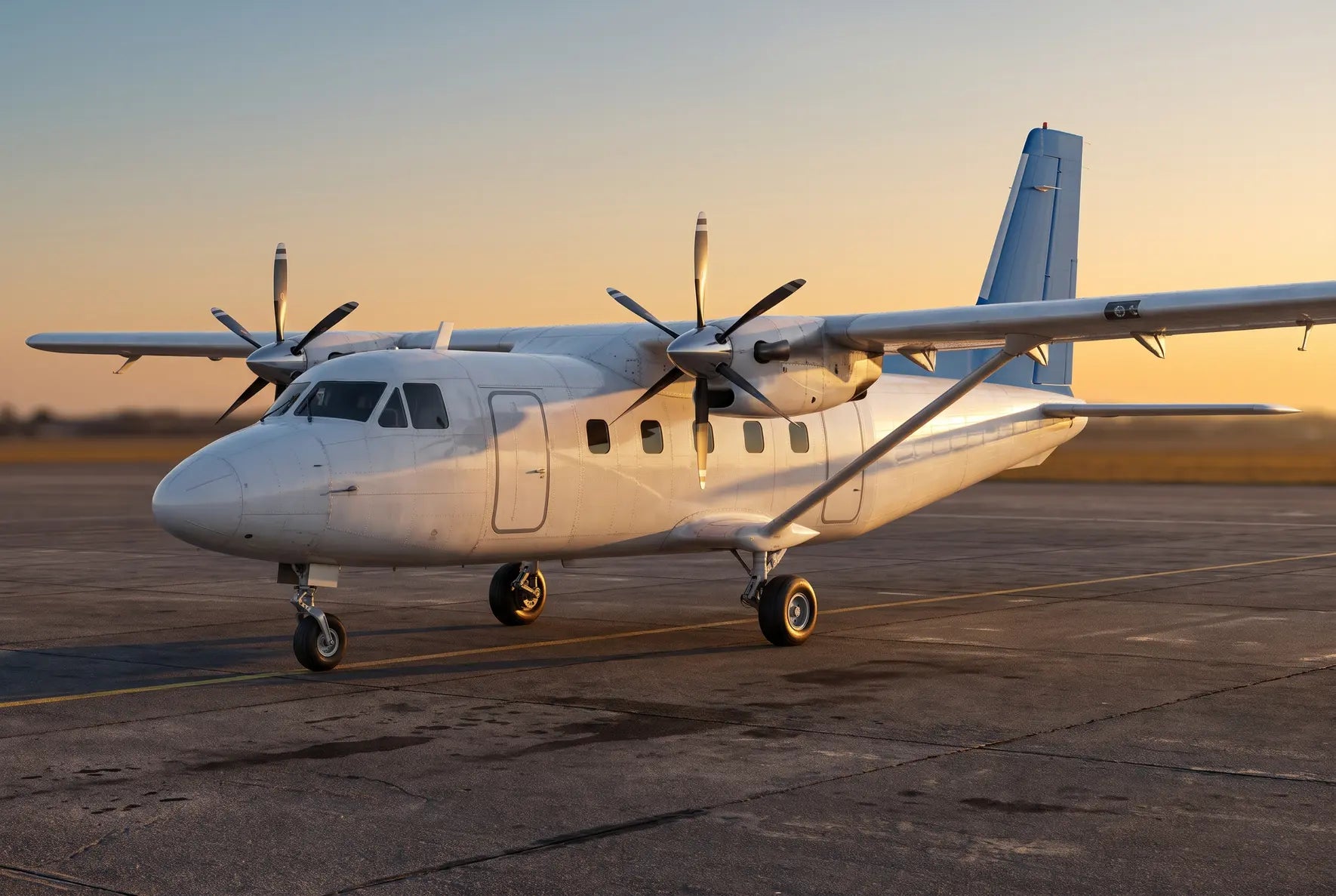
The Harbin Y-12 is a twin-engine, high-wing utility turboprop designed and built by the Harbin Aircraft Manufacturing Corporation (HAMC), part of the Aviation Industry Corporation of China (AVIC). The family exists because China needed a rugged, affordable STOL aircraft for short-haul passenger, cargo, geophysical survey and utility roles, capable of operating from unpaved and short airstrips. The Y-12 grew directly out of the earlier piston-engine Y-11, which Harbin re-engineered into a turboprop derivative to improve payload, reliability and hot-and-high performance.
Development began around 1980, and the prototype made its first flight on 14 July 1982. The initial Y-12 I production version used two Pratt & Whitney Canada PT6A-11 engines, with roughly 30 airframes built. Engineers then introduced the improved Y-12 II, powered by more capable PT6A-27 turboprops and with the leading-edge slats removed; it first flew on 16 August 1984 and earned Chinese CAAC certification in December 1985, the year the type entered service. A major milestone followed in March 1995, when the Y-12 IV became the first Chinese-designed and produced aircraft to receive a US FAA type certificate. The export-oriented Y-12E gained FAA certification in August 2006, typically fitted with PT6A-135A engines and fixed landing gear. These export achievements helped establish the type across more than 30 countries, appealing to operators and to markets served by regional carriers such as Air Arabia.
What sets the Y-12F apart
The Y-12F is the most significant redesign in the family and marks a clear break from the earlier Y-12E. Design work started in April 2005, the maiden flight took place on 29 December 2010, and the aircraft achieved CAAC certification on 10 December 2015, FAA validation on 22 February 2016, and EASA certification on 13 July 2023 under CS-23 Commuter category. Compared with the Y-12E, it introduces a wider fuselage, an entirely new wing, retractable tricycle landing gear in place of fixed gear, more powerful PT6A-65B engines, and a modern Honeywell Primus Apex integrated glass cockpit. These changes raise capacity to up to 19 passengers or a 3-tonne cargo load (including three LD3 containers) and lift the maximum take-off weight to about 8,400 kg.
The main identifiers that distinguish the Y-12F from its closest relatives are summarised below:
- Engines: two Pratt & Whitney Canada PT6A-65B turboprops (versus PT6A-135A on the Y-12E).
- Landing gear: retractable tricycle undercarriage, replacing the Y-12E fixed gear.
- Airframe: wider fuselage and a new high-wing design.
- Weights and capacity: MTOW approximately 8,400 kg; up to 19 passengers or roughly 3 tonnes of payload.
- Performance: economic cruise around 400 km/h and a service ceiling of about 7,000 m.
- Avionics: Honeywell Primus Apex integrated suite with an automatic flight control system.
- Certification: CAAC (2015), FAA (2016) and EASA (2023) type certificates.
Progress on the Y-12F was gradual, reflecting the demands of validating a new commuter-category airframe across multiple authorities. The extended path from first flight in 2010 to European approval in 2023 illustrates the rigour of concurrent CAAC, FAA and EASA review. Successful completion of FAA automatic flight control system testing in June 2018 was a key procedural step toward broadening the aircraft's international acceptance.

A Harbin Y-12 aircraft of the Revolutionary Guard Air Force is captured in flight against a clear blue sky. The plane features distinctive red, green, and white markings.
Harbin Y-12: Technical Specifications, Systems and Performance
The Harbin Y-12 is a Chinese twin-engine, high-wing utility turboprop designed for short-takeoff-and-landing (STOL) operations from short, unprepared or semi-prepared strips. Its mission profile favours regional connectivity, cargo, parachuting and light commuter work rather than high cruise speed. The design trades outright range and speed for rugged field performance, a boxy fuselage with a large cargo door, and fixed tricycle landing gear that simplifies maintenance in remote environments. The most widely operated versions, the Y-12 II and the later civil-oriented Y-12 IV / Y-12E, share the same basic airframe geometry and powerplant, differing mainly in aerodynamic refinements, systems and avionics fit.
Compared with larger four-engine transports built for range and payload, such as the Boeing 747-100, the Y-12 sits at the opposite end of the spectrum: a small, economical feeder aircraft optimised for low operating cost and access to airfields that jets cannot use.
- Wingspan: approximately 17.23 m
- Length: approximately 14.86 m
- Height: approximately 5.58 m
- Wing area: about 34.3 m²
- Crew: 2 (pilot and copilot)
- Passenger capacity: up to 17 in commuter configuration
- Maximum payload: about 1,700 kg (17 passengers or cargo)
- Operating empty weight: roughly 2,840–3,000 kg, depending on fit
- Maximum takeoff weight (MTOW): 5,300 kg
- Cruise speed: approximately 250–292 km/h, depending on power setting
- Maximum speed: around 328 km/h at 3,000 m
- Service ceiling: about 7,000 m (≈22,960 ft)
- Range: around 1,340 km with maximum fuel and reserves
- Fuel capacity: approximately 1,600 L (≈1,230 kg usable)
- Takeoff / landing field length: on the order of 370 m / 340 m in STOL conditions
- Engines: 2 × Pratt & Whitney Canada PT6A-27 turboprops
- Propellers: three-blade Hartzell constant-speed, fully-feathering, reversible-pitch units
Systems and handling-relevant technology
The Y-12 uses conventional, mechanically actuated flight controls with a proven high-lift wing that supports its short-field behaviour, keeping stall speeds low and control response predictable for line pilots. Its constant-speed, fully-feathering and reversible Hartzell propellers allow effective ground deceleration and steep, controlled approaches, which are essential on short runways. Automation is deliberately modest: earlier Y-12 II aircraft typically carry a basic two-axis autopilot and flight director for IFR work, while later Y-12 IV / Y-12E examples are often marketed with more modern radios and, in some installations, partial glass-cockpit retrofits with GPS navigators. The fixed landing gear and simple systems architecture reduce maintenance burden, an advantage for operators in remote regions.
Published performance figures for the Y-12 vary between sources, and this is normal. Numbers depend on operator options, cabin density, actual weights, atmospheric assumptions (temperature, pressure altitude) and runway condition. For that reason, field lengths and range should be read as representative values under stated conditions rather than absolute guarantees. Certified figures such as maximum landing weight are best taken from the official type certificate or flight manual, and some of these are not published in accessible public references.
Engines: the Pratt & Whitney Canada PT6A family
Export Y-12 aircraft are powered by two Pratt & Whitney Canada PT6A-27 turboprops, each rated at about 680 shp (roughly 507 kW), driving reduction gearing at approximately 2,200 propeller rpm. The PT6 entered service in the early 1960s and became one of the most-produced turboprop families in aviation history, built in tens of thousands of units. Its architecture is a free-turbine layout with a reverse-flow combustor, combining three axial compressor stages with a single centrifugal stage and a separate power turbine that drives the propeller. This design is prized for reliability, ease of maintenance and a favourable power-to-weight ratio.
The PT6A-27 is far from unique to the Y-12: it also powers well-known utility and commuter aircraft such as the de Havilland Canada DHC-6 Twin Otter, the Embraer EMB 110 Bandeirante, the Beechcraft 99, the Let L-410 Turbolet and the Pilatus PC-6 Turbo Porter. The related lower-power PT6A-11 appears in the same family at around 500 shp. Chinese domestic Y-12 batches and prototypes have also been associated with locally built turboprops from the WJ engine series, reflecting parallel domestic supply, though the internationally certified and exported Y-12 remains firmly tied to the PT6A-27.
Harbin Y-12 vs King Air 350i vs DHC-6 Twin Otter 400 vs Pilatus PC-12 NGX Specifications
Scroll horizontally to see more →
| Parameter | Harbin Y-12 | Beechcraft King Air 350i | De Havilland Canada DHC-6 Twin Otter Series 400 | Pilatus PC-12 NGX |
|---|---|---|---|---|
| Entry into service | 1980 | 2008 | 2010 | 2019 |
| Engines | 2 × Pratt & Whitney Canada PT6A-27 turboprops | 2 × Pratt & Whitney Canada PT6A-60A turboprops | 2 × Pratt & Whitney Canada PT6A-34 turboprops | 1 × Pratt & Whitney Canada PT6E-67XP turboprop |
| Length | 14.86 m | 14.22 m | 15.77 m | 14.43 m |
| Wingspan | 17.24 m | 17.65 m | 19.81 m | 16.28 m |
| Height | 5.58 m | 4.37 m | 5.94 m | 4.26 m |
| Typical seating and layout (short description + approximate passengers) | Regional utility/combi: 10–17 passengers | Corporate/utility turboprop: 8–11 passengers | Short-field commuter: 19 passengers | Single-pilot executive/business: 6–8 passengers |
| MTOW | 5.30 t | 6.80 t | 5.67 t | 4.99 t |
| Range | 724 nm | 1,556 nm | 770 nm | 1,803 nm |
| Cruise speed | 0.28 Mach | 0.43 Mach | 0.25 Mach | 0.50 Mach |
| Service ceiling | 23,000 ft | 35,000 ft | 25,000 ft | 30,000 ft |
| Program note | Chinese twin-turboprop utility and commuter aircraft; the baseline short-field Y-12 family model. | Higher-performance pressurized turboprop in the same general light transport class, optimized for executive and utility missions. | Rugged STOL commuter and utility aircraft; comparable short-haul mission but larger cabin and stronger short-field emphasis. | Single-engine modern turboprop positioned above the Y-12 in range, speed, and cabin refinement for business and utility use. |
Scroll horizontally to see more →
The table compares the Harbin Y-12 with three popular turboprops across dimensions, seating, performance, and mission focus. The Y-12 offers 10–17 seats but shorter range (724 nm) and a lower ceiling (23,000 ft) than the pressurized King Air 350i (1,556 nm, 35,000 ft). The Twin Otter carries the most passengers (19) and emphasizes STOL utility, while the PC-12 NGX trades a single engine for the best range (1,803 nm) and highest cruise Mach (0.50).
Harbin Y-12 Operations, Routes and Airlines Worldwide
The Harbin Y-12 is a high-wing, twin-turboprop STOL commuter and utility aircraft built to carry up to 19 passengers on short sectors. Its missions span regional passenger transport, cargo and combi flights, skydiving, geological and aerial survey, maritime surveillance, medevac and agricultural work. Published range for the classic Y-12 and Y-12E family is around 1,340 km, though payload cuts this sharply: the Y-12 IV covers roughly 630 km with a full load of 19 passengers and up to about 1,310 km light. The stretched Y-12F extends maximum range to about 2,255 km with full fuel, but only around 994 km with 19 passengers and reserves. In practice, most commercial sectors run between 200 and 800 km, and operators typically fly several short legs per day, exploiting an endurance of roughly 5 hours to link remote points on point-to-point networks.
Operationally, the type favours secondary and regional airports rather than major hubs. Its STOL design, fixed landing gear and rugged airframe suit short, semi-prepared or unpaved strips, with a landing distance near 630 m on the Y-12 IV and a service ceiling of about 7,000 m. This makes it a common replacement for older utility types on thin, low-density routes. Operators face a steep payload-range trade-off, wear from rough-field use, and, on early variants, basic analogue avionics that may need retrofits for modern airspace requirements such as ADS-B. A comparable regional role is filled by the Xian Y-7 on slightly larger sectors.
Where the Harbin Y-12 operates
The strongest documented base is in Asia, especially China, where regional and utility operators use the aircraft on local auxiliary routes, alongside government agencies flying survey, forest and agricultural missions. Several Asian air arms operate it as a light transport. In Africa, use is largely military and governmental, supporting remote connectivity, medevac and patrol. In Europe the presence is niche, mainly small charter, parachute and government users rather than scheduled airlines. Across North America and South America, documented commercial use is limited, with only small numbers reported in utility and charter roles.
- Europe: no major scheduled carrier is widely documented; the type appears mainly with small charter, skydiving clubs and government operators for utility and parachute flights.
- North America and South America: presence is limited, with a small number of aircraft reported for utility and charter work rather than mainstream airline fleets.
- Asia: Chinese regional and utility operators use it on short auxiliary routes, while the Nepalese Army Air Wing flies it in mountainous terrain and the Bangladesh Air Force, Sri Lanka Air Force, Pakistan Air Force and Myanmar Air Force operate it as a light transport.
- Africa: the Tanzania Air Force and Zambian Air Force use it for transport, with other air arms such as those of Ghana, Namibia and Kenya listed among utility operators.
Typical seating and cabin layouts
The Y-12 is certified for up to 19 seats, with references also citing 17-seat commuter fits. The Y-12 IV cabin measures about 1.70 m high and 4.82 m long, with four windows per side, seating passengers single-aisle in a compact arrangement. Regional airlines generally fit the maximum 18 to 19 seats to maximise revenue on short routes, while leisure, skydiving and charter operators often use bench or minimal seating with open cabin space for gear. The modular cabin also converts to all-cargo, combi, medevac or special-mission fits: the Y-12F can carry 19 passengers or three LD3 containers, while government and military users favour flexible interiors that switch between troop, cargo and mission roles. Individual airline seat maps are rarely published, but the 19-seat maximum and modular philosophy are consistent across the Harbin Y-12 family.
In this video, discover the Harbin Y-12 (Yunshuji-12), a light multirole turboprop utility aircraft from China, developed from the Harbin Y-11, with an overview of its role and evolution.
Harbin Y-12 Safety Record: Accident History and How Safe It Is
The Harbin Y-12 is a Chinese high-wing, twin-engine turboprop utility aircraft built by Harbin Aircraft Manufacturing Corporation (HAMC, part of AVIC). In service since the early 1980s, it has been produced in several hundred units across the Y-12 II, Y-12 IV, Y-12E and the more recent Y-12F variants, serving both civil regional operators and military or government users worldwide. According to consolidated public records, the type has been involved in roughly two dozen hull-loss accidents and just over 110 fatalities across its lifetime. Most serious events were concentrated in early Y-12 II operations during the 1990s and early 2000s, frequently in remote, mountainous or weather-challenging environments. Because global fleet flight-hour and departure data are not published, a precise accident rate per flight hour cannot be reliably calculated. Detailed occurrence records can be reviewed on the Aviation Safety Network database.
Notable accidents and what changed afterwards
- MIAT Mongolian Airlines, 1998 (Galt, Mongolia): a Y-12 II struck a mountain in heavy icing, killing all 28 on board, the deadliest event involving the type. Reported factors included a wing de-ice system fault and overloading. Accidents of this nature typically reinforce attention to icing procedures, de-icing system reliability and weight-and-balance control.
- Lao Aviation, 1993 (Phonsavan, Laos): the aircraft clipped trees in fog on approach, a classic case of controlled flight into terrain (CFIT), with 18 fatalities. Such events across many aircraft types have driven wider emphasis on terrain awareness, weather minima and disciplined IFR procedures.
- Kenya Air Force, 2006 (Mount Marsabit, Kenya): an official investigation concluded that poor visibility and bad weather led to impact with terrain during repeated approach attempts, with 14 fatalities. The recurring CFIT pattern underlines the value of crew training and approach discipline in marginal conditions. Background is summarised by this documented case.
- Zambian Air Force, 2021 (Mukinge, Zambia): a Y-12E overran the runway after landing, with no fatalities. Later variants such as the Y-12E and Y-12F incorporate improved engines, aerodynamics and systems, and their post-2010 occurrences have been predominantly non-fatal.
How safe is the Harbin Y-12?
The Y-12 family reflects an evolutionary design philosophy: the Y-12 IV and Y-12E introduced structural, systems and performance enhancements over the earlier Y-12 II, and at least one foreign authority, the New Zealand Civil Aviation Authority, has formally type-accepted the Y-12 IV after assessing it against its own airworthiness rules. The aircraft is certificated primarily under the Civil Aviation Administration of China (CAAC). Most historical losses trace to CFIT and weather-related performance issues rather than fundamental design faults, which is why standard operating procedures, terrain awareness and pilot training remain central to safe operation, much as they do for the crews and duty frameworks discussed in this overview of airline pilot working conditions. Judged against traffic volume and the safety patterns seen across small utility turboprops, the Y-12 performs consistently with its category when operated within its limits and under proper regulatory oversight. It is also worth keeping perspective: as broader industry data from the ICAO Safety Report confirm, aviation remains one of the safest modes of transport.
01 What typical routes and missions does the Harbin Y-12 usually fly?
The Harbin Y-12 is most often used on short regional routes, typically under 300–400 km, linking small towns, remote communities, and island or mountainous airports. Operators use it for scheduled passenger services, government and charter flights, medevac, and light cargo missions. Its short takeoff and landing performance makes it suitable for airstrips with limited length or basic infrastructure. In some countries it also supports tourism flights, aerial survey, and utility operations where larger regional aircraft cannot operate efficiently.
02 How many passengers can the Harbin Y-12 carry and what is the cabin like?
Depending on the variant and interior configuration, the Harbin Y-12 typically seats around 17–19 passengers in a single-aisle layout. The cabin is functional and compact, designed more for practicality than luxury, with basic seating and limited overhead storage. Windows are relatively large for an aircraft of this size, which can offer good outside views on scenic routes. Boarding is usually via a rear or side door with integrated steps, and there is no standard in-flight galley or entertainment system on most configurations.
03 What is the passenger experience on the Harbin Y-12 in terms of comfort and noise?
As a high-wing, twin-turboprop utility aircraft, the Harbin Y-12 tends to be noisier and more vibration-prone than larger pressurized regional airliners, especially near the propellers. The cabin is generally unpressurized, so flights are usually operated at lower altitudes, which can mean more noticeable turbulence but also better views of the terrain below. Seat pitch and width vary by operator, but the experience is closer to that of a small commuter or bush plane than a mainline jet. For travellers, choosing a seat farther from the propellers and avoiding the very rear of the cabin can slightly reduce perceived noise and vibration.
04 Which airlines and operators commonly use the Harbin Y-12 and on what kinds of routes?
The Harbin Y-12 is operated by a mix of regional airlines, government agencies, and charter companies, particularly in China, parts of Asia, Africa, and Latin America. It is popular where there is a need to connect smaller communities with limited passenger demand and basic runway infrastructure. Typical routes include feeder services from remote towns to larger hubs, inter-island connections, and flights to mountainous or high-altitude airfields. Some operators also deploy the Y-12 on dedicated cargo, patrol, or training missions when a larger aircraft would be uneconomical.
05 How does the Harbin Y-12 perform compared with similar small commuter aircraft?
The Harbin Y-12 is designed as a rugged utility and commuter aircraft, comparable in role to types such as the DHC-6 Twin Otter or Let L-410. It offers good short takeoff and landing capability, high-wing clearance for rough fields, and a relatively simple systems layout, which can help keep operating and maintenance costs manageable for small operators. Its cruise speed and range are modest, optimized for short regional sectors rather than long-distance routes, but adequate for typical missions of around 300–700 km depending on load and conditions. Fuel efficiency is generally competitive for its class when operated at appropriate weights and altitudes, though not on the level of newer-generation turboprops with more advanced engines and aerodynamics.
06 What should a traveller know about safety and seat choice on a Harbin Y-12 flight?
The Harbin Y-12 has been in service for decades, and its safety profile reflects its use in challenging environments such as short or remote airstrips, where pilot training, operator standards, and local weather play a significant role. The aircraft incorporates typical safety features for its class, including twin turboprop engines, a sturdy fixed landing gear, and a high-wing configuration that enhances ground clearance and low-speed handling. For comfort, travellers who are sensitive to motion or noise may prefer seats closer to the wing and away from the very rear of the cabin, where engine and airflow noise can feel more pronounced. As with any small aircraft, following crew instructions, staying seated with belts fastened, and understanding that turbulence may feel more noticeable than on large jets can help make the flight more comfortable.