

BAe ATP: History and Development of the Advanced Turbo-Prop
The BAe ATP (Advanced Turbo-Prop) was British Aerospace's attempt to build a quieter, more fuel-efficient regional airliner from the proven bones of an earlier design. It descends directly from the Hawker Siddeley / BAe 748, a successful 1960s feederliner, and represents the final development of that lineage. Understanding why the ATP exists means understanding the market it was designed for: a segment reshaped by rising fuel prices and stricter noise expectations at regional airports.
Two pressures drove the programme. The 1979 oil crisis sharpened airline demand for fuel economy, while growing public concern over aircraft noise pushed manufacturers toward slower-turning propellers and cleaner engines. British Aerospace judged there was room for a short-range turboprop optimised for low noise, low fuel burn and modern systems, while reusing much of the 748 structure to hold down development cost.
Programme announcement came in March 1984, when BAe presented the Advanced Turbo-Prop as a stretched, re-engined derivative of the 748. The prototype, registered G-MATP, made its first flight on 6 August 1986 from Woodford, near Manchester. Certification followed in March 1988 under the authority of the UK Civil Aviation Authority, with the type later validated by EASA as Type Certificate EASA.A.192 (BAe ATP). The aircraft entered service in May 1988 with British Midland, and Air Wisconsin became an early operator in the United States.
The manufacturer was British Aerospace, later part of BAE Systems. Wings and airframe sections were built at Chadderton near Oldham, with final assembly at Woodford and later at Prestwick. In October 1992, production moved to BAe Regional Aircraft at Prestwick and the aircraft was re-launched as the Jetstream 61. Total production of the ATP and Jetstream 61 combined reached about 64 to 67 airframes, of which only four were completed as Jetstream 61s before the line closed.
What sets the BAe ATP apart from the HS 748
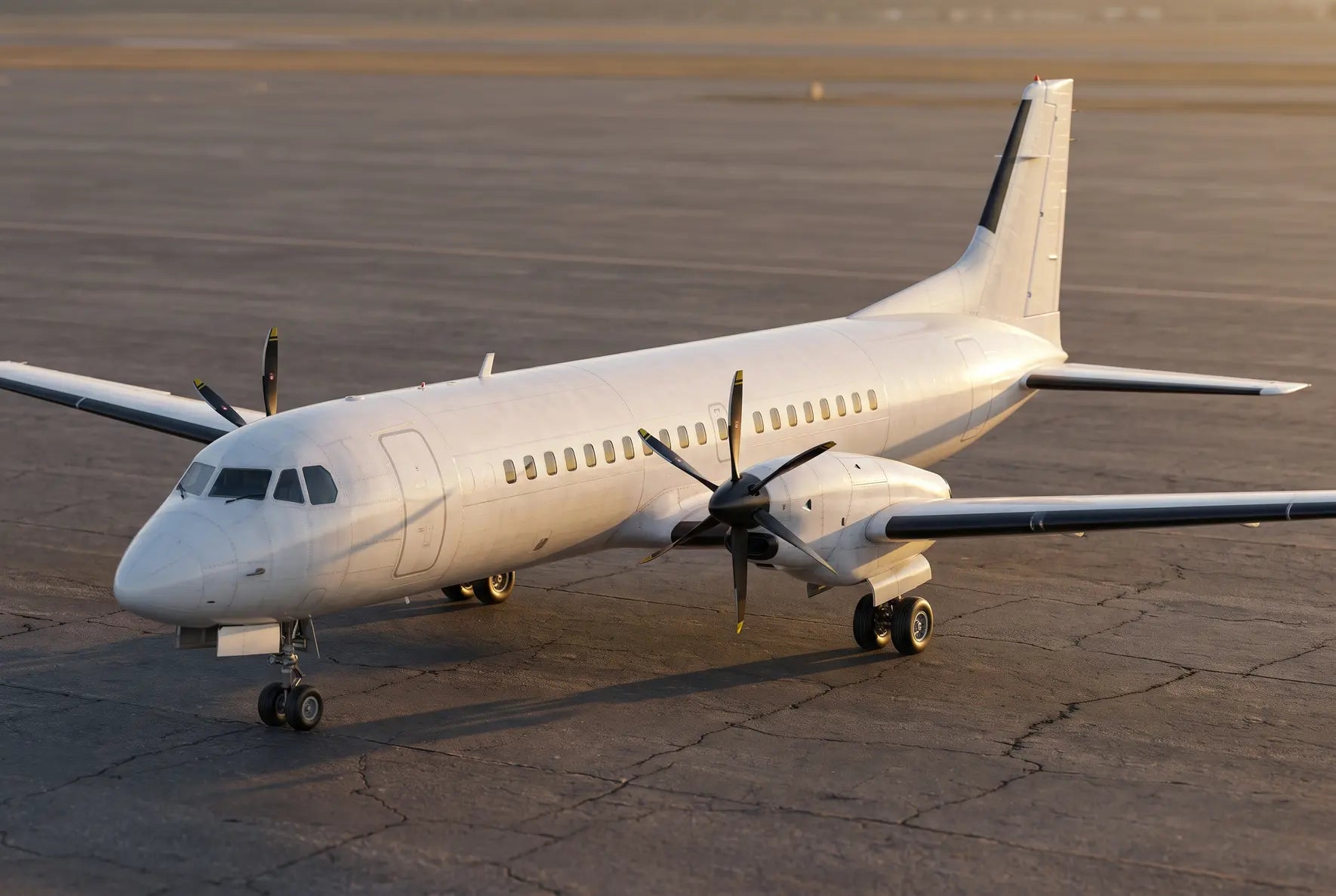
The ATP was an evolution rather than a clean-sheet design, but the differences are substantial. The 748 fuselage was stretched by roughly 5.5 m to seat around 64 passengers (with high-density layouts quoted up to 72), compared with the 40 to 50 seats typical of the 748. The Rolls-Royce Dart engines of the 748 gave way to Pratt & Whitney Canada PW126 turboprops driving six-blade, slow-turning propellers, cutting external and cabin noise while improving fuel efficiency. Refined aerodynamics, structural updates and a more modern flight deck completed the transformation.
The following points summarise the main variant identifiers verifiable from authoritative sources:
- Engines: two Pratt & Whitney Canada PW126 or PW126A turboprops, roughly 1,978 kW (2,653 shp) each.
- Propellers: six-blade BAe/Hamilton Standard composite, constant-speed, about 4.19 m diameter.
- Dimensions: length 26.00 m; wingspan 30.63 m.
- MTOW: primarily 22,930 kg (50,550 lb), with higher-weight configurations quoted up to about 23,678 kg.
- Performance: cruise speed around 496 km/h (268 kt); range near 1,825 km (985 nmi) with a typical passenger load.
- Later designation: re-launched as the Jetstream 61 from 1992.
Commercial difficulties and the Jetstream 61
The ATP entered a market already dominated by the ATR 42/72 and the de Havilland Canada Dash 8, both established with strong support networks. By the time the ATP reached service in 1988, roughly two years after first flight, its rivals held a decisive head start. Sales stayed modest, and the 1992 Jetstream 61 re-launch, whose prototype flew in May 1994, failed to reverse the trend: only four aircraft were completed to that standard. British Aerospace ultimately withdrew from the segment after fewer than 70 airframes.
Despite limited commercial success, the ATP earned a reputation for good short-field performance and low noise, and many airframes found a long second life as freighters, with operators such as West Atlantic flying the type into 2023. For readers following the wider regional-aviation and pilot-training landscape shaped by carriers like Iberia, our coverage of the FTE Jerez and Iberia cadet programme offers useful context on how the industry has evolved since the turboprop era.

An Atlantic Airlines Bae ATP aircraft, registration G-BTPJ, is captured mid-flight against a cloudy sky. The plane's landing gear is extended as it prepares to descend.
BAe ATP Technical Specifications, Systems and Engine Details
The British Aerospace ATP (Advanced Turbo-Prop) was conceived as a quiet, fuel-efficient regional airliner for short and medium sectors, typically carrying around 64 passengers in a single-class layout. It was developed as a stretched, modernised derivative of the Hawker Siddeley HS 748, retaining that aircraft's proven structural concept while adding aerodynamic refinements, an updated flight deck and new engines. The core design trade-off favoured low noise, low fuel burn and good short-field performance over outright speed, positioning the ATP against contemporaries such as the ATR 72 and Fokker 50 rather than against regional jets.
For pilots and engineers, the aircraft's defining traits are its large, low-loaded wing, its slow-turning six-blade propellers and its modest cruise altitude, all of which reflect a mission built around frequent cycles into secondary airports. Operators seeking a comparable but larger four-engine widebody study can review our overview of the Boeing 747-400.
- Length: 26.00 m (85 ft 4 in)
- Wingspan: 30.63 m (100 ft 6 in)
- Height: 7.14 m (23 ft 5 in)
- Wing area: 78.3 m² (approx. 843 ft²)
- MTOW: 22,930 kg (50,552 lb) standard, with an optional 23,678 kg (52,200 lb)
- Maximum landing weight: approx. 23,133 kg (51,000 lb)
- Fuel capacity: 6,364 L (approx. 1,681 US gal)
- Engines: 2 × Pratt & Whitney Canada PW126/PW126A
- Power: approx. 1,978 kW (2,653 shp) per engine
- Propellers: six-blade BAe/Hamilton Standard, 4.19 m (13 ft 9 in) diameter
- Cruise speed: approx. 490–496 km/h (265–268 kt)
- Range: approx. 1,825 km (985 nm) with 64 passengers
- Service ceiling: 25,000 ft (approx. 7,600 m)
- Typical field length: takeoff approx. 1,350–1,460 m, landing approx. 1,130 m
Systems and handling-relevant technology
The ATP was operated by a crew of two and introduced a modernised flight deck relative to the HS 748, with a more integrated instrument layout, dual navigation and communication radios, weather radar and an autopilot suitable for regional IFR operations; the exact line-fit avionics varied by operator. The six-blade, low-tip-speed propellers were central to the aircraft's low community-noise signature, working together with the new-generation PW126 engines to reduce cabin and external noise compared with earlier four-blade turboprops. Handling reflects a large, forgiving wing that supports the relatively short field lengths quoted above, while the airframe was designed for high-cycle regional service with maintainability in mind.
Published performance figures for the ATP vary between sources, and this is normal. Numbers depend on the selected MTOW option (22,930 kg versus 23,678 kg), cabin density (64 up to roughly 72 seats), payload and reserve assumptions, and atmospheric and runway conditions. As a result, values such as range, takeoff distance and cruise speed should be read as representative envelopes rather than fixed absolutes, and any given tail number may perform differently depending on its configuration and the day's conditions. Independent summaries such as those held by SKYbrary are useful cross-references for operational context.
Engines: the Pratt & Whitney Canada PW100 family
The ATP is powered by two Pratt & Whitney Canada PW126/PW126A turboprops, members of the PW100 family produced by Pratt & Whitney Canada, the Longueuil, Québec subsidiary long associated with small and medium gas turbines. The PW100 began as a technology demonstrator in 1977, first flew on a Vickers Viscount testbed in 1982 and entered airline service in December 1984 on the de Havilland Canada Dash 8. It was launched to extend the company's turboprop offering above the roughly 1,000 shp ceiling of the earlier PT6A, ultimately covering a class from about 1,800 shp to more than 5,000 shp.
The PW100 uses an uncommon three-shaft layout, with a gas-generator core and a separate free power turbine driving a reduction gearbox and propeller. The PW126/PW126A sit in the family's mid-range power bracket, alongside the PW120-series variants used by comparable regional aircraft. The wider PW100 family powers a broad fleet including the ATR 42 and ATR 72, the Dash 8/Q Series, the Fokker 50 and the Embraer EMB-120 Brasilia, with the high-power PW150 later developed for the Dash 8-400 (Q400). According to the manufacturer, the PW100 family has grown to close to 3,000 aircraft in service worldwide and accumulated roughly 200 million flight hours, making the ATP's powerplant part of one of the most widely used regional turboprop lineages in service.
BAe ATP vs ATR 72-200 vs Dash 8-300 vs Fokker 50: Regional Turboprop Specifications
Scroll horizontally to see more →
| Parameter | BAe ATP | ATR 72-200 | De Havilland Canada DHC-8-300 (Dash 8-300) | Fokker 50 |
|---|---|---|---|---|
| Entry into service | 1988 | 1989 | 1989 | 1987 |
| Engines | 2 × Pratt & Whitney Canada PW126A turboprops | 2 × Pratt & Whitney Canada PW124B turboprops | 2 × Pratt & Whitney Canada PW123 turboprops | 2 × Pratt & Whitney Canada PW125B turboprops |
| Length | 26.0 m | 27.2 m | 25.7 m | 25.3 m |
| Wingspan | 30.6 m | 27.1 m | 27.4 m | 29.0 m |
| Height | 7.1 m | 7.7 m | 7.5 m | 8.5 m |
| Typical seating and layout (short description + approximate passengers) | 1-class: 64–72 passengers | 1-class: 68–74 passengers | 1-class: 50–56 passengers | 1-class: 50–58 passengers |
| MTOW | 23.7 t | 21.5 t | 18.6 t | 20.8 t |
| Range | 985 nm | 890 nm | 920 nm | 1,080 nm |
| Cruise speed | 0.44 Mach | 0.41 Mach | 0.42 Mach | 0.42 Mach |
| Service ceiling | 25,000 ft | 25,000 ft | 25,000 ft | 25,000 ft |
| Program note | Noise-reduced British turboprop developed from the HS 748, targeting regional routes with improved fuel efficiency and cabin comfort. | Stretched derivative of the ATR 42, positioned as a high-capacity regional turboprop widely used on short-haul feeder services. | Mid-size member of the Dash 8 family, optimized for short to medium regional sectors with strong performance from shorter runways. | European regional turboprop successor to the F27, positioned as a versatile short-haul aircraft for medium-density routes. |
Scroll horizontally to see more →
The table compares key specs of four late-1980s regional turboprops, showing how capacity and performance differ. The BAe ATP and ATR 72-200 offer the highest typical seating (about 64–74), while the Dash 8-300 and Fokker 50 are smaller (about 50–58). Ranges are close, but the Fokker 50 leads at 1,080 nm, ahead of the ATP (985 nm) and ATR 72-200 (890 nm). MTOW is highest for the ATP (23.7 t), and cruise speeds cluster around 0.41–0.44 Mach with the same 25,000 ft ceiling.
BAe ATP Operations: Routes, Missions and Airlines Worldwide
The BAe ATP was conceived as a short-haul regional turboprop, seating roughly 64 to 72 passengers four-abreast and cruising at about 265 to 268 knots (490 to 496 km/h) near 15,000 ft. Typical passenger sectors ran between 300 and 800 nautical miles (about 550 to 1,480 km), translating to block times of roughly 1.2 to 3.5 hours. Maximum practical passenger range reached about 985 nmi (1,825 km) with a reduced load, while full payload plus reserves cut range to around 340 nmi (630 km), so operators had to plan payload-range trade-offs carefully. Technical figures are documented by British Aerospace ATP references and the SKYbrary aircraft profile.
As a regional airliner, the type suited both hub-and-spoke feeding and point-to-point links, typically flying four to eight short sectors per day. It was valued for its economy on short legs and its ability to serve secondary and regional airports with modest runways and limited facilities. Challenges included slower block times than regional jets on longer routes, a small production run of 64 aircraft that limited fleet commonality and spares support, and the high-cycle wear inherent to frequent short-sector flying. Many airframes were later converted to full freighters for overnight parcel and mail work.
Where the BAe ATP Operates
The aircraft was overwhelmingly a European type, with additional passenger and cargo use across Asia, and later charter or freight roles in Africa and North America. Across Europe, it served as a regional feeder for major flag carriers and as the region's dominant turboprop freighter until European operations ended in 2023. In North America it flew United Express feeder routes, while confirmed South America use is not well documented. In Asia it linked domestic and remote airports, and in Africa it appeared in late-career charter and cargo service. The type's history is summarised by Key.Aero.
- Europe: British Airways was the largest customer, using the type on domestic and Scottish Highland feeders that later passed to British Regional Airlines and BA Connect; Loganair and Manx Airlines flew island and BA-branded services; Sun-Air of Scandinavia operated BA-franchise routes; Air Europa Express ran up to 17 aircraft on Spanish domestic trunk and island routes; SATA Air Acores served the Azores; NextJet was Europe's last passenger operator until 2018; and West Air Sweden (West Atlantic) flew the largest cargo fleet, including the final European flight in 2023.
- North & South America: Air Wisconsin and United Feeder Service operated the type in United Express regional passenger service into hubs such as Chicago, while Wings West Airlines briefly flew a single aircraft in the US West. Documented scheduled South America operators are not corroborated by authoritative sources.
- Asia: Merpati Nusantara Airlines operated about five aircraft on Indonesian domestic routes; Deraya Air Taxi used them for cargo and charter work; Asian Spirit flew Philippine inter-island services; Biman Bangladesh Airlines operated two on short-haul routes from Dhaka; and First Flight Couriers in India used the type for express freight.
- Africa: late-career use included AeroSpace Consortium in Kenya, operating passenger and cargo aircraft on East African charter and freight work, with African operators among the last to fly the type before certificate withdrawal.
Typical Seating and Cabin Layouts
Network and regional passenger operators generally configured the cabin around 68 to 72 single-class economy seats, four-abreast, replacing older 50 to 60 seat types such as the Hawker Siddeley 748. Leisure and domestic trunk operators like Air Europa Express favoured the high-density 72-seat layout, while some carriers such as SATA Air Acores used modified doors for special cargo alongside passenger seating. From the 2010s, most surviving airframes were all-cargo ATP Freighter conversions with reinforced floors and large cargo doors, removing passenger seating entirely. Manufacturer and heritage detail is available via BAE Systems Heritage and current BAE Systems Regional Aircraft support pages. Readers exploring related turboprop and regional operations may also find context in this overview of Frontier Airlines operations.
In this video, learn how BAE Systems withdrew the BAe ATP type certificate, marking the end of formal support for the aircraft from 1986 to 2025, and what this decision means for operators and the fleet.
BAe ATP Safety Record: How Safe Is This Regional Turboprop?
The BAe ATP (Advanced Turbo-Prop), later marketed as the BAe Jetstream 61, was a British Aerospace regional airliner that first flew on 6 August 1986 and entered scheduled service in 1988. With only 65 airframes built and a modest fleet spread across operators in Europe, Asia and later in freight and humanitarian roles, its total exposure was small compared with mass-produced turboprops such as the ATR 72 or the Bombardier Dash 8. Across roughly three decades of service, the type recorded a limited number of hull-loss events, with the Aviation Safety Network type database listing only two fatal accidents, together accounting for 50 fatalities. Set against several hundred thousand sectors flown by the worldwide fleet, this places the aircraft within the expected safety range for a certified Western-built turboprop of its generation.
Notable accidents and what changed afterwards
- Merpati Nusantara Airlines Flight 106 (1997, Indonesia). On 19 April 1997 an ATP (PK-MTX) on approach to Buluh Tumbang Airport, Tanjung Pandan, in poor weather entered a steep left bank at around 2,000 ft and departed controlled flight, impacting short of the runway. Fifteen of the 53 occupants died. The event is classified as a loss of control on approach and reinforced the wider industry emphasis on approach-and-landing accident reduction and crew handling in adverse weather.
- SATA Air Acores (1999, Azores). On 11 December 1999 an inter-island ATP flew into rising terrain near Sao Jorge Island during an approach in reduced visibility, with 35 fatalities. The Portuguese investigation classified it as controlled flight into terrain (CFIT), citing loss of terrain awareness and descent below a safe flight path. Accidents of this profile drove the accelerated adoption of Terrain Awareness and Warning Systems (TAWS/EGPWS) and improved approach procedures across regional operations.
- Manx Airlines (1997, Manchester, UK). A landing-gear retraction fault damaged the gear after takeoff, with no injuries. The Air Accidents Investigation Branch (AAIB) recommended revising the ATP Emergency and Abnormal Checklist in line with CAP 676 guidance, an example of documentation and procedural refinement following a technical defect.
- Aurigny Air Services (2021, Isle of Man). An AAIB report addressed an autopilot that failed to disengage before landing at Ronaldsway, with no injuries, illustrating continued in-service safety monitoring of the type late in its operational life.
How safe is the BAe ATP?
Judged by accident rate against traffic volume, the ATP performed in line with comparable regional turboprops: two fatal accidents from a fleet of 65 aircraft over decades of service is a low absolute count, and both fatal events involved approach-phase factors rather than fundamental airframe or engine failures. The design followed conventional certification standards of its era, with proven Pratt & Whitney Canada PW126 engines, standard operating procedures, recurrent crew training and regulatory oversight from the UK CAA and later EASA, whose type-certification framework governed continued airworthiness until manufacturer support was withdrawn in 2025. For context on how these figures compare across the industry, the Yakovlev Yak-40 offers a useful comparison of a contemporary regional design, while broad statistics compiled by the International Air Transport Association (IATA) confirm the long-term downward trend in accident rates. Overall, the evidence supports the wider conclusion that commercial aviation remains one of the safest modes of transport.
01 What kind of routes and mission profile is the BAe ATP typically used for?
The BAe ATP was designed primarily for short- to medium-haul regional routes, typically up to about 1,500–1,800 km depending on payload and configuration. It has often been used on high-frequency services between secondary cities, busy commuter links, and thinner routes where a jet would be uneconomical. Cargo-converted ATPs now commonly operate overnight express parcel and feeder freight flights. Its performance makes it well suited to airports with shorter runways and more challenging weather conditions, which is why it has seen extensive use in Northern Europe and Scandinavia.
02 How is the cabin layout and passenger comfort on the BAe ATP?
The BAe ATP passenger cabin was typically laid out in a 2-2 seating configuration, giving four seats per row with an aisle down the middle, similar to other regional turboprops of its era. The fuselage is relatively long and narrow, so overhead space is modest but adequate for standard carry-on bags. Compared with earlier turboprops, the ATP introduced improved soundproofing and propeller design to reduce cabin noise, so the environment is generally quieter than older types like the HS 748. Passengers usually experience a firm but comfortable ride, with a cabin ambience more comparable to classic regional jets than to older noisy turboprops.
03 How noisy is the BAe ATP in flight compared with other regional turboprops?
The BAe ATP was specifically engineered to offer lower noise levels than many earlier-generation turboprops, including its HS 748 predecessor. Use of six-bladed Dowty-Rotol propellers and attention to vibration damping results in a noticeable reduction in propeller drone in the cabin. While there is still the characteristic turboprop hum and some vibration, passengers seated around the wing area generally find the noise level acceptable and conversation possible without raising voices. From a community perspective, the ATP was developed to meet increasingly strict airport noise regulations, which made it attractive for operations into noise-sensitive airports.
04 Which airlines have operated the BAe ATP and on what kinds of routes?
The BAe ATP has been operated by several European regional carriers, including British Airways subsidiaries, Air Europe Express, and Scandinavian and UK regional airlines, often on domestic and near-international routes. Typical services included UK domestic sectors such as London–Manchester or Glasgow, Scandinavian intra-regional flights, and links between smaller European cities and major hubs. In later years, many aircraft transitioned to dedicated cargo operators for express freight and postal services, reflecting the type’s good economics in lower-density markets. Today, passenger operations are rare, but the aircraft remains visible in specialized cargo and charter roles.
05 How does the performance and fuel efficiency of the BAe ATP compare with similar aircraft?
The BAe ATP was designed as a fuel-efficient replacement for older turboprops, using Rolls-Royce Dart-derived engines and aerodynamic improvements to reduce fuel burn per seat. Its cruising speed is lower than that of regional jets but comparable to other turboprops such as the ATR 42, making it well suited to sectors of one to two hours where jets gain little time advantage. The aircraft’s economics are strongest on routes with moderate passenger demand, where its capacity is well matched and its fuel efficiency offsets slower cruise speeds. Short-field performance is solid, allowing operations from regional airports where larger jets might face limitations.
06 What should a traveller know about safety, turbulence behaviour, and seat choice on the BAe ATP?
The BAe ATP has a conventional, robust design with a safety record in line with other Western-built regional turboprops of its generation, and it has been operated under strict European regulatory oversight. As with most turboprops, the aircraft tends to fly at slightly lower altitudes than jets on shorter routes, so passengers may feel turbulence a bit more distinctly, especially over mountainous or coastal areas. Travellers seeking a smoother ride often prefer seats near the wing, where motion is reduced and noise is moderate. For views outside, seats ahead of the wing typically offer the best visibility, while avoiding seats directly adjacent to the propellers can make the cabin experience more comfortable for noise-sensitive passengers.