History and Development of the Lockheed Model 14 Super Electra
The Lockheed Model 14 Super Electra was conceived in the mid-1930s as a larger, faster successor to the company's twin-engine Electra line. Where the earlier Model 10 Electra seated ten and the Model 12 Electra Junior was a scaled-down feederliner, the Model 14 grew the concept upward to carry 12 to 14 passengers. Its purpose was direct and commercial: to challenge the Douglas DC-2 and DC-3 and the Boeing 247 on the main routes where the smaller Electra had been outclassed on capacity and economics.
The manufacturer and the program
The Lockheed Aircraft Corporation of Burbank, California, had established itself by the mid-1930s as a leader in advanced all-metal, high-speed transports. The Model 10 Electra was its first successful modern twin, and the firm evolved that lineage rapidly into the Model 12, the Model 14, and the military derivatives that followed. The young aerodynamicist Clarence "Kelly" Johnson, whose work on tail design and high-lift devices shaped the whole Electra family, provided the aerodynamic foundation for the Super Electra, while Don Palmer led day-to-day project engineering.
The aircraft moved quickly from drawing board to flight. Detailed engineering was essentially complete by early 1937, with roughly US $5 million in orders already placed. The prototype made its first flight on 29 July 1937, flown by Lockheed test pilot Marshall Headle. Deliveries and early airline operations followed in late 1937 and 1938.
What distinguishes the Super Electra
The Model 14 differed from its Electra predecessors in scale and aerodynamic sophistication. It introduced Fowler-type trailing-edge flaps, which increased both wing area and camber on extension, allowing low approach and landing speeds despite a high cruise speed. It retained the family's twin-fin and rudder tail and all-metal stressed-skin low-wing structure. Early machines used Pratt & Whitney Hornet radials, while many production aircraft adopted Wright Cyclone engines; the aircraft Lockheed prepared for Howard Hughes was fitted with 1,100-hp engines. The flutter and stability lessons learned during earlier Electra development were applied here, so the Model 14 entered service without the systemic aeroelastic problems associated with that earlier work.
The following identifiers help separate the Super Electra from the closest sub-variants:
- Capacity: 12 to 14 passengers, against ten for the Model 10 and a smaller cabin for the Model 12
- Engines: Pratt & Whitney Hornet radials on early aircraft; Wright Cyclone radials on many production examples
- High-lift system: Fowler flaps, a defining feature versus the simpler flaps of earlier Electras
- Performance: maximum speed about 250 mph, cruise about 215 mph, service ceiling 24,500 ft, range about 740 nautical miles
- Configuration: all-metal low-wing monoplane with twin tail
The Super Electra earned early fame in 1938, when Howard Hughes flew a specially equipped Model 14 around the world from New York, covering roughly 14,672 miles in 71 hours, 11 minutes and averaging about 206 mph, a record for its day. The type sold strongly to foreign carriers, including Air France, Trans-Canada Air Lines, Northwest Airlines and Japanese operators.
Military and licensed derivatives
The airframe proved highly adaptable. Lockheed's militarized Model 414 became the Lockheed Hudson light bomber and maritime patrol aircraft, widely used by the Royal Air Force, the U.S. Army Air Forces and the U.S. Navy, with the larger Ventura following the same lineage. Licensed production in Japan exceeded Lockheed's own output: Tachikawa built 119 Type LO transports (Allied name "Thelma"), and Kawasaki produced 121 of the lengthened Ki-56 cargo version (Allied name "Thalia"). Lockheed itself built around 112 to 114 aircraft, for a combined family total often cited as 354. The aircraft's enduring transport role echoes in the work of later dedicated cargo operators such as ABX Air, which carried forward the freight mission these early twins helped pioneer.

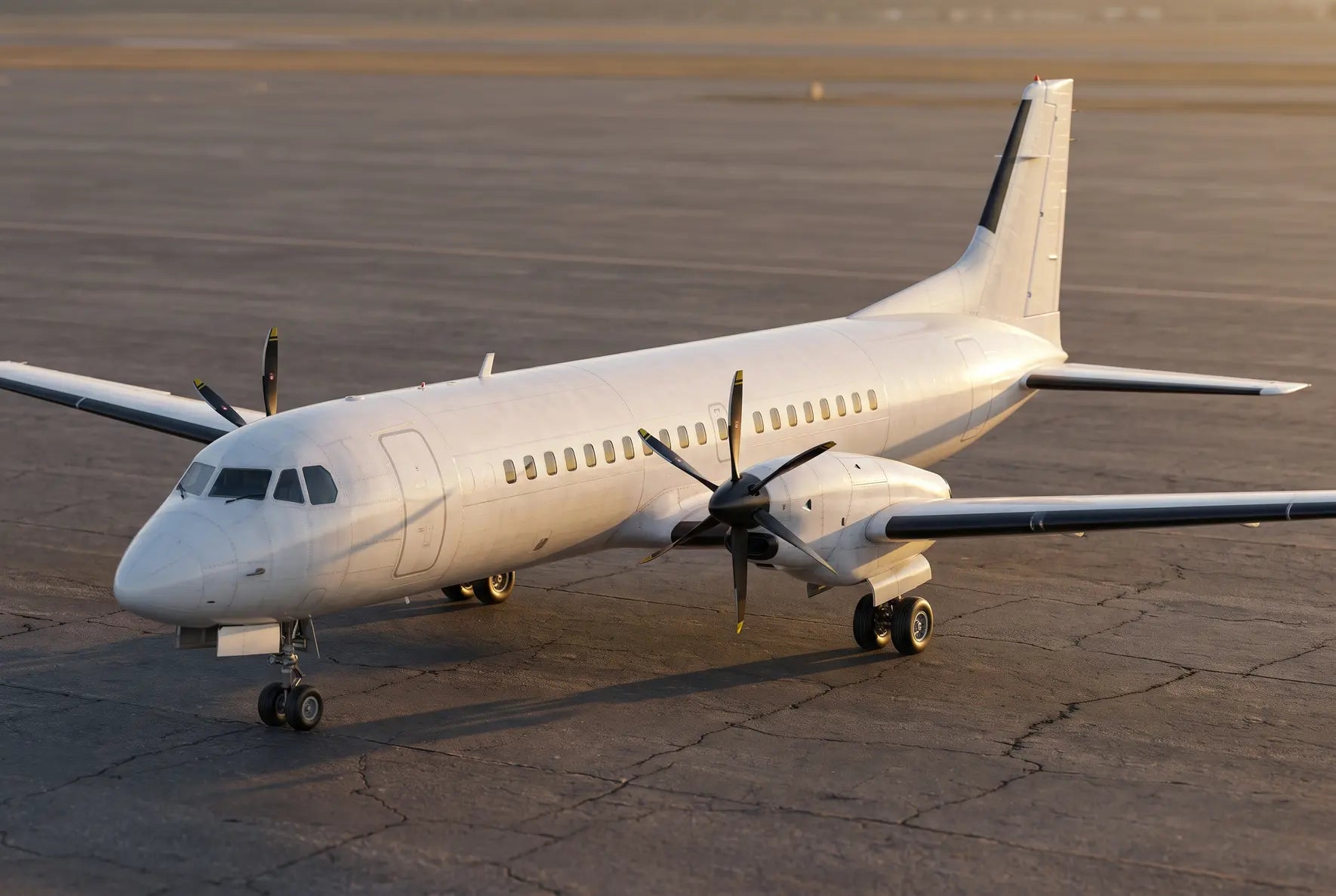
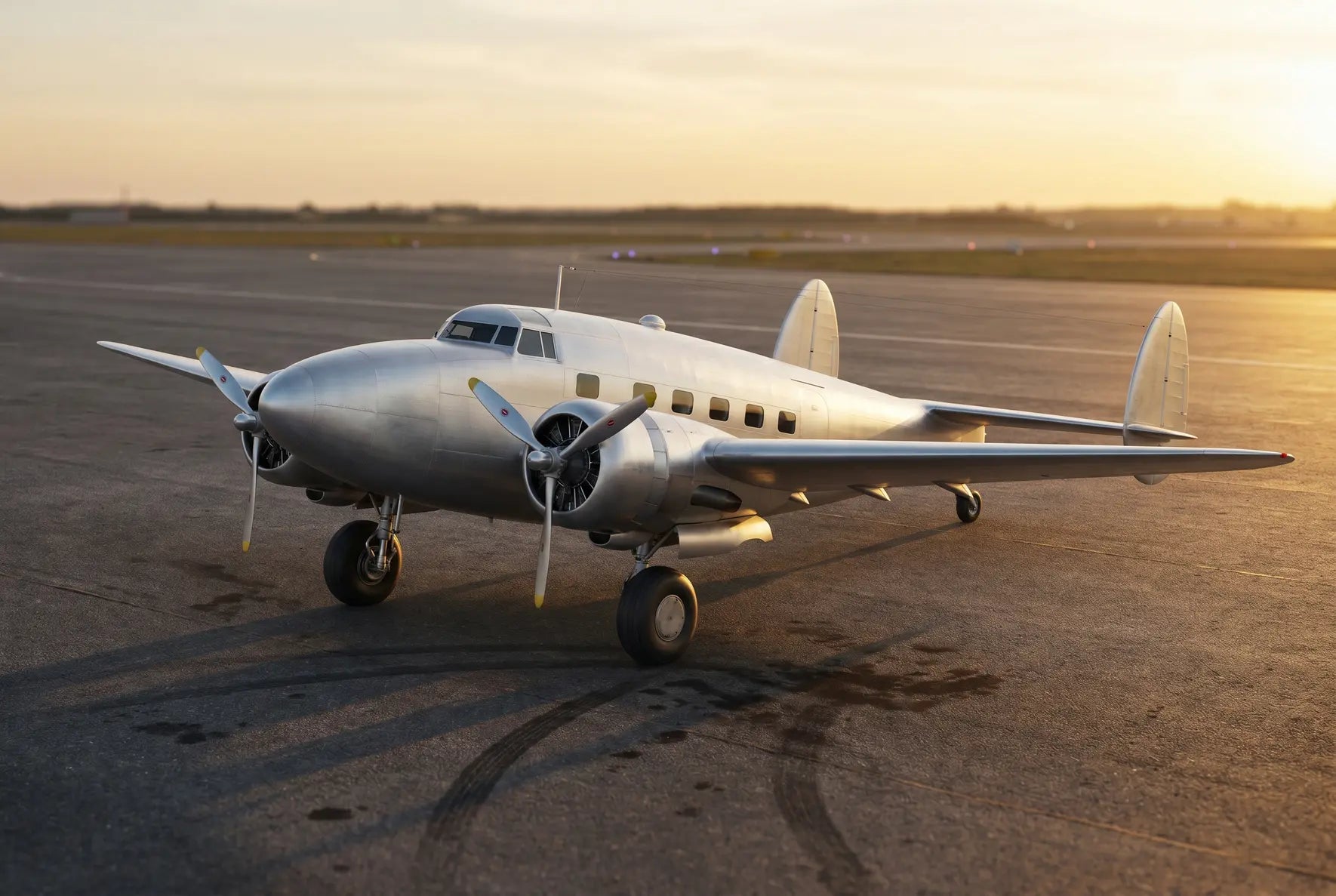
A vintage Lockheed Model 14 Super Electra airplane marked with KLM logo is parked on a tarmac. The aircraft, with dual propellers, exhibits a sleek, streamlined design reminiscent of the early era of commercial aviation.
Lockheed Model 14 Super Electra: Specifications, Systems and Engines
The Lockheed Model 14 Super Electra was a twin-engine, all-metal, low-wing airliner introduced in 1937 to carry roughly 12 to 14 passengers with a crew of two. It was conceived as a faster, larger successor to the Lockheed Model 10 Electra, intended to challenge the Boeing 247 and the Douglas DC-2 in medium-capacity service. From the Model 10 it inherited Lockheed's clean aerodynamic philosophy, all-metal construction and the distinctive twin-tail layout, scaled up for greater payload.
The central design trade-off was size and payload against structural complexity and cost. To preserve a speed advantage over the DC-3 class while keeping approach speeds manageable, Lockheed fitted Fowler flaps, which increased wing area and lift on takeoff and landing. According to Lockheed Martin's own historical record, these new Fowler flaps were a defining competitive feature of the Super Electra.
- Wingspan: 65 ft 6 in (19.96 m)
- Length: 44 ft 4 in (13.51 m)
- Height: 11 ft 5 in (3.48 m)
- Wing area: 551 sq ft (51.19 m²)
- Empty weight: approx. 10,750 lb (4,876 kg), 14-WF62 airliner
- Gross weight: approx. 15,650 lb (7,099 kg)
- Maximum takeoff weight: 17,500 lb (7,938 kg)
- Fuel capacity: 644 US gal (2,440 L)
- Maximum speed: approx. 250 mph (402 km/h) at low altitude
- Cruise speed: approx. 215 mph (346 km/h)
- Range: approx. 850 mi (1,370 km) at maximum takeoff weight; longer figures apply to economy-cruise and ferry conditions
- Service ceiling: approx. 24,500 ft (7,468 m)
- Engines: two 9-cylinder air-cooled radials, Pratt & Whitney Hornet or Wright Cyclone depending on variant
Systems and Handling-Relevant Technology
The Super Electra was a conventional twin-engine low-wing transport with manual flight controls and Lockheed's characteristic twin vertical tails. Its retractable landing gear with tailwheel reduced drag and supported the higher cruise speeds that distinguished the type. The Fowler flap system was the most significant high-lift technology of the airframe, lowering approach and landing speeds and improving short-field behaviour relative to simpler split-flap designs of the period.
The airframe proved robust enough to serve as the basis for the militarised Lockheed Hudson, a maritime patrol and light bomber derivative. The design was also produced under licence in Japan by Tachikawa and Kawasaki, contributing to a total output frequently cited at around 354 aircraft, including about 114 built by Lockheed and roughly 240 in Japan.
Published performance figures for the Model 14 vary across sources because the type was offered in several engine and weight configurations, and because numbers depend on cabin density, loaded weight, altitude, power setting and atmospheric assumptions. Cruise and range values quoted at 50 percent power, for example, differ substantially from full-gross airline figures, so individual numbers should be read in the context of their stated test conditions rather than as absolute limits. Operators in the period included Northwest Airlines, Pan American Airways, Air France and Trans-Canada Air Lines, and the type's reach can be appreciated alongside the heritage of carriers profiled in our overview of Porter Airlines.
Engines and Powerplant Options
The earliest variants, the Model 14-H and 14-H2, used the Pratt & Whitney R-1690 Hornet, a single-row, 9-cylinder air-cooled radial rated at about 750 hp on the 14-H and roughly 800 hp on the 14-H2 with the Hornet S1E2G. Pratt & Whitney introduced the Hornet in the late 1920s as a larger companion to the Wasp, and the R-1690 family powered contemporaries such as the Boeing Model 40 and the Douglas Dolphin.
Most production aircraft, including the standard 14-WF62 airliner, used the Wright R-1820 Cyclone 9-cylinder radial. The GR-1820-F62 was commonly rated around 900 hp normal with up to 1,000 hp for takeoff, while the 14-G3B used the GR-1820-G3B at about 820 hp. The later 14-N series, including the long-range 14-N2, employed the GR-1820-G102 at 900 hp normal and up to 1,100 hp for takeoff. The R-1820 Cyclone was one of the most widely produced radials of its era, sharing its core design lineage with engines that powered Cyclone-equipped Douglas DC-3 variants, the Boeing B-17 Flying Fortress and the Douglas SBD Dauntless, which underlines the broad industrial maturity behind the Super Electra's powerplant.
Lockheed Model 14 Super Electra vs Model 10 Electra, Model 18 Lodestar and Douglas DC-3 Specifications
Scroll horizontally to see more →
| Parameter | Lockheed Model 14 Super Electra | Lockheed Model 10 Electra | Lockheed Model 18 Lodestar | Douglas DC-3 |
|---|---|---|---|---|
| Entry into service | 1937 | 1935 | 1940 | 1936 |
| Engines | 2 × Wright SGR-1820-F62 Cyclone radial engines | 2 × Pratt & Whitney R-985 Wasp Junior radial engines | 2 × Pratt & Whitney R-1830 Twin Wasp radial engines | 2 × Pratt & Whitney R-1830 Twin Wasp radial engines |
| Length | 13.5 m | 11.9 m | 15.2 m | 19.7 m |
| Wingspan | 20.0 m | 16.8 m | 21.9 m | 29.1 m |
| Height | 3.6 m | 3.1 m | 4.6 m | 5.2 m |
| Typical seating and layout (short description + approximate passengers) | Single-class: 12–14 passengers | Single-class: 10 passengers | Single-class: 14–18 passengers | Single-class: 21–32 passengers |
| MTOW | 7.9 t | 4.5 t | 10.9 t | 11.4 t |
| Range | 1,080 nm | 750 nm | 1,700 nm | 1,500 nm |
| Cruise speed | 0.31 Mach | 0.25 Mach | 0.30 Mach | 0.26 Mach |
| Service ceiling | 24,500 ft | 19,000 ft | 22,300 ft | 23,200 ft |
| Program note | Enlarged, higher-performance successor to the Model 10 Electra, aimed at competing directly with the DC-3 on short- to medium-haul routes. | Baseline Lockheed twin-engined airliner of the early 1930s, providing the design foundation for the later Super Electra family. | Stretched and refined development of the Super Electra with more seats and improved economics for regional and medium-range services. | Benchmark contemporary airliner and major competitor, offering greater capacity and range for mainline short- and medium-haul operations. |
Scroll horizontally to see more →
The table compares core specifications of the Lockheed Model 14 Super Electra with the Model 10 Electra, Model 18 Lodestar, and Douglas DC-3. The Super Electra sits between the smaller Model 10 and larger DC-3, offering 12–14 seats and 1,080 nm range. The Lodestar improves range to 1,700 nm with 14–18 seats. The DC-3 leads in capacity (21–32) and size, while the Super Electra has the highest listed cruise Mach.
Routes, Missions and Airlines Flying the Lockheed Model 14 Super Electra Worldwide
The Lockheed Model 14 Super Electra was a fast, twin-engine, medium-range airliner of the late 1930s, designed as a larger, quicker development of the earlier Lockheed 10 Electra to compete directly with the Boeing 247 and Douglas DC-2. Carrying two pilots and typically 12 to 14 passengers, it cruised at roughly 215 mph (≈346 km/h) with a normal airline range of about 740 nautical miles (≈1,370 km), making it ideally suited to short and medium scheduled sectors.
In everyday service, operators flew the type on stage lengths well below its maximum range to preserve fuel reserves. Typical legs fell into three bands: short regional hops of 200–400 miles (≈320–640 km); medium sectors of 400–800 miles (≈640–1,280 km) covering international European or trans-regional North American routes; and longer over-water or colonial legs approaching 1,000–1,200 miles (≈1,600–1,900 km) where intermediate airfields were scarce. With high cruising speeds for its era, the aircraft enabled brisk daily utilisation on multi-leg point-to-point and feeder networks linking major cities with secondary and regional fields.
The principal operational challenge for operators lay in the late-1930s context: limited navigation infrastructure, modest payload margins on the longest sectors, and, from 1939 onward, widespread war losses and military requisitions that cut short many civil careers. The type's robust all-metal airframe nonetheless proved its strength, forming the basis of the Lockheed Hudson maritime patrol and bomber aircraft used extensively by Allied air forces.
Where the Lockheed Model 14 Super Electra Operates
The Super Electra saw service across all four broad regions. In Europe, it flew fast scheduled passenger routes between national capitals and Continental cities. Across North and South America, it served domestic trunk and feeder networks, mail contracts and regional sectors. In Asia and the Pacific, both U.S.-built and Japanese license-built examples operated airline and government transport duties. In Africa, it handled internal and regional services as well as wartime ferry and communications flights.
- Europe: KLM used it on medium-range European and Dutch colonial routes; LOT Polish Airlines bought the L-14H variant in 1938 for scheduled services radiating from Warsaw; Aer Lingus operated it on Ireland–UK and intra-European routes as its first modern all-metal twins; British Airways Ltd flew European trunk routes such as London–Berlin, famously carrying Neville Chamberlain back from Munich in 1938 aboard G-AFGN; Air France used it on short and medium European sectors; and Romania's LARES ran domestic and Balkan services.
- North & South America: Northwest Airlines was the launch customer, placing the type in service in October 1937 on Midwestern and Pacific Northwest routes; Trans-Canada Air Lines used it on early trans-continental and regional Canadian sectors; Continental Airlines flew domestic trunk routes in the western and central United States; and Aerovias Brasil operated it on domestic and regional passenger services in Brazil during the early 1940s.
- Asia: Dai Nippon Koku and predecessor Japanese carriers operated the type and its license-built derivatives (with about 240 built by Tachikawa and Kawasaki) on domestic and regional routes, often in mixed civil and government service; Guinea Airways flew it on demanding passenger and cargo routes across Australia and Papua New Guinea.
- Africa: South African Airways operated it on internal and regional routes, with several aircraft later impressed for wartime transport, ferry and communications duties across the continent.
Typical Seating and Cabin Layout
Civil Super Electras were consistently configured for 12 to 14 passengers in a single-aisle cabin. A common arrangement placed roughly six to seven rows of seats two-abreast, with a forward baggage compartment, additional aft baggage space and a rear lavatory. Conservative 12-seat fits favoured comfort and baggage allowance, while higher-density 14-seat layouts maximised capacity. Network carriers such as KLM and Northwest Airlines generally retained the standard scheduled-passenger trim, while special long-range examples, most notably Howard Hughes' modified Model 14-N2 used on his 1938 round-the-world flight of around 14,672 miles in just under four days, replaced cabin seating with navigation equipment, radios, bunks and additional fuel tanks. Detailed period figures and the type's development history are documented by the Lockheed Martin heritage pages and by contemporary aviation histories.
In this video, Flight Sim Historian Episode 467 takes a concise look at the often overlooked Lockheed Model 14 Super Electra, featuring its legacy and aircraft details as showcased in FSX:SE.
Safety Record of the Lockheed Model 14 Super Electra: How Safe Was It?
The Lockheed Model 14 Super Electra was a fast, all-metal twin engine airliner built in modest numbers, with roughly 230 to 350 airframes produced between 1937 and 1940 once Japanese licence production by Tachikawa and Kawasaki is included. After a first flight on 29 July 1937, the type entered front-line airline service in 1938 with operators such as Northwest Airlines, KLM, LOT, Sabena and partners of British Overseas Airways. Relative to this small fleet and a short primary career of only a few years before many aircraft were converted for wartime use, the Super Electra accumulated a noticeable cluster of hull losses, several involving fatalities. Accident databases such as the Aviation Safety Network document dozens of occurrences spread across stall events, terrain impacts in poor weather, and at least one structural failure, giving the type a troubled reputation in its earliest years of operation.
Notable accidents and what changed afterwards
A small number of events shaped how the aircraft was operated and refined.
- Northwest Airlines, 1938 (Montana, USA): An in-flight structural failure of a Super Electra is often cited as an early indicator of empennage and tailplane weaknesses. The investigation pointed toward reinforcement of the tail structure and closer inspection of attachment fittings, alongside concern over buffeting in turbulent airflow behind the wing and flaps.
- Northwest Airlines, July 1938 (Billings, USA): A take-off stall highlighted handling near the stall with the large Fowler flaps deployed, leading to revised flap-operating procedures, adjusted weight-and-balance limits and stricter loading instructions for operators.
- LOT Polish Airlines, July 1938 (Romania): A loss of all on board, with the official cause undetermined and contemporary suspicion of a weather-related event, reinforced the need for conservative speed margins and careful operation in adverse conditions.
- TACA de Nicaragua, 1946 (La Libertad): The deadliest single Super Electra accident, a take-off crash linked to overloading and short-strip performance, underlined the importance of accurate performance planning at austere airfields.
Many of these lessons carried directly into the militarised Lockheed Hudson, a maritime patrol and light bomber developed from the same airframe, which benefited from the structural strengthening and operating refinements identified during civil service. Detailed narratives of individual events can be cross-checked through the Bureau of Aircraft Accidents Archives.
How safe is the Lockheed Model 14 Super Electra?
Judged against modern standards, the Super Electra recorded a high loss rate for its small fleet, but that figure must be read in the context of late 1930s and 1940s aviation. Navigation aids were rudimentary, weather forecasting was limited, and many accidents reflected the operating environment, terrain and crew workload rather than a single systemic defect. Where genuine design weaknesses existed, notably tail buffeting and stall behaviour with full flaps, they were identified and corrected through structural reinforcement, revised standard operating procedures and stricter regulatory oversight by the authorities of the era. Readers comparing early piston airliners with today's regional turboprops can see how far certification and analysis have advanced by reviewing modern programmes such as the Xian MA700. Long-run statistics compiled by bodies such as the International Civil Aviation Organization confirm that risk per flight has fallen dramatically since the Super Electra's day. Despite its troubled early record, the type and its successors contributed to the iterative learning that defines the industry, and commercial aviation remains one of the safest modes of transport available today.
01 What kind of routes and range did the Lockheed Model 14 Super Electra typically fly?
The Lockheed Model 14 Super Electra was designed as a medium-range airliner, ideal for regional and intercity routes of around 800 to 1,400 km (about 500 to 850 miles). With additional tanks and ferry configuration, some aircraft flew much longer record flights, but in normal airline service it commonly linked major cities on sectors of 1 to 3 hours. Airlines such as Northwest Airlines, KLM and British Airways used it on busy passenger routes where higher speed and good climb performance were important. It was often positioned as a faster alternative to earlier twin‑engine transports on similar routes.
02 How many passengers could the Lockheed Model 14 Super Electra carry and what was the cabin like?
The Lockheed Model 14 Super Electra typically carried about 12 to 14 passengers in a single-aisle cabin with a crew of two pilots. Seating was usually in 2–1 or 2–2 arrangements depending on the airline’s layout, with relatively generous legroom by modern regional-jet standards but no stand-up headroom for most adults. The cabin was not pressurized, so flights were operated at altitudes where supplemental oxygen was not required, which also meant more exposure to turbulence and weather. Interior finishes were fairly comfortable for the era, with upholstered seats and basic heating and ventilation but no modern soundproofing or inflight entertainment.
03 How comfortable and noisy was a flight on the Lockheed Model 14 Super Electra?
As a 1930s all‑metal twin with radial piston engines mounted close to the fuselage, the Lockheed Model 14 Super Electra was noticeably louder than modern turboprop or jet aircraft. Passengers could expect strong engine noise and vibration, especially near the wing and propeller arc, although the cabin was considered acceptable by the standards of its time. The aircraft flew at relatively low altitudes, so views from the large windows were good, but weather and turbulence were felt more directly than in modern pressurized airliners. Comfort depended a lot on seating position; seats closer to the nose or tail tended to be slightly quieter than those over the wing.
04 Which airlines operated the Lockheed Model 14 Super Electra and on what kinds of services?
The Lockheed Model 14 Super Electra entered service with Northwest Airlines in the United States and was also operated by carriers such as KLM, British Airways (the prewar airline), and Aer Lingus. These airlines used it mainly on short‑ to medium‑haul trunk routes within North America and Europe, and on some regional international services. The type’s relatively high cruise speed for the late 1930s made it attractive on competitive routes where journey time mattered. Several aircraft were later adapted for military transport and patrol roles, especially as the design evolved into the Lockheed Hudson during World War II.
05 How did the Lockheed Model 14 Super Electra perform compared with similar aircraft like the DC-3?
The Lockheed Model 14 Super Electra was developed partly as a response to the Douglas DC‑3 and featured smaller wings with Fowler flaps to improve lift and performance. In many configurations it had a higher maximum and cruise speed than the DC‑3, with typical cruise around 215–230 mph, but it carried fewer passengers. Its range in standard airline layout was adequate for regional routes but generally shorter than a DC‑3 configured for longer sectors. Airlines valued the Model 14 for its speed and modern design, while the DC‑3 became more widespread because of its greater capacity, range flexibility, and large production numbers.
06 What is known about the safety and handling characteristics of the Lockheed Model 14 Super Electra?
The Lockheed Model 14 Super Electra was a conventional low‑wing, twin‑engine design with retractable landing gear and an H‑tail, drawing on experience from the earlier Model 10 Electra. It offered strong performance for its size, including good climb and relatively high cruise speed, but like other pre‑war piston twins it was flown without modern avionics, pressurization, or advanced ice‑protection systems. Its safety record reflects the era, with accidents more often linked to weather, navigation limitations, and operational factors rather than any single design flaw. The type’s basic airframe proved robust enough to be developed into the Lockheed Hudson, which served extensively in demanding wartime operations.