Ilyushin Il-96-400: History and Development of the Stretched Variant
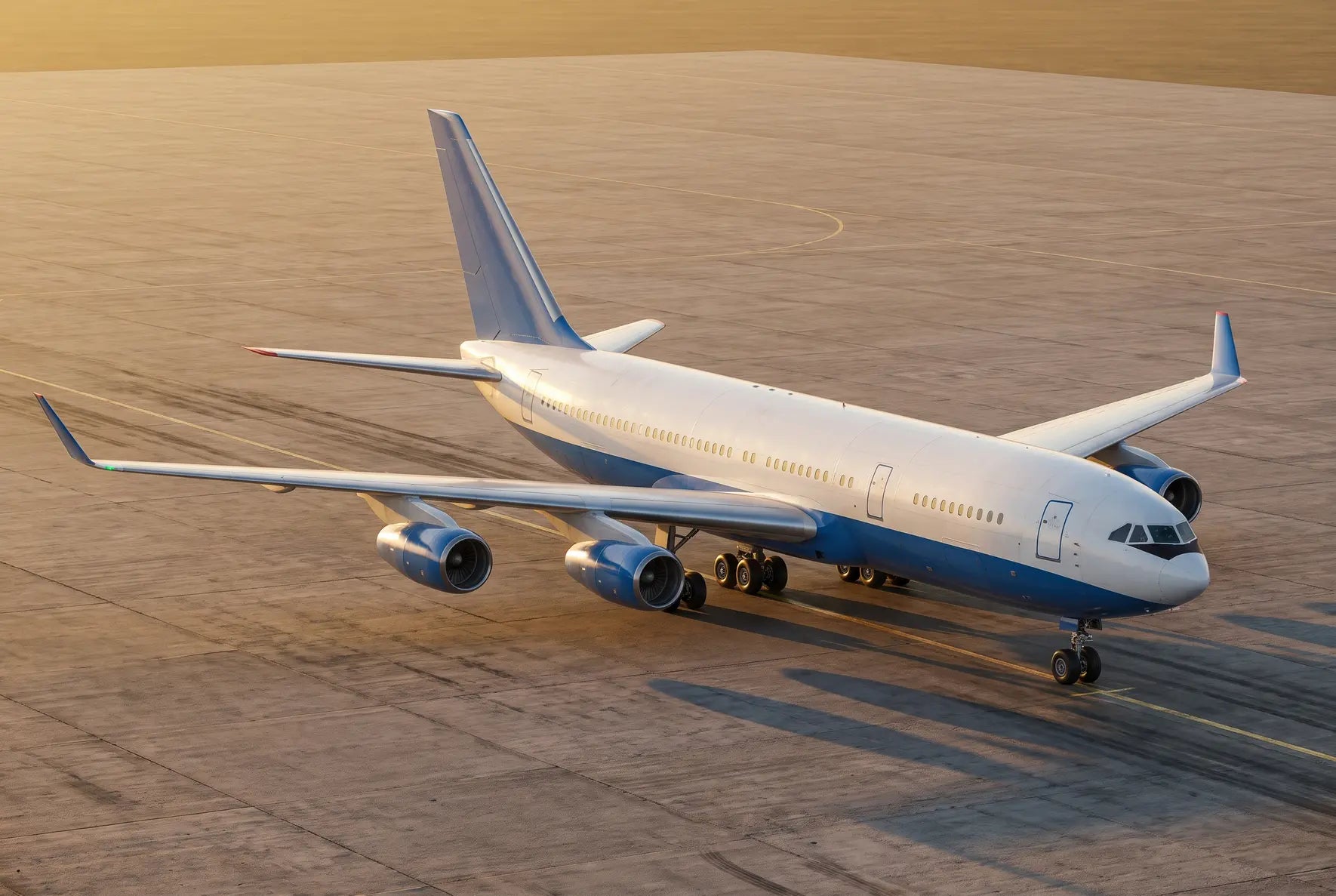
The Ilyushin Il-96-400 is the stretched, higher-capacity development of the Il-96 widebody family, engineered by the Ilyushin Design Bureau (OKB Ilyushin) and built by the Voronezh Aircraft Production Association (VASO), today part of Russia's United Aircraft Corporation (UAC). To understand why this variant exists, it helps to look at the family that produced it.
The Il-96 was conceived in the 1980s as a modernised, longer-range successor to the Il-86, giving the Soviet industry a competitive long-haul widebody able to challenge the Boeing 767/777 and Airbus A330. The base prototype, which became the Il-96-300, first flew on 28 September 1988, was certified in 1992, and entered service with Aeroflot in 1992-1993. It was the first Soviet/Russian long-range widebody, powered by four Aviadvigatel PS-90A turbofans.
The Il-96-400 grew out of the Il-96M/T concept, which explored a stretched fuselage originally intended for Western engines and avionics. The Il-96-400 reuses that lengthened body, roughly 9 m longer than the Il-96-300, but with Russian PS-90A1 powerplants and Russian systems. The aim was clear: more capacity and payload than the Il-96-300, offered in passenger, freighter and special-mission forms. The dedicated freighter, the Il-96-400T, first flew on 16 May 1997 and entered commercial service in 2009. Passenger airframes were completed only slowly, with long gaps between individual aircraft, reflecting limited airline demand.
What sets the Il-96-400 apart
The defining difference from the Il-96-300 is the stretched fuselage, which raises typical three-class seating to around 375 passengers and up to roughly 436 in high-density layouts, while range with a 315-passenger three-class cabin sits near 10,000 km. The Il-96-400T freighter adds a large forward cargo door measuring about 3.6 m by 2.6 m. Engines also mark the variant: the shift from the PS-90A of the Il-96-300 to the PS-90A1 series, retaining the four-engine layout with improved output. The later Il-96-400M, announced in 2017 and flown for the first time on 1 November 2023 as prototype RA-96115, extends the concept further with a 9.35 m stretch over the Il-96-300, upgraded PS-90A3M engines, modernised avionics and a revised cabin for up to about 370 seats.
The main variant identifiers that distinguish the Il-96-400 from its closest relatives are summarised below:
- Fuselage: approximately 9 m longer than the Il-96-300 (9.35 m on the Il-96-400M).
- Engines: four Aviadvigatel PS-90A1 (PS-90A3M on the Il-96-400M).
- Capacity: up to 375 passengers in three-class layout, up to about 436 in high-density.
- Range: around 10,000 km with 315 passengers (three-class).
- Sub-types: Il-96-400 passenger, Il-96-400T freighter (forward cargo door 3.6 m x 2.6 m), Il-96-400M modernised passenger.
Program challenges and revival
Commercially, the Il-96 family struggled, with only around 33-34 airframes of all versions built. The type earned a solid safety record, yet higher fuel burn and the maintenance cost of four engines left it economically behind twin-engine Western rivals. On 11 August 2009, Russia's Minister of Industry and Trade announced the end of mass production of Il-96 passenger models, retaining only cargo versions such as the Il-96-400T. The economics behind this decision echo the wider contrast between full-service carriers and budget operators explored in our overview of the differences between low-cost and legacy airlines. The Il-96-400M program then stalled for years before Western sanctions restricting access to Boeing and Airbus prompted a revival under a policy of import substitution, leading to the 2023 first flight. The variant today occupies a niche in government, VIP and cargo roles rather than mainstream airline service.

A Cubana de Aviación Ilyushin Il-96-300 jet aircraft is shown in mid-flight against a blue sky. The plane features a distinctive blue, red, and white livery with the airline's name visible on the fuselage.
Il-96-400 Technical Specifications, Systems and Engine Overview
The Ilyushin Il-96-400 is a stretched, four-engine wide-body developed from the Il-96M/T lineage, designed for long-haul operations across the vast distances typical of Russian and CIS route networks. Its core mission is to carry substantial passenger or cargo loads over intercontinental sectors, which drives the classic long-haul trade-off between range and payload. The airframe inherits the aerodynamic layout and structural philosophy of the earlier Il-96 family, adding a longer fuselage and higher-thrust engines to lift more weight over comparable distances.
Two principal members define the range: the Il-96-400M passenger variant and the Il-96-400T freighter. Both share the same basic stretched airframe, so many published figures overlap. The design favours generous fuel volume and a large wing, prioritising range and runway margin over the raw efficiency of newer twin-engine wide-bodies.
- Length: 63.93 m
- Wingspan: 60.12 m
- Height: 17.55 m
- MTOW: 265,000 kg (some Russian-language references cite up to 270,000 kg for the -400T)
- Operating empty weight: around 122,300 kg
- Maximum landing weight: around 220,000 kg
- Range: approximately 10,000 km, commonly quoted for a 315-passenger three-class layout
- Cruise speed: roughly Mach 0.78 to 0.84 (about 850 to 870 km/h)
- Service ceiling: about 13,100 m (43,000 ft)
- Fuel capacity: around 152,620 L
- Passenger capacity: up to 436, with a typical two-class layout near 386 and three-class near 315
- Engines: 4 x Aviadvigatel PS-90A1 turbofans, each about 171 kN thrust
Systems and handling-relevant technology
The Il-96 family uses a conventional, hydraulically powered mechanical flight-control system: control columns and pedals drive cables, rods and hydraulic actuators rather than a full Western-style fly-by-wire architecture. This keeps handling predictable and maintenance well understood by crews trained on the type. The baseline avionics build follows the Il-96-300 pattern, with an EFIS-style glass cockpit, a flight management system, inertial and satellite navigation, and an autopilot certified for precision approaches on suitably equipped aircraft. The Il-96-400M programme is associated with modernised displays and updated navigation and communication systems intended to align the flight deck with contemporary CNS/ATM requirements while retaining the proven control architecture. Braking, anti-skid and engine control follow the family's established systems, and the high commonality of the powerplant simplifies line maintenance and health monitoring.
Published performance figures should be read with care. Real-world numbers vary with operator options, cabin density, actual takeoff and landing weights, atmospheric conditions and runway state, so a quoted 10,000 km range or a given field length reflects specific assumptions rather than a fixed guarantee. Weight and route planning discipline matters as much on this aircraft as it does for the crews and operating conditions discussed in our overview of airline pilot conditions at SunExpress.
The engines: Aviadvigatel PS-90A1
All four engines are Aviadvigatel PS-90A1 high-bypass turbofans, designed by UEC-Aviadvigatel and built at the Perm Engine Plant, the successor to the Soloviev design bureau (the designation "PS" honours designer Pavel Solovyov). The PS-90A1 is a higher-thrust derivative of the baseline PS-90A, developed in 2007 specifically for the Il-96-400T, and it retains roughly 98% component commonality with the original engine to ease logistics and training.
The baseline PS-90A is a two-shaft turbofan in the roughly 157 kN (about 16,000 kgf) takeoff-thrust class, with a bypass ratio near 4.3, an overall pressure ratio around 35.5 and a fan-duct thrust reverser. Entering service in the early 1990s, it was described as the first domestic Russian "fourth-generation" civil transport engine. The PS-90A1 raises takeoff thrust to about 17,400 kgf (roughly 171 kN) and adds a low-emission combustor and second-generation noise-absorbing structures. The wider PS-90 family also powers the Il-96-300, the Tupolev Tu-204 and Tu-214, and modernised Ilyushin Il-76 variants such as the Il-76TD-90, along with upgraded Beriev A-50 aircraft. Detailed manufacturer data is published by Perm Motors.
Ilyushin Il-96-400 vs A340-300 vs 777-200ER vs A330-300: Specifications Comparison
Scroll horizontally to see more →
| Parameter | Ilyushin Il-96-400 | Airbus A340-300 | Boeing 777-200ER | Airbus A330-300 |
|---|---|---|---|---|
| Entry into service | N/A | 1993 | 1997 | 1994 |
| Engines | 4 × Aviadvigatel PS-90A1 turbofans | 4 × CFM International CFM56-5C4 turbofans | 2 × General Electric GE90-94B turbofans | 2 × General Electric CF6-80E1 or Rolls-Royce Trent 700 turbofans |
| Length | 63.93 m | 63.60 m | 63.73 m | 63.66 m |
| Wingspan | 60.12 m | 60.30 m | 60.90 m | 60.30 m |
| Height | 17.55 m | 16.85 m | 18.50 m | 16.79 m |
| Typical seating and layout (short description + approximate passengers) | 3-class: 315–386 passengers | 3-class: 250–290 passengers | 3-class: 250–300 passengers | 3-class: 277–300 passengers |
| MTOW | 265 t | 275 t | 297.6 t | 242 t |
| Range | 5,400 nm | 7,300 nm | 7,730 nm | 5,650 nm |
| Cruise speed | 0.80 Mach | 0.82 Mach | 0.84 Mach | 0.82 Mach |
| Service ceiling | 43,000 ft | 41,000 ft | 43,100 ft | 41,000 ft |
| Program note | Stretched, higher-capacity long-haul derivative of the Il-96-300 aimed at Russian medium- and long-range routes. | Four-engined long-haul wide-body optimized for long-range intercontinental services in the early 1990s. | Dual-engine long-range wide-body positioned as a high-capacity, high-range mainline flagship on global routes. | Dual-engine wide-body designed as a versatile long-haul workhorse balancing capacity, range, and operating economics. |
Scroll horizontally to see more →
The table compares key specifications of the Il-96-400 against the A340-300, 777-200ER, and A330-300. All four are similar in length and wingspan (~64 m and ~60 m), but they differ in powerplants and performance. The Il-96-400 and A340 use four engines, while the 777 and A330 are twinjets. The 777-200ER leads in MTOW (297.6 t), range (7,730 nm), speed (Mach 0.84), and ceiling (43,100 ft). The A340 offers strong range (7,300 nm) but lower ceiling and speed. The Il-96-400 seats more (315–386) but has shorter range (5,400 nm) than the long-haul Airbus and Boeing.
Il-96-400 Operations: Typical Routes, Missions and Airlines Worldwide
The Ilyushin Il-96-400 family is built around long-haul missions, and its real-world career splits clearly between the passenger derivatives and the Il-96-400T freighter. Typical sectors range from around 5,000 km at maximum load up to roughly 11,500–12,000 km with a reduced payload, so operators mostly fly one long rotation per day rather than the high-frequency short-haul cycling seen on narrowbodies. This low-cycle, long-sector pattern suits state transport, strategic cargo and occasional scheduled long-haul work, but it also means the airframe often sits idle between missions.
Operationally, the type is designed around major hubs. Its takeoff run of about 2,450 m and four Aviadvigatel PS-90 engines let it work from large Russian airports such as Moscow Sheremetyevo, Vnukovo and Domodedovo, and from big international cargo fields. Its missions are almost entirely hub-and-spoke or point-to-point trunk flying rather than regional feeder work. The main challenges for operators are economic: four older-generation engines burn more fuel per tonne-kilometre than modern twins, a three-crew cockpit raises staffing costs, and the small global fleet limits spares and maintenance support outside Russia. Those factors, combined with sanctions, keep the type on strategic and politically motivated routes rather than open commercial competition.
Where the Il-96-400 operates
Commercial use is concentrated in two areas: Russia and Cuba, meaning the aircraft is seen mainly across Europe/Asia (through Russia) and around the Caribbean edge of North & South America (through Cuba). In Russia the emphasis is on strategic freight and state transport, while Cuban service historically covered long-haul passenger links. The type has effectively no scheduled presence in Africa, where any appearances are limited to occasional charter or diplomatic flights rather than based operations.
- Europe (Russia): Sky Gates Airlines operates the Il-96-400T freighter, having taken delivery of multiple aircraft for cargo work capable of up to 92 tonnes. The Russian state special flight detachment also uses Il-96 variants for presidential and government transport out of Moscow.
- North & South America: Cubana de Aviación has been the principal passenger operator of the Il-96 family, using it for long-haul links from Havana; this is the type's main foothold in the Americas.
- Asia: Russian long-haul domestic flying places the type across the Asian part of Russia, historically including Aeroflot services such as Moscow to Petropavlovsk-Kamchatsky.
- Africa: No airline is documented as basing or regularly scheduling the Il-96-400 here; use is limited to sporadic charter and state missions.
Historic freight operator Polet Airlines flew the Il-96-400T on charter cargo services, with a main deck taking 26 pallets and a lower hold for up to 32 LD3 containers, illustrating widebody-class handling comparable to Western freighters. Pilots interested in operator-specific working conditions can compare career notes such as those in this overview of Swiftair.
Typical seating
Cabin layouts vary widely by variant and operator. The baseline Il-96 seats about 300 passengers in three classes, while the stretched Il-96-400 derivative is documented at up to 436 seats in high-density form. The modernized Il-96-400M is quoted at roughly 350 seats in a two-class layout and up to 370–402 seats in denser single-class configurations, with a range near 8,100 km. Network and state operators favour multi-class arrangements with generous premium cabins, while higher-density figures reflect potential leisure or maximum-capacity fits rather than widely flown installations. Documented specifications are available through the Ilyushin manufacturer pages and summarised on Airport Technology, which note the wide-body cabin and cargo compartment of up to 776 m³ on the freighter.
In this video, discover the Soviet widebody Ilyushin IL-96 and follow Aeroflot on its last flight, exploring what made flying Soviet and Russian aircraft feel completely different from the rest of the world.
Ilyushin Il-96-400 Safety Record and How Safe Is It in Service
The Ilyushin Il-96-400 belongs to a widebody family that has flown since the original Il-96-300 entered service with Aeroflot in 1993. Across the entire Il-96 line, roughly 33 airframes have been built, and the type has recorded no passenger or crew fatalities in more than three decades of operation. This clean fatality record is one of the strongest among widebody airliners, although it must be read against a very small fleet, limited flight cycles and mostly government, VIP and cargo missions rather than high-volume airline service. The stretched Il-96-400, its Il-96-400T freighter and the modernized Il-96-400M passenger variant, which first flew on 1 November 2023, share the same core design and airworthiness lineage. As with any low-utilisation type, the small statistical base means the record reflects limited exposure rather than millions of sectors, so it should be interpreted with that context in mind. Independent occurrence data can be reviewed on the Aviation Safety Network type database.
Major Accidents and Serious Incidents
The Il-96 family has experienced very few notable events, and none has resulted in loss of life. The most relevant cases for understanding the type are summarised below.
- Il-96-300 braking-system grounding, Russia, 2005. Following a series of documented brake faults across the fleet, including a technical malfunction affecting the Russian presidential aircraft in Turku, Finland, Rosaviatsia ordered all Il-96-300s grounded from 22 August to 3 October 2005. No injuries occurred. Operators resumed flights after inspections, corrective modifications and fleet-wide airworthiness directives addressed the brake-disc locking issue.
- Aeroflot Il-96-300 RA-96010 fire, Moscow Sheremetyevo, 2014. The aircraft, already retired from passenger service, caught fire while stored on the ground and was written off. There were no occupants and no casualties. This remains the only recorded hull loss in the Il-96 family and did not involve an in-flight event.
- Il-96-400T RA-96101 incident, Sky Gates Airlines, Yakutsk, 2025. This freighter of the -400 series sustained only minor damage with all nine occupants unharmed. It is classified as an incident rather than an accident and was not written off, and it is the only event so far recorded for the Il-96-400 branch of the family.
No accidents or serious incidents have been recorded for the Il-96-400M, which as of 2025 remains in flight testing and certification. The 2005 grounding stands out as the clearest example of regulatory oversight acting on a systemic technical issue before it caused harm.
How Safe Is the Ilyushin Il-96-400?
Judged against its recorded traffic volume, the Il-96-400 shows a favourable picture: zero fatalities and only minor-damage events in public databases. The design retains conservative four-engine redundancy, quadruple hydraulics and a fly-by-wire system with mechanical backup, which supports fault tolerance during long-haul flights. Standard operating procedures, crew training and continued oversight by Rosaviatsia under obligations linked to the International Civil Aviation Organization framework underpin its continued airworthiness. Readers comparing widebody safety with smaller regional types may find useful context in this overview of the Embraer ERJ 145, since fleet size and mission profile strongly influence how accident statistics should be read. Broader industry data, such as the annual safety analyses published by IATA, consistently confirm that commercial aviation remains one of the safest modes of transport, a conclusion that applies to a low-incident type like the Il-96-400 as much as to more widely operated aircraft.
01 What is the typical range and mission profile of the Ilyushin Il-96-400?
The Ilyushin Il-96-400 is a stretched, longer-range development of the Il-96 widebody airliner, designed primarily for long-haul operations. Its maximum range is commonly cited around 10,000–10,500 km depending on payload and configuration, making it suitable for transcontinental routes between Russia, Asia, and parts of Europe and the Middle East. In practice, it is used more on government and special-purpose flights than regular commercial schedules, often flying long non-stop legs where direct connectivity is important. The airframe is also adapted into specialized variants such as the Il-96-400VPU for high-end government and command-and-control missions.
02 How is the cabin of the Ilyushin Il-96-400 typically configured for passengers?
The Ilyushin Il-96-400 has a widebody fuselage that allows flexible cabin layouts, but there is no single standard configuration because most airframes are customized for government or special charter use. When configured for commercial passengers, it can seat around 350–435 travelers in a dense all-economy layout, or fewer in a mixed two- or three-class arrangement. Government and VIP versions often feature a combination of business-class seating, meeting rooms, rest areas, and small private suites rather than a traditional airline cabin. As a result, the passenger experience can vary significantly depending on the operator and mission.
03 Which operators use the Ilyushin Il-96-400 and on what kinds of routes?
The Ilyushin Il-96-400 is produced in relatively small numbers and is not widely used by commercial airlines. Most aircraft are operated by Russian government entities, including special flight detachments responsible for transporting state officials, and by certain Russian carriers or charter operators on a limited basis. Typical routes involve long-haul flights within Russia or between Russia and key international destinations, often for official delegations or specialized missions rather than scheduled commercial service. This niche role means that ordinary passengers rarely encounter the Il-96-400 on regular airline networks.
04 How does the Ilyushin Il-96-400 compare to similar long-haul widebody aircraft?
The Ilyushin Il-96-400 competes conceptually with widebody types like the Airbus A340 and early Boeing 777 models, offering four engines, a long fuselage, and intercontinental range. Its four-jet configuration provides redundancy but is generally less fuel-efficient than modern twin-engine designs, which limits its appeal for cost-sensitive commercial airlines. The aircraft’s design emphasizes robust performance over a wide range of climatic conditions and airport standards, aligning with Russian operational needs. In many cases, its role has shifted from mainstream commercial use toward specialized government and cargo or multi-role applications where fuel efficiency is not the only priority.
05 What is known about the safety record and design features of the Ilyushin Il-96-400?
The Il-96 family, including the Ilyushin Il-96-400, has a relatively low number of hull-loss accidents compared with more numerous Western widebodies, largely because the fleet size and exposure are small. The aircraft incorporates redundant systems typical of long-haul airliners, such as four engines, multiple hydraulic systems, and comprehensive avionics tailored to Russian standards. Structural design emphasizes durability and operation from challenging climates and infrastructure, which aligns with its primary use in Russian service. Safety performance is generally considered solid within its operational niche, although its limited deployment makes direct statistical comparisons with high-volume types less straightforward.
06 What should a traveller know if flying on an Ilyushin Il-96-400?
Travellers who do fly on an Ilyushin Il-96-400 are likely to be on a government, charter, or special assignment flight rather than a standard commercial service. Seat comfort, legroom, and amenities depend heavily on the operator’s specific cabin fit, so conditions may range from basic economy-style seating to high-end VIP arrangements. The aircraft’s four-engine layout tends to produce a steady cruise and a traditional widebody feel, with noise levels comparable to older-generation long-haul jets rather than the very latest twin-engine models. For window views and a smoother ride, seats over the wing typically experience less perceived turbulence, as on most large airliners.