

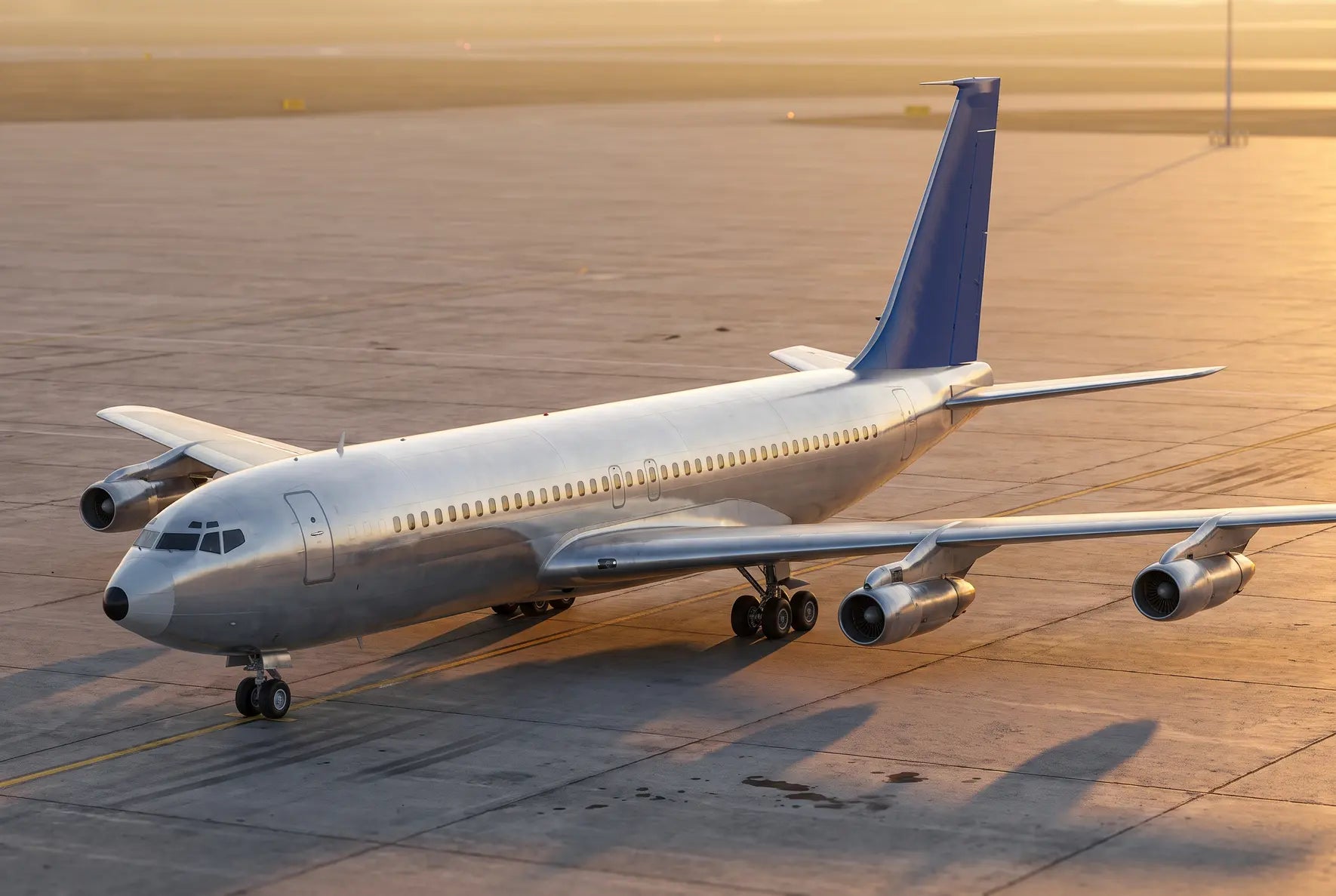
History and Development of the Boeing 707-120: From Dash 80 to Jet Age Pioneer
The Boeing 707-120 was the first production version of the Boeing 707 family, and it effectively launched the jet age for airline passengers. To understand why it existed, it helps to look at its origin: the Model 367-80, or "Dash 80", a privately funded technology demonstrator that first flew on 15 July 1954. Boeing built the Dash 80 to prove the viability of a swept-wing, four-engine jet transport that could serve both as a military tanker (the future KC-135) and as a commercial airliner. Post-war traffic growth and competition from Douglas and Lockheed pushed Boeing to turn that prototype into a marketable jetliner, and the result was the 707-120.
Compared with the Dash 80, the production 707-120 received a longer and, crucially, a wider fuselage optimised for six-abreast seating, along with a greater wingspan. This wider cross-section is one of the key differences between the airliner and the narrower KC-135 tanker derived from the same prototype.
The program milestones for the variant are well documented:
- Dash 80 prototype first flight: 15 July 1954
- First flight of the production 707-120: 20 December 1957
- FAA type certification (with Pratt & Whitney JT3C-6 engines): 18 September 1958
- Entry into service with Pan American World Airways (New York to Paris): 26 October 1958
That inaugural Pan Am service is widely regarded as the start of regular Boeing 707 operations and a landmark moment in transatlantic aviation. The certification history and technical parameters are captured in the FAA Type Certificate Data Sheet for the 707 series. The type's power came from four Pratt & Whitney JT3C turbojets, the civil version of the J57, which used water-methanol injection to boost takeoff thrust. That system improved performance from shorter or hot-and-high runways but added weight and maintenance complexity.
A defining evolution followed in 1959, when Boeing began fitting more efficient Pratt & Whitney JT3D low-bypass turbofans. Aircraft with these engines were redesignated 707-120B, entering service with American Airlines in 1961. The turbofan retrofit lowered fuel burn, extended range, reduced noise and smoke, and largely eliminated routine water injection, making the -120 series the bridge between first-generation turbojet and second-generation turbofan Boeing jetliners. Roughly 56 to 57 original turbojet 707-120s were built, including three VC-137A aircraft for the U.S. Air Force.
What Sets the 707-120 Apart From Other 707 Variants
Within the family, the 707-120 is the baseline short-body, medium-range model. The 707-220 kept the same basic airframe but substituted higher-thrust Pratt & Whitney JT4A turbojets for improved hot-and-high performance; only a handful were built for United Airlines. The later 707-320 Intercontinental was a much larger development, with a stretched fuselage, greater wingspan and wing area, higher fuel capacity and maximum takeoff weight, all enabling true non-stop intercontinental range. The -120 opened early jet routes, while the -320 became the standard for long-haul flying and gradually replaced the -120 on the longest sectors. Readers interested in how modern operators still build networks around aircraft range and economics may find our overview of Viva Aerobus operations a useful contemporary comparison.
The following identifiers summarise what distinguishes the Boeing 707-120 in technical terms:
- Engines: four Pratt & Whitney JT3C-6 turbojets with water-methanol injection; JT3D turbofans on the 707-120B
- Wingspan: 130 ft 10 in (39.88 m), the shortest of the main 707 passenger variants
- Operating empty weight: approximately 127,500 lb (57,600 kg)
- Range: roughly 3,600 to 4,040 nautical miles depending on load and configuration
- Capacity: up to about 174 to 179 passengers in high-density single-class layouts
- Fuselage: widened relative to the Dash 80 and KC-135 for six-abreast seating
- Status: first production 707 variant and Pan Am's jet-age launch aircraft
Additional background on the wider 707 program and its variants is available through the Encyclopaedia Britannica entry on the Boeing 707. Taken together, the 707-120 stands out as the first commercially successful Boeing jetliner, the type that inaugurated Pan Am's transatlantic jet service, and the baseline from which the entire 707 line and much of Boeing's later jet transport philosophy evolved.

A Pan Am Boeing 707-321B aircraft is captured in flight against a clear sky. The classic design of the airliner reflects the iconic era of jet aviation.
Boeing 707-120 Technical Specifications, Systems and Engines
The Boeing 707-120 was the original production member of the 707 family, designed to make long-range jet transport commercially practical in the late 1950s. Its mission was clear: carry a meaningful passenger load across transcontinental and transatlantic sectors at a cruise speed close to twice that of the piston airliners it replaced. To achieve this, Boeing paired a swept, high-aspect wing with four underwing turbojets, accepting the era's classic trade-offs of high fuel burn and demanding runway performance in exchange for speed and range that transformed the airline network.
As the baseline variant, the 707-120 established the aerodynamic and structural template later refined in the longer-range 707-320 and the shorter 720. Later, the airframe evolved dramatically, culminating decades on in widebody twins such as the Boeing 777-200ER, but the 707-120 remains the reference point for the family's handling and systems philosophy.
Specs that matter
- Wingspan: approximately 39.88 m (130 ft 10 in)
- Length: approximately 44.04 m (144 ft 6 in)
- Height: approximately 12.67 m (41 ft 7 in)
- MTOW: around 116,700 kg (about 257,000 lb)
- MLW: around 86,300 kg where published (source-dependent)
- Operating empty weight: roughly 57,600 to 58,700 kg depending on accounting convention
- Range: around 6,700 km with passengers, quoted per specific payload and reserve assumptions
- Cruise speed: approximately 965 to 974 km/h (typical high-subsonic cruise)
- Service ceiling: about 12,000 m (roughly 39,000 ft)
- Engines: four Pratt & Whitney JT3C-6 turbojets
- Typical seating: around 137 two-class, up to about 174 in high-density layouts
Systems and handling-relevant technology
The 707-120 used conventional hydraulically boosted flight controls with mechanical linkages, a fully manual reversion capability, and no fly-by-wire, reflecting late-1950s design practice. Leading-edge and trailing-edge high-lift devices were essential given the high wing loading, and the original JT3C turbojets relied on water/methanol injection to boost takeoff thrust on hot days or from limiting runways. Braking employed multi-disc wheel brakes with anti-skid protection, and thrust reversers assisted deceleration. Performance was computed manually from operator charts rather than by onboard flight management systems, and engine control was through direct throttle-to-fuel-control linkage rather than electronic engine control.
Published performance numbers for the 707-120 vary between sources, and this is expected. Figures shift with operator-selected weight options, cabin density, reserve-fuel and payload assumptions, and atmospheric and runway-condition inputs. For that reason, quoted range, field length and cruise values should be read as representative rather than absolute, and always in the context of the specific configuration they describe.
Engines: from J57 turbojet to JT3D turbofan
The 707-120 was powered by the Pratt & Whitney JT3C, the civilian designation of the military J57, an early axial-flow turbojet that first ran in January 1950 and was among the first U.S. engines to exceed 10,000 lbf of thrust. The JT3C-6 fitted to early production 707s was rated near 11,200 lbf dry and about 13,500 lbf with water/methanol injection. The J57/JT3C core was extraordinarily influential, powering aircraft as varied as the North American F-100, Convair F-102, McDonnell F-101, Lockheed U-2, and early Boeing B-52 bombers, as well as the Douglas DC-8 and Boeing 720.
Recognising the turbojet's fuel and noise penalties, Pratt & Whitney developed the JT3D turbofan from the same core, replacing the first compressor stages with fan stages to raise airflow, thrust and efficiency while lowering noise. This engine defined the re-engined 707-120B, whose JT3D-powered American Airlines 707-123B entered service on 12 March 1961, delivering roughly 17,000 to 18,000 lbf per engine. The 707-120 itself first flew in 1957 and entered service with Pan American in 1958, helping open long-haul jet travel to the mass market.
Boeing 707-120 vs Airbus A300B2 vs Douglas DC-8-10 vs Boeing 720: Specs and Performance Comparison
Scroll horizontally to see more →
| Parameter | Boeing 707-120 | Airbus A300B2 | Douglas DC-8-10 | Boeing 720 |
|---|---|---|---|---|
| Entry into service | 1958 | 1974 | 1959 | 1961 |
| Engines | 4 × Pratt & Whitney JT3C-6 | 2 × General Electric CF6-50C | 4 × Pratt & Whitney JT3C-6 | 4 × Pratt & Whitney JT3C-7 |
| Length | 46.6 m | 53.6 m | 45.9 m | 41.4 m |
| Wingspan | 44.4 m | 44.8 m | 43.4 m | 39.9 m |
| Height | 12.9 m | 16.5 m | 12.9 m | 12.2 m |
| Typical seating and layout (short description + approximate passengers) | 2-class: 140–170 passengers | 2-class: 250–280 passengers | 2-class: 130–160 passengers | 2-class: 120–149 passengers |
| MTOW | 151 t | 142 t | 120 t | 106 t |
| Range | 2,800 nm | 2,500–3,000 nm | 3,500 nm | 3,500 nm |
| Cruise speed | 0.83 Mach | 0.80 Mach | 0.82 Mach | 0.82 Mach |
| Service ceiling | 42,000 ft | 39,000 ft | 35,000 ft | 39,000 ft |
| Program note | Pioneering early jetliner that launched Boeing’s commercial jet age and set the standard for medium- to long-haul travel. | First wide-body twinjet, positioned as a high-capacity medium-haul workhorse for European trunk and regional routes. | Contemporary rival to the 707, offering similar early-jet performance with slightly different capacity and range options. | Shorter-range derivative of the 707 optimized for medium-haul routes and lower-cost operations compared with the original 707-120. |
Scroll horizontally to see more →
This table compares four classic jetliners across dimensions, engines, capacity, and performance. The A300B2 stands out as the only wide-body twin, carrying about 250–280 passengers versus roughly 120–170 for the 707-120, DC-8-10, and 720. The 707-120 has the highest MTOW (151 t), while the DC-8-10 and 720 list the longest range (3,500 nm) despite lower weights.
Boeing 707-120 Routes, Missions and Airlines Worldwide
The Boeing 707-120 was the first production model of the 707 family, conceived as a transcontinental and medium-range transatlantic jet rather than a true intercontinental type. Powered by four Pratt & Whitney JT3C-6 turbojets rated around 11,200 lbf dry (up to 13,500 lbf with water injection), it cruised near 590 mph (about Mach 0.82) with a maximum takeoff weight close to 257,000 lb (116,600 kg). Its typical missions were U.S. coast-to-coast sectors of roughly four to five hours and North Atlantic crossings, though the latter frequently demanded a refuelling stop, for example at Gander, because range hovered around 3,600 to 4,000 nautical miles depending on payload.
Operationally the type suited a hub-and-spoke model centred on major gateways. It needed about 11,000 ft (3,353 m) of runway at full weight, which restricted it to large airports with long paved strips and limited its use at secondary or regional fields. Early jet fleets in the late 1950s and 1960s were commonly scheduled for high daily utilisation to recover their cost, keeping aircraft on demanding rotations between primary hubs. High noise levels and the thirsty first-generation turbojets were the main challenges, later eased on the 707-120B re-engined with Pratt & Whitney JT3D turbofans.
Where the Boeing 707-120 Operates
Across North & South America, Europe, Asia and Africa, the aircraft was flown mainly by flag carriers and major trunk airlines on premium long-haul and transcontinental routes. In North & South America it opened the first sustained domestic and transatlantic jet services; in Europe it linked capital-city hubs to New York; in Asia and the Pacific a special long-range derivative carried the type across vast oceanic distances; and in Africa it appeared within the wider 707 network as carriers adopted jet equipment.
- North & South America: Pan American World Airways launched the type into commercial service on 26 October 1958 on New York to Paris, while American Airlines flew the first domestic transcontinental jet service, New York to Los Angeles, on 25 January 1959 with its 707-123. These carriers used the 707-120 on their busiest premium trunk routes. Regional long-haul operators such as Varig later operated 707 equipment on South American networks.
- Europe: Air France and BOAC adopted the 707 for transatlantic services from their principal hubs, and Lufthansa is cited among major operators of the family, deploying jets on prestige intercontinental routes.
- Asia: Qantas ordered the shortened, longer-range Boeing 707-138, a bespoke derivative of the 707-120 built to cope with the range and airfield constraints of Australian operations.
- Africa: African flag carriers adopted 707 equipment as the family spread worldwide, using the jets to connect their hubs with Europe. Readers interested in how smaller carriers manage flying and pilot conditions may find this overview of Aurigny Air Services a useful contrast to legacy long-haul operators.
Typical Seating and Cabin Layouts
Cabin configurations varied with operator strategy. Network and flag carriers favoured two-class layouts of about 137 passengers, splitting a forward premium cabin from an economy section for long transatlantic and transcontinental sectors. Higher-density, single-class arrangements pushed capacity toward 174 to 179 seats. The short-body 707-138 for Qantas traded some capacity for range, illustrating how airframe length shaped seat count. For documented reference material, the Boeing 707 technical overview and the air vectors 707 history detail the variant specifications and cabin ranges cited above.
In this video, experience what it was like to fly on a Boeing 707, as the creator recalls the world’s last passenger Boeing 707 flight, sharing onboard moments and personal impressions from this historic journey.
Boeing 707-120 Safety Record and How Safe Is It Today
The Boeing 707-120 was the first commercial version of Boeing's pioneering four-engine jetliner, entering transatlantic service with Pan American World Airways on 26 October 1958 after certification on 18 September 1958. Roughly 56 to 57 turbojet 707-120s were built, joined later by 72 turbofan-powered 707-120Bs and a small number of shortened 707-138Bs for Qantas. As the aircraft that opened the jet age, this variant operated at a time when swept-wing jet handling, high-altitude performance, air traffic control and crew transition training were all still maturing. Any assessment of its record has to be read against that pioneering context: the wider 707 family accumulated roughly 167 hull-loss occurrences and about 2,739 fatalities across five decades of intensive service, according to compiled industry figures, with many early events driving lasting improvements in procedures, design and certification. For broader historical background on the type, the Britannica overview of the Boeing 707 is a useful reference.
Major accidents and what changed afterwards
- American Airlines Flight 514 (15 August 1959, Boeing 707-123, near Calverton, New York): the first fatal crash of a 707, during a crew training flight involving loss of control while pilots were transitioning to the new jet. Early events of this kind pushed airlines toward far more structured swept-wing jet transition training.
- American Airlines Flight 1 (1 March 1962, Boeing 707-123B, into Jamaica Bay after departing Idlewild/JFK): associated with a rudder-control malfunction that led to loss of control shortly after takeoff. The event drew industry attention to rudder-control reliability, inspection and crew procedures on the type.
- Pan Am Flight 214 (8 December 1963, Boeing 707-121, near Elkton, Maryland): the investigating board determined that a lightning strike ignited the fuel/air mixture in a reserve fuel tank, causing structural failure of the left outer wing. The FAA notes that Airworthiness Directive AD 64-05-01 subsequently required additional aluminium skin over the wing vent-surge-tank area, and that today's fuel-tank and lightning-protection rules (14 CFR 25.581, 25.954 and 25.981) did not yet exist at the time. The FAA's Lessons Learned analysis of Pan Am Flight 214 documents these changes in detail.
- Early Dutch-roll and jet-upset handling: during transition training with the yaw damper switched off, control inputs could amplify the 707's lateral-directional oscillation and provoke a serious upset. This reinforced the operational lesson to keep yaw dampers engaged and to revise pilot training for swept-wing handling.
How safe is the Boeing 707-120?
Judged purely on early hull-loss figures, the 707-120 looks less safe than modern jets, but that comparison is misleading without traffic context. Many of its accidents occurred during the industry's steep learning curve of the late 1950s and 1960s, and each investigation fed back into design margins, standard operating procedures, training syllabuses and certification rules that now protect every airliner. Its fundamentally sound structure, engine redundancy and progressive refinements (yaw dampers, fuel-tank protection, improved rudder systems) made it far safer as the fleet matured. Very few 707-120s remain in any service today, so it is largely of historical rather than operational interest, a point reflected in the career changes of many pilots who moved on to modern operators such as those described in this look at flying for TUI Airways. Crucially, the safety lessons learned on aircraft like the 707 underpin today's exceptional record. As data compiled by the Aviation Safety Network and analyses such as ICAO's annual Safety Report consistently show, commercial aviation remains one of the safest modes of transport in the world.
01 What was the Boeing 707-120 designed for?
The Boeing 707-120 was Boeing’s first production jet airliner and was designed mainly for long-range, medium-capacity passenger service. It entered airline service in 1958 with Pan American World Airways and helped make scheduled jet travel practical on major domestic and transatlantic routes. Compared with later 707 versions, the -120 was optimized for speed and range, not maximum passenger capacity.
02 How many passengers could the Boeing 707-120 carry?
Typical seating on the Boeing 707-120 varied by airline layout, but it commonly carried around 140 passengers in a standard two-class arrangement, with higher-density layouts possible. The cabin was narrower than later widebody jets, so seat pitch and personal space depended heavily on the operator and the era. On some routes, airlines used mixed-class or higher-density seating to balance comfort with range and payload.
03 What kind of routes did the Boeing 707-120 fly?
The Boeing 707-120 was best suited to long-haul and transcontinental routes that needed jet speed but did not require the larger payload of later variants. Early airline service included transatlantic flights and major trunk routes, where its speed cut journey times dramatically compared with piston aircraft. Its range and payload were good for the period, but many airlines later preferred longer-range 707 versions for the most demanding intercontinental missions.
04 Was the Boeing 707-120 noisy and comfortable for passengers?
Yes, by modern standards the Boeing 707-120 was noisy, especially before later engine and airframe improvements became common across the fleet. Cabin comfort was also more basic than today, with narrower seats, higher cabin noise, and less refined climate control than current airliners. That said, for its time it was considered a major step forward because it was faster and smoother than propeller-driven airliners.
05 Which airlines operated the Boeing 707-120?
The Boeing 707-120 was flown by several major airlines, including Pan American, TWA, American, BOAC, and Qantas, among others. It was especially important to carriers building early jet networks across the North Atlantic, the United States, and long-haul international routes. Many airlines later replaced it with newer 707 variants or more efficient widebody aircraft as traffic and range requirements increased.
06 Is the Boeing 707-120 safe to fly on today?
The Boeing 707-120 was an early jet design with important safety features for its era, including swept wings and four engines, but it no longer appears in normal scheduled passenger service. Most surviving aircraft are cargo, military, VIP, or preserved examples, so a traveler is unlikely to encounter one on a regular airline route. As with any vintage aircraft, operations depend on maintenance standards, regulatory approval, and the specific aircraft’s condition rather than the type name alone.