

Yakovlev Yak-40: History and Development of the Soviet Feederliner
The Yakovlev Yak-40 was conceived in the mid-1960s to solve a specific problem for Soviet civil aviation: how to bring jet service to the vast network of short, unpaved regional airfields that still relied on ageing piston aircraft. Aeroflot operated large fleets of Lisunov Li-2, Ilyushin Il-12 and Il-14, and Antonov An-2 types on local and feeder routes, and needed a modern, rugged replacement able to fly from grass or gravel strips while offering true jet comfort and reliability. The Yak-40 was the answer, and it is widely recognised as the first purpose-built regional jet to enter large-scale service anywhere in the world.
The aircraft was developed by the Yakovlev Experimental Design Bureau (OKB Yakovlev), led by the veteran designer Aleksandr S. Yakovlev. In 1965 the bureau was tasked with creating a light feeder jet, with formal design work reported to have begun in April 1965. Serial production was assigned to the Saratov Aviation Plant (State Factory No. 262), which built the type from 1967 to 1981.
The programme progressed quickly through several key milestones:
- 21 October 1966: maiden flight of the first prototype (registration SSSR-1966), flown by test pilots A. I. Kolosov and Yu. B. Petrov.
- 1968: Soviet type certification granted after evaluation of five prototypes.
- 30 September 1968: entry into revenue service with Aeroflot on regional routes.
- November 1981: end of production, with roughly 1,011 aircraft built.
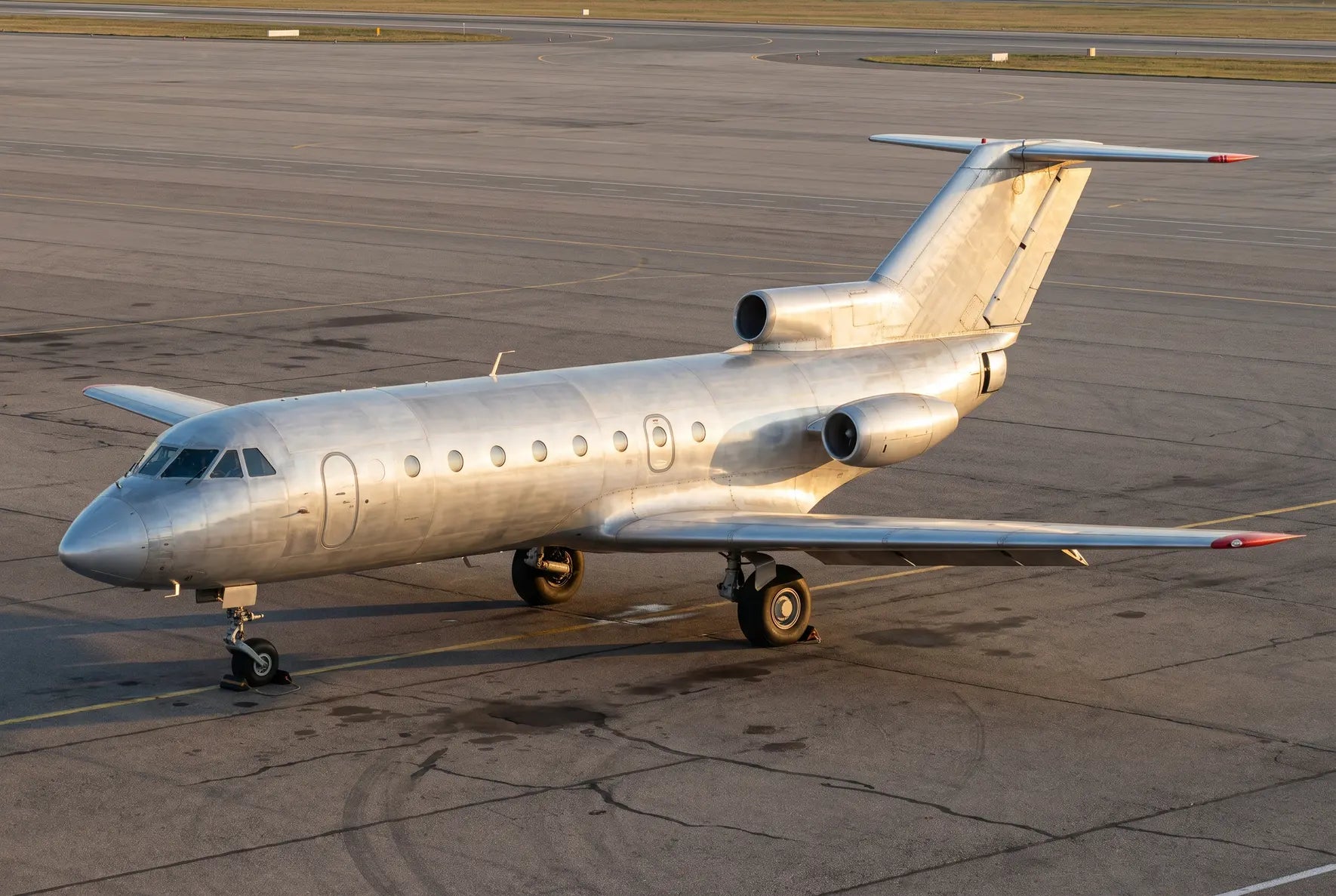
Technically, the Yak-40 is an all-metal, low-wing trijet with a T-tail, powered by three Ivchenko AI-25 turbofans. Two engines sit on short pylons on either side of the rear fuselage, while the third is buried in the tail and fed by an S-shaped intake duct. A built-in rear airstair allowed independent boarding at airports lacking ground equipment, reinforcing the rugged, self-sufficient design philosophy. In a typical single-class layout it carried about 32 passengers over ranges of roughly 1,700 to 1,800 km, with a maximum take-off weight near 16,000 kg. Additional configuration and performance details are documented in the type overview.
One notable refinement occurred between prototype and production aircraft: the first series machines differed from the prototypes in that the central engine intake was slightly reprofiled and the cockpit section lengthened, reflecting aerodynamic and structural fine-tuning rather than a major redesign. The three-turbofan concept on so small an airframe was later viewed by some analysts as fuel-inefficient, yet the aircraft proved highly reliable and popular within the USSR, and its supporters maintained it remained worth producing even at the close of its manufacturing run.
What sets the Yak-40 apart from its sub-variants
Within the family, the baseline Yak-40 is the standard ~32-seat feeder airliner. The Yak-40K is a convertible combi/cargo-oriented version with a modified cabin and door arrangement for mixed passenger and freight use, while the Yak-40M is a refined passenger development with minor aerodynamic and systems improvements. The defining traits of the baseline aircraft covered here can be summarised as follows:
- Powerplant: three Ivchenko AI-25 turbofans (twin side-mounted plus one tail-buried).
- Configuration: low-wing all-metal trijet with T-tail and integral rear airstair.
- Field capability: designed for short, unpaved and remote airfields.
- Capacity and reach: about 32 passengers, roughly 1,700 to 1,800 km range, MTOW near 16,000 kg.
- Distinction from Yak-40K/M: pure passenger role, without the K model's cargo/combi provisions or the M model's later refinements.
The Yak-40 also earned a place in aviation history as one of the first Soviet civil aircraft to gain certification in Western European countries, with around 125 examples exported to 18 nations. As an early regional jet, it foreshadowed the market later served by aircraft such as the Bombardier CRJ705, demonstrating decades earlier that jet efficiency and comfort could be brought to short-haul feeder routes.

A Yakovlev Yak-40 jet is captured in mid-flight against a clear blue sky. The aircraft is seen from the front as it approaches with its landing gear down, showcasing its compact, tri-jet design.
Yak-40 Technical Specifications, Systems Highlights and Engines
The Yakovlev Yak-40 was conceived in the mid-1960s to bring jet service to short regional routes and to operate from small, poorly equipped, and even semi-prepared airfields across the Soviet Union. Its design brief explains almost every trade-off: a rear-mounted tri-jet layout to keep engines clear of runway debris, a low wing loading and robust landing gear for short fields, and a self-contained rear airstair so it could turn around without ground support. The result is a rugged, simple aircraft that prioritised operational flexibility and reliability over range and fuel efficiency.
Because it was one of the first true regional jets, the Yak-40 traded outright economy for versatility. Its three Ivchenko AI-25 turbofans gave engine-out redundancy and short-field capability, but modest range compared with Western contemporaries of the era. Core dimensions and propulsion data are consistent across authoritative references such as SKYbrary and Airliners.net.
- Length: approximately 20.36–20.40 m
- Wingspan: 25.0 m
- Height: 6.50 m
- Wing area: 70.0 m²
- MTOW: approximately 15,500–16,000 kg (varies by source and configuration)
- Empty weight: approximately 9,400 kg
- Maximum payload: approximately 2,700 kg
- Typical passenger capacity: 32
- Cruise speed: around 550 km/h (about 300 kn)
- Range: around 1,800 km in a favourable configuration, though shorter figures are cited depending on payload and operating conditions
- Service ceiling: approximately 8,000 m (about 26,000 ft)
- Fuel capacity: approximately 3,900–3,910 L
- Engines: 3 × Ivchenko AI-25 turbofans, each about 14.7 kN (roughly 3,300 lbf)
Systems and Handling-Relevant Technology
The Yak-40 uses conventional mechanical flight controls with hydraulic assistance rather than any form of automated or fly-by-wire architecture, in keeping with its 1960s origins and its emphasis on maintainability at remote bases. The three rear-mounted AI-25 engines are managed through basic analog engine control and monitoring, well suited to regional operations where simplicity reduced downtime. De-icing for the wing, tail and engine inlets follows the typical bleed-air approach of Soviet aircraft in this class, supporting operations in a wide range of climatic conditions. The tri-jet configuration provides balanced thrust and useful redundancy, while rear engine placement lowers the risk of foreign object damage when operating from unpaved or semi-prepared surfaces. These same rugged design traits made the type a natural fit for carriers such as those covered in this overview of Red Wings Airlines.
Published performance numbers for the Yak-40 vary between sources, and this is normal rather than contradictory. Takeoff field length is quoted from roughly 700 m to about 1,000 m, and landing distance from around 550 m to 750 m, depending on weight, cabin density, atmospheric assumptions, runway surface and condition, and the specific operator configuration. Range figures behave the same way, shrinking substantially when payload and reserves increase. Any single value should therefore be read as representative of a defined set of assumptions, not as an absolute limit.
The Ivchenko AI-25 Engines
The AI-25 is a twin-spool, medium-bypass turbofan developed from 1965 by the Ivchenko OKB (later Ivchenko-Progress) in the Soviet Union specifically for the Yak-40, with first tests around 1966 and series production from 1967 at the plant in Zaporizhzhia. Production was later associated with Motor Sich, which continued to build the AI-25 family, and it is frequently described as the first bypass engine used on a short-haul aircraft in the USSR. Architecturally it combines a three-stage low-pressure compressor, an eight-stage high-pressure compressor, an annular combustor, a single-stage high-pressure turbine, and a two-stage low-pressure turbine, driving a fixed exhaust nozzle. Each engine produces about 14.7 kN of thrust, and the switch from turbojets to a bypass design brought meaningful efficiency gains for the era, as summarised by encyclopedic engine references.
Beyond the Yak-40, the AI-25 family powered several notable aircraft. The uprated AI-25TL became the powerplant of the widely exported Aero L-39 Albatros jet trainer, while related variants were used on the Hongdu JL-8 / K-8 trainer and the unusual PZL M-15 Belphegor agricultural jet. This broad application base, spanning airliners, trainers and specialised types, helped make the AI-25 one of the more prolific Soviet-era small turbofans.
Yakovlev Yak-40 vs Yak-42 vs Tu-134A vs Fokker F28: Specifications and Performance Comparison
Scroll horizontally to see more →
| Parameter | Yakovlev Yak-40 | Yakovlev Yak-42 | Tupolev Tu-134A | Fokker F28 Fellowship 4000 |
|---|---|---|---|---|
| Entry into service | 1968 | 1980 | 1967 | 1969 |
| Engines | 3 × Ivchenko AI-25 turbofan | 3 × Lotarev D-36 turbofan | 2 × Soloviev D-30 turbofan | 2 × Rolls-Royce Spey 555-15 turbofan |
| Length | 20.36 m | 36.38 m | 37.10 m | 29.00 m |
| Wingspan | 25.00 m | 34.88 m | 29.00 m | 27.40 m |
| Height | 6.50 m | 9.83 m | 9.02 m | 8.50 m |
| Typical seating and layout (short description + approximate passengers) | Single-class: 24–32 passengers | 2-class: 120–132 passengers | 2-class: 72–84 passengers | Single-class: 65–85 passengers |
| MTOW | 16 t | 54 t | 47 t | 36.5 t |
| Range | 970 nm | 2,050 nm | 1,550 nm | 1,600 nm |
| Cruise speed | 0.45 Mach | 0.73 Mach | 0.75 Mach | 0.75 Mach |
| Service ceiling | 26,000 ft | 25,000 ft | 39,000 ft | 35,000 ft |
| Program note | Short-haul tri-jet regional airliner designed for small, low-infrastructure airports in the Soviet Union. | Stretched tri-jet developed as a larger medium-haul successor to Yak-40 on domestic and regional routes. | Competing short-to-medium-haul twin-jet serving trunk routes in the Eastern Bloc with higher speed and capacity. | Western short-haul twin-jet regional airliner of similar generation, offering comparable capacity and range for European markets. |
Scroll horizontally to see more →
The table compares four classic short-to-medium-haul jets by size, engines, capacity, and performance. The Yak-40 is the smallest, a low-infrastructure tri-jet carrying 24–32 passengers with the shortest range and lowest cruise speed. Yak-42 scales up to 120–132 seats and the longest range but with a lower ceiling. Tu-134A and F28 are twin-jets with similar Mach 0.75 cruise, while Tu-134A has the highest ceiling.
Yak-40 Operations: Typical Routes, Missions and Airlines Worldwide
The Yakovlev Yak-40 was conceived as a short-haul regional trijet, replacing older piston types such as the Antonov An-2 and Lisunov Li-2 on local Soviet routes. Its design brief centred on sectors of roughly 300 to 800 km, comfortably within its practical range of about 820 km at full payload, while ferry ranges of up to 2,000 km were possible at reduced load. Cruise speed sat near 550 km/h, ideal for short legs. According to historical records, by 1980 the type served 276 domestic destinations within the Aeroflot network and had carried some 354 million passengers by 1993.
Its defining strength was field performance. The Yak-40 could operate from short, semi-prepared runways as short as 700 m, including gravel and grass strips, thanks to a rugged undercarriage with large-diameter wheels and reverse thrust on the centre engine. This allowed access to secondary and remote airfields with minimal ground support, using built-in airstairs for fast turnarounds. In practice this meant intensive, multi-sector daily patterns, with regional operators typically flying several short legs per day linking small towns to larger hubs.
Operationally, the type filled two roles: a hub-and-spoke feeder within large national systems such as Aeroflot, and point-to-point regional links between smaller cities elsewhere. The main challenge for operators was economics: three Ivchenko AI-25 engines increased fuel burn and maintenance compared with twin-engine rivals, which limited its appeal as fuel prices rose and Western regional jets matured.
Where the aircraft operates
The Yak-40 was built in roughly 1,011 units, of which about 130 were exported. Across Europe it formed the backbone of Soviet and Eastern Bloc regional networks, flying short domestic feeders and occasional charters. In Asia it served Middle Eastern and Central Asian carriers on short regional sectors, while in Africa it appeared mainly in Angola for civil and government transport. In North & South America, no major scheduled airline is documented as an operator; any presence was limited to isolated VIP or governmental examples.
- Europe: Aeroflot was the launch and principal operator from September 1968, using it for local feeder services. Interflug (East Germany), LOT Polish Airlines, TAROM (Romania), CSA Czechoslovak Airlines, Balkan Bulgarian Airlines, Malev (Hungary) and the Yugoslav charter carrier Aviogenex flew it on short-haul regional routes. In the West, General Air (Germany) and Aertirrena (Italy) used it for regional and charter work, while later CIS operators such as Motor Sich Airlines and Vologda Aviation Enterprise kept the type flying.
- North & South America: No major scheduled carriers are documented; use, if any, was confined to occasional VIP or state aircraft rather than airline service.
- Asia: Iraqi Airways is the best-documented Middle Eastern operator, flying short regional sectors. Numerous Central Asian regional operators in Kazakhstan and Uzbekistan flew the type within and after the Aeroflot system.
- Africa: Angola is the clearest case, with civil Yak-40s and the Angolan Air Force using the type for regional passenger and utility missions from limited-infrastructure fields.
Typical seating
Cabin layouts varied with operator type. Network and local carriers most commonly used a standard three-abreast arrangement seating 24 to 27 passengers at around 78 cm (30 in) pitch, while higher-density economy layouts reached 32 passengers in a four-abreast configuration. The stretched Yak-40M variant offered up to 40 seats. Corporate and VIP conversions traded capacity for comfort, typically carrying 12 to 15 passengers, with 13-seat interiors specifically documented in museum and charter records such as this aircraft guide. The cabin measured about 7.70 m long, 2.15 m wide and 1.85 m high, modest dimensions that suited leisure and feeder roles rather than mainline trunk services. For readers interested in how regional and leisure fleets are operated more broadly, this overview of Transavia France operations offers useful context on point-to-point network practice.
In this video, you will join a rare flight aboard a 40 year old Soviet Yak 40, as the creator finally experiences this classic Russian jet after years of trying, capturing the unique sights and feel of the trip.
Yakovlev Yak-40 Safety Record and How Safe Is It Overall
The Yakovlev Yak-40 is a Soviet three-engine regional jet that entered service in 1968, with roughly 1,011 aircraft built between 1967 and 1981 at the Saratov factory. Its safety record must be read against that large fleet, more than half a century of operation and the demanding environments it was designed for, including short and unpaved runways across the USSR and later the CIS. Independent accident compilations differ by inclusion criteria, but the type has accumulated well over 100 recorded accidents and incidents and several hundred fatalities across its service life. Many of these events occurred in the Soviet and post-Soviet operating context, where reporting standards, oversight and infrastructure differed from those in Western Europe and North America. The list of accidents and incidents involving the Yak-40 provides a chronological overview for readers who wish to examine individual events.
Notable accidents and what changed afterwards
Several occurrences illustrate recurring risk factors rather than a single design flaw. A neutral summary of representative events:
- Aeroflot, Bratsk (1972): the aircraft crashed on approach, with wind shear cited as a primary factor. The event reinforced the importance of approach monitoring and awareness of low-level wind changes near terrain.
- Aeroflot, Irkutsk (1981): a mid-air collision with an Mi-8 helicopter, in which loss of separation and possible crew error were noted. Occurrences of this kind underlined the need for stricter airspace separation and coordination in busy or mixed-traffic areas.
- Uzbekistan Airways Flight 1154, Tashkent (2004): the aircraft was destroyed after a night approach in which the investigation cited an unstable approach, continuing below minima and failure to initiate a go-around. As documented by the Aviation Safety Network, the lessons centred on strict adherence to published approach minima and go-around criteria.
Across these events, the changes that followed were largely procedural and training-related: firmer stabilised-approach and go-around policies, improved crew resource management and closer attention to standard operating procedures. Contemporary reporting, such as coverage by FlightGlobal, repeatedly identified pilot error and procedural violations, rather than the airframe itself, as dominant causes in regional statistics.
How safe is the Yakovlev Yak-40
Judging the Yak-40 fairly means comparing its accident history to the traffic it generated over decades of intensive short-haul cycles, often in harsh climates and from rough fields. Its design philosophy favoured ruggedness and simplicity: three rear-mounted Ivchenko AI-25 turbofans, robust landing gear and the ability to operate independently of prepared runways. Most serious events trace back to operational and environmental factors, weather, separation and procedural discipline, more than to inherent structural weakness. Where operators applied disciplined standard operating procedures and effective regulatory oversight, outcomes improved markedly. Readers comparing older regional jets with modern business and regional types may find it useful to review a contemporary aircraft such as the Airbus A319CJ. Broader context is available through safety bodies such as SKYbrary. When measured against the enormous volume of flights it performed, and despite an ageing design, the wider evidence continues to confirm that aviation remains one of the safest modes of transport.
01 What kind of routes and range is the Yakovlev Yak-40 typically used for?
The Yakovlev Yak-40 is a short‑range regional jet designed for routes of up to about 1,800 km, making it suitable for domestic and cross‑border flights between smaller cities. It was created to serve secondary airports with limited infrastructure, often replacing older piston aircraft on local services. Typical missions include connecting regional hubs with remote communities, government and VIP transport, and charter flights where runway quality can be an issue. Its modest range and capacity make it most effective on sectors of roughly 1–2 hours flying time.
02 How is the cabin layout and passenger comfort on a Yakovlev Yak-40?
The Yakovlev Yak-40 cabin typically seats between 24 and 32 passengers in a 2+2 layout, with relatively narrow seats compared with modern regional jets. The cabin is pressurized and heated, but noise levels are higher than on newer aircraft due to its three rear‑mounted engines and older insulation standards. Overhead space and legroom are adequate for short flights, though the interior can feel compact and somewhat dated on aircraft that have not been refurbished. VIP and corporate variants may offer improved seating, upgraded finishes, and more personal space than standard airline versions.
03 Which airlines and operators use the Yakovlev Yak-40 today and on what kinds of routes?
The Yakovlev Yak-40 is largely retired from mainstream airline fleets but remains in limited service with some operators in Eastern Europe, Central Asia, and parts of the former Soviet Union. It is now more often seen on charter, governmental, and special‑mission flights than on regular commercial schedules. When used by regional airlines, the aircraft typically operates short domestic legs between smaller airfields, especially where runways may be unpaved or poorly equipped. Travellers are most likely to encounter a Yak-40 on niche routes in remote regions or on specialized charter services.
04 How does the Yakovlev Yak-40 perform compared with similar regional aircraft?
The Yakovlev Yak-40 cruises at about 550 km/h and has a range around 1,800 km, which is modest by modern regional jet standards but adequate for short‑haul missions. Its three Ivchenko AI‑25 turbofan engines offer good low‑speed handling and short‑field performance, allowing operations from relatively short or unprepared runways. However, the tri‑jet configuration and older technology generally mean higher fuel burn and operating costs compared with newer twin‑engine regional jets. The Yak-40’s strength lies in ruggedness and field performance rather than fuel efficiency or speed.
05 What is the safety record and notable design features of the Yakovlev Yak-40?
The Yakovlev Yak-40 was designed to meet Western airworthiness requirements of its time and became the world’s first commuter tri‑jet, a notable milestone in regional aviation. Its key safety‑related features include a robust landing gear, straight wings for predictable low‑speed handling, and the ability to operate from rough, short airstrips. The center engine alone is equipped with reverse thrust, aiding stopping performance on short runways. Like many older types, its accident history reflects both operational environments and aging airframes, so safety on individual aircraft depends heavily on maintenance standards, crew training, and regulatory oversight.
06 What should a passenger know about the in‑flight experience on a Yakovlev Yak-40 (seats, noise, turbulence)?
Passengers on a Yakovlev Yak-40 can expect a relatively basic cabin with limited amenities compared with modern jets, and seat comfort optimized for short flights rather than long journeys. The rear‑mounted engines reduce noise in the forward cabin slightly, but overall noise and vibration levels can be noticeable, particularly near the back. The aircraft’s straight‑wing design and relatively low cruise altitude around 7,000–8,000 m can result in a firm but generally stable ride in mild turbulence, though weather and route choices play a bigger role in comfort. Window views are typical of small regional jets, and choosing a seat forward of the wing often provides a quieter, more pleasant experience.