

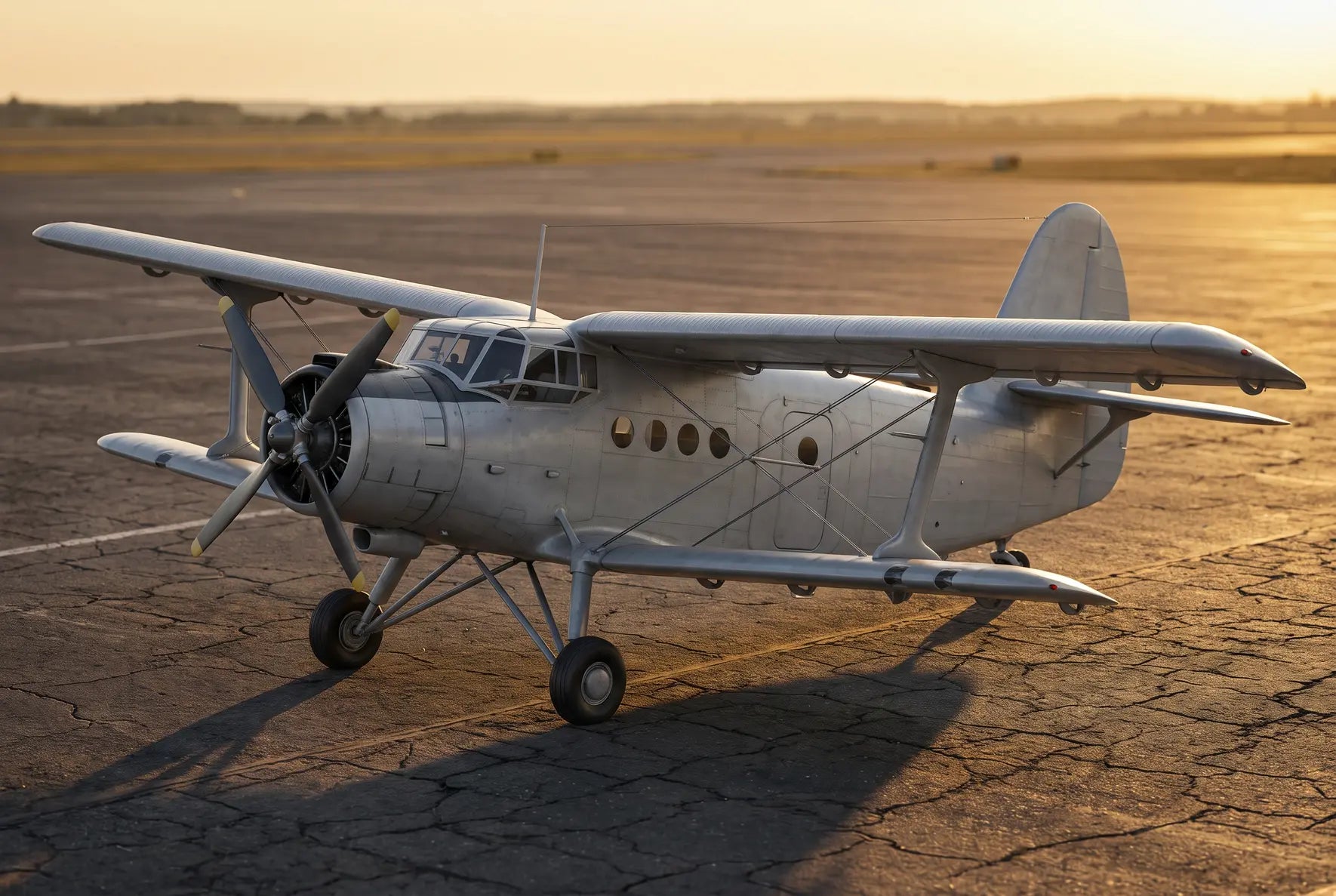
History and Development of the Antonov An-2 Utility Biplane
The Antonov An-2 is a single-engine utility biplane conceived in the late 1940s to replace the ageing Polikarpov Po-2 in agricultural and light transport roles across the Soviet Union. After World War II, the Soviet Ministry of Forestry issued a requirement for a rugged aircraft able to spray crops, carry passengers and freight, drop parachutists and operate from short, unimproved strips. Oleg Konstantinovich Antonov and his newly formed design bureau, OKB-153, answered that brief, and the An-2 became the bureau's first production aircraft. The manufacturer's own history describes it as the "firstling" of the O. K. Antonov Design Bureau, the machine that established its reputation. Details of that origin are documented on the official Antonov history page.
The design was launched in 1947, and the SKh-1 prototype made its first flight on 31 August 1947 in Novosibirsk. Following successful trials, serial production began in 1949 at State Aircraft Factory No. 473 in Kiev, and the type entered regular civil and agricultural service around 1949-1950. According to Antonov, the Kiev Aviation Plant built 3,320 aircraft between 1948 and 1963. The aircraft is powered by the Shvetsov ASh-62IR, a nine-cylinder air-cooled radial rated at roughly 1,000 hp, chosen for its reliability and strong low-speed performance. Comprehensive technical data are catalogued in the Antonov An-2 reference entry.
Production quickly spread beyond the USSR. In Poland, WSK PZL-Mielec assembled the type and its derivatives from around 1960 to 2002, producing the largest share of the fleet. In China, licensed manufacture as the Y-5 began in 1958, first at Nanchang (1957-1968) and later at Shijiazhuang (from 1970 onward), where updated derivatives are still built. Combined output across all countries exceeds 18,000 aircraft, and Antonov notes that the An-2 is listed in the Guinness Book of World Records as the most intensively manufactured biplane after World War II, with a production run spanning several decades. This kind of longevity is comparable in spirit to other long-lived Eastern-bloc programmes; for a contrast in scale, see our profile of the Ilyushin Il-86 widebody.
What Sets the An-2 Apart From Its Sub-Variants
The baseline An-2 is a general-purpose utility and passenger aircraft, but the family branched into several specialised versions that differ mainly in mission equipment rather than airframe. The An-2R is the primary crop-dusting variant, with a reinforced floor and plumbing for chemical tanks. The An-2T is configured for cargo, while the An-2P carries airline-style seating for around 12 passengers. The An-2M, built in a series of 506 aircraft at the Dolgoprudny plant between 1966 and 1971, is a refined agricultural version with a slightly lengthened fuselage, a redesigned angular fin and rudder, repositioned landing gear, a larger 1,960-litre chemical tank and an air-conditioned cockpit. The An-2V is the twin-float seaplane, and the later An-3 re-engines the airframe with a TVD-20 turboprop to improve efficiency and reliability.
The following identifiers help distinguish the An-2 and its closest relatives:
- Engine: Shvetsov ASh-62IR nine-cylinder radial, about 1,000 hp (TVD-20 turboprop on the An-3).
- Configuration: braced biplane with fabric-covered wings, upper wingspan of 18.2 m and wing area near 71.5 m².
- Weights: maximum takeoff weight around 5,440-5,500 kg, with a payload near 2,140 kg.
- Performance: cruise about 190 km/h, very low stall speed near 50 km/h, range around 845 km.
- Capacity: typically two crew plus 12 passengers, or an equivalent cargo/agricultural load.
- STOL: exceptional short-field capability, with controlled flight documented at extremely low airspeeds.

The image depicts a green Antonov An-2 aircraft in flight. This biplane, known for its distinctive design and large size, is an iconic Soviet utility aircraft.
Antonov An-2 Technical Specifications, Systems and Engine
The Antonov An-2 is the world's largest single-engine biplane, designed as a rugged short takeoff and landing (STOL) utility aircraft for agriculture, cargo, parachuting and short regional passenger work. Its biplane layout was a deliberate trade-off: instead of chasing high cruise speed, the design prioritises very low stall speed, generous lift, and the ability to operate from rough, unprepared strips. Full-span leading-edge slats, large flaps and drooping ailerons give it exceptional low-speed control, so the airframe rewards payload and field performance over efficiency at altitude.
What the An-2 inherits from its family is simplicity and durability. The braced upper and lower wings, fabric-covered control surfaces and fixed conventional landing gear make it forgiving to maintain in remote conditions, which is why it has remained in service for decades and appears in fleets alongside other legacy short-haul types such as the Fokker F28-2000.
- Upper wingspan: 18.2 m; lower wingspan: 14.24 m
- Length: 12.4 m; height: approximately 4.1 m
- Total wing area: approximately 71.5 m²
- Empty weight: approximately 3,300 to 3,450 kg
- Maximum takeoff weight (MTOW): approximately 5,500 kg
- Typical useful load: approximately 2,140 kg
- Capacity: 2 crew plus up to 12 passengers in a standard layout
- Maximum speed: approximately 258 km/h; cruise: approximately 185 to 190 km/h
- Stall speed: around 50 km/h, thanks to full-span slats and high-lift wing
- Service ceiling: approximately 4,500 m
- Range: approximately 845 km with standard fuel and typical load
- Fuel capacity: approximately 1,200 litres total (around 310 US gal usable)
- Powerplant: Shvetsov ASh-62IR nine-cylinder radial, approximately 1,000 hp (746 kW)
Detailed dimensional and performance figures are documented in the Antonov An-2 technical overview and cross-referenced pilot data published by AOPA.
Systems and handling-relevant technology
The An-2 uses fully manual, cable-and-pushrod flight controls with no hydraulic boost, so control forces are transmitted directly to the pilot. There is no autopilot in baseline versions and no electronic flight management; performance is computed from published tables and pilot judgement rather than onboard automation. The high-lift system, with automatic leading-edge slats and interconnected flaps and ailerons, is the defining feature: it allows controlled flight at very low airspeeds and remarkably short ground rolls. Braking is provided by pneumatic wheel brakes on the main gear, and the tailwheel configuration demands attentive directional control during ground operations.
The ASh-62IR is a carburetted, supercharged radial with a single-stage two-speed centrifugal supercharger, driving a four-blade constant-speed, variable-pitch AV-2 propeller. Engine management relies on conventional throttle, propeller pitch and mixture levers rather than digital control, and maintenance follows scheduled inspection rather than automated health monitoring, reflecting the aircraft's mid-twentieth-century origins.
Published performance numbers for the An-2 vary noticeably between sources because of operator options, cabin or cargo density, actual takeoff weight, national license-build differences, and atmospheric and runway conditions. Short-field takeoff and landing distances in particular are usually presented as typical operational values rather than a single certified figure, so any quoted numbers should be read with their loading and environmental context in mind.
Engine options, history and other applications
Throughout its production the An-2 has been powered almost exclusively by the Shvetsov ASh-62 family. Originally designated M-62 and finalised around 1938 by Arkadiy Shvetsov's design bureau, it evolved from the Shvetsov M-25, itself a licensed derivative of the American Wright R-1820 Cyclone. Revised induction and higher boost raised output from roughly 775 hp to about 1,000 hp. The engine is a nine-cylinder single-row air-cooled radial of approximately 29.8 litres displacement, with a 6.4:1 compression ratio and a dry weight near 560 kg, delivering about 1,000 to 1,010 hp at 2,200 rpm for takeoff and around 850 hp at rated altitude.
The engine was widely license-built, ensuring a durable parts supply. In Poland it was produced by WSK PZL Kalisz as the ASz-62IR, and in China as the HS-5, which powers the Chinese-built An-2 derivative, the Shijiazhuang Y-5. Beyond the An-2, the ASh-62 and its variants powered the Lisunov Li-2 (the Soviet license-built DC-3), later versions of the Polikarpov I-16 and the Polikarpov I-153 biplane fighter, giving it one of the longest service records of any piston aero engine. Typical installations run on aviation gasoline, with AvGas 100LL commonly used on surviving examples.
Antonov An-2 Variants vs DHC-3 Otter: Specifications Comparison
Scroll horizontally to see more →
| Parameter | Antonov An-2 | Antonov An-2R | Antonov An-2TP | DHC-3 Otter |
|---|---|---|---|---|
| Entry into service | 1949 | 1950 | 1951 | 1953 |
| Engines | 1 × Shvetsov ASh-62IR radial | 1 × Shvetsov ASh-62IR radial | 1 × Shvetsov ASh-62IR radial | 1 × Pratt & Whitney R-1340 radial |
| Length | 12.40 m | 12.40 m | 12.40 m | 12.96 m |
| Wingspan | 18.18 m | 18.18 m | 18.18 m | 17.69 m |
| Height | 4.10 m | 4.10 m | 4.10 m | 3.99 m |
| Typical seating and layout (short description + approximate passengers) | Passenger: 12 passengers | Agricultural / utility: 8–10 passengers or hopper payload | Passenger / combi: 10–12 passengers | Passenger / utility: 10–11 passengers |
| MTOW | 5.50 t | 5.50 t | 5.50 t | 3.63 t |
| Range | 485 nm | 450–500 nm | 450–500 nm | 450 nm |
| Cruise speed | 0.28 Mach | 0.28 Mach | 0.28 Mach | 0.25 Mach |
| Service ceiling | 14,425 ft | 14,400 ft | 14,400 ft | 18,000 ft |
| Program note | Baseline STOL biplane utility aircraft used for passenger, cargo, and special-mission roles. | Dedicated agricultural and utility variant optimized for crop-spraying and short-field work. | Passenger and combi variant tailored for regional transport from unprepared strips. | Comparable Western single-engine STOL utility aircraft offering similar mission capability and era. |
Scroll horizontally to see more →
The table compares core specs of the Antonov An-2 family (An-2, An-2R, An-2TP) against the DHC-3 Otter. All An-2 variants share the same ASh-62IR radial engine, dimensions and 5.50 t MTOW, while differing mainly by role and seating (agricultural to passenger/combi). The Otter is slightly longer but has a smaller wingspan and much lower MTOW (3.63 t), similar range, slower cruise, yet a higher service ceiling (18,000 ft vs ~14,400 ft).
Antonov An-2 Operations: Routes, Missions and Airlines Worldwide
The Antonov An-2 is a single-engine STOL biplane built around short, low-speed sectors rather than long-haul flying. With an economical cruise of roughly 185-190 km/h and a practical range of about 845-900 km with a modest payload, most missions fall well inside a few hundred kilometres. Regional feeder and remote-supply legs commonly run in the 100-400 km band, while agricultural sorties are far shorter, often only tens of kilometres between the base and the treatment area, flown repeatedly through the day. Parachute operations typically involve short 15-50 km round trips from the airfield to the drop zone. Endurance of around six hours at economy cruise supports several sectors per day, so utility and skydiving operators frequently stack multiple short flights, and low-density regional carriers schedule 2-4 legs daily.
Operationally, the type favours point-to-point networks over hub-and-spoke systems. Its design origins as a forestry and agricultural aircraft explain its bias toward secondary strips, grass, dirt and snow surfaces, and small village airfields rather than major hubs. Takeoff runs near 170 m and landing runs around 215 m, combined with a stall close to 50 km/h, let it serve fields that turboprops cannot reach. The main challenges for operators are the ageing airframes (production ran from 1947 to around 2001), the Avgas-burning ASh-62IR radial that consumes roughly 185-200 L/h, and the increasingly limited availability of high-octane Avgas and qualified overhaul shops outside Poland, Russia and China. These same short-field economics also shape modern point-to-point commuter thinking, as seen with carriers profiled in our look at Mokulele Airlines.
Where the Antonov An-2 operates
The type has served in more than 70 countries. In Europe it grew from Soviet and Polish rural aviation, covering short passenger hops, mail and cargo runs, crop-spraying and aero-club parachuting. Across North & South America it is far rarer and largely found with skydiving centres, heritage flyers and, historically, agricultural work in the Caribbean. In Asia it remains a rural workhorse, notably through the Chinese-built derivative and North Korean and Mongolian utility flying. In Africa it appears mostly in military and state utility, medevac and light-transport roles using ex-Soviet airframes.
- Europe: Aeroflot operated large fleets across the USSR for regional passenger, cargo, forestry and agricultural work; LOT Polish Airlines flew An-2s on short domestic routes with 10-14 seats, while PZL-Mielec built the type under licence for agricultural and aero-club use. Czech and Slovak clubs still fly the "Andula" for parachuting.
- North & South America: Registered examples in the United States and Canada serve parachute centres, airshow and sightseeing flying. Cuba used the type for sugarcane spraying and rural transport, and Nicaragua also fielded An-2s for light transport.
- Asia: China produced the licence-built Shijiazhuang Y-5 for passenger, cargo, agricultural and paratroop roles; Air Koryo operates the type on domestic services in North Korea, and Mongolian operators used it for remote passenger and supply flights.
- Africa: Angola, Mali, Sudan, Ethiopia, Tanzania and Somalia have used ex-Soviet An-2s for short-range troop and cargo transport, medevac and paratroop training, with Egypt, Tunisia and Benin operating mixed civil and military utility flights from unpaved strips.
Typical seating and cabin layouts
Cabin fit varies sharply by role. Soviet-built passenger An-2P aircraft carried 10 permanently installed seats, while Polish passenger versions offered 12-14 seats plus two child jump seats and a baby cot. The paratroop An-2TD uses folding side benches for 12 jumpers, and a medical layout accommodates up to six stretchers with two attendants. Cargo variants strip the seats for roughly 1,500 kg of freight through the side door, and agricultural aircraft replace the cabin with chemical tanks and spray gear. Regional passenger operators favour the fixed 10-12 seat layout, while leisure, skydiving and heritage operators keep folding benches or open cabins for flexibility. Fuller technical and configuration data are documented by AirVectors.
In this video, explore the history of the Antonov An-2, the eternal biplane also known as Annushka, Kukuruznik, or Colt, and learn how this Soviet-developed multipurpose piston aircraft endured.
Antonov An-2 Safety Record and How Safe Is This Utility Biplane?
The Antonov An-2 has one of the longest service histories of any powered aircraft, and its safety record must be read against that scale. First flown on 31 August 1947, the single-engine biplane remained in production for decades, with Antonov's own history pages citing 11,915 aircraft built in Soviet and Ukrainian factories, while broader estimates including Polish (PZL-Mielec) and Chinese (Y-5) production place the total above 18,000. With so many airframes operating over more than seven decades, often from unprepared strips and in demanding regions, the type has accumulated a substantial absolute accident count. Data compiled from the Aviation Safety Network indicate around 784 hull losses and roughly 810 fatalities recorded through early 2022. In proportional terms, that represents a single-digit percentage of the total fleet lost over its long life, a figure shaped more by ageing airframes, marginal operators and harsh environments than by any inherent design flaw.
Notable accidents and what changed afterwards
Several documented events illustrate the recurring risk factors associated with the type.
- Saratov region, USSR (1965): A training flight crashed shortly after takeoff in whiteout conditions, killing all eight on board. Investigators attributed it to spatial disorientation, likely aggravated by a caged gyro horizon. The case reinforced instrument-reference discipline and pre-flight instrument checks in poor-visibility training.
- Near Moscow, Russia (2017): An An-2 (RA-35171) lost control during a low-altitude display and came to rest inverted, per the Aviation Safety Network record. Factors included manoeuvring beyond flight-manual limits, reduced aileron authority at high speed and an expired Certificate of Airworthiness. It prompted tighter enforcement of airworthiness documentation and altitude minima for vintage display flying.
- Sweden (2019): A takeoff accident investigated by the Swedish Accident Investigation Authority (SHK) was traced to the lack of a robust method for calculating required takeoff distance. The report encouraged systematic performance planning with conservative margins for surface and weather conditions.
Because the An-2 is long out of mainstream production, post-accident improvements have centred on maintenance, airworthiness oversight and operational procedures rather than airframe redesign.
How safe is the Antonov An-2 today?
The An-2's design philosophy favours forgiving low-speed handling, short takeoff and landing distances (typical takeoff run around 170 m) and a rugged structure suited to rough fields. Flown within its limits and properly maintained, it offers wide margins against low-speed loss of control and landing overruns. The counterweight is a single engine often operated far from suitable diversion sites, and a global fleet frequently maintained to varying standards. Analyses referenced by ICAO flagged an unusually high accident cluster from 2017 onward among certain commercial operators, while Western operators using the type mainly for display and skydiving recorded far fewer injury accidents, underlining how strongly regulatory oversight, standard operating procedures and maintenance culture influence real-world outcomes. Comparable oversight-driven improvements shaped the record of jet-era transports such as the Boeing 707-320C. Precise accident rates per flight hour are difficult to compute because reliable exposure data for the scattered An-2 fleet are not published, so absolute counts should be interpreted with that limitation in mind. Across the industry as a whole, aviation continues to rank among the safest modes of transport.
01 What typical missions and routes does the Antonov An-2 usually fly?
The Antonov An-2 is most commonly used on short regional routes, especially to remote villages and airfields with basic or unpaved runways. Its missions include passenger services in rural areas, parachute and skydiving operations, agricultural spraying, and cargo flights where infrastructure is limited. Many operators also use the An-2 for sightseeing flights and bush operations in Eastern Europe, Central Asia, Siberia, and some parts of China. It is valued wherever reliable access is needed to small airstrips and difficult terrain.
02 What is the cabin like on an Antonov An-2 in terms of comfort and noise?
The Antonov An-2 cabin is simple and functional, with basic seating that can be configured for passengers, cargo, or mixed use depending on the operator. Noise levels are noticeably higher than on modern turboprops or jets because of the large radial piston engine and rugged airframe, so earplugs or noise-reducing headsets are often recommended. Heating and ventilation are generally adequate but can feel more rudimentary, especially on older airframes. The overall experience is more utilitarian and adventurous than luxurious, which many aviation enthusiasts find appealing.
03 How far can the Antonov An-2 fly and how does its performance compare with similar aircraft?
The Antonov An-2 has a typical range of roughly 800 to 1,000 kilometers, depending on load, configuration, and operating conditions. Its top speed is lower than most modern regional turboprops, but it excels in short takeoff and landing performance, allowing operations from very short and soft runways. Fuel efficiency is modest compared with newer designs, as the radial piston engine consumes more fuel for the same payload than a modern turboprop. However, the An-2 is often chosen not for speed or fuel burn but for its ability to carry useful loads into places where other aircraft cannot operate safely.
04 Which airlines or operators still use the Antonov An-2 and on what kinds of routes?
Today the Antonov An-2 is mainly flown by smaller regional airlines, charter companies, skydiving clubs, and government or special-mission operators rather than large scheduled carriers. It is still seen in countries such as Russia, Ukraine, Poland, Romania, and China, often on short-haul routes linking small communities with regional hubs. Some operators fly it for tourism, offering scenic flights over mountains, lakes, or historical sites. Others use it in roles like pipeline patrol, forestry support, and medical or humanitarian flights into remote areas.
05 Is the Antonov An-2 a safe aircraft and what design features influence its safety record?
The Antonov An-2 has a long operational history and is generally considered robust, with a strong airframe and forgiving flight characteristics when properly maintained and operated. Its large wings, biplane design, and low stall speed provide good low-speed handling and allow controlled flight at speeds where many other aircraft would stall. As with any older type, safety depends heavily on maintenance quality, adherence to regulations, and pilot training, since some airframes are several decades old. Accident statistics show that incidents often relate to operational factors such as weather, overloading, or inadequate upkeep rather than fundamental design flaws.
06 What should a passenger know before flying on an Antonov An-2, such as seat choice or turbulence behavior?
On an Antonov An-2, choosing a seat closer to the wing and near the center of the cabin can slightly reduce the sensation of turbulence and engine vibration. The biplane wing and sturdy landing gear help the aircraft handle rough strips and gusty conditions, though the ride can feel more lively than on larger jets, especially at low altitude. Windows are typically large and spaced along the cabin, so most seats offer good outside views, which is a highlight for enthusiasts on sightseeing flights. Boarding and interior movement may feel more compact and basic, so wearing practical clothing and keeping baggage light and easy to stow tends to make the flight more comfortable.