

Convair CV-340 History and Development: The Stretched Convairliner
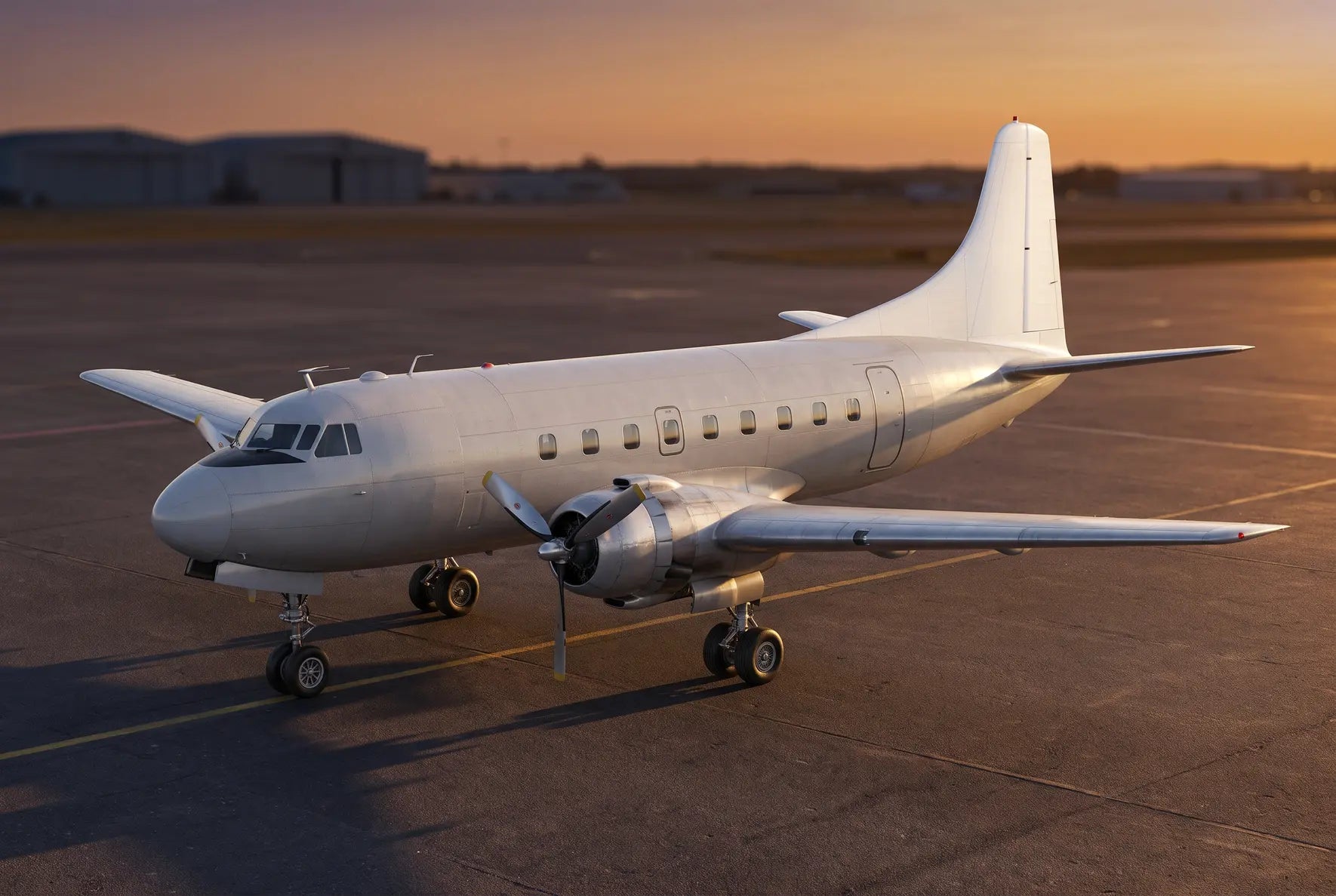
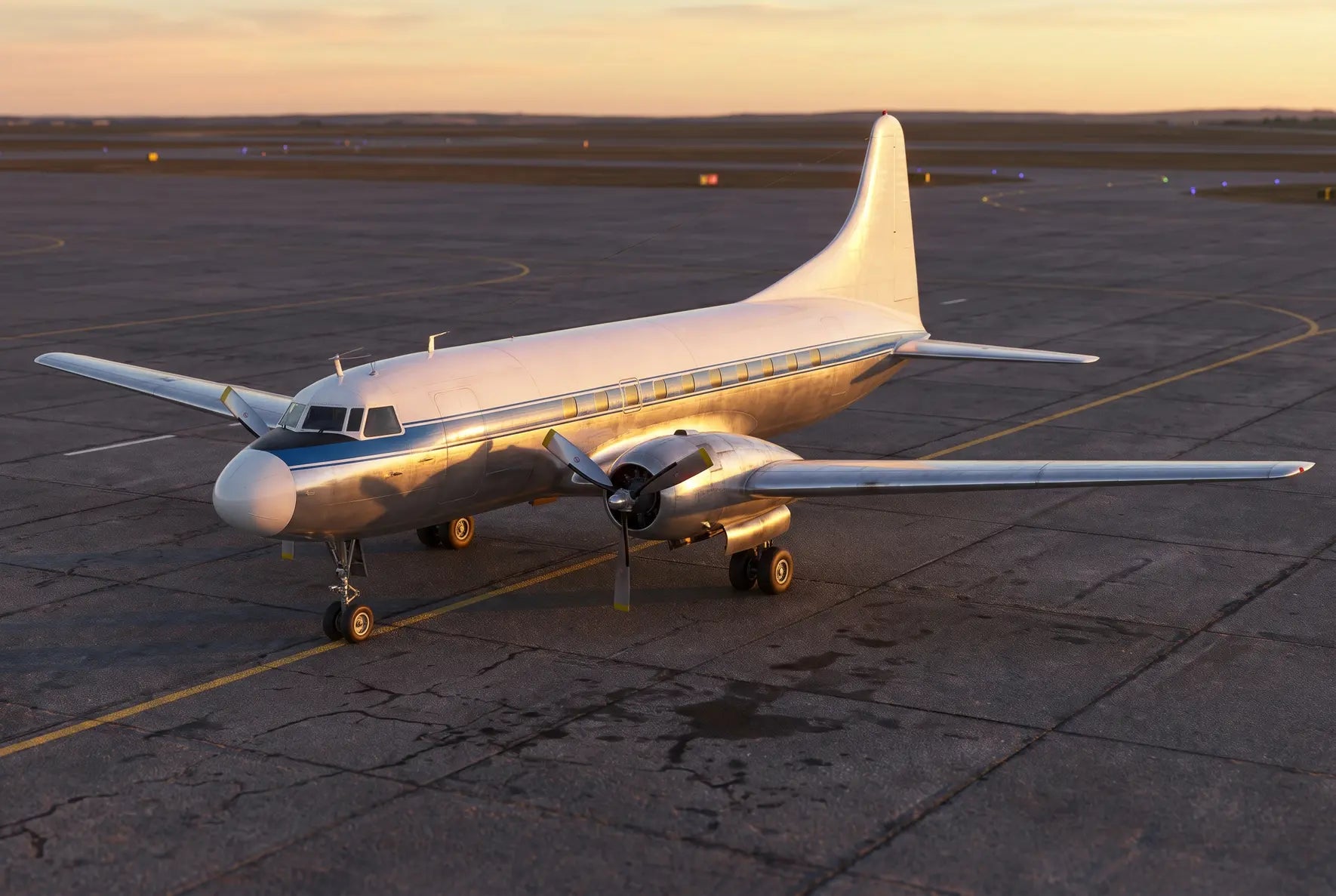
The Convair CV-340 belongs to the family of pressurised twin-engine airliners built by Convair, the trading name of the Consolidated Vultee Aircraft Corporation, which later became a division of General Dynamics. The family originated after the Second World War, when American Airlines asked for a modern, pressurised replacement for the ubiquitous Douglas DC-3. That request produced the CV-240, and the CV-340 emerged as its logical, larger successor. Like other post-war twins that reshaped short-haul flying, it belongs to a lineage that later evolved into modern regional jets such as the Fokker 100.
The CV-340 was created chiefly to satisfy United Air Lines, which wanted a "Super 240" offering more seats and better high-elevation performance for its western route network. Convair responded by stretching and re-winging the CV-240 rather than designing a wholly new aircraft.
The chronological milestones are as follows:
- 1949-1951: Design evolution from the successful CV-240 into the enlarged CV-340.
- 5 October 1951: First flight of the CV-340.
- Early-to-mid 1950s: Certification and entry into scheduled airline service, with United among the principal launch customers.
The aircraft retained the Pratt & Whitney R-2800 Double Wasp, an 18-cylinder twin-row air-cooled radial, rated at roughly 2,400 hp continuous and up to 2,500 hp for take-off per engine. Around 133 CV-340s were delivered to civil operators, alongside military orders. Reference dimensions and performance can be cross-checked against aviation technical databases such as the Convair CV-240 family record and dedicated type sheets like this CV-340 technical profile.
What sets the CV-340 apart
Compared with the earlier CV-240, the CV-340 introduced a fuselage lengthened by about 1.36 m and a wingspan increased by roughly 4.14 m, together with revised landing gear and higher weights. These changes lifted the maximum take-off weight to about 21,320 kg and allowed a standard cabin for around 44 passengers in a 2+2 layout, a modest but useful gain over the CV-240. Typical cruise was near 457 km/h, with range up to about 2,600 km using maximum fuel and reserves.
The later CV-440 Metropolitan built directly on the CV-340, adding improved soundproofing, cabin refinements and detailed aerodynamic and nacelle changes to remain competitive against emerging turboprops. Structurally the two were closely related, but the CV-440 was marketed as the more refined, quieter development. In the following decade many CV-340 and CV-440 airframes were converted to turboprop power as the Convair CV-580, fitted with Allison 501-D13 engines of about 3,750 shp; that conversion, developed by Pacific Airmotive, was certificated in 1960 and greatly extended the type's service life.
The distinguishing features of the CV-340 can be summarised as follows:
- Engines: two Pratt & Whitney R-2800 Double Wasp radials, about 2,400-2,500 hp each.
- Dimensions: wingspan 32.12 m, length 24.12 m, wing area 85.5 m2.
- Weights: MTOW around 21,320 kg.
- Capacity: typically 40-44 passengers, commonly 44 in standard layout.
- Performance: cruise near 457 km/h, service ceiling about 9,150 m, range up to roughly 2,600 km.
- Lineage: stretched, re-winged derivative of the CV-240 and direct forerunner of the CV-440 and CV-580.
Operators of the CV-340 spanned domestic and international networks, including United Air Lines, Braniff, Continental, Delta, Hawaiian, KLM, Lufthansa, Alitalia, Finnair and All Nippon Airways, with some aircraft remaining active into the early 1970s.

This black and white image shows a Scandinavian Airlines System Convair CV-440 Metropolitan aircraft named Ivar Viking, in flight over a coastline with mountains in the background.
Convair CV-340 Technical Specifications, Systems and Performance
The Convair CV-340 Metropolitan was engineered as a short-to-medium-range piston airliner, a stretched and more powerful development of the earlier CV-240. Its mission focused on regional trunk and feeder routes where robust field performance, a pressurised cabin and reliable economics mattered more than long range or high altitude. The core design trade-off favoured payload and runway flexibility over ceiling and cruise altitude, giving operators a rugged aircraft able to serve shorter, less-developed airfields while carrying around 44 passengers in a comfortable, pressurised cabin.
From the Convairliner family the CV-340 inherited the twin-radial layout, the tricycle undercarriage and the pressurised fuselage, adding a longer body, a larger wingspan and uprated engines. The same lineage later evolved into the CV-440 and, through re-engining, the turboprop CV-580, illustrating how adaptable the airframe proved to be over decades of service.
Specs that matter
- Wingspan: 105 ft 4 in (32.13 m)
- Length: 79 ft 2 in (24.14 m)
- Height: 28 ft 2 in (8.59 m)
- Wing area: 920 sq ft (85.6 m²)
- Maximum takeoff weight: approximately 47,000 lb (21,319 kg)
- Empty weight: approximately 32,399 lb (14,696 kg)
- Typical passenger capacity: 44 in standard configuration
- Cruise speed: around 284 mph (457 km/h, 247 kt), subject to weight and altitude
- Range: roughly 1,150 mi (1,851 km), depending on payload and reserves
- Service ceiling: about 25,000 ft (7,620 m)
- Fuel capacity: around 1,750 US gal (6,624 L)
- Engines: two Pratt & Whitney R-2800-CB16 Double Wasp radials, roughly 2,500 hp each
- Propellers: three-bladed, as reported across the family
Systems and Handling-Relevant Technology
As a design of its era, the CV-340 used conventional cable-and-pushrod flight controls rather than powered or fly-by-wire systems, so handling depended heavily on aerodynamic balance and pilot input. A key feature of the type was its pressurised cabin, an advantage over many unpressurised competitors of the late 1940s and early 1950s. Braking, hydraulics and pneumatics followed mature piston-transport practice of the period, while performance planning relied on printed charts and pilot computation rather than onboard computers. Engine management centred on manifold-pressure and RPM control of the large radials, with careful mixture and cowl-flap handling to manage cylinder temperatures.
Published performance figures for the CV-340 vary between sources, and this is expected. Numbers shift with operator-specific cabin density and interior fit, actual takeoff and landing weights, fuel and reserve assumptions, and atmospheric conditions such as temperature and pressure altitude. Runway surface and slope also affect field performance. For these reasons, values such as range and cruise speed should be read as representative rather than absolute, and always in the context of a defined payload and weight condition.
Engines: The Pratt & Whitney R-2800 Double Wasp
The CV-340 was powered by two Pratt & Whitney R-2800 Double Wasp engines, an 18-cylinder, two-row, air-cooled radial design with a displacement of about 2,804 cu in (roughly 45.9 L). In CV-340 service the R-2800-CB16 variant delivered around 2,500 hp, a notable increase over the powerplants of the earlier CV-240. First developed in the early 1940s, the R-2800 became one of the most significant American radial engines of the World War II era, valued for its power and durability.
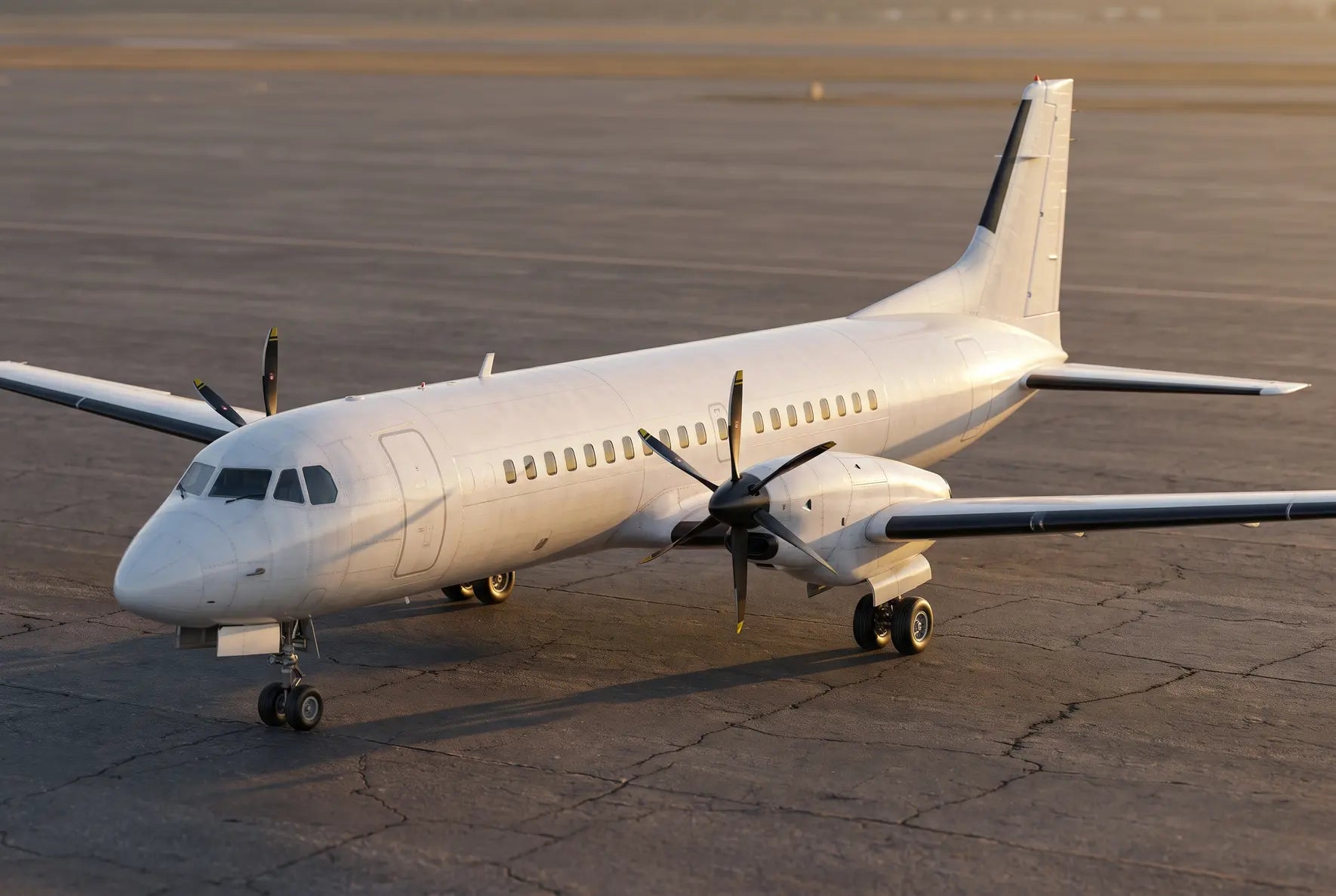
Beyond the Convairliners, the R-2800 family powered a wide range of celebrated military aircraft, including the Republic P-47 Thunderbolt and the Grumman F6F Hellcat, as well as numerous transports and later civil types. Its combination of reliable output and proven service history made it a natural choice for postwar airliners that needed dependable piston power. For readers interested in how the same basic airframe transitioned to turbine power, the Saab 2000 offers a useful comparison of later high-speed turboprop regional design philosophy.
Convair CV-340 vs CV-240, CV-440 and CV-580 Specifications Comparison
Scroll horizontally to see more →
| Parameter | Convair CV-340 | Convair CV-240 | Convair CV-440 | Convair CV-580 |
|---|---|---|---|---|
| Entry into service | 1951 | 1948 | 1955 | 1956 |
| Engines | 2 × Pratt & Whitney R-2800-CB16 Double Wasp radial engines | 2 × Pratt & Whitney R-2800 Double Wasp radial engines | 2 × Pratt & Whitney R-2800-CB16 Double Wasp radial engines | 2 × Allison T56-A-14 turboprop engines |
| Length | 24.14 m | 22.76 m | 24.14 m | 24.14 m |
| Wingspan | 32.13 m | 27.97 m | 32.13 m | 32.13 m |
| Height | 8.59 m | 8.20 m | 8.59 m | 8.59 m |
| Typical seating and layout (short description + approximate passengers) | 2-class pressurized cabin: 44 passengers | 2-class pressurized cabin: 40 passengers | 2-class pressurized cabin: 52 passengers | 2-class turboprop conversion: 50–56 passengers |
| MTOW | 21 t | 19 t | 21 t | 22 t |
| Range | 1,150 nm | 1,000 nm | 1,370 nm | 1,230 nm |
| Cruise speed | 0.42 Mach | 0.41 Mach | 0.42 Mach | 0.43 Mach |
| Service ceiling | 24,900 ft | 16,000 ft | 24,900 ft | 27,000 ft |
| Program note | Stretched pressurized DC-3 replacement with improved cabin and performance over the CV-240. | Baseline short-fuselage member of the family and the direct predecessor to the CV-340. | Further stretched, higher-capacity refinement of the same piston-airliner family. | Turboprop re-engining and modernization of the Convair 340/440 airframe for later commuter and cargo roles. |
Scroll horizontally to see more →
The table compares key specs across the Convair 240/340/440 family and the turboprop CV-580 conversion. The CV-340 stretches the CV-240 with more seats (44 vs 40), higher MTOW (21 t vs 19 t) and a much higher ceiling (24,900 ft vs 16,000 ft) while keeping similar cruise Mach. The CV-440 pushes capacity to about 52 and range to 1,370 nm. The CV-580 swaps radials for Allison T56 turboprops, raising MTOW and ceiling and slightly improving cruise speed.
Convair CV-340 Operations, Routes and Airlines Worldwide
The Convair CV-340 was conceived as a pressurised, short- to medium-range airliner and a direct replacement for the Douglas DC-3 on regional networks. In everyday scheduled service, operators flew it on sectors of roughly 300 to 1,000 km, well within its normal range of about 933 km and a maximum of around 1,850 km (Aeropedia). Cruise speed sat near 450 to 480 km/h at about 5,500 m, allowing faster, higher and smoother flights than the piston airliners it succeeded.
Because it was designed for multi-stop, inter-city flying, the type typically flew several short legs each day. Explicit block-hour figures are not documented for the CV-340, but 1950s piston regional airliners commonly logged around 6 to 8 block hours daily across many take-offs and landings. This frequent-cycle profile suited its role and matched the airframe's ability to use relatively short runways at secondary fields.
Operational environments
The CV-340 worked mainly in point-to-point and feeder roles, linking secondary cities and channelling traffic into larger hubs. Its short-field capability made it well suited to regional and secondary airports rather than long-haul intercontinental hubs. A military derivative, the C-131B, added transport and airborne-electronics test missions with provision for up to 48 occupants and a parachute-capable door. The main operational challenge for airlines was economic: as jets and turboprops matured, piston Convairs became costly to run, which pushed many airframes into cargo and combi conversions on regional freight routes later in life.
Where the aircraft operates
The CV-340 saw its widest use across North America and Europe, where flag and trunk carriers deployed it on dense short-haul city pairs as a pressurised DC-3 replacement. In Asia and Africa its presence was narrower and often reached through leasing, secondary owners and, more recently, heritage or scenic operations. Missions were consistent worldwide: regional trunk routes, hub feeders and multi-stop schedules serving mid-sized airports. Notably, English-language Convair histories do not list Aeroflot among CV-240-family operators, in contrast to the Western and Soviet-built types more typically associated with the carrier, as discussed in this overview of Aeroflot.
- Europe: KLM operated it on short-haul services from Amsterdam (c. 1953 to 1963), while Lufthansa, SAS, Finnair, Alitalia, JAT Yugoslav Airlines, Linjeflyg and Fred Olsen Air Transport used it on continental regional routes linking capitals and secondary cities.
- North & South America: United Airlines was the launch customer, ordering 52 aircraft, and Braniff placed the type into service first on 1 November 1952. Continental Airlines, Delta Air Lines, National Airlines, Northeast Airlines and Hawaiian Airlines flew it on domestic short-haul networks, with later airframes converted to CV-580 turboprops (Convair CV-240 family). In South America, documented use is sparse, though at least one airframe operated in Bolivia before moving on.
- Asia: Ariana Afghan Airlines is the clearly documented CV-340 operator, using it on regional services; related Convair variants such as the CV-440 were flown by carriers including All Nippon Airways.
- Africa: Rovos Air in South Africa operated the type on heritage and scenic flights, including former Continental and Bolivian airframes.
Typical seating
The CV-340 entered service as a 44-seat development of the CV-240, with the fuselage stretched by 1.37 m and cabin length increased by about 96.5 cm to add seating rows (Airways). Most airlines flew it in a single-class economy cabin with roughly 2-2 seating across the narrow single aisle, a forward passenger door on the port side, and galley, wardrobe and lavatory areas fore and aft. Network carriers typically retained the standard 40 to 44 seats to balance comfort with mail and cargo, as reflected in period United Airlines material citing a full load of 44 passengers. Higher-density or leisure-oriented layouts could reach about 48 to 52 seats by reducing galley space and tightening pitch, while combi and freighter conversions removed part or all of the cabin for palletised cargo. Additional airframe and configuration details are catalogued by B3A Aircraft Records.
In this video, learn how the Convair 340/440 helped replace the DC-3 in practice without fully supplanting it, following Lufthansa’s 1955 return to flight as two CV-340s departed Munich and Hamburg.
Convair CV-340 Safety Record: Accident History and How Safe It Is
The Convair CV-340 Metropolitan was a pressurised, twin-engine piston airliner that first flew in 1951 and entered service in 1952 with United Air Lines and Continental Airlines. Around 209 airframes were built, and many later flew for regional carriers, cargo operators and government fleets, with a number converted to turboprop power. When its accident and serious-incident history is placed against several decades of service, tens of millions of flight cycles across the wider Convair CV-240/340/440 family, and its long operational life, the CV-340 shows a safety profile broadly typical of 1950s medium piston airliners. Most hull losses were driven by weather, controlled flight into terrain, engine or fuel-management issues and maintenance errors, rather than by intrinsic design flaws. Because databases such as the Aviation Safety Network group the CV-240, CV-340 and CV-440 together, precise per-variant totals require manual review, but the pattern is consistent across sources.
Notable accidents and what changed afterwards
A small number of events illustrate the operational risks of the era and the improvements that followed.
- Continental Airlines, 1954 (N90853, near Midland, Texas): a CV-340 lost control after takeoff and belly-landed in a field with no fatalities. The investigation pointed to a maintenance error affecting the control system, reinforcing tighter maintenance inspection and control-rigging checks.
- United Air Lines Flight 329, 1955 (N73154, near Des Moines, Iowa): loss of elevator control shortly after takeoff led to an emergency wheels-up landing; all 39 aboard survived. Maintenance errors were again identified, prompting stricter procedures for flight-control assembly and post-maintenance verification.
- Braniff Flight 560, 1955 (Chicago Midway): the aircraft struck an obstacle on a low final approach and came to rest inverted, with 22 of 43 occupants killed. Documented in the CV-240 family accident record, this approach accident contributed to the wider push toward obstacle clearance standards and improved approach guidance around busy airports.
- Saudi operator, 1968 (HZ-AAZ): a CV-340-68 crashed after a third attempt to land in blowing dust and poor visibility, as detailed in the Aviation Safety Network entry. Such weather-related approach accidents underscored the value of firm missed-approach discipline and minimum-visibility limits.
How safe is the Convair CV-340?
Judged against the traffic volume it handled and the technology of its time, the CV-340 was a sound aircraft. Its conservative design philosophy, low wing, tricycle gear, conventional controls and the mature, widely used Pratt & Whitney R-2800 radial engines, favoured reliability over experimentation, and its pressurised cabin allowed operations above much low-level weather. Accident rates were driven mainly by the 1950s operating environment: limited navigation aids, non-precision approaches and maintenance practices that have since matured. The type did not suffer an unusual number of structural or design-driven losses compared with peers such as the Douglas DC-6 or the closely related Convair CV-440. Readers comparing piston-era types with modern regional airliners can see this evolution in later designs such as the Mitsubishi SpaceJet M90, where standardised operating procedures, redundant systems and stronger regulatory oversight reflect decades of accumulated lessons. Long-term data compiled by the Flight Safety Foundation confirm the broader trend: despite the risks inherent to early piston operations, aviation has continued to become safer, and it remains one of the safest modes of transport.
01 What kind of routes and range was the Convair CV-340 designed for?
The Convair CV-340 was designed primarily for short- to medium-haul regional routes, typically 500 to 1,500 kilometers in length. Its normal range of around 900 km and maximum range of roughly 1,800 km made it well suited to dense domestic trunk routes and shorter international hops. Airlines commonly used the CV-340 on multi-stop services linking major cities with secondary airports, where frequent departures and good short-field performance were more important than very long range. This mission profile made it a workhorse for postwar regional and feeder networks rather than transcontinental flights.
02 How many passengers did the Convair CV-340 carry and what was the cabin like?
The Convair CV-340 typically seated about 44 passengers in a single-aisle layout, an increase over the earlier CV-240 thanks to its slightly stretched fuselage. The cabin was pressurized and relatively comfortable for its era, with two-abreast seating on each side of the aisle and large oval windows that gave good outside views. Noise and vibration from the two Pratt & Whitney radial engines were noticeable compared with modern turbofans, especially near the wing, but were considered normal for 1950s propeller airliners. For flights of one to two hours, the cabin environment was generally regarded as practical and pleasant rather than luxurious.
03 Which airlines operated the Convair CV-340 and on what types of services?
The Convair CV-340 was flown by a wide range of airlines, including Braniff, Continental, Hawaiian, Delta, Alitalia, All Nippon, Finnair, KLM, Lufthansa and Ansett, among others. Operators used the aircraft intensively on domestic trunk routes and regional services, such as Melbourne–Sydney–Brisbane sectors in Australia and intra-European or inter-island flights elsewhere. Many airlines later converted CV-340s into turboprop CV-580s to extend their service lives on similar regional and commuter routes. In several markets, the CV-340 helped bridge the transition from smaller piston transports to larger jet airliners, filling an important mid-size capacity niche.
04 How does the Convair CV-340 perform compared with similar classic airliners?
The Convair CV-340 offered a cruising speed of roughly 450–460 km/h and a typical range around 1,700–1,800 km in airline service, placing it broadly in the same performance bracket as aircraft like the Douglas DC-4 and Martin 4-0-4. Its two 2,400–2,500 hp Pratt & Whitney R-2800 radial engines provided solid climb performance and good reliability for regional operations. Compared with the earlier CV-240, the CV-340’s stretched fuselage and refined systems allowed more passengers and slightly improved operating economics without a major change in handling characteristics. Later turboprop conversions such as the CV-580 significantly boosted speed, range and fuel efficiency while retaining the robust Convair airframe.
05 What is known about the safety record and design features of the Convair CV-340?
The Convair CV-340 was built to the safety standards of its time, with a strong, all-metal low-wing airframe and a pressurized cabin designed for frequent regional operations. Its use of well-proven Pratt & Whitney R-2800 engines and conventional mechanical systems contributed to a reputation for robustness and predictable handling among operators. Accidents involving CV-340s tended to reflect the broader risk profile of mid-20th-century piston airliners, such as weather, navigation and human factors, rather than unique design flaws. Many airframes were later converted to turboprop variants and continued flying for decades, which suggests a durable underlying structure and basic design.
06 What should a passenger know about comfort, seat choice and ride quality on a Convair CV-340?
On a Convair CV-340, seats located forward of the wing generally experience slightly less propeller noise and vibration than those near the engines, which can be helpful for comfort on longer sectors. The aircraft’s sturdy wing and relatively low cruising altitudes for regional flights mean turbulence is felt but usually manageable, with the ride comparable to other classic propeller airliners. The large oval windows provide good views, so window seats can be particularly enjoyable for enthusiasts, especially during takeoff and landing. Overall, travellers can expect a more mechanical, “classic airliner” feel than on modern jets, with a straightforward and functional cabin environment.