

History and Development of the Fokker 100: From F28 Successor to Regional Jet Icon
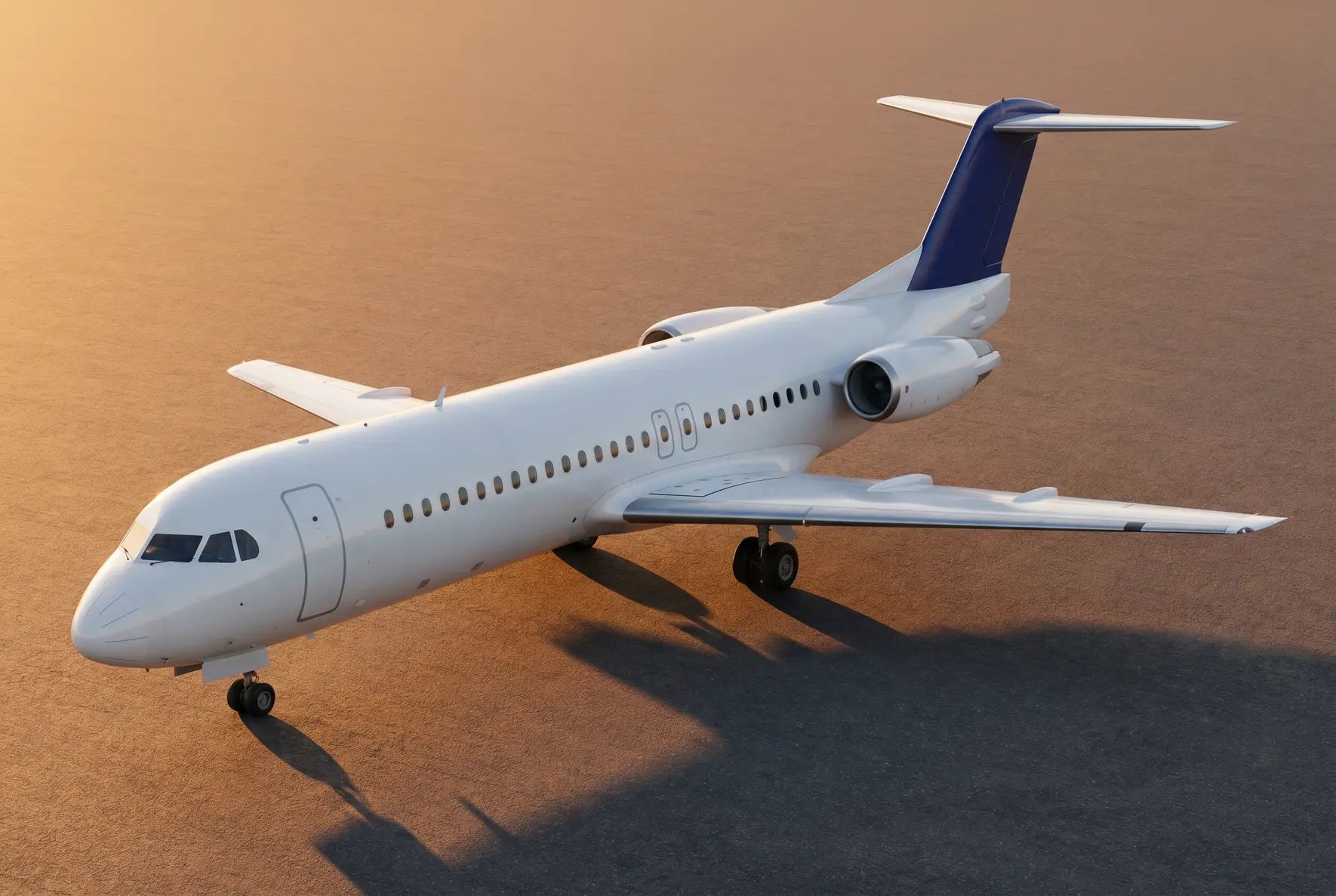
The Fokker 100 emerged as one of the most significant European regional jets of the late twentieth century. Developed by the Dutch manufacturer Fokker (Koninklijke Nederlandse Vliegtuigenfabriek Fokker), headquartered near Amsterdam, the aircraft was conceived as a substantially modernised and stretched successor to the Fokker F28 Fellowship, a twin-engine, T-tail jet that had served the short-haul market since the late 1960s. By the early 1980s, the F28 was nearing the limits of its growth potential, and Fokker identified a gap in the market for a 100-seat regional jet with lower operating costs, modern avionics, and quieter engines.
Program Launch and Key Milestones
Fokker officially launched development of what was initially designated the F28 Mk.0100 in November 1983, alongside the Fokker 50 turboprop programme. Engineers retained the F28's proven rear-mounted twin-engine layout and T-tail configuration, but introduced sweeping changes. The fuselage was stretched by approximately 5.74 metres, a new and larger wing was designed with increased aerodynamic efficiency, and a digital EFIS glass cockpit replaced the analogue instrumentation of the F28. Critically, the older Rolls-Royce Spey engines gave way to the new Rolls-Royce Tay turbofans, delivering better fuel economy and significantly lower noise levels.
Two prototypes were constructed. The first, registered PH-MKH, completed its maiden flight on 30 November 1986. The second prototype, PH-MKC, joined the flight test programme approximately three months later. After an intensive certification campaign, type certification was granted on 20 November 1987. Under the European (JAA/EASA) system, the aircraft was certified as the Fokker 28 Mk. 0100 under type certificate A-053.
The first delivery took place on 29 February 1988, when launch customer Swissair received its initial Fokker 100. The type entered commercial service that same year. A pivotal commercial milestone came in March 1989, when American Airlines placed an order for 75 aircraft, the largest single order in Fokker's history, valued at approximately US$3.1 billion. Deliveries to American Airlines began in 1991. Other notable operators included KLM Cityhopper, USAir, TAM of Brazil, and several Australian carriers, establishing the Fokker 100 as a genuinely global type. The aircraft's large cabin windows and comfortable interior became appreciated features among passengers and airlines alike.
Engines, Upgrades, and Production Variants
Early production Fokker 100s were powered by the Rolls-Royce Tay Mk 620-15, rated at approximately 13,850 lbf of thrust per engine. Later aircraft received the uprated Tay Mk 650-15, delivering around 15,100 lbf of thrust thanks to a slightly larger-diameter fan, combustor improvements, and new high-pressure turbine blades. This upgrade improved climb performance and high-altitude capability. The standard Fokker 100 had a maximum take-off weight (MTOW) of approximately 43,090 kg (95,000 lb), while an extended-range variant raised MTOW to 45,800 kg (100,990 lb), increasing range from roughly 2,450 km to about 3,170 km. Fokker also offered a Quick Change (QC) version for rapid conversion between passenger and freight configurations, and an Executive Jet (EJ) variant with a VIP cabin interior. All variants remained certified under the same EASA type certificate data sheet for the F28 Mk. 0100.
What Distinguishes the Fokker 100 from Related Variants
Compared to its predecessor the F28 Fellowship, the Fokker 100 offered a longer fuselage, seating for up to 122 passengers in high-density layout versus approximately 85 for the F28-4000, modern Tay engines in place of the older Speys, and a fully digital cockpit. Conversely, the Fokker 70, which first flew in April 1993, was a shortened derivative of the Fokker 100 with a fuselage 4.62 metres shorter, seating around 80 passengers, and exclusively powered by the Tay 620. Pilots of both types shared the same type rating, offering operators significant fleet flexibility.
Key variant identifiers for the Fokker 100 include:
- Engines: Rolls-Royce Tay Mk 620-15 (early) or Tay Mk 650-15 (later production)
- MTOW: 43,090 kg standard; up to 45,800 kg for the extended-range version
- Typical seating: 97 passengers in two-class layout; up to 122 in high-density configuration
- Cockpit: Digital EFIS glass cockpit, a major departure from the F28's analogue instruments
- Configuration options: Standard passenger, Quick Change (QC), and Executive Jet (EJ)
- Type certificate designation: Fokker 28 Mk. 0100 (EASA TC A-053)
Financial Struggles and End of Production
Despite its commercial and operational success, the Fokker 100 programme was undermined by severe financial pressures. Development costs escalated from an estimated US$500 million to approximately US$800 million. In April 1993, DASA (Daimler-Benz Aerospace) acquired a 51% controlling stake in Fokker, supported by the Dutch government. However, persistent per-aircraft production losses and intense competition from Boeing 737 variants and the emerging Airbus A319 eroded margins. On 22 January 1996, Daimler-Benz decided to withdraw financial support, cutting Fokker's line of credit. The company was declared bankrupt on 15 March 1996. Remaining aircraft on the production line were completed, with the last of 283 Fokker 100s rolling off the Schiphol assembly line in 1997. While Fokker as a manufacturer ceased to exist, support and maintenance services continued under Fokker Services (now Fokker Services Group), and dozens of Fokker 100s remain in commercial operation today.

A KLM Cityhopper Fokker 100 aircraft is captured in flight, showcasing the distinctive blue and white livery of the Dutch airline. The plane is flying against a cloudy sky.
Fokker 100 Technical Specifications, Systems and Engine Overview
The Fokker 100 was designed as a modern replacement for the ageing Fokker F28 Fellowship, targeting short-to-medium-haul routes of up to approximately 3,000 km with around 100 passengers. The airframe retained the proven T-tail, rear-mounted engine layout of the F28, but introduced a significantly stretched fuselage, a redesigned wing with increased span and area, and a completely new glass cockpit. Fokker's key design trade-off centred on maximising seat-mile economics on thin regional routes while keeping field performance compatible with shorter runways, a balance achieved through efficient Rolls-Royce Tay turbofans and a relatively lightweight structure.
Compared to direct competitors of the era such as the BAe 146 or the Tupolev Tu-134, the Fokker 100 offered a leap in cockpit technology and fuel efficiency. The type was certificated in three weight variants (Standard, Intermediate, and High Gross Weight), allowing operators to match acquisition cost and performance to their specific network requirements.
- Length: 35.53 m (116 ft 7 in)
- Wingspan: 28.08 m (92 ft 1 in)
- Height: 8.50 m (27 ft 11 in)
- Wing area: 93.5 m²
- Typical seating: 100 to 109 passengers (single-class, five-abreast); maximum certified up to 119
- MTOW: 43,090 kg (Standard) / 44,450 kg (Intermediate) / 45,810 kg (High Gross Weight)
- OEW: approximately 24,270 to 24,750 kg depending on variant
- MLW: 38,780 kg (Standard) / 39,915 kg (Intermediate and HGW)
- MZFW: 35,835 kg (Standard) / 36,740 kg (Intermediate and HGW)
- Fuel capacity: approximately 13,360 litres (3,531 US gal)
- Engines: 2 x Rolls-Royce Tay turbofans: Tay 620-15 (61.6 kN / 13,850 lbf) or Tay 650-15 (67 kN / 15,100 lbf)
- Maximum cruise speed: Mach 0.77 (approximately 845 km/h); typical cruise around Mach 0.73 to 0.75
- Service ceiling: 11,285 m (37,000 ft) per manufacturer data
- Range: approximately 2,450 to 3,170 km (1,320 to 1,710 NM), depending on weight variant, payload and reserves
- Takeoff field length (at MTOW): approximately 1,820 to 1,850 m (5,970 to 6,070 ft) under ISA, sea-level conditions
- Landing field length: approximately 1,350 m (4,430 ft)
- Noise certification: ICAO Annex 16 Chapter 3 compliant
- Avionics: Rockwell Collins EFIS glass cockpit with dual FMS, CAT IIIA autoland (CAT IIIB optional)
Systems, Flight Controls and Handling Technology
The Fokker 100 uses conventional mechanically signalled, hydraulically powered primary flight controls for ailerons, elevators and rudder, with artificial feel units providing control force feedback. Spoiler functions, including roll augmentation, in-flight speed brakes and automatic ground spoilers, are electronically commanded and hydraulically actuated, making them effectively a partial fly-by-wire secondary control. These spoilers deploy automatically on touchdown based on weight-on-wheels and thrust-lever position, integrating with the autobrake and anti-skid systems to maximise deceleration.
The cockpit is centred on a Rockwell Collins EFIS suite with electronic primary flight and navigation displays, a Multifunction Display System (MFDS) for system pages and crew alerting, and a dual Flight Management System (FMS). The Automatic Flight Control and Augmentation System (AFCAS) integrates autopilot, flight director, yaw damper and a Thrust Management System (TMS) that commands engine thrust for all flight phases. The combination enables fully managed vertical and lateral navigation from shortly after takeoff down to autoland, with full flight envelope protection. Braking relies on hydraulic multi-disc brakes with individual-wheel anti-skid protection, touchdown inhibition and selectable autobrake deceleration levels for landing and rejected takeoff scenarios.
Published performance figures for the Fokker 100 can vary noticeably between sources because operators selected different MTOW options, cabin configurations and equipment lists. Range and field-length values are also sensitive to atmospheric assumptions (ISA versus hot-and-high conditions), runway surface state, and reserve fuel policies. Any numbers quoted in manufacturer brochures or type certificate data sheets should be understood as reference figures under defined conditions, not as absolute operational guarantees.
Rolls-Royce Tay 620 and 650: The Fokker 100's Powerplant
The Fokker 100 is exclusively powered by the Rolls-Royce RB.183 Tay, a twin-spool, medium-bypass turbofan. The Tay was developed by combining the proven high-pressure core of the RB.183 Mk 555 Spey, itself the powerplant of the earlier Fokker F28, with a new wide-chord fan scaled from the much larger RB.211-535E4 engine. First run in August 1984, the Tay entered airline service on the Fokker 100 in 1988.
Two variants power the type. The Tay 620-15 produces 61.6 kN (13,850 lbf) of takeoff thrust and was fitted to early-production and standard-weight Fokker 100 airframes. The Tay 650-15 delivers 67 kN (15,100 lbf) and was introduced for higher-weight variants, offering about 9% more takeoff thrust and 15% more climb and cruise thrust than the 620, achieved through a slightly larger fan diameter (approximately 45 inches versus 44 inches), improved HP turbine blading and combustor upgrades. Both variants have a bypass ratio of approximately 3.0 to 3.1 and an overall pressure ratio of 16.0 to 16.4. Cruise specific fuel consumption is quoted at around 0.69 lb/lbf/hr at FL300 and Mach 0.73.
Beyond the Fokker 100, the Tay 620-15 also powers the shorter Fokker 70 in a de-rated configuration. A closely related variant, the Tay 651-54, was used to re-engine a fleet of Boeing 727-100QF freighters operated by UPS, sharing an identical core with the 650-15 but featuring different nacelle and accessory gearbox interfaces. The broader Tay family also includes the Tay 611 series, which powers the Gulfstream IV, G350, G400 and G450 business jets. By 2004, the Tay engine family had surpassed 20 million flight hours across more than 650 delivered engines, building a reputation for high dispatch reliability, low community noise and competitive fuel economics on short-haul operations.
Fokker 100 vs Fokker 70 vs BAe 146-100 vs MD-87 Specifications Comparison
Scroll horizontally to see more →
| Parameter | Fokker 100 | Fokker 70 | BAe 146-100 | McDonnell Douglas MD-87 |
|---|---|---|---|---|
| Entry into service | 1988 | 1994 | 1984 | 1987 |
| Engines | 2 × Rolls-Royce Tay 620-15 or 650-15 | 2 × Rolls-Royce Tay 620-15 | 4 × Lycoming ALF 502R-5 | 2 × Pratt & Whitney JT8D-217C or -219 |
| Length | 35.53 m | 30.91 m | 26.19 m | 39.75 m |
| Wingspan | 28.08 m | 28.08 m | 26.34 m | 32.82 m |
| Height | 8.50 m | 8.50 m | 8.61 m | 9.14 m |
| Typical seating and layout (short description + approximate passengers) | 2-class: 85–109 passengers | 2-class: 70–80 passengers | 2-class: 70–82 passengers | 2-class: 110–130 passengers |
| MTOW | 45.8 t | 38.1 t | 38.1 t | 67.8 t |
| Range | 1,320 nm | 1,850 nm | 1,300 nm | 2,050 nm |
| Cruise speed | 0.77 Mach | 0.77 Mach | 0.72 Mach | 0.76 Mach |
| Service ceiling | 37,000 ft | 37,000 ft | 35,000 ft | 37,000 ft |
| Program note | Stretched, higher-capacity development of the Fokker F28, positioned as a 100-seat short- to medium-haul regional jet. | Shortened derivative of the Fokker 100 optimized for lower-capacity regional routes and challenging airports. | Four‑engine regional jet of similar era aimed at short-haul, noise‑sensitive operations from short runways. | Shortened member of the MD-80 family targeting similar 100–130 seat markets with greater range and capacity. |
Scroll horizontally to see more →
The table compares four regional jets across size, performance, and capacity. MD-87 is the largest and heaviest, offering the highest seating (110–130) and longest range (2,050 nm). Fokker 70 is shorter yet has strong range (1,850 nm) for its class, while Fokker 100 sits between with 85–109 seats. BAe 146-100 is smallest and slower (0.72 Mach) but uses four engines and is aimed at short-runway operations.
Fokker 100 Operations: Typical Routes, Missions and Airlines Worldwide
The Fokker 100 was designed to fill the gap between turboprops and larger narrowbody jets on short- to medium-haul routes. Typical stage lengths range from 550 to 1,700 km (300 to 900 nautical miles), translating into flight times of approximately 1 to 2.5 hours per sector. On high-frequency regional networks in Europe or South America, the aircraft can fly four to six sectors per day, achieving daily utilisation rates of around 5 to 8 block hours. In specialised roles such as fly-in/fly-out (FIFO) mining support in Australia, utilisation drops to roughly 3 to 4 block hours per day, or about 1,200 hours per year, preserving airframe life on a type rated for up to 90,000 landings.
The Fokker 100 thrives in both hub-and-spoke and point-to-point networks. Its 100-seat capacity makes it well suited to feed passengers from secondary cities into major hubs, while its moderate runway requirements (approximately 1,800 m for take-off and 1,350 m for landing) allow regular operations at regional and secondary airports that cannot accommodate larger narrowbodies. Many operators also deploy it on direct routes between mid-sized cities where demand exceeds turboprop capacity but does not justify an Airbus A320 or Boeing 737.
Operators face several documented challenges. Since Fokker went bankrupt in 1996, spare-parts supply relies on specialist third-party providers and the part-out of retired airframes, which can mean longer lead times and higher component prices. Maintenance costs rise with age, and avionics retrofit mandates such as ADS-B Out require custom engineering work that is proportionally expensive for a shrinking global fleet. Fuel burn per seat is also notably higher than on current-generation regional jets; a proposed next-generation Fokker 100 concept with Pratt & Whitney GTF engines projected a 50 percent reduction in fuel consumption per seat compared with the original. These factors explain why most large network carriers have already retired the type, while niche operators continue to benefit from low acquisition costs and the aircraft's solid runway performance.
Where the Fokker 100 Operates Around the World
At its commercial peak in the 1990s and early 2000s, the Fokker 100 served airlines across every major region. In Europe, it was a staple of hub-and-spoke feeder services for carriers based at Amsterdam, Vienna, and Lisbon, among others. In North America, American Airlines was the single largest customer with 75 aircraft connecting secondary cities to Dallas/Fort Worth and Chicago O'Hare. Across South America, Brazilian and Colombian carriers used it on dense domestic trunk routes. In the Middle East, several Iranian airlines still rely on the type for domestic services, while in the broader region airlines such as Royal Jordanian operated related Fokker types on their regional networks. In Africa, a small number of East African operators have flown the Fokker 100 on regional routes, and in Asia-Pacific, Australia and Papua New Guinea now host the largest remaining fleets.
- Europe - KLM Cityhopper operated the Fokker 100 on high-frequency routes from Amsterdam to regional cities across the United Kingdom, Germany, and Scandinavia. Austrian Airlines used it as a feeder from Vienna, while Portugalia Airlines connected Lisbon and Porto with secondary European destinations. Helvetic Airways flew it on scheduled and ACMI charter services from Zurich. Carpatair in Romania operated three aircraft on routes to Italy and Germany into the 2020s, and Trade Air in Croatia used it for ACMI and charter work. The Slovak and French governments also operated Fokker 100s for VIP transport and flight-test duties respectively.
- North and South America - American Airlines deployed its 75 Fokker 100s on domestic routes from hubs including Dallas/Fort Worth, Chicago O'Hare, and Nashville, and even configured six aircraft in a 56-seat all-business-class layout for premium services from Dallas Love Field. The fleet was fully retired by 2004. In South America, TAM Airlines and VARIG/Rio-Sul in Brazil flew the type on busy domestic sectors between Sao Paulo and regional centres, while Avianca in Colombia used it on domestic trunk routes from Bogota. Air Panama continued operating two aircraft on regional Central American routes into the 2020s.
- Asia and Oceania - Iran remains a major operator: Iran Aseman Airlines, Iran Air, Qeshm Air, Karun Airlines, and Kish Air collectively fly more than 20 Fokker 100s on domestic routes linking Tehran, Shiraz, Isfahan, and smaller cities. In Papua New Guinea, Air Niugini uses up to seven aircraft as its mainline domestic jet from Port Moresby. Australia hosts the world's largest active concentration: Alliance Airlines operates approximately 25 Fokker 100s on charter and FIFO mining flights, while QantasLink (via Network Aviation) connects Perth with remote Western Australian communities using around 16 aircraft, and Virgin Australia Regional similarly serves Western Australian routes.
- Africa - Fokker 100 operations have been more limited on the continent. Jetways Airlines in Kenya and Salaam Air Express in Somalia have each operated single aircraft on regional routes in East Africa and toward the Gulf. Historically, carriers including Sudan Airways and Air Burkina used the type on short domestic and regional sectors, often through wet-lease arrangements.
Typical Seating Configurations on the Fokker 100
The Fokker 100 fuselage accommodates a 2-3 abreast seating arrangement with a single aisle, a cabin width of approximately 3.10 m, and a standing height of about 2.01 m. Certification allows anywhere from 97 seats in a two-class layout up to 122 in a high-density single-class configuration, though the vast majority of operators settle on approximately 100 economy seats as a practical compromise.
Among current regional operators, QantasLink configures its Fokker 100s with 100 economy seats at a pitch of 31 inches (79 cm) and a seat width of 17 inches. Alliance Airlines offers a similar 100-seat all-economy cabin at 33 inches of pitch, while Virgin Australia Regional provides a notably generous 34 inches (86 cm), which is frequently praised in passenger reviews. Historically, network carriers such as KLM, Swissair, and American Airlines fitted a small forward business-class cabin in a 2-2 layout alongside a 2-3 economy section, bringing the total to around 97 seats. Fokker also marketed a corporate variant, the Fokker 100EJ, seating 19 to 31 passengers in bespoke lounge, office, and stateroom configurations with optional auxiliary fuel tanks for extended range.
This video explores why Fokker went bankrupt despite building respected aircraft, focusing on the Fokker 100’s promise in commercial aviation and the pressures and business factors that led to the company’s collapse.
Fokker 100 Safety Record: Accident History and How Safe Is This Aircraft?
With 283 units built between the late 1980s and 1997, the Fokker 100 has accumulated millions of flight hours across dozens of operators on every continent. According to data compiled by AirSafe.com, the combined Fokker 70/100 family has a fatal passenger accident rate of approximately 0.18 per million flights, based on an estimated 11.11 million departures. That figure places the F100 well below older predecessors such as the Fokker F28 (1.62 per million flights) and early Boeing 737-100/200 variants (0.62), and in the same order of magnitude as many classic narrow-body jets that defined regional aviation for decades. Over more than 35 years of commercial service, the type has recorded only a small number of hull-loss accidents, the majority of which were linked to operational and environmental factors rather than inherent airframe design flaws.
Major Accidents and Safety Lessons
Three accidents stand out in the Fokker 100's operational history, each prompting meaningful improvements in procedures, training or design.
- TAM Flight 402 (31 October 1996, São Paulo, Brazil) – A TAM Fokker 100 (PT-MRK) crashed into a residential area seconds after takeoff from Congonhas Airport, killing all 95 occupants and four people on the ground. The Brazilian investigation authority CENIPA determined that an uncommanded deployment of the right thrust reverser during the takeoff roll caused asymmetric drag and loss of control. A feedback cable in the reverser system had separated inside its turnbuckle, defeating the intended safety interlocks. The accident led to mandatory design changes documented by the FAA, including reinforced reverser feedback mechanisms, tighter inspection intervals for reverser components, and updated crew training for recognising and responding to reverser anomalies during critical phases of flight.
- Palair Macedonian Airlines Flight 301 (5 March 1993, Skopje, North Macedonia) – A Fokker 100 attempted takeoff during heavy snowfall. Ice and snow had accumulated on the wings despite a de-icing procedure that proved inadequate. The contaminated wing surfaces reduced lift to the point where the aircraft could not sustain flight. It rolled and impacted terrain shortly after liftoff, killing 83 of the 97 people on board. The investigation highlighted insufficient de-icing procedures, limited airport infrastructure and a lack of winter-operations training. In the years that followed, operators tightened hold-over time tables, introduced mandatory tactile wing checks, and strengthened winter-operations curricula for both flight and ground crews, changes that eventually fed into broader international de-icing standards.
- Bek Air Flight 2100 (27 December 2019, Almaty, Kazakhstan) – A Fokker 100 lost lift shortly after takeoff in icy conditions and struck a building beyond the airport perimeter, killing 12 of the 98 occupants. Kazakhstan's investigation authority concluded that ground icing on the wings was the primary cause, compounded by the crew's failure to perform an adequate pre-flight inspection and serious organisational deficiencies within the airline. According to Aviation Safety Network, a subsequent audit revealed systemic maintenance shortcomings, including unrecorded parts swaps and missing data plates. Bek Air's Air Operator Certificate was revoked in April 2020.
A common thread across these events is the decisive role of human and organisational factors: inadequate de-icing procedures, insufficient crew awareness, and lax oversight each contributed more than any single airframe deficiency. Every accident triggered concrete regulatory action, from airworthiness directives to operator certificate revocations, reinforcing the industry's learn-and-improve cycle.
How Safe Is the Fokker 100 Today?
When measured against its total traffic volume, the Fokker 100's accident rate is consistent with that of comparable regional jets of its generation. The type was certified under stringent European and American transport-category standards (JAR 25/FAR 25) and features redundant hydraulic systems, dual independent avionics, and crashworthy structural design. Over the course of its service life, fleet-wide retrofits added Traffic Collision Avoidance Systems (TCAS) and Enhanced Ground Proximity Warning Systems (EGPWS), aligning the aircraft with the same safety nets mandated for all modern airliners.
As Boeing's Statistical Summary of Commercial Jet Airplane Accidents consistently shows, the global fatal accident rate for all commercial jets has declined by more than 65% over the past two decades, driven by better design, improved standard operating procedures (SOPs) and stronger regulatory oversight. Airlines that still operate the Fokker 100 today do so under the same rigorous maintenance programmes, crew training requirements and continuous airworthiness monitoring that govern newer types. Operators across Europe, Australia and the Middle East continue to fly the F100 on scheduled services, reflecting sustained confidence in the type's structural integrity and systems reliability. For travellers curious about pilot working conditions at various European carriers, a closer look at how airlines like easyJet Europe manage crew standards illustrates the broader industry commitment to safety culture.
Ultimately, while no aircraft type has a perfect record, the Fokker 100's safety history must be read in the context of an industry that moves roughly four billion passengers a year with remarkably few fatal events. Aviation remains, by a wide margin, one of the safest modes of long-distance transport available, and the Fokker 100's decades of service reflect that broader reality.
01 What kind of routes and range is the Fokker 100 typically used for?
The Fokker 100 is mainly used on short- to medium-haul routes, typically up to about 2,000 to 2,400 km, depending on configuration and payload. Airlines have used it on busy regional business routes, thinner domestic services, and short international flights where a 100-seat jet is the right size. It is well suited to operations from secondary and regional airports, including some with shorter runways. This makes the Fokker 100 a flexible choice for connecting smaller cities to major hubs.
02 What is the cabin like on a Fokker 100 for passengers?
The Fokker 100 cabin usually has a 2-3 seating layout, giving many passengers either a window or aisle seat and fewer middle seats than some rivals. Overhead bins are adequate but not as large as on many newer aircraft, so larger cabin bags may be limited. Noise levels are generally moderate, with the quietest area toward the front because the engines are mounted at the rear of the fuselage. Cabin interiors vary by airline, as many operators have refurbished seats, lighting, and finishes over the years.
03 Which airlines still operate the Fokker 100 and on what types of routes?
Although production ended in the 1990s, several operators in regions such as Australia, Europe, and parts of South America and the Middle East have continued using the Fokker 100. It is commonly deployed on regional business routes, charter flights, and shuttle services where around 100 seats are needed but demand does not justify a larger jet. Some airlines also use the Fokker 100 on thinner leisure and seasonal routes. Fleet sizes are generally small, and aircraft may be operated by regional or charter specialists rather than large global carriers.
04 How does the Fokker 100 compare with similar regional jets?
The Fokker 100 competes with aircraft such as older-generation Embraer ERJ and early Embraer E-Jet models in terms of capacity and range. Its typical seating of around 97 to 109 passengers fits between smaller regional jets and larger single-aisle aircraft like the Boeing 737 or Airbus A320. Fuel efficiency is generally lower than that of the latest-generation regional jets because the Fokker 100 uses older engine technology. However, for some operators it remains economical on niche routes thanks to fully depreciated airframes and suitable performance from regional airports.
05 What is known about the Fokker 100 safety record and design features?
The Fokker 100 has a safety record broadly comparable with other aircraft of similar age and generation, with a relatively small number of serious accidents over many years of service. It was designed with a robust airframe, rear-mounted engines, and a T-tail, and includes systems such as thrust reversers, spoilers, and modern (for its era) avionics. Most incidents have been related to weather, approach and landing, or operational factors rather than inherent structural flaws. Active fleets are maintained under current regulatory standards, and many aircraft have received avionics and systems upgrades over time.
06 Are there any practical seat or comfort tips for flying on a Fokker 100?
On a Fokker 100, seats toward the front of the cabin are generally quieter because the engines are mounted at the rear. Passengers sensitive to noise often prefer seats ahead of the wing, while those who like engine sound or a more “classic jet” feel might choose seats closer to the back. Window alignment can vary slightly by airline and row, but most window seats provide a good external view because the wing is relatively low and compact. Because overhead bins are smaller than on many newer jets, checking larger carry-on bags in advance can make boarding easier.