

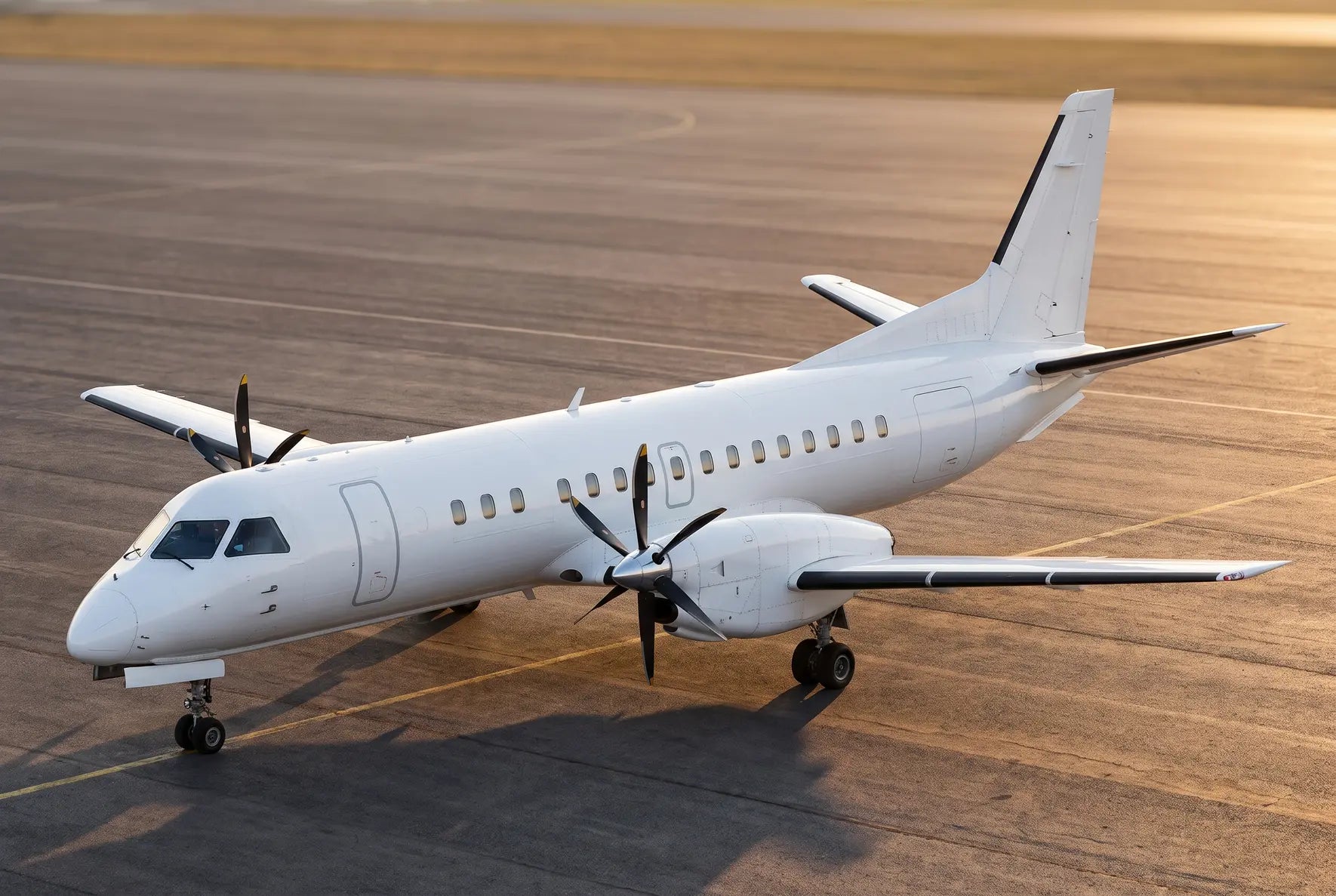
Saab 2000 History and Development: From Program Launch to Service
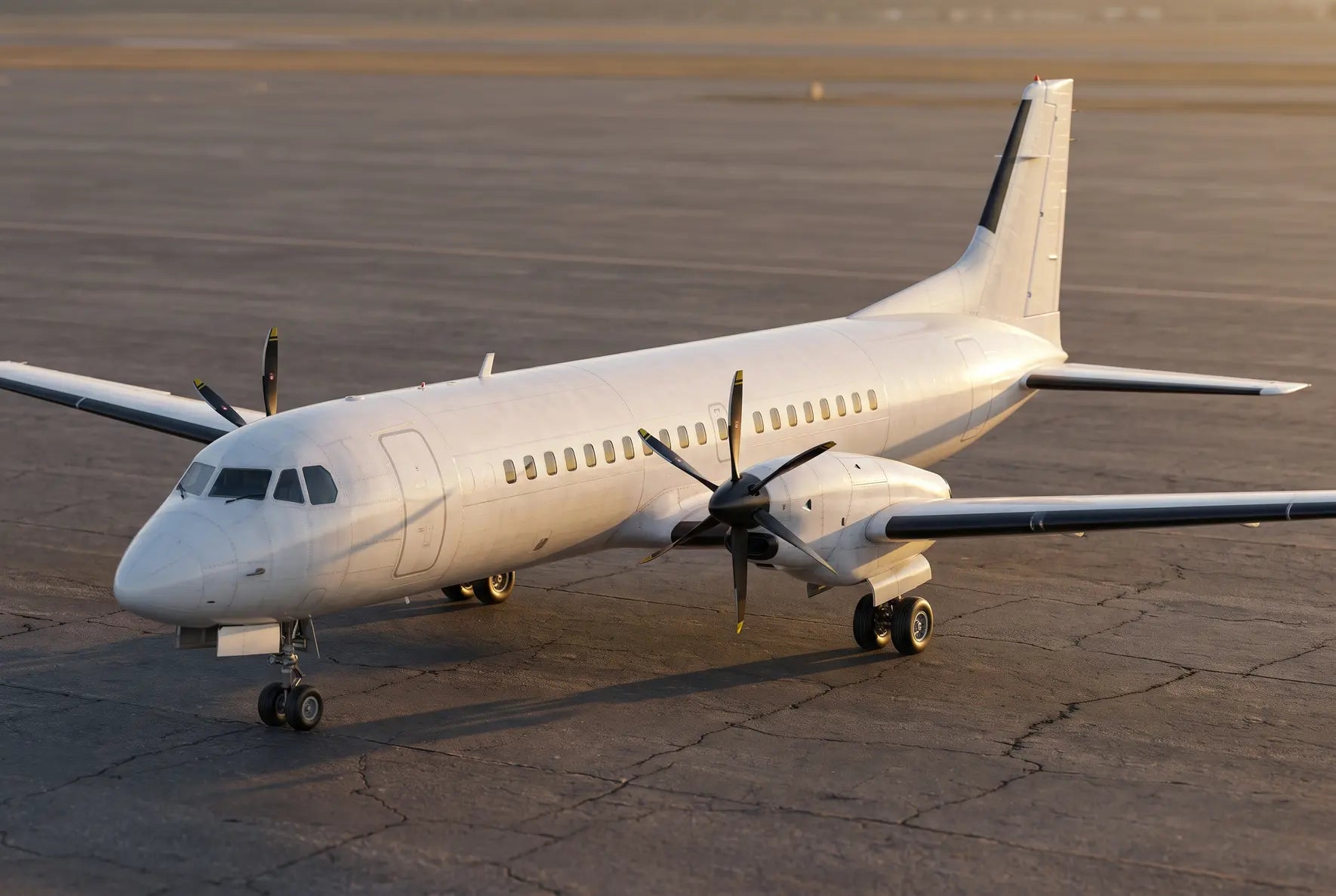
The Saab 2000 was conceived as a faster, higher-capacity evolution of the successful Saab 340, aimed at operators who wanted turboprop economics combined with near-jet cruise performance. Built by the Swedish aerospace and defence manufacturer Saab, the aircraft was designed for the growing regional market of the late 1980s, when airlines were seeking larger regional airliners able to link secondary cities at speeds close to those of contemporary jets. Production took place at Saab's facility in Linkoping, Sweden.
Saab formally launched the programme in May 1989, marketing the design as a "high-speed" regional turboprop. Early market response was strong, with reported firm orders for 46 aircraft and options for a further 147 at launch. The prototype made its first flight on 26 March 1992. Certification followed with the European Joint Aviation Authorities in March 1994 and the United States FAA in April 1994. The launch customer, Crossair, took delivery of its first aircraft on 30 August 1994, and the type entered scheduled airline service in September 1994. Production ended after 63 aircraft, with the final delivery in April 1999, a limited run that reflected shifting market conditions.
Technically, the Saab 2000 introduced several notable systems for its class. It was powered by two Rolls-Royce Allison AE 2100A turboprops driving Dowty Rotol propellers, and it used the Rockwell Collins Pro Line 4 avionics suite. Maximum cruise speed reached about 370 kt (685 km/h), with a typical capacity of 50 to 58 passengers depending on layout and a maximum take-off weight of roughly 23,000 kg. Further technical detail is documented in the Saab 2000 reference record.
What distinguishes the Saab 2000 from the Saab 340
The Saab 2000 is a stretched, more powerful derivative of the Saab 340 rather than an all-new design. Its fuselage was lengthened to increase seating capacity, and it adopted the larger AE 2100-class engines and bigger propellers that gave it substantially higher cruise speed. The engines were mounted further outboard on the wing than on the Saab 340, a change intended to reduce cabin noise. Where the Saab 340 remained a conventional regional turboprop, the Saab 2000 was positioned as a turboprop offering jet-like speed, closing much of the performance gap with regional jets that were emerging at the time. Readers comparing regional aircraft of this era may also find the Boeing 727-200 a useful point of contrast among short- and medium-haul airliners.
The following identifiers summarise the features that define this variant:
- Engines: two Rolls-Royce Allison AE 2100A turboprops, derated for the airframe
- Propellers: Dowty Rotol units
- Avionics: Rockwell Collins Pro Line 4 suite
- Cruise speed: around 370 kt (685 km/h)
- Capacity: approximately 50 to 58 passengers
- MTOW: about 23,000 kg
- Configuration: stretched fuselage relative to the Saab 340, with outboard-mounted engines for reduced cabin noise
Program challenges and commercial outcome
Despite a promising order book, the Saab 2000 faced commercial headwinds. Its relatively high cost, launch timing during a period of economic and geopolitical uncertainty, and increasing competition from regional jets limited airline uptake. The aircraft was also among the first commercial types to use the Allison AE 2100 turboprop family, and full certification came roughly two years after first flight as engine and propeller systems matured. These factors combined to keep production to 63 airframes, making the Saab 2000 a comparatively rare aircraft, though one respected for its speed and cabin refinement among regional turboprops.

A cream-colored Etihad Regional Saab 2000 aircraft is captured mid-flight against a clear blue sky. The propeller-driven plane, operated by Darwin Airline, displays its red detailing and Swiss flag emblem on the tail.
Saab 2000 Technical Specifications, Systems and Engines
The Saab 2000 was engineered as a high-speed regional turboprop, stretching the proven Saab 340 airframe to carry more passengers while approaching the block times of contemporary regional jets. Its mission was clear: connect short and medium regional routes with jet-like cruise speed and turboprop economics. To achieve this, Saab combined a longer fuselage, a redesigned high-aspect-ratio wing, and powerful Rolls-Royce turboprops driving slow-turning six-blade propellers to keep cabin noise and vibration low. The result is a design trade-off favouring speed and comfort over the very long range or heavy payload of larger regional aircraft.
From its Saab 340 lineage, the type inherits a conventional low-wing layout, pressurised cabin architecture and a focus on reliable short-field operation. According to Saab's product data, the aircraft targets a commercially viable range of roughly 1,000 nautical miles flown in about three hours, with a field length near 1,200 m that suits regional airports.
- Wingspan: 24.76 m (Saab data; SKYbrary rounds to 24.80 m)
- Length: 27.28 m
- Height: 7.73 m
- MTOW: approximately 21,320 kg
- Typical seating: 50 passengers standard, up to 58 in high-density layout
- Maximum cruise speed: 370 kt (about 685 km/h)
- Service ceiling: 31,000 ft (about 9,450 m)
- Engines: 2 x Rolls-Royce AE 2100A, around 4,125-4,152 shp each
- Propellers: Dowty Rotol, six-blade
- Fuel capacity: approximately 4,250 kg
- Takeoff field length: around 1,200 m (source-dependent; other references cite 1,300-1,500 m)
- Avionics baseline: Collins Pro Line 4 EFIS
Systems and handling-relevant technology
The Saab 2000 pairs conventional mechanically signalled flight controls with a modern glass cockpit built around the Collins Pro Line 4 electronic flight instrument system, giving crews integrated flight and engine displays plus flight management functions. The six-blade Dowty propellers were central to the design: their slow rotational speed and blade count help reduce noise and vibration, a factor closely linked to cabin comfort and to the way aircraft windows and cabin structures are engineered to manage acoustic and pressurisation loads. The aircraft also uses anti-skid braking and performance computation appropriate to short regional runways, while engine control and health monitoring support consistent dispatch reliability.
Published performance figures should always be read in context. Numbers such as takeoff field length, range and cruise speed vary with operator-selected weights, cabin density, temperature and altitude, runway condition and the certification basis used. For example, quoted takeoff field length ranges from roughly 1,200 m to 1,500 m across sources because each figure reflects different assumptions and definitions. For that reason, values here are indicative rather than absolute, and operators rely on their own certified performance data for dispatch planning.
The Rolls-Royce AE 2100 engine family
The AE 2100 is a turboprop originally developed by the Allison Engine Company and later marketed under Rolls-Royce after Allison was acquired in the mid-1990s. It shares a common core with the AE 1107 turboshaft and the AE 3007 turbofan, a modular design approach that spread development costs across military and civil applications. The Saab 2000 holds a notable place in its history as the first civil aircraft powered by the AE 2100, entering service in the mid-1990s with the AE 2100A variant driving its six-blade Dowty propellers through a reduction gearbox.
Beyond the Saab 2000, the family is best known in military service. The AE 2100D3 powers the Lockheed Martin C-130J Super Hercules, while the AE 2100D2 equips the Leonardo (formerly Alenia) C-27J Spartan tactical transport. These applications benefit from the engine's full-authority digital engine control and its combination of high power output with proven reliability, illustrating how a single core architecture serves roles from regional airline flying to demanding tactical airlift.
Saab 2000 vs Saab 340B vs ATR 72-600 vs Dash 8-400: Specs Comparison
Scroll horizontally to see more →
| Parameter | Saab 2000 | Saab 340B | ATR 72-600 | De Havilland Canada Dash 8-400 |
|---|---|---|---|---|
| Entry into service | 1994 | 1989 | 2010 | 2000 |
| Engines | 2 × Rolls-Royce AE 2100A turboprops | 2 × General Electric CT7-9B turboprops | 2 × Pratt & Whitney Canada PW127M turboprops | 2 × Pratt & Whitney Canada PW150A turboprops |
| Length | 27.3 m | 19.7 m | 27.2 m | 32.8 m |
| Wingspan | 24.8 m | 21.4 m | 27.1 m | 28.4 m |
| Height | 7.7 m | 6.9 m | 7.7 m | 8.4 m |
| Typical seating and layout (short description + approximate passengers) | Single-class regional: 50–58 passengers | Single-class regional: 33–36 passengers | Single-class regional: 68–78 passengers | Single-class regional: 70–82 passengers |
| MTOW | 22.5 t | 13.2 t | 23.0 t | 29.3 t |
| Range | 1,550 nm | 1,330 nm | 825 nm | 1,100 nm |
| Cruise speed | 0.62 Mach | 0.52 Mach | 0.50 Mach | 0.64 Mach |
| Service ceiling | 31,000 ft | 25,000 ft | 25,000 ft | 27,000 ft |
| Program note | High-speed stretched Saab turboprop aimed at jet-like regional performance on short to medium routes. | Baseline Saab regional turboprop providing economical short-haul capacity with smaller passenger loads. | Modern European regional turboprop optimized for high-efficiency short sectors and high-cycle operations. | High-capacity, high-performance turboprop positioned for busy regional routes and challenging airfields. |
Scroll horizontally to see more →
The table compares four regional turboprops across dimensions, performance, and capacity. Saab 2000 stands out for long range (1,550 nm) and higher cruise (0.62 Mach) with 50–58 seats, bridging turboprop efficiency and faster schedules. Saab 340B is smaller (33–36 seats) and lower ceiling. ATR 72-600 offers higher capacity but shorter range, while Dash 8-400 pairs the highest seating and MTOW with the fastest cruise (0.64 Mach).
Saab 2000 Operations: Routes, Missions and Airlines Worldwide
The Saab 2000 was conceived as a high-speed regional turboprop, offering jet-like schedule times on short and medium sectors. With a cruise speed near 359 kt (665 km/h) and a top cruise around 368-370 kt, it flies roughly 100 km/h faster than contemporaries such as the ATR 42, Fokker 50 and Dash 8-300, according to published aircraft data. Its design range of about 1,549 nmi (2,869 km) allows missions well beyond typical regional needs, but in scheduled service most sectors fall in the 200-900 nmi band, with the type technically capable of up to ~1,500 nmi depending on payload and reserves.
Regional turboprops in this class commonly fly several cycles per day, and the Saab 2000 was built for high-frequency rotations linking smaller cities to larger centres. A required field length near 1,200 m (under 4,000 ft) and a service ceiling of 31,000 ft make it well suited to short runways and terrain-affected environments, which is why it saw use across Alpine and island networks. The main operational challenge for operators has been fleet scarcity: only 63 aircraft were built between 1994 and 1999, with around 31 still in airline or military service as of late 2024, limiting spares availability and support economics compared with more numerous types.
Where the Saab 2000 Operates
The aircraft is overwhelmingly a European story, where it served hub-and-spoke feeder roles and point-to-point regional links from secondary airports. In North & South America its presence has been narrower, concentrated in remote and short-field operations. In Asia deployments have been limited, while in Africa the type has had virtually no mainstream scheduled passenger presence, with surviving airframes increasingly moving into special-mission and surveillance roles rather than airline service.
- Europe: Launch customer Crossair introduced the type on 30 August 1994 as a fast Swiss regional feeder. Regional Airlines flew it on behalf of Air France in a classic hub feeder role; Darwin Airline, later branded Etihad Regional, operated it across Switzerland and Italy. Eastern Airways and Loganair used it on UK and near-European regional routes, with Loganair exploiting its short-field ability at weather-challenged Scottish airports. Carpatair flew it on Eastern European hub-and-spoke sectors, OLT Ostfriesische Lufttransport in northern Germany, and Sky Work Airlines from Bern. Swedish and Norwegian carriers including Golden Air and Braathens historically operated the type on domestic regional networks.
- North & South America: PenAir (Peninsula Airways) flew the Saab 2000 in Alaska and other remote regions, where short runways and strong turboprop performance are essential.
- Asia: Documented scheduled passenger use has been limited, with no major carriers consistently recorded operating the type in regular service.
- Africa: No significant mainstream airline fleets have operated the type in scheduled passenger service.
For a European regional context on how short-haul turboprop and regional networks connect island and mainland communities, see this overview of Air Corsica operations.
Typical Seating Configurations
The Saab 2000 was marketed with a 50-58 seat range, and the EASA type-certificate lists a certified maximum of 53 passengers for the European Union. Network and regional carriers typically favoured a comfortable 50-seat single-class cabin at a 32-inch pitch, prioritising schedule utility and passenger comfort. Higher-density layouts of up to 58 seats at a 30-inch pitch were offered for operators seeking maximum capacity, and some carriers reduced counts below the nominal maximum, with documented all-economy layouts of 45 to 50 seats visible on published seat maps. Leisure and charter operators tended toward the upper end of capacity or flexible all-economy cabins to maximise seat count and turnaround efficiency, while network carriers kept simpler, more spacious single-cabin arrangements.
In this video, discover the Saab 2000, the Swedish-built turboprop known as the Concordino. Get a closer look at its design and performance, and learn what makes this remarkable aircraft stand out.
Saab 2000 Safety Record: How Safe Is This Regional Turboprop?
The Saab 2000 holds a strong safety record for a regional turboprop of its generation. Only 63 aircraft were built between 1992 and 1999, and the type entered commercial service with Crossair in 1994. Despite this small fleet, the aircraft has accumulated more than three decades of operations in scheduled, charter and special-mission roles across Europe, North America and Asia. Across those years and cycles, the Saab 2000 has recorded no fatal passenger accidents in commercial airline service, and hull losses remain very rare relative to the number of flights flown. Most notable events have involved technical or environmental factors rather than catastrophic in-flight structural failure, which places the type among the safer high-speed turboprops in its class. For continuously updated, type-specific records, the Aviation Safety Network database catalogues each occurrence, its damage level and any linked official report.
Notable Occurrences and What Changed Afterwards
A small number of serious incidents have shaped operational understanding of the aircraft. The most instructive is well documented by official investigators:
- Loganair (operating in Eastern Airways branding), 15 December 2014, Sumburgh (Shetland, Scotland): A Saab 2000 (G-LGNO) discontinued its approach in poor weather and was struck by lightning. The autopilot remained engaged contrary to the crew's understanding. When the commander applied nose-up inputs, the autopilot's pitch trim countered with nose-down trim, and the aircraft pitched to 19° nose-down, exceeded maximum operating speed by 80 kt and reached a descent rate of about 9,500 ft/min before recovery. The UK AAIB final report issued five Safety Recommendations addressing autopilot system design and the certification requirements for autopilot systems, reinforcing crew procedures for disengagement and manual recovery.
- Other events: The remaining occurrences in the type's history have generally been non-fatal and have involved runway or technical factors in adverse conditions. Findings from such investigations typically feed into refined stabilised-approach criteria, landing-performance calculations on contaminated runways and improved crew coordination, implemented through operator procedures, service bulletins and training updates rather than type-wide redesign.
These lessons apply beyond passenger service. Operators in demanding niche and freight roles, including those covered in our overview of Polar Air Cargo operations, rely on the same disciplined procedures and recurrent training that underpin the Saab 2000's record.
How Safe Is the Saab 2000 Overall?
Measured against its traffic volume, the Saab 2000 is a demonstrably safe aircraft. Its clean-sheet 1990s design combined a strengthened airframe, powerful Rolls-Royce AE 2100 turboprops and advanced avionics, giving jet-like cruise speeds with turboprop efficiency. Standard operating procedures, recurrent simulator training and oversight from authorities such as EASA and the FAA ensure that identified risks are addressed through documentation and pilot proficiency. The rarity of serious events across the fleet's operational life reflects both robust engineering and mature crew training. Broader industry data from the ICAO Safety Report confirms the wider context: commercial aviation remains one of the safest forms of transport available, and the Saab 2000 sits comfortably within that safety framework.
01 What typical routes and ranges does the Saab 2000 usually fly?
The Saab 2000 is designed for regional routes of roughly 500 to 1,000 nautical miles, making it well suited to medium-distance sectors of about 1.5 to 3 hours. Its practical range is around 1,000 nm in typical airline service, with a maximum range in the 1,500 nm class depending on load and conditions. This allows airlines to connect secondary cities directly without needing large jets. The aircraft’s strong short-runway performance also makes it useful for airports with limited runway length or challenging approaches.
02 What is the cabin layout and comfort like on the Saab 2000?
The Saab 2000 usually features a single-aisle 2–2 seating layout, with about 50 seats in a standard configuration and up to 58 in a high-density layout. Typical seat pitch is around 32 inches in standard layout, which is comparable to many regional jets and offers reasonable legroom for most passengers. The cabin was designed with active noise reduction using dozens of microphones and speakers, so the noise level is lower than on many older turboprops. The cabin cross-section is shared with the Saab 340 but stretched, giving a more spacious feel than many passengers expect on a turboprop.
03 How noisy is the Saab 2000 in flight compared with other turboprops?
The Saab 2000 is notably quieter than many traditional turboprops thanks to its active noise control system. This system uses a network of microphones and speakers to generate anti-noise, reducing the low-frequency propeller hum that is common on turboprop aircraft. As a result, cabin noise levels are closer to those of regional jets, especially at cruise. Passengers sitting toward the front generally experience slightly less engine and propeller noise than those seated near the wing and aft cabin.
04 Which airlines operate the Saab 2000 and what kinds of routes do they use it on?
Only 63 Saab 2000s were built, and around half remain in airline or military service, so the type is relatively rare. Today it is mostly used by smaller regional, charter, and specialized operators rather than large national carriers. Typical missions include regional passenger services between secondary cities, corporate and VIP charters, and cargo or special operations flights. Some operators also use the Saab 2000 for higher-speed turboprop services where jet-like block times are desired but turboprop economics are still attractive.
05 How does the Saab 2000 compare to similar regional aircraft in performance and efficiency?
The Saab 2000 is one of the fastest turboprop airliners ever built, with a maximum cruise speed around 370 knots, noticeably higher than common competitors such as the ATR 42, Fokker 50, and older Dash 8 variants. It combines this speed with efficient Rolls-Royce AE 2100-series engines and six-blade composite propellers, giving turboprop-level fuel burn on routes where a regional jet would typically be used. Its power-to-weight ratio is very high, resulting in strong climb performance and good payload on short runways. For airlines, this means near-jet flight times with lower operating costs on suitable regional sectors.
06 What should passengers know about flying on a Saab 2000 in terms of safety and seat choice?
The Saab 2000 has a modern design with two powerful engines, advanced propellers, and systems comparable to contemporary regional aircraft, and its overall safety record is in line with other turboprops in its class. For a smoother and quieter ride, seats ahead of the wing are generally preferable, as they are further from the main propeller and landing gear noise. The aircraft can cruise up to 31,000 feet, where air tends to be smoother, so turbulence is often less pronounced than on lower-flying turboprops. Window alignment varies slightly by airline, but choosing a seat over or just forward of the wing typically offers a good view of both the wing and propellers while balancing noise and comfort.