

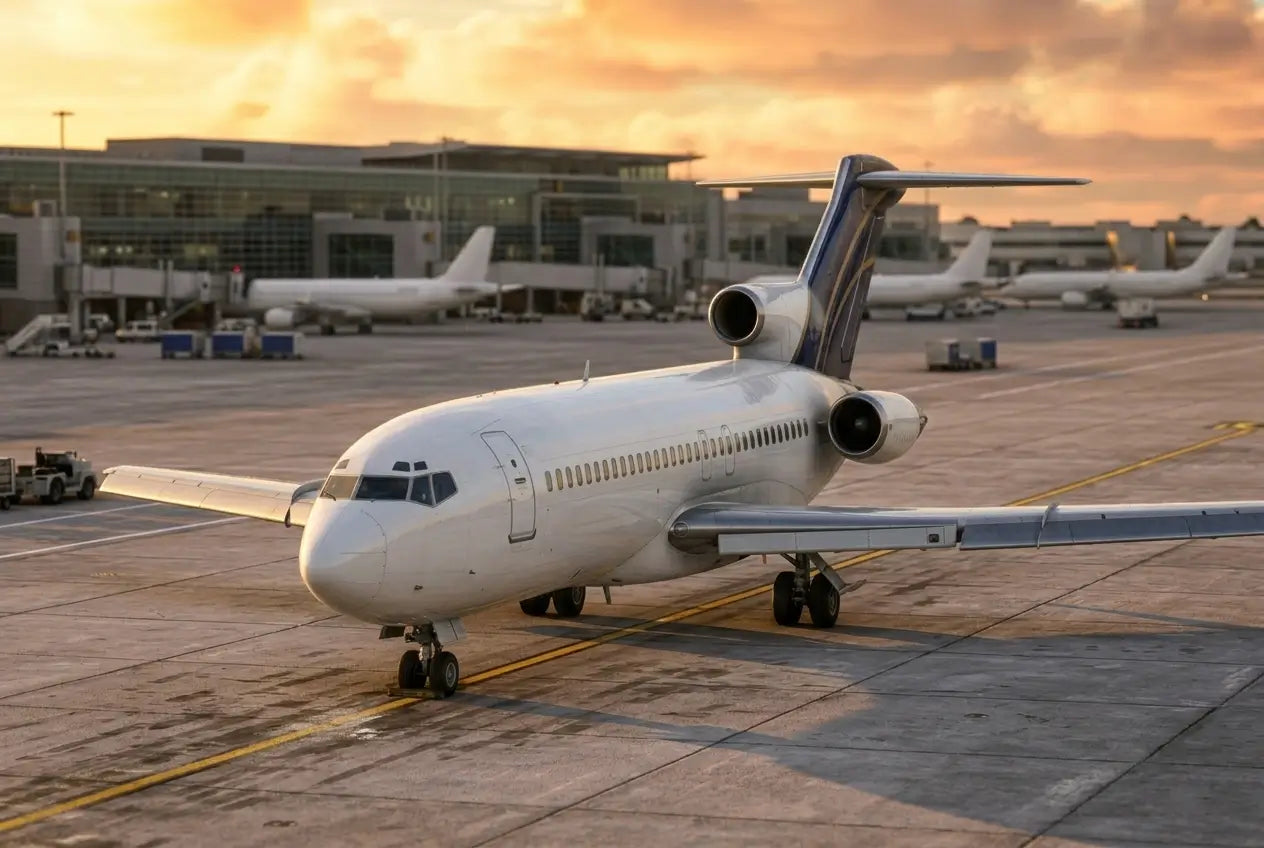
Boeing 727 100: History, Program Launch, Development and Variant Evolution
The Boeing 727 100 emerged from a strategic effort by Boeing Commercial Airplanes to fill a critical gap in the airline industry during the late 1950s and early 1960s. While the Boeing 707 and 720 were proving successful on long haul and transcontinental routes, major U.S. carriers needed a short to medium range jetliner capable of operating from shorter runways, high altitude airports such as Denver, and routes over water to destinations like the Caribbean. Eastern Airlines required three engines for overwater reliability, United Airlines demanded high altitude performance, and American Airlines sought operational efficiency that the twin engine designs of the era could not yet guarantee under existing regulatory constraints. Boeing answered these competing requirements with a trijet configuration that would become one of the most significant commercial aircraft programs in aviation history.
Program Launch and Key Milestones
Boeing officially launched the 727 program in December 1960, backed by substantial orders from Eastern Airlines and United Airlines as primary launch customers. Additional commitments from American Airlines, TWA, and Lufthansa followed shortly after, giving Boeing the confidence to proceed with full scale development. The aircraft was assembled at Boeing's Renton production facility near Seattle, Washington, where a dedicated workforce of approximately 5,000 employees built the first airframe, registered N7001U.
The prototype rolled out on November 27, 1962, with fuselage, cockpit, Pratt & Whitney JT8D engines, and landing gear already installed. The maiden flight took place on February 9, 1963, from Paine Field in Everett, Washington, piloted by Boeing test pilots Lew Wallick, Dix Loesch, and M. K. Shulenberger. The roughly two hour flight was largely successful, although the crew experienced a compressor surge on the centre (number two) engine during rotation, an issue that was subsequently resolved through inlet duct modifications and airflow adjustments.
An intensive flight test campaign followed, involving three prototype airframes that accumulated over 1,000 combined flight hours across structural, systems, and environmental trials conducted at locations including Edwards Air Force Base, Albuquerque, and Denver. The FAA granted type certification on December 24, 1963, under Type Certificate Data Sheet A3WE. Eastern Airlines inaugurated revenue service on February 1, 1964, operating the first commercial flight from Miami to Philadelphia via Washington. United Airlines followed just one week later, on February 6, 1964, with service from San Francisco to Denver.
Production of the Boeing 727 100 series continued until October 1972, by which time a total of 572 airframes had been built, including 407 standard passenger variants, plus convertible and quick change models. The entire 727 family, encompassing the later stretched 727 200, ultimately reached 1,832 units produced by 1984, making it the most successful commercial jetliner of its era until surpassed by the Boeing 737, also built at the Renton facility.
What Distinguishes the Boeing 727 100 from Later Variants
The Boeing 727 100 is the original, shorter fuselage member of the 727 family. Its most immediate successor, the 727 200, introduced a fuselage stretch of 6.10 metres (20 feet), achieved by inserting 3.05 metre plugs both forward and aft of the wing, increasing overall length from 40.59 metres (133 feet 2 inches) to 46.69 metres (153 feet 2 inches). This extension allowed the 727 200 to carry significantly more passengers, typically between 150 and 189 seats, compared to the 727 100's capacity of approximately 106 in a two class layout or up to 131 in a single class configuration.
Beyond fuselage length, the 727 200 offered a higher maximum takeoff weight and, in its Advanced subvariant, more powerful engines and increased fuel capacity for extended range. The 727 100 also featured a distinctive oval shaped centre engine air intake with a shorter S duct, whereas the 727 200 adopted a round intake. These visual and structural differences make the two variants readily distinguishable on the ramp. In terms of role, the 727 100 excelled on thinner, shorter routes where its lighter operating weight and short field performance were advantageous, while the 727 200 was optimised for higher density, longer stage lengths. Both types served alongside other narrow body trijets of the era, such as the McDonnell Douglas MD 90 30 family's predecessors, reflecting an industry wide preference for rear mounted engine configurations during this period.
The following summary outlines the key variant identifiers for the Boeing 727 100 family:
- Engines: Three Pratt & Whitney JT8D turbofans (JT8D 1 at 14,000 lbf thrust, JT8D 7 at 14,000 lbf, or JT8D 9 at 14,500 lbf depending on configuration)
- Fuselage length: 40.59 m (133 ft 2 in)
- Maximum takeoff weight: Up to 76,658 kg (169,000 lb)
- Typical passenger capacity: 106 (two class) to 131 (single class)
- Centre engine intake shape: Oval (shorter S duct), distinguishing it visually from the round intake of the 727 200
- 727 100C (Convertible): Equipped with a reinforced cargo floor and a large forward cargo door (compatible with 707 320C pallets) for mixed passenger and freight operations
- 727 100QC (Quick Change): Featured palletised seating systems enabling rapid conversion between all passenger and all cargo configurations within hours

This image shows an Iberia Boeing 727 airplane flying above the clouds with a clear blue sky in the background. The aircraft features a classic Iberia livery with red, yellow, and orange stripes.
Boeing 727 100 Technical Specifications, Systems and Engine Overview
The Boeing 727 100 was conceived as a short to medium haul trijet capable of operating from shorter runways and higher elevation airports that the earlier 707 could not efficiently serve. Its rear mounted, three engine configuration combined with advanced high lift devices gave it exceptional flexibility on routes where runway length, noise constraints or passenger demand did not justify a larger widebody. The design deliberately traded four engine redundancy for lighter weight and lower operating costs, while retaining intercontinental range reserves that made it viable on transcontinental segments with favourable winds.
What set the 727 100 apart within the early jet transport family was its wing. Equipped with triple slotted trailing edge flaps and leading edge slats and Krueger flaps, the wing could generate very high lift coefficients at low speed, enabling steep approach profiles and short field performance that few jets of the era could match. Combined with a T tail and aft fuselage mounted engines that kept the wing aerodynamically clean, the 727 100 delivered a cruise efficiency competitive with its contemporaries while retaining docile low speed handling characteristics.
- Overall length: 40.59 m (133 ft 2 in)
- Wingspan: 32.92 m (108 ft 0 in)
- Height: 10.36 m (34 ft 0 in)
- Typical seating: 106 passengers in two class layout, up to 129 in single class
- Maximum takeoff weight (MTOW): 76,657 kg (169,000 lb)
- Operating empty weight (OEW): approximately 39,780 kg (87,696 lb)
- Fuel capacity: approximately 29,100 litres (7,680 US gal)
- Range: 2,250 nmi (4,170 km) with 106 passengers in a two class configuration
- Maximum cruise speed: Mach 0.81 (approximately 518 kn / 960 km/h)
- Engines: 3 × Pratt & Whitney JT8D low bypass turbofans (JT8D 1, JT8D 7, JT8D 9 certified for this variant)
- Thrust per engine: 62.3 to 64.5 kN (14,000 to 14,500 lbf) depending on JT8D variant installed
- Noise compliance: originally ICAO Chapter 2; hush kit retrofits required for Chapter 3 operations
Systems, Flight Controls and Handling Technology
The 727 100 relies on a fully powered hydraulic flight control architecture built around three independent 3,000 psi systems designated A, B and Standby. Systems A and B operate simultaneously to drive all primary control surfaces: inboard and outboard ailerons, elevators and a dual section rudder split into upper and lower segments. If either primary system fails, the other sustains full control authority with no perceptible change in handling. The Standby system provides an additional layer of redundancy for the lower rudder and the leading edge devices. Only in the unlikely event of a dual failure of both A and B do the ailerons and elevators revert to manual cable control, a scenario that is manageable but demands higher control forces from the crew.
Each rudder segment is paired with its own yaw damper, which senses yaw rate and applies corrective inputs to suppress Dutch roll without moving the rudder pedals. The horizontal stabilizer is electrically actuated rather than hydraulic, with dual feel computers that provide artificial stick force feedback proportional to airspeed. Trailing edge flap asymmetry protection monitors flap position and automatically halts movement if an imbalance is detected, a significant safety feature during approach configuration changes.
The avionics baseline reflects the analog era of the 1960s. Standard equipment includes dual flight directors, an autopilot capable of managing climb, cruise, descent and coupled ILS approaches, plus a Horizontal Situation Indicator (HSI) with VOR and course selectors. An instrument comparator system cross checks captain and first officer displays, illuminating warning lights if tolerances are exceeded. Anti skid braking is standard, with the system modulating brake pressure to prevent wheel lockup on wet or contaminated runways.
Published performance figures for the 727 100 can vary significantly between sources and operators. Differences in cabin configuration, passenger count, cargo load, fuel reserves policy, atmospheric temperature, airport elevation and runway surface condition all influence real world takeoff distances, landing distances and achievable range. Manufacturer numbers typically assume standard day conditions (ISA, sea level) and a specific payload, so direct comparisons with other types should account for these assumptions. For professionals looking to deepen their understanding of aircraft performance and the broader economics of aviation, a structured reference such as the one available at Ready for Takeoff can provide valuable context.
The Pratt & Whitney JT8D: The Engine Behind the 727 100
Every Boeing 727 100 rolled off the production line with three Pratt & Whitney JT8D turbofans, an engine family that became one of the most commercially successful powerplants in aviation history. Development began in the early 1960s to meet airline demand for a reliable, efficient turbofan suited to short and medium haul operations. The JT8D made its inaugural flight on the Boeing 727 prototype in February 1963 and entered revenue service in 1964.
The JT8D is a dual spool, low bypass turbofan with a bypass ratio between 0.96 and 1.07, depending on the variant. Internally, the original series features a single stage fan, a six stage low pressure compressor, a seven stage high pressure compressor, nine can annular combustion chambers, a single stage high pressure turbine and a three stage low pressure turbine. For the 727 100 specifically, the FAA Type Certificate (TCDS A3WE) lists the JT8D 1, JT8D 7 and JT8D 9 as approved engine options, with takeoff thrust ratings ranging from 14,000 lbf (62.3 kN) for the JT8D 7 to 14,500 lbf (64.5 kN) for the JT8D 9.
Beyond the 727, the JT8D family powered an extraordinarily wide fleet of aircraft. The early JT8D variants served the Boeing 737 100 and 737 200, the Douglas DC 9 in all its variants, and the Sud Aviation Caravelle (re engined versions). The higher thrust JT8D 200 series, delivering 18,500 to 21,700 lbf, became the exclusive powerplant for the McDonnell Douglas MD 80 family starting in 1980. Over the full production run, more than 14,750 JT8D engines were manufactured, accumulating over 673 million flight hours according to Pratt & Whitney. Production of the original series ended in 1985, although replacement engines for military platforms continued into 2011. The JT8D's combination of proven reliability, relatively low maintenance costs and broad operator familiarity helped make the 727 100 one of the most successful early jetliners in commercial aviation.
Boeing 727-100 vs 727-200 vs 737-200 vs DC-9-30 Specifications Comparison
Scroll horizontally to see more →
| Parameter | Boeing 727-100 | Boeing 727-200 | Boeing 737-200 | Douglas DC-9-30 |
|---|---|---|---|---|
| Entry into service | 1964 | 1968 | 1968 | 1967 |
| Engines | 3 × Pratt & Whitney JT8D-7 | 3 × Pratt & Whitney JT8D-15 | 2 × Pratt & Whitney JT8D-9 | 2 × Pratt & Whitney JT8D-9 |
| Length | 40.6 m | 46.7 m | 30.5 m | 36.4 m |
| Wingspan | 32.9 m | 32.9 m | 28.4 m | 28.3 m |
| Height | 10.4 m | 10.4 m | 11.0 m | 9.1 m |
| Typical seating and layout | 2-class: 125–149 passengers | 2-class: 163–189 passengers | 2-class: 115–130 passengers | 2-class: 125–139 passengers |
| MTOW | 77 t | 95 t | 52 t | 64 t |
| Range | 2,590 nm | 2,600 nm | 2,100 nm | 2,500 nm |
| Cruise speed | 0.82 Mach | 0.82 Mach | 0.82 Mach | 0.82 Mach |
| Service ceiling | 37,400 ft | 35,200 ft | 37,000 ft | 37,000 ft |
| Program note | Short-fuselage baseline trijet for short/medium routes | Stretched higher-weight version for greater capacity/range | Twin-engine short-body successor for similar missions | DC-9 stretched variant, direct market competitor |
Scroll horizontally to see more →
The table compares key specs of the Boeing 727-100 and 727-200 against the Boeing 737-200 and Douglas DC-9-30. The 727 variants are trijets and the largest, with the -200 stretched for more seats and higher MTOW (95 t vs 77 t) while keeping similar range. The 737-200 is shorter and lighter (52 t) with the shortest range (2,100 nm). The DC-9-30 offers range close to the 727s at lower weight.
Boeing 727-100 Operations, Typical Routes and Airlines Around the World
The Boeing 727-100, the original short fuselage variant of the 727 family, entered commercial service in February 1964 and was purpose built for short to medium haul operations. With a maximum range of approximately 2,250 to 2,300 nautical miles (around 4,170 km) in a typical two class configuration carrying about 106 passengers, the aircraft was tailored for domestic trunk routes and regional international services. Flights typically lasted between one and three hours, connecting major metropolitan hubs with secondary cities across North America. The trijet's ability to operate from relatively short runways, thanks to its triple slotted flaps and aft mounted engines offering excellent ground clearance, made it especially versatile for airports with limited infrastructure.
Operationally, the Boeing 727-100 thrived in hub and spoke networks. Airlines scheduled it on high frequency, short sector routes feeding their main hubs, achieving several flight cycles per day. Its built in ventral airstair allowed boarding at airports without jetbridges, a significant advantage at smaller regional stations during the 1960s and 1970s. Daily utilisation on busy domestic corridors could reach six to ten block hours, with quick turnarounds enabled by the aircraft's straightforward ground handling requirements.
Despite its operational flexibility, the Boeing 727-100 posed notable challenges for operators over time. The three Pratt & Whitney JT8D engines, while reliable, consumed considerably more fuel per seat than the twin engine narrowbodies that followed. More critically, these engines were notoriously loud. As Stage 2 and Stage 3 noise regulations took effect in the United States and Europe during the 1990s, operators faced the choice of installing expensive hush kits (costing roughly $695,000 per aircraft) or retiring the type altogether. Most major carriers chose retirement, and by 2008 only 81 Boeing 727-100 airframes remained in airline service worldwide. The economics of maintaining three engines on a short body aircraft, combined with rising fuel costs and tightening environmental standards, accelerated the transition to more efficient types such as the Boeing 737 and Airbus A320 families.
Where the Boeing 727-100 Operated Worldwide
The Boeing 727-100 saw service on every inhabited continent, although its heaviest concentration was always in North America. In the United States, the type formed the backbone of domestic networks for launch customers United Airlines and Eastern Air Lines, as well as American Airlines, Northwest Airlines, and Delta Air Lines. In South America, Brazilian carriers embraced the aircraft for both domestic trunk routes and international connections across the continent. European operators deployed it on shorter continental services, while in Asia and the Middle East it served a mix of domestic, regional, and charter missions. African operators often acquired second hand Boeing 727-100s for passenger and cargo operations on routes where the type's short field performance proved invaluable.
For aspiring pilots interested in understanding how airline fleets and route networks shape career opportunities, the Ryanair Future Flyer Programme overview provides useful insight into modern airline recruitment pathways.
- North & South America: The largest operator base by far. United Airlines, Eastern Air Lines, and American Airlines were launch customers in the United States and used the Boeing 727-100 on high frequency domestic corridors such as New York to Chicago and Washington to Atlanta. Northwest Airlines initially configured its fleet with just 93 seats and generous legroom. Delta Air Lines operated the type with 131 seats on shuttle style routes including Washington DC National to New York LaGuardia. Budget carriers like People Express flew as many as 46 aircraft on low fare services. In South America, VARIG operated 19 Boeing 727-100s from 1970, replacing Electra II turboprops on Brazilian domestic routes such as Rio de Janeiro to Manaus, and on international services connecting São Paulo to Caracas and Miami. Transbrasil operated 22 aircraft on domestic and regional schedules, while SAM Colombia used 14 passenger configured airframes alongside six freighters across Colombian routes.
- Europe: European use of the Boeing 727-100 was more limited than in North America. Alitalia in Italy operated the type on short haul European routes, and Lufthansa in Germany deployed the aircraft on intra European services during the late 1960s and 1970s. TransAer International Airlines in Ireland also operated the variant, primarily for charter and ad hoc services. European operators generally transitioned to the Boeing 737 and other twin engine types earlier than their American counterparts due to stringent noise rules.
- Asia: In Asia and the Middle East, several carriers incorporated the Boeing 727-100 into their fleets. All Nippon Airways in Japan used the type on Japanese domestic routes, while Alia Royal Jordanian Airlines in Jordan operated it on regional Middle Eastern services. Philippine Airlines flew a small fleet on Southeast Asian routes, and Royal Nepal Airlines deployed five aircraft in one of the most challenging operational environments in the world. Qatar Airways operated six aircraft during its early years before transitioning to more modern equipment.
- Africa: The Boeing 727-100 found a second life with several African operators, often acquired as second hand airframes from retiring North American and European fleets. Okada Air in Nigeria flew six aircraft before ceasing operations in 1997. Nationwide Airlines in South Africa operated three until 2008, while Transafrik International in Angola built a significant fleet of 14 aircraft used primarily for cargo and logistical support missions. Trans Air Congo also operated both passenger and freighter variants in Central Africa.
Typical Seating Configurations on the Boeing 727-100
The Boeing 727-100 featured a single aisle cabin with a fuselage interior width of approximately 3.56 metres (11 ft 8 in), accommodating six abreast seating in economy class in a 3+3 arrangement. According to Boeing's published specifications, the aircraft typically carried 106 passengers in a two class layout or up to 129 in an all economy configuration. Maximum high density seating could reach 149 passengers, though this was uncommon in regular scheduled service.
Network carriers generally offered a dual class cabin. Eastern Air Lines configured its Boeing 727-100 fleet with 12 first class seats in a 2+2 layout forward and 107 economy class seats in a 3+3 arrangement, totalling 119 passengers. Northwest Airlines initially fitted only 93 seats with generous legroom before gradually increasing capacity to 118 seats by 1990. Delta Air Lines offered a 131 seat configuration, while VARIG in Brazil used a 94 seat layout with 22 business class seats in 2+2 abreast and 72 economy class seats in 3+3 abreast. Economy seat widths on the Boeing 727-100 were typically around 17 to 18 inches (43 to 46 cm), consistent with the single aisle narrowbody standard of the era. Convertible variants such as the 727-100C and the Quick Change 727-100QC could be reconfigured between passenger and all cargo layouts in approximately 30 minutes, offering operators remarkable flexibility for mixed use operations.
In this video, experience a cockpit view from a private Boeing 727-100 Super 27, N311AG, departing Sacramento McClellan (MCC), then flying to Stockton (SCK) for a touch-and-go on November 19, 2018.
Boeing 727 100 Safety Record: Accidents, Incidents and How Safe It Really Is
The Boeing 727-100 entered commercial service in February 1964 and remained on front line duty with major carriers for more than three decades. Approximately 572 aircraft of this specific variant were produced between 1963 and 1972, and the full 727 family reached 1,832 airframes before the production line closed in 1984. Over its long career the 727-100 accumulated millions of flight hours and cycles across more than 100 operators worldwide. When evaluating the type's safety record, it is important to place individual events in context: the vast majority of flights were completed without incident, and many of the accidents that did occur took place during the earliest years of operation, when crews were still adapting to a new generation of jet airliner.
Across all 727 variants, the Aviation Safety Network documents a total of roughly 120 hull losses resulting from crashes, criminal acts and other causes. A significant proportion of early 727-100 losses were attributed to human factors rather than structural or mechanical shortcomings, a pattern that prompted far reaching changes in training and operational procedures.
Notable Accidents and the Lessons They Produced
Several high profile events shaped the safety evolution of the Boeing 727-100 and left a lasting mark on commercial aviation standards.
- United Airlines Flight 389 (16 August 1965) — A Boeing 727-22 crashed into Lake Michigan during its descent toward Chicago O’Hare, killing all 30 people on board. The Civil Aeronautics Board was unable to determine the exact reason the aircraft was not levelled off at its assigned altitude of 6,000 feet. A widely discussed contributing factor was possible misreading of the three pointer altimeter by 10,000 feet. The accident underscored the need for improved altimeter training and better cockpit instrument standardisation.
- American Airlines Flight 383 (8 November 1965) — A Boeing 727-23 struck a hillside during a visual approach to Cincinnati in poor visibility, resulting in 58 fatalities among 62 occupants. Investigators found the crew failed to monitor altitude adequately during a stabilised approach in deteriorating weather. The tragedy reinforced the critical importance of altitude awareness, especially at night and in instrument meteorological conditions.
- All Nippon Airways Flight 60 (4 February 1966) — A 727-100 plunged into Tokyo Bay, killing all 133 occupants. Like the earlier U.S. accidents, the event was linked to crew inexperience on type and excessive sink rates during the approach phase. Together with the United and American crashes, this accident led the FAA to order a comprehensive review of 727 operating procedures, mandate enhanced pilot transition training and encourage airlines to limit the maximum flap setting to 30 degrees rather than the original 40 degree option. These procedural changes dramatically reduced approach related incidents on the type.
- TWA Flight 841 (4 April 1979) — A Boeing 727-31 carrying 89 people entered an uncommanded roll and spiral dive from 39,000 feet near Saginaw, Michigan, plummeting roughly 34,000 feet in just 63 seconds. The flight crew recovered control near 5,000 feet and landed safely at Detroit; there were no fatalities and only eight minor injuries. The NTSB attributed the probable cause to the isolation of the number 7 leading edge slat in an extended or partially extended position, combined with untimely flight control inputs. The finding spurred additional inspection protocols for leading edge slat mechanisms and intensified debate about uncommanded flight control failures on tri jet airliners.
Each of these events catalysed measurable safety advances. Airlines rewrote flight manuals, regulators tightened oversight of crew training syllabi and manufacturers improved inspection bulletins for critical flight control components. The broader aviation community also accelerated the development and mandatory fitment of the Ground Proximity Warning System (GPWS) throughout the 1970s, a technology that has since virtually eliminated controlled flight into terrain among equipped operators.
How Safe Is the Boeing 727-100 Today?
Judged by modern standards, the Boeing 727-100 belongs to an earlier generation of narrowbody jets that predates many of today’s automated safety systems. Its hull loss rate per million departures was higher than that of later designs such as the 737NG or A320 families, yet this figure must be read alongside the era in which most of those losses occurred. The majority of serious accidents happened in the 1960s and 1970s, when cockpit resource management, stabilised approach criteria and terrain awareness technology were still in their infancy.
By design, the 727's three engine configuration provided an additional margin of thrust redundancy, and its robust structure earned a reputation for durability on short to medium haul routes, including operations from challenging airfields with shorter runways. Over time, successive airworthiness directives and service bulletins addressed structural fatigue, corrosion and system reliability, keeping the fleet airworthy well beyond its original design horizon.
Very few 727-100 airframes remain in active commercial service today, and those that do operate under the same rigorous regulatory framework applied to every certificated transport category aircraft. For anyone exploring the broader story of how aircraft safety has evolved from the pioneering jet age to the present, Ready for Take Off offers an engaging, well researched overview that places types like the 727 in historical perspective.
Ultimately, the legacy of the Boeing 727-100 is one of continuous learning. Its early accident record, while sobering, drove industry wide improvements in pilot training, cockpit instrumentation and regulatory oversight that benefit every passenger who flies today. According to the IATA Safety Report, the global jet accident rate has fallen by more than 90 percent since the 1970s, confirming that commercial aviation remains one of the safest forms of transport in the world.
01 What is the typical range and mission profile of the Boeing 727-100?
The Boeing 727-100 has a range of approximately 2,590 nautical miles with a standard payload, making it well-suited for short to medium-haul domestic routes. The aircraft can cruise at 600 mph and requires a takeoff distance of around 8,300 feet, enabling it to operate from smaller airports that couldn't accommodate larger jets. This combination of range, speed, and flexibility made it an ideal workhorse for regional and mainline carrier networks throughout the 1970s and beyond.
02 How many passengers does the Boeing 727-100 typically carry?
The Boeing 727-100 accommodates between 163 and 189 passengers depending on the seating configuration chosen by the airline. The cabin spans 3.55 meters in width and has a total deck area of 91.05 square meters, providing reasonable comfort for the era in which it was designed. This capacity struck a balance that made the aircraft economical for regional services while still offering sufficient volume for profitable operations on busier routes.
03 What made the Boeing 727-100 design unique compared to other jets of its era?
The Boeing 727-100 featured an innovative three-engine configuration positioned on the fuselage rather than the wings, which allowed the cabin to sit lower for easier passenger boarding and cargo handling while maintaining aerodynamic performance. The cabin width matched the earlier 707 and 720 models, allowing airlines to standardize seating and amenities across their fleets. This design philosophy enabled the 727-100 to fit into airport gates and hangars originally built for propeller-driven aircraft, maximizing operational flexibility.
04 How does fuel efficiency compare between the Boeing 727-100 and newer aircraft?
The original Boeing 727-100 with JT8D-7 engines achieved fuel consumption typical for 1960s-era jet technology, but later retrofit programs could reduce consumption by 10 to 12 percent through more efficient engine variants. Modern aircraft like the Boeing 717-200 or Airbus A320 offer substantially better fuel economy due to advances in engine technology and aerodynamics. Despite this, the 727-100 remained popular for decades due to its lower purchase and maintenance costs relative to newer designs.
05 What is the noise level of the Boeing 727-100, and how does it affect operations today?
The original Pratt & Whitney JT8D engines that power the 727-100 are louder than modern turbofans, which led to noise reduction initiatives in the 1980s and 1990s. Raisbeck Engineering developed retrofit packages including exhaust mixers and modified flap schedules that enabled many 727-100 aircraft to meet Stage 3 noise certification requirements. Today, aging 727-100 aircraft face increasingly strict noise restrictions at major airports, limiting their operations primarily to smaller regional facilities or cargo conversions where noise regulations are less stringent.
06 Which airlines commonly operated the Boeing 727-100, and what routes did they serve?
By the mid-1970s, all major United States carriers including American Airlines, TWA, Pan Am, and Northwest Airlines operated large fleets of 727-100 aircraft on their domestic networks. The type became the backbone of short to medium-range service, connecting regional hubs to major cities and smaller airports that lacked infrastructure for wider-body jets. The aircraft's versatility made it equally valuable for cargo operations, and several carriers later converted their passenger 727-100s to all-freight configuration when newer passenger jets became available.