

Boeing 707-320C History and Development: The Convertible That Defined an Era
The Boeing 707 family traces its roots to the Boeing 367-80 prototype, which first flew on 15 July 1954 in Renton, Washington. Conceived as a gamble by the Boeing Company to break into the commercial jet market, the 367-80 (known as the "Dash 80") proved that a swept-wing, four-engine jetliner could serve both military tanker and civil transport roles. The production 707-120 made its maiden flight on 20 December 1957, and Pan American World Airways inaugurated scheduled transatlantic 707 service on 26 October 1958, ushering in the Jet Age.
Boeing quickly expanded the 707 platform to meet intercontinental demand. The 707-320 Intercontinental, introduced in 1959, featured a longer fuselage and extended wings for greater fuel capacity and range. When Pratt & Whitney developed the JT3D turbofan, Boeing re-engined the airframe to create the 707-320B in 1962, delivering a significant reduction in fuel consumption and noise compared to the earlier JT4A turbojet-powered models. These turbofan-equipped Intercontinental variants quickly became the backbone of long-haul operations for airlines around the world.
By the early 1960s, airlines were looking for greater operational flexibility. The air freight market was growing rapidly, and carriers wanted an aircraft that could switch efficiently between passenger and cargo missions. Boeing's answer was the Boeing 707-320C, where the "C" stands for "Convertible." The variant received FAA approval in April 1963 and entered operational service in June 1963. It was assembled at Boeing's Renton plant, south of Seattle, the same facility responsible for the entire 707 production line. Pan American World Airways was the launch customer, continuing its close partnership with Boeing that had shaped every major 707 milestone.
The Boeing 707-320C proved remarkably popular. With 335 aircraft built, it became the most-produced variant in the entire 707 family. Production continued into the late 1970s, with the final 707 rolling off the Renton line in 1979. Airlines such as Air France, South African Airways, VARIG, Northwest Airlines, EgyptAir, and Pakistan International Airlines all operated the type. Many carriers initially took delivery of the 707-320C in passenger configuration, anticipating that the built-in cargo capability would enhance the aircraft's resale value. As widebody jets like the Boeing 747 and Douglas DC-10 entered service in the 1970s, numerous 707-320Cs were converted to dedicated freighter roles, giving the variant a remarkably long operational life. Derivatives of the 707-320C airframe also served as the basis for military platforms, including the E-3 Sentry AWACS and the E-6B Mercury communications aircraft.
What Sets the Boeing 707-320C Apart from Other 707 Variants
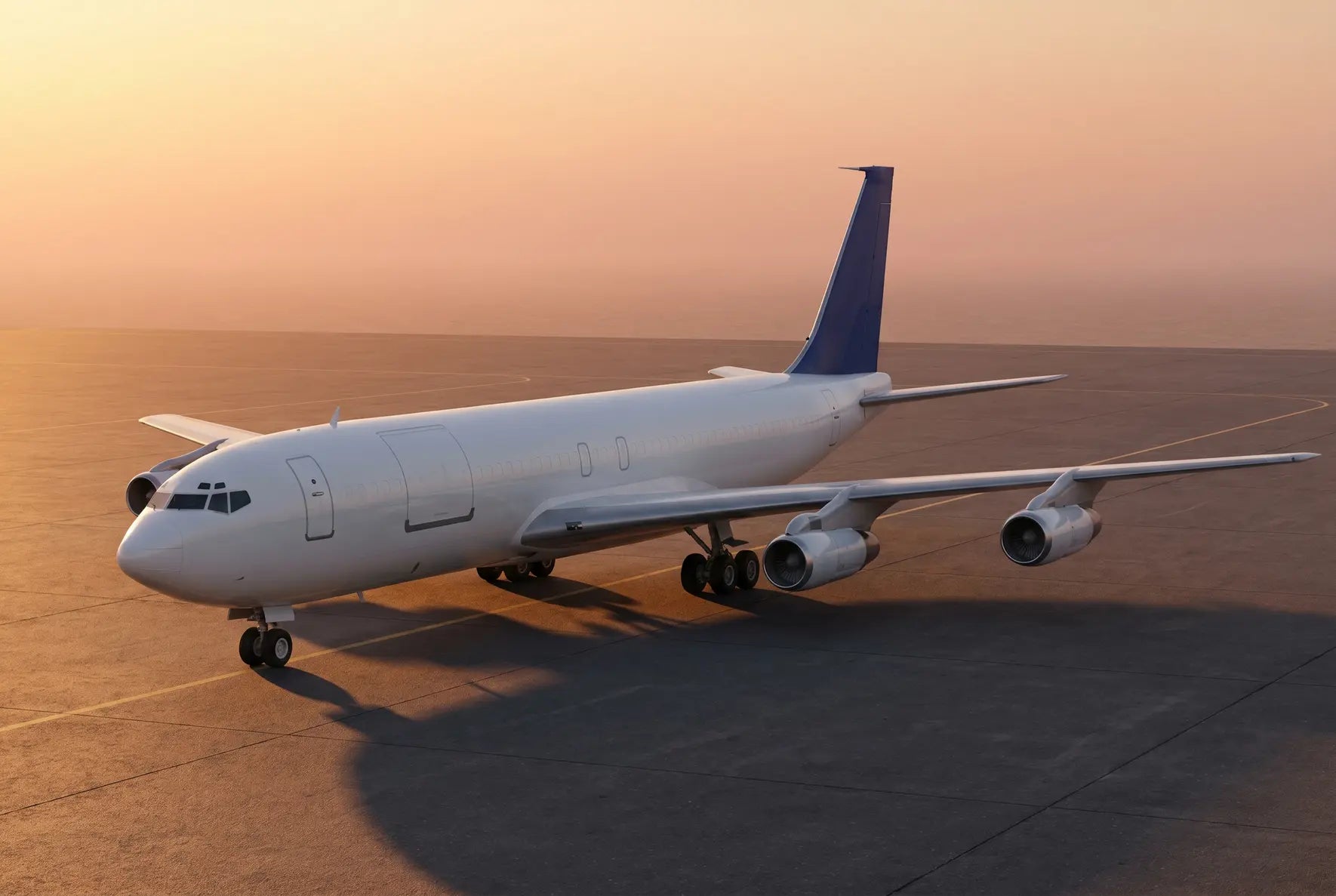
The defining feature of the Boeing 707-320C was a large cargo door on the port (left) side of the fuselage, forward of the wing, measuring approximately 2.34 m wide by 3.40 m high. This door, combined with a strengthened cabin floor, allowed the aircraft to be rapidly reconfigured between all-passenger, all-cargo, or mixed (combi) layouts. To accommodate the additional emergency egress requirements imposed by a higher maximum passenger capacity, Boeing added two extra emergency exits (one on each side, aft of the wing), raising the certified limit to 219 passengers in a high-density, single-class arrangement.
Aerodynamically, the 707-320C introduced three-section leading-edge flaps that improved takeoff and landing performance and enhanced lift distribution across the wing. These improvements made the ventral fin (underfin) found on early 707-320 and 707-320B aircraft unnecessary, and it was deleted from the 707-320C entirely. Boeing later incorporated the same advanced wing design into subsequent 707-320B production, designating those aircraft as 707-320B Advanced. While the regional jet market would later be served by very different airframes, such as the Bombardier CRJ1000, the 707-320C was pivotal in establishing the concept of long-range, convertible jet transport.
The following list summarises the key variant identifiers for the Boeing 707-320C:
- Engines: Four Pratt & Whitney JT3D-3B turbofans (18,000 lbf each) or JT3D-7 turbofans (19,000 lbf each)
- Wingspan: 145 ft 9 in (44.42 m)
- Maximum takeoff weight: Up to 335,000 lb (152,000 kg) with JT3D-7 engines
- Range: Approximately 5,000 nmi (9,265 km) with full payload
- Cargo door: Large forward port-side door (2.34 m x 3.40 m) for main-deck freight loading
- Ventral fin: Eliminated (present on earlier 707-320 and early 707-320B models)
- Wing: Three-section leading-edge flaps (shared with 707-320B Advanced)
- Total production: 335 aircraft, the highest of any 707 variant

The image shows a Boeing 707-321B airplane in flight, operated by Pan American World Airways. The aircraft is clearly visible against a backdrop of lightly clouded skies, highlighting its classic design.
Boeing 707-320C Technical Specifications, Systems and Engine Options
The Boeing 707-320C, introduced in 1963, was the convertible passenger-cargo variant of the Intercontinental 707-320 series. Its defining feature was a large forward cargo door measuring approximately 2.34 m by 3.40 m, paired with a strengthened cabin floor that allowed operators to switch between all-passenger, all-freight, or mixed configurations. Aerodynamically, the 707-320C inherited the 707-320B's redesigned wing with full-span leading-edge slats and improved low-speed handling, while retaining the swept-wing, podded-engine layout that made the 707 family a reference in long-range jet transport. The design philosophy favoured intercontinental range with a flexible payload, making it attractive to airlines that needed one airframe for both scheduled passenger services and cargo charters.
A total of 335 Boeing 707-320C units were produced, making it the most-built variant of the 707 family. Its versatility extended the commercial life of many airframes well into the 2000s, particularly with freight operators and military users. Several airlines that once operated the 707-320C, such as Pegasus Airlines, went on to modernise their fleets while building on the operational foundations established during the early jet era.
- Overall length: 152 ft 11 in (46.61 m)
- Wingspan: 145 ft 9 in (44.42 m)
- Height: 42 ft 5 in (12.93 m)
- Maximum takeoff weight (MTOW): 333,600 lb (151,315 kg) with JT3D-3B engines; up to 335,000 lb (152,000 kg) with JT3D-7 engines
- Operating empty weight (OEW): approximately 146,400 lb (66,406 kg)
- Maximum landing weight (MLW): 247,000 lb (112,037 kg)
- Maximum zero fuel weight: 230,000 lb (104,330 kg)
- Fuel capacity: approximately 23,860 US gallons (90,299 litres)
- Maximum cruise speed: Mach 0.90 / 525 kn (966 km/h) at approximately 33,000 ft
- Typical range: approximately 5,000 nm (9,260 km) in long-range configuration; reduced with higher payload
- Service ceiling: approximately 41,000 ft (12,500 m)
- Takeoff field length (MTOW, sea level, ISA): approximately 10,600 to 11,050 ft (3,230 to 3,370 m)
- Engines: four Pratt & Whitney JT3D low-bypass turbofans (JT3D-3B or JT3D-7)
- Maximum passenger capacity: up to 219 in high-density layout; 147 to 189 in typical mixed-class configurations
Systems, Flight Controls and Handling Technology
The 707-320C uses a conventional mechanical flight control architecture with hydraulic power assistance. Primary flight surfaces, including ailerons, elevators, rudder, and spoilers, are actuated through hydraulic servo units fed by three independent hydraulic systems. There is no fly-by-wire technology; the pilot's inputs are transmitted mechanically and boosted hydraulically, giving direct and predictable handling qualities typical of the era. Spoilers serve both as speed brakes in flight and as ground lift-dump devices on landing.
The navigation and guidance suite centres on an analogue flight director system with two Horizon Director Indicators (HDIs) for pitch and roll commands and two Course Deviation Indicators (CDIs) for lateral guidance. The autopilot integrates heading, VOR/LOC tracking, altitude hold, and auto-approach modes. Engagement of the yaw damper is required before autopilot activation, as swept-wing jets of this generation are inherently susceptible to Dutch roll oscillation. Anti-skid braking is fitted to the main landing gear, helping manage deceleration on varied runway surfaces.
Published performance figures for the 707-320C can vary significantly depending on operator-specific factors. Engine variant (JT3D-3B versus JT3D-7), cabin configuration, actual operating weight, atmospheric conditions (temperature, altitude, humidity), and runway surface state all affect takeoff distances, range, and payload capacity. The figures listed above reflect manufacturer-published data under standard sea-level ISA conditions and maximum weights. Operators routinely adjusted these numbers in their own performance manuals to account for route-specific variables.
Pratt & Whitney JT3D Engines: Options, History and Applications
The Boeing 707-320C was powered exclusively by the Pratt & Whitney JT3D, a low-bypass turbofan developed in the late 1950s as a more efficient successor to the JT3C and JT4A turbojet engines used on earlier 707 and KC-135 variants. By adding a front-mounted fan stage and a bypass airflow path (bypass ratio of approximately 1.4:1), Pratt & Whitney achieved roughly 15 to 20 percent lower specific fuel consumption compared with the turbojets it replaced, while simultaneously reducing jet exhaust noise.
Two JT3D sub-variants were offered on the 707-320C. The JT3D-3B was the baseline, delivering approximately 18,000 lbf (80 kN) of takeoff thrust per engine, supporting an MTOW of 333,600 lb. The JT3D-7, an uprated version, produced approximately 19,000 lbf (84.5 kN) per engine and was fitted on later-production airframes, permitting a slightly higher MTOW of 335,000 lb. Both variants featured characteristic secondary-air inlet doors on the forward cowling that opened during takeoff to supply additional airflow and closed automatically at higher speeds.
Beyond the 707, the JT3D family powered a wide range of commercial and military aircraft. It was the standard engine for the Douglas DC-8 turbofan variants (Series 50 and 60), and its military designation, TF33, powered the Boeing E-3 Sentry (AWACS), the E-8 Joint STARS, the Northrop Grumman B-52H Stratofortress in its original configuration, and the C-141 Starlifter. This cross-platform commonality gave operators and military logistics a significant advantage in parts availability and maintenance expertise. The JT3D remained in widespread service for over four decades, a testament to its fundamental engineering soundness, even as later powerplants surpassed it in bypass ratio and fuel efficiency.
Boeing 707 Variants vs Douglas DC-8-62 Specifications Comparison
Scroll horizontally to see more
| Parameter | Boeing 707-320C | Boeing 707-320B | Boeing 707-120 | Douglas DC-8-62 |
|---|---|---|---|---|
| Entry into service | 1968 | 1968 | 1958 | 1967 |
| Engines | 4 × Pratt & Whitney JT3D-3/7 | 4 × Pratt & Whitney JT3D-3/7 | 4 × Pratt & Whitney JT3C-6 | 4 × JT3D-7 |
| Length | 46.7 m | 46.7 m | 44.4 m | 45.9 m |
| Wingspan | 44.5 m | 44.5 m | 40.8 m | 45.2 m |
| Height | 12.7 m | 12.7 m | 11.7 m | 12.9 m |
| Typical seating and layout | 2-class: 180–219 passengers | 2-class: 170–195 passengers | 2-class: 140–181 passengers | 2-class: 180–215 passengers |
| MTOW | 152 t | 152 t | 122 t | 151 t |
| Range | 6,500 nm | 6,500 nm | 3,000 nm | 6,500 nm |
| Cruise speed | 0.85 Mach | 0.85 Mach | 0.82 Mach | 0.82 Mach |
| Service ceiling | 39,000 ft | 39,000 ft | 37,500 ft | 39,000 ft |
| Program note | Convertible passenger/cargo with large cargo door, strengthened floor for freighter operations | Advanced passenger intercontinental with high-thrust turbofans | Original short/medium-range 707 baseline model | Main competitor four-engine jet with stretched fuselage and high-bypass engines |
Scroll horizontally to see more
The table compares key specs of three Boeing 707 variants and the Douglas DC-8-62. The 707-320B and 320C share the same size, MTOW (152 t) and long range (6,500 nm), while the 707-120 is shorter, lighter (122 t) and limited to about 3,000 nm. The DC-8-62 is slightly longer with similar range and ceiling, but cruises slower (0.82 Mach vs 0.85).
Boeing 707-320C Operations: Airlines, Typical Routes and Global Missions
The Boeing 707-320C entered service in 1963 as the convertible passenger-freighter variant of the Intercontinental series. Powered by four Pratt & Whitney JT3D-7 turbofan engines, it offered a maximum range of approximately 5,000 nautical miles (9,260 km) in a typical two-class layout of around 141 passengers. Flights on core transatlantic sectors such as New York to London covered roughly 3,000 nmi and lasted about 6 to 7 hours, while trans-Pacific routes like Seattle to Tokyo stretched to 4,500 nmi with block times approaching 9 to 10 hours. Airlines typically achieved 8 to 12 daily utilisation hours on long-haul schedules, depending on turnaround times and route density.
The Boeing 707-320C was designed primarily for point-to-point intercontinental services rather than hub-and-spoke feeder patterns. Major carriers operated it from large international gateways: Pan American World Airways deployed the type from New York-JFK across the Atlantic and Pacific, while Northwest Orient Airlines built its North Pacific network around 31 delivered airframes, linking cities like Seattle, Tokyo and Manila. The large forward cargo door (approximately 2.34 m x 3.40 m) and strengthened floor meant operators could rapidly convert the cabin between all-passenger, mixed, and all-cargo configurations, carrying up to 13 standard pallets in freighter mode. This flexibility gave the aircraft a second life as dedicated freighters from the mid-1970s onward, as widebody jets such as the Boeing 747 and DC-10 replaced it on passenger routes.
Operational challenges included the four-person flight-deck crew requirement (captain, first officer, flight engineer and navigator), which increased labour costs compared with later two-crew aircraft. Fuel consumption was also higher than subsequent narrow-bodies, and growing noise regulations from the 1980s gradually restricted operations at airports in Europe and North America. Despite these hurdles, the convertible design preserved resale values and extended the type's useful service well into the 2000s, particularly in cargo and military roles.
Where the Boeing 707-320C Operated Around the World
The Boeing 707-320C saw service on every major long-haul corridor. In Europe, flag carriers used it for prestige transatlantic and colonial routes. In North America and South America, it connected hub cities with destinations across the Atlantic and Pacific. Asian and Middle Eastern airlines relied on the type for ultra-long sectors linking their capitals to Europe and North America. In Africa, state airlines operated the 707-320C on intercontinental passenger services to Europe and, later, as freighters supporting cargo demand on the continent. While modern narrow-bodies like the Embraer E175 now handle regional segments that once fed these long-haul 707 services, the Intercontinental variant carved out its legacy on the world's longest routes.
- Europe – Air France operated a large fleet of 707-320 variants on transatlantic routes from Paris to New York (approximately 3,150 nmi). Lufthansa deployed 24 aircraft from Frankfurt to New York and Asian destinations. SABENA flew from Brussels to New York and Africa, while Aer Lingus used the type on Shannon and Dublin to US East Coast services. British Caledonian and TAP Air Portugal also relied on the 707-320C for long-haul charter and scheduled operations to South America and Africa.
- North & South America – Pan American World Airways was the single largest operator, with 36 Boeing 707-320C aircraft in its fleet of 133 total 707s, covering transatlantic and trans-Pacific routes from New York-JFK. American Airlines flew 40 airframes on transcontinental US and Latin American services. TWA operated 18 units primarily on New York to Paris and London sectors. In South America, VARIG used 20 707s on routes from Rio de Janeiro to New York and Europe. Aerolíneas Argentinas (11 aircraft) and Avianca (11 aircraft) connected Buenos Aires and Bogotá with Madrid, New York and other intercontinental hubs. LAN Chile operated 14 units on trans-Pacific services from Santiago.
- Asia – Pakistan International Airlines was among the largest 707 operators globally, with 37 airframes connecting Karachi and Lahore to London and New York. Qantas flew 21 707-320 variants on its famed Kangaroo Route from Sydney to London via Asia. Cathay Pacific (up to 14 aircraft), Korean Air (11 aircraft), Air India (11 aircraft) and Iran Air (14 aircraft) all operated the type on long-haul services to Europe and North America. El Al used 24 airframes on the demanding Tel Aviv to New York route, spanning roughly 5,900 nmi.
- Africa – EgyptAir operated 21 Boeing 707s from Cairo to Europe and North America, while South African Airways deployed 17 aircraft on the Johannesburg to London route (approximately 6,200 nmi). Ethiopian Airlines used 9 airframes to link Addis Ababa with European and American destinations, and Air Zimbabwe acquired second-hand 707s from Lufthansa for intercontinental passenger and cargo services between 1985 and 1998.
Typical Seating Configurations on the Boeing 707-320C
In a standard two-class layout, the Boeing 707-320C seated approximately 141 to 151 passengers, with around 18 first-class seats and 123 to 133 economy seats arranged six-abreast (3+3) at a pitch of roughly 34 inches (86.4 cm). Pan Am marketed its 707-320C Intercontinental with 141 mixed-class seats, as documented in the Boeing historical image archive. American Airlines configured its closely related 707-323 with 14 first-class and 133 coach seats.
Charter and leisure operators pushed capacity higher. In a single-class, high-density economy layout, the cabin accommodated up to 189 passengers, which was the certified exit limit for the variant. Practical all-economy configurations typically seated around 181 passengers across approximately 30 rows at 34-inch pitch. The convertible nature of the 707-320C meant that some operators, notably Northwest Orient Airlines, ran a mixed passenger-cargo arrangement with a forward cargo compartment alongside first-class seating on the main deck, without reducing total passenger numbers in the aft cabin. Further technical details on the 707-320C cabin and specifications can be found on the Boeing 707 Wikipedia page. No commercial airline operates the Boeing 707 today; Saha Airlines of Iran was the last commercial operator, ending passenger flights in 2013, while military derivatives such as the E-3 Sentry remain in active service.
In this video, discover why the Boeing 707 thrived while rival early jetliners struggled. Learn the key design, performance, and market factors that made it a breakthrough and reshaped commercial aviation.
Boeing 707-320C Safety Record: Accident History and How Safe Is It?
The Boeing 707-320C entered service in the mid-1960s as the convertible passenger-freighter variant of the 707-320 Intercontinental series. With approximately 335 to 337 airframes delivered, it became the most-produced member of the 707 family. Over six decades of operation, the type accumulated millions of flight hours across airlines, charter operators, military forces and cargo carriers worldwide. According to the Aviation Safety Network database, the broader Boeing 707 family recorded more than 170 hull-loss accidents throughout its operational life. A significant share of those involved 707-320C sub-variants (identified by customer codes such as -321C, -345C, -3D3C or -3J9C). Many of these events occurred during the 1960s and 1970s, a period when safety standards, cockpit technology and crew training were far less advanced than they are today.
Notable Accidents Involving Boeing 707-320C Sub-Variants
Several high-profile accidents shaped the safety legacy of the 707-320C family and contributed directly to lasting improvements in aviation regulation.
- Varig Flight 820 (July 1973) – A Boeing 707-345C operating for the Brazilian carrier Varig caught fire during approach to Paris-Orly. The blaze originated in a rear lavatory and spread rapidly through the cabin. Of 134 occupants, 123 lost their lives, most from smoke inhalation before the aircraft made an emergency landing in a field. The investigation, led by French authorities, found that flammable materials inside the lavatory fuelled the fire. This disaster accelerated international mandates for ICAO fire safety standards, including smoke detectors and automatic fire extinguishers in aircraft lavatories, fire-blocking seat materials and improved crew breathing equipment.
- Kano crash (January 1973) – A Boeing 707-3D3C chartered by Nigeria Airways and operated by Alia Royal Jordanian crashed on landing at Kano Airport, Nigeria, during a return flight from Jeddah. The nose gear collapsed after a hard touchdown in poor visibility caused by harmattan haze. The subsequent fire killed 176 of the 202 occupants. Investigators attributed the crash primarily to pilot error during approach in degraded visual conditions. The event highlighted the need for improved approach lighting and instrument procedures at airports in regions prone to dust and haze.
- Agadir crash (August 1975) – A Boeing 707-321C operated by Alia Royal Jordanian on charter for Royal Air Maroc struck a mountain during a night approach to Agadir, Morocco, killing all 188 people on board. The crew, reportedly unfamiliar with the route, descended on an incorrect track in fog and darkness. This controlled flight into terrain (CFIT) accident remains the deadliest involving any Boeing 707 variant. It reinforced advocacy for Ground Proximity Warning Systems (GPWS), which the FAA mandated for large transport aircraft in 1974 and which became standard worldwide through the late 1970s.
- Saha Airlines crash (January 2019) – A Boeing 707-3J9C cargo aircraft operating on behalf of the Iranian Air Force landed at Fath Air Base near Karaj, Iran, instead of the intended Payam International Airport roughly 10 km away. The military runway was far too short for the 707; the aircraft overran, crashed through a perimeter wall and caught fire. Fifteen of the 16 crew members died. The accident underscored the risks of operating aging airframes without modern navigation aids or enhanced ground proximity warning technology, as detailed by the Bureau of Aircraft Accidents Archives.
How Safe Is the Boeing 707-320C?
Evaluating the safety of the Boeing 707-320C requires historical context. Most hull-loss events occurred during the first two decades of jet transport, when the global fleet lacked systems now considered standard: GPWS, Traffic Collision Avoidance Systems (TCAS), flight data monitoring and comprehensive crew resource management (CRM) training. Many accidents were caused by human factors or environmental conditions rather than fundamental airframe deficiencies. The 707-320C was built to the structural and certification standards of its era, with a robust fail-safe wing design and redundant hydraulic systems that served it well for decades of intercontinental operations.
When hull-loss figures are measured against the total number of flights, cycles and years in service, the 707-320C's record is broadly consistent with other first-generation jet airliners. Accident rates across the entire commercial jet fleet have fallen dramatically since the 1970s, according to data published in Boeing's Statistical Summary of Commercial Jet Airplane Accidents. Modern successors benefit directly from lessons learned during the 707 era. Travellers curious about how different aircraft types compare in terms of design philosophy and operational history can explore profiles such as the BAe 146-300, another type that carved its own niche in regional aviation.
Despite its ageing fleet and the higher accident rates typical of early jets, the Boeing 707-320C played a pivotal role in making commercial aviation the remarkably safe mode of transport it is today. Every incident contributed to regulatory progress, better training, and improved aircraft design that continue to protect passengers and crew on every flight.
01 What is the typical range and mission profile of the Boeing 707-320C?
The Boeing 707-320C offers a maximum range of about 3,000 nautical miles with full payload, making it suitable for transcontinental routes like New York to Los Angeles or London to New York. Its convertible design allows quick reconfiguration between passenger and cargo configurations, ideal for mixed missions on medium to long-haul flights. Airlines used it for high-density passenger services or bulk freighter operations on routes demanding flexibility.
02 Which airlines operated the Boeing 707-320C and on what routes?
Major operators included Pan American World Airways, Trans World Airlines, and cargo specialists like Flying Tigers and Seaboard World Airlines. These airlines flew the Boeing 707-320C on transatlantic and transpacific passenger routes in the 1960s-1980s, later shifting to freighter services for cargo across the Atlantic, Pacific, and to the Middle East. Military variants served in tanker and transport roles for the USAF.
03 How was the cabin layout and passenger experience on the Boeing 707-320C?
The Boeing 707-320C typically seated 150-189 passengers in a narrow-body layout with three-abreast seating on each side and a single aisle. Passenger experience featured reasonable legroom for the era but higher noise levels from four engines compared to modern jets, with some vibration during cruise. Convertible models often had mixed cargo-passenger setups, affecting comfort on freighter-passenger combo flights.
04 What are the performance and fuel efficiency characteristics of the Boeing 707-320C?
Powered by four Pratt & Whitney JT3D turbofan engines, the Boeing 707-320C cruises at Mach 0.82 with a takeoff weight up to 335,000 pounds. Fuel efficiency lagged behind later widebodies like the 747, consuming around 5,000 pounds per hour per engine on long sectors. Its strength lay in payload versatility rather than economy, outperforming props but trailing high-bypass twins.
05 What is the safety record of the Boeing 707-320C?
The Boeing 707-320C shares the strong safety record of the 707 family, with hull-loss accidents rare relative to flights operated, aided by redundant systems and early adoption of turbofans. Key design features include a robust wing with high-lift devices for short-field performance and fail-safe fuselage structure. Most incidents stemmed from operational factors, not inherent flaws, per aviation safety databases.
06 What practical tips apply for passengers on a Boeing 707-320C flight?
Opt for window seats in rows 10-20 for better views and slightly less engine noise from the quieter forward section. The aircraft handles turbulence smoothly due to its size and swept wings, though four engines produce noticeable hum at cruise. Earplugs help with cabin noise, and upper-deck lounges on some passenger variants offered a premium seating alternative.