

Riyadh Air Overview & Company Profile
Riyadh Air (IATA code RX, ICAO code RXI) is Saudi Arabia's new premium international carrier, wholly owned by the Kingdom's sovereign wealth fund, the Public Investment Fund (PIF). Announced publicly in 2023 as the country's second national airline alongside the established flag carrier Saudia, it is one of the most heavily capitalised start-ups in aviation history. The airline is a flagship project of Saudi Vision 2030, the national program aiming to turn the Kingdom into a global connectivity and tourism hub. It is headquartered in Riyadh and based at King Khalid International Airport (RUH).
Riyadh Air is led by CEO Tony Douglas, the British executive who previously ran Etihad Airways and was appointed to Riyadh Air by PIF in March 2023. The carrier positions itself as a "digitally native" premium airline built around a mobile-first customer experience and a young, technologically advanced fleet. After a period of pre-launch training rotations to London using a leased Boeing 787-9 from Oman Air (starting late October 2025), Riyadh Air operated its first scheduled revenue flight with its own aircraft on 10 June 2026 on the Riyadh to London Heathrow route, a launch brought forward from the originally planned 1 July. By late July 2026 it was flying to London Heathrow, Jeddah, Dubai, Cairo, Madrid and Manchester, all on the Boeing 787-9.
For pilots, Riyadh Air represents a rare "ground floor" opportunity: joining a well-funded carrier at inception, flying brand-new widebodies, and helping shape an operational culture from scratch. The trade-off is the inherent uncertainty of a start-up, where seniority structures, long-term pay scales, and the full route network are still being built. The airline has set a target of serving more than 100 destinations by 2030 and connecting to roughly 22 cities within its first nine months of operation.
Because Riyadh Air only began commercial flying in June 2026, much of the detail a pilot would normally research (published pay scales, a mature seniority list, upgrade timelines, layover hotel standards) does not yet exist in official form. Throughout this guide, confirmed facts from Riyadh Air, Boeing, Airbus and GACA are separated clearly from figures reported by candidates on pilot forums. Treat all compensation and roster numbers as indicative until confirmed in a written contract offer.
Fleet Composition & Type Ratings
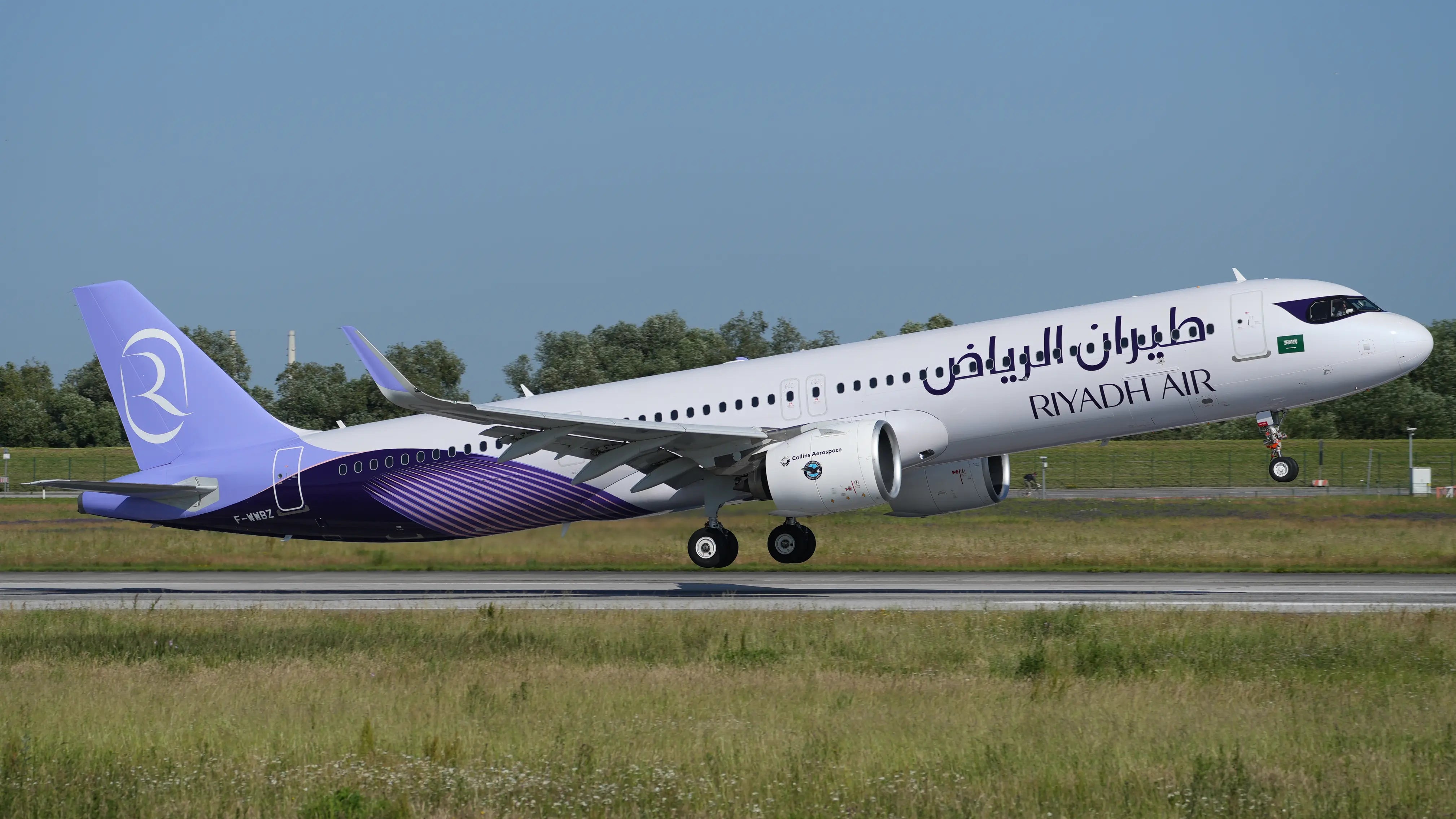
Riyadh Air will operate one of the youngest and most modern fleets in the world. As a start-up, every aircraft is brand new, giving the carrier an effective fleet age of close to zero. The airline has committed to a three-type fleet of Boeing 787-9 Dreamliners, Airbus A321neo single-aisle jets, and Airbus A350-1000 widebodies, totalling up to 182 aircraft on order when firm orders, options and purchase rights are combined. Full details are published on the airline's own fleet page.
The Boeing 787-9 is the backbone of initial operations. The order covers up to 72 aircraft (reported as 39 firm plus 33 to follow). According to Boeing's June 2026 press release, the first two Dreamliners were delivered in early June 2026, and the fleet had reached roughly five aircraft by the end of that month, with deliveries reported to be heading toward eight by the end of July. The 787-9 is configured in a four-class layout (Business Elite, Business, Premium Economy and Economy). The Airbus A321neo (60 on order) will handle regional and medium-haul routes, while the A350-1000 (up to 50: 25 firm plus 25 purchase rights, with a range beyond 16,000 km) will become the long-haul flagship, with first Airbus deliveries expected from late 2026 onward.
| Aircraft Type | Role | On Order | Status / Notes |
|---|---|---|---|
| Boeing 787-9 Dreamliner | Widebody | Up to 72 (39 firm + 33) | Entry fleet. ~5 delivered by late June 2026, all in service. Four-class cabin. |
| Airbus A321neo | Narrowbody | 60 | Ordered at FII 8th Edition. Regional / medium-haul. Deliveries later in the rollout. |
| Airbus A350-1000 | Widebody | Up to 50 (25 firm + 25 rights) | Ordered at the Paris Air Show. Ultra-long-haul flagship, range 16,000+ km. Not yet delivered. |
Fleet data as of mid-2026. Delivered numbers change rapidly as new aircraft arrive roughly monthly. Options and purchase rights may or may not be exercised.
Early recruitment is focused entirely on the Boeing 787-9, with the Airbus fleets to follow as those aircraft are delivered. Crucially, Riyadh Air's Direct Entry Captain postings are marked "Non-Type Rated Welcome", meaning experienced widebody captains without a 787 rating can be hired and receive structured type-rating training as part of employment. The advertised 787 First Officer vacancies, by contrast, are generally aimed at pilots who already hold a current 787 type rating. Bonding terms and any service commitments attached to type-rating training are not published, so confirm them directly during recruitment.
Public sources do not confirm the engine choice for either the 787-9 (GEnx-1B or Trent 1000) or the A321neo (CFM LEAP-1A or Pratt & Whitney PW1100G). Neither Boeing, Airbus nor Riyadh Air has specified the powerplant in the materials reviewed. Any engine detail circulating on forums should be treated as unverified until confirmed by official documentation.
Pilot Salary & Compensation Breakdown
Riyadh Air does not publish pilot pay scales, and because the airline is only months into commercial operations, there is no negotiated, publicly documented salary structure. The figures below are drawn from candidate reports circulating on the PPRuNe Middle East forum and should be read as unofficial and approximate. What is certain is that, like all Gulf carriers, Riyadh Air pays a tax-free salary: Saudi Arabia levies no personal income tax on employment income, so gross figures are effectively take-home for expatriate pilots.
Reported Boeing 787 Captain Package (Unofficial)
Candidate reports describe a Direct Entry Captain package built from a monthly basic salary plus housing and transport allowances, a guaranteed minimum of 75 flight hours per month, and additional hourly and bonus pay. One early report cited a basic of around USD 15,500 per month, later corrected in the same thread to approximately 48,750 Saudi riyals (about USD 13,000).
| Component | Reported Monthly (USD) | Notes |
|---|---|---|
| Basic salary | ~$13,000 (48,750 SAR) | Initially reported ~$15,500, later corrected downward. |
| Housing allowance | ~$5,300 | Paid as a cash allowance, not company-provided housing. |
| Transport allowance | ~$1,300 | Covers commuting and private vehicle costs. |
| Flight pay (75h guaranteed) | ~$2,500 | Around $35 per hour on a minimum monthly guarantee. |
| Indicative monthly total | ~$22,000 | Tax-free. Excludes annual bonus and role uplifts. |
Unofficial, from candidate forum reports. A tax-free monthly total near $22,000 equates to roughly $260,000 per year before bonus, but individual offers will vary.
Role Uplifts, Bonus & First Officer Context
| Element | Reported Value | Notes |
|---|---|---|
| Line training uplift (LTI) | +12% of basic | Applied to basic salary for instructor duties. |
| Type Rating Instructor (TRI) | +13% of basic | For approved training-captain roles. |
| Type Rating Examiner (TRE) | +14% of basic | For approved examiner roles. |
| Annual bonus | Up to 2 months salary | Performance and productivity based. |
| First Officer pay | Not publicly reported | No reliable figures available; expect a package below captain level, still tax-free. |
First Officer compensation has not surfaced in credible reports. Do not assume a specific figure until you receive a written offer.
None of the salary figures above are confirmed by Riyadh Air. They come from unofficial candidate accounts, one of which was corrected mid-thread, illustrating how fluid these numbers are for a brand-new airline. Actual pay will depend on rank, fleet, roster type (the commuting roster reportedly reduces flying pay and removes the housing allowance), and the terms of your individual contract. Because Saudi Arabia has no personal income tax, gross pay is effectively net, which makes even a mid-range Gulf package highly competitive against European carriers where social charges and income tax can remove 30 to 45 percent of gross. Always verify figures in writing before making a decision.
Roster Pattern & Quality of Life
Riyadh Air's official Direct Entry Captain posting confirms two important quality-of-life points: all pilot roles are Riyadh-based, and a "lifestyle rostering option" is available once defined criteria are met, subject to availability. Beyond that official language, the detail comes from candidate reports, which describe two distinct roster systems: a standard residential roster and a commuting "lifestyle" roster.
On the reported standard roster, pilots have approximately 103 days off and 262 days on duty per year, with around 42 days of annual leave and roughly 9 public holidays. This is a demanding schedule by European standards and reflects a start-up in rapid ramp-up. The lifestyle (commuting) roster reportedly offers around 177 days off and 188 days on, built on a 14 days on, 14 days off pattern that lets pilots keep their primary home outside Saudi Arabia. The trade-off: the commuting roster is reported to carry lower flying pay and no housing allowance, and it only becomes available after a probation period (about six months) plus roughly three months of training, and is subject to seniority and availability.
📅 Illustrative Month — Standard Roster, Boeing 787 First Officer (RUH)
Illustrative only. Built to reflect a reported ~103 days off per year on the standard roster and typical long-haul trip patterns. Riyadh Air has not published an official roster template.
Riyadh Air is a single-base airline: every pilot is rostered out of King Khalid International Airport, with no multi-base bidding. Residential pilots relocate to Riyadh and draw the housing allowance to rent locally; commuting pilots use the 14/14 lifestyle roster to keep a home abroad and travel in for their on-blocks. Riyadh offers modern infrastructure, tax-free income and no cold-weather commuting, but expatriates should factor in cultural adaptation, family considerations and the reality that a new airline's rosters are still stabilising. Confirm which roster you qualify for, and when, before signing.
Benefits, Allowances & End of Service
Riyadh Air's benefits package follows the established Gulf template of cash allowances rather than in-kind provision, wrapped around a tax-free salary. As with pay, the most granular detail comes from candidate reports rather than official publications, so the items below are indicative. The airline's own recruitment materials confirm that relocation to Riyadh is employer-paid and that flying is full-time from the Riyadh hub.
The single biggest financial draw of a Riyadh Air contract is the absence of personal income tax. A pilot who moves from a European legacy carrier, where income tax plus social charges can erase 30 to 45 percent of gross pay, may find that a nominally similar Gulf salary translates into substantially higher take-home income. Housing and transport allowances further raise the effective value of the package. The counterweight is that Saudi packages rely on cash allowances and end-of-service gratuities rather than a lifelong pension scheme, so long-term retirement planning is the pilot's own responsibility. Model your net position carefully, including private pension provision and the cost of living in Riyadh, before comparing offers.
Because there is no collective agreement and no published benefits handbook, everything above can vary between individual contracts and may change as the airline matures. Schooling support, for example, is a standard benefit at Emirates and Qatar Airways but has not been confirmed in Riyadh Air candidate reports, so do not assume it. Request written detail on medical cover limits, loss-of-license terms, end-of-service calculation, and any travel benefits before accepting.
Career Progression & Seniority
Career progression at Riyadh Air is defined by one central fact: it is a start-up scaling from a handful of aircraft toward a fleet of up to 182 by the end of the decade. That growth curve is the opposite of a mature airline's, and it changes the career calculus significantly. Most obviously, Riyadh Air recruits Direct Entry Captains, including non-type-rated captains who are trained onto the 787. Command is available on day one for pilots who meet the experience minimums, rather than after a decade or more of seniority accrual as at many European legacy carriers.
For First Officers, rapid fleet expansion should mean genuine upgrade opportunity over time, as each new aircraft and route creates command vacancies. However, because the airline is so new, there is no established seniority list, no published upgrade timeline, and no proven upgrade track record yet. Any specific "years to command" figure would be speculation. What can be said is that the structural conditions (fast growth, a large order book, direct-entry command already in use) favour quicker progression than a slow-growing legacy carrier, provided deliveries and route launches proceed as planned.
| Career Milestone | Typical Path | Notes |
|---|---|---|
| Join as First Officer (B787) | Direct entry | Advertised roles generally expect an existing 787 type rating and 2,000 hrs multi-crew jet time. |
| Join as Direct Entry Captain (B787) | Direct entry | Non-type-rated captains welcome; type-rating training provided. 6,000 hrs total, 2,000 hrs widebody command. |
| Training roles (LTI / TRI / TRE) | By selection | Instructor and examiner roles carry reported pay uplifts of 12 to 14 percent of basic. |
| Cross-fleet to Airbus (A321neo / A350-1000) | As fleets grow | Airbus types arrive later; transition policy not yet published. |
| First Officer to Captain upgrade | Not yet defined | No published timeline. Growth favours opportunity, but no seniority track record exists yet. |
Riyadh Air is actively recruiting 787 captains and first officers plus A321 cadre check pilots, and the CEO has signalled aggressive network growth (around 22 cities within the first nine months and 100-plus destinations by 2030). As the Airbus fleets come online later in the decade, an entirely new tranche of positions and training roles will open. The upside for early joiners is real: shaping procedures, moving into instructor roles, and potentially fast command. The caveat is equally real: start-up growth can slow if aircraft deliveries slip or demand softens, and without a seniority agreement, progression rules can evolve. Weigh the pioneering upside against that structural uncertainty.
Recruitment Process & Requirements
Riyadh Air is running a high-profile international pilot recruitment campaign, hiring Boeing 787 Direct Entry Captains, 787 First Officers, and A321 cadre check pilots. Applications are handled through the airline's official pilot careers portal. The postings do not restrict applicants to Saudi nationals and explicitly welcome experienced international pilots, with employer-paid relocation and visa sponsorship. As of mid-2026 there is no ab-initio cadet program; the focus is on experienced, rapidly deployable crews. A Saudi cadet pathway may emerge later given the Kingdom's Saudization goals, but none has been officially announced.
Boeing 787 Direct Entry Captain — Requirements
Boeing 787 First Officer — Requirements
Selection Stages (Based on Candidate Reports)
Application & Screening
Apply through Riyadh Air's official careers portal. Files are screened against the hours, licence, recency and medical minimums above. Because the airline warns of recruitment fraud, only ever apply and communicate through official channels, and never pay a fee or share bank details during selection.
Initial Interview (Remote)
Candidate accounts describe an initial interview conducted remotely via Microsoft Teams, covering background, motivation and suitability for a start-up environment.
Psychometric Testing
Reported psychometric and aptitude assessments, in line with the multi-stage selection used by major Gulf carriers, evaluating cognitive ability and personality fit.
Technical Panel Interview
A technical interview panel assessing systems knowledge, operational judgement and command or crew-cooperation competencies appropriate to the rank applied for.
Simulator Assessment
A Boeing 787 simulator assessment, reportedly held at locations such as London Heathrow or Dubai. Successful candidates proceed to medical, licence validation under GACA, visa processing and, where applicable, type-rating training.
Because Riyadh Air is a start-up, recruiters place real weight on adaptability and a willingness to help build systems rather than simply operate mature ones. Be ready to discuss why you want a start-up over an established carrier. Ensure your ICAO ATPL, medical and recency are current and clearly documented, since operating-seat time is scrutinised (simulator, second officer and flight engineer time will not count). The selection stages listed here come from candidate forums and may change: always confirm the current process on the official careers portal.
Launch Network & Layover Outlook
Layovers are a defining perk of long-haul flying, but at a carrier this new the "layover map" is still being drawn. Riyadh Air's confirmed schedule up to late July 2026 was built around six routes from Riyadh, all flown by the 787-9: London Heathrow (from 10 June, daily), Jeddah (from 14 June, rising to four daily), Dubai (from 18 June, daily), Cairo (from 25 June, daily), Madrid (from 17 July, four weekly) and Manchester (from 23 July, three weekly). Málaga and Kuala Lumpur have been announced to follow as further aircraft arrive. The European and Asian sectors are the genuine crew night-stops; short regional legs such as Dubai and the Jeddah domestic run are typically quicker patterns. The cards below focus on verifiable route facts rather than hotel specifics, which the airline has not published.
As a start-up, Riyadh Air's crew hotel contracts, layover lengths and rest patterns are still being established, so the specifics (hotels, transport, exact night-stop durations) are not yet public and are not stated here to avoid speculation. What is known: operations are Boeing 787-9 long-haul from a single Riyadh base, subject to GACA flight-time-limitation rules aligned with ICAO standards. Expect the layover network to broaden quickly as deliveries arrive roughly monthly and the route map moves toward the 100-plus destination target. Confirm current rest and hotel provisions directly with the airline.
How Riyadh Air Compares: Airline Radar Chart
The most useful benchmarks for Riyadh Air are the two established Gulf super-connectors it is explicitly built to compete with: Emirates (Dubai) and Qatar Airways (Doha). Within Saudi Arabia, the legacy flag carrier Saudia and the low-cost airline flynas are also relevant reference points, and they appear in the discussion below. The radar scores are editorial estimates based on publicly available data, candidate reports and industry benchmarks, and they reflect the position of an experienced pilot weighing a long-term move.
Key Takeaways from the Comparison
Fleet is Riyadh Air's clearest win. Every Riyadh Air aircraft is factory-new. Its 787-9s, and later A350-1000s and A321neos, form one of the youngest fleets in the world. Emirates and Qatar Airways operate superb but larger, mixed-age fleets, including older widebodies now being phased out. A pilot who values flying the newest metal from day one has a strong reason to look at Riyadh Air.
Pay is competitive but the top end still favours the incumbents. Riyadh Air's reported captain package (a tax-free basic near USD 13,000 per month plus housing, transport, flight pay and bonus) is aggressive for a new entrant. Emirates offers a rich tax-free package including housing, schooling and a provident fund, and Qatar Airways has been reported offering senior pilot earnings up to around USD 300,000 per year. Riyadh Air appears designed to match rather than exceed the very top of that range, at least initially, and its figures remain unofficial.
Career progression can be faster at Riyadh Air, but less certain. Direct-entry command (including non-type-rated captains) and rapid fleet growth create genuine near-term opportunity, whereas Emirates and Qatar Airways run large, more seniority-bound systems. The flip side is that Riyadh Air has no proven upgrade track record and no seniority agreement yet, so progression is opportunity-rich but unproven.
Stability and work-life are where the incumbents lead. Emirates and Qatar Airways have decades of operational maturity, established rosters and deep networks. Riyadh Air counters with PIF's enormous financial backing and a reported 14/14 commuting "lifestyle" roster that is attractive by Gulf standards, but its standard roster is demanding and its systems are still bedding in. Against Saudia and flynas, Riyadh Air offers a more premium, widebody-focused, Riyadh-based career than flynas's narrowbody low-cost model or Saudia's more traditional Jeddah-centred operation.
Scores are editorial estimates based on research into publicly available data, manufacturer and airline press releases, candidate reports on pilot forums, and general industry benchmarks. Riyadh Air scores particularly high on Fleet and reasonably on Salary and Career Progression, but lower on Job Security and Work-Life relative to the two established carriers, reflecting its start-up status rather than any weakness in funding. These are general assessments for an experienced pilot; individual experiences will vary by rank, fleet and roster. Figures will be revised as Riyadh Air matures and publishes official data.
Labor Context & Industrial Relations
The labor environment at Riyadh Air is fundamentally different from that at European or North American carriers, and understanding it is essential before signing. Saudi Arabia does not have a tradition of pilot unions or collective bargaining. There is no pilot union representing Riyadh Air crews, and there is no collective agreement setting pay, rosters or work rules. Employment is governed by individual contracts under Saudi labor law, overseen by the Ministry of Human Resources and Social Development, rather than by negotiated agreements.
Aviation safety, licensing and operational standards are regulated separately by the General Authority of Civil Aviation (GACA), which applies ICAO-aligned frameworks for pilot licences, medical certification and air operator oversight. GACA governs the safety side of a pilot's career (licence validation, medicals, flight-time limitations), while pay, allowances, rostering and disciplinary matters sit with the employer under national labor law. For expatriate pilots, work visas, residency and family sponsorship are handled through Saudi immigration processes, with relocation and sponsorship reportedly arranged by the airline.
What the Absence of a Union Means for Pilots
Without collective bargaining, the terms in your individual contract carry unusual weight, because there is no union agreement to fall back on and changes to rosters, allowances or upgrade rules can be implemented by the employer within the limits of the law. On the positive side, Saudi labor law does provide statutory protections, including end-of-service gratuity, notice periods and working-hour limits, and PIF ownership brings both deep funding and reputational sensitivity that can support stable conditions. On the risk side, the lack of a union places a premium on careful contractual due diligence.
Before accepting a Riyadh Air offer, get written clarity on: base salary and how allowances are paid; which roster you qualify for and when (standard versus 14/14 lifestyle); flight-pay rates and the guaranteed hours; type-rating bonding or service commitments; medical and loss-of-license cover; end-of-service calculation; termination and notice terms; and licence-validation requirements under GACA. Speak with recently hired pilots where possible, and remember that a start-up's policies can evolve, so favour terms that are explicit rather than implied.
Verdict: Who Is Riyadh Air For?
🎯 Our Take
Riyadh Air is one of the most compelling start-up opportunities in modern aviation. Backed by the near-limitless resources of the Public Investment Fund, it pairs a brand-new fleet of Boeing 787-9s (with A350-1000s and A321neos to come) with tax-free Gulf compensation, employer-paid relocation, and the rare chance to help build a national carrier from the first flight. Direct-entry command, including non-type-rated captain hiring, and a reported 14/14 commuting roster add to the appeal for experienced pilots.
The trade-offs are those of any start-up, amplified by the Saudi labor context. Pay and benefit figures are still largely unofficial, there is no seniority list or proven upgrade timeline, the standard roster is demanding, and there is no pilot union, so your individual contract is your only real protection. The airline began commercial flying only in June 2026, so a pilot joining now is betting on execution: on-time deliveries, network growth and the maturing of systems that do not yet exist.
For an experienced widebody pilot who is comfortable with risk, values flying the newest aircraft, and wants tax-free income with genuine early-mover career upside, Riyadh Air is a serious proposition. For a pilot who prioritises proven stability, published pay scales and collective representation, an established carrier may be the safer choice, at least until Riyadh Air's structures settle.
1 Does Riyadh Air hire non-Saudi (expatriate) pilots?
Yes. Riyadh Air's official pilot postings do not restrict applications to Saudi nationals and actively welcome experienced international pilots, with employer-paid relocation and visa sponsorship. Over the longer term, Saudi Arabia's Saudization policy is likely to increase the proportion of Saudi nationals in the cockpit, but during the current ramp-up the airline is recruiting expatriate captains and first officers globally.
2 What are the minimum requirements for a Riyadh Air 787 pilot?
For a Boeing 787 Direct Entry Captain: a minimum of 6,000 hours total on multi-crew, multi-engine aircraft, at least 2,000 hours of recent widebody command (787 or 777 preferred), at least 150 hours in command in the previous 12 months, a valid ICAO ATPL, an unrestricted Class 1 medical, and ICAO English Level 5 or higher. For a 787 First Officer: a minimum of 2,000 hours on multi-crew, multi-engine jets (operating-seat time only), a valid full ICAO ATPL, ICAO English Level 4 or higher, and an unrestricted Class 1 medical.
3 Do I need a Boeing 787 type rating before I apply?
Not necessarily for captains. Riyadh Air's Direct Entry Captain postings are marked "Non-Type Rated Welcome," with structured 787 type-rating training provided as part of employment. The advertised First Officer vacancies, however, are generally aimed at pilots who already hold a current 787 type rating. Bonding or service-commitment terms attached to type-rating training are not published, so confirm them during recruitment.
4 Is Riyadh Air pilot pay tax-free, and how much is it?
Yes, pay is tax-free because Saudi Arabia has no personal income tax. Exact figures are not published by the airline. Candidate reports suggest a 787 captain basic of around USD 13,000 per month (about 48,750 Saudi riyals), plus a housing allowance near USD 5,300, a transport allowance near USD 1,300, guaranteed flight pay for 75 hours, and a bonus of up to two months' salary. These numbers are unofficial and were revised even within the forum threads that reported them, so treat them as indicative only and verify any offer in writing.
5 What is the "lifestyle" commuting roster?
Riyadh Air's official captain posting confirms a "lifestyle rostering option" is available once defined criteria are met. Candidate reports describe it as a 14-days-on, 14-days-off commuting pattern giving roughly 177 days off per year, versus about 103 days off on the standard residential roster. The lifestyle roster reportedly becomes available after probation (around six months) plus about three months of training, is subject to seniority and availability, and carries lower flying pay with no housing allowance. Confirm eligibility and terms directly with the airline.
6 Where are Riyadh Air pilots based?
All pilots are based in Riyadh at King Khalid International Airport (RUH). Riyadh Air is a single-base airline with no multi-base bidding. Residential pilots relocate to Riyadh and draw the housing allowance, while pilots on the lifestyle roster commute in for their on-blocks. Even commuting pilots operate out of Riyadh during duty periods.
7 Does Riyadh Air have a cadet program for low-hour pilots?
Not as of mid-2026. Current recruitment is focused on experienced Direct Entry Captains, 787 First Officers and A321 cadre check pilots, which is typical of a start-up that needs crews it can deploy quickly. Given Saudi Arabia's emphasis on developing national talent, a cadet or sponsored pathway may be launched in future, but none has been officially announced. Low-hour candidates should watch the official careers portal for any new programs.
8 How does Riyadh Air compare to Emirates and Qatar Airways?
Riyadh Air is smaller and much newer, but it competes on the same premium, tax-free Gulf model. Its biggest edge is a brand-new fleet and the early-mover career upside of direct-entry command and rapid growth. Emirates and Qatar Airways lead on operational maturity, network depth, proven stability, and, at the very top end, headline pay (Qatar Airways has been reported offering senior earnings up to around USD 300,000 per year). Riyadh Air aims to be competitive rather than clearly superior on pay, while offering the distinctive appeal of building a carrier from the ground up.
Official Links & Resources
Because Riyadh Air is new and much of the pilot-facing detail is still evolving, always verify information directly with official sources before applying or making career decisions. These are the key websites and organisations relevant to a Riyadh Air pilot career:
For a start-up moving this fast, information can change month to month as aircraft are delivered and routes launch. Bookmark the official Riyadh Air Media Hub for fleet and network announcements, and re-check the pilot careers portal regularly for updated requirements, new fleets (the A321neo and A350-1000 will bring fresh vacancies), and any future cadet program. Confirm every pay, roster and benefit detail in writing before you commit.