
History and Development of the Yakovlev Yak-42 Regional Trijet
The Yakovlev Yak-42 is a Soviet short- and medium-range trijet airliner designed to modernise regional air travel across the USSR. It was created by the A.S. Yakovlev Design Bureau (OKB), the same bureau behind the smaller Yak-40 commuter jet of the 1960s. The Yak-42 reused the general low-wing, rear-mounted engine layout of the Yak-40 but was a completely re-engineered, larger aircraft intended to replace ageing types such as the Tupolev Tu-134, the Antonov An-24/An-26 turboprops, and the Ilyushin Il-18 on domestic routes. Its goal was to bring true jet performance and higher capacity, around 100 to 120 passengers, to Aeroflot's busy short-haul network.
Design studies began in the early 1970s, with the program formally launched around 1972. The first prototype was rolled out in 1974, and the type made its maiden flight in March 1975. A distinctive feature of the test program was the construction of three prototypes with different wing-sweep angles, built to compare cruise efficiency, low-speed handling and structural weight. After evaluation, Yakovlev selected the intermediate configuration, with sweep of roughly 23 degrees at quarter-chord, for series production. Manufacturing began at the Smolensk and Saratov plants in 1977, and the aircraft entered Aeroflot revenue service around 1980. The Yak-42 was notable for being the first Soviet airliner powered by modern high-bypass turbofans, three Lotarev (Progress) D-36 engines, each rated at about 63.75 kN (14,330 lbf), with two mounted on the rear fuselage and one in the tail. A built-in rear airstair allowed self-contained boarding at smaller airports, much like the Yak-40 and comparable Western regional trijets operated by carriers such as Lufthansa CityLine.
The program suffered a serious setback on 28 June 1982, when Aeroflot Flight 8641, a Yak-42 (CCCP-42529), broke up in flight near Verbovichi in the Byelorussian SSR, killing all 132 people on board. The investigation traced the cause to fatigue failure of the horizontal stabiliser jackscrew, linked to a structural design flaw, as documented in the type's recorded service history. The entire fleet was grounded for roughly two years and production effectively halted while the tailplane actuation system and related structure were reinforced. Aircraft returned to service only after these corrections, and the strengthened design subsequently became the baseline for production.
What sets the Yak-42 apart from its sub-variants
The original Yak-42 is best understood against its main successor, the long-range Yak-42D (the suffix D denoting Dalniy, or long-range), which became the standard production model after the 1982 grounding. The base Yak-42 was a shorter-range jet with a practical range of about 2,000 km, standard fuel tankage and the original landing gear and wing. The Yak-42D added extra fuel, an increased maximum take-off weight of roughly 56.5 tonnes and aerodynamic refinements, raising maximum range to about 4,000 km (around 2,200 nmi). Later modernised variants marketed as the Yak-142, Yak-42-100 or Yak-42D-100 retained the three D-36 engines but added Western-standard avionics, wing spoilers and minor cabin changes to improve export prospects. Around 185 aircraft of all versions were built, of which roughly 105 were Yak-42D long-range models, with production ending in 2003.
The features below summarise the key variant identifiers across the Yak-42 family:
- Engines: three Lotarev (Progress) D-36 high-bypass turbofans, about 63.75 kN (14,330 lbf) each, on all versions.
- Wing: low-mounted, swept approximately 23 degrees at quarter-chord; Yak-42D and later variants added leading-edge slats and revised wingtips.
- Capacity: typically up to 120 passengers, six-abreast, in single-class layout.
- Weights and range: base Yak-42 around 57 t MTOW and ~2,000 km; Yak-42D up to ~56.5 t certified for extended fuel and ~4,000 km range.
- Landing gear: Yak-42D introduced four-wheel main bogies for improved runway loading.
- Avionics: original Soviet analog suite on early aircraft; Western avionics and wing spoilers on Yak-142 / Yak-42-100 / Yak-42D-100 modernisations.
- Boarding: integral rear-fuselage airstair for independent operations at smaller airports.

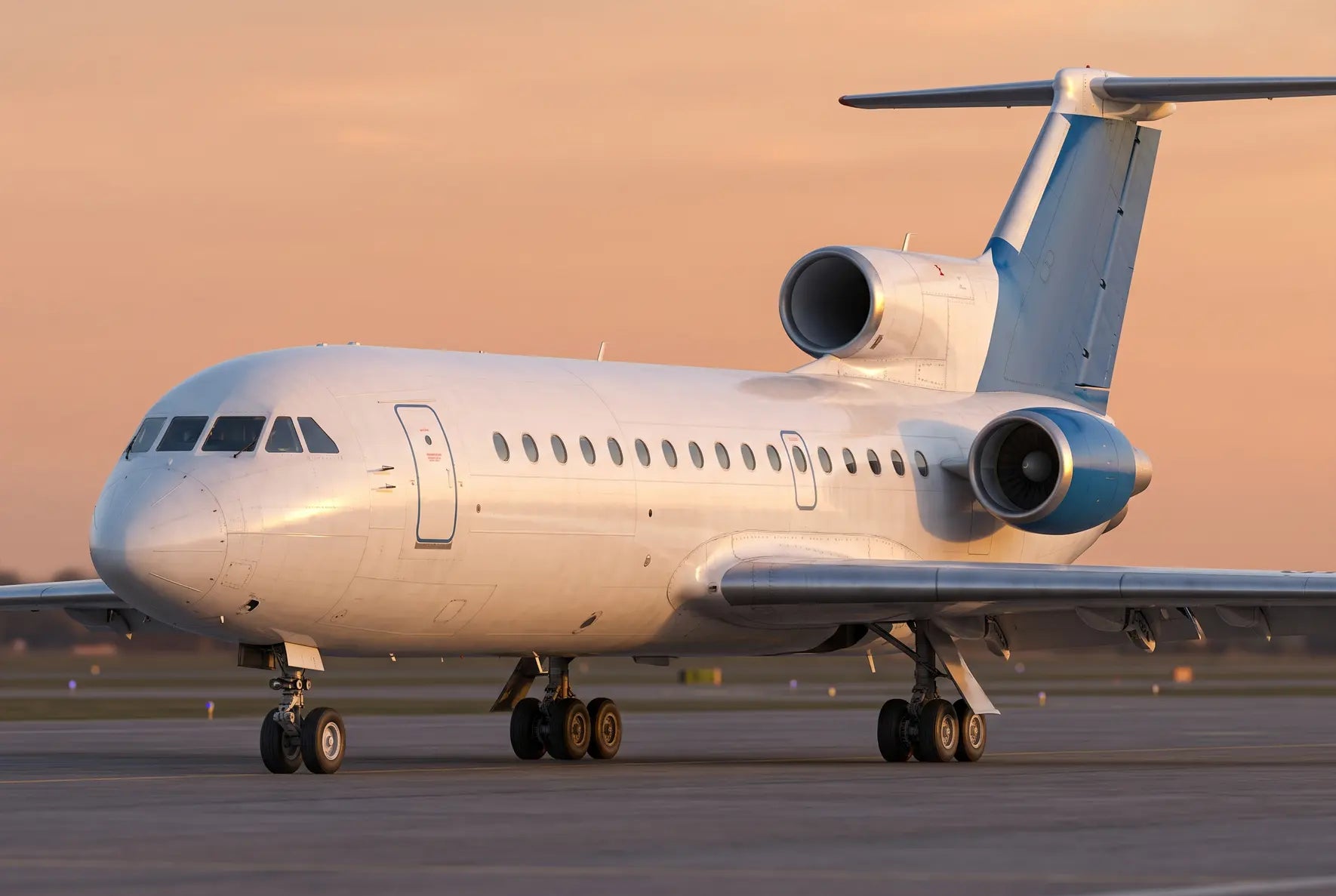
The image shows a Yakovlev Yak-42D aircraft in flight against a clear blue sky. The airplane, marked with distinctive blue lines, is approaching a smooth landing.
Yak-42 Technical Specifications, Systems and Engine Performance
The Yakovlev Yak-42 was designed in the 1970s as a short to medium-haul trijet intended to replace the Tupolev Tu-134 and the Ilyushin Il-18 on Soviet regional and trunk routes. Its mission shaped almost every engineering choice: a clean, low-mounted swept wing for cruise efficiency, three rear-fuselage engines to keep the wing aerodynamically clean and reduce foreign-object-damage risk, and high-lift devices that allow operation from medium-length airfields of roughly 1,800 m, including surfaces in poor condition across the USSR's climatic range.
The design balances payload against range and field performance rather than chasing outright speed. From the wider Yakovlev family it inherits a robust airframe philosophy and a T-tail layout shared with other contemporary trijets, while the supercritical-type airfoil keeps fuel burn competitive at a typical cruise around Mach 0.75. Trijets were a defining configuration of that era; for a very different take on rear-mounted, purpose-built transports, see our feature on the Aero Spacelines Super Guppy.
- Wingspan: 34.88 m
- Length: 36.38 m
- Height: 9.83 m
- Wing area: 150 m²
- MTOW (Yak-42D): approximately 57,500 kg
- Operating empty weight: roughly 33,000 kg
- Maximum landing weight: about 51,000 kg
- Range: up to 4,000 km, and around 1,700 km with maximum payload
- Cruise speed: 700–740 km/h depending on source and variant
- Service ceiling: about 9,600 m (around 31,500 ft)
- Typical seating: up to 120 passengers, with around 104 in two-class layouts
- Engines: three Lotarev D-36 turbofans, about 63.7 kN each
Detailed figures and variant comparisons are documented on the Yak-42 reference entry and in technical compilations such as Airlines-inform.
Systems and handling-relevant technology
The Yak-42 uses a hydraulically powered primary flight control system, with mechanical linkages from the cockpit driving hydraulic actuators on the ailerons, elevators and rudder. Pitch trim is provided by a movable horizontal stabilizer. Unlike some Western types that offer extensive manual reversion, the Yak-42 depends mainly on its powered controls, so hydraulic integrity is treated as safety-critical. Multiple engine-driven hydraulic systems supply the flight controls, landing gear, flaps, slats and spoilers, with cross-feed and backup pumping for redundancy.
High-lift surfaces include full-span leading-edge devices and double-slotted trailing-edge flaps, supporting modest approach speeds and short-field capability. The tricycle landing gear features twin-wheel nose steering and main bogies suited to rougher surfaces, with multi-disc hydraulic brakes and an anti-skid system that modulates pressure on wet or contaminated runways. Baseline automation reflects 1970s practice: an analog autopilot and flight director with altitude hold, heading hold, navigation tracking and ILS approach coupling, supported by RSBN, VOR/ILS and ADF equipment. Autothrottle was not standard on early aircraft, and a full flight management system was absent until later modernization studies (Yak-42M and Yak-142) introduced updated avionics and improved ICAO noise compliance.
Published performance numbers vary because they depend on operator options, cabin density, selected takeoff weight, atmospheric assumptions and runway condition. A range quoted with a light passenger load is not comparable to one stated at maximum payload, and field-length values shift with temperature, altitude and surface state. The specifications above should therefore be read as representative of the Yak-42D under typical conditions rather than as fixed absolutes.
The Lotarev D-36 engines
All Yak-42 variants are powered by three Lotarev D-36 turbofans, developed by the Zaporizhzhia design bureau known today as Ivchenko-Progress. The D-36 is a modern three-shaft, high-bypass turbofan with a bypass ratio of roughly 5.3 and a thrust of about 63.7 kN per unit. It was among the first high-bypass engines fitted to a Soviet airliner, chosen for better fuel economy and lower noise than the low-bypass engines used on earlier types such as the Tu-134. On the Yak-42, two engines are podded on the rear fuselage while the third sits in the tail with an S-duct intake at the fin root.
The same D-36 family also powers Antonov transports, most notably the Antonov An-72 and the related An-74, underlining the engine's flexibility across both airliner and short-field military transport roles. This shared powerplant lineage helped consolidate maintenance experience and spares support across several Soviet and post-Soviet operators.
Yakovlev Yak-42 vs Yak-42D vs Tupolev Tu-134A-3 vs Boeing 737-300 Specifications Comparison
Scroll horizontally to see more →
| Parameter | Yakovlev Yak-42 | Yakovlev Yak-42D | Tupolev Tu-134A-3 | Boeing 737-300 |
|---|---|---|---|---|
| Entry into service | 1980 | 1982 | 1970 | 1984 |
| Engines | 3 × Lotarev D-36 turbofan | 3 × Lotarev D-36 turbofan | 2 × Soloviev D-30 turbofan | 2 × CFM International CFM56-3 turbofan |
| Length | 36.38 m | 36.38 m | 37.10 m | 33.40 m |
| Wingspan | 34.88 m | 34.88 m | 29.00 m | 28.90 m |
| Height | 9.83 m | 9.83 m | 9.02 m | 11.10 m |
| Typical seating and layout (short description + approximate passengers) | 2-class: 100–120 passengers | 2-class: 100–120 passengers | 2-class: 72–84 passengers | 2-class: 128–149 passengers |
| MTOW | 57.5 t | 57.5 t | 47.0 t | 62.8 t |
| Range | 2,200 nm | 2,200 nm | 1,900 nm | 2,060 nm |
| Cruise speed | 0.72 Mach | 0.72 Mach | 0.78 Mach | 0.74 Mach |
| Service ceiling | 31,500 ft | 31,500 ft | 39,400 ft | 37,000 ft |
| Program note | Baseline Soviet-era three‑engined mid-range jet designed to replace the Tu‑134 and offer modern high‑bypass turbofans. | Longer‑range Yak‑42 variant optimized for extended domestic and regional routes within the same airframe family. | Earlier‑generation Soviet twin‑engine short‑/medium‑haul jet serving as the Yak‑42’s predecessor in size and mission. | Western narrow‑body competitor of similar era, offering higher efficiency and forming part of Boeing’s classic 737 family. |
Scroll horizontally to see more →
The table compares four short- to medium-haul jets across size, performance, and capacity. Yak-42 and Yak-42D share identical dimensions and D-36 tri-jet power, seating about 100–120 with a 2,200 nm range. The older Tu-134A-3 is similar in length but has a smaller wingspan, lower MTOW, and fewer seats (72–84) with shorter range. The 737-300 carries the most passengers (128–149) and has the highest MTOW, with range close to the Yak-42 but only two engines.
Yak-42 Operations and Airlines: Routes, Missions and Fleets Worldwide
The Yakovlev Yak-42 is a three-engine, single-aisle airliner built for short- and medium-haul work. It was conceived to replace the Tu-134, An-24 and An-26 on Soviet regional networks, carrying around 100 to 120 passengers over sectors of roughly 500 to 2,500 km. The standard model offered a range of about 2,000 km, while the long-range Yak-42D pushed this to roughly 4,000 km with a typical cruise speed of 700 to 740 km/h, according to technical references on the type.
The first scheduled passenger service, an Aeroflot flight from Moscow to Krasnodar, took place on 22 December 1980, a representative medium-range domestic mission. In service the aircraft typically flew several short to medium legs per day rather than single long sectors, a utilisation pattern common to 100-seat narrow-bodies. Its rugged airframe and modest field-length requirements made it suitable for less-developed regional airports, including rough runways across Siberia and remote regions.
Operationally, the Yak-42 fitted naturally into a hub-and-spoke structure, feeding secondary cities from major hubs such as Moscow and Leningrad. The main challenges for operators were economic and regulatory: the type was less fuel-efficient and noisier than Western competitors like the Boeing 737 and MD-80, production ceased in 2003 after roughly 180 aircraft, and tightening noise and emission rules plus rising maintenance costs gradually pushed the fleet into charter, government and research roles. A useful comparison among Western regional jets of the same era is the Fokker 70, which served similar medium-density markets in the West.
Where the Yak-42 operates
The aircraft has always been concentrated in the former Soviet sphere. In Europe, meaning predominantly Russia and other CIS states, it served domestic and regional scheduled networks plus occasional short international sectors into airports such as Prague. Across Asia, carriers in Russia and Kazakhstan used it on regional routes from resource-rich and remote regions, where its tolerance of basic infrastructure was an advantage; the type was also exported to China, Iran and Pakistan for regional work. In Africa and the Americas, documented use is limited mainly to occasional charter and government operations, including deliveries to Cuba, so a reliably sourced airline list for those regions is sparse.
- Europe: Aeroflot was the launch and primary operator, flying short- and medium-haul domestic routes; Russian regional carriers such as Izhavia, KrasAvia, Turukhan Airlines and the now-defunct Saratov Airlines (which operated up to 18 regular domestic and international routes until 2018) maintained scheduled services, while RusJet, Kosmos and Lukoil Avia used the type for charter and corporate transport.
- North & South America: no major scheduled operators are documented; ex-Soviet aircraft, including examples delivered to Cuba, appeared mainly in ad-hoc charter and government roles, so no authoritative airline list can be confirmed.
- Asia: Kaz Air Jet in Kazakhstan operates the type for business charter, the Kazakh Air Force flies one in government service, and carriers in China, Iran and Pakistan used exported aircraft on regional routes.
- Africa: cited sources do not name specific African airlines; usage was largely confined to occasional charter and state transport flights.
Typical seating
The Yak-42 has a genuine 3-3 abreast cabin with a single aisle, made possible by a fuselage diameter of around 3.6 to 3.8 m, comparable to Western mainline narrow-bodies. Network operators typically fitted a dense single-class layout of 120 seats (about 20 rows of six) for high-density routes, or a two-class arrangement of around 104 seats, such as 8 business plus 96 economy seen on Izhavia aircraft, as documented in published seat maps. Aeroflot also trialled a 102-seat layout that traded cabin volume for extra internal luggage space. Charter and corporate operators favoured roomier 100-seat or bespoke VIP cabins with lounge and meeting areas. The long-range Yak-42D kept the same cross-section and 3-3 seating while adding larger fuel tanks, leading-edge slats and four-wheel main-gear bogies, as summarised in the aircraft specifications.
This video explores the Yak-42, a Soviet regional jet airliner developed in the late 1970s by the Yakovlev Design Bureau, examining its origins, role in USSR aviation, and why the program ultimately fell short.
Yakovlev Yak-42 Safety Record and How Safe Is the Aircraft?
The Yakovlev Yak-42 is a three-engine, T-tail regional jet that entered service with Aeroflot on 22 December 1977. With only around 185 to 187 aircraft built between 1977 and 2003, its fleet and traffic volume have always been modest compared with mainstream Western short-haul jets, and operations were concentrated mainly in the Soviet Union, Russia and a handful of foreign carriers. Within that context, the type recorded eight fatal accidents and roughly 570 fatalities up to early 2018, according to data compiled by the Aviation Safety Network. The accident profile mixes one significant design-related structural failure with several events tied primarily to crew training, approach and takeoff procedures, and operator oversight rather than recurring airframe defects.
Major accidents and what changed afterwards
- Aeroflot Flight 8641 (1982): A Yak-42 broke up in flight near Verbovichi, in the Byelorussian SSR, killing all 132 people on board. Investigators traced the loss of control to failure of the horizontal stabilizer jackscrew caused by fatigue and design flaws. The entire Yak-42 fleet was grounded until the defect was rectified in October 1984, making this the principal design-related safety event in the type's history and prompting a redesign of the tailplane trim mechanism.
- Yak-Service Flight 9633 (2011): A Yak-42D crashed shortly after takeoff from Tunoshna Airport near Yaroslavl, Russia, while carrying the Lokomotiv Yaroslavl ice hockey team. Of the 45 occupants, 44 died. The investigation by the Interstate Aviation Committee pointed to crew training and procedural deficiencies, including incorrect takeoff technique that produced inadequate climb performance, alongside weaknesses in the operator's safety management. The carrier's air operator certificate was withdrawn, and regulators tightened oversight of charter operations and pilot proficiency checks across legacy Soviet types.
- Aerosvit Airlines Flight 241 (1997): A Yak-42 on a route from Ukraine to Thessaloniki, Greece, struck terrain on approach with multiple fatalities. The event highlighted approach navigation and crew situational awareness issues, and reinforced the value of improved approach procedures, terrain awareness and crew resource management training for the type.
Across these cases, the response shifted over time: the 1982 accident drove a hardware redesign and a multi-year grounding, while the later events led to regulatory and procedural changes rather than further structural modifications. Readers interested in how earlier turboprop airliners shaped these safety lessons may find useful background in the history of the Vickers Vanguard.
How safe is the Yakovlev Yak-42?
Judging the Yak-42 fairly means weighing its accident history against its limited traffic volume and operating environment. Detailed exposure figures such as total flight hours and cycles are not published in open databases, so a precise rate comparison with modern jets is not possible. In qualitative terms, the type's record reflects its era and regional operations, with variable maintenance standards and crew training playing a larger role than the airframe itself, especially after the 1982 stabilizer defect was corrected. Design philosophy, standardised operating procedures and regulatory oversight have since improved how the surviving fleet is operated, and only a small number of aircraft remain in commercial service today. Regardless of any single type, industry-wide statistics published by bodies such as the International Civil Aviation Organization consistently confirm that commercial aviation remains one of the safest modes of transport.
01 What kind of routes and range is the Yakovlev Yak-42 designed for?
The Yakovlev Yak-42 is a three‑engine short- to medium‑range jet designed for sectors of roughly 1 to 3 hours, with a maximum range of about 4,000 km on the Yak‑42D version. This allows it to serve domestic routes within large countries and regional international flights, such as Moscow–Madrid or Beijing–Bangkok–length journeys. Earlier variants had shorter range and were mainly used on dense domestic routes where field performance and ruggedness were more important than very long legs. Cargo and converted versions can trade some range for higher payload, making the type flexible for regional freight operations as well.
02 What is the cabin layout and comfort like on the Yakovlev Yak-42?
The Yakovlev Yak-42 cabin is typically arranged in a six‑abreast 3‑3 seating layout, with up to about 120 seats in a single‑class configuration or around 100–104 seats in a two‑class layout. The cabin cross‑section is relatively wide for its class, giving standard narrow-body shoulder room but not as much space as newer Western designs with slimline seats and modern overhead bins. Interior fit and finish vary by operator and by how recently the aircraft was refurbished, so travellers may encounter anything from older Soviet-era decor to updated interiors. Overhead storage and legroom are generally adequate for regional flights, but frequent flyers may find the overall experience more basic than on modern Airbus A320 or Boeing 737 cabins.
03 How noisy and smooth is a flight on the Yakovlev Yak-42 for passengers?
As with many rear‑engined tri‑jets, passengers seated forward of the wings on the Yakovlev Yak-42 experience a noticeably quieter ride than those seated near the tail. The three Lotarev D‑36 turbofan engines produce more noise than modern high‑bypass engines, so the cabin can feel louder, especially in the aft rows. In cruise the aircraft rides at typical jet altitudes up to around 9,600 m, and turbulence behaviour is comparable to other narrow‑body jets of similar size. For a more comfortable experience, travellers who are sensitive to noise often prefer seats in the front half of the cabin, away from the engines and auxiliary power unit in the tail.
04 Which airlines still operate the Yakovlev Yak-42 and on what kinds of routes?
The Yakovlev Yak-42 has largely disappeared from major airline fleets and is now mainly found with smaller carriers, charter operators, government flight units, and some cargo and special‑mission operators. Historically it was common on domestic and regional routes in Russia, Ukraine, other former Soviet republics, and parts of Eastern Europe, connecting medium‑sized cities to major hubs. Today, when used in passenger service, it is typically seen on charter flights, seasonal holiday routes, or ad‑hoc operations where operators value its relatively low acquisition cost. Spotters may also encounter Yak‑42s in specialized roles such as aerial survey, environmental monitoring, or converted freighter service.
05 How does the Yakovlev Yak-42 perform compared with similar jets?
The Yakovlev Yak-42 offers cruise speeds around 700–740 km/h and a range up to about 4,000 km in its long‑range variant, broadly comparable to early generations of Western short‑ to medium‑haul jets. However, its three‑engine layout and older D‑36 turbofan technology make it less fuel‑efficient than modern twin‑engine aircraft like the Boeing 737NG or Airbus A320. Take‑off and landing distances of roughly 1,700–1,800 m give it solid performance from medium‑length runways, which suited regional airports across the former Soviet Union. Operators considering performance alone may appreciate its robust design and reasonable field requirements, but fuel burn and maintenance economics are generally less favourable than contemporary competitors.
06 What is the Yakovlev Yak-42 safety record and are there any notable design features?
The Yakovlev Yak-42 has a mixed safety record, with several serious accidents over its service life, many linked to factors such as crew training, maintenance practices, and challenging operating environments rather than a single systemic design flaw. Its design includes a robust airframe with a planned structural life of around 30,000 one‑hour cycles and triple‑engine redundancy, which was valued for operations over remote areas. Later variants incorporated updated avionics and systems to meet international standards, and many airframes received modifications over time. As with any older aircraft, actual safety performance depends heavily on the specific operator’s maintenance regime, regulatory oversight, and crew training standards.