History and Development of the Xian MA60 Regional Turboprop
The Xian MA60, marketed as the Modern Ark 60, is a twin-engine regional turboprop built by the Xi'an Aircraft Industrial Corporation (XAIC), a subsidiary of the state-owned Aviation Industry Corporation of China (AVIC). It exists because China needed a modern regional airliner that could operate from short, rugged airfields while reducing dependence on Soviet-era propulsion and avionics. Rather than starting from a clean sheet, XAIC evolved an aircraft it already knew well.
The MA60 is a stretched, Western-re-engined derivative of the Xian Y-7-200A, which was itself a licensed and modified development of the Soviet Antonov An-24. This lineage explains the high-wing layout, the tricycle landing gear and the short take-off and landing (STOL) capability that let the type serve underdeveloped routes. The key change was modernisation: XAIC replaced the older Soviet-pattern powerplants with Western engines and systems to make the aircraft more efficient, reliable and easier to support.
The development milestones for the programme are consistently documented in aviation references:
- February 2000: prototype first flight.
- June 2000: airworthiness certification granted by the Civil Aviation Administration of China (CAAC).
- 2003 to 2004: wider entry into commercial service with regional carriers.
- 2006: type certification by the Indonesian Air Transport Directorate General, supporting early exports.
Technically, the MA60 is powered by two Pratt & Whitney Canada PW127J turboprops, each rated at roughly 2,051 kW, driving Hamilton Sundstrand four-bladed composite propellers. The flight deck introduced Western avionics, a major step up from the largely Soviet-derived instrumentation of the Y-7. Typical accommodation is around 48 to 60 passengers in a four-abreast (2-2) cabin, with a maximum take-off weight in the low-20-tonne class, a cruise speed near 430 km/h and a range of about 1,600 km. These figures place it in the same broad market as Western turboprops, though its export ambitions were shaped by a specific certification strategy.
Notably, XAIC never pursued FAA or EASA type certification, focusing instead on domestic Chinese and developing-country markets. That decision limited access to Western operators and, combined with a small fleet that recorded several fatal accidents from 2009 onward, gave the type a mixed safety reputation. Investigations into these events generally attributed primary causes to crew factors and operational issues rather than fundamental design flaws, but the absence of globally recognised certification and support documentation continued to affect its commercial standing.
What sets the MA60 apart from its close relatives
The MA60 sits between the older Y-7 and the later Modern Ark upgrades, and its distinguishing features are best understood against those neighbours. Compared with the Y-7-200A, the MA60 offers a stretched fuselage for higher capacity, Western PW127J engines, composite propellers and modern electronic displays. Against the later MA600, which first flew in September 2008, the MA60 is the earlier-generation aircraft: the MA600 introduced an upgraded Rockwell Collins Pro Line 21 glass cockpit, a refined cabin with improved noise levels and slightly higher engine ratings, while retaining the same basic PW127J installation and airframe concept. The subsequent MA700 is a far more extensive, clean-sheet redesign in the 70-plus seat class with fly-by-wire controls, breaking more decisively from the An-24 heritage. For readers comparing turboprops with contemporary regional jets such as the Boeing 737-300, the MA60 represents a very different mission profile focused on short sectors and low-infrastructure airfields.
The following identifiers help distinguish the MA60 from adjacent sub-variants:
- Engines: two Pratt & Whitney Canada PW127J turboprops (~2,051 kW each).
- Propellers: Hamilton Sundstrand four-bladed composite units.
- Avionics: earlier-generation Rockwell Collins suite, upgraded to Pro Line 21 on the MA600.
- Capacity: approximately 48 to 60 passengers, four-abreast cabin.
- Performance: cruise near 430 km/h, range about 1,600 km, service ceiling around 7,620 m (25,000 ft).
- Airframe origin: stretched Xian Y-7-200A derived from the Antonov An-24.
- Certification: CAAC-certified (June 2000); no FAA or EASA type certificate.

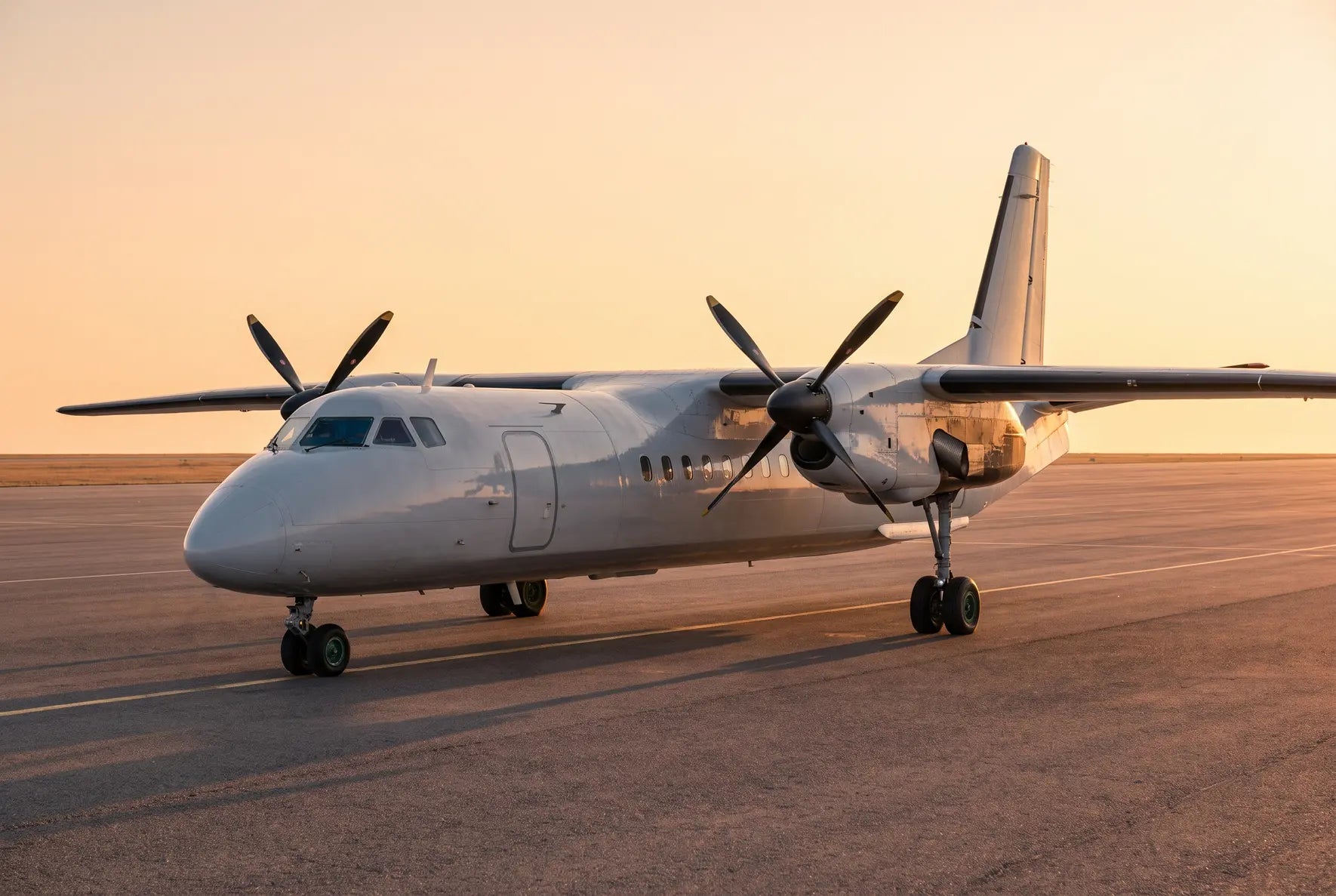
The image shows an Okay Airways Modern Ark 60 aircraft with registration B-3706 in flight, highlighting its white fuselage and orange accents against a clear sky.
Xian MA60 Technical Specifications, Systems and Engine Highlights
The Xian MA60 (Modern Ark 60) is a twin-turboprop regional airliner built by AVIC Xi'an Aircraft Industry. Its mission is short-haul connectivity on thin routes, often into airfields with limited infrastructure, so the design prioritises operating economy, straightforward handling and the ability to work from relatively short runways rather than long-range cruise performance. The airframe traces its lineage to the Xian Y-7, itself a licence development of the Antonov An-24, giving the MA60 a conventional high-wing, low-wing-loading layout with rear-mounted stairs and rugged landing gear suited to regional operations.
Compared with a widebody jet such as the Boeing 777-300, the MA60 targets a completely different segment: modest payload over short sectors, with turboprop efficiency at lower altitudes. The key trade-off is deliberate. Range and cruise speed are limited, but block fuel per sector and field-length requirements stay low, which is what regional operators value most.
- Length: 24.71 m (81 ft 1 in)
- Wingspan: 29.20 m (95 ft 10 in)
- Height: approximately 8.85 m (29 ft)
- Wing area: 75.0 m² (807 ft²)
- Typical seating: 52 to 56 passengers, up to 60 in high-density single-class layout
- Operating empty weight: around 13,700 kg (30,203 lb)
- Maximum takeoff weight (MTOW): 21,800 kg (about 48,060 lb)
- Maximum landing weight: approximately 21,200 to 21,600 kg, depending on source
- Maximum payload: around 5,500 kg (12,125 lb)
- Service ceiling: 7,620 m (25,000 ft)
- Cruise speed: economic cruise near 430 km/h (232 kt), with higher speeds quoted for maximum cruise
- Range: roughly 1,430 to 1,600 km (about 770 to 860 NM), varying with payload and reserves
- Takeoff field length (MTOW): approximately 1,800 m (5,905 ft)
- Engines: two Pratt & Whitney Canada PW127J turboprops, each rated near 2,050 kW (2,750 shp)
Systems and Handling-Relevant Technology
The MA60 retains conventional flight controls consistent with its An-24 and Y-7 heritage, using mechanical and hydraulically assisted surfaces rather than fly-by-wire. This keeps the aircraft mechanically simple and predictable to fly, which suits operators with mixed fleets and limited support infrastructure. Braking uses a hydraulic wheel-brake system with anti-skid, and the reversible-pitch propellers assist with deceleration on landing, an important asset given the short-field mission.
Engine management is handled at the powerplant level by the PW127's single-channel Electronic Engine Control (EEC) with hydro-mechanical backup, providing digital primary control with mechanical reversion for dispatch reliability. Export configurations have been associated with Western avionics, and several data references cite a Rockwell Collins Pro Line 21 suite with an FMS-3000 flight management system, AHS-3000 attitude and heading reference system, and TWR-80 weather radar, though installations can vary between operators.
Published performance figures should be read with care. Numbers differ across sources because of cabin density, selected MTOW, atmospheric assumptions such as ISA deviation and field elevation, runway condition, and how each operator defines range and reserves. As a result, quoted cruise speeds, ranges and field lengths are planning references rather than absolute values, and the correct figures for a given flight always come from the operator's approved data.
The PW127J Engine and Its Family
The MA60 is powered by two Pratt & Whitney Canada PW127J engines, members of the long-running PW100 family developed by Pratt & Whitney Canada. The PW100 is a three-spool, free-turbine turboprop line covering roughly 2,000 to 5,000 shp, and it has dominated the regional turboprop market for over four decades. Architecturally, each engine uses two centrifugal compressors driven by independent axial turbines, a reverse-flow annular combustor, and a two-stage power turbine that drives the propeller through a front reduction gearbox. Because the power turbine is mechanically independent of the gas generator, the propeller is turned via a separate power shaft in a classic free-turbine arrangement.
The PW127 series is optimised for hot-and-high operation, offering more takeoff, climb and cruise power than earlier PW124 variants through a higher mass-flow compressor and hot-section improvements. Related engines power a wide range of aircraft, including the ATR 42 and ATR 72 families, the Antonov An-140, the CASA C-295 and the Ilyushin Il-114, while the larger PW150 from the same lineage powers the De Havilland Canada Dash 8-400. This shared heritage means the MA60 benefits from a mature engine with a broad global support network, one of the more significant practical advantages of the type over its purely Soviet-engined predecessors in the Y-7 line.
Xian MA60 vs MA600 vs ATR 72-600 vs Bombardier Q400 Specifications Comparison
Scroll horizontally to see more →
| Parameter | Xian MA60 | Xi'an MA600 | ATR 72-600 | Bombardier Q400 |
|---|---|---|---|---|
| Entry into service | 2000 | 2010 | 2010 | 2000 |
| Engines | 2 × Pratt & Whitney Canada PW127J turboprops | 2 × Pratt & Whitney Canada PW127J turboprops | 2 × Pratt & Whitney Canada PW127M turboprops | 2 × Pratt & Whitney Canada PW150A turboprops |
| Length | 24.71 m | 24.71 m | 27.17 m | 32.83 m |
| Wingspan | 29.20 m | 29.20 m | 27.05 m | 28.42 m |
| Height | 8.86 m | 8.86 m | 7.65 m | 8.30 m |
| Typical seating and layout (short description + approximate passengers) | Single-class: 52–60 passengers | Single-class: 60–68 passengers | Single-class: 68–78 passengers | Single-class: 70–82 passengers |
| MTOW | 21.8 t | 22.5 t | 23.0 t | 29.3 t |
| Range | 860 nm | 980 nm | 825 nm | 1,100 nm |
| Cruise speed | 0.39 Mach | 0.40 Mach | 0.37 Mach | 0.44 Mach |
| Service ceiling | 25,000 ft | 25,000 ft | 25,000 ft | 27,000 ft |
| Program note | Baseline Chinese twin-turboprop regional airliner aimed at short-haul routes and small regional carriers. | Improved and modernised MA60 derivative offering upgraded cabin and systems for higher-capacity regional operations. | European benchmark 70-seat turboprop widely used worldwide for short-haul regional services. | Higher-performance regional turboprop positioned for faster, longer-range services and higher payload within the same market segment. |
Scroll horizontally to see more →
The table compares key specs of the Xian MA60 and improved MA600 against the ATR 72-600 and Bombardier Q400. MA600 adds capacity and range over the MA60 (60–68 seats and 980 nm vs 52–60 seats and 860 nm) with similar dimensions and engines. ATR 72-600 carries more passengers but has shorter range, while the Q400 is the largest and fastest, with the highest MTOW and 1,100 nm range.
Xian MA60 Routes, Missions and Airlines Operating It Worldwide
The Xian MA60 (Modern Ark 60) is a 56 to 60-seat regional turboprop built for short domestic and intra-regional sectors. Its published range is about 1,600 km (roughly 860 nm), with a typical cruise speed near 430 km/h (about 230 kt) and a service ceiling of 7,620 m (25,000 ft). In practice, operators fly it well below its maximum range, mostly on sectors of 200 to 800 km lasting one to two hours, occasionally out to about 1,000 to 1,200 km. On these short hops, regional carriers plan multiple daily rotations, commonly five to eight legs and roughly five to nine block hours per day, allowing morning and evening feeds into larger cities and frequent shuttles between secondary points.
The aircraft descends from the Y-7-200A and Antonov An-24 lineage, which gives it short and rough-field capability. This shapes its operational environment: it is frequently seen at secondary and tertiary airports with limited ground support, non-paved or deteriorated surfaces, and challenging terrain or hot-and-high conditions. It serves both hub-and-spoke feeding, where small communities connect into a national hub, and point-to-point networks linking secondary cities or island pairs directly.
Operators do face real challenges. The type holds CAAC certification but was never certified by EASA or the FAA, restricting it to markets in Asia, Africa and parts of Latin America and limiting resale, leasing and financing options. Reported difficulties with spare parts, local technical support and route suitability at demanding airfields have increased aircraft-on-ground time and, in some cases, prompted early fleet retirements. Crew training and support for pilots on less common types is a recurring theme across regional operators, an issue explored further in the context of airline pilot conditions and career paths.
Where the Xian MA60 Operates
Because the type lacks Western certification, it has essentially no scheduled commercial presence in Europe or North America. The bulk of activity is concentrated in Asia, where Chinese and Southeast Asian carriers use it for domestic feeder and point-to-point routes, and in Africa, where its rough-field ability suits short, low-density sectors between secondary airports. In South America, sustained airline use is limited, with most examples flown by state and military operators.
- Europe: No EASA-certified airline operates the type in revenue service. Interest has been mainly industrial, including past discussion in Russia around licence production rather than established commercial fleets.
- North & South America: No mainstream carriers in the United States, Canada or Mexico operate it. In South America, the Ecuadorian Air Force and Bolivian Air Force have used it for military transport rather than scheduled passenger service.
- Asia: Sichuan Airlines was the launch customer from August 2000; Joy Air operates it on Chinese regional routes feeding larger hubs. Zest Airways (Philippines) flew it on domestic routes including short-runway Caticlan (Boracay), Lao Skyway and Lao Airlines serve domestic Laos sectors, Nepal Airlines used it in mountainous terrain, while Felix Airways (Yemen) and Cambodia Bayon Airlines flew regional and domestic links.
- Africa: Air Zimbabwe and Camair-Co (Cameroon) operate it on domestic and short regional routes, and Massawa Airways (Eritrea) uses it for domestic services. Several air forces, including Ghana and Zambia, employ it as a transport platform.
Typical Seating and Cabin Layouts
The MA60 is almost always fitted as a single-class, all-economy cabin with 4-abreast (2-2) seating along a single aisle. The cabin measures about 10.8 m long, 2.7 m wide and 1.9 m high, supporting a nominal 56 to 60 seats. A widely documented in-service layout seats 56 passengers in a 2-2 arrangement, while technical sheets list up to 60 in higher-density configurations. Network and scheduled regional carriers tend to favour standard economy layouts around 56 to 60 seats, sometimes opting for the lower count to improve comfort and weight margins. Charter, state and multi-role operators may use maximum-density passenger seating or specialised, lower-capacity interiors for cargo, executive transport, medevac or patrol duties. The aircraft is powered by two Pratt & Whitney Canada PW127J engines with four-bladed composite propellers, and is built by Xi'an Aircraft Industrial Corporation under AVIC. For comparative cabin dimensions and specification details, see the SKYbrary MA60 profile and the Airlines Inform technical sheet.
In this video, experience a flight aboard the Chinese-built Xian MA60 airliner in Nepal, with insights into the aircraft, the route, and what it is like operating this regional turboprop in challenging terrain.
Xian MA60 Safety Record: Accident History and How Safe It Is
The Xian MA60, a twin-turboprop regional airliner built by Xi'an Aircraft Industrial Corporation under AVIC, entered commercial service in the early 2000s as a stretched development of the Xian Y-7, itself derived from the Antonov An-24. Placing its safety record in context requires modest numbers: open sources indicate roughly 60 to 70 airframes built, with about 57 exported overseas as of January 2016. Against that small fleet, the Aviation Safety Network lists around 14 accidents and incidents through 2015, including one fatal accident and several hull losses. In absolute terms the fatal accident count is low, but the ratio of serious landing, gear and hydraulic events to fleet size and cumulative cycles is high compared with established Western turboprops, and a significant share of exported aircraft were later grounded or stored.
Notable accidents and serious incidents
Several events shaped the type's reputation and prompted operational responses:
- Merpati Nusantara Airlines Flight 8968, Indonesia (2011). On approach to Kaimana in poor weather, the aircraft crashed short of the runway, with 25 fatalities. Indonesia's KNKT/NTSC investigation identified human factors, including loss of situational awareness, weak crew resource management and training shortcomings, rather than a design defect. Afterward, Indonesian authorities restricted MA60 operations at three airports with difficult approaches and ordered a special audit covering maintenance, spares, training and procedures.
- Merpati Nusantara Airlines hard landing, Kupang, Indonesia (2013). The pilot flying selected reverse thrust well before touchdown, producing a very hard landing that broke the fuselage. The event was attributed to a procedural error, and prompted a further audit of Merpati's MA60 operations and crew training. See the SKYbrary MA60 profile for technical context.
- Myanma Airways runway excursion, Kawthaung (2013). A drop in hydraulic pressure disabled braking and nose-wheel steering during landing, and the aircraft struck a wall without fatalities. Myanmar's Civil Aviation Department grounded and later withdrew the MA60, replacing it with ATR-72s and highlighting concerns about hydraulic and gear reliability.
- Joy Air excursion, Fuzhou, China (2015). A right main gear tyre burst on landing led to a runway excursion and fuselage breakup, with three injuries and no fatalities. The event, documented by the Bureau of Aircraft Accidents Archives, reinforced existing questions about gear and tyre reliability.
How safe is the Xian MA60?
Measured purely by fatal accidents per airframe, a single fatal event across roughly 60 to 70 aircraft is not statistically extreme for a regional turboprop. The concern lies in the pattern of non-fatal but serious landing, gear and hydraulic occurrences, combined with reported spare-parts shortages and uneven after-sales support, which pushed several operators to store or retire the type. Regulatory oversight also differs from peers: the MA60 was certified by China's CAAC and some importing authorities such as Indonesia's DGCA, but it never obtained FAA or EASA type certification, so it cannot be operated in US or EU airspace. That distinction shapes how disciplined standard operating procedures, crew training and maintenance programmes must be to offset the aircraft's design lineage. Enthusiasts comparing generations of regional and piston-era aircraft may find useful perspective in the history of the Douglas DC-3, whose long service life underscores how procedures and oversight, not just airframe age or origin, drive safety outcomes. For broader benchmarking, aggregate figures published by the U.S. Bureau of Transportation Statistics show that scheduled air carrier fatal accident rates have fallen close to zero in well-regulated markets. Taken together, the evidence suggests the MA60's real-world safety depends heavily on operator quality, training and maintenance, and, as with all commercial types, aviation as a whole remains one of the safest modes of transport.
01 What kind of routes is the Xian MA60 typically used on?
The Xian MA60 is mainly used on short to medium regional routes, generally up to about 1,400–1,600 km, connecting secondary cities and remote areas with limited ground infrastructure. Its turboprop engines and short take-off and landing capabilities make it suitable for shorter runways and less-developed airports where larger jets may not operate efficiently. Airlines use the MA60 for domestic trunk routes, island hops, and cross-border regional services where passenger loads are around 40–60 seats. This mission profile places the MA60 in the same role as aircraft like the ATR 42/72 and Dash 8 on comparable sectors.
02 What is the passenger experience like inside a Xian MA60?
The Xian MA60 cabin is laid out in a four-abreast configuration, with two seats on each side of the aisle and a typical single-class capacity of around 50–60 passengers. Cabin height is roughly 1.9 m and width about 2.7 m, so passengers can expect a typical regional turboprop feel: reasonably spacious for short flights, but more compact than most jet airliners. Noise from the propellers is noticeable, especially near the wings, although the aircraft is equipped with regulated air conditioning for temperature comfort. For most travellers, the experience is comparable to other turboprops, with a focus on practicality rather than premium features.
03 Which airlines operate the Xian MA60 and on what kinds of routes?
The Xian MA60 has been operated by several regional carriers, including Air Zimbabwe, Lao Airlines, Felix Airways, Joy Air, Camair-Co, and Cambodia Bayon Airlines, among others. These airlines typically deploy the MA60 on domestic and near-international routes where demand fits a 40–60 seat aircraft and airport infrastructure may be basic. Examples include connecting provincial capitals with smaller towns, serving island or coastal routes, and linking secondary airports that are not regularly served by larger jets. Because of its design heritage from the rugged Antonov An-24 family, operators favor the MA60 on routes where reliability on less-than-ideal runways is important.
04 How does the performance of the Xian MA60 compare with similar regional turboprops?
The Xian MA60 is powered by two Pratt & Whitney Canada PW127J turboprop engines, each producing about 2,750 shp, giving it a typical cruise speed around 270–280 knots and a range of roughly 800–860 nautical miles. This places its speed and range broadly in the same category as popular turboprops like the ATR 42/72 and Dash 8, although exact performance varies by configuration and operator. The MA60’s take-off and landing distances of about 1,600–1,800 m are tailored for regional airports, and its maximum take-off weight is in the 21.8-tonne class, with a payload of around 5.5 tonnes. Overall, it is designed as a workhorse for short sectors rather than long-haul efficiency.
05 What is known about the safety record and design features of the Xian MA60?
The Xian MA60 has experienced several notable accidents, including multiple fatal events since the late 2000s, which have drawn attention due to the aircraft’s relatively small global fleet. The aircraft incorporates modern Western engines and avionics, including PW127J turboprops, composite four-bladed propellers, and systems such as de-icing to allow operation in icing conditions. It is certified by the Civil Aviation Administration of China but has not obtained FAA or EASA certification, which limits its operation in North American and most European airspace. As with any aircraft type, operational safety depends heavily on airline maintenance standards, crew training, and the specific operating environments, not just the design alone.
06 Are there any practical tips for passengers flying on a Xian MA60, such as seat choice or ride comfort?
Passengers sensitive to noise may prefer seats forward of the wing on a Xian MA60, as turboprop and airflow noise is usually more pronounced around and behind the propellers. Window alignment can vary slightly by airline configuration, but choosing a seat near the front offers a better chance of a quieter and smoother ride, especially in moderate turbulence. The MA60’s robust wing and turboprop layout tend to handle typical regional weather reasonably well, though bumps may be more noticeable at lower cruising altitudes compared with larger jets. Travellers should also be aware that overhead bins and legroom are sized for short-haul operations, so packing compact hand luggage can make boarding and stowing easier.