

Antonov An-140: History and Development of the Regional Turboprop
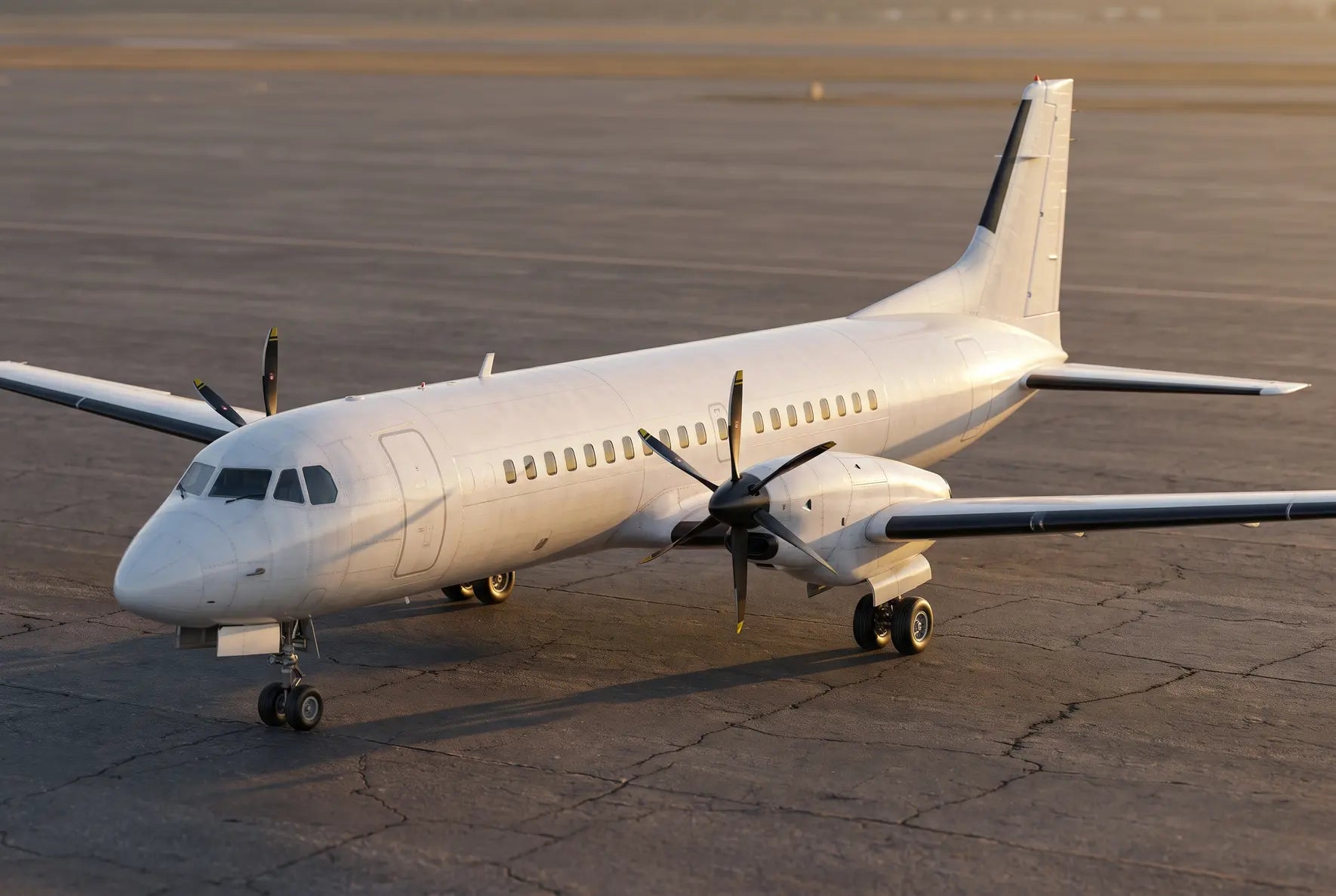
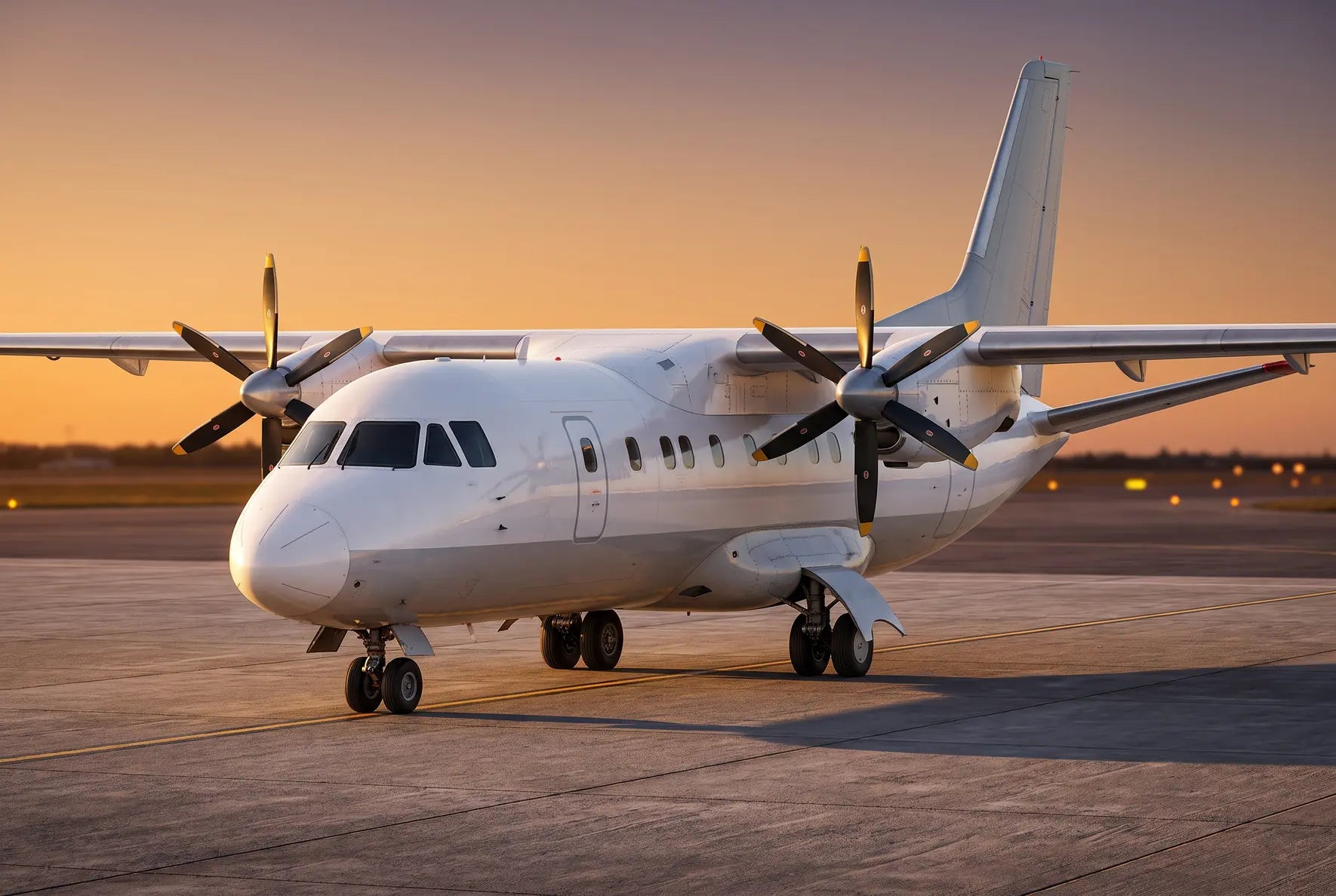
The Antonov An-140 is a twin-engine regional turboprop designed by the Antonov design bureau in Ukraine to replace the ageing An-24 on short and medium regional routes. The goal was a modern 50-seat aircraft with better comfort, range and economy that could still operate from short, poorly prepared airstrips common across the former Soviet Union. According to Antonov's own program history, the requirements specification for the new 50-seat aircraft was approved on 15 March 1994.
The chronological development path is well documented by the manufacturer and by independent aviation references:
- 1994: Requirements specification approved for the 50-seat regional turboprop.
- 1997: Maiden flight of the prototype (17 September 1997); preparation for series manufacturing began at the Samara facility.
- 11 October 1999: First production An-140 flew from Kharkiv, Ukraine.
- 22 April 2000: Type certificates issued for the An-140 and the An-140-100.
- 7 February 2001: First Iranian-built IrAn-140 took to the air.
- March 2002: Entry into regular passenger service.
- 2 August 2005: First Aviakor-built An-140 flew in Samara, Russia.
The program was notable for its multinational production. Beyond Antonov's home plant in Kharkiv, the aircraft was assembled under licence by HESA in Isfahan, Iran (as the IrAn-140) from Antonov-supplied kits, and by Aviakor in Samara, Russia. Powerplant options centred on the Klimov TV3-117VMA-SBM1 turboprop, produced by Motor Sich, while the program was also offered with the Pratt & Whitney Canada PW127A for export customers seeking Western engines. Pilots and engineers studying regional turboprop systems can test related knowledge through this aviation exam.
What sets this variant apart
The An-140 family is closely related, and the distinctions between builds are largely about certification standard and production origin rather than radical airframe redesigns. The baseline An-140 is the original 52-seat model, while the An-140-100 was certified as a separate, standardized production version. The IrAn-140 represents Iranian licensed assembly, and the Aviakor aircraft form the Russian production run of the An-140-100. Published performance figures vary by payload and configuration across sources, so the most defensible headline values come from Antonov's own data: 52 passengers, roughly 2,100 km range in the passenger version, and a cruise speed of about 520 to 575 km/h.
The key variant identifiers that can be verified through authoritative sources are summarised below:
- Manufacturer/origin: Antonov (Kharkiv), HESA (Iran), Aviakor (Russia).
- Engines: Klimov TV3-117VMA-SBM1 (Motor Sich); Pratt & Whitney Canada PW127A option.
- Capacity: up to 52 passengers.
- Range: about 2,100 km in the passenger configuration (Antonov figure).
- Cruise speed: approximately 520 to 575 km/h.
- Maximum takeoff weight: roughly 21,500 kg per secondary sources.
The program was affected by both safety and industrial setbacks. Independent summaries record several accidents and hull losses across the fleet, the most serious being the loss of Aeromist Kharkiv Flight 2137 near Isfahan, Iran, on 23 December 2002. On the industrial side, output was constrained by geopolitical and supply-chain disruption, and Russian production at Aviakor ended around 2016. Overall build numbers remained low for a regional airliner, with references citing roughly 33 aircraft produced across all three sites, leaving only limited in-service use in later years rather than a large active fleet.

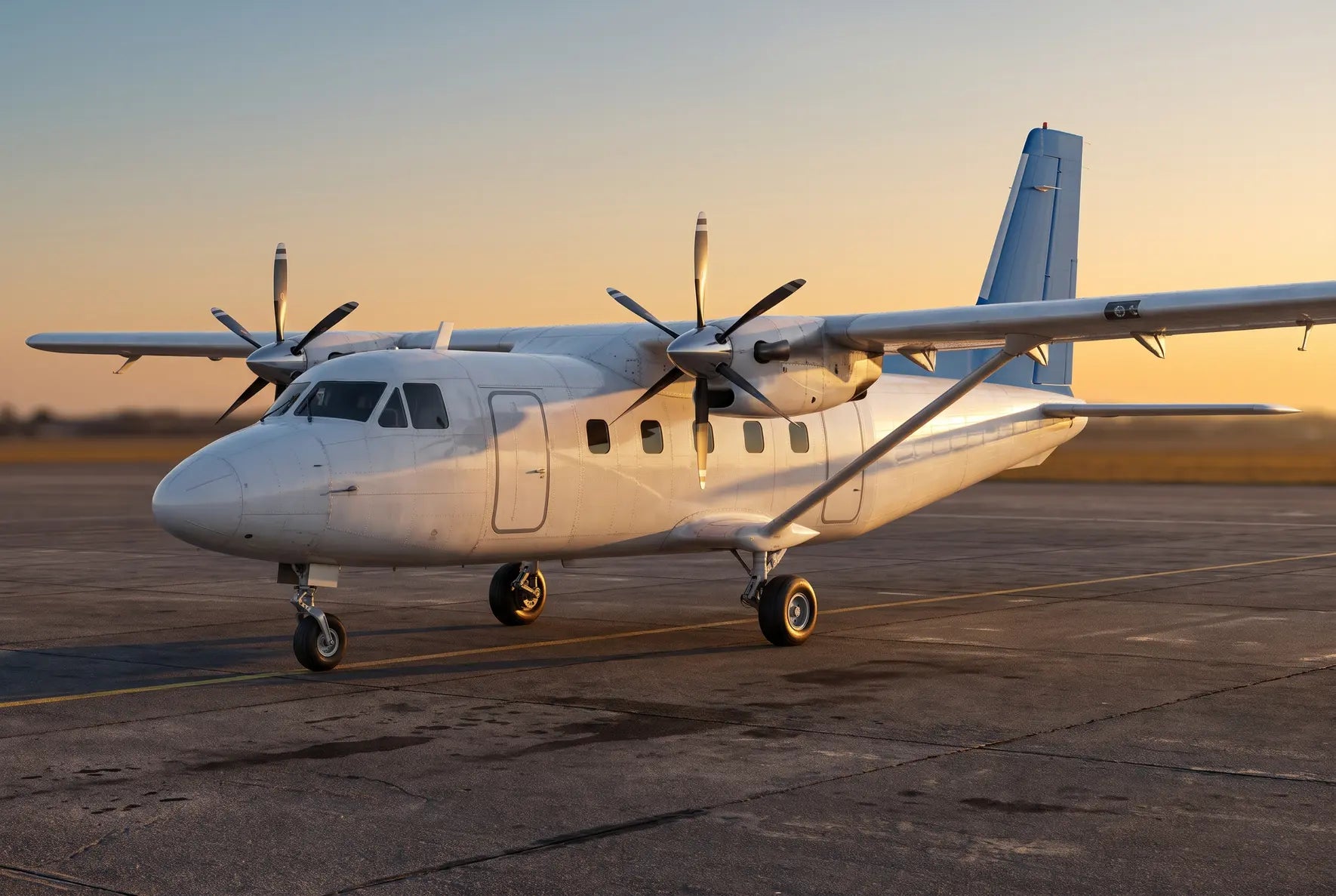
The image shows an Antonov An-140 aircraft in flight, displaying its distinctive blue and white color scheme. It is a small, twin-turboprop airliner known for regional transportation.
Antonov An-140 Technical Specifications, Systems and Engines
The Antonov An-140 is a high-wing twin-turboprop regional airliner conceived as the successor to the venerable An-24. Its design brief centred on rugged, autonomous operation from short, unprepared or semi-prepared airfields, including gravel, snow and ice, across a wide temperature envelope. That mission drives most of the trade-offs: a robust airframe and landing gear, generous field performance and modest cruise speeds, rather than the outright range or speed of pure-jet regionals. From its Antonov lineage it inherits the high-wing layout, reinforced landing gear and multi-role flexibility, updated with more efficient engines, a two-pilot cockpit and an airline-standard cabin.
The baseline An-140 seats 52 passengers in a single-class layout and is built around Ukrainian/Russian turboprops, with a Western engine option offered to broaden its export appeal. Published performance varies between sources because operators specify different weights, cabin densities and engine fits.
Specs that matter
- Length: 22.605 m (74 ft 2 in)
- Wingspan: 24.505 m (80 ft 5 in)
- Height: 8.225 m (27 ft 0 in)
- Wing area: 51 m² (550 ft²)
- Operating empty weight: approx. 12,810 kg (28,241 lb)
- MTOW: approx. 19,150 kg (42,219 lb), with higher-weight variants cited up to 21,500 kg
- Maximum landing weight: approx. 19,100 kg (42,108 lb)
- Maximum payload: 6,000 kg (13,228 lb)
- Fuel capacity: approx. 4,370 kg (9,634 lb)
- Typical passenger range: roughly 900-1,400 km depending on payload and reserves; ferry range up to about 3,680 km
- Cruise speed: roughly 460-470 km/h (250-255 kt), with a maximum near 575 km/h
- Service ceiling: approx. 7,600 m (about 24,900 ft)
- Engines: 2 × Motor-Sich AI-30 / Klimov TV3-117VMA-SBM1, approx. 1,838 kW (2,465 shp) each; optional 2 × Pratt & Whitney Canada PW127A
- Propellers: six-blade composite AV-140, constant-speed, feathering and reversible
- Design life: around 50,000 flight hours / 50,000 landings / 25 years
Systems and handling technology
The An-140 uses conventional manual flight controls with horn-balanced ailerons, elevator and rudder, trim tabs and wing spoilers, rather than fly-by-wire. Primary controls run through mechanical linkages, while a hydraulic system supports landing gear, brakes and secondary actuation. Automation is limited to a two-pilot-friendly autopilot and flight director coupled to the navigation suite, plus centralised caution and warning indications. Braking uses the Rubin wheel and brake system, with twin-wheel main and nose units sized for gravel and unpaved surfaces. Engine control on the AI-30/TV3-117VMA-SBM1 combines a FED fuel-management system with a Star engine control unit, a hybrid electronic and hydromechanical arrangement rather than a full Western-style FADEC; the PW127A option carries Pratt & Whitney Canada's electronic engine and propeller control. Maintainability was a stated priority, with a published target near 6.5 man-hours per flight hour. Readers comparing rough-field turboprops may find our broader coverage useful in this aircraft resource.
Quoted figures should be read with context. Range, field length and cruise numbers shift with the engine variant, passenger and cargo load, selected MTOW, atmospheric conditions and runway state. For example, takeoff field length is cited from around 880 m at lighter regional weights up to roughly 1,750 m under heavier or more demanding assumptions, so no single value applies to every operation.
Engine options and their heritage
The standard powerplant is the Motor-Sich AI-30, a licence-built version of the Klimov TV3-117VMA-SBM1, developed with design input from Ivchenko-Progress in Zaporizhzhia. The wider TV3-117 family is one of the most produced Soviet-era turboshaft and turboprop lines, originally engineered by Klimov for helicopters such as the Mil Mi-8/17, Mi-24, and the Kamov Ka-27, Ka-32 and Ka-50/52. The SBM1 is a turboprop derivative optimised for fixed-wing efficiency and long cycle life, driving the six-blade composite AV-140 propeller for strong short-field and reverse-thrust performance. As an export alternative, Antonov offered the Pratt & Whitney Canada PW127A, part of the well-established PW100 family that powers the ATR 42/72, the Bombardier/De Havilland Dash 8 and the Airbus/CASA C-295. In the An-140 this option drives Hamilton Sundstrand 247F propellers and is aimed at operators already familiar with PW100 maintenance and logistics.
Antonov An-140 vs An-140-100 vs ATR 72-500 vs Bombardier Q400 Specifications Comparison
Scroll horizontally to see more →
| Parameter | Antonov An-140 | Antonov An-140-100 | ATR 72-500 | Bombardier Q400 |
|---|---|---|---|---|
| Entry into service | 2002 | 2002 | 1999 | 2000 |
| Engines | 2 × Motor-Sich AI-30 series 1 turboprop engines | 2 × Motor-Sich AI-30 series 1 turboprop engines | 2 × Pratt & Whitney Canada PW127F turboprop engines | 2 × Pratt & Whitney Canada PW150A turboprop engines |
| Length | 22.6 m | 22.6 m | 27.2 m | 32.3 m |
| Wingspan | 25.5 m | 25.5 m | 27.1 m | 28.4 m |
| Height | 8.2 m | 8.2 m | 8.7 m | 8.3 m |
| Typical seating and layout (short description + approximate passengers) | Single-class: 46–52 passengers | Single-class: 46–52 passengers | Single-class: 68–74 passengers | Single-class: 70–78 passengers |
| MTOW | 21.5 t | 21.5 t | 22.5 t | 29.3 t |
| Range | 2,100 nm | 2,100 nm | 825 nm | 1,100 nm |
| Cruise speed | 0.48 Mach | 0.48 Mach | 0.44 Mach | 0.50 Mach |
| Service ceiling | 24,900 ft | 24,900 ft | 25,000 ft | 27,000 ft |
| Program note | Baseline Ukrainian-designed regional turboprop intended as a modern replacement for the An-24 on short-haul routes. | Principal production passenger variant of the An-140 family with improved systems and cabin for regional airline operations. | European high-wing turboprop benchmark for short-haul regional services, widely used as a competitor in the 70-seat class. | Higher-performance regional turboprop offering faster cruise and greater payload-range, positioned at the upper end of the turboprop market. |
Scroll horizontally to see more →
The table compares key specs of the An-140 and An-140-100 against ATR 72-500 and Bombardier Q400, covering dimensions, engines, seating, MTOW, range, speed, and ceiling. The An-140 variants are smaller and seat 46–52, but show a much longer listed range (2,100 nm) than the ATR (825 nm) and Q400 (1,100 nm). The Q400 is the largest and heaviest (29.3 t MTOW) and cruises fastest (0.50 Mach), while the ATR and Q400 carry roughly 70+ passengers.
Antonov An-140 Operations: Routes, Missions and Airlines Worldwide
The Antonov An-140 is a 52-seat regional turboprop conceived as a successor to the An-24, built for short-haul feeder work from short, remote and poorly equipped airfields. In passenger configuration Antonov quotes a mission of 52 passengers over about 2,100 km, with an economical cruise near 520 km/h and a maximum cruise around 575 km/h. Operators typically treat a realistic maximum sector as roughly 2,000 to 2,200 km with a full cabin, though most scheduled legs are far shorter.
Typical missions fall between 300 and 1,000 km, giving block times of roughly 40 minutes to about 1.5 hours per leg. On dense regional networks the type can fly several rotations per day, connecting secondary and remote airports to larger hubs in a classic point-to-point and feeder role rather than long-haul hub-and-spoke service. The aircraft is designed to work day and night from airfields up to 2,500 m elevation, in temperatures from -55 C to +45 C, and from short or unprepared strips including snow and gravel, per Airport Technology.
Operational challenges are notable. Only around 35 airframes were built between Ukraine and Iran, so spares, engine support and long-term maintenance are harder than for mainstream rivals such as the ATR 42/72 or Dash 8. The TV3-117 family powerplants tie the type to post-Soviet supply chains, complicated further by sanctions affecting Russian and Iranian operators. A difficult safety record, including four hull losses, has also affected regulator and airline confidence. Readers comparing regional types may find our frequently asked questions useful for context.
Where the Antonov An-140 operates
Active service has always been concentrated in the former Soviet space and the Middle East rather than across the four broad regions equally. In Europe, Ukrainian carriers flew domestic and near-regional legs; in Asia, Iranian license-built aircraft served internal routes before being grounded; the type never established scheduled passenger operations across North & South America or, in any significant way, across Africa, where only isolated orders were placed.
As of late 2022 only about nine airframes remained in active service, largely with Russian military units and one civil operator, so current flying is effectively limited to Russia and its Far East regions.
- Europe: Ukrainian operators dominated early service. Aeromist-Kharkiv flew regional and international sectors and was involved in the 2002 Isfahan accident; Motor Sich Airlines operated it on sub-1,000 km domestic and charter legs; Ilych-Avia took two aircraft for regional Ukrainian routes; and Antonov Airlines held a small number for corporate and utility use.
- North & South America: No airlines in these regions have operated the type in scheduled passenger service; the aircraft has effectively no commercial footprint across the Americas.
- Asia: In Russia, Yakutia Airlines operates the An-140-100 on routes across the Sakha Republic and Russian Far East, while the Russian Aerospace Forces and Naval Aviation use military examples. In Iran, HESA-assembled IrAn-140 aircraft flew with Iran Air Tours, Safiran Airlines, Sepahan Airlines and Iran Aseman Airlines until the Civil Aviation Organisation of Iran grounded the fleet after the 2014 crash. Azerbaijan Airlines figured among early customers.
- Africa: Air Libya Tibesti was listed as ordering five aircraft, though public data on the depth and duration of actual commercial service is limited.
Typical seating and cabin layouts
The standard cabin seats 52 passengers four-abreast in a 2-2 single-aisle layout, with an economy seat pitch of about 78 cm (roughly 30 to 31 inches), figures documented on the Airlines-Inform specification page. Network and regional operators such as Yakutia and the former Ukrainian carriers used this full single-class layout to maximise feeder capacity on short legs. A VIP or corporate variant reduces the cabin to up to 30 passengers with more generous spacing for government and business missions, as noted in the variant guide. Because the fleet is small and largely government or regional, no leisure-charter high-density reconfigurations are documented, and seat-map variation is minimal compared with mainstream Western turboprops.
In this video, follow a trip report on Motor Sich Airlines from Kyiv Zhuliany to Odesa, flying economy on the Antonov AN-140. See the onboard experience, cabin views, and the journey across Ukraine.
Antonov An-140 Safety Record and How Safe Is It in Service
The Antonov An-140 is a niche regional turboprop with a small production run: roughly 25 airframes built by 2013, assembled in Ukraine (Kharkiv), Russia (Samara) and under licence in Iran as the HESA IrAn-140. It first flew in September 1997 and entered commercial service in March 2002. Because the fleet has always been small and utilisation modest, the number of accidents relative to the tiny number of aircraft and flight cycles makes its safety record poor when measured against mainstream Western turboprops such as the ATR 72 or the DHC-8. Databases such as the Aviation Safety Network and the Bureau of Aircraft Accidents Archives record several fatal events across a fleet that numbered only a few dozen aircraft, and by 2021 essentially one example remained in scheduled passenger service.
Major accidents and what changed afterwards
- Aeromist-Kharkiv Flight 2137 (2002): On 23 December 2002 an An-140 (UR-14003) carrying aviation specialists to Isfahan, Iran, struck mountainous terrain during a night approach, killing all 44 on board. The Interstate Aviation Committee attributed the crash to procedural navigation errors, including incorrect use of GPS on approach. The event reinforced the wider industry move toward stricter approach procedures and terrain awareness training to prevent controlled flight into terrain.
- Azerbaijan Airlines Flight AHY217 (2005): On 23 December 2005 an An-140-100 (4K-AZ48) departed Baku for Aktau at night in poor visibility and entered a descending spiral, killing all 23 occupants. Investigators found the gyro horizons failed because counterfeit assemblies had been installed during production, leading to spatial disorientation. This finding prompted tighter scrutiny of component traceability and manufacturing quality control, and greater emphasis on verifying attitude instruments before night departures.
- Sepahan Airlines Flight 5915 (2014): On 10 August 2014 an IrAn-140 crashed shortly after takeoff from Tehran-Mehrabad, killing about 40 of the 48 people on board. An engine failure seconds after liftoff combined with an incorrect crew response and marginal single-engine climb performance led to loss of control. Afterwards Iranian authorities suspended and effectively withdrew the type from commercial passenger service, and reviewed engine-out training and performance requirements.
How safe is the Antonov An-140?
Judged purely on outcomes, the An-140 family has recorded a high proportion of fatal accidents for such a small fleet, and its causes span navigation error, counterfeit components and engine-out handling rather than a single design flaw. Regulators responded largely by restricting or withdrawing the type rather than through a broad redesign, which limits meaningful comparison with high-volume turboprops that benefit from mature standard operating procedures and continuous oversight. Prospective travellers and researchers weighing the type should read the official investigation reports and consult recognised statistics such as those published by ICAO and IATA, which report global fatal accident rates well below one per million departures. For readers exploring aircraft history and economics in more depth, our guide on how you can deduct the purchase of the book from your taxes may also be useful. Despite the An-140's individual record, the wider evidence remains clear: commercial aviation as a whole is one of the safest modes of transport, far safer per passenger-kilometre than everyday road travel.
01 What kind of routes and range is the Antonov An-140 designed for?
The Antonov An-140 is a regional turboprop airliner designed mainly for short- and medium-haul routes. In a typical 50–52 seat passenger configuration, it can fly around 2,000–2,100 km nonstop, making it suitable for domestic and near-international sectors. Its ability to operate from shorter runways and less-equipped airports means it is often used on routes linking regional cities rather than major hubs. Some variants can fly further with fewer passengers or reduced payload, which gives operators flexibility in mission planning.
02 What is the cabin like on an Antonov An-140 in terms of comfort and noise?
The Antonov An-140 cabin normally seats up to 52 passengers in a single-aisle layout with a seat pitch around 78 cm, which is comparable to many other regional turboprops. As with most turboprop aircraft, passengers seated closer to the engines and propellers may notice more noise and vibration, while seats farther forward are usually quieter. The aircraft was designed to meet modern comfort standards for regional flights, with reclining seats and standard overhead storage. For typical flight lengths of one to three hours, comfort is generally considered adequate, though not as quiet as larger jet airliners.
03 Which airlines have operated the Antonov An-140 and on what types of routes?
The Antonov An-140 has mainly been operated by airlines and state operators in Ukraine, Russia, Iran, and a few other countries in the region. Carriers have used it on domestic and regional services, connecting secondary cities with shorter runways and limited ground infrastructure. Because the An-140 is capable of operating from unpaved or semi-prepared airstrips, it has also been employed on routes to remote or less-developed airports. Its relatively small capacity and good short-field performance make it well-suited for low- to medium-demand routes where larger jets would not be economical.
04 How does the Antonov An-140 compare with similar turboprops like the ATR 42 or Dash 8?
The Antonov An-140 is broadly comparable in size and capacity to aircraft such as the ATR 42 and earlier Dash 8 variants, with seating for around 50 passengers and a cruise speed in the 500–575 km/h range. Its design emphasizes operations from short and sometimes rough runways, giving it strong performance on marginal airfields similar to some rugged Dash 8 configurations. In terms of fuel efficiency, it is competitive for its era, but newer Western turboprops often benefit from more modern engines and avionics. The An-140 tends to be most attractive where operators need a robust aircraft tailored to regional infrastructure and climatic conditions rather than maximum cabin refinement.
05 What is known about the safety record and design features of the Antonov An-140?
The Antonov An-140 incorporates modern safety features for a regional turboprop of its generation, including twin turboprop engines, advanced propeller systems, and systems designed for operations in a wide range of weather conditions. It was developed as a successor to the Antonov An-24, with improvements in systems, avionics options, and overall performance. The fleet size has always been relatively small, so accident statistics are limited compared with more common types, and each incident has a proportionally larger effect on its perceived safety record. As with any aircraft, overall safety depends not only on the design but also on operator maintenance standards, crew training, and the operating environment.
06 As a passenger, what should I know about flying on an Antonov An-140 (best seats, windows, turbulence)?
On an Antonov An-140, passengers who prefer a quieter ride often choose seats toward the front of the cabin, away from the engines and propellers mounted near the wings. Window size is typical for a regional turboprop, providing reasonable outside views, although exact alignment with seats can vary slightly by airline configuration. Like other high-wing turboprops, the An-140 can feel firm in turbulence, but its robust structure and wing design are intended to handle rough air and short-field operations. Travellers sensitive to motion may prefer seats near the wing, where the ride often feels more stable during bumps and during takeoff and landing from short runways.