

Bombardier Dash 8 Q400: History and Development of a Fast Turboprop
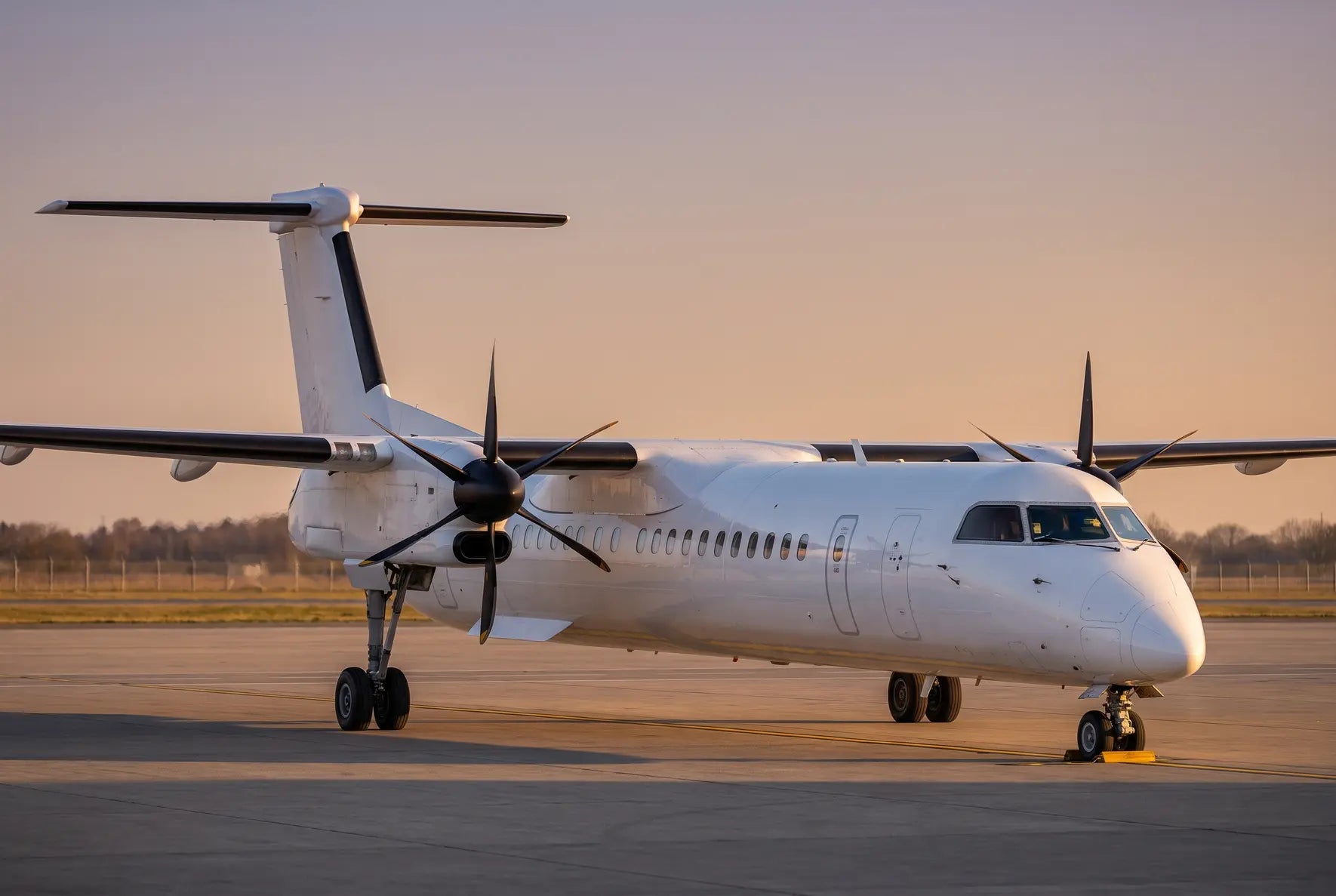
The Bombardier Dash 8 Q400 (officially the DHC-8-400) is the largest, fastest and most powerful member of the Dash 8 family. It exists because de Havilland Canada (DHC) wanted a modern regional turboprop that kept the excellent short-field economics of the earlier Dash 7 while offering better cruise performance and lower operating costs. The original Dash 8 Series 100 first flew on 20 June 1983 and gained Canadian certification in September 1984, powered by Pratt & Whitney Canada PW100-series engines and seating around 37 to 39 passengers.
By the mid-1990s, airline demand for larger 70-seat turboprops, and competition from types such as the ATR 72, pushed Bombardier (then owner of DHC) to launch a substantially stretched and re-engined derivative. The Series 400 program was launched in 1995. The first airframe rolled out on 21 November 1997, the aircraft made its maiden flight on 31 January 1998, and after certification work through 1999 the type entered commercial service in 2000 with SAS Commuter. The distinctive six-bladed Dowty R408 propellers were certified on 29 July 1999.
The program changed hands several times. DHC passed through Boeing ownership before Bombardier Aerospace acquired the de Havilland operations and developed the Q400. In 2019, Bombardier sold the Dash 8 program to Longview Aviation Capital, which revived the historic De Havilland Canada brand. Production was suspended in 2022 pending relocation to a new facility, though the aircraft remains catalogued. The type has been operated by numerous carriers across North America and Europe, alongside other established U.S. regional operators such as Eastern Airlines.
What sets the Q400 apart from earlier Dash 8 variants
The Q400 differs sharply from the Q100, Q200 and Q300. Each is powered by two Pratt & Whitney Canada PW150A turboprops rated at roughly 4,850 to 5,071 shaft horsepower, roughly double the output of the PW120/PW123 engines used on earlier Dash 8s. This raises maximum cruise speed to about 360 knots (around 667 km/h), placing the Q400 in direct competition with regional jets rather than legacy turboprops. The fuselage is significantly stretched, lifting typical seating to between 70 and 78 passengers, with high-density layouts reaching up to 90. The "Q" designation reflects the active Noise and Vibration Suppression (NVS) system, which uses sensors and active controls to cut propeller-induced cabin noise. A later Q400 NextGen offering added cabin, avionics and weight-option refinements.
The main variant identifiers are:
- Engines: two Pratt & Whitney Canada PW150A turboprops
- Propellers: two six-bladed Dowty R408 composite propellers, 13.5 ft (4.1 m) diameter
- Maximum cruise speed: about 360 kt (667 km/h)
- Operational ceiling: 25,000 ft (7,620 m)
- Range: approximately 1,457 nm (2,040 km) at full passenger load
- Maximum take-off weight: around 65,200 lb (about 29,575 kg)
- Capacity: typically 70 to 78 seats, up to 90 in high-density layouts
- Active Noise and Vibration Suppression (NVS) system
Program issues and technical responses
The Q400 faced a notable episode in 2007, when several SAS aircraft suffered main landing-gear collapses on landing. Investigations, as documented in Christopher Buckley's De Havilland Canada: Beaver to Dash 8, pointed to corrosion and a misplaced o-ring obstructing a hydraulic restrictor valve. Bombardier called for Q400s with more than 10,000 flights to be grounded until their landing gear could be certified safe, affecting roughly 60 of the 160 aircraft then in service. SAS ultimately withdrew its Dash 8-400 fleet, replacing it with CRJ-900 regional jets. The events prompted revised landing-gear inspection regimes and design scrutiny that shaped subsequent maintenance procedures for the type.

A Widerøe Bombardier DHC-8-402Q aircraft is captured flying in a clear sky. The plane displays a distinctive green and white livery with visible propellers and landing gears.
Bombardier Dash 8 Q400: Technical Specifications and Systems Highlights
The Bombardier Dash 8 Q400 (type designation DHC-8-400) is the largest and fastest member of the Dash 8 family, engineered to bridge the gap between conventional regional turboprops and short-haul jets. Its mission is high-frequency regional flying: fast block times, strong short-field capability and lower trip fuel burn than a comparable jet. To achieve near-jet cruise speeds the airframe was stretched, structurally reinforced and matched to far more powerful engines than earlier Dash 8 variants, while retaining the family's high wing, T-tail and rugged trailing-link landing gear suited to demanding runways.
The design centres on a range-versus-payload compromise typical of regional turboprops: high cruise speed and short-field performance are prioritised over long range. The result is an aircraft that can operate from relatively short runways yet cruise close to 360 kt, a niche that historically overlapped with early jets such as the Convair 990 Coronado in the broader story of fast regional and short-haul transport.
- Overall length: 32.83 m (107 ft 9 in)
- Wingspan: 28.42 m (93 ft 3 in)
- Height: 8.34 m (27 ft 4 in)
- MTOW: 29,574 kg (65,200 lb) standard; 30,481 kg (67,200 lb) in the Enhanced High Gross Weight (EHGW) configuration
- Maximum Landing Weight: 28,123 kg (62,000 lb) standard; 29,030 kg (64,000 lb) EHGW
- Maximum Zero Fuel Weight: 26,308 kg (58,000 lb) standard; 27,669 kg (61,000 lb) EHGW
- Typical operating empty weight: approximately 17,885 kg standard, 18,030 kg (39,750 lb) EHGW
- Usable fuel: approximately 1,724 US gal (about 6,526 L / 5,318 kg)
- Maximum cruise speed: 360 kt (667 km/h)
- Service ceiling: 25,000 ft baseline, with 27,000 ft (8,230 m) as a certified maximum operating altitude depending on configuration
- Full-passenger range: about 1,100 nm (2,037 km) at 102 kg/225 lb per passenger
- Takeoff field length (ISA, sea level, MTOW): about 1,277 m (4,188 ft)
- Landing field length (ISA, sea level, MLW): about 1,268 m (4,160 ft)
- Typical seating: 82 seats at 30-inch pitch, up to 90 in high-density layout
- Noise: compliant with ICAO Annex 16 Chapter 14, with a cumulative margin cited by the manufacturer of 25.3 EPNdB to the Chapter 3 limit
Systems and Handling-Relevant Technology
The Q400 uses a hybrid flight-control architecture. Primary surfaces (ailerons, elevators and rudder) are conventionally actuated with hydraulic power and mechanical routing from the cockpit, while the spoilers are electronically controlled, giving precise roll augmentation and speedbrake function. The flight deck is a Thales integrated avionics suite with large-format EFIS displays, an integrated flight management system, autopilot/flight director and crew alerting, all interfaced with the engine and propeller electronic controls.
Braking is provided by hydraulic multi-disc main-wheel brakes with an electronic anti-skid system that senses wheel speed and modulates pressure to prevent lock-up, certified to transport-category standards including rejected-takeoff and contaminated-runway criteria. A defining comfort feature is the Active Noise and Vibration Suppression (ANVS) system, the source of the marketing letter "Q" for "Quiet": airframe actuators and cabin microphones and speakers generate anti-noise and counter-vibration signals synchronised to the propeller's 1,020 rpm operating regime. Engine and airframe health monitoring feed continuous sensor data (temperatures, pressures, torque and vibration) into central maintenance and diagnostic systems that support condition-based maintenance and trend analysis.
Published performance figures for the Q400 vary between sources because they depend on the exact configuration and assumptions. MTOW, ceiling and range differ between the standard and EHGW builds, while range and field-length values shift with cabin density, seat pitch, payload assumptions, atmospheric conditions (ISA deviation, altitude) and runway state. For that reason the numbers above should be read as reference values tied to specific conditions rather than absolute guarantees, and operator-specific data always takes precedence.
Engines: The Pratt & Whitney Canada PW150A
The Q400 is powered by two Pratt & Whitney Canada PW150A turboprops driving six-blade Dowty propellers. Built by Pratt & Whitney Canada in Longueuil, Quebec, the PW150A is a three-spool, free-turbine engine with a three-stage axial plus single centrifugal compressor, a reverse-flow annular combustor and a two-stage power turbine driving an offset reduction gearbox. It is a growth development of the long-running PW100 family, selected by Bombardier for the Dash 8-400 in April 1995, certified by Transport Canada on 24 June 1998, and entering service on the aircraft in 2000.
According to the PW150 series data, the baseline certified rating is about 3,415 kW (roughly 4,580 shp) with residual thrust near 767 lbf, though Q400 documentation cites higher continuous and takeoff settings, up to around 5,071 shp under specific conditions. The PW100/150 family is one of the most widely produced regional turboprop lines in history, with thousands of engines built and well over 100 million flight hours accumulated since the PW100 entered service in 1984. Beyond the Q400, the PW150A also powers the Antonov An-132, while closely related PW100 variants power aircraft such as the ATR 42/72, Embraer EMB-120, Fokker 50 and the earlier Dash 8 Series 100, 200 and 300.
Dash 8 Q400 vs Dash 8-300 vs ATR 72-600 vs Embraer E175 Specifications Comparison
Scroll horizontally to see more →
| Parameter | Bombardier Dash 8 Q400 | De Havilland Canada Dash 8-300 | ATR 72-600 | Embraer E175 |
|---|---|---|---|---|
| Entry into service | 2000 | 1989 | 2010 | 2005 |
| Engines | 2 × Pratt & Whitney Canada PW150A | 2 × Pratt & Whitney Canada PW123 | 2 × Pratt & Whitney Canada PW127M | 2 × General Electric CF34-8E |
| Length | 32.8 m | 25.7 m | 27.2 m | 31.7 m |
| Wingspan | 28.4 m | 27.4 m | 27.1 m | 26.0 m |
| Height | 8.4 m | 7.5 m | 7.7 m | 9.9 m |
| Typical seating and layout (short description + approximate passengers) | Dual-class: 68–74 passengers | Single-class: 50 passengers | Single-class: 68–78 passengers | Dual-class: 70–88 passengers |
| MTOW | 29.3 t | 19.5 t | 23.0 t | 40.0 t |
| Range | 1,100 nm | 924 nm | 825 nm | 2,000 nm |
| Cruise speed | 0.56 Mach | 0.47 Mach | 0.45 Mach | 0.78 Mach |
| Service ceiling | 27,000 ft | 25,000 ft | 25,000 ft | 41,000 ft |
| Program note | Largest and fastest Dash 8 variant, optimized for high-capacity short-haul turboprop operations. | Baseline stretched Dash 8 turboprop, serving lower-capacity regional routes. | Competing high-efficiency turboprop for short-haul regional markets with similar seating. | Jet-powered regional competitor offering higher speed and range for similar passenger markets. |
Scroll horizontally to see more →
The table compares key specs of four regional aircraft across size, performance, and typical seating. The Dash 8 Q400 is the largest and fastest turboprop, carrying 68–74 passengers and reaching 1,100 nm, outperforming the smaller Dash 8-300 (50 seats, 924 nm). The ATR 72-600 offers similar capacity to the Q400 but with lower speed and shorter range. The E175 stands apart as a jet, with much higher cruise speed, 2,000 nm range, and 41,000 ft ceiling.
Bombardier Dash 8 Q400 Missions, Routes and Airlines Worldwide
The Bombardier Dash 8 Q400 is built for short and medium-haul regional flying, combining near-jet cruise speed of roughly 360 kt (667 km/h) with turboprop operating economics. Most sectors fall in the 200 to 500 nautical mile band, translating into airborne times of about 45 to 90 minutes and typical block times of 1.5 to 3.0 hours. On the busiest commuter routes, average flight-cycle times hover near one hour, allowing operators to schedule frequent out-and-back rotations from a single base.
Daily utilisation is high. Quick turnarounds let operators achieve 6 to 10 flight cycles per day and accumulate roughly 8 to 12 block hours, which suits dense feeder and shuttle networks. The type is equally at home in hub-and-spoke systems, feeding mainline jets from secondary and tertiary airports, and in point-to-point networks linking mid-size cities, islands and remote communities. Its robust landing gear, short-field capability (runways near 1,300 m) and strong hot-and-high performance let it serve regional airports and rugged terrain that larger jets cannot economically reach, as detailed in the manufacturer's De Havilland Dash 8-400 specifications.
Operators do face challenges. Per-seat fuel burn is competitive on medium stages but less advantageous on very short, low-demand sectors, so careful matching of aircraft to route and demand is essential. The high cycle count drives frequent landing-gear and engine hot-section inspections, and operations into short, high-elevation or unpaved fields require precise performance planning and thorough crew training. For a comparison with long-haul widebody economics, see our overview of the Airbus A340-300.
Where the Q400 Operates
The type serves four broad regions. In Europe, it dominates thin business routes and Nordic lifeline services, feeding hubs and reaching island and coastal fields. Across North and South America, it works as a regional feeder for major carriers in Canada and the United States, plus specialised charter roles in Latin America. In Asia, it links secondary cities to hubs and handles island and mountainous sectors, while in Africa it supports regional connectivity, government and relief flights into fields with limited infrastructure.
- Europe: Wideroe is one of the largest operators, running dense short-runway services across Norway; Austrian Airlines flies around 76-seat aircraft feeding Vienna to Central European cities; Luxair and Croatia Airlines handle regional and Adriatic routes; LOT Polish Airlines operated 78-seat Q400s on domestic and short-haul services until January 2023; and Flybe and Air Berlin were major past operators across the UK and Germany.
- North and South America: Jazz Aviation operates the type for Air Canada Express as a hub-and-spoke feeder; WestJet Encore flies single-class aircraft on Western Canadian routes; and in Argentina, Flytec uses the Q400 for mining charters into high-altitude strips based at Salta.
- Asia: Regional carriers in Japan, India, Indonesia and the Philippines deploy the aircraft on domestic hub-feeding and short-haul island sectors, generally in standard single-class layouts.
- Africa: Air Cote d'Ivoire runs Q400s on West African regional routes from Abidjan; LAM Mozambique Airlines uses the type on short domestic services; and 748 Air Services supports charter and relief operations in East Africa.
Typical Seating Layouts
Network and flag-carrier affiliates typically fit 74 to 78 seats, sometimes with a small business section, at an economy pitch of about 30 inches. Austrian Airlines configures its aircraft with 76 seats, while LOT Polish Airlines used a 78-seat single-class cabin. Leisure, low-cost and charter operators lean toward higher density, pushing layouts to 80 seats and up to the certified maximum of around 90, with reduced pitch and no premium cabin to minimise cost per seat on short, high-demand routes.
In this video, discover what makes the Bombardier Dash 8 Q400 amazing, focusing on the design choices that help it perform so well in the skies and why it stands out among turboprops.
Bombardier Dash 8 Q400 Safety Record: How Safe Is It Really?
The Bombardier Dash 8 Q400 (DHC-8-400) has built a solid safety record for a regional turboprop since it entered airline service around 2000. More than 620 aircraft have been delivered to over 70 operators worldwide, and by 2017 the Q400 fleet had logged roughly 7 million flight hours, carried more than 400 million passengers and maintained a dispatch reliability above 99.5%. Across the wider Dash 8 family (Series 100/200/300/400), recorded accidents and incidents total around 80 events with 31 hull losses. Seen against that scale of operations, the type's serious-event rate is low, and most incidents trace back to human factors or maintenance quality rather than fundamental airframe design flaws. Enthusiasts researching earlier propliner history may also appreciate the contrast with older designs such as the Avro York.
Major accidents and what changed afterwards
A small number of events have shaped how the aircraft is operated and maintained today.
- Colgan Air Flight 3407 (2009): Operated by Colgan Air as Continental Connection, this DHC-8-402 crashed near Buffalo, New York, killing 49 on board and one person on the ground. The NTSB report AAR-10/01 identified the captain's inappropriate response to the stall-warning system, leading to an aerodynamic stall and loss of control, with contributing factors including inadequate stall training, fatigue and poor procedural discipline. No design defect was cited. The accident drove sweeping U.S. reforms, including the Airline Safety and FAA Extension Act of 2010, stricter first-officer qualification rules, new flight-and-duty-time and rest requirements, and expanded stall and upset-recovery training.
- SAS Scandinavian Airlines gear collapses (2007): Within weeks, SAS suffered three Q400 main landing-gear failures on landing, at Aalborg, Vilnius and Copenhagen, all without fatalities. Investigators linked the failures to corrosion and manufacturing quality issues in gear components rather than a structural design flaw. Bombardier issued All Operators Messages and service bulletins mandating accelerated inspections, particularly for higher-cycle aircraft, and redesigned affected landing-gear parts. SAS permanently withdrew its entire Q400 fleet.
- Earlier Dash 8 approach accidents: Several 1990s and 2000s events on earlier series involved controlled flight into terrain and unstable approaches. These contributed to industry-wide adoption of Enhanced Ground Proximity Warning Systems (EGPWS/TAWS), now standard on modern Q400s alongside TCAS II and advanced weather radar.
How safe is the Bombardier Dash 8 Q400?
Measured against traffic volume, the Q400 is a very safe aircraft. Over more than two decades, millions of flight hours and hundreds of millions of passengers, it has recorded a single major fatal accident in scheduled passenger service. Its safety performance is broadly comparable to other modern regional turboprops such as the ATR 72. The design combines proven twin-turboprop engineering with protective systems like the stick shaker and stick pusher, while standard operating procedures, recurrent training and strict regulatory oversight from bodies such as the FAA and EASA form additional safeguards. As data compiled by organisations like the Aviation Safety Network shows, the risk profile is dominated by operator quality and crew performance rather than any inherent hazard in the platform. Consistent with broader statistics from sources such as ICAO, aviation remains one of the safest modes of transport.
01 What kind of routes is the Bombardier Dash 8 Q400 typically used on?
The Bombardier Dash 8 Q400 is mainly used on short to medium-haul regional routes, typically up to about 1,100 nautical miles, making it ideal for flights of 1–3 hours. Airlines use it to connect smaller cities with major hubs, serve high-frequency business routes, and reach airports with shorter or more challenging runways. Its ability to operate efficiently in hot-and-high conditions and on less-developed airfields also makes it popular for serving remote communities. Travellers will often encounter the Dash 8 Q400 on domestic and intra-European routes rather than long-haul flights.
02 How comfortable is the cabin on a Bombardier Dash 8 Q400?
The Bombardier Dash 8 Q400 has a four-abreast cabin layout (2–2 across) with a stand-up height of around 1.9 m, giving most passengers room to move comfortably in the aisle. Typical seat pitch in economy is around 30–31 inches, and many airlines configure the aircraft with about 70–82 seats, though the maximum certified capacity is close to 90. The Q-series “Quiet” technology uses active noise and vibration suppression to reduce propeller noise, so the cabin is noticeably quieter than older turboprops, especially over the wings. Seats forward of the wing often feel a bit quieter, while those just next to the engines may experience more background hum.
03 Which airlines commonly operate the Bombardier Dash 8 Q400 and on what kinds of routes?
The Bombardier Dash 8 Q400 has been operated by more than 70 airlines and operators worldwide, including carriers such as Austrian Airlines, Flybe (formerly), Widerøe, and various regional affiliates of larger airlines. These operators typically use the Q400 on dense regional routes where there is steady passenger demand but jet aircraft would be less economical. In Europe, for example, Austrian Airlines has used the Q400 on routes like Vienna–Prague, Vienna–Budapest, and other short intra-European city pairs. In Scandinavia and Canada, the type is widely used to link smaller communities with major airports, often in demanding weather and runway conditions.
04 How does the Bombardier Dash 8 Q400 perform compared with similar regional aircraft?
The Bombardier Dash 8 Q400 is one of the fastest regional turboprops, with a typical cruise speed of about 360 knots, noticeably quicker than many competing turboprops. Its range of roughly 1,100–1,300 nautical miles is sufficient for most regional missions while keeping fuel burn lower than that of comparable regional jets on short sectors. The aircraft combines high capacity for a turboprop (around 70–82 seats in common layouts) with strong short-field performance, allowing operation from runways that might be restrictive for jets. This makes the Q400 attractive for airlines looking to balance speed, fuel efficiency, and the ability to serve smaller airports.
05 What is the safety record and key design features of the Bombardier Dash 8 Q400?
The Bombardier Dash 8 Q400 is a modern, transport-category airliner designed and certified to the same international safety standards as jet aircraft in its class. It uses two powerful Pratt & Whitney Canada PW150A turboprop engines and features a robust high-wing design, giving good ground clearance and protection for operations on less-than-ideal runways. The Q400 incorporates an Active Noise and Vibration Suppression system, advanced avionics, and redundant systems for critical functions. While individual incidents have occurred, as with any widely used airliner, the type is regarded as having a solid overall safety record when operated and maintained according to regulations.
06 What should passengers know when choosing a seat on the Bombardier Dash 8 Q400?
On the Bombardier Dash 8 Q400, seats ahead of the wing often feel slightly quieter and may experience less propeller noise, while seats directly next to the engines can be louder but offer good views of the propellers and wing. Many travellers prefer window seats on the left side to avoid direct sunlight on certain routes, but this varies with direction and time of day. The high wing means the view is downward rather than over the wing like on low-wing jets, which some enthusiasts enjoy for scenery and photography. Due to the aircraft’s responsive wing and robust design, it generally handles turbulence similarly to other regional aircraft, though motion can feel more immediate on shorter flights.