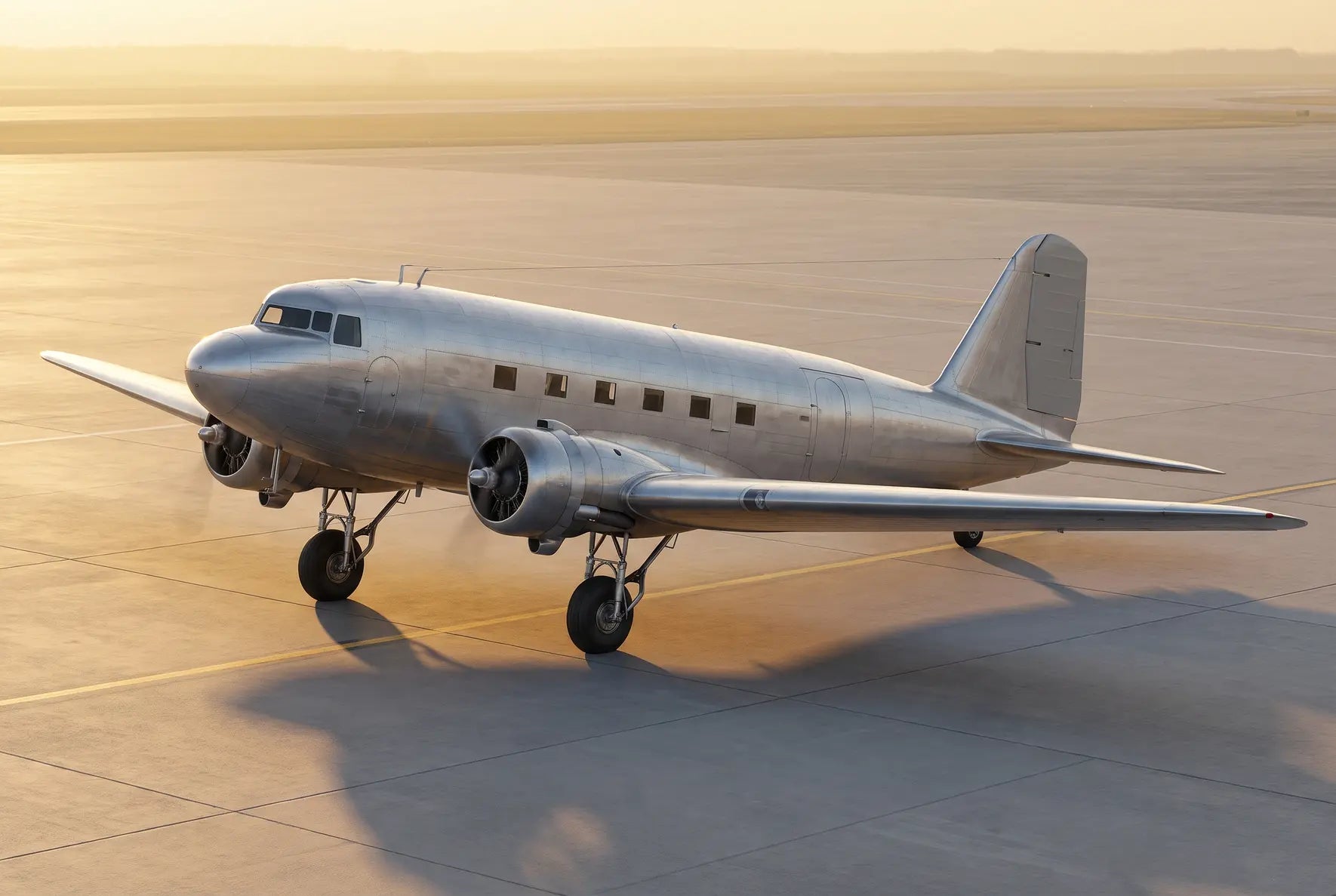
History and Development of the Douglas DC-2: From TWA Spec to Airline Icon
The Douglas DC-2 emerged from one of aviation's most consequential moments. In March 1931, a wooden-winged Fokker F-10 crashed, killing celebrated football coach Knute Rockne. The disaster shattered public confidence in wood-structure airliners and pushed U.S. carriers toward modern, all-metal designs. Meanwhile, Boeing's sleek 247 was largely reserved for United Air Lines, leaving rival Transcontinental & Western Air (TWA) without a competitive aircraft.
In 1932, TWA president Jack Frye issued a now-famous specification for an all-metal, multi-engine airliner. The Douglas Aircraft Company, based in Santa Monica, California, responded with the prototype DC-1, a low-wing, stressed-skin monoplane with retractable gear and two Wright radial engines. The DC-1 first flew on 1 July 1933. Only one DC-1 was built, because even before delivery TWA ordered an improved, enlarged production version: the Douglas DC-2.
The DC-2 prototype first flew on 11 May 1934, with the type entering service with TWA on 18 May 1934. It quickly proved faster, more comfortable and more reliable than its rivals, and it became the first Douglas aircraft to win the Collier Trophy. Production ran from 1934 to 1939, with approximately 192 airframes built (roughly 130 civil and 62 for military use). Operators included TWA, KLM and Pan American Airways, spreading the design across the world. This new generation of dependable metal airliners also shaped the professional culture and operational standards later carried forward by European carriers such as ASL Airlines Ireland.
A defining moment came in October 1934, when KLM entered a DC-2 named the Uiver in the MacRobertson Air Race from Mildenhall, England, to Melbourne, Australia. Flying as a standard airliner, complete with passengers, mail and every scheduled stop, the Uiver finished second overall, beaten only by a dedicated racing aircraft. The result proved that a commercial transport could rival purpose-built racers in speed and reliability.
What Sets the DC-2 Apart
The DC-2 was a direct evolution of the DC-1, not merely a rebadge. Its fuselage was lengthened by roughly 0.61 m (about 2 ft), adding one seating row and raising capacity from 12 to 14 passengers. It also received more powerful Wright Cyclone engines, improving payload and cruise performance. Compared with the later DC-3 and Douglas Sleeper Transport (DST), the DC-2 was noticeably smaller: the DC-3 grew a wider wing, a broader fuselage and greater capacity, ultimately overshadowing the DC-2 it was derived from.
The following variant identifiers summarise the features that distinguish a standard airline-configuration DC-2:
- Engines: two Wright Cyclone radials, typically SGR-1820-F52 rated near 875 hp each; some aircraft, including KLM's Uiver, used RG-1820-FB2 units at about 710 hp.
- Capacity: 14 passengers with a crew of 2 to 3.
- Dimensions: wingspan 85 ft (25.9 m); length about 62 ft (18.9 m); height roughly 16 ft (4.9 m).
- Weights: empty around 12,408 lb (about 5,630 kg); maximum gross near 18,600 lb (about 8,420 kg).
- Performance: cruise roughly 190 to 205 mph (310 to 333 km/h); range around 1,000 miles (1,600 km); service ceiling near 22,500 ft (6,858 m).
- Structure: all-metal, stressed-skin low-wing monoplane with retractable main landing gear.
By combining metal construction, refined aerodynamics and airline economics, the DC-2 established the technical template that the DC-3 would perfect, cementing Douglas as a leader in commercial aviation for decades.

A black and white image of a Douglas DC-2 aircraft on display at an airfield with a group of people observing. The plane bears the KLM airline logo and is positioned next to a hangar.
Douglas DC-2 Technical Specifications, Systems and Engines
The Douglas DC-2 was designed in 1934 as a short-to-medium-range airliner aimed at carrying passengers faster, farther and more comfortably than the biplanes and early monoplanes it replaced. As a stretched, more powerful development of the one-off DC-1, it prioritised a balanced payload-range envelope over outright endurance, seating 14 passengers in an all-metal, stressed-skin airframe. The key design trade-offs revolved around matching engine power to a relatively clean cantilever wing, giving useful cruise performance from modest fields while keeping structural weight in check. Its all-duralumin, semi-monocoque construction and retractable main gear became defining features that were carried forward and refined in the far more numerous DC-3.
For pilots and engineers, the DC-2 is best understood as a transitional airframe: it introduced airline-grade reliability and controllability at a time when radial-engine ratings and propeller technology were advancing quickly, which is why published figures vary between sub-variants.
- Wingspan: 85 ft 0 in (25.91 m), per The Museum of Flight.
- Length: approximately 61 ft 11.75 in (18.89 m).
- Height: 16 ft 3.75 in (4.97 m).
- Wing area: 939 ft² (87.2 m²).
- Empty weight (OEW): 12,408 lb (5,628 kg).
- Maximum takeoff weight (gross): about 18,560 lb (8,419 kg).
- Crew: 2 to 3; passengers: 14 in standard airline configuration.
- Cruise speed: about 190 mph (310 km/h) at 8,000 ft.
- Maximum speed: about 210 mph (340 km/h) at 8,000 ft.
- Range: approximately 1,000 mi (1,600 km).
- Service ceiling: around 22,450 ft (6,840 m).
- Rate of climb: about 1,000 ft/min (5.1 m/s).
- Wing airfoils: NACA 2215 at root, NACA 2209 at tip.
Systems, structure and handling
The DC-2 used a cantilever low wing and tail unit with a stressed-skin duralumin structure, an approach that distributed loads through the skin rather than an internal frame and set a template for later airliners. Flight controls were conventional and cable-actuated, with manual reversion by design, so handling depended heavily on trim management and coordinated use of the rudder during engine-out situations. A significant technological step was the use of Hamilton Standard variable-pitch propellers, which let crews optimise blade angle for takeoff, climb and cruise, improving field performance and efficiency. The retractable main landing gear reduced drag in cruise, while the fixed-configuration tailwheel layout kept ground handling familiar for pilots of the era. Broader context on the aircraft and its operational legacy is available through the Douglas DC-2 reference overview. For readers interested in how modern carriers structure their operations today, our review of Iberia Express offers a useful contemporary comparison.
Published performance numbers should be read with caution. Figures vary because operators selected different engine ratings, cabin densities and weights, and because quoted speeds and ranges depend on altitude, atmospheric assumptions, fuel load and runway condition. A cruise value cited at 8,000 ft, for example, will differ from a sea-level or high-altitude number, and range depends directly on payload and whether optional auxiliary tanks were fitted.
Engines and powerplant options
The DC-2 was powered mainly by Wright Cyclone GR/SGR-1820-F series nine-cylinder, air-cooled radial engines built by Wright Aeronautical, later part of Curtiss-Wright. Standard installations included the Wright GR-1820-F52, typically rated around 775 hp, while earlier or export variants used the Cyclone SGR-1820-F3 at roughly 710 hp; some museum examples are documented with higher ratings up to about 975 hp, reflecting takeoff versus continuous ratings. The Wright Cyclone 1820 family, displacing 1,820 cubic inches, went on to power a wide range of aircraft, including the Boeing 247 and later variants of the Boeing B-17 Flying Fortress, making it one of the most influential American radials of its era. Detailed engine and airframe data can be reviewed through technical specification compilations. Certain DC-2s were instead fitted with Pratt & Whitney Hornet radials of the R-1690 family, nine-cylinder engines producing broadly comparable power, positioned between the smaller Wasp and larger Twin Wasp in Pratt & Whitney's line-up and used across several 1930s transports and military types.
Douglas DC-2 vs DC-3 vs Dornier Do 17 vs Do 215 Specifications Comparison
Scroll horizontally to see more →
| Parameter | Douglas DC-2 | Douglas DC-3 | Dornier Do 17 | Dornier Do 215 |
|---|---|---|---|---|
| Entry into service | 1934 | 1936 | 1937 | 1939 |
| Engines | 2 × Wright GR-1820-F52 Cyclone radial piston engines | 2 × Pratt & Whitney R-1830 Twin Wasp radial piston engines | 2 × Bramo 323 Fafnir radial piston engines | 2 × Daimler-Benz DB 601A liquid-cooled V12 piston engines |
| Length | 18.89 m | 19.66 m | 15.80 m | 16.00 m |
| Wingspan | 25.91 m | 29.10 m | 18.00 m | 19.95 m |
| Height | 4.97 m | 5.16 m | 4.60 m | 4.60 m |
| Typical seating and layout (short description + approximate passengers) | Single-class: 14 passengers | Single-class: 21–32 passengers | Bomber/transport: up to 6 crew + small passenger or cargo load | Reconnaissance/transport: up to 4 crew + limited passenger or cargo capacity |
| MTOW | 8.29 t | 11.43 t | 10.50 t | 10.50 t |
| Range | 870 nm | 1,500 nm | 700 nm | 800 nm |
| Cruise speed | 0.25 Mach | 0.25 Mach | 0.26 Mach | 0.28 Mach |
| Service ceiling | 22,450 ft | 23,200 ft | 26,250 ft | 26,250 ft |
| Program note | Early all-metal twin-engined airliner that helped establish Douglas in the commercial transport market and paved the way for the DC-3. | Successor to the DC-2 with increased capacity and performance, becoming the benchmark piston airliner of the late 1930s and 1940s. | Contemporary German twin-engined bomber and transport aircraft of similar size and era, demonstrating parallel military-use development of twin-engine designs. | Refined derivative of the Do 17 with more powerful inline engines and improved performance, showing the evolution of twin-engine aircraft roles around the DC-2 generation. |
Scroll horizontally to see more →
The table compares key specs of the Douglas DC-2 and DC-3 with the Dornier Do 17 and Do 215, highlighting how similar-era twin‑engine designs diverged by role. The DC-3 is larger and heavier than the DC-2 and offers much greater range (1,500 nm vs 870 nm) with higher passenger capacity. The Do 17/215 are shorter with smaller wingspans, prioritize military crew/cargo, and reach higher ceilings (26,250 ft) and slightly higher cruise Mach, with the Do 215 using more powerful inline engines.
Douglas DC-2 Operations, Routes and Airlines Around the World
The Douglas DC-2 entered service in 1934 as a modern all-metal airliner built for medium-haul trunk routes. With a practical range of about 1,000 statute miles (roughly 1,610 km) and a cruise speed near 190–205 mph (305–330 km/h), it was scheduled on segments of a few hundred miles each, typically flying several legs per day. Longer city pairs such as New York–Los Angeles (about 2,450 miles / 3,940 km) were flown as multi-stop journeys, since a single nonstop exceeded its fuel reserves.
Operational environment and challenges
Major carriers used the type on structured trunk networks that blended point-to-point services between major cities with multi-stop "through" routes forming an early hub-and-spoke pattern, anchored by hubs such as New York, Chicago and Amsterdam. Its robust design and modest size allowed operations from both major city airports and less-developed regional fields. Operators nonetheless faced real challenges: limited 1930s navigation aids, night and weather flying, mountainous terrain and high-altitude airports in South America and Asia, and range constraints that required frequent intermediate stops on long routes. Despite this, the aircraft earned a reputation as safe, comfortable and reliable, and the demand for skilled crews to fly these expanding networks foreshadowed the modern pilot recruitment challenges that airlines still discuss today.
Where the Douglas DC-2 operates
The type served four broad regions. In Europe, flag carriers flew it on trunk routes and long multi-leg intercontinental services toward the Middle East and the Dutch East Indies. Across North & South America, it anchored United States transcontinental and East Coast networks while affiliated carriers extended it into the Andes and Brazil. In Asia, it linked Chinese cities under a Pan American joint venture, and in Australia domestic operators connected major cities. Documented named airline use in Africa is limited, with the continent served mainly through European and Pan American network extensions.
- Europe: KLM was the largest operator outside the United States, ordering around 18–19 aircraft for European trunk routes and services toward the Dutch East Indies; its DC-2 PH-AJU “Uiver” famously placed second overall and won the handicap division of the 1934 MacRobertson Air Race from Mildenhall to Melbourne. LOT Polish Airlines operated three DC-2B aircraft from 1935 to 1939, and Swissair flew the type on central-European routes.
- North & South America: TWA was the launch operator with 30 aircraft on transcontinental trunk routes; American Airlines flew New York–Los Angeles services; Eastern Air Lines received 14 aircraft for East Coast routes. Pan American Airways took 16 aircraft, using some on Central American services, while Panagra, Avianca (SCADTA), Panair do Brasil, Cruzeiro do Sul and PLUNA operated it across South America.
- Asia: China National Aviation Corporation (CNAC), jointly operated with Pan American, flew the type on demanding routes within China and to nearby regions such as Shanghai, Hong Kong and Guangzhou.
- Australia: Holyman's Airways and Australian National Airways used the aircraft on domestic and Tasmanian routes linking regional centres with cities such as Melbourne, Sydney and Adelaide.
Typical seating and cabin layouts
The DC-2 was originally designed to seat 14 passengers, arranged two-abreast on either side of a central aisle within its narrow fuselage of roughly 2.0 m diameter. Network flag carriers such as TWA and KLM favoured this comfortable standard layout, while some higher-density regional operators fitted additional capacity, giving a documented range of about 14 to 17 seats. Crews typically numbered two to three, and the cabin was marketed as comfortable rather than dense, reflecting its role as a premium trunk-route airliner rather than a mass-transport type.
In this video, discover the Douglas DC-2, the commercial airliner that helped revolutionize aviation. Learn how the DC-1 prototype was designed to meet a key requirement and paved the way for the DC-3.
Douglas DC-2 Safety Record and How Safe Is the Aircraft?
The Douglas DC-2 entered airline service in 1934 and remained a front-line type only until about 1937, when the larger DC-3 superseded it. With roughly 130 civil airframes plus about 62 military examples (the C-33 and C-39 transports), the fleet was small compared with later mass-produced airliners, so absolute accident totals are correspondingly low. Judged against the technology of the mid-1930s, the DC-2 helped prove that scheduled passenger flying could be comfortable and reliable, and most of its losses stemmed from operational limitations of the era, such as sparse navigation aids and night-flying facilities, rather than from structural weakness. Accident narratives for the type are catalogued by the Aviation Safety Network and the Bureau of Aircraft Accidents Archives.
Notable accidents and what changed afterwards
- TWA Flight 6 (1935, USA): A DC-2 flew low in poor visibility while attempting to reach a landing field with limited fuel and struck terrain near Atlanta, Missouri, killing five of thirteen aboard, including a serving U.S. Senator. The high profile of the case drew regulatory attention to airline operational control and helped accelerate improvements in weather reporting, route structuring and oversight of scheduled operations.
- KLM "Uiver" (1934, Iraq): The famous MacRobertson Air Race DC-2 was lost near Rutbah Wells, killing all seven aboard. The loss underscored the risks of early long-range operations over regions with few ground aids and reinforced the case for better en-route radio facilities and crew training for long-distance flights.
- USAAF C-39 (1942, Puerto Rico): A DC-2-derived transport struck high ground in low visibility near Coamo, killing all 22 aboard, the worst accident in the type's history. Controlled flight into terrain of this kind fed into evolving military procedures for instrument flying, terrain clearance and weather minimums.
- Mexicana DC-2 (1945, Mexico): The aircraft struck the Iztaccihuatl volcano in bad weather, killing all fifteen aboard. As with similar terrain accidents, the long-term industry response was the expansion of radio navigation aids and route planning that avoided high terrain.
Across these events, the recurring themes are controlled flight into terrain in poor weather, limited navigation and night-landing facilities, human factors and occasional engine failures typical of piston transports. Design-driven structural failures are rare in the DC-2 record.
How safe is the Douglas DC-2?
For an airliner of its generation, the DC-2 was a genuine step forward in safety and reliability. Its all-metal, stressed-skin monoplane construction, retractable landing gear and twin radial engines gave it stronger structure, redundancy and better performance margins than the fabric-covered tri-motors it replaced. Its accident rate, set against the modest traffic it carried, is broadly in line with other 1930s transports operating in the same demanding conditions, and the type is remembered less for unsafe design than for validating the principles later refined in the DC-3. Comparing this early era with the mature standards of modern types, such as those found in later designs like the Boeing 757-200, illustrates how far standardised procedures and regulatory oversight have advanced. Contemporary safety data compiled by ICAO confirm the trend that, thanks to design maturity, robust SOPs and rigorous oversight, aviation remains one of the safest modes of transport.
01 What was the Douglas DC-2 designed for?
The Douglas DC-2 was a twin-engine commercial airliner introduced in 1934 to carry passengers on short- to medium-range routes more efficiently than earlier transports. It was built by the Douglas Aircraft Company and was intended to compete with aircraft such as the Boeing 247.[1][3][4]
02 How many passengers could the Douglas DC-2 carry?
The Douglas DC-2 typically carried 14 passengers in a one-class layout, with a crew of two or three depending on the operation.[1][3][7] Some later listings show seat counts up to 17, but the classic passenger configuration most often cited is 14 seats.[1][2]
03 What range and speed did the Douglas DC-2 have?
The Douglas DC-2 had a typical range of about 1,600 km and a cruise speed in the low-300 km/h range, with a maximum speed around 340 km/h.[1][2][3][7] That made it well suited to regional and trunk routes of the 1930s rather than long-haul flying.[1][3]
04 What was the cabin experience like on a Douglas DC-2?
The Douglas DC-2 offered a much more modern passenger experience than many earlier airliners, with an enclosed cabin and a layout designed for relatively comfortable scheduled service.[3] Compared with today’s airliners, the cabin was narrow, noisy, and basic, but it was considered a major step forward for comfort and reliability in its era.[3][7]
05 What airlines and routes used the Douglas DC-2?
The Douglas DC-2 was operated by several early airline customers around the world, including KLM, which famously entered one in the 1934 London-to-Melbourne Air Race.[9] It was mainly used on scheduled passenger routes where its range and payload fit the day’s domestic and international trunk sectors.[1][3][9]
06 How safe and important was the Douglas DC-2?
The Douglas DC-2 is widely regarded as an important step in airline safety and practicality because it helped prove that passenger flying could be comfortable, reliable, and commercially successful.[3][8] Its all-metal low-wing design, retractable landing gear, and twin-engine layout were advanced for the time, and it became the direct predecessor to the much more successful DC-3.[3][6][8]