

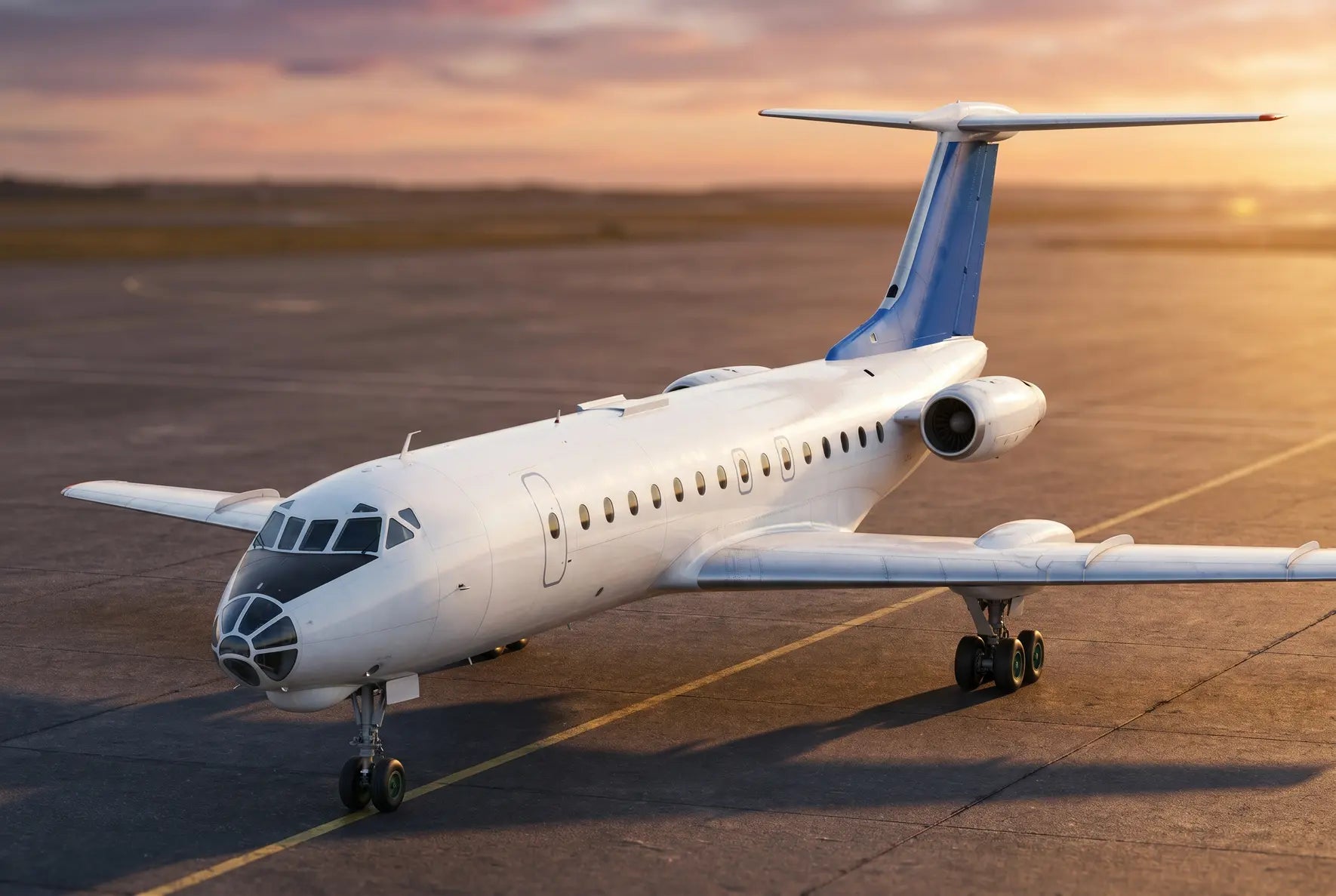
Tupolev Tu-134: History, Development and Evolution of the Soviet Short-Haul Jet
The Tupolev Tu-134 is a twin-engine, narrow-body jet airliner developed by the Tupolev Design Bureau (OKB A. N. Tupolev) in the Soviet Union during the early 1960s. Designed for short- and medium-haul routes, the aircraft was conceived to replace aging piston-engine transports such as the Ilyushin Il-14 and to improve upon the earlier Tupolev Tu-124, from which it directly descended. Its rear-mounted engine layout and T-tail configuration drew clear inspiration from contemporary Western designs like the Sud Aviation Caravelle and the BAC One-Eleven. The type received the NATO reporting name Crusty.
Development work on what was initially designated Tu-124A began around 1960. The new design departed significantly from the Tu-124 by relocating the two Soloviev D-30 turbofan engines from under the wings to the rear fuselage, adopting a T-tail, and introducing a reinforced landing gear suitable for less-prepared Soviet airfields. These changes were substantial enough that, on 20 November 1963, the aircraft was officially redesignated Tu-134. The prototype, registered SSSR-45075, completed its maiden flight on 29 July 1963. Soviet type certification followed in 1965, and serial production commenced in 1966 at the Kharkov Aviation Production Association (KhAPO) in Kharkiv, Ukrainian SSR.
The Tu-134 entered scheduled passenger service with Aeroflot in September 1967, initially operating the Moscow to Adler (Sochi) domestic route. Its first international scheduled flight took place on 12 September 1967, connecting Moscow and Stockholm. Notably, the Tu-134 became the first Soviet airliner to receive international certification from ICAO, enabling it to operate into Western European airports. By 1968, the type had been exported to Eastern Bloc carriers including Interflug (East Germany), LOT Polish Airlines, and Malev Hungarian Airlines. In 1969, the aircraft was displayed at the Paris Air Show. Many airlines worldwide, from Air Europa-era European carriers to state-operated airlines across Asia and Latin America, operated in regulatory environments shaped during this period of jet expansion.
The stretched Tu-134A performed its first flight on 22 April 1969 and entered Aeroflot service on 9 November 1970. It featured a fuselage approximately 2.1 metres longer than the original, increasing capacity from around 56 to roughly 76 passengers, along with uprated Soloviev D-30 Series II engines and improved systems. Later production introduced a solid radar nose in place of the original glazed navigator's station. The Tu-134A-3, developed in the mid-1970s, adopted the more reliable D-30 Series III powerplants with higher thrust and longer overhaul intervals.
Around 1980, the Tu-134B entered development as the highest-capacity civil variant, accommodating up to approximately 96 passengers in high-density layouts. Its most significant change was the elimination of the dedicated navigator position: the glazed nose was replaced entirely by a solid radar radome, and the flight deck was reconfigured for a two-pilot-plus-flight-engineer crew. The Tu-134B-3, appearing in the late 1970s, combined the B-series cabin with Series III engines and modernised avionics. Production of all Tu-134 variants continued at KhAPO until 1989, by which time a total of 854 aircraft had been built across all versions.
By 2002, stricter EU noise regulations effectively banned the Tu-134 from most European airports. Aeroflot retired its last Tu-134 on 1 January 2008. Following the fatal crash of RusAir Flight 9605 near Petrozavodsk on 20 June 2011, the Russian government ordered accelerated withdrawal of the type from commercial service. The last commercial Tu-134 passenger flight in Russia was operated by Alrosa on 22 May 2019, flying from Mirny to Novosibirsk. As of recent reporting, Air Koryo of North Korea remains the last known commercial operator of the type.
What Distinguishes the Tu-134 Variants
The Tu-134 family evolved through several distinct sub-variants, each addressing capacity, operational efficiency, or crew requirements. The original Tu-134 featured a shorter fuselage (approximately 34.5 m), a glazed navigator's nose with a separate chin-mounted radar, and a typical capacity of around 56 to 72 passengers. The Tu-134A introduced the fuselage stretch to roughly 37.1 m, higher maximum take-off weight (approximately 47,000 to 47,500 kg versus 45,000 kg on the original), and uprated D-30 Series II engines. The Tu-134B and B-3 removed the navigator's station entirely, adopted a solid nose radome, and pushed seating capacity to as many as 96 in dense configurations. Military derivatives such as the Tu-134UBL (bomber crew trainer with a reprofiled nose simulating the Tu-22M) and the Tu-134Sh (navigator trainer) repurposed the airframe for Soviet Air Force training roles from the late 1970s onward, as documented by Airways Magazine.
Key variant identifiers across the Tu-134 family include:
- Engines: Soloviev D-30 (original), D-30 Series II (Tu-134A/B), D-30 Series III (Tu-134A-3/B-3)
- Fuselage length: approximately 34.5 m (original) versus approximately 37.1 m (A, A-3, B, B-3)
- Maximum take-off weight: approximately 45,000 kg (original) to approximately 49,000 kg (B-3)
- Nose configuration: glazed navigator nose with chin radar (original and early A) versus solid radar radome (later A, all B variants)
- Crew: pilot, co-pilot, flight engineer, and navigator (original/A) versus pilot, co-pilot, and flight engineer only (B/B-3)
- Typical seating: 56-72 (original), 72-80 (A), 76-84 (A-3), 80-84 (B), 84-96 (B-3)

The image shows a Tupolev Tu-134 aircraft in flight against a cloudy sky. The plane, marked with a distinctive logo and registration number, suggests it is operated by a specific airline.
Tupolev Tu-134 Technical Specifications, Systems and Engine Overview
The Tupolev Tu-134 was designed as a short- to medium-range, twin-engine narrow-body jet airliner for Soviet and Eastern Bloc domestic routes. Developed by the Tupolev design bureau in the early 1960s as a deep modernisation of the Tu-124, the aircraft adopted a rear-fuselage engine layout with a T-tail, delivering a cleaner wing and reduced cabin noise around the wing section. The design traded centre-of-gravity sensitivity and aft-cabin vibration for aerodynamic efficiency and simpler wing construction. Over roughly 850 airframes produced between 1966 and 1984, the family evolved through the base Tu-134, the stretched and re-engined Tu-134A, and the crew-optimised Tu-134B, each improving payload, avionics and field performance.
The Tu-134 was built for routes of up to approximately 3,000 km with a full passenger load in the 72 to 84 seat range, depending on cabin configuration. Its two aft-mounted Soloviev D-30 turbofans gave it adequate thrust for operations from a variety of airfields across the Soviet Union, including some with limited infrastructure. The airframe proved rugged and was widely used by airlines such as Aeroflot, LOT Polish Airlines, Malev and Turkish Airlines, among others.
- Length: 37.05 to 37.1 m (depending on variant and measurement convention)
- Wingspan: 29.00 to 29.01 m (no winglets or wingtip devices)
- Height: 9.02 to 9.14 m
- Wing area: approximately 127.3 m²
- Maximum take-off weight (MTOW): 47,000 kg for the Tu-134A (per SKYbrary); early Tu-134 variants approximately 44,500 kg
- Operating empty weight (OEW): approximately 27,960 to 29,050 kg depending on variant
- Typical passenger capacity: 72 to 84 in standard layouts; up to 96 in high-density Tu-134B3 configuration
- Engines: 2 x Soloviev D-30-II low-bypass turbofans, each rated at approximately 66.7 kN (14,990 lbf)
- Fuel capacity: approximately 13,200 litres (Tu-134A)
- Cruise speed: 850 to 885 km/h (459 to 478 kt), depending on altitude and weight
- Maximum speed: 950 km/h (513 kt)
- Range: 1,900 to 3,000 km (1,025 to 1,620 nm), depending on payload and fuel load
- Service ceiling: approximately 12,100 m (39,700 ft)
- Take-off distance: approximately 2,180 m at MTOW (as published by SKYbrary)
- Avionics baseline: electromechanical instruments, ABSU-134 automatic flight control system; later aircraft fitted with satellite navigation and TCAS
- Noise compliance: met ICAO Chapter 2 standards at time of certification; restricted from many Western European airports after stricter Chapter 3 rules took effect in 2002
Systems Architecture and Handling Technology
The Tu-134 uses conventional, mechanically actuated flight controls in a T-tail configuration. The ABSU-134 autopilot provided basic automation for en-route and approach phases. On upgraded aircraft, the avionics suite supported ICAO Category II approach capability, though pilot workload remained higher than on later-generation Western types. Early Tu-134 models featured a distinctive glazed navigator nose, which was replaced by a conventional radome housing weather radar (Groza radar station) on the Tu-134A and subsequent variants.
Braking was enhanced on the Tu-134A and Tu-134B with the addition of engine thrust reversers, replacing the earlier braking parachute used on the base Tu-134. Later aircraft received anti-skid braking systems, improving performance on wet or contaminated runways. The rear-engine, T-tail arrangement provides a clean wing but introduces pitch sensitivity at low speed and high angle of attack, requiring attentive energy management during approach. Centre-of-gravity control is also more critical due to the concentration of engine mass at the tail.
Published performance figures for the Tu-134 can vary significantly between sources. Differences arise from the specific sub-variant (Tu-134, Tu-134A, Tu-134B), operator-selected cabin density, actual take-off weight, atmospheric conditions (temperature, pressure altitude, humidity), and runway surface state. Range figures, for example, depend on whether they assume maximum fuel with reduced payload or full passenger load with standard reserves. Take-off distances shift with altitude and temperature. Any comparison across sources should account for these variables, and absolute claims about performance should be treated with caution.
Soloviev D-30: The Engine Behind the Tu-134
The Soloviev D-30 is a two-spool, low-bypass turbofan engine developed in the mid-1960s by the Soloviev design bureau, now known as Aviadvigatel. Officially classified in Soviet documentation as a "bypass turbojet," the D-30 was one of the first Soviet engines to incorporate cooled turbine blades, a significant step forward in Soviet engine technology at the time. The engine features a bypass ratio of roughly 1.0:1 and uses a cannular combustion chamber design.
For the Tu-134 family, the standard powerplant is the D-30 Series II (commonly written D-30-II), rated at approximately 66.7 kN (14,990 lbf) of thrust per engine. The D-30-II has a dry weight of about 1,546 kg. Early Tu-134 models used the original D-30, while the Tu-134A introduced the D-30-II with improved performance and, critically, thrust reversers that replaced the braking parachute system of the earlier variant.
The D-30 became the foundation for a prolific family of derivatives. The D-30KU variant powers the Ilyushin Il-62M long-range airliner. The D-30KU-154 was adapted for the Tupolev Tu-154M, the widely used Soviet medium-haul trijet. The D-30KP and D-30KP-2 variants power the Ilyushin Il-76 military and cargo transport, one of the most produced heavy airlifters in the world. This broad application across airliners and military transports made the D-30 family one of the most important Soviet engine programmes of its era, valued for its robustness and adaptability across a wide thrust range.
Tupolev Tu-134 vs Tu-134A vs Tu-134B vs Yakovlev Yak-40 Specifications Comparison
Scroll horizontally to see more →
| Parameter | Tupolev Tu-134 | Tupolev Tu-134A | Tupolev Tu-134B | Yakovlev Yak-40 |
|---|---|---|---|---|
| Entry into service | 1967 | 1970 | 1972 | 1968 |
| Engines | 2 × Soloviev D-30 turbofan | 2 × Soloviev D-30-II turbofan | 2 × Soloviev D-30-II turbofan | 3 × Ivchenko AI-25 turbofan |
| Length | 34.35 m | 37.10 m | 37.10 m | 20.36 m |
| Wingspan | 29.00 m | 29.00 m | 29.00 m | 25.00 m |
| Height | 9.02 m | 9.02 m | 9.02 m | 8.32 m |
| Typical seating and layout (short description + approximate passengers) | Single-class: 72–76 passengers | Single-class: 76–84 passengers | Single-class: 80–90 passengers | Single-class: 24–32 passengers |
| MTOW | 44.5 t | 47.0 t | 47.6 t | 16.0 t |
| Range | 1,350–1,350 nm | 1,620–1,620 nm | 1,620–1,620 nm | 810–1,080 nm |
| Cruise speed | 0.82 Mach | 0.82 Mach | 0.82 Mach | 0.70 Mach |
| Service ceiling | 39,400 ft | 39,400 ft | 39,400 ft | 26,250 ft |
| Program note | Baseline Soviet short- to medium-haul jet introduced in the late 1960s, replacing turboprop types on trunk and regional routes. | Improved Tu-134 variant with stretched fuselage, more powerful engines and higher weights, becoming the most widely used version. | Further-developed Tu-134 derivative optimized for higher-density single-class operations and charter use. | Smaller contemporary Soviet regional jet designed for short feeder routes and operations from short, austere airfields, complementing larger Tu-134s. |
Scroll horizontally to see more →
The table compares core specifications of the Tu-134 family and the smaller Yak-40. Tu-134A/B are longer than the baseline Tu-134 and carry more passengers (up to 90 vs 72–76), with higher MTOW and longer range (1,620 nm vs 1,350 nm). All Tu-134 variants cruise at Mach 0.82 and reach 39,400 ft, while the Yak-40 is slower (Mach 0.70), lower (26,250 ft), lighter, and short-range, reflecting its feeder-role design.
Tupolev Tu-134 Operations: Typical Routes, Missions and Airlines Worldwide
The Tupolev Tu-134 was designed as a short- to medium-haul jet airliner, filling a role comparable to early Western types such as the Sud Aviation Caravelle or the Douglas DC-9. Typical stage lengths ranged from 400 to 1,500 km (250 to 930 mi), with most commercial sectors lasting between 45 minutes and two hours. Longer missions of up to approximately 2,000 km were possible on the Tu-134A variant, though airlines generally kept sectors well within the published maximum range of around 1,900 to 3,100 km depending on the sub-type and payload. A cruise speed of roughly 850 to 880 km/h allowed efficient scheduling on dense short-haul networks.
In regular airline service, the Tupolev Tu-134 was typically utilised for approximately 6 to 9 block hours per day, completing 4 to 8 sectors. A representative daily pattern for an Aeroflot aircraft in the 1980s might have included two or three short morning rotations from a hub to regional cities, a midday medium-haul leg, and further short evening sectors returning the aircraft to its base or overnight station. This high-frequency operation made the type well suited to both hub-and-spoke feeding roles and point-to-point services between secondary cities.
Operationally, the Tupolev Tu-134 served primary international airports, regional hubs and, notably, less-developed airfields. Its robust landing gear and relatively modest runway requirements (approximately 2,400 to 2,500 m for take-off) allowed operations from austere or semi-prepared strips in remote areas of the Soviet Union and allied states, including parts of Siberia and Central Asia. This versatility also extended to military, VIP and government transport, navigator training, and research missions.
However, the type faced growing challenges from the 1990s onward. Its Soloviev D-30 engines did not meet ICAO Chapter 3 noise standards, which progressively restricted access to Western European airports. Fuel consumption was high compared with newer replacements such as the Yakovlev Yak-42 or Western regional jets, increasing direct operating costs. Safety concerns linked to ageing airframes and outdated avionics further accelerated retirement. The last scheduled passenger flight of the Tupolev Tu-134 in Russia was operated by Alrosa Airlines on 22 May 2019.
Where the Tupolev Tu-134 Operates and Has Operated
The Tupolev Tu-134 was predominantly a European and Asian aircraft, with the vast majority of the 854 airframes produced serving operators in the Soviet Union and Warsaw Pact nations. In Europe, it formed the backbone of domestic and regional networks for state carriers across the Eastern Bloc, linking national capitals and secondary cities on sectors typically under 1,500 km. In Asia, it connected cities across the Soviet Far East, Central Asian republics and a handful of external operators. Use in North and South America was virtually non-existent in scheduled airline service. In Africa, a small number of state or government operators flew the type, though large-scale commercial adoption never materialised.
- Europe: The largest operator by far was Aeroflot, which flew more than 600 Tupolev Tu-134s before retiring the type on 1 January 2008. Other major European operators included LOT Polish Airlines, Malev Hungarian Airlines, Interflug (East Germany), TAROM (Romania), CSA Czechoslovak Airlines, Balkan Bulgarian Airlines, JAT Yugoslav Airlines, and Aviogenex. These carriers used the aircraft primarily on intra-European routes of 400 to 1,200 km. Post-Soviet Russian operators such as UTair, Kuban Airlines and Alrosa Airlines continued to fly the type into the 2010s, while Sirius Aero operated VIP-configured examples on charter services.
- North and South America: The Tupolev Tu-134 had no significant presence in the Americas. No North or South American airline is known to have operated the type in regular scheduled passenger service.
- Asia: Beyond the extensive Soviet and post-Soviet network across Russia and Central Asia, the Tupolev Tu-134 was operated by CAAC (China) on domestic routes during the 1970s and 1980s, and by Syrianair on regional Middle Eastern services. Central Asian carriers such as Kazakh Airlines, Tajik Air, Turkmenistan Airlines and Kyrgyzstan Air Company inherited fleets after the dissolution of the Soviet Union. Air Koryo (North Korea) is documented as the last commercial airline still operating the Tupolev Tu-134 in passenger configuration.
- Africa: Commercial adoption in Africa was limited. A small number of state operators and government fleets used the type, often through short-term leases or as VIP transports, but no major African scheduled airline built a network around the Tupolev Tu-134.
Typical Seating Configurations on the Tupolev Tu-134
The Tupolev Tu-134 features a narrow-body fuselage with a cabin width of approximately 2.8 m (9.2 ft), arranged in a 2-2 single-aisle layout throughout. Seating capacity varied by variant and operator. The original Tu-134 typically seated 64 to 72 passengers, while the Tu-134A accommodated 72 to 84 in a standard all-economy configuration, with 76 seats widely cited as the baseline. The Tu-134B, optimised for higher-density short-haul routes, usually carried around 80 passengers. Seat pitch was in the region of 76 to 79 cm (30 to 31 in), comparable to Western short-haul jets of the same era. A useful reference for seat-map layouts is FlightSeatMap.
Most operators configured the cabin in a single economy class, but some airlines, particularly Aeroflot on international routes, installed a small forward salon of 8 to 12 seats at a wider pitch, functioning as a rudimentary business or first-class section. Government and VIP variants were extensively customised, seating as few as 15 to 40 passengers with separate compartments, conference tables and private offices. For a comparison with modern VIP-configured narrow-body jets, such as those derived from Western airframes, see the Airbus A319CJ overview. A detailed technical summary of the Tu-134 is available on SKYbrary.
In this video, discover the Tupolev Tu-134, a twin-engine single-aisle jet airliner developed by the Soviet Tupolev design bureau in the early 1960s, and why it was seen as a jet for everyone.
Tupolev Tu-134 Safety Record: Accident History and How Safe Is It?
The Tupolev Tu-134 entered scheduled passenger service in 1967 with Aeroflot and remained in widespread airline use for more than four decades. A total of approximately 854 airframes were produced across all variants between 1966 and 1989, serving operators in around 42 countries. Over that long operational lifespan, the Tu-134 accumulated a substantial accident record. According to the Aviation Safety Network database, the type has been involved in 76 hull-loss accidents resulting in 1,387 fatalities. That equates to roughly one hull loss for every 11 aircraft built, a ratio that is high by modern standards but must be evaluated in the context of the era, the operating environments and the regulatory frameworks under which most Tu-134 flights took place. Many of these losses occurred in the Soviet Union and its successor states during periods when crew resource management training, ground-proximity warning systems and modern air traffic control infrastructure were not yet standard.
Notable Accidents and Their Impact on Safety
Several Tu-134 accidents stand out for their scale and the lessons they prompted.
- Dniprodzerzhynsk mid-air collision (1979) - On 11 August 1979, two Aeroflot Tu-134s collided at cruising altitude near Dniprodzerzhynsk in the Ukrainian SSR, killing all 178 occupants on both aircraft. The Soviet investigation attributed the collision to air traffic control errors, poor coordination between radar sectors and the absence of any airborne collision avoidance system. The disaster exposed systemic weaknesses in Soviet ATC and contributed to subsequent improvements in radar surveillance, controller training and, eventually, the gradual adoption of TCAS across CIS airspace.
- Aeroflot Flight 5463, Almaty (1983) - On 30 August 1983, a Tu-134A flying from Karaganda struck terrain on approach to Almaty, killing all 90 people on board. The crew had descended below the minimum safe altitude in mountainous terrain without the required visual references. This controlled-flight-into-terrain (CFIT) event highlighted the critical need for ground-proximity warning equipment and stricter adherence to instrument approach minima, changes that were gradually adopted in the following years.
- RusAir Flight 9605, Petrozavodsk (2011) - On 20 June 2011, a Tu-134A-3 operating for RusLine crashed approximately one kilometre short of the runway at Petrozavodsk during a night non-precision approach in poor weather, killing 47 of 52 occupants. The investigation by the Interstate Aviation Committee (MAK) found that the crew continued descending below published minima without visual contact with the runway, and that the captain had an illegal blood-alcohol level. Serious deficiencies in operator oversight, CRM and approach procedure compliance were also identified. This accident accelerated the Russian government's decision to withdraw Tu-134s from regular passenger service by 2012, tightened pre-flight alcohol testing requirements for crew, and reinforced the push to replace ageing Soviet-era fleets with aircraft equipped with modern avionics, EGPWS and flight management systems.
How Safe Is the Tupolev Tu-134 Today?
Assessed purely by numbers, the Tu-134's hull-loss ratio of roughly 0.089 per airframe produced places it in the mid-range of Soviet-era jet transports. The Tu-154, for example, recorded a somewhat lower ratio of approximately 0.065 hull losses per airframe built. However, a substantial share of Tu-134 accidents was driven by operational and systemic factors rather than inherent design flaws: inadequate crew training, poor CRM culture, ageing navigation infrastructure and limited regulatory oversight at certain operators. The aircraft itself offered a robust airframe designed for austere airfields, redundant hydraulic and electrical systems and reliable Soloviev D-30 engines. On the other hand, most Tu-134s lacked modern safety technology such as EGPWS, TCAS and digital flight management systems throughout the majority of their careers. As described by SKYbrary, the type was a short-range airliner whose operational safety profile was closely tied to the standards and infrastructure of its operators.
As of the mid-2020s, the Tu-134 has been almost entirely retired from commercial passenger service. Russia's last scheduled passenger Tu-134 flight took place on 22 May 2019, and only a handful remain in limited military or government transport roles. For travellers flying on modern aircraft types such as the Boeing 787-9, the safety landscape is fundamentally different: contemporary airliners benefit from advanced fly-by-wire protections, real-time terrain and traffic awareness, mandatory Safety Management Systems and decades of industry-wide lessons learned. Despite the Tu-134's chequered record, it is important to note that ICAO global safety data consistently confirms that commercial aviation remains one of the safest modes of transport, with accident rates continuing to fall as technology, training and regulatory oversight improve worldwide.
01 What kinds of routes and missions was the Tupolev Tu-134 typically used for?
The Tupolev Tu-134 was primarily designed for short- to medium-haul routes, usually up to about 2,000–2,500 km in practical airline use. It connected major Soviet and Eastern Bloc cities, as well as regional destinations with relatively basic infrastructure. The aircraft also served as a government and VIP transport and, in later years, as a navigator and crew-training platform for military forces. Its performance from shorter, sometimes less-developed runways made it suitable for a wide range of domestic and regional missions.
02 How comfortable is the Tupolev Tu-134 cabin for passengers?
The Tupolev Tu-134 has a narrow fuselage with a typical single-aisle 2+2 seating layout, giving it a relatively spacious feel compared with some 3+3 narrow-bodies. However, the rear-mounted engines and older design mean the cabin is louder, especially toward the back, than modern airliners. Overhead bins are smaller and seat pitch varies by operator, often feeling more compact than on contemporary jets. Passengers usually find the quietest and most comfortable experience in the forward rows, ahead of the wing.
03 Which airlines operated the Tupolev Tu-134 and where could you fly on it?
The largest operator of the Tupolev Tu-134 was Aeroflot, which used it extensively across the Soviet domestic network and to nearby international destinations in Europe, the Middle East, and Asia. After the breakup of the USSR, many successor airlines such as UTair, Belavia, LOT Polish Airlines (earlier in its career), and various regional carriers used it on short domestic and cross-border routes. In later years, Tu-134s became increasingly rare in commercial service and were gradually retired in favor of more modern types. Today, most surviving aircraft are used by government or military operators, often for training or transport rather than scheduled passenger flights.
04 How does Tupolev Tu-134 performance compare with similar Western aircraft?
The Tupolev Tu-134 is broadly comparable in size and role to aircraft like the early BAC One-Eleven and smaller variants of the Douglas DC-9. Its Soloviev D-30 low-bypass turbofan engines provide good thrust but are relatively fuel- and noise-inefficient by modern standards. Takeoff and landing performance is robust, allowing operations from shorter or less-prepared runways, which suited many Soviet-era airports. However, in fuel burn, emissions, and maintenance economics, the Tu-134 is clearly outperformed by later regional jets such as the Embraer E-Jet and Bombardier CRJ families.
05 What is the safety record of the Tupolev Tu-134 and what design features stand out?
The Tupolev Tu-134 has a long operational history that includes several notable accidents, many of which were linked to challenging weather, navigation errors, or air traffic control and infrastructure issues rather than a single recurring design flaw. The aircraft features a robust airframe, T-tail, rear-mounted engines, and a glass nose on early variants, which housed a navigator’s station for operations in low-navigation-aid environments. Later versions replaced the glass nose with radar, improving weather and navigation capabilities. Its safety record reflects both the era and operating environment in which it flew, making direct comparisons with modern jets difficult without context.
06 What should a traveller know if flying on a Tupolev Tu-134 today?
Flights on the Tupolev Tu-134 are now rare and usually limited to special charters, government operations, or museum and enthusiast events. Seat comfort and cabin noise will feel more like a classic jet experience: louder overall, with the rear cabin affected most by engine noise and vibration, so forward seats are generally more comfortable. Window alignment can vary slightly by row, but the large windows offer good views of the wing and engines set far back on the fuselage. Travellers should expect a more analog, heritage atmosphere compared with modern airliners, with fewer contemporary amenities and quieter zones.