

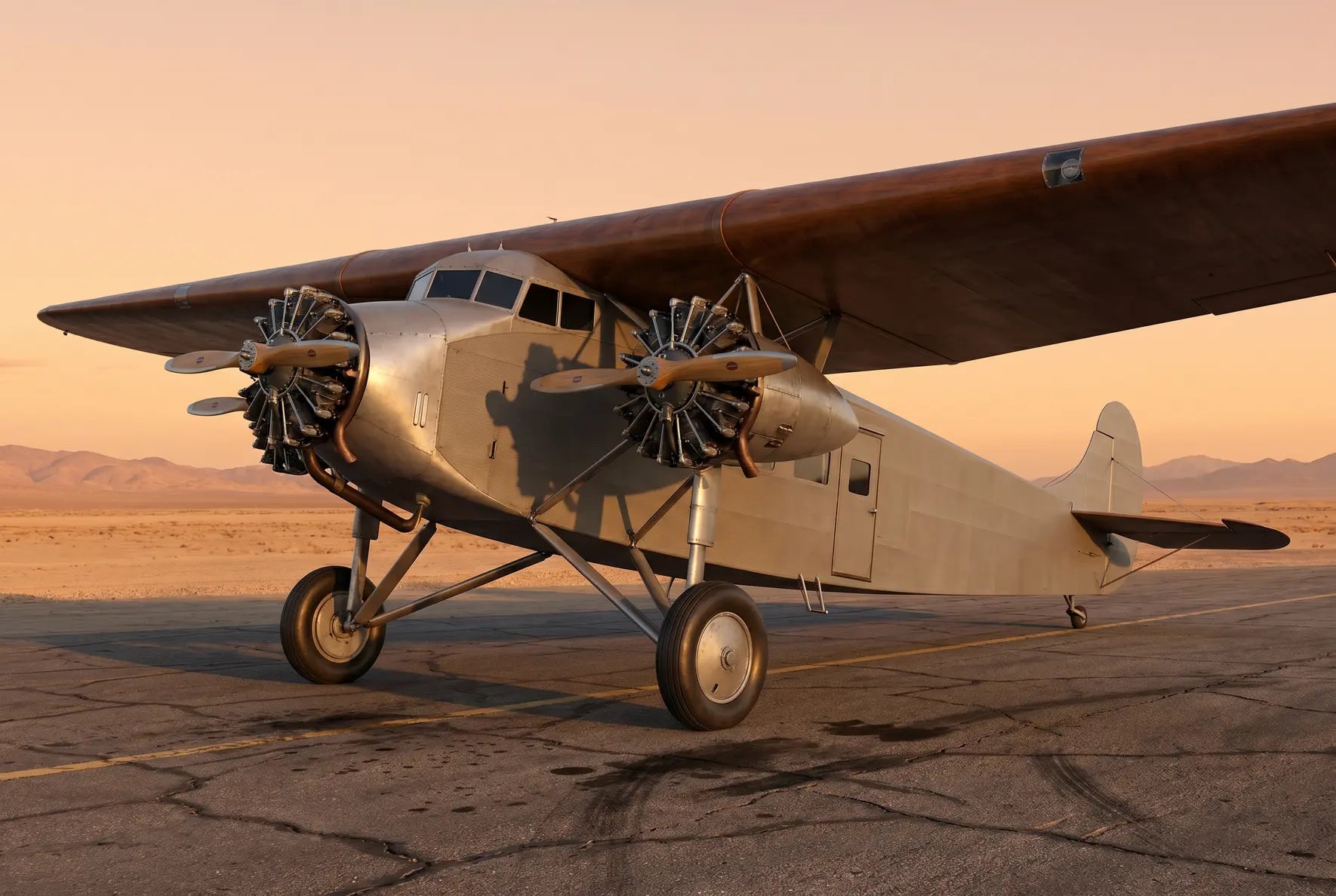
Fokker F.VII History and Development: From Single-Engine Pioneer to Iconic Trimotor
The Fokker F.VII emerged in the early 1920s as one of the world's first purpose-built commercial airliners. Designed by Walter Rethel for the Dutch aircraft manufacturer Fokker (formally Nederlandsche Vliegtuigenfabriek), the F.VII was conceived to meet growing demand from European airlines such as KLM for a reliable, enclosed-cabin monoplane capable of carrying passengers on scheduled routes. Anthony Fokker had re-established his company in the Netherlands in 1919 after relocating from Germany following World War I, and the F.VII became the firm's first major postwar civil success.
The original Fokker F.VII was a high-wing cantilever monoplane with a welded steel-tube fuselage covered in fabric and a thick wooden wing. It seated six passengers plus two crew. The first prototype flew on 11 April 1924, powered by a 360 hp Rolls-Royce Eagle V-12 engine. All five initial production aircraft were delivered to KLM, which used them on European and intercontinental routes. One of these aircraft, registered H-NACC, departed Amsterdam on 1 October 1924 for the landmark Amsterdam-to-Batavia (Dutch East Indies) flight, arriving on 24 November 1924 after a series of stops and delays caused by an engine failure in Bulgaria.
By 1925, Fokker introduced the refined F.VIIa, a slightly enlarged single-engine version with improved payload capacity (typically 8 to 10 passengers) and updated undercarriage. Anthony Fokker brought an F.VIIa fitted with a 400 hp Packard Liberty engine to the United States to compete in the Ford Reliability Tour. There, responding to demand for greater safety and performance over long routes, Fokker fitted the aircraft with three 200 hp Wright J-4 Whirlwind radial engines, creating the F.VIIa/3m. This first Fokker trimotor flew on 4 September 1925 and won the Ford Reliability Tour, demonstrating the advantages of engine redundancy for commercial operations.
The definitive variant, the F.VIIb/3m, followed shortly afterwards with a larger wingspan of 21.71 m (compared to approximately 19.3 m on the F.VIIa/3m), improved payload, and a wing area of 67.6 m². It became the most numerous and widely operated version. Typical airline configurations seated 8 passengers, though some operators fitted up to 10 or 12 seats. The F.VIIb/3m was powered by three Wright J-5 Whirlwind engines producing 220 hp each, though operators across Europe also used Bristol Jupiter and Gnome-Rhône Jupiter radials. In total, approximately 250 F.VII-family aircraft were produced in the Netherlands, at the Atlantic Aircraft Corporation factory in Teterboro, New Jersey (Fokker's U.S. subsidiary), and by licensees including Avia (Czechoslovakia), Manfred Weiss (Hungary), and Plage i Laśkiewicz (Poland).
The Fokker F.VII trimotor became synonymous with pioneering aviation. On 9 May 1926, Richard E. Byrd claimed to have overflown the North Pole in the F.VIIa/3m Josephine Ford. In June 1928, Charles Kingsford Smith completed the first trans-Pacific flight from Oakland to Brisbane in the F.VIIb/3m Southern Cross. That same month, Amelia Earhart became the first woman to cross the Atlantic by air as a passenger aboard the F.VIIb/3m Friendship. These achievements cemented the type's global reputation and helped popularize long-distance air travel. Much as the Boeing 787-8 would later redefine long-haul efficiency with composite materials, the Fokker F.VII pushed the boundaries of its era's technology on intercontinental routes.
Sub-Variants and Key Differences
The Fokker F.VII family evolved through four principal sub-variants, each building on the previous design. The original F.VII (1924) was a single-engine, six-seat airliner that served as a proof of concept. The F.VIIa (1925) enlarged the airframe for 8 to 10 passengers and offered several engine options, including the Packard Liberty and Bristol Jupiter. The F.VIIa/3m (1925) introduced the trimotor configuration on the F.VIIa's shorter-span wing, delivering engine-out capability that was crucial for overwater and remote-area operations. The F.VIIb/3m (1926 onwards) was the definitive production model, distinguished by its enlarged wing, higher maximum take-off weight of approximately 5,200 kg, and standardized three-engine nacelle arrangement. All variants shared the same fundamental construction: a welded steel-tube fuselage with fabric covering and a plywood-skinned wooden cantilever wing.
However, this wood-and-fabric construction contributed to the type's eventual decline. On 31 March 1931, a TWA Fokker trimotor crashed near Bazaar, Kansas, killing all on board, including celebrated football coach Knute Rockne. Investigations revealed structural deterioration in the wooden wing. The accident prompted U.S. regulators and airlines to accelerate the transition to all-metal airliners, effectively ending the Fokker trimotor's front-line airline career and paving the way for types such as the Boeing 247 and Douglas DC-3.
Key identifiers across the Fokker F.VII family include:
- Engine options: Rolls-Royce Eagle (360 hp), Bristol Jupiter, Packard Liberty (400 hp), Wright J-4 Whirlwind (200 hp), Wright J-5 Whirlwind (220 hp), Gnome-Rhône Jupiter
- Configuration: Single-engine (F.VII, F.VIIa) or trimotor (F.VIIa/3m, F.VIIb/3m)
- Wingspan: Approximately 19.3 m (F.VIIa/3m) to 21.71 m (F.VIIb/3m)
- Passenger capacity: 6 (original F.VII) to 8-12 (F.VIIb/3m, depending on layout)
- Construction: Welded steel-tube fuselage with fabric covering; plywood-skinned wooden cantilever wing
- Total production: Approximately 250 aircraft across all variants and licensees

This image features a Fokker passenger aircraft with a distinctive tri-motor design. The plane, marked with the registration SP-ABA, is parked on a grassy field, showcasing its sleek and aerodynamic structure.
Fokker F.VII Technical Specifications, Systems, and Engine Options
The Fokker F.VII was designed as a practical commercial transport, not a racing or military machine. Its core engineering trade-off prioritised robust simplicity, short-field capability, and structural efficiency over outright speed. As a cantilever high-wing monoplane, the F.VII eliminated external bracing struts, reducing drag and simplifying maintenance. Its mixed construction combined a welded steel-tube fuselage covered in fabric with a plywood-skinned wooden wing, a hallmark of Fokker airliners of the era. The high wing also offered excellent ground clearance for propellers and a naturally stable "pendulum" configuration that contributed to inherently forgiving handling qualities.
The family evolved from the original single-engine F.VII of 1924 through the improved F.VIIa, and culminated in the famous trimotor variants (F.VIIa/3m and F.VIIb/3m). The trimotor configuration added two wing-mounted engines, giving airlines a critical safety margin: the ability to sustain flight after a single engine failure, essential for routes over water or remote terrain. The F.VIIb/3m, with its longer wingspan (21.70 m versus 19.30 m on the F.VIIa), became the definitive version, widely operated by airlines such as KLM, KNILM, and LOT and used for record-breaking flights including Kingsford Smith's trans-Pacific crossing aboard the Southern Cross.
- Configuration: high-wing cantilever monoplane, fixed taildragger landing gear
- Crew: 2 (pilot and co-pilot or mechanic)
- Passenger capacity: 8 in standard airline configuration (up to 10-12 in higher-density layouts)
- Wingspan: 19.30 m (F.VIIa) / 21.70 m (F.VIIb/3m)
- Length: 14.60 m
- Height: 3.90 m
- Wing area: 58.5 m2 (F.VIIa) / 71.7 m2 (F.VIIb/3m)
- Empty weight: 1,950 kg (F.VIIa single-engine) / 3,050 kg (F.VIIb/3m)
- Maximum take-off weight: 3,500 kg (F.VIIa) / 5,200 kg (F.VIIb/3m)
- Maximum speed: 190 km/h (F.VIIa) / 185 km/h (F.VIIb/3m)
- Cruise speed: approximately 170 km/h across variants
- Service ceiling: 2,900 m (F.VIIa) / approximately 4,250-4,267 m (F.VIIb/3m)
- Range: approximately 1,029 km (F.VIIa, standard fuel) / 1,100 km (F.VIIb/3m); extended range possible with auxiliary tanks
- Engines (F.VIIb/3m baseline): 3 x Wright J-5 Whirlwind, 164 kW (220 hp) each, air-cooled 9-cylinder radial
- Construction: plywood-skinned wooden wing; welded steel-tube fuselage with fabric covering
Systems, Flight Controls, and Handling
The Fokker F.VII used a conventional mechanical flight control system typical of its era. Ailerons, elevator, and rudder were actuated via cables, pulleys, and bellcranks from the cockpit control column and rudder pedals. There was no power assistance; all control forces were aerodynamic and pilot-applied. Trim was achieved through adjustable tailplane incidence. The system was deliberately designed for robust, easily inspected cable runs with minimal complexity, which suited the maintenance capabilities of 1920s airline operations.
The fixed, non-retractable landing gear featured two main wheels on steel-tube struts with a wider track on the improved F.VIIa for better ground stability, and a tailskid or tailwheel at the rear. Shock absorption relied on bungee or rubber cord within the struts. The fixed gear added drag but was highly reliable and easily serviced, an important consideration for operations from rough or unprepared airfields. Contemporary pilots described the F.VII as having "very good flight characteristics" and being "easy to pilot." The generous wing area and low wing loading contributed to docile stall behaviour and good low-speed handling, qualities valued by airline pilots of the period.
Published performance figures for the Fokker F.VII vary depending on the specific sub-variant, engine installation, operator configuration, and atmospheric assumptions. For example, the F.VIIa/3m with three Wright J-6-5 engines rated at 350 hp each achieved a maximum speed of 190 km/h and a service ceiling of 4,750 m, while the standard F.VIIb/3m with three J-5 Whirlwinds at 220 hp each reached 185 km/h and approximately 4,267 m. Range figures depend heavily on fuel load, cabin density, and whether auxiliary tanks were fitted. All performance numbers should therefore be understood as representative rather than absolute.
Engines: Variants, Manufacturers, and History
The Fokker F.VII family was fitted with a wide variety of powerplants over its production life, reflecting both the evolving engine technology of the 1920s and the preferences of operators across different countries.
The original single-engine F.VII and F.VIIa used inline and radial engines including the Packard Liberty, a liquid-cooled V-12 of approximately 400-450 hp originally designed as a joint American effort for World War I. Post-war, the Liberty powered many converted bombers and early transports. The F.VIIa soon transitioned to the Bristol Jupiter (and its French-licensed equivalent, the Gnome-Rhone Jupiter), an air-cooled 9-cylinder radial producing around 400-450 hp. The Jupiter became one of the most widely licensed radial engines of the decade, powering aircraft as diverse as the Bristol Bulldog fighter, the Handley Page HP.42 airliner, and the Breguet 19 reconnaissance aircraft.
The defining engine of the Fokker Trimotor was the Wright J-5 Whirlwind, a 7-cylinder air-cooled radial engine manufactured by Wright Aeronautical Corporation in the United States. Rated at approximately 200-240 hp depending on sub-variant, the J-5 was celebrated for its exceptional reliability and endurance. It was the same engine that powered Charles Lindbergh's Spirit of St. Louis across the Atlantic in 1927, as well as the Travel Air and Stinson Detroiter transports. On the F.VIIa/3m and F.VIIb/3m, three Whirlwinds provided a combined output of around 600-720 hp with the redundancy of triple-engine operation. The more powerful Wright J-6 series later replaced J-5 engines on some US military Fokker trimotor derivatives, such as the C-2A (redesignated C-7), offering increased power in the same general installation.
Additional engine options appeared on specific operator aircraft. Four F.VIIb/3m airliners delivered to KNILM in the Netherlands East Indies were powered by three Armstrong Siddeley Lynx engines, 7-cylinder air-cooled radials of approximately 215 hp each, an engine also found on the Avro 504N trainer. Some European and colonial operators chose Gnome-Rhone Jupiter radials for their F.VIIb/3m fleets, and at least one US Navy TA-3 derivative received a Pratt & Whitney R-1340 Wasp in the nose position, a 9-cylinder radial of 400-600 hp that went on to become one of the most important American aero engines of the interwar period, powering the Lockheed Vega, Sikorsky S-38, and many military trainers worldwide.
Fokker F.VII Family vs Ford Trimotor 5-AT: Specifications and Performance Comparison
Scroll horizontally to see more →
| Parameter | Fokker F.VII | Fokker F.VIIa | Fokker F.VII/3m | Ford Trimotor 5-AT |
|---|---|---|---|---|
| Entry into service | 1924 | 1925 | 1925 | 1929 |
| Engines | 1 × Bristol Jupiter radial | 1 × Bristol Jupiter VI radial | 3 × Wright J-4/5 Whirlwind radial | 3 × Pratt & Whitney R-1340 Wasp radial |
| Length | 14.3 m | 14.6 m | 14.6 m | 15.2 m |
| Wingspan | 19.3 m | 19.3 m | 21.7 m | 23.7 m |
| Height | 3.9 m | 3.9 m | 3.9 m | 3.9 m |
| Typical seating and layout (short description + approximate passengers) | Single-class: 8–10 passengers | Single-class: 8–10 passengers | Single-class: 8–12 passengers | Single-class: 12–15 passengers |
| MTOW | 4.1 t | 4.3 t | 5.5 t | 6.3 t |
| Range | 550 nm | 550–770 nm | 550–650 nm | 570 nm |
| Cruise speed | 0.15 Mach | 0.16 Mach | 0.16 Mach | 0.16 Mach |
| Service ceiling | 14,000 ft | 14,000 ft | 14,000 ft | 16,000 ft |
| Program note | Early 1920s single-engine high-wing monoplane airliner that laid the foundation for Fokker’s successful trimotor family. | Improved single-engine development of the F.VII with a more powerful Jupiter engine and refined structure for airline use. | Three-engine “Fokker Trimotor” variant offering better performance, redundancy and payload on pioneering medium-range routes. | All-metal American trimotor contemporary to the F.VII/3m, positioned as a rugged regional airliner and competitor in the same market niche. |
Scroll horizontally to see more →
The table compares the Fokker F.VII, F.VIIa and F.VII/3m against the Ford Trimotor 5-AT across key airline metrics. The shift from single-engine F.VII/F.VIIa to the tri-motor F.VII/3m increases MTOW (4.1–4.3 t to 5.5 t) and capacity (up to 12), while the Ford carries the most passengers (12–15) and has the highest MTOW (6.3 t) plus a higher ceiling (16,000 ft). Ranges overlap around 550–770 nm and cruise is similar at 0.15–0.16 Mach.
Fokker F.VII Operations: Airlines, Routes and Missions Around the World
The Fokker F.VII, also known as the Fokker Trimotor in its three-engine variants, was one of the most widely operated airliners of the late 1920s and early 1930s. Designed for short- to medium-range services, the aircraft typically flew sectors of 200 to 600 km on scheduled airline routes, though its maximum range of approximately 1,160 km (for the F.VIIb/3m variant) allowed longer legs when needed. Daily utilisation patterns reflected the era's limited infrastructure: most operators flew a single return trip per day, with aircraft rarely exceeding four to five flight hours daily due to daylight-only operations, lack of instrument approach systems, and the need for thorough post-flight inspections on grass or unprepared strips.
The Fokker F.VII excelled in both hub-and-spoke and point-to-point networks, though the distinction was less formal in the 1920s than in modern aviation. Major airlines such as KLM used it on trunk routes radiating from Amsterdam Schiphol, while colonial operators like SABENA deployed the type on multi-stop long-haul services from Brussels to the Belgian Congo. In the United States, carriers such as Western Air Express and Transcontinental Air Transport (later TWA) operated the trimotor on airmail contract routes and early transcontinental passenger services connecting secondary airports across the Midwest and West. The aircraft's robust high-wing design and fixed undercarriage made it well suited to rough-field operations, from tropical airstrips in the Dutch East Indies to dusty landing grounds in Africa.
Operational challenges were significant. Engines required frequent overhauls, navigation relied on visual references and basic radio, and weather delays were routine. In tropical and colonial environments, heat, humidity, and limited maintenance facilities added further complexity. Despite these constraints, the Fokker F.VII proved remarkably reliable and became the backbone of early commercial aviation worldwide, as documented by the Fokker F.VII Wikipedia entry.
Where the Fokker F.VII Operated
The Fokker F.VII achieved truly global reach during the 1920s and 1930s. In Europe, it formed the core fleet of pioneering national airlines on scheduled passenger and mail routes between capital cities and major commercial centres. In North America, licence-built trimotors served as the workhorses of early airmail and passenger services, with one famous operation seeing passengers travel by train at night and Fokker trimotor by day to cross the continent in 48 hours. In Asia, the aircraft connected colonial outposts across the vast Indonesian archipelago and served governmental routes in Manchuria. In Africa, it opened regular air links between Europe and central Africa, often flying over remote jungle and desert terrain where no other transport existed. The type also became legendary for exploration flights, including pioneering polar and transoceanic crossings that demonstrated the potential of long-distance air travel.
- Europe: KLM (Netherlands) operated all five original F.VII airframes plus additional F.VIIa and trimotor variants on routes such as Amsterdam to London, Hamburg, and Copenhagen, and on proving flights toward the Dutch East Indies. SABENA (Belgium) flew approximately 28 F.VII-series aircraft on European services and colonial routes to central Africa. Swissair (Switzerland) operated one F.VIIa and eight F.VIIb/3m on Alpine crossings and international services to Germany, France, and Italy. LOT Polish Airlines used six F.VIIa and 13 licence-built F.VIIb/3m trimotors on domestic routes such as Warsaw to Krakow and international connections. Det Danske Luftfartselskab (Denmark) operated three F.VIIa between Copenhagen and northern Europe. CIDNA (France) used seven F.VIIa on European services, while Air Orient (France) flew eight F.VIIb on Mediterranean and Near East routes.
- North and South America: Western Air Express operated Fokker F.VII trimotors on contract airmail routes including Los Angeles to Salt Lake City. Transcontinental Air Transport (later TWA) used the type on its famous air-rail transcontinental service across the United States. American Airways (later American Airlines) carried mail and passengers on early east-west routes. Pan American Airways deployed F.VIIb/3m aircraft on Caribbean and Latin American routes from Florida to Cuba, Central America, and northern South America, where the rugged trimotor excelled on short tropical airstrips. For those interested in how aviation training pathways have evolved since these pioneering days, programmes such as integrated flight training courses illustrate how far pilot development has come.
- Asia: KNILM (Koninklijke Nederlandsch-Indische Luchtvaart Maatschappij) operated F.VIIa and trimotor variants on inter-island services across the Dutch East Indies (modern Indonesia), connecting Java, Sumatra, and Borneo for colonial government, business, and mail traffic. The Manchuria Aviation Company in Manchukuo used two F.VIIb/3m on regional passenger and governmental transport services in northeast Asia. Air Orient extended its F.VIIb services from France through the Levant toward Indochina.
- Africa: SABENA was the dominant operator, running regular services from Brussels to the Belgian Congo via multiple stops across North Africa and central Africa. French and Italian colonial carriers, including Ala Littoria, used F.VII variants on Mediterranean crossings to North African territories such as Algeria, Tunisia, and Libya. The aircraft was also used for survey and exploration flights to establish safe air routes over challenging jungle and desert terrain.
Typical Cabin Layouts and Seating Configurations
Cabin configurations of the Fokker F.VII varied by variant and operator, but all shared a relatively simple layout reflecting 1920s airliner design. The original single-engine F.VII seated approximately 6 passengers in three rows of paired seats behind a two-crew cockpit. The improved F.VIIa expanded this to around 8 passengers in a narrow cabin with two-abreast seating, a small centre aisle, and a modest lavatory at the rear.
The trimotor variants, the F.VIIa/3m and the widely produced F.VIIb/3m, typically accommodated 8 to 10 passengers depending on the operator's interior fit. Network carriers such as KLM and Swissair generally configured the cabin for maximum passenger count (10 seats), while aircraft used on longer exploration or colonial routes often had seats removed to accommodate additional fuel tanks, cargo, or specialist equipment. There was no distinction between business and economy class; all passengers shared the same spartan cabin. Detailed specifications of the F.VII family are available through the Fokker Heritage website. The cockpit seated two pilots side by side, separated from the passenger cabin, and baggage was typically stored at the rear of the fuselage or in small external compartments.
In this video, you grab a free aircraft in Flight Sim 2024 as the Fokker F.VII is showcased, then taken through a practical flight test to see how it handles and how enjoyable it is to fly.
Fokker F.VII Safety Record: Accidents, Incidents and How Safe Was It?
The Fokker F.VII family was one of the most widely used airliner designs of the late 1920s and early 1930s. Across all variants, including the single-engine F.VIIa and the popular trimotor F.VIIb/3m, an estimated 250 to 290 airframes were built by Fokker and its licensees in Belgium, Italy, Poland, the United Kingdom and the United States. Over 20 civil and military operators flew the type on scheduled services, mail routes and pioneering long-distance flights from roughly 1925 until the mid-1930s, with some airframes remaining active in secondary roles until the early years of World War II. According to event listings in the Aviation Safety Network and the Bureau of Aircraft Accidents Archives, the F.VII family accumulated roughly two dozen documented hull-loss accidents across its service life. While that figure appears significant, it must be weighed against the era in which the aircraft operated: navigation aids were primitive, weather forecasting was rudimentary, airfields were often unprepared, and engine reliability was far below modern standards. The Fokker trimotor's overall record was broadly typical for early commercial aviation.
Notable Accidents and Their Impact on Aviation Safety
KLM F.VII, Wolvertem, Belgium (9 July 1926) - KLM Fokker F.VII registration H-NACC was operating a scheduled Rotterdam-Brussels-Paris service when the crew encountered thick fog and rain en route. The pilot descended to low altitude to regain visual contact with the ground. While manoeuvring at approximately 50 metres, the aircraft struck the ground near Wolvertem, Belgium, killing both occupants on board. The accident was attributed to controlled flight into terrain in instrument meteorological conditions. Although no single regulation resulted directly from this event, it contributed to a broader push within European aviation toward improved weather minima and the gradual adoption of instrument flight procedures and radio navigation aids.
TWA Fokker F-10, Bazaar, Kansas (31 March 1931) - Although the enlarged Fokker F-10 was technically a separate model, it shared the F.VII's plywood-laminate wooden wing design. TWA's Fokker F-10A broke up in flight near Bazaar, Kansas, killing all eight people on board, including celebrated Notre Dame football coach Knute Rockne. Investigators determined that moisture had penetrated the wooden wing structure over time, causing hidden deterioration of the glue joints and plywood. The right wing failed catastrophically in flight. This accident had sweeping consequences: the U.S. Department of Commerce temporarily grounded all Fokker trimotors, ordered detailed inspections of wooden wing structures, and tightened airworthiness requirements for wooden airframes. Public and operator confidence in plywood-construction airliners collapsed almost overnight, accelerating the industry-wide transition to all-metal stressed-skin designs such as the Boeing 247 and Douglas DC-2. The Rockne crash remains one of the most consequential accidents in early commercial aviation history.
Hajduszoboszlo, Hungary (10 August 1938) - A Manfred Weiss-built Fokker F.VIIIb, registration HA-FNC, departed Debrecen on a scheduled flight to Budapest. Minutes after take-off, the aircraft encountered a violent storm, went out of control during the initial climb, and crashed in a field near Hajduszoboszlo. All 12 occupants were killed, including nine journalists. The event underscored the vulnerability of early airliners to severe convective weather and the absence of reliable storm-avoidance tools or procedures at the time.
Engine-reliability concerns in KLM service (1927-1929) - KLM's F.VIIa fleet experienced 16 emergency landings due to engine failure in 1927 alone, declining to 10 in 1928 and just 3 in 1929 as powerplant reliability improved. These forced landings, although rarely fatal, highlighted the critical importance of engine dependability and contributed to operator demand for more robust power units and multi-engine configurations with better single-engine performance margins.
How Safe Was the Fokker F.VII?
Assessing the safety of the Fokker F.VII requires historical perspective. The aircraft operated in an era before standardised instrument flight rules, radar-based air traffic control, terrain awareness systems and modern pilot training programmes. The roughly two dozen hull losses recorded across the entire fleet represent accident circumstances that were common to virtually all airliner types of the period: engine failures, weather-related loss of control and controlled flight into terrain. The F.VII's most consequential safety legacy lies in the structural lessons learned from the related F-10 crash, which accelerated the global transition from wooden to metal airframe construction and prompted significantly tighter airworthiness certification standards. These improvements benefited every subsequent generation of commercial aircraft. For those interested in how modern European operators maintain rigorous safety standards, the contrast with 1920s practices is striking. Today, commercial aviation remains one of the safest modes of transport, a reality built in part on the hard lessons of pioneering types like the Fokker trimotor.
01 What was the Fokker F.VII used for?
The Fokker F.VII was a 1920s to early 1930s airliner designed for short- to medium-range passenger and mail service, but it also became a popular platform for military transport and long-distance record flights. It was widely used on trunk routes, colonial routes, and remote regional services where reliable operation mattered more than speed. Its range and ruggedness made it useful on routes that were too demanding for many early transport aircraft.
02 How many passengers could the Fokker F.VII carry?
Passenger capacity varied by version and cabin fit, but the Fokker F.VII family typically carried around 8 to 12 passengers in airline service. Cabin layouts were simple by modern standards, with basic seating and limited space for baggage. The emphasis was on practicality and endurance rather than comfort features such as pressurization, insulation, or soundproofing.
03 Which airlines or operators flew the Fokker F.VII?
The Fokker F.VII was operated by a wide range of airlines and government users in Europe, North America, and elsewhere, including KLM, Dutch colonial services, and several U.S. carriers. It was also common with military and charter operators because it handled rough conditions and long routes well. In airline service, it was often chosen for pioneering scheduled networks and feeder routes rather than dense high-capacity corridors.
04 How far could the Fokker F.VII fly?
Range depended on the exact variant and payload, but the Fokker F.VII was known for relatively long range for its era, often around 1,000 to 1,200 miles, with some versions and mission profiles extending further. That made it suitable for overwater crossings, remote stops, and multi-leg routes where fuel reserves were important. Its range was one of the reasons it became important in early commercial aviation.
05 Was the Fokker F.VII safe and reliable?
For its time, the Fokker F.VII earned a strong reputation for reliability, and its high-wing, multi-engine layout supported steady handling and redundancy compared with many earlier aircraft. Like other aircraft of the period, however, it operated without modern safety systems, weather radar, pressurization, or advanced navigation aids. Its safety record should be judged in historical context, alongside the limitations of 1920s aviation technology.
06 What is it like to fly on a Fokker F.VII today?
Today, a Fokker F.VII flight is usually possible only in a museum, restoration, or special heritage setting rather than regular commercial service. Passengers would expect a very loud, drafty, and vibration-heavy ride compared with modern aircraft, with excellent outside visibility from the cabin but little in the way of comfort. Seat choice would depend on the aircraft layout, but window seats would usually offer the best view of the wing and the classic high-wing airliner profile.