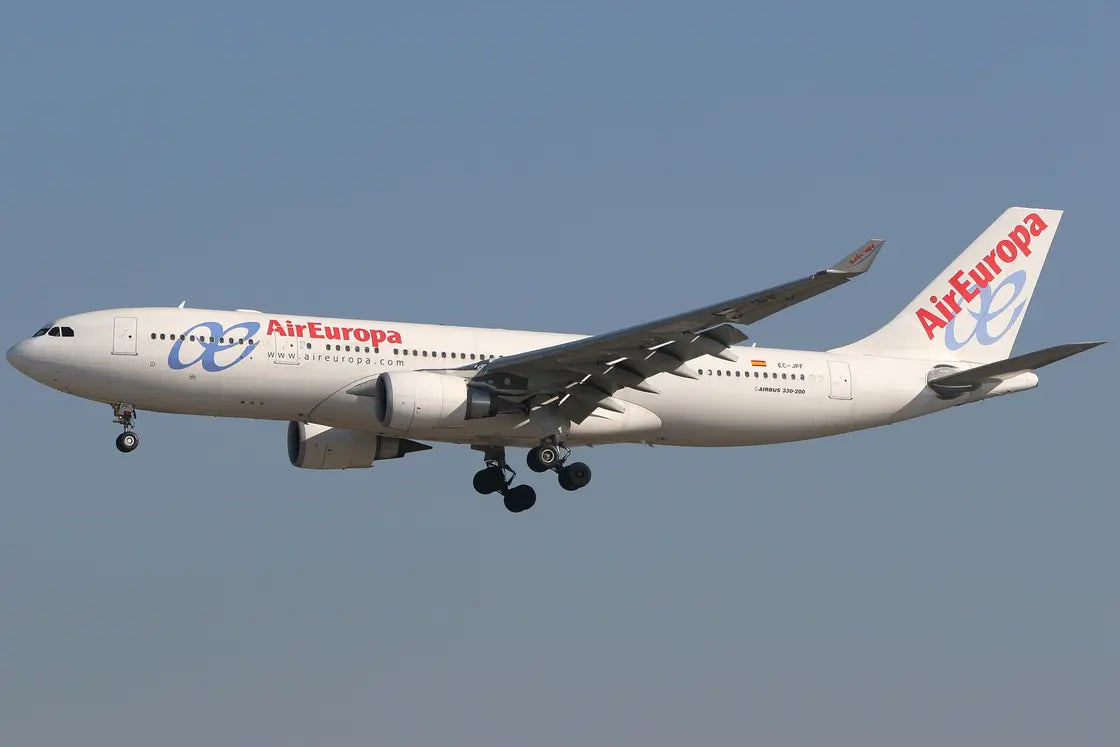
Air Europa Overview & Company Profile
Air Europa is Spain's third-largest airline, founded in 1986 as part of the British ILG-Air Europe Group and initially operating holiday charter flights with Boeing 737-300s and 757s from Mediterranean resorts. The airline distinguished itself as Spain's first private company to operate national scheduled flights, establishing a credible alternative to Iberia decades before the low-cost revolution reshaped European aviation. Today, Air Europa is owned by Globalia Corporación Empresarial S.A., one of Spain's largest tourism conglomerates, with minority stakes held by IAG (20%) and Turkish Airlines (approximately 25-27%).
The airline became a full member of the SkyTeam alliance on September 1, 2007, giving it access to a global network of 19+ member carriers including Air France-KLM, Delta Air Lines, and Korean Air. Its primary hub is at Adolfo Suárez Madrid-Barajas Airport (MAD), with focus city operations at Palma de Mallorca (PMI) and Tenerife North (TFN). Air Europa serves over 55 destinations across Europe, North Africa, the Caribbean, and Latin America, with a particular strategic focus on the Spain-to-Americas corridor that sets it apart from most European carriers of its size.
The airline's ownership story has been eventful. IAG attempted to acquire Air Europa for €1 billion in 2019, revised the price to €500 million post-COVID, and ultimately abandoned the deal in August 2024 after the European Commission demanded too many remedies. Following this, Turkish Airlines completed a strategic investment of €300 million in early 2025, acquiring a minority stake while Globalia retained majority ownership. This partnership aims to leverage Air Europa's Madrid hub for transatlantic traffic and strengthen Turkish Airlines' presence in Latin American markets.
Fleet Composition & Type Ratings
Air Europa operates an all-Boeing fleet, a rarity among major European carriers that tend to favour Airbus. The fleet is built around two families: the Boeing 737 for short- and medium-haul European routes, and the Boeing 787 Dreamliner for long-haul transatlantic operations. This is set to change dramatically following the airline's January 2026 order for up to 40 Airbus A350-900 widebodies, marking Air Europa's first venture into Airbus territory and signalling a massive long-haul fleet renewal.
The airline's current fleet comprises approximately 59 aircraft in active service. The narrowbody segment includes 26 Boeing 737-800s (including 11 operated by subsidiary Aeronova/Air Europa Express) and 4 Boeing 737 MAX 8s, with 16 more MAX deliveries pending. The widebody fleet is one of the most modern in Southern Europe: 11 Boeing 787-8 Dreamliners and 18 Boeing 787-9 Dreamliners form the backbone of Air Europa's prized Latin American network.
| Aircraft Type | Role | In Service | On Order | Routes / Notes |
|---|---|---|---|---|
| Boeing 737-800 | Narrowbody | 26 | - | European & domestic Spanish routes. 189 pax. Includes 11 at Aeronova subsidiary. Range: 5,765 km. |
| Boeing 737 MAX 8 | Narrowbody | 4 | 16 | Replacing older 737-800s. 20% fuel savings vs. previous gen. First deliveries May 2025. |
| Boeing 787-8 | Widebody | 11 | - | Long-haul to Latin America & Caribbean. 274 pax (22 business). Range: ~14,200 km. |
| Boeing 787-9 | Widebody | 18 | - | Long-haul flagship. 307-339 pax. Range: ~15,750 km. Daily to Buenos Aires, São Paulo, Miami. |
| Airbus A350-900 | Widebody | - | Up to 40 | Ordered Jan 2026. First Airbus type for Air Europa. Deliveries expected from ~2027-2028. |
Fleet data as of early 2026. Numbers are approximate and change with ongoing deliveries and retirements. Air Europa previously operated A330-200/300 and Boeing 767 widebodies, both now retired.
The order for up to 40 Airbus A350-900s, formalized in December 2025 following a Memorandum of Understanding signed at the Dubai Airshow in November 2025, represents a generational shift. For the first time, Air Europa pilots will have an Airbus type rating pathway alongside Boeing. Existing 787 crews are expected to receive priority for A350 transition training, while the introduction of a new aircraft family will create fresh captain positions and accelerated upgrade opportunities as the fleet expands. The A350 features advanced flight deck automation, Rolls-Royce Trent XWB engines, and composite airframe construction delivering significant efficiency gains over the 787.
Pilot Salary & Compensation Breakdown
Air Europa pilot salaries are governed by the 5th Collective Bargaining Agreement (V Convenio Colectivo), ratified in July 2023 following a period of industrial action involving 26 days of strikes. The agreement delivered an 11.5% wage increase effective through 2025, along with an innovative performance-based compensation component tied to on-time punctuality, customer satisfaction (NPS), and operational productivity. Compensation includes a monthly base salary, block-hour pay, per diem allowances for layovers, and bonuses linked to company results.
Exact pay scales are not publicly disclosed. However, industry benchmarking against comparable Spanish and European carriers, combined with data from pilot salary databases and union sources, allows for reasonable estimation. Air Europa compensation sits between Iberia (higher) and Vueling (lower), reflecting its position as a full-service carrier with significant long-haul operations.
First Officer (F/O) Pay Scale (Estimated)
| Seniority | Monthly Gross (est.) | Annual Gross (est.) | Notes |
|---|---|---|---|
| Year 1 (entry) | €3,300 - €4,000 | ~€40,000 - €50,000 | Narrowbody (737) assignment typical at entry. |
| Year 3-5 | €4,500 - €5,500 | ~€55,000 - €68,000 | Progressing through seniority steps. Some widebody transition possible. |
| Year 7-10 (widebody) | €5,500 - €7,000 | ~€68,000 - €85,000 | 787 Dreamliner long-haul flying. Premium block rates + higher per diems. |
Captain (CDB) Pay Scale (Estimated)
| Seniority | Monthly Gross (est.) | Annual Gross (est.) | Notes |
|---|---|---|---|
| Entry Captain (narrowbody) | €8,000 - €10,000 | ~€95,000 - €120,000 | 737-800 or MAX. Short/medium-haul European network. |
| Captain, 5+ yrs (widebody) | €11,000 - €14,000 | ~€130,000 - €170,000 | 787-8/9 long-haul. Latin America & Caribbean routes. |
| Senior Captain (LH widebody) | €14,000 - €16,000+ | ~€170,000 - €200,000+ | Most senior 787 Captains. Includes all allowances and performance bonuses. |
These figures are estimates compiled from industry benchmarking data, European pilot salary surveys (easyEASA, SimpleFlying, EuroCockpit), pilot forums, and publicly available information about the 2023 SEPLA collective agreement. Actual compensation depends on the exact terms of the current CBA, individual seniority steps, aircraft type, block hours logged, and performance bonuses. Spanish income tax rates (up to ~47% at higher brackets) and social contributions (~6.5% employee share) significantly reduce take-home pay. Always verify with the latest official SEPLA publications or directly with Air Europa HR.
Roster Pattern & Quality of Life
Air Europa operates under EASA ORO.FTL Flight Time Limitation rules, supplemented by the SEPLA collective agreement which negotiates additional protections beyond the regulatory minimum. The FTL framework caps maximum flight duty periods at 13 hours for two-sector operations, with reductions for multi-sector and night flying. Extensions are limited to one hour on a maximum of two occasions per seven consecutive days. All European carriers must publish rosters at least 14 days in advance.
The airline's roster structure varies significantly between narrowbody and widebody operations. Short-haul 737 crews typically fly 4-5 day duty blocks followed by 2-3 days off, with schedules designed around the European network from Madrid, Palma, and Tenerife. Long-haul 787 crews operate on different patterns: a typical rotation involves 1-2 days of flying to Latin America (with layovers at destination of 24-48 hours) followed by 3-4 days off for recovery. Spanish labor law and EASA regulations together create a roster environment broadly comparable to other Southern European full-service carriers.
📅 Sample Month: Medium-Haul First Officer (737, MAD Base)
Long-haul 787 crews operate fewer duty days per month but accumulate higher block hours per trip. A Madrid-Buenos Aires rotation, for example, involves roughly 12-13 hours of block time each way, with a 24-48 hour layover in between. Augmented crews (3 pilots) are used on the longest sectors, enabling in-flight rest. Long-haul pilots typically log 600-900 block hours annually, while narrowbody pilots may log 750-900+ hours depending on seasonal schedules.
The vast majority of Air Europa pilots are based at Madrid-Barajas (MAD), the airline's primary hub for both short-haul and long-haul operations. Secondary bases at Palma de Mallorca and Tenerife North serve seasonal and leisure-focused routes. There is no formal residency requirement: Spanish law allows airline crew to live anywhere, and many pilots commute from other Spanish cities using the country's excellent high-speed rail network (AVE) or internal flights. Living costs in Madrid are moderate compared to Northern European capitals, though the city has seen significant rental price increases in recent years.
Benefits, Travel Perks & Retirement
Air Europa's benefits package combines Spanish statutory employee rights (which are strong by European standards) with additional provisions negotiated through the SEPLA collective agreement. The airline's SkyTeam membership adds a valuable layer of staff travel benefits extending far beyond the company's own network.
Air Europa's full SkyTeam membership since 2007 gives pilots access to discounted or standby travel across one of the world's three major airline alliances. This includes airlines such as Air France-KLM, Delta Air Lines, Korean Air, China Eastern, Aeromexico, and others spanning every continent. For pilots who value personal travel, this benefit is substantial, offering access to a truly global network that smaller carriers outside an alliance simply cannot match. Staff travel policies (cabin class access, family eligibility, booking priority) are governed by internal rules typically linked to seniority and employment length.
Career Progression & Seniority
Career progression at Air Europa follows a seniority-based system, as is standard across European full-service carriers. Upgrade from First Officer to Captain and transition from narrowbody to widebody fleets depend on your position in the seniority list, airline growth, and captain attrition through retirements and departures. The airline's planned fleet expansion (56+ aircraft on order, including 40 A350s) is expected to create significant new captain positions over the coming years, potentially accelerating upgrade timelines compared to larger, more established carriers.
Air Europa's smaller pilot population (compared to Iberia's significantly larger workforce) can work both for and against career progression. On the positive side, fleet growth proportionally creates more captain openings relative to total pilot numbers. On the other hand, a smaller airline has less structural depth to absorb market shocks, meaning hiring freezes or furloughs can impact career timelines more abruptly than at a major flag carrier.
| Career Milestone | Typical Timeline | Notes |
|---|---|---|
| Join as First Officer (737) | Day 1 | Most common entry fleet. Type rating on 737-800 or MAX provided by airline. |
| Widebody F/O transition (787) | 3-7 years | Seniority-dependent. 787 type rating funded by Air Europa. |
| Captain upgrade (narrowbody) | ~8-12 years | Estimated. Subject to growth, retirements, and CBA provisions. Command assessment required. |
| Captain on widebody (787/A350) | ~12-18+ years | Top of seniority list. Premium long-haul command positions. |
| A350 transition | From ~2027-2028 | New type rating pathway. Existing 787 crews expected to get transition priority. |
| Training Captain / TRI / TRE | Variable | Separate selection and instructor certification. Additional compensation. |
With 40 Airbus A350-900s on order and 16 more Boeing 737 MAX deliveries pending, Air Europa is set for substantial growth. Every new widebody aircraft requires a fresh crew of 4-6 pilots (accounting for multiple rotations), and every new narrowbody needs 3-4. This expansion will generate dozens of new captain positions over the next decade. For pilots joining now as First Officers, the timing could be favourable: entering during a growth phase typically correlates with faster career progression than joining a stable or contracting operation. Whether Air Europa offers direct-entry Captain positions is not publicly confirmed, but the scale of fleet expansion may incentivize lateral hiring of experienced captains from other carriers.
Recruitment Process & Requirements
Air Europa recruits pilots primarily through its careers portal at empleo.aireuropa.com. The airline hires experienced pilots holding valid EASA licenses, and has historically partnered with flight training organizations like FTEJerez for a mentored cadet scheme (Air Europa Express MAPS), though the current status of that program is unclear. Recruitment is conducted on a rolling basis as operational needs dictate, with positions advertised through the airline's own portal and pilot recruitment networks.
Minimum Requirements
Selection Stages
Online Application
Submit CV, licenses, and supporting documentation through empleo.aireuropa.com. Ensure all EASA credentials, medical certificate, and language proficiency records are current before applying.
Aptitude & Psychometric Testing
Computer-based assessments typically using Cut-E/AON test platforms. Evaluates logical reasoning, mathematical ability, spatial awareness, multitasking, and personality traits. Preparation resources are available through specialist providers.
English Language Assessment
Verification of ICAO English language proficiency. May include a dedicated English interview or test component. Spanish language ability is also evaluated during the process.
HR & Technical Interview
Face-to-face or video interview at Air Europa facilities in Madrid. Covers technical knowledge, CRM competencies, motivation, and career history. Expect scenario-based questions on decision-making and crew resource management.
Simulator Assessment
Approximately 1-hour session evaluating basic aircraft handling, SOP adherence, and decision-making under pressure. Assessment criteria vary between type-rated and non-type-rated candidates. Assessed on both technical skills and CRM.
Medical & Contract
Successful candidates undergo Class 1 medical verification (if not already valid) and receive a conditional offer. Type rating training begins for non-type-rated pilots, followed by line training and a final line check.
Spanish language proficiency is highly important at Air Europa. While cockpit operations follow ICAO English standards, internal communications, briefings, company culture, and many interactions with ground staff and ATC within Spain are conducted in Spanish. Non-native Spanish speakers should invest in language preparation before applying. Specialist interview and simulator preparation services tailored to Air Europa's selection process are offered by organizations such as PASS Professional Assessments and Aviation Insider. The airline also periodically attends pilot recruitment fairs across Europe.
Top 5 Layover Destinations
Air Europa's defining strength is its long-haul network from Madrid to Latin America and the Caribbean. This is what sets the airline apart from most European carriers of its size and makes it particularly attractive to pilots who want international widebody flying without joining a mega-carrier. Layovers on these routes typically last 24-48 hours, with contracted hotels at each destination. The airline has been aggressively expanding frequencies in 2025-2026, with daily services now operating to Buenos Aires, São Paulo, and Lima, and enhanced frequencies to Miami and multiple Caribbean points.
Air Europa's Latin American network extends well beyond these five cities. The airline also operates to Santo Domingo, Punta Cana, Bogotá, Lima (daily from 2025), Medellín, Quito, Guayaquil, Asunción (daily from June 2025), Salvador da Bahia, Recife, and Córdoba (Argentina). This breadth of destinations is remarkable for an airline of Air Europa's size and gives pilots exposure to a diverse range of cultures, climates, and operational environments across the Americas.
How Air Europa Compares: Airline Radar Chart
How does Air Europa stack up against Spain's two other major carriers, Iberia and Vueling? Below is a comparative analysis across five key metrics. Iberia is the legacy flag carrier (IAG-owned, full-service, Airbus fleet), while Vueling is IAG's low-cost subsidiary focused on short-haul European operations. Air Europa sits between the two in scale and positioning.
Key Takeaways from the Comparison
Iberia leads on compensation and job security. As Spain's flag carrier and IAG's primary Spanish subsidiary, Iberia offers the highest pilot salaries in the country (up to €170,000+ for long-haul Captains), the strongest job security through IAG group resources, and a larger, more diverse Airbus fleet. However, Iberia's larger pilot population means captain upgrade timelines can be longer, and competition for positions is intense.
Air Europa offers the best long-haul route diversity for its size. No other Spanish airline of comparable scale offers daily 787 services to Buenos Aires, São Paulo, Lima, and Miami simultaneously. For pilots who prioritize international widebody flying and Latin American layovers, Air Europa punches well above its weight. The planned A350 fleet will strengthen this advantage further.
Vueling offers faster career entry but limited scope. As a low-cost carrier operating only narrowbody A320 family aircraft, Vueling provides no long-haul flying, lower base salaries, and more intensive roster patterns. However, Vueling's growth creates relatively fast captain upgrade opportunities (est. 8-12 years), and its IAG backing provides reasonable job security. It remains an excellent stepping stone for pilots seeking initial airline experience before moving to a full-service carrier.
Air Europa's fleet renewal tilts the balance. With 40 A350s and 16 737 MAX on order, Air Europa is investing heavily in next-generation equipment. This modernization closes the fleet quality gap with Iberia and creates career progression opportunities that neither Iberia's mature fleet nor Vueling's single-type operation can match proportionally.
Scores are editorial estimates based on publicly available salary data, industry reports (easyEASA, SimpleFlying, EuroCockpit Association), pilot community feedback, airline financial filings, and SEPLA/union publications. They represent a general assessment for an experienced pilot considering a long-term career. Individual experiences will vary based on seniority, fleet assignment, and personal priorities. Scores will be updated as new collective agreements and fleet changes take effect.
Union & Industrial Relations
Pilot representation at Air Europa is handled by SEPLA (Sindicato Español de Pilotos de Líneas Aéreas), Spain's national airline pilots' union. Founded over 60 years ago, SEPLA represents approximately 7,300+ pilots across all Spanish airlines, including passenger, cargo, aerial work, and helicopter operations. The union operates company-specific councils for each major Spanish carrier, with the Air Europa council handling airline-specific collective bargaining, grievance resolution, and employment policy.
SEPLA Structure & Governance
Recent Strike History & Key Disputes
The 2023 strikes were disruptive but ultimately resulted in a strong outcome for pilots: meaningful wage increases, performance bonuses, and formalised protections. SEPLA's successful negotiation demonstrates effective union representation at Air Europa. For new recruits, union membership provides access to legal support, collective bargaining representation, and a network of 7,300+ fellow pilots across Spain. The current period of labour stability, combined with fleet growth and Turkish Airlines investment, creates a constructive environment for career development. Contact SEPLA at sepla.es or via email at sepla@sepla.es for membership information.
Verdict: Who Is Air Europa For?
🎯 Our Take
Air Europa occupies a unique niche in European aviation. It is the only mid-sized European carrier offering extensive daily widebody operations to Latin America, all from a single Madrid hub with strong SkyTeam alliance backing. For pilots who dream of flying the 787 Dreamliner (and soon the A350) to Buenos Aires, Miami, Havana, and São Paulo, Air Europa offers an accessible path that does not require joining a mega-carrier with a 15-year upgrade queue.
The trade-offs are real. Salaries sit below Iberia (though the gap narrowed with the 2023 CBA improvements), job security depends on a smaller parent company (Globalia) rather than a global airline group, and the airline's ownership structure has been turbulent in recent years. The failed IAG acquisition created uncertainty, though the Turkish Airlines investment has brought fresh capital and strategic clarity. Fleet modernisation with 40 A350s on order signals long-term ambition.
For Spanish-speaking pilots (or those willing to learn), Air Europa offers a compelling proposition: international widebody flying, a growing fleet, competitive benefits under Spanish labour law, SkyTeam travel perks, and a career trajectory that could accelerate as new aircraft arrive. It is not Iberia, but it does not need to be. For the right pilot, it may be exactly the opportunity that delivers both career fulfilment and quality of life.
1 Do I need to speak Spanish to fly for Air Europa?
Yes, Spanish proficiency is effectively required. While cockpit operations follow ICAO English standards, Air Europa is a Spanish company where internal communications, briefings, company procedures, and interactions with Spanish ATC and ground staff are conducted in Spanish. Non-native speakers should aim for at least B2-C1 level Spanish before applying. ICAO Level 4+ English remains mandatory for international operations.
2 Does Air Europa pay for the type rating?
Air Europa typically covers type rating costs for pilots recruited through the official selection process, as is standard practice at European full-service carriers. Candidates already holding a Boeing 737 or 787 type rating may have an advantage in the selection process, but it is generally not a mandatory prerequisite for application. Confirm current policy directly with Air Europa HR or your SEPLA representative.
3 How long does it take to upgrade to Captain?
Upgrade timelines at Air Europa are estimated at approximately 8-12 years for narrowbody Captain and 12-18+ years for widebody Captain, though this varies significantly with fleet growth, retirements, and airline performance. The current fleet expansion (40 A350s + 16 737 MAX on order) is expected to create new captain positions at an accelerated rate compared to historical norms. Air Europa's smaller pilot population means growth-driven captain openings represent a higher proportion of total positions than at Iberia.
4 Can non-EU citizens apply?
EU/EEA citizens can apply directly under freedom of movement provisions. Non-EU citizens require a valid work permit for Spain, which typically requires employer sponsorship. Post-Brexit, UK pilots also need work authorisation. While Air Europa does not publicly advertise visa sponsorship, the airline may consider it for exceptional candidates, particularly during periods of high recruitment demand. Contact Air Europa HR for current policy.
5 What happened with the IAG acquisition?
IAG (parent of Iberia and British Airways) attempted to acquire Air Europa between 2019 and 2024, with the price revised multiple times (from €1B to €500M to €400M). The European Commission raised competition concerns on domestic Spanish, European short-haul, and transatlantic routes. IAG ultimately abandoned the deal in August 2024, deeming the required remedies too onerous. IAG retained its 20% stake. Turkish Airlines subsequently invested approximately €300M for a ~26% shareholding, while Globalia maintained majority ownership. This outcome preserved Air Europa's operational independence while providing strategic partnership and fresh capital.
6 How does Air Europa compare to Iberia for pilots?
Iberia offers higher salaries, stronger job security (IAG group backing), a larger and more diverse Airbus fleet, and a longer track record. Air Europa offers potentially faster career progression (smaller airline + fleet growth), a modern all-Boeing fleet transitioning to include A350, unique Latin American route diversity for its size, and SkyTeam vs. Iberia's oneworld membership. Iberia is the safer, more established choice; Air Europa is the growth opportunity with more uncertainty but significant upside potential as fleet expansion materialises.
7 Is Air Europa financially stable?
Air Europa's financial stability has improved significantly since the COVID crisis. The airline reported operating profit of €100M in 2018, suffered during the pandemic, but has recovered strongly with expanding routes and frequencies. The €300M Turkish Airlines investment in 2025 injected fresh capital, and the 40-aircraft A350 order signals long-term financial commitment. However, as a subsidiary of Globalia (a private tourism conglomerate), detailed financial reporting is less transparent than publicly listed carriers. The combination of Globalia majority ownership, IAG minority stake, and Turkish Airlines partnership creates a diversified ownership structure that mitigates single-party risk.
8 What is the pilot union situation at Air Europa?
Air Europa pilots are represented by SEPLA (Sindicato Español de Pilotos de Líneas Aéreas), Spain's national airline pilots' union with 7,300+ members. Following a period of strikes in May-July 2023 (26 days, 300+ cancelled flights), SEPLA successfully negotiated the 5th Collective Agreement with 11.5% wage increases through 2025 and performance-based bonuses. The current labour environment is stable. Union membership is optional but widely recommended for collective bargaining representation and legal support.
Official Links & Resources
Before applying or making any career decisions, always verify information directly with official sources. These are the key websites and organisations relevant to Air Europa pilot careers:
Bookmark the SEPLA website (sepla.es) and follow them on social media for the most timely updates on Air Europa pilot conditions, CBA negotiations, and recruitment cycles. For interview preparation, consider specialist providers like PASS Assessments who offer Air Europa-specific simulator and interview coaching. The airline also advertises positions on Pilot Jobs Network and Pilot Career Center.