

Lockheed L-1011-250: History, Development and What Made This TriStar Variant Unique
The Lockheed L-1011-250 was a late-stage upgrade variant of the L-1011 TriStar wide-body trijet, developed to bridge the performance gap between the standard-fuselage L-1011-200 and the shortened, ultra-long-range L-1011-500. Rather than a new-build production model, the -250 was a conversion programme that applied the extended wing, active load-control ailerons and more powerful engines originally engineered for the -500 to the full-length TriStar fuselage. The result was an aircraft that could carry more passengers than the -500 while flying significantly farther than the -200.
To understand why Lockheed created the -250, it helps to trace the broader TriStar family and the commercial pressures that shaped each successive variant.
Origins of the L-1011 Programme and the Path to the -250
The L-1011 programme was launched in March 1968 after American Airlines sought a wide-body jet capable of carrying roughly 250 passengers on busy domestic routes. Lockheed selected the Rolls-Royce RB211 three-spool turbofan as the sole powerplant, a decision that would define the aircraft's strengths and vulnerabilities alike. When American ultimately chose the McDonnell Douglas DC-10, the TriStar moved forward on launch orders from TWA and Eastern Air Lines.
The prototype made its maiden flight on 16 November 1970 from Palmdale, California. However, the programme was severely disrupted when Rolls-Royce entered receivership on 4 February 1971, largely because of cost overruns on the RB211. The crisis delayed certification by roughly two years and damaged airline confidence. The FAA finally certificated the baseline L-1011-1 on 14 April 1972, and Eastern Air Lines received the first delivery on 26 April 1972, entering revenue service days later.
Lockheed then pursued progressively longer-range derivatives to compete with the DC-10-30:
- L-1011-100 (mid-1970s) - added a centre-section fuel tank and raised the maximum take-off weight (MTOW) for greater range, while keeping the original RB211-22B engines.
- L-1011-200 (late 1970s) - introduced the higher-thrust Rolls-Royce RB211-524B engines and a further MTOW increase, aimed at hot-and-high operations for launch customer Saudia.
- L-1011-500 (first flight 16 October 1978, service entry 1979 with British Airways) - a substantially redesigned variant with a fuselage shortened by approximately 4.1 metres, an extended-span wing with active load-control ailerons, and maximum fuel capacity for intercontinental range.
The success of the -500's aerodynamic improvements led Lockheed to offer those same wing and powerplant upgrades for the standard-length airframe. This package became the Lockheed L-1011-250. According to the Forecast International archived report on the L-1011, the -250 consisted of converted and re-engined TriStars, with six aircraft converted from L-1011-1 configuration. Delta Air Lines was the only major carrier to undertake the conversion, with airframes upgraded to -250 standard from 1987 onward. Delta's fleet records confirm specific L-1011-1 airframes were re-engined and structurally modified to carry the -250 designation, making Delta the only airline to operate all five civil TriStar variants: -1, -100, -200, -250 and -500.
Because Lockheed's commercial aircraft division was already winding down (the final TriStar, the 250th airframe, was delivered in 1984), the -250 never became a headline variant in the way the -500 did. It was instead a pragmatic, late-life performance upgrade that extended the usefulness of existing Delta TriStars until the type's retirement on 31 July 2001.
What Differentiates the L-1011-250 from the -200 and -500
The L-1011-250 occupied a specific niche between two closely related variants. Compared with the L-1011-200, the -250 featured the lengthened wing and active load-control ailerons derived from the -500 programme, substantially more fuel capacity, and upgraded RB211-524B4 engines rated at approximately 222.4 kN (50,000 lbf) of take-off thrust. These changes yielded a higher MTOW of approximately 231,335 kg (510,000 lb) and a range of roughly 4,000 nautical miles with a typical passenger load, a notable improvement over the -200's approximately 3,680 nm.
Compared with the L-1011-500, the -250 retained the full-length fuselage of about 54.2 metres, preserving higher passenger capacity (typically 280 to 300 seats in a two-class layout versus the -500's roughly 240 to 250 seats). The trade-off was slightly less maximum range than the -500, which could achieve over 5,300 nm thanks to its lighter, shorter fuselage. Both variants shared essentially the same engine type, extended wing and advanced flight systems, including the TriStar's pioneering Category III automatic landing capability. For readers interested in how modern regional jets approach performance optimisation differently, the development story of the Sukhoi Superjet 100-95 offers an instructive comparison in variant engineering.
Key identifiers that distinguish the L-1011-250 from other TriStar sub-variants:
- Engines: three Rolls-Royce RB211-524B4 turbofans, each rated at approximately 222.4 kN (50,000 lbf)
- Wing: extended-span wing with active load-control ailerons, adapted from the L-1011-500
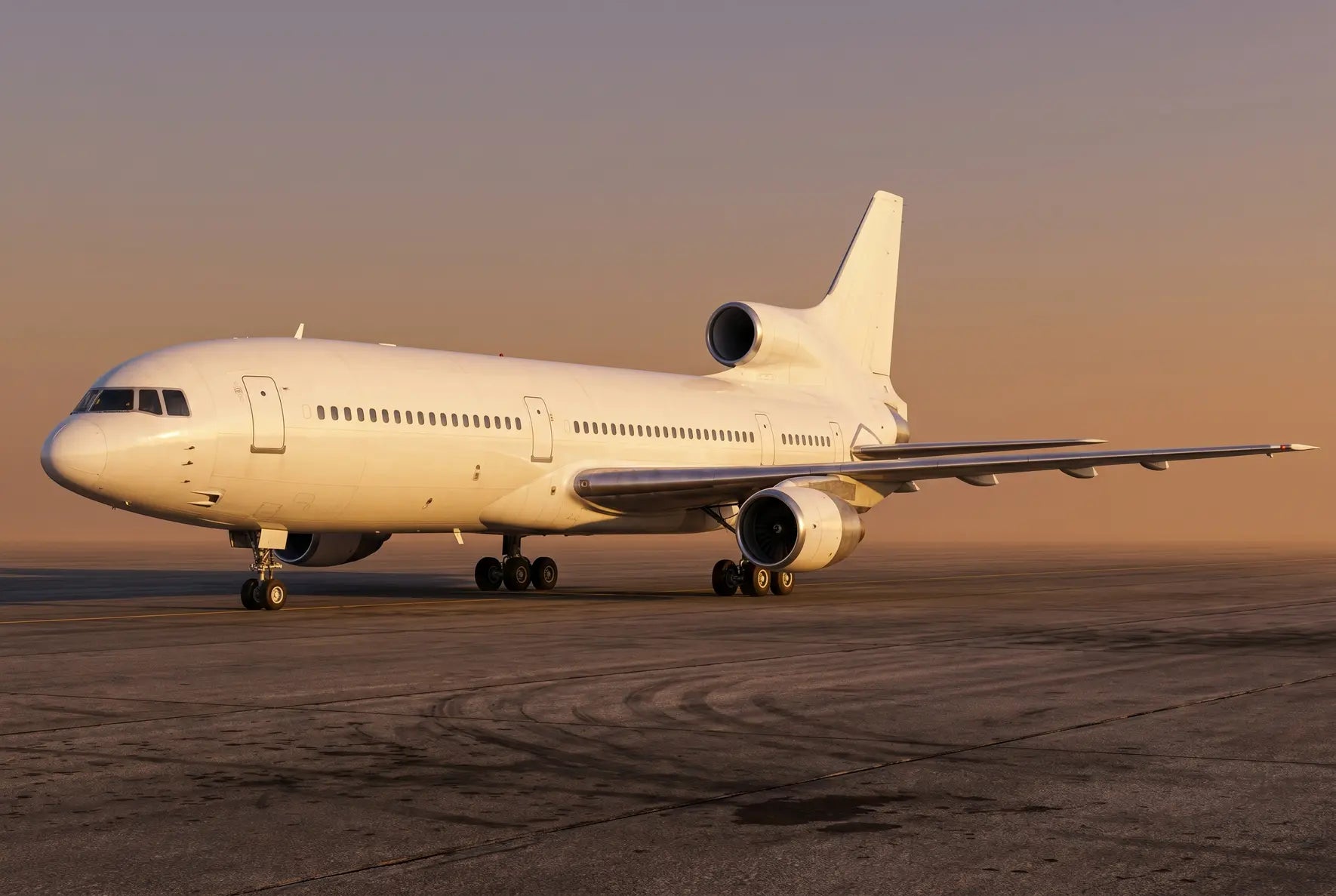
- Fuselage: standard-length body (approximately 54.2 m), identical to the -1, -100 and -200
- MTOW: approximately 231,335 kg (510,000 lb)
- Conversion only: no new-build -250 airframes were produced; all six were converted from L-1011-1 aircraft by Delta Air Lines
- Range: approximately 4,000 nm with typical two-class payload, bridging the gap between the -200 and -500
The L-1011-250 represents Lockheed's final effort to extract maximum commercial value from the TriStar platform. Although only six aircraft ever carried the designation, the variant demonstrated that the -500's aerodynamic and powerplant advances could be successfully retrofitted to the original full-length airframe, giving Delta a flexible, longer-range wide-body without the capacity penalty of the shortened -500.

The image shows a Lockheed L-1011-385-1 TriStar 1 aircraft in flight, marked with the Court Line titles. This wide-body airliner is captured mid-air against a clear sky.
Lockheed L-1011-250 TriStar: Technical Specifications, Systems and Engine Profile
The Lockheed L-1011-250 was developed as an extended-range, higher-gross-weight conversion of late-build L-1011-1, -100, and -200 airframes. Its core mission was to deliver near-L-1011-500 range while retaining the full-length fuselage and its higher passenger capacity. This created a distinct payload-range trade-off: the -250 could seat roughly 280 passengers in a typical three-class layout (or up to approximately 360 in high-density configuration) and still cover intercontinental sectors, whereas the shorter-fuselage -500 sacrificed seats to maximise range. The upgrade centred on three elements: re-engining with more powerful Rolls-Royce RB211-524B turbofans, increased maximum take-off weight, and additional fuel capacity.
Structurally, the -250 inherited the standard TriStar airframe dimensions and wing design. The type retained the all-flying tailplane (stabilator), four independent hydraulic systems, and the advanced Avionic Flight Control System (AFCS) that distinguished the L-1011 family from its contemporaries. The result was an aircraft capable of long-haul operations from existing runways, without requiring the structural redesign Lockheed applied to the -500.
- Overall length: 54.17 m (177 ft 8 in)
- Wingspan: 47.34 m (155 ft 4 in)
- Height: 16.87 m (55 ft 4 in)
- Wing area: approximately 321 m2
- Engines: 3 x Rolls-Royce RB211-524B / -524B4I turbofans, each rated at approximately 222.4 kN (50,000 lbf)
- MTOW: approximately 224,980 to 231,335 kg (sources vary by operator configuration)
- Operating empty weight (OEW): approximately 113,000 kg
- Maximum landing weight (MLW): approximately 166,920 kg
- Maximum structural payload: approximately 40,345 kg
- Fuel capacity: approximately 119,885 litres
- Maximum cruise speed: approximately 962 to 973 km/h (518 to 525 kt) at around 10,670 m
- Range (typical configuration, approximately 280 pax): approximately 9,400 to 9,900 km; up to approximately 10,900 km with maximum fuel at MTOW (with reserves)
- Service ceiling: approximately 12,700 to 13,110 m (42,000 to 43,000 ft)
- Take-off field length at MTOW: approximately 2,990 to 3,000 m
- Landing distance at MLW: approximately 1,800 to 2,040 m
- Seating: approximately 280 (three-class) to 360+ (single-class high-density)
- Autoland capability: CAT IIIB certified (fail-operational triplex autopilot)
Systems Architecture and Handling Technology
The L-1011 family, including the -250, was notable for its unusually integrated systems philosophy. The AFCS combined autopilot, flight director, autothrottle, and navigation coupling into a single coordinated architecture rather than treating each as a stand-alone subsystem. The triplex autopilot provided fail-operational redundancy essential for CAT IIIB automatic landings in near-zero visibility. In practice, this meant the -250 could complete approaches at fog-prone airports where other widebodies of the era would be forced to divert.
The flight controls used conventional mechanical signalling (cables and rods) powered by four independent 3,000-psi hydraulic systems. This quad-hydraulic arrangement exceeded the triple-system norm of the period and provided an additional layer of redundancy for all flight control surfaces, spoilers, landing gear, and utility systems. The TriStar also featured Direct Lift Control (DLC) on approach: rather than correcting glideslope deviations with pitch changes, the system deflected specific spoiler panels to adjust lift directly. This resulted in smoother, more stable approaches with less pitch oscillation, reducing pilot workload and improving passenger comfort, particularly during ILS-coupled autoland sequences.
The L-1011 was also among the first airliners to use an early Flight Management System. Certified by the FAA in 1977, it provided automated Mach/IAS cruise control, an optimised descent mode that back-computed top-of-descent to arrive on altitude and on speed, and a Rough Air Mode that adjusted engine power and control inputs during turbulence. Braking used an anti-skid system integrated with the quad-hydraulic architecture, ensuring consistent stopping performance across runway conditions.
Published performance figures for the L-1011-250 vary depending on operator-specific options such as cabin density, actual operating weights, atmospheric assumptions (ISA or ISA+15, for example), runway elevation and condition, and reserve fuel policies. The MTOW range of approximately 225,000 to 231,000 kg reflects different airline configurations and certification blocks. Range values are similarly sensitive to payload, cruise altitude, and wind assumptions. Any figures should therefore be interpreted with proper context rather than as fixed absolutes.
Rolls-Royce RB211-524B: The Engine Behind the -250
The L-1011-250 was powered by three Rolls-Royce RB211-524B (or the refined -524B4I) high-bypass turbofans, each delivering approximately 222.4 kN (50,000 lbf) of thrust. This represented a substantial step up from the RB211-22B engines of the original L-1011-1, which produced around 187 kN (42,000 lbf). Like all RB211 variants, the -524B used Rolls-Royce's signature three-spool design, with separate low-pressure, intermediate-pressure, and high-pressure shafts. This architecture allowed each spool to rotate at its optimum speed, improving thermodynamic efficiency and engine response compared to two-spool designs of the period.
The RB211 programme had a famously turbulent origin. Development of the original RB211-22 for the L-1011-1 involved pioneering carbon-fibre fan blades (branded Hyfil), which failed catastrophically during bird-ingestion tests and had to be replaced with heavier titanium blades. The resulting cost overruns under fixed-price contracts contributed directly to Rolls-Royce's financial collapse and nationalisation in 1971. Government intervention in both the UK and the US kept the engine and the TriStar programmes alive. Once the early problems were resolved, the RB211 matured into a reliable, fuel-efficient powerplant that earned a strong reputation with operators.
From the baseline -22 series, Rolls-Royce progressively developed the RB211-524 family with an enlarged fan, uprated core, and improved turbine materials. The -524 initially delivered around 213.5 kN (48,000 lbf) for the L-1011-200, then climbed to approximately 222.4 kN (50,000 lbf) with the -524B and -524B4 variants used on the -250 and -500. The -524B4I ("B4 Improved") introduced incremental gains in specific fuel consumption, reliability, and durability through internal aerodynamic and materials refinements rather than a fundamental architecture change.
Beyond the TriStar, the RB211-524 family became one of Rolls-Royce's most important commercial engine programmes. Higher-thrust derivatives, including the -524C, -524D, -524G, and -524H, powered multiple Boeing 747-200, 747-300, and 747-400 variants as well as certain Boeing 767-300ER airframes. The three-spool concept and core technology of the RB211 directly evolved into the Rolls-Royce Trent family, which today powers the Airbus A330, A350, A380, and Boeing 787, making the RB211 one of the most consequential engine programmes in modern commercial aviation history.
Lockheed L-1011 TriStar Variants vs McDonnell Douglas DC-10-30 Specifications
Scroll horizontally to see more →
| Parameter | Lockheed L-1011-250 | Lockheed L-1011-1 | Lockheed L-1011-500 | McDonnell Douglas DC-10-30 |
|---|---|---|---|---|
| Entry into service | 1980 | 1972 | 1979 | 1972 |
| Engines | 3 × Rolls-Royce RB211-524B-02 turbofans | 3 × Rolls-Royce RB211-22B turbofans | 3 × Rolls-Royce RB211-524B4 or RB211-524B4I turbofans | 3 × General Electric CF6-50C2 turbofans |
| Length | 54.2 m | 50.1 m | 50.1 m | 55.5 m |
| Wingspan | 47.3 m | 47.3 m | 47.3 m | 50.4 m |
| Height | 16.9 m | 16.9 m | 16.9 m | 17.7 m |
| Typical seating and layout (short description + approximate passengers) | 2-class: 280–310 passengers | 2-class: 250–300 passengers | 2-class: 230–280 passengers | 2-class: 270–320 passengers |
| MTOW | 225 t | 195 t | 231 t | 263 t |
| Range | 5,900 nm | 2,680 nm | 5,345 nm | 5,200 nm |
| Cruise speed | 0.85 Mach | 0.85 Mach | 0.86 Mach | 0.84 Mach |
| Service ceiling | 42,000 ft | 42,000 ft | 43,000 ft | 42,000 ft |
| Program note | Upgraded high-gross-weight TriStar variant with RB211-524 engines, offering increased range and performance while retaining the standard fuselage length. | Baseline TriStar model aimed at medium- to long-haul routes, optimized for efficiency and passenger comfort on flights up to around 2,700 nm. | Long-range TriStar variant with higher MTOW and extra fuel, positioned for intercontinental services and hot-and-high operations. | Long-range version of the DC-10 family and the TriStar’s main market rival, widely used for intercontinental passenger and cargo operations. |
Scroll horizontally to see more →
This table compares key specifications of three Lockheed L-1011 TriStar variants and the DC-10-30. The L-1011-250 stretches to 54.2 m and boosts range to 5,900 nm over the early L-1011-1 at 2,680 nm. The L-1011-500 trades capacity for long-range efficiency, while the DC-10-30 leads MTOW at 263 t and has the widest wingspan at 50.4 m.
Lockheed L-1011-250 Operations: Airlines, Routes and Typical Missions Worldwide
The Lockheed L-1011-250 was a re-engined and structurally upgraded conversion of earlier long-body TriStar airframes (-1, -100 and -200), fitted with three Rolls-Royce RB211-524B4 turbofans rated at 222.4 kN (approximately 50,000 lbf) each. With a maximum takeoff weight of around 224,980 kg and a maximum fuel range of roughly 10,934 km, the variant was designed for medium-to-long-haul missions where extra payload and improved hot-and-high performance were essential. Only about six aircraft were converted to -250 standard, making it one of the rarest TriStar sub-variants ever operated.
In daily airline service, L-1011 operators typically achieved around 2,600 to 2,800 flight hours per year, translating to approximately 7 to 9 block hours per day. Sector lengths varied widely depending on the mission: domestic trunk routes in the United States averaged 2.5 to 5 hours, while intercontinental services to Europe or the Middle East could stretch to 6 to 8 hours. The -250's enhanced range allowed it to cover transatlantic segments that earlier -1 and -100 models could not operate economically at full payload.
The Lockheed L-1011-250 fitted naturally into hub-and-spoke networks. Delta Air Lines, which was the primary operator, deployed its TriStars as high-capacity connectors from major hubs such as Atlanta (ATL), Dallas/Fort Worth (DFW) and Cincinnati (CVG). On a typical day, an aircraft would fly two to four sectors, linking these hubs to large spoke cities on the US West Coast, in Florida, the Caribbean and across the Atlantic. Outside the United States, other TriStar variants with similar capabilities served point-to-point intercontinental routes from hubs in London, Bahrain, Riyadh and Hong Kong.
Operators of the L-1011 family faced several well-documented challenges. The aircraft depended exclusively on Rolls-Royce RB211 engines, with no alternative powerplant option, which created supply and support vulnerabilities, especially after Rolls-Royce's financial difficulties in the early 1970s. As the global fleet shrank following the end of production in 1984 (only 250 TriStars were built in total), sourcing spare parts became increasingly expensive. The three-crew cockpit also raised operating costs compared with emerging two-crew widebodies such as the Boeing 767 and Airbus A310. Combined with higher fuel consumption relative to newer twins, these factors accelerated fleet retirements through the 1990s. Like the McDonnell Douglas DC-8-61, another classic long-range type, the TriStar eventually gave way to more fuel-efficient designs.
Where the Lockheed L-1011-250 Operated Around the World
The -250 conversion programme was closely associated with Delta Air Lines in North America, but the broader L-1011 family served airlines on every major continent. In Europe, carriers used the TriStar on medium-and-long-haul scheduled and charter routes, connecting hubs like London Heathrow and London Gatwick to the Middle East, Africa and holiday destinations in the Mediterranean. In Asia, the type linked regional hubs in Hong Kong, Tokyo and Bahrain to destinations across the continent and into Europe. Across Africa and South America, TriStars appeared mainly on intercontinental links operated by European and Middle Eastern carriers rather than local airlines.
According to the Delta Flight Museum, Delta was the only major airline to operate all five L-1011 variants: the -1, -100, -200, -250 and -500. Its fleet of 70 TriStars was the largest in the industry, with up to 56 in service simultaneously.
- North America: Delta Air Lines was the principal -250 operator, using upgraded TriStars on long domestic trunk routes (ATL-LAX, ATL-SFO) and transatlantic services (ATL-LGW, ATL-FRA). Eastern Air Lines (44 L-1011s) and Trans World Airlines (39 L-1011s) also operated large fleets of earlier variants on transcontinental and Caribbean routes. Air Canada and Air Transat flew TriStars on transatlantic and Caribbean leisure services from Toronto and Montreal. ATA Airlines used high-density TriStars for charter and military transport missions.
- Europe: British Airways operated TriStars on scheduled routes from Heathrow to the Middle East and Africa. Its leisure subsidiary British Airtours (later Caledonian Airways) deployed high-density configurations to Mediterranean and Caribbean holiday destinations. LTU in Germany used the type on long-haul leisure routes to the Caribbean and Asia. Air Atlanta Icelandic provided wet-lease and charter services with upgraded TriStars across Europe and beyond.
- Asia: Cathay Pacific became the largest non-US operator with 19 TriStars, linking Hong Kong to regional Asian cities and longer routes to Sydney and Tokyo. All Nippon Airways operated 21 aircraft on high-density domestic trunk routes within Japan. Gulf Air flew 13 TriStars from Bahrain to European and Asian hubs. Saudi Arabian Airlines deployed 18 TriStars on routes from Jeddah and Riyadh to Europe, Asia and Africa, with seasonal surge capacity for Hajj pilgrim traffic.
- Africa: TriStar services to African destinations were primarily operated by European and Middle Eastern carriers. British Airways served Nairobi and other East African points from London, while Gulf Air and Saudi Arabian Airlines connected Middle Eastern hubs to North and East Africa. TAP Air Portugal linked Lisbon with African capitals and occasionally sub-leased aircraft to LAM Mozambique Airlines and TAAG Angola Airlines.
Typical Seating Configurations on the L-1011-250
The L-1011-250 retained the same wide-body, twin-aisle fuselage cross-section as all long-body TriStars, allowing flexible cabin layouts. Seating capacity depended heavily on the operator's market positioning. In a typical two-class configuration used by network carriers such as Delta Air Lines, the aircraft seated approximately 250 to 280 passengers, with around 30 to 32 seats in first class arranged in a 2-2-2 layout and 230 to 240 economy seats in a 2-4-2 configuration. Three-class layouts (first, business and economy) reduced total capacity to roughly 230 to 260 seats.
Leisure and charter operators pushed density much higher. Airlines like British Airtours, LTU and Air Transat configured their TriStars in near-all-economy layouts with a 2-5-2 seat arrangement, accommodating 330 to 400 passengers on holiday routes. Japanese domestic operator All Nippon Airways also favoured high-density layouts of 300 to 350 seats, with a small premium cabin at the front. Detailed seat maps for various L-1011 configurations can be found through resources such as AircraftInvestigation.info, which documents technical specifications and performance data for the -250 variant.
This video explores Lockheed L-1011 TriStar widebody operations, highlighting why it was considered the most advanced analog jet of its era, with a distinctive three-engine design and innovative systems.
Lockheed L-1011-250 Safety Record: How Safe Is the TriStar?
Lockheed produced a total of 250 L-1011 TriStar airframes between 1968 and 1984, and the type entered commercial service in 1972. Over roughly three decades of airline operations, the full TriStar family recorded 10 hull losses and approximately 540 fatalities across all variants. For its era and fleet size, those figures place the Lockheed L-1011-250 and its sibling variants among the safest first-generation widebody airliners. The L-1011-250 itself, an upgraded higher-gross-weight development fitted with more powerful Rolls-Royce RB211-524B engines, was operated primarily by Delta Air Lines from the late 1970s until around 2001. There is no recorded fatal accident uniquely attributed to the L-1011-250 sub-variant. The only hull loss documented for the -250 configuration occurred in 2002 at Kinshasa, with no fatalities. Across the broader TriStar programme, most fatal events were linked to human factors, weather phenomena or post-landing emergency management rather than systemic airframe design flaws, which speaks to the fundamental soundness of Lockheed's engineering.
Major Accidents and Safety Lessons from the L-1011 Programme
Several high-profile accidents involving other L-1011 variants shaped modern aviation safety standards. Although none of these events involved the -250 specifically, they are directly relevant because all TriStar variants share the same basic airframe architecture and systems philosophy.
- Eastern Air Lines Flight 401 (1972) - An L-1011-1 crashed into the Florida Everglades after the crew became fixated on a faulty nose-gear indicator light and failed to monitor a gradual autopilot-induced descent. Of the 176 people on board, 101 lost their lives. The investigation by the NTSB (Report AAR-73-14) identified crew distraction and poor task allocation as primary causes. This accident became a landmark case in the development of Crew Resource Management (CRM) training, now mandatory across the global airline industry. It also led to improved autopilot mode annunciation and stricter altitude-alerting procedures.
- Saudia Flight 163 (1980) - An L-1011-200 suffered an in-flight cargo-area fire shortly after departure from Riyadh. The crew returned and landed safely, but a critically delayed evacuation meant that all 301 occupants perished from smoke inhalation and toxic fumes while the aircraft sat on a taxiway. As documented on the FAA Lessons Learned page, this disaster accelerated worldwide regulations on cabin material flammability, cargo-compartment fire detection and suppression, and immediate-evacuation decision protocols.
- Delta Air Lines Flight 191 (1985) - An L-1011-1 encountered a severe microburst on final approach to Dallas/Fort Worth, causing a rapid loss of airspeed and altitude. The crash killed 137 people. The NTSB report (AAR-86-05) cited inadequate windshear detection and the crew's decision to continue the approach into convective weather. This event drove the deployment of Terminal Doppler Weather Radar at major airports, the mandate for onboard predictive windshear warning systems, and standardised escape manoeuvres still trained today.
Each of these tragedies led to concrete, lasting improvements in cockpit procedures, aircraft systems and regulatory oversight that benefit every commercial aircraft flying today, including modern widebodies such as the Boeing 787-8.
How Safe Is the Lockheed L-1011-250?
When the accident record is measured against total flight hours and departures, the Lockheed L-1011 TriStar compares favourably with other widebodies of the same generation. According to the Aviation Safety Network database, the type experienced fewer hull losses per airframe built than the McDonnell Douglas DC-10 and had no recurring design-induced accident pattern. The TriStar's triple-redundant hydraulic system, advanced autoland capability certified to CAT IIIc standards, and Direct Lift Control on approach were considered cutting-edge safety features for the 1970s and contributed to the aircraft's strong operational reputation. Airlines such as Delta, which operated up to 56 L-1011s simultaneously, used the type extensively on domestic and international routes without encountering systemic safety issues. Regulatory bodies including the FAA maintained rigorous oversight of the fleet throughout its service life, issuing airworthiness directives as needed to address ageing-aircraft concerns. Taken as a whole, the L-1011-250 and the broader TriStar family earned a well-regarded safety profile. Aviation remains, statistically, one of the safest modes of long-distance transport, and the lessons drawn from TriStar operations continue to underpin the safety standards that protect passengers on every commercial flight today.
01 What was the main role and typical range of the Lockheed L-1011-250 in airline service?
The Lockheed L-1011-250 was primarily used for medium- to long-haul routes, often linking major hubs on transcontinental and transatlantic services. With its more powerful RB211-524B engines and higher weights than early L-1011s, it could typically fly around 4,000–5,000 nautical miles depending on configuration and payload. Airlines used the L-1011-250 on dense trunk routes where a widebody with good field performance and reliable long-range capability was needed. It often operated flights of 5 to 9 hours, fitting a niche between shorter regional services and ultra-long-haul missions.
02 How did the cabin layout and comfort of the Lockheed L-1011-250 compare with other widebodies?
Most Lockheed L-1011-250 aircraft had a 2-4-2 economy seating layout, which gave many passengers either a window or aisle seat and fewer middle seats than some competitors. Cabins typically seated around 250–300 passengers depending on airline configuration, with wide aisles and relatively spacious galleys. The L-1011’s circular cross-section and well-designed sidewalls created a sense of roominess, and many travellers remarked on its quiet and smooth ride. Compared with some early widebodies, the L-1011-250 was considered comfortable, especially on medium- and long-haul flights.
03 Which airlines operated the Lockheed L-1011-250 and on what kinds of routes was it most commonly seen?
The Lockheed L-1011-250 was flown by several major carriers, including Delta Air Lines, British Airways, and charter and leisure operators in Europe and the Middle East. It was frequently used on high-density holiday routes from Europe to destinations in the Mediterranean, Canary Islands, and transatlantic leisure markets. In the United States, it appeared on busy domestic trunk routes as well as services to Latin America and Europe. Later in its life, many L-1011-250s moved into charter, Hajj, and ACMI lease operations, reflecting their robust payload-range capability.
04 How did the performance and fuel efficiency of the Lockheed L-1011-250 compare to similar tri-jets?
The Lockheed L-1011-250, powered by Rolls-Royce RB211-524B engines and certified at higher maximum takeoff weights than earlier variants, offered improved climb and cruise performance and better hot-and-high capability. Compared with earlier L-1011-1s, it generally had more flexibility on longer sectors and from challenging airports. Against rivals such as the DC-10-30, fuel burn was broadly comparable for the era, though specific efficiency depended heavily on airline configuration and route profile. Its advanced automation and system design helped airlines operate it reliably and competitively on medium- to long-haul missions.
05 What safety and design features stand out on the Lockheed L-1011-250?
The Lockheed L-1011-250 inherited the L-1011 family’s advanced safety-oriented design, including a sophisticated autopilot and automatic landing capability that could perform Category III approaches in low visibility when properly equipped. Its direct-lift-control system allowed small glide path corrections using spoilers rather than large pitch changes, contributing to stable approaches and comfortable landings. The aircraft also featured a robust three-spool turbofan powerplant and redundant hydraulic and electrical systems, designed with fault tolerance in mind. Overall, its safety record reflected both its advanced engineering for the time and the standards of the airlines that operated it.
06 What should passengers know about the Lockheed L-1011-250 experience, such as seat choice, windows, and ride quality?
On a typical Lockheed L-1011-250 with 2-4-2 seating, many travellers preferred window or aisle seats in the pairs along the cabin sides for more privacy and easier access. Window alignment could vary slightly by row depending on the specific airline layout, but most windows were relatively large and offered good outside views. The aircraft’s design, including its low-mounted, swept wings and refined flight control systems, contributed to a reputation for a smooth, stable ride, even in moderate turbulence. Noise levels were generally lower toward the front and away from the rear-mounted center engine inlet, so forward cabin seats were often considered the quietest.