

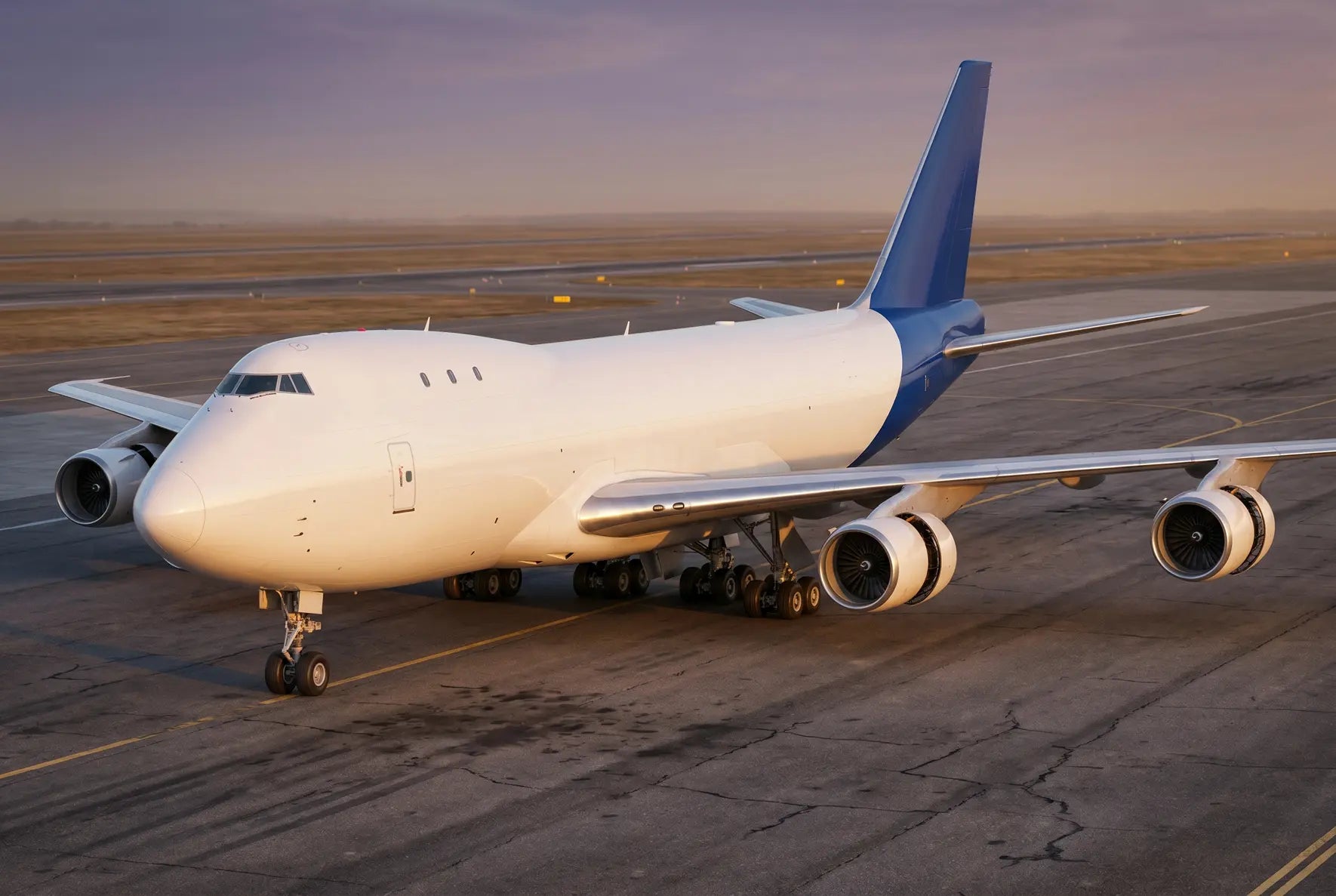
Boeing 747-100: History, Development and Origins of the First Jumbo Jet
The Boeing 747-100 was the aircraft that launched the widebody era and transformed intercontinental air travel. Its origins trace back to the early 1960s, when a surge in global passenger demand and the limitations of existing narrowbody jets such as the Boeing 707 prompted airlines to seek a dramatically larger aircraft. Pan American World Airways (Pan Am) president Juan Trippe and Boeing president William Allen began discussions in late 1965 about a double-aisle airliner capable of carrying more than twice the passengers of the 707 while reducing per-seat operating costs.
Boeing gave the programme formal go-ahead on 15 April 1966, the same month Pan Am placed a landmark launch order for 25 aircraft valued at approximately $525 million. Engineer Joe Sutter was reassigned from the 737 programme to lead the 747 design team, which eventually grew to around 4,500 engineers. Because no existing facility could accommodate the new jet, Boeing simultaneously constructed the world's largest building by volume at Everett, Washington, completing it in parallel with aircraft development.
The powerplant selected for the 747-100 was the Pratt & Whitney JT9D, the first high-bypass turbofan engine designed specifically for a widebody airliner. Early development of the JT9D proved challenging: the engine suffered from compressor stalls, turbine blade failures and excessive fuel consumption during testing, which contributed to schedule pressure and significant cost overruns for both Boeing and Pratt & Whitney. By 1968, programme costs had reached roughly $1 billion.
The first aircraft, registered N7470 and named City of Everett, was ceremonially rolled out at the Everett plant on 30 September 1968. Its maiden flight took place on 9 February 1969 from Paine Field, piloted by Jack Waddell with co-pilot Brien Wygle and flight engineer Jess Wallick. The flight programme involved five test airframes and accumulated more than 1,400 flight hours over ten months. On 13 December 1969, a test aircraft undershot the runway at Renton Municipal Airport during landing, tearing off the right outboard landing gear and damaging two engine nacelles. Although the incident was serious, it did not prevent certification. The Federal Aviation Administration (FAA) granted type certification on 30 December 1969.
Pan Am took delivery of its first 747-100 (registration N733PA) on 12 December 1969. The aircraft entered commercial service on 22 January 1970 on the New York JFK to London Heathrow route, one day later than originally scheduled due to engine overheating on the initially assigned airframe. Airlines across the globe, from Lufthansa and Japan Airlines to carriers serving popular European leisure routes, soon followed with their own 747 orders, making the type a symbol of affordable mass long-haul travel throughout the 1970s and 1980s.
Production of the 747-100 family totalled approximately 205 aircraft, with the last examples delivered in 1986. Boeing manufactured every airframe at the Everett facility, consolidating the company's position as the world's leading producer of large commercial jets.
What Distinguishes the Boeing 747-100 from Later Variants
The baseline 747-100 was powered exclusively by Pratt & Whitney JT9D engines (initially the JT9D-3A rated at approximately 43,500 lbf of thrust, later upgraded to the JT9D-7A at around 46,000 lbf). In contrast, the subsequent 747-200, introduced in 1971, offered a choice of three engine families (JT9D, General Electric CF6 and Rolls-Royce RB211), significantly higher maximum takeoff weight (up to 833,000 lb versus 735,000 lb), increased fuel capacity and considerably greater range of over 6,500 nmi. The 747-100 also featured only three upper-deck windows per side on most production aircraft, while many 747-200s were built with ten. Structurally, the 747-100 had a lighter airframe without the reinforcements introduced on the 747-200 for higher-weight operations.
Two notable sub-variants emerged from the baseline 747-100. The 747-100SR (Short Range) was developed specifically for high-density domestic routes in Japan, with a reinforced airframe designed for a much higher number of flight cycles and seating for over 500 passengers but reduced fuel load and range. The 747-100B combined the stronger airframe and landing gear of the SR variant with greater fuel capacity (48,070 US gallons), raising MTOW to approximately 750,000 lb and extending range. Only nine 747-100B aircraft were built, and this variant was the first 747-100 to offer alternative engine options including the CF6-50 and RB211-524.
Key variant identifiers for the Boeing 747-100 family include:
- Engines (baseline): Four Pratt & Whitney JT9D-3A or JT9D-7A high-bypass turbofans
- Maximum takeoff weight: 333,400 kg (735,000 lb) for the baseline; 340,200 kg (750,000 lb) for the 747-100B
- Typical range: Approximately 5,300 nmi (baseline)
- Cruise speed: Mach 0.84
- Upper-deck windows: Three per side on most production aircraft (some later retrofitted to ten)
- Wingtip type: Conventional rounded wingtips, without winglets
- Cockpit: Analogue three-crew flight deck (pilot, co-pilot, flight engineer)

A Boeing 747 airplane in Iberia livery flies above a landscape with patches of clouds and fields visible below. The aircraft is painted in white, red, and yellow colors, displaying the Iberia logo prominently on its body and tail.
Boeing 747-100 Technical Specifications, Performance Data and Systems Overview
The Boeing 747-100 was conceived as a long range, high capacity widebody airliner capable of carrying up to 480 passengers across intercontinental routes. Its design philosophy centred on maximising payload over transoceanic distances, combining a partial double deck fuselage with four high bypass turbofan engines. The airframe introduced the now iconic hump shaped upper deck and a 6.1 metre wide main cabin allowing ten abreast seating with twin aisles. As the founding member of the 747 family, the 747-100 established the structural and aerodynamic template that subsequent variants (747-200, 747-300, 747-400) would refine over more than five decades.
From an engineering standpoint, the 747-100 balanced range against maximum takeoff weight within the structural limits of late 1960s metallurgy and powerplant technology. Its swept wing, designed for high subsonic cruise, featured triple slotted trailing edge flaps spanning 78.7 m² when fully extended, granting acceptable takeoff and approach speeds despite the type's considerable mass. The aircraft required a three person flight crew: captain, first officer and flight engineer.
- Overall length: 70.7 m (231 ft 10 in)
- Wingspan: 59.6 m (195 ft 8 in)
- Height: 19.3 m (63 ft 5 in)
- Typical seating (3 class): 366 passengers; maximum single class up to 480
- Maximum takeoff weight (MTOW): 333,400 kg (735,000 lb), varying by sub variant
- Operating empty weight (OEW): approximately 162,500 kg (358,000 lb)
- Maximum landing weight (MLW): 255,800 kg (564,000 lb)
- Fuel capacity: approximately 183,380 litres (48,400 US gallons)
- Range: approximately 5,300 NM (9,800 km) with a typical passenger load
- Cruise speed: Mach 0.84 (approximately 523 kt / 969 km/h at altitude)
- Maximum operating speed: Mach 0.92
- Service ceiling: 13,700 m (45,100 ft)
- Takeoff field length: approximately 3,190 m (10,466 ft) at MTOW
- Engines: 4 x Pratt & Whitney JT9D series turbofans (see engine section below)
- Flight crew: 3 (pilot, co pilot, flight engineer)
- FAA Type Certificate: A20WE
Flight Controls, Avionics and Systems Architecture
The 747-100 employed a conventional hydraulically powered flight control system backed by four fully independent hydraulic circuits. Primary surfaces, including ailerons, elevators and the split upper/lower rudder, were driven by dual tandem hydraulic servo actuators, ensuring controllability even after the loss of two hydraulic systems. Spoiler panels on the upper wing surface provided additional roll authority and acted as ground spoilers and speed brakes. Pilot inputs were transmitted through mechanical cables with artificial feel provided by a dual feel computer system, giving tactile feedback proportional to aerodynamic loads.
The cockpit of the 747-100 was entirely analogue. Over fifty gauges and instruments were monitored by the flight engineer from a dedicated panel on the right side of the flight deck. Navigation relied on an inertial navigation system (INS) derived from Apollo era technology, which eliminated the need for a dedicated navigator. A two axis autopilot (pitch and roll) controlled elevators and ailerons for functions such as altitude hold, airspeed hold and autoland, while independent yaw damper systems on the upper and lower rudder sections countered Dutch roll tendencies. Braking on the 16 main gear wheels used hydraulic power from multiple systems, with an anti skid system modulating brake pressure via wheel speed sensors to prevent tyre lockup during landing and rejected takeoffs.
Published performance figures for the 747-100 can vary significantly depending on operator selected options, cabin configuration and passenger load, fuel load, atmospheric conditions (temperature, pressure altitude, wind) and runway surface state. Figures such as range, takeoff field length and payload are always subject to these variables. Any numbers quoted by manufacturers or reference databases represent specific baseline assumptions and should be read with that context in mind rather than taken as absolutes.
Pratt & Whitney JT9D: The Engine That Made the Jumbo Jet Possible
The Boeing 747-100 was powered exclusively by the Pratt & Whitney JT9D, the world's first high bypass ratio turbofan engine designed for widebody airliners. The JT9D programme was launched in September 1965, with the first engine run taking place in December 1966. FAA certification followed in May 1969, and the engine entered commercial service in January 1970 aboard Pan American World Airways' inaugural 747 flights.
The initial production variant fitted to early 747-100 airframes was the JT9D-3A, producing approximately 43,500 lbf (193 kN) of takeoff thrust. It featured a single stage fan with a diameter of roughly 93 inches, a three stage low pressure compressor, an eleven stage high pressure compressor, and a two spool turbine section. Dry weight was approximately 8,850 lb (4,013 kg). As the 747-100 programme matured, Boeing and Pratt & Whitney introduced the JT9D-7A, certified in September 1972, which raised thrust to approximately 46,950 lbf (209 kN). The JT9D-7F, rated at roughly 48,000 lbf (213.5 kN), was also offered on later production 747-100 airframes.
Beyond the 747, the JT9D family went on to power other iconic widebody types including the Boeing 767, McDonnell Douglas DC-10, and the Airbus A300. Its high bypass design, with a bypass ratio of approximately 5:1, set the standard for fuel efficiency and noise reduction in its era. Production of the JT9D ceased in 1990, with the engine family ultimately succeeded by the Pratt & Whitney PW4000 series. Although the JT9D is long out of production, its legacy as the powerplant that made the widebody revolution possible remains a landmark in turbofan engineering. For a look at how turboprop technology powers a very different category of regional aircraft, see the Bombardier Q400 overview on this site.
Boeing 747 Variants Comparison: 747-100 vs 747-200 vs 747-400 vs 747-8
Scroll horizontally to see more →
| Parameter | Boeing 747-100 | Boeing 747-200 | Boeing 747-400 | Boeing 747-8 |
|---|---|---|---|---|
| Entry into service | 1970 | 1971 | 1989 | 2011 |
| Engines | 4 × Pratt & Whitney JT9D | 4 × Pratt & Whitney JT9D / GE CF6 / RR RB211 | 4 × GE CF6 / PW PW4000 / RR RB211 | 4 × GE GEnx-2B67 |
| Length | 70.7 m | 70.7 m | 70.7 m | 76.4 m |
| Wingspan | 59.6 m | 59.6 m | 64.4 m | 68.4 m |
| Height | 19.3 m | 19.3 m | 19.4 m | 19.4 m |
| Typical seating and layout | 3-class: 366–452 passengers | 3-class: 366–416 passengers | 3-class: 400–416 passengers | 3-class: 410–467 passengers |
| MTOW | 333 t | 366 t | 413 t | 448 t |
| Range | 5,300 nm | 6,850 nm | 7,260 nm | 8,000 nm |
| Cruise speed | 0.84 Mach | 0.85 Mach | 0.85 Mach | 0.85 Mach |
| Service ceiling | 45,000 ft | 45,000 ft | 45,000 ft | 43,100 ft |
| Program note | Original 747 jumbo jet, launched long-haul widebody era | Improved range and MTOW over -100 baseline | Glass cockpit, winglets, major range/capacity upgrade | Modern stretched longest 747 with new engines |
Scroll horizontally to see more →
The table compares key specifications across four Boeing 747 generations, showing how the jumbo evolved from the 747-100 (1970) to the 747-8 (2011). Length and wingspan increase notably on the 747-8, while MTOW rises from 333 t to 448 t. Range improves from 5,300 nm to 8,000 nm, and later models add newer engine options and upgrades like the 747-400’s glass cockpit and winglets.
Boeing 747-100 Operations: Airlines, Routes, and Typical Missions Worldwide
The Boeing 747-100 entered commercial service in January 1970 with Pan American World Airways and quickly became the backbone of long haul aviation. With a maximum range of approximately 5,300 nautical miles (9,800 km) and a cruising speed of Mach 0.84, the type was purpose built for transoceanic and intercontinental operations. Typical stage lengths ranged from 3,000 to 5,000 nautical miles, covering routes such as New York to London (approximately 3,000 nm) or Los Angeles to Tokyo (approximately 4,800 nm). In peak service during the 1970s and 1980s, airlines achieved daily utilisation figures of 10 to 12 block hours per aircraft, reflecting the high demand on trunk routes between major hubs.
The Boeing 747-100 operated almost exclusively within hub and spoke networks, connecting large international gateways such as New York JFK, London Heathrow, Tokyo Narita, Paris CDG, and Frankfurt. Its size and long takeoff field length requirement of 2,160 to 3,190 metres made it unsuitable for secondary or regional airports with shorter runways. Operators needed high passenger volumes to fill the aircraft economically, so the type was concentrated on the world's busiest intercontinental corridors rather than point to point routes.
Operators faced several challenges. Early Pratt & Whitney JT9D engines suffered from reliability issues and high fuel consumption. The aircraft's considerable noise levels prompted airport restrictions, and load factors on early services were sometimes disappointing until traffic volumes grew to match the 747's unprecedented capacity. By the late 1990s, many surviving airframes had been converted to freighter roles as newer, more fuel efficient widebodies such as the Airbus A330-200 replaced them on passenger routes.
Where the Boeing 747-100 Operated Around the World
The Boeing 747-100 served airlines across four broad regions, linking the world's largest economies and population centres. In Europe, flag carriers deployed the type on prestigious transatlantic services and routes to Asia. In North America, major carriers used it for both transatlantic and transpacific operations, while South American airlines relied on it for connections to North America and Europe. In Asia, the type proved vital on transpacific routes and, in Japan, a dedicated short range variant served some of the world's busiest domestic corridors. Africa saw only limited and short lived operations of the 747-100.
- Europe: Air France flew the 747-100 from Paris CDG to New York JFK and Los Angeles. British Airways (successor to BOAC) operated the type from London Heathrow to New York and other long haul destinations. Lufthansa deployed it from Frankfurt to New York, Chicago, and Tokyo. Alitalia used the aircraft on Rome to New York services, while Iberia connected Madrid to New York and Latin American cities. Aer Lingus operated a small number on transatlantic routes from Shannon, and SABENA flew the type from Brussels to New York.
- North & South America: Pan American World Airways was the launch customer and pioneered global routes including New York to London and San Francisco to Tokyo. American Airlines configured the type for long haul domestic and transatlantic flights. United Airlines connected Chicago and San Francisco to London and Hong Kong. TWA served New York to Paris and other European capitals. Northwest Airlines operated transpacific services from Minneapolis and Seattle to Tokyo. Air Canada linked Toronto and Vancouver to London and Tokyo. In South America, LAN Chile (now LATAM) used the 747-100 between Santiago and Miami, and Avianca connected Bogotá to New York.
- Asia: Japan Airlines (JAL) was one of the largest operators worldwide, using the 747-100 on transpacific routes from Tokyo Narita to Los Angeles, New York, and London. All Nippon Airways (ANA) operated the dedicated 747-100SR variant on high density domestic routes within Japan, seating up to 456 passengers. JAL's own 747-100SR accommodated up to 498 passengers on routes such as Tokyo to Osaka and Sapporo. Iran Air connected Tehran to London and New York, and reportedly operated one of the last 747-100s in passenger service. China Airlines flew from Taipei to Los Angeles, Philippine Airlines served Manila to San Francisco, and Thai Airways International operated from Bangkok to London and Frankfurt.
- Africa: Confirmed operations were rare. East African Airways leased an Aer Lingus 747-100 for brief periods in 1974 and 1975, operating it from Nairobi on a short term basis. No other African carrier is confirmed to have operated the standard 747-100 variant in scheduled service.
Typical Seating Configurations on the Boeing 747-100
Boeing offered the 747-100 with a standard three class layout accommodating approximately 352 passengers, but total capacity varied widely depending on the operator's market. In a two class arrangement, the aircraft typically seated around 452 passengers, while an all economy configuration could hold up to 490 passengers. The cabin measured 57 metres in length and 6.13 metres in width, divided into five distinct zones separated by central galley and lavatory islands. This layout allowed ten abreast economy seating in a 3–4–3 arrangement with seats approximately 20 inches wide.
Network carriers such as Pan Am initially configured the aircraft with a generous first class cabin of up to 58 seats, a large economy section, and a distinctive upper deck lounge reserved for premium passengers. By the 1980s, many airlines had reduced first class to around a dozen seats in favour of expanding business class. American Airlines offered a 396 seat layout with 66 first class and 330 coach seats, featuring a unique onboard dining section. Charter and leisure oriented operators pushed capacity higher, while the Japanese domestic 747-100SR variant set records with up to 550 seats in near all economy configuration for JAL and ANA on short, high frequency routes. Detailed historical seat maps for many 747-100 operators can be explored on AeroLOPA, while production records and airline histories are available on Wikipedia's list of Boeing 747 operators.
In this video, follow the worlds last Boeing 747-100 on an Iran Air full flight, featuring cockpit takeoff to landing views and walkthroughs of all cabins, delivering rare pilot-eye aviation footage.
Boeing 747-100 Safety Record: How Safe Was the Original Jumbo Jet?
The Boeing 747-100 entered commercial service in January 1970 and remained operational with several airlines into the early 2000s, with around 140 airframes still flying as freighters in 1999. Approximately 205 units were delivered over a production run that ended in 1986, giving the type more than three decades of active duty. Across that lifespan the original Jumbo Jet accumulated millions of revenue flights on long haul routes worldwide. According to data compiled by AirSafe.com, the early 747 family (747-100, 747-200, 747-300 and 747SP combined) recorded a hull loss rate of roughly 1.02 per million departures over some 13 million flights. That figure is significantly higher than modern widebodies such as the 747-400 (0.06 per million) or the Airbus A320 family (0.09 per million), yet it must be read in context: the 747-100 operated during an era when cockpit procedures, air traffic control standards and aircraft design philosophy were still evolving. As noted in the Wikipedia list of Boeing 747 accidents, a total of 66 hull losses have been recorded across all 747 variants, representing about 4 percent of the 1,574 frames built. Many of the most consequential events involved 747-100 airframes and led directly to sweeping improvements in aviation safety.
Major Accidents and the Lessons They Produced
Tenerife Airport Disaster (1977). On 27 March 1977, KLM Flight 4805 (a 747-206B) and Pan Am Flight 1736 (a 747-121) collided on the runway at Los Rodeos Airport in dense fog, killing 583 people in the deadliest accident in aviation history. The primary factors were miscommunication between the KLM crew and air traffic control, combined with low visibility and the captain's decision to begin the takeoff roll without explicit clearance. In the aftermath, the industry overhauled standard radiotelephony phraseology and made readback of all ATC clearances mandatory. Most importantly, the disaster became the catalyst for Crew Resource Management (CRM) training, which broke down hierarchical cockpit culture and empowered co-pilots and flight engineers to challenge a captain's decisions. CRM became compulsory for all airline pilots and is now considered a cornerstone of flight safety worldwide.
Pan Am Flight 103, Lockerbie (1988). On 21 December 1988, a bomb concealed in the forward cargo hold of Pan Am's 747-121 Clipper Maid of the Seas detonated at 31,000 feet over Lockerbie, Scotland, killing all 259 on board and 11 people on the ground. The investigation exposed critical gaps in baggage screening and interline transfer procedures. In response, the United States enacted the Aviation Security Improvement Act of 1990, mandating passenger to baggage reconciliation, advanced explosive detection systems and stricter security protocols. Internationally, ICAO strengthened its security standards and helped broker the 1991 Convention on the Marking of Plastic Explosives, making covert explosive devices harder to assemble undetected.
TWA Flight 800 (1996). On 17 July 1996, a 747-131 operated by Trans World Airlines broke apart shortly after departure from New York JFK when the centre wing fuel tank exploded. All 230 occupants perished. The NTSB final report (AAR-00/03) determined that flammable fuel and air vapours in the nearly empty tank were ignited by an electrical fault in the fuel quantity indication system. This accident prompted the FAA to issue Special Federal Aviation Regulation 88 (SFAR 88), requiring operators to reexamine all potential ignition sources in fuel tanks. It also led to the 2008 rule mandating fuel tank inerting systems on transport category aircraft, a design change that significantly reduced the risk of vapour ignition across the global fleet.
Each of these tragedies, while devastating, triggered measurable advances in design standards, crew training and regulatory oversight that continue to protect passengers and crews today. Other notable 747-100 hull losses, including early ground incidents in the 1970s, further refined maintenance procedures and ground handling protocols. Comparing aircraft from different generations can also highlight how lessons from one programme influence another; for example, regional jets such as the Antonov An-158 were designed decades later, benefiting from the very safety culture that 747 era accidents helped establish.
How Safe Is the Boeing 747-100 by Modern Standards?
When measured against the traffic volumes it sustained, the 747-100 compiled a safety record that was broadly in line with its contemporaries. The hull loss rate of about 1.02 per million departures for early 747 variants is higher than that of current generation types, but it reflects the technological and procedural context of the 1970s and 1980s rather than an inherent flaw in the airframe. Boeing designed the 747 with structural redundancy, quadruple hydraulic systems and four engines, features that provided significant margins on over water and extended range operations. The ICAO Safety Report 2024 notes that the global accident rate for all commercial jets stood at 1.87 per million departures in 2023, a figure that continues to fall year on year thanks in part to lessons learned from earlier programmes like the 747. Rigorous standard operating procedures, recurrent simulator training and continuous airworthiness directives from the FAA and other authorities ensured that the 747-100 fleet was progressively made safer throughout its operational life. Taken as a whole, the story of the Boeing 747-100 is one of an aircraft that helped build the modern safety framework, and commercial aviation remains, by a wide margin, one of the safest forms of transport available.
01 What is the typical range of the Boeing 737?
The Boeing 737 has a maximum range of about 3,800 nautical miles for newer variants like the 737 MAX 8, suitable for transcontinental flights. It commonly flies routes under 3,000 miles, such as North America coast-to-coast or intra-European hops. Fuel efficiency improvements in MAX models reduce consumption by up to 20% compared to older generations.
02 Which airlines operate the Boeing 737 and on what routes?
Major operators include Southwest Airlines, Ryanair, and United Airlines, using it for high-frequency short-haul and medium-haul routes. Southwest flies it extensively on U.S. domestic legs averaging 1,000 miles, while Ryanair deploys it across Europe for low-cost point-to-point services. In Asia, airlines like Lion Air use it for dense regional networks.
03 How is the cabin layout and passenger comfort on the Boeing 737?
The Boeing 737 typically features a single-aisle layout with 6-abreast seating in economy, offering 17-18 inch wide seats on most configurations. Newer MAX variants have larger overhead bins and optional split scimitar winglets for smoother rides. Noise levels are lower than predecessors due to advanced engine technology, enhancing overall comfort on longer flights.
04 What is the safety record of the Boeing 737?
The Boeing 737 family has a strong safety record, with over 10,000 units produced and billions of safe passenger miles flown. It includes redundant systems like dual hydraulic setups and advanced flight management computers. Post-2019 updates addressed specific MAX issues, making it one of the most scrutinized and reliable narrowbody jets.
05 How does the Boeing 737 perform compared to the Airbus A320?
06 What are good seat choices on the Boeing 737 for passengers?
Rows 1-5 in first class or premium economy offer more legroom and quicker deplaning, while economy window seats like 12A or 12F provide good views away from engines. Avoid rear rows near lavatories for noise and queues. The MAX version handles turbulence well due to its swept-wing design, feeling stable mid-cabin.