

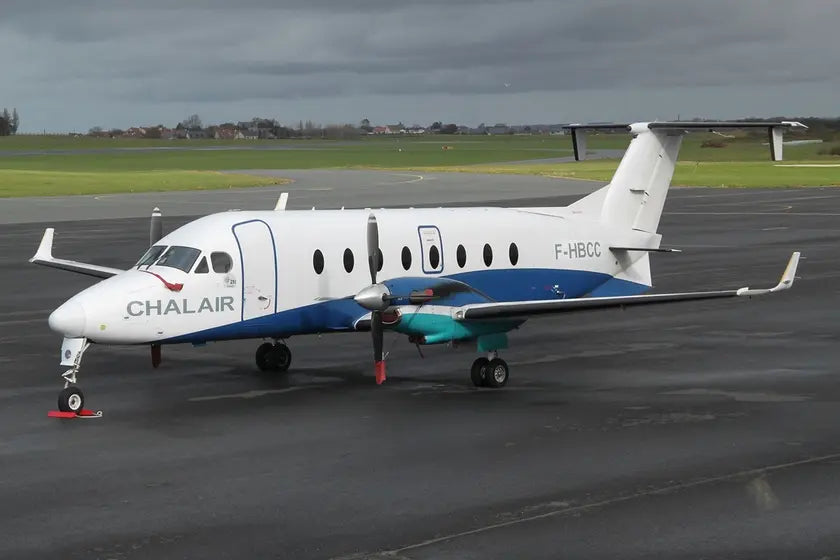
Chalair Aviation Overview & Company Profile
Chalair Aviation is an independent French regional airline founded in 1986, headquartered at Caen-Carpiquet Airport in Normandy. The airline specializes in connecting smaller French cities to Paris and to each other through a network of scheduled regional services, many of which operate under Public Service Obligation (PSO) contracts subsidized by the French government. Since 2003, the airline has been led by Alain Battisti, who also served as president of the FNAM (Federation Nationale de l'Aviation Marchande), France's main aviation industry federation, from 2013 until 2024.
Chalair operates a modest but focused fleet of turboprop aircraft, including ATR 42/72s and Beechcraft 1900Ds, with approximately 27 pilots on its roster and a total workforce of around 42 employees. The airline carries out roughly 30 to 35 daily flight movements, a volume consistent with its role as a niche regional connector rather than a high-frequency hub-and-spoke operator. Chalair maintains two operational bases: its headquarters at Caen-Carpiquet and a secondary hub at Bordeaux-Merignac. In addition to its year-round PSO routes linking Brive, Aurillac, and Castres to Paris Orly, the airline operates seasonal summer services to destinations across France and, increasingly, to international points including Brussels, Kerry (Ireland), and Geneva.
Chalair holds EASA Air Operator Certification and is supervised by the DGAC (Direction Generale de l'Aviation Civile), France's civil aviation authority. The airline also holds JAR Part 145 maintenance certification and provides aircraft management and engineering services to third-party operators. Chalair is a partner of the Flying Blue frequent-flyer programme, connecting its passengers to the Air France-KLM loyalty ecosystem.
A significant portion of Chalair's revenue comes from Public Service Obligation routes, which are contracted by the French government to maintain air connectivity to regions poorly served by rail or road. Chalair operates year-round PSO services from Brive-la-Gaillarde, Aurillac, and Castres to Paris Orly. These contracts provide revenue stability and predictable scheduling for pilots, though they are subject to periodic competitive tender and government review. According to EU transport records, Chalair has won multiple PSO tenders in recent years, underscoring its specialization in thin-route regional connectivity.
Fleet Composition & Aircraft Types
Chalair Aviation operates one of the smallest but most focused fleets among French commercial carriers, consisting entirely of turboprop aircraft optimized for regional operations on routes with limited passenger demand and variable airport infrastructure. The fleet comprises three distinct types, with the ATR 42-500 and ATR 72-500 forming the backbone of scheduled operations and the Beechcraft 1900D handling thinner routes with lower demand. This turboprop-only fleet strategy keeps operating costs manageable and allows access to smaller airfields with shorter runways that jet aircraft cannot serve.
| Aircraft Type | Role | In Service | Capacity | Notes |
|---|---|---|---|---|
| ATR 42-500 | Regional turboprop | 3 | 48 pax | Main workhorse. 1 aircraft currently parked. PSO and seasonal routes. |
| ATR 72-500 | Regional turboprop | 2 | 70 pax | Higher-capacity variant. Common type rating with ATR 42. Summer seasonal routes. |
| Beechcraft 1900D | Commuter turboprop | 2 | 19 pax | Twin turboprop. Used on thinnest routes. Stand-up cabin (1.83m ceiling). |
Fleet data as of early 2026. Numbers are approximate and may fluctuate with seasonal demand and maintenance rotations.
The ATR 42-500 is the most numerous type in the fleet, powered by twin Pratt & Whitney Canada PW127E engines producing 2,400 shaft horsepower combined. It cruises at around 265 knots and requires a takeoff field length of approximately 3,710 feet, making it ideal for operations at smaller regional airports. The closely related ATR 72-500, with its stretched fuselage accommodating 70 passengers, shares a common type rating with the ATR 42, enabling efficient crew cross-utilization and reducing training costs. Both types feature EFIS glass cockpits and modern navigation equipment meeting current EASA certification standards.
The Beechcraft 1900D is Chalair's smallest aircraft, a 19-seat pressurized twin turboprop with a cruise speed of approximately 280 knots (518 km/h) and a maximum range of roughly 1,550 km. Powered by twin Pratt & Whitney Canada PT6A-67D engines, the 1900D is capable of operating from very short runways, per the airline's own specifications published on chalair.fr. Chalair is one of a shrinking number of European operators still maintaining active 1900D service for scheduled commercial flights.
Pilots at Chalair may hold ratings on both the ATR family (common type rating for ATR 42/72) and the Beechcraft 1900D, depending on operational assignment. The ATR common rating significantly reduces training burden for crew transitioning between the two ATR variants. However, the Beechcraft 1900D requires a separate initial type rating covering its distinct systems, handling characteristics, and performance envelope. No fleet renewal or new aircraft orders have been publicly announced, reflecting the airline's conservative financial approach and the continued suitability of turboprops for its niche regional routes.
Pilot Salary & Compensation
Pilot compensation at Chalair Aviation reflects the economic realities of independent regional airline operations in France. As a small carrier with limited revenue and thin-route economics, Chalair's salary levels sit considerably below those offered by major French carriers like Air France or even larger regional subsidiaries like Air France HOP. Compensation varies by aircraft type, with ATR pilots earning more than those assigned to the smaller Beechcraft 1900D fleet.
Estimated Pay Scales (ATR & Beechcraft 1900D)
| Position | Aircraft | Monthly Gross (est.) | Annual Gross (est.) |
|---|---|---|---|
| First Officer (entry) | ATR / B1900D combined | ~€1,950 - €2,200 | ~€23,000 - €26,000 |
| First Officer (experienced) | ATR 42/72 | ~€2,500 - €2,700 | ~€30,000 - €32,000 |
| First Officer (experienced) | Beechcraft 1900D | ~€2,000 - €2,100 | ~€24,000 - €25,000 |
| Captain | ATR 42/72 | ~€4,500 - €5,500 | ~€54,000 - €66,000 |
| Captain | Beechcraft 1900D | ~€3,300 - €4,000 | ~€40,000 - €48,000 |
Estimates based on historical data from pilot job network sources and adjusted for general French regional market trends. Actual current figures may differ.
Precise, current salary data for Chalair Aviation is not publicly available. The figures above are estimates derived from historical compensation reports (circa 2020) published on pilot job network platforms, adjusted for general market trends. French regional airline pilot compensation has been under upward pressure since 2022 due to industry-wide pilot shortages, so current rates may be somewhat higher than the baseline figures shown. French social charges (~22-25% employee contribution) and income tax further reduce take-home pay from these gross figures. Always verify directly with Chalair during the recruitment process for current compensation details.
To put these numbers in context, the average gross salary for a French airline pilot across all carriers is approximately €88,000 to €109,000 annually, according to recent industry surveys. First Officers at Air France start at roughly €5,000 to €5,500 per month gross, more than double the estimated entry-level salary at Chalair. This compensation differential is the primary challenge facing independent regional carriers when competing for pilot talent against major airline groups offering substantially higher wages, structured career pathways, and international networks.
Despite the salary gap, some pilots actively choose carriers like Chalair for reasons beyond compensation: predictable regional schedules with minimal reserve flying, the ability to live near a preferred base without commuting to Paris, early command opportunities on turboprop aircraft, and the satisfaction of operating into challenging smaller airfields. For pilots early in their careers, building turboprop PIC time at a regional can also serve as a stepping stone to larger carriers that value command experience.
Roster Pattern & Quality of Life
Chalair Aviation operates under EASA flight time limitation (FTL) regulations combined with French labor law, which together establish a protective framework for crew scheduling. The airline's regional turboprop operations involve multiple short sectors per duty day (typically 1 to 3 hours per flight), with turnarounds at regional airports. This operational profile, combined with the airline's modest scale and focused route network, generally results in more predictable and stable schedules than those at larger, high-frequency carriers.
📅 Sample Month: ATR First Officer (Bordeaux Base)
Chalair's regional operations typically involve duty periods well below the EASA maximum of 14 hours, given that most sectors are short domestic flights. Pilots on ATR operations may fly 2 to 4 sectors per duty day, while Beechcraft 1900D crews may operate up to 4 to 5 shorter sectors. The airline's small size means reserve operations are limited compared to major carriers, providing pilots with greater schedule certainty and fewer last-minute disruptions.
Unlike major carriers where all pilots must be based at a single expensive hub (e.g., Paris for Air France), Chalair offers two base options in mid-sized French cities. Caen, in Normandy, offers a moderate cost of living roughly 30-40% lower than Paris, with excellent quality of life and proximity to the coast. Bordeaux, a vibrant southwestern city, combines world-class dining and culture with housing costs well below Parisian levels. For pilots prioritizing lifestyle and affordability over salary maximization, this dual-base structure is a genuine advantage.
Benefits, Pension & Protections
While Chalair's salary levels are modest by industry standards, French statutory employment protections provide all pilots with a comprehensive benefits floor regardless of airline size. The combination of mandatory social security, the CRPN aviation crew pension, and French labor law creates a safety net that partially compensates for the compensation gap with larger carriers. These protections are a distinctive advantage of flying for any French-based airline versus carriers in less regulated jurisdictions.
The CRPN is a private non-profit pension fund specifically for French-based aircrew, operating since 1951. It provides a supplementary pension on top of the basic French state pension, calculated on career-average indexed earnings with a maximum of 25 qualifying years. Contributions are graduated based on gross earnings. The scheme includes a survivors' pension (60% of member's pension) and orphan's benefits, plus bonus provisions for parents of 3 or more children. This applies equally to Chalair pilots as to Air France Captains, making it one of the most generous aviation-specific retirement systems in Europe regardless of which carrier employs you.
Career Progression & Seniority
Career progression at Chalair Aviation follows the standard European regional airline framework: seniority-based advancement from First Officer through to Captain, governed by EASA licensing requirements and internal company policies. The airline's small size creates both advantages and limitations. On one hand, upgrade opportunities may arise more quickly than at airlines with hundreds of pilots. On the other hand, the limited number of Captain positions and the flat organizational structure mean fewer overall advancement slots and virtually no specialized shore-based career paths (training management, standardization, quality assurance).
| Career Milestone | Typical Timeline | Notes |
|---|---|---|
| Join as First Officer (ATR or B1900D) | Day 1 | Entry fleet depends on operational needs and base assignment. |
| Transition between ATR 42 / ATR 72 | As needed | Common type rating. Differences training only. |
| Cross-fleet qualification (ATR ↔ B1900D) | Variable | Separate type rating required. Based on operational needs. |
| Captain upgrade | ~5-8 years (est.) | Seniority-dependent. Command assessment required (interview + sim check). |
| Training Captain / TRE / TRI | Variable | Limited positions at a 27-pilot airline. Requires separate selection. |
The upgrade timeline from First Officer to Captain at a small regional carrier like Chalair is typically shorter than at major airlines, potentially 5 to 8 years depending on attrition and fleet changes. This is significantly faster than the approximately 15-year timeline at Air France. For ambitious pilots, gaining turboprop command experience at a regional carrier can be an effective career strategy: building PIC hours on multi-crew aircraft before transitioning to a larger airline where this experience is valued during recruitment.
Chalair's modest organizational structure means there are no internal pathways to wide-body flying, no long-haul operations, and no management career track comparable to those at major airline groups. Pilots who join Chalair should view it either as a career destination (stable regional flying in a preferred location) or as a stepping stone (building PIC turboprop time for future applications to larger carriers). Many regional airline pilots in France ultimately move to Air France, Transavia, Air Corsica, or international carriers once they have accumulated sufficient command experience and meet the recruitment requirements of their target airline.
Recruitment Process & Requirements
Chalair Aviation recruits experienced pilots through its official careers portal and, for unsolicited applications, via the employment section of its website. The airline does not operate a cadet or ab-initio training programme. All candidates must hold existing professional pilot qualifications and be ready for type rating training on either ATR or Beechcraft 1900D aircraft. Recruitment is conducted on a rolling basis as operational needs arise, without the structured annual campaign cycles used by major carriers.
Minimum Requirements
Selection Process
Application Submission
Submit CV, licenses, medical certificate, and flight experience documentation via the Chalair careers page or by unsolicited application. Candidates with prior ATR or Beechcraft 1900D type rating experience are prioritized, as they reduce training investment for the airline.
Document Review & Screening
HR and flight operations review applications for licensing compliance, language proficiency, and relevant experience. Candidates with flight instructor (CFI) backgrounds are noted favorably, as industry data suggests strong foundational skills and sustained proficiency.
Interview & Assessment
Selected candidates are invited for a technical interview and CRM (Crew Resource Management) assessment. This stage evaluates aviation knowledge, operational decision-making, and cultural fit within a small crew environment where teamwork is critical.
Simulator Assessment (if applicable)
Depending on the candidate's experience level and the position, a simulator session may be conducted to evaluate handling skills and multi-crew coordination. This step may be combined with type rating training for candidates without an existing rating on the assigned aircraft.
Medical Verification & Contract
Successful candidates must present a valid Class 1 medical certificate before receiving a formal contract. Type rating training (if required) is scheduled through an approved training organization, typically covering ATR or Beechcraft 1900D ground school, simulator training, and base training. A minimum service commitment (typically 2-3 years) may apply if the airline funds the type rating.
French language fluency is absolutely essential. All internal communications, briefings, and interactions at Chalair are conducted in French. Candidates with prior turboprop multi-crew experience (ATR, Beechcraft, Saab, Dash-8) have a significant advantage. If you hold a current ATR type rating, highlight this prominently in your application as it eliminates a major training cost for the airline. Monitor the Pilot Jobs Network Chalair page for the latest vacancies and historical salary data.
How Chalair Compares: Airline Radar Chart
How does Chalair Aviation stack up against France's two most comparable independent regional operators: Twin Jet (13 Beechcraft 1900D, based in Aix-en-Provence) and Air Corsica (ATR fleet plus A320s, based in Corsica)? Below is a comparative analysis across five key metrics relevant to pilot career decisions.
Key Takeaways from the Comparison
Air Corsica leads across most metrics. As a larger regional carrier operating both ATR turboprops and Airbus A320 family jets, Air Corsica offers better salary prospects, a more diverse fleet, stronger job security through its strategic position as Corsica's primary carrier, and a broader benefits package. For pilots seeking the best overall package among French regional carriers, Air Corsica is the stronger option, though it requires willingness to live in Corsica.
Chalair and Twin Jet occupy similar territory. Both are small independent operators with modest fleets and limited salary scales. Chalair has a slight edge in fleet diversity (ATR 42/72 plus Beechcraft 1900D versus Twin Jet's all-Beechcraft fleet) and offers two mainland base options. Twin Jet counters with a larger network (200+ weekly flights across 12+ routes) and strong business traveler focus. Both carriers offer comparable quality-of-life advantages through regional base locations and predictable scheduling.
All three benefit from French labor protections. CRPN pension, health insurance, loss-of-license coverage, and statutory leave entitlements apply equally regardless of carrier size, creating a common benefits floor that softens the salary differential between these regional operators and major airlines.
Scores are editorial estimates based on publicly available salary data, fleet information, airline financial profiles, and pilot industry reports. They represent a general assessment for an experienced pilot evaluating career options among French regional carriers. Individual experiences will vary based on seniority, fleet assignment, base location, and personal priorities. Air Corsica and Twin Jet scores will be refined as dedicated articles are published for each airline.
Verdict: Who Is Chalair Aviation For?
🎯 Our Take
Chalair Aviation is a niche French regional carrier that fills a specific role in the country's aviation ecosystem: connecting small and mid-sized cities to Paris and to each other via PSO and seasonal routes. For pilots, it offers a very particular value proposition. The salary is among the lowest in French commercial aviation, the fleet is small and aging, and there is no structured career pathway to wide-body or long-haul operations.
What Chalair does offer is stability through government-backed PSO contracts, the chance to live and work in attractive mid-sized French cities (Caen, Bordeaux) rather than the Paris region, predictable regional schedules with minimal reserve flying, and potentially faster access to a Captain's seat than at a major airline. All French statutory benefits apply in full, including the CRPN pension and comprehensive health coverage.
This is not a career destination for pilots seeking high earnings, international routes, or fleet diversity. It is best suited for pilots who value lifestyle, geographic preference, and operational predictability, or for early-career pilots looking to build turboprop PIC time as a stepping stone to larger carriers.
Chalair Aviation's small workforce (27 pilots) operates without documented formal union representation. The SNPL (Syndicat National des Pilotes de Ligne) represents French airline pilots nationally, but small carriers may not have sufficient workforce size for a dedicated company-level section. All French labor law protections apply regardless of union status, including working time regulations, dismissal protections, and collective bargaining rights. Pilots considering Chalair should be aware that individual employment terms may be negotiated on a more customized basis than at unionized major carriers, where standardized collective agreements govern all pilot conditions.
1 Do I need to speak French to fly for Chalair?
Yes. Fluent French is mandatory for all pilot positions. Non-native speakers must hold EASA FCL.055 Level 6 in French. All internal communications, briefings, ATC interactions on domestic routes, and company culture are in French. There is no English-only pathway at Chalair.
2 Does Chalair pay for type rating training?
Chalair may fund type rating training for selected candidates, particularly when there is an operational need and the candidate demonstrates strong potential. A minimum service commitment (typically 2-3 years) is usually required when the airline covers training costs. Candidates who already hold an ATR or Beechcraft 1900D type rating have a significant advantage in the recruitment process, as they eliminate this expense for the airline.
3 How long does it take to become Captain at Chalair?
Captain upgrade at a small regional carrier like Chalair can occur faster than at major airlines, potentially within 5 to 8 years depending on seniority, attrition, and fleet changes. This is considerably faster than the approximately 15-year timeline at Air France. However, the limited number of Captain positions (in a 27-pilot airline) means upgrade timing is highly variable and depends on individual circumstances.
4 Can non-EU citizens apply?
Chalair requires EU/EEA nationality or valid EU work authorization. This is standard across European commercial aviation. Non-EU pilots would need to hold an existing right to work in France and have their third-country licenses validated to EASA standards, a complex and time-consuming process.
5 What are the PSO routes and why do they matter?
Public Service Obligation routes are contracted by the French government to maintain air connectivity to regions poorly served by other transport modes. Chalair operates year-round PSO services from Brive, Aurillac, and Castres to Paris Orly. These contracts provide revenue stability and schedule predictability for pilots, though they are subject to periodic competitive tender. PSO routes form the financial backbone of Chalair's operations, making the airline's viability partly dependent on continued government support for regional connectivity.
6 Is Chalair a good stepping stone to Air France?
It can be, though there is no direct recruitment pipeline. Building multi-crew PIC time on turboprop aircraft at Chalair demonstrates command experience that is valued by larger carriers. However, Air France's professional pilot stream requires candidates to hold specific qualifications including EASA ATPL, TOEIC 850+, and FCL.055 Level 6 French. Pilots who accumulate 1,500+ total hours with significant PIC time at Chalair would be eligible to apply through Air France's professional pilot selection, though they would compete against all other qualified applicants.
7 What is the Beechcraft 1900D like to fly?
The Beechcraft 1900D is a pressurized twin turboprop with jet-like performance (280-knot cruise speed) in a compact 19-passenger configuration. Pilots report that it handles well and offers genuine stick-and-rudder flying compared to fly-by-wire jets. The 1900D can operate from very short runways, opening access to small regional airfields that larger aircraft cannot serve. It is becoming an increasingly rare type in European commercial service, making Chalair one of the few operators where this experience can be gained.
8 Does Chalair offer seasonal contracts?
Chalair's summer seasonal route expansion (including services to Ajaccio, Kerry, Brussels, Nice, Geneva, and others) may create demand for additional crew during peak periods. Whether the airline offers seasonal or fixed-term contracts for these periods is not publicly documented. Interested pilots should inquire directly via the Chalair careers page for the latest employment opportunities and contract types available.
Official Links & Resources
Before applying or making any career decisions, always verify information directly with official sources. These are the key websites and organisations relevant to Chalair Aviation pilot careers:
Check the ECA Social Rating of European Airlines report (available at eurocockpit.eu) for comparative data on pilot working conditions across European carriers, including smaller regional operators. For Chalair-specific vacancies and salary updates, set up alerts on pilotjobsnetwork.com and pilotcareercenter.com. The Chalair press releases page at en.chalair.fr/communiques-de-presse is also worth monitoring for route announcements that may signal recruitment needs.