

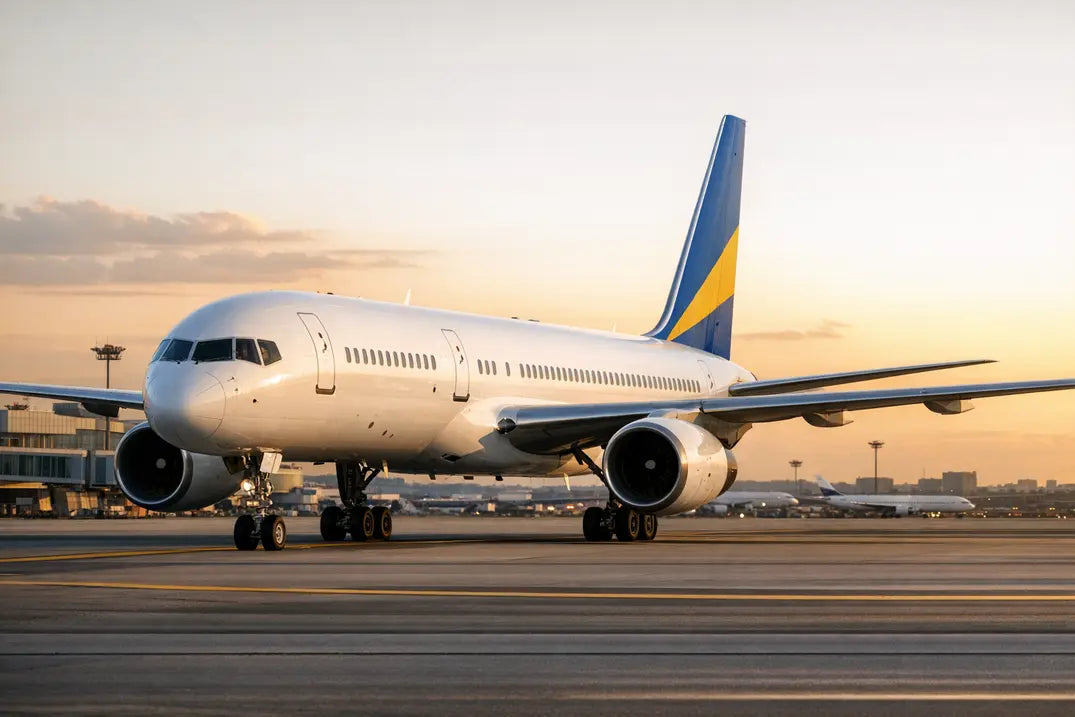
Boeing 757 200: History, Program Launch, and Development Milestones
The Boeing 757 200 traces its origins to the mid 1970s, when Boeing began studying a replacement for the highly successful but aging Boeing 727 trijet. Internally designated the 7N7, the project aimed to deliver a modern, fuel efficient narrow body twinjet capable of serving the same short to medium haul routes with significantly lower operating costs. Rather than simply stretching the 727, Boeing opted for an entirely new airframe featuring advanced aerodynamics, high bypass turbofan engines, and a two crew glass cockpit shared with the widebody 767 program, which was being developed in parallel. This parallel approach allowed both aircraft to share development costs and achieve a high degree of cockpit commonality, meaning pilots could transition between the two types with minimal additional training.
Boeing formally launched the 757 program after securing commitments from two major carriers. In March 1979, Eastern Air Lines placed an order for 21 aircraft and British Airways ordered 19, confirming the program and giving it the commercial momentum needed to proceed. The development timeline was intended to be the shortest in Boeing's history at that point, targeting just 27 months from program launch to certification.
Key Development Milestones
Final assembly of the first Boeing 757 200 began at Boeing's Renton factory near Seattle in January 1981, on the same production line that had built the 727. The prototype, powered by twin Rolls Royce RB211 535C turbofans, was rolled out on 13 January 1982. The maiden flight followed on 19 February 1982, approximately one week ahead of schedule, although the test crew encountered a brief engine stall caused by low oil pressure during the sortie.
A rigorous flight test campaign lasting seven months utilised five aircraft and accumulated around 1,380 hours. The programme benefitted from shared data with the 767 certification effort. Notably, the production airframe came in approximately 1,630 kg (3,600 lb) lighter than originally projected, with roughly 3% better fuel consumption and an additional 200 nautical miles of range compared to initial estimates.
The FAA granted type certification on 21 December 1982 for the Rolls Royce powered variant, and the UK Civil Aviation Authority followed on 14 January 1983. Boeing delivered the first aircraft to launch customer Eastern Air Lines on 22 December 1982, and the type entered revenue service on 1 January 1983.
The Pratt & Whitney PW2037 powered variant arrived later, with its first delivery going to Delta Air Lines on 5 November 1984. This engine option broadened airline choice and intensified competition with the Rolls Royce offering. ETOPS certification for Rolls Royce RB211 equipped 757s was granted by the FAA in 1986, opening up transatlantic and overwater routes. PW2000 powered variants received their own ETOPS approval in 1992, further expanding the operational envelope of the fleet.
Production of the Boeing 757 200 continued for over two decades. The last airframe, the 1,050th 757 built, rolled off the Renton line on 28 October 2004 destined for Shanghai Airlines; it was delivered on 28 November 2005 after a period in storage. In total, 1,049 Boeing 757 200s were delivered to airlines and operators worldwide. For readers who want to explore the broader story of commercial aviation and its most iconic aircraft, Ready for Takeoff offers a curated collection of aviation books that bring these engineering achievements to life.
What Sets the Boeing 757 200 Apart from Other 757 Variants
The 757 200 is the baseline passenger variant of the 757 family and remains by far the most produced version. It is distinguished from the 757 300, a stretched derivative introduced in 1999 with a fuselage 7.13 m (23.4 ft) longer, higher maximum takeoff weight of 123,600 kg (272,500 lb), and seating for up to 295 passengers in a single class layout. While the 757 300 shares the same wing and cockpit, it features reinforced structure, upgraded landing gear, and a retractable tailskid to prevent tail strikes during rotation. The 757 200 offers superior range at 3,850 to 3,915 nautical miles compared to approximately 3,400 nautical miles for the stretched variant.
The 757 200PF (Package Freighter) is an all cargo derivative with a main deck cargo door, reinforced flooring, and capacity for up to 15 standard pallets. The 757 200M (Combi) allows a mixed passenger and freight configuration on the main deck. Both cargo variants share the same airframe dimensions and powerplant options as the passenger 757 200 but are optimised for payload rather than range.
The following list summarises the key identifiers that define the Boeing 757 200 passenger variant:
- Engine options: Rolls Royce RB211 535C, RB211 535E4, RB211 535E4B; Pratt & Whitney PW2037, PW2040
- Fuselage length: 47.32 m (155 ft 3 in)
- Typical seating: 200 passengers in a two class layout; maximum 239 in a single class configuration
- Maximum takeoff weight: 115,680 kg (255,000 lb) standard, up to 122,470 kg (270,000 lb) in high gross weight configuration
- Maximum range: 3,850 to 3,915 nautical miles (7,130 to 7,250 km)
- Cockpit: Two crew digital glass flight deck with six CRT displays, shared type rating with the Boeing 767
- ETOPS capability: Approved for extended twin engine operations over water (120 minute diversion, RB211 from 1986; PW2000 from 1992)

A Delta Airlines Boeing 757-200 aircraft is captured in flight, approaching its destination. The plane is set against a clear blue sky, showcasing its distinct livery and design.
Boeing 757 200 Technical Specifications, Systems and Engine Options
The Boeing 757 200 was conceived as a direct replacement for the Boeing 737 and 727 on short to medium haul routes, combining narrowbody economics with widebody range capability. Its design philosophy prioritised strong takeoff performance from constrained runways, high cruise efficiency, and the ability to carry up to 239 passengers in a single class layout over sectors exceeding 3,000 nautical miles. Developed in parallel with the widebody 767, the 757 200 shares a common two crew glass cockpit, instrumentation, avionics, and flight management architecture with its larger sibling, enabling a shared type rating that significantly reduced crew training costs for operators flying both types.
The aircraft's wing, swept at 25 degrees with a 5 degree dihedral, was optimised for a balance between high speed cruise and low speed handling. Boeing chose a supercritical airfoil with greater fuel capacity and lower drag than the 727 wing it replaced. The 757 200 does not use inboard ailerons; roll control relies on outboard ailerons and flight spoilers. These engineering trade offs produced an airframe that could depart hot and high airports while still achieving competitive block fuel burn on transcontinental and transatlantic ETOPS sectors.
- Overall length: 47.3 m (155 ft 3 in)
- Wingspan: 38.05 m (124 ft 10 in)
- Tail height: 13.6 m (44 ft 6 in)
- Cabin width: 3.53 m (11 ft 7 in), six abreast economy seating
- Typical seating: 200 (two class) to 239 (single class)
- MTOW options: 99,800 kg (220,000 lb), 113,400 kg (250,000 lb), and 115,680 kg (255,000 lb)
- OEW: approximately 58,400 to 59,400 kg (128,380 to 130,875 lb), depending on configuration
- Fuel capacity: 42,680 L (11,276 US gal) with PW2037/RB211 535E4; 43,490 L (11,489 US gal) with PW2040/RB211 535E4 B
- Design range: approximately 3,900 nmi (7,222 km) at high MTOW with a typical two class load
- Cruise speed: Mach 0.80 (approximately 525 mph / 844 km/h at cruise altitude)
- Service ceiling: up to 42,000 ft
- Engines: two Rolls Royce RB211 535 series or two Pratt & Whitney PW2000 series turbofans (36,600 to 43,500 lbf thrust class)
- Avionics baseline: Honeywell/Rockwell Collins EFIS glass cockpit with six CRT displays, EICAS, FMS, and laser gyro IRS
Systems Architecture and Handling Technology
The 757 200 uses conventional cable actuated flight controls with hydraulic power, relying on three independent hydraulic systems: one driven by each engine and a third powered by electric pumps. Spoilers use electrical signalling for actuation, a partial fly by wire approach that reduces weight while preserving redundancy. The autobrake system offers multiple deceleration settings (1 through 4, MAX AUTO, and RTO) and works in conjunction with an anti skid system for reliable stopping on contaminated or short runways.
Engine management on PW2000 equipped aircraft benefits from Full Authority Digital Engine Control (FADEC), a landmark feature when the PW2037 was certified in 1984 as the first civilian FADEC controlled turbofan. Rolls Royce powered variants use a hydromechanical fuel control system with electronic supervision. The Engine Indication and Crew Alerting System (EICAS) provides real time monitoring across both powerplant options, consolidating engine parameters and maintenance messages on a dedicated CRT display. Avionics upgrades introduced from 1999 onward added enhanced ground proximity warning with terrain display, predictive windshear indication, and GPS capable flight management computers.
Published performance figures for the 757 200 can vary considerably depending on operator selected MTOW, engine variant, cabin configuration, passenger load factor, atmospheric conditions, and runway characteristics. For example, takeoff field length at sea level on a standard day ranges from approximately 1,420 m to over 2,070 m depending on weight and engine model. Range values likewise depend on seating density and mission rules. Numbers quoted by Boeing, airlines, or reference databases should always be read with attention to the specific assumptions stated.
Powerplant Options: Rolls Royce RB211 535 and Pratt & Whitney PW2000
The Boeing 757 200 was offered with two competing engine families, both in the 37,000 to 43,500 lbf thrust class. The Rolls Royce RB211 535 is a three shaft, high bypass turbofan derived from the larger RB211 that powered the Lockheed TriStar and Boeing 747. Rolls Royce adapted the design by cropping the fan and modifying the intermediate pressure compressor to achieve the thrust levels required for the 757 programme. The initial variant, the RB211 535C, produced 37,400 lbf (166 kN) and entered service with Eastern Airlines in January 1983, making it the launch engine on the 757 and the first Rolls Royce powerplant to debut on a Boeing airliner. Rolls Royce subsequently developed the RB211 535E4 at 40,100 lbf (178 kN) and the RB211 535E4 B at 43,100 lbf (192 kN), the latter also powering the stretched 757 300. American Airlines' 1988 order for 50 Rolls Royce powered 757s, motivated in part by the engine's low noise signature, cemented the RB211 535 as the dominant engine choice on the type.
The Pratt & Whitney PW2000 family traces its origin to the JT10D programme launched in the early 1970s. Renamed PW2037 in December 1980, it entered 757 service in late 1984 with Delta Air Lines. The PW2037 produces 37,000 lbf (162.8 kN), while the uprated PW2040 delivers 40,100 lbf (178.4 kN) and the PW2043 exceeds 43,000 lbf. Developed in cooperation with MTU Aero Engines, the PW2000 was notable as the first civilian turbofan with full authority digital engine control. Beyond the 757, a military derivative designated F117 PW 100 powers the Boeing C 17 Globemaster III strategic transport, demonstrating the engine family's versatility across commercial and defence applications. Both engine families earned 180 minute ETOPS approval, enabling 757 200 operators to fly extended overwater routes across the Atlantic and beyond.
Boeing 757-200 vs 757-300 vs 767-200 vs Airbus A321-200 Specifications
Scroll horizontally to see more
| Parameter | Boeing 757-200 | Boeing 757-300 | Boeing 767-200 | Airbus A321-200 |
|---|---|---|---|---|
| Entry into service | 1983 | 1999 | 1982 | 1994 |
| Engines | 2 × Rolls-Royce RB211 or PW2000 | 2 × Rolls-Royce RB211-535E4B or PW2043 | 2 × GE CF6 or PW JT9D or RB211 | 2 × IAE V2500 or CFM56 |
| Length | 47.3 m | 54.5 m | 48.5 m | 44.5 m |
| Wingspan | 38.1 m | 38.1 m | 47.6 m | 35.8 m |
| Height | 13.6 m | 13.6 m | 15.9 m | 11.8 m |
| Typical seating and layout | 2-class: 178–239 passengers | 2-class: 243 passengers | 2-class: 216–255 passengers | 2-class: 185–220 passengers |
| MTOW | 116 t | 123 t | 136 t | 93 t |
| Range | 3,900 nm | 3,200 nm | 6,600 nm | 3,200 nm |
| Cruise speed | 0.80 Mach | 0.80 Mach | 0.80 Mach | 0.80 Mach |
| Service ceiling | 42,000 ft | 42,000 ft | 43,000 ft | 39,000 ft |
| Program note | Baseline narrowbody for medium-haul routes with hot/high performance | Stretched 757 variant for higher capacity on medium routes | Widebody with similar capacity but longer range and twin-aisle comfort | Main Airbus narrowbody competitor with single-aisle efficiency |
Scroll horizontally to see more
The table compares key specs of the Boeing 757-200, 757-300, 767-200 and Airbus A321-200. The 757-300 is longest and seats more than the 757-200, but both share similar cruise speed and a 42,000 ft ceiling. The 767-200 stands out with far greater range (6,600 nm) and a wider twin-aisle layout, while the A321-200 is shorter, lighter (93 t MTOW) and matches the 757-300’s 3,200 nm range.
Boeing 757-200 Operations: Typical Routes, Missions and Airlines Worldwide
The Boeing 757-200 was designed for short to medium haul routes, typically covering sectors between 1,000 and 3,900 nautical miles. This versatility allows it to serve transcontinental flights across the United States, such as New York to Los Angeles (approximately 2,150 nm), as well as transatlantic crossings from the U.S. East Coast to Europe. The type cruises at Mach 0.80, which translates to roughly 460 to 490 knots, and its strong thrust to weight ratio gives it excellent performance at hot and high airports or runways that would challenge many other narrowbodies of similar capacity.
In hub and spoke networks, the Boeing 757-200 excels at connecting major hubs with high frequency domestic and international services. Airlines historically scheduled the type for 10 to 12 block hours per day on short and medium sectors, cycling through multiple rotations. Its ability to operate from shorter runways also made it a favourite for point to point services between secondary airports and popular leisure destinations. Boeing's published mission profiles show approximately 9 minutes of taxi out time per flight, efficient climb and descent phases, and 5 minutes of taxi in, allowing operators to maximise daily utilisation across busy schedules.
For operators, the ageing fleet presents growing challenges. Many airframes have been in service for over 25 years, which increases maintenance costs and the frequency of heavy structural checks. The type is also classified as "Heavy" for wake turbulence purposes by aviation authorities, which can impose wider spacing requirements on departure and approach, reducing airport throughput during peak hours. Nevertheless, no modern narrowbody has fully replicated its combination of range, runway performance, and single aisle economics, which is why operators continue to rely on it. Its cousin, the Boeing 767-200ER, offered a widebody alternative for similar route lengths but with greater capacity.
Where the Boeing 757-200 Operates Around the World
As of late 2025, approximately 520 Boeing 757-200 airframes remained on operator registries worldwide, though the balance between passenger and cargo roles has shifted dramatically. In North America, the type remains a mainstay for legacy carriers on domestic and Caribbean routes, while major cargo operators rely on freighter conversions for express parcel networks. In Europe, passenger operations have contracted significantly, with Icelandair retiring its fleet in 2026 and several carriers converting frames to cargo duty under the DHL network. Asia has become the largest growth region for freighter variants, driven by the e commerce boom in China. In Africa, the type has had minimal presence, with no major current passenger or cargo operators confirmed on the continent.
Below is a breakdown of notable operators by region, covering both current and historically significant airlines.
- North & South America: Delta Air Lines operates the world's largest passenger fleet of the type, with 75 airframes used on domestic transcontinental routes, Caribbean services, and select South American destinations. United Airlines has operated around 40 examples on domestic routes and seasonal ETOPS transatlantic services from hubs such as Newark and Washington Dulles, though the fleet is being phased out in favour of the Airbus A321XLR. On the cargo side, UPS Airlines flies 68 freighter variants and FedEx Express operates 63 examples, making them the second and third largest 757 operators globally. The United States Air Force also operates 10 airframes as C 32A and C 32B government transport aircraft.
- Europe: Icelandair has been one of the most iconic European operators, using its six Boeing 757-200s for transatlantic services linking Reykjavik with destinations in North America and Europe, though all are being retired in 2026 in favour of the Airbus A321LR. Cargo operations dominate the European fleet, with DHL Air UK operating five freighter variants, DHL Air Austria flying 18 examples, and EAT Leipzig using six converted frames. Azur Air in Russia continues to fly six examples on leisure charter routes, though operations have been constrained by international sanctions.
- Asia: The region is dominated by cargo operations. SF Airlines in China operates 43 freighter conversions, making it the largest single fleet of 757 200 freighters in Asia. YTO Cargo Airlines and China Postal Airlines add a further 16 frames between them. In India, Blue Dart Aviation operates six freighter variants for express logistics. Passenger operations in the region have largely ended.
- Africa: The Boeing 757-200 has had very limited operational presence in Africa. No major current passenger or cargo operators on the continent have been confirmed through authoritative fleet databases.
Typical Seating Configurations on the Boeing 757-200
Cabin layouts for the Boeing 757-200 vary considerably depending on the operator and mission. The fuselage cross section accommodates six abreast seating in a 3+3 configuration in economy, or 2+2 in premium cabins. Total seat counts typically range from 168 to 239, with the widest variation found between network carriers and charter or leisure operators.
Network carriers such as Delta Air Lines configure their Boeing 757-200 fleet in several variants. The most common domestic layout seats 193 passengers across three classes: 20 in First Class (2+2), 41 in Comfort+ (3+3), and 132 in Economy (3+3). A dedicated transcontinental and international variant reduces capacity to 168 seats by expanding the premium cabin to 16 lie flat Business Class seats alongside 44 Comfort+ and 108 Economy seats. United Airlines typically seats around 176 to 199 passengers in a two class configuration with 16 business class seats and 42 Economy Plus seats forward of the main Economy cabin.
Icelandair configured its fleet with 184 seats split between Saga Premium (2+2) and Economy (3+3), reflecting a hybrid approach suited to medium haul transatlantic leisure routes. Charter and leisure airlines generally push density higher, seating 200 to 228 passengers in all economy or minimal premium layouts. At the opposite end of the spectrum, VIP and executive charter configurations can feature as few as 50 to 78 all business class seats with lie flat capability, catering to corporate group travel and government missions.
In this video, we examine the Boeing 757-200 and ask whether it deserves the label of worst plane ever, highlighting key performance points, design quirks, operational challenges, and overall reputation.
Boeing 757 200 Safety Record: Accident History and How Safe Is It
The Boeing 757 200 entered commercial service in 1983 with Eastern Air Lines and remained in production until 2004. Over that period, Boeing delivered 913 units of the 757 200 variant, making it the most popular member of the 1,050 strong 757 family. According to Aviation Safety Network, the entire Boeing 757 programme has accumulated roughly 25 million flights across more than four decades. As of August 2023, the type had recorded ten hull loss accidents. With a fatal hull loss rate of approximately 0.22 per million flights, the 757 sits comfortably within the range of its narrowbody contemporaries and well below older designs such as the Douglas DC 9 40, which operated in an era with less advanced safety technology. Hundreds of Boeing 757 200s remain in active airline service today, predominantly with major United States carriers such as Delta Air Lines and United Airlines, a testament to the enduring confidence operators place in the airframe.
Notable Accidents and the Safety Improvements They Prompted
Several high profile events involving the Boeing 757 200 led to significant advances in aviation safety procedures, crew training and onboard systems worldwide.
- American Airlines Flight 965 (December 1995, Cali, Colombia) – The aircraft struck mountainous terrain during approach, resulting in 159 fatalities out of 163 occupants. Colombian investigators and the FAA determined the primary cause to be navigational error: the flight crew incorrectly programmed the flight management system (FMS) and began a descent toward the wrong waypoint. The accident led to a wave of recommendations centred on FMS training, approach procedure standardisation and cockpit resource management (CRM). It also accelerated development and mandatory installation of Terrain Awareness and Warning Systems (TAWS), now standard on virtually every commercial jet.
- Birgenair Flight 301 (February 1996, Dominican Republic) – Shortly after take off from Puerto Plata, the Boeing 757 200 crashed into the Atlantic Ocean, killing all 189 people on board. The investigation found that the captain's pitot tube had been blocked, most likely by insect nesting, after the aircraft sat idle for 20 days without pitot covers. Erroneous airspeed readings confused the flight crew and led to an aerodynamic stall. In response, the FAA mandated revisions to Boeing 757 and 767 flight manuals, including new “IAS DISAGREE” and “ALT DISAGREE” EICAS cautions and an “Airspeed Unreliable” checklist in the Quick Reference Handbook. Maintenance directives worldwide tightened pitot static system inspection protocols for aircraft returning from extended storage.
- Überlingen Mid Air Collision (July 2002, Germany) – A DHL Boeing 757 200PF freighter and a Bashkirian Airlines Tupolev Tu 154M collided at cruise altitude, killing all 71 people aboard both aircraft. The German Federal Bureau of Aircraft Accident Investigation (BFU) concluded that conflicting instructions from air traffic control and the Traffic Collision Avoidance System (TCAS) were the core issue: the Tupolev crew followed ATC instructions to descend rather than the TCAS resolution advisory to climb. This disaster prompted ICAO to mandate that TCAS resolution advisories take precedence over ATC instructions, a rule now embedded in global procedures. Eurocontrol and the FAA also upgraded TCAS software to Version 7.1, which improved resolution advisory logic and voice alerting.
Each of these events, while tragic, catalysed measurable improvements in cockpit technology, crew training syllabi and international regulations, reinforcing the principle that every accident investigation serves to make the global fleet safer.
How Safe Is the Boeing 757 200 Today?
When evaluating the safety of any aircraft type, context matters. The Boeing 757 200 has completed an estimated 25 million flights over more than 40 years of service. Its fatal hull loss rate of roughly 0.22 per million departures, as reported by AirSafe.com, places it among the safer narrowbody types of its generation. By comparison, the industry wide fatal accident rate for commercial jets declined to approximately 0.07 per million departures over the 2014 to 2023 period, according to Boeing’s Statistical Summary of Commercial Jet Airplane Accidents. The 757 200’s higher figure reflects incidents that occurred predominantly in the 1990s and early 2000s; the type has not experienced a hull loss accident attributable to design failure in recent years.
The aircraft’s design philosophy contributes to its resilience. Twin engine redundancy, robust fail safe structures and continuous airworthiness directives issued by the FAA ensure that every 757 200 in service meets current safety standards regardless of age. Standard operating procedures across major carriers include enhanced GPWS, TCAS II and modern ADS B surveillance, all of which layer additional protection. Regulatory oversight through ICAO, the FAA and EASA further guarantees that operators adhere to strict maintenance, inspection and crew qualification requirements.
In perspective, commercial aviation as a whole remains one of the safest modes of transport. The ICAO State of Global Aviation Safety Report recorded a global accident rate of 1.87 per million departures in 2023, a figure that continues to trend downward. The Boeing 757 200 has played its part in this positive trajectory, and its operational record confirms it as a dependable narrowbody for the routes it continues to serve.
01 What is the typical range and cruising speed of a Boeing 757-200?
The Boeing 757-200 has a cruising speed of approximately 525 mph (844-850 km/h) and a range that varies depending on configuration. With maximum fuel and minimal payload, the aircraft can fly up to 7,400-7,600 km, while typical two-class configurations with 186 passengers achieve a range of about 6,232 km. For shorter routes with higher passenger density, ranges typically fall between 3,370 and 5,424 km.
02 How many passengers does a Boeing 757-200 typically carry?
The Boeing 757-200 accommodates between 186 and 239 passengers depending on cabin configuration. Standard two-class layouts seat around 186 passengers, while high-density all-economy arrangements can fit up to 239 passengers. Airlines can also modify the aircraft for cargo use, swapping passenger capacity for freight capability.
03 What makes the Boeing 757-200 suitable for long-distance regional routes?
The Boeing 757-200 is well-suited to regional and transcontinental routes due to its combination of efficiency, range, and payload capacity. The aircraft can operate from airports with runway requirements of approximately 2,350 meters, and its two Pratt & Whitney or Rolls-Royce turbofan engines provide excellent fuel efficiency across medium-haul distances. This makes it ideal for connecting hub cities over distances of 3,000-6,000 kilometers without requiring the larger infrastructure demands of widebody aircraft.
04 Is the Boeing 757-200 comfortable for long flights?
The Boeing 757-200 offers reasonable comfort for medium-haul flights, though it is a narrow-body aircraft with a single-aisle configuration. Seating width and legroom depend on the airline's specific configuration, but typical seat pitches range from 31 to 32 inches in economy class. The aircraft's engines and aerodynamic design, including winglets, contribute to relatively smooth flight characteristics and lower noise levels compared to older generation aircraft.
05 How does the Boeing 757-200 compare to other narrow-body aircraft in terms of efficiency?
The Boeing 757-200 is known for exceptional fuel efficiency among narrow-body airliners, consuming approximately 4 kg of fuel per kilometer at optimal cruise conditions. Its fuel burn per seat is approximately 38.5-47.8 kg per 1,000 nautical miles depending on cabin density, making it competitive with modern narrow-body competitors. The aircraft's advanced aerodynamics, including its supercritical wing design and winglets, contribute to this efficiency advantage on both short and medium-haul routes.
06 What is the maximum altitude the Boeing 757-200 can reach?
The Boeing 757-200 has a service ceiling of approximately 11,674 meters and a theoretical maximum ceiling of 15,400 meters when fully loaded. Typical operating altitudes range from 10,000 to 12,800 meters, which allows the aircraft to fly above most weather systems and achieve optimal fuel efficiency. Higher altitude capability also helps reduce flight times and provides smoother ride conditions for passengers by circumventing turbulent lower-altitude air masses.